



Abstract
This study compared the effects of different sprint ball-based training programs on fitness-related performances in youth soccer players. Forty male players (age: 15.2 ± 0.6 yrs) participated in a short-term (8 weeks) randomized parallel fully controlled training study, with pre-to-post measurements. Players were randomly assigned to 3 sprint ball-based training groups: training with combined sprint (performing linear and change of direction sprints; CST), or using linear sprint (LST), or performing sprint with change of direction (CODT) and to a control group (CONT). Pre- and post-training players completed a test battery involving linear sprinting (10 and 20 m, and flying 10 m), 505 test (COD), 15 m test with ball (CODB), countermovement jump test (CMJ test) and maximal oxygen consumption (VO2max). All physical performance’ variables improved after the training intervention (all p < 0.05; ES ≥ 0.2). No main effect of groups was observed in linear sprinting, CMJ and VO2max (p > 0.05; ES < 0.2). A training group main effect was found (p < 0.0001; ES = 0.50) for COD with CODT induced better performance than LST and CONT (all p <0.0001; ES > 0.8). Also, a training group main effect (p = 0.009; ES = 0.35) was found for CODB with CODT elicited better performance than LST and CONT (all p = 0.001; ES > 0.80). Our findings suggest that ball-based training programs were more effective to improve fitness levels in youth players during the in-season period and that CODT modality was more effective to improve COD and CODB performances.
Keywords
Introduction
Decade after decade, the soccer game has evolved resulting in noticeable changes in the players’ physical performances. 1 It is well known that soccer competition ‘success depends on the well-developed physical conditions, however, the demands of the matches are also related to technical skills as well as tactical behaviors. 2 Therefore, time-motion analysis was widely used to better understand the soccer competition's demands and helps to quantify training loads and physical conditioning accordingly. 3 In elite games, it was reported that the total distance covered varied between 9 to 14 km depending on the level of players and their physical condition,4–6 and that players performed approximately 1.35 s of intense efforts (every 4–6 s) involving accelerations/decelerations, changes of direction (COD), and jumps, interspersed with brief recovery intervals.2,7 Moreover, it was reported that each player performed 17 to 81 sprints, with each action lasting 2 to 4 s, covering a distance shorter than 20 m, and most often performed without a ball.8–10 However, the distance covered when running with the ball represents a not negligible fraction of the total distance covered (1.2–4.6%), with distances dependent on the playing position.11,12 Nevertheless, it has been shown that running with the ball increased the physiological stress compared with normal running, 13 and match-related fatigue has also been shown to affect physical efforts with the ball. 12
Contemporary soccer requires players from different positions to be able to perform at high running speeds actions with ball. 11 This statement is supported by the findings from previous research, which showed that for a given speed of locomotion, the training stimulus in running with ball was higher than during normal running, suggesting therefore the benefits of using soccer-specific routines wherever possible. 14 Specifically, several protocols were designed to develop the physical performances (e.g. linear sprinting, repetitive sprint ability, COD, agility, jump, maximal oxygen consumption [VO2max]) based on dribbling actions in soccer players at different levels and ages, such as small-sided training games (SSGs) and specific circuits.13,15,16 However, to our current knowledge, no studies have examined the effects of manipulating sprint training with ball in line and/or with COD on youth soccer players’ physical fitness. Thus, the present study aimed to compare the effect of 8 weeks of different sprint training regimens with ball on explosive, high-intensity and endurance-intensive performances among young soccer players. We hypothesized that all sprint training regimens with ball performed twice a week would enhance physical fitness in young soccer players.
Experimental approach to the problem
In this training study, a randomized, parallel, fully controlled with pre-to-post measurement design was used. Participants were assigned to 3 sprint ball-based training interventions groups performed either a combined sprint training (i.e. combined linear and change of direction sprints; CST), linear sprints training (LST), or sprints with change of direction training (CODT), and a control group (CONT). The CONT players completed skill-development activities, according to their teams' original training plans, during the sprint ball-based training interventions across all the training study. During the rest of the soccer training time, all participants completed the same individual and team skill-development drills to satisfy the randomized controlled design assumed. The study was conducted during the soccer in-season period, lasted 10 weeks and consisted of 1 week of pre-testing (T1), 8 weeks of specific training (twice a week), and 1 week of post-testing (T2). Physical performances’ tests included linear sprinting [10 and 20 m sprint with standing start (S10 and S20, respectively) and flying 10 m (FS10)], 505 test (COD), 17 15-m test with ball (CODB), 18 countermovement jump (CMJ) 19 and the 20-m multi-stage shuttle run test 20 were administrated before and after 8 weeks of training.
Participants
A priori power analysis was calculated using the G*Power software (Version 3.1.9.4, University of Kiel, Kiel, Germany) using the F test family (ANOVA: repeated measures, within-between interaction), with 4 conditions (i.e. CST, LST, CODT and CONT), and 2 times of measurement (T1 and T2). The analysis revealed that a total sample size of 36 would be sufficient to find significant and medium-sized effects of condition (effect size f = 0.25, α = 0.05) with an actual power of 83.6%. Thus, forty young male soccer players, from the same team, volunteered to participate in the study. They were randomly assigned into 3 experimental groups: CST (n = 10; mean ± SD: age: 15.4 ± 0.5 yrs; height: 172.8 ± 3.6 cm; body mass: 66.0 ± 3.8 kg; body mass index: 22.1 ± 1.5 kg.m−2), LST (n = 10; mean ± SD: age: 15.2 ± 0.6 yrs; height: 172.6 ± 3.6 cm; body mass: 66.8 ± 4.8 kg; body mass index: 22.4 ± 1.6 kg.m−2) and CODT (n = 10; mean ± SD: age: 15.2 ± 0.6 yrs; height: 173.3 ± 4.4 cm; body mass: 67.3 ± 4.4 kg; body mass index: 22.5 ± 2.3 kg.m−2), and a control group (n = 10; mean ± SD: age : 15.1 ± 0.7 yrs; height: 173.7 ± 4.8 cm; body mass: 68.9 ± 5.7 kg; body mass index : 22.7 ± 1.9 kg.m−2). Written consent was obtained from the subjects and their parents after being thoroughly informed about the purpose and potential risks of participating in the study. All participants were screened and were safe from injuries prior to preliminary testing. They had been involved in competitive soccer for at least 5 years, were training 5 times per week (≈ 1.50 h per session) and were competing regularly at U17 regional level. None of the athletes had previous experience with specialized sprint training with ball. The study was fully approved by a local research ethics committee (approval No. 026/2018) and the protocol was conducted according to the Declaration of Helsinki for human research. 21
Testing procedures
One week before starting the experimentation starts, athletes were familiarized with the testing procedure and all tests and training sessions were performed in the same time of day to avoid any diurnal variation of the performance. All tests were administered on 2 non-consecutive days separated by 72 h. On the first test day, after the anthropometric assessment, sprinting, COD and jumping tests were performed. On the second day, the 20-m multistage shuttle run test was assessed. All tests were performed under similar environmental conditions (Temperature 14–21 °C, humidity: 63 ± 4%).
Before the tests, participants completed a 15 min standardized warm-up session, consisting of 10 min of jogging, and dynamic stretching, followed by 2 sets of sprint exercises (5 m, 10 m and 15 m). All players performed each test with at least 1 min of rest between successive trials to ensure sufficient recovery.
Linear sprint
Participants performed separately two 20 m with standing start and two flying 10 m sprint tests. For the 20 m test, time for 10 and 20 m was assessed using an electronic timing system (Globus, Microgate, SARL, Italy). The photocells were placed at 0.2 m height at the starting position, with a marker for the front foot placed 0.5 m behind this position, and at 1 m height at 10 and 20 m lines. The flying 10 m sprint assessment was performed using a straight line 15 m sprint test The time was measured using 2 pairs of photoelectric cells positioned at 5 and 15 m marks. The players were instructed to run at maximum speed until the stop line and the best performance was used for subsequent analysis.
Change of direction without ball
The 505 test was used to evaluate the capacity of the players to quickly change direction and was performed as described by Draper and Lancaster. 17 The 505 test is commonly used in soccer due to its ability to challenge deceleration and reacceleration aspects, simplicity and isolated nature of the turn.22–26 Moreover, due to its relatively short duration, the 505 test may place a greater emphasis on COD ability compared with other COD speed tests lasting ≈ 10–18 s (e.g. T-test, Illinois COD speed test).25,27,28 This means that not only the ability of the player to rapidly change direction is assessed during T-test and Illinois test but also their metabolic capacities. 25 However, the completion of the 505 test takes 2–3 s25,29 which means that the metabolic involvement is reduced compared with other tests. One set of the aforementioned dual-beam electronic timing gates was used to determine players’ ability to perform a single, rapid 180° change of direction over 5 m. Players started in their own time, sprinting with maximal effort. Players performed two trials and the best performance was used in the subsequent analysis.
Change of direction with ball
The 15 m test with ball was used to evaluate the ability of the players dribbling the cones and shooting at the goal, previously described by Cavaco et al. 18 Six cones were diagonally placed with a distance of 3 m between them, centered on the goal. Players had to dribble between the cones as fast as possible, without turning over the cones or losing control of the ball. The participant was timed from the first cone until they overcame the last cone. Subsequently, participants shot at the goal where two targets were placed, delimited by a rope 1 m from each pole. The subjects ended dribbling between the cones at the crescent of the penalty area and shot as quickly as possible without invasion of the area, having 3.65 m for the shot. For efficacy, the ball had to pass between one of the targets set and considered as effective in the case that the ball hit the rope and not the post A shot on goal at the end of the test was used to motivate the players and make the test more fun. Each player performed three maximal trials and the fastest time achieved was used in the subsequent analysis.
Countermovement jump test
Players performed the countermovement jump test as described by Haj Sassi et al. 19 They were instructed to keep their hands on their hips to prevent the influence of arm swing movements. They began from an upright standing position, performed a very fast preliminary down-ward eccentric action followed immediately by a powerful upward motion. Players were instructed to leave the ground with the knees and ankles extended and land in the same position and location. Also, they were instructed to jump as high as possible. The jumping height (cm) was assessed with an infrared jump system (Optojump; Microgate, Bolzano, Italy). Each athlete performed 3 trials and the best result was recorded and used in subsequent analysis.
Endurance-intensive fitness assessment
The 20 m multistage shuttle run test
20
consisted of running with continuously increasing velocity back and forth between two lines separated by 20 meters until voluntary exhaustion. Athletes started with an initial speed of 8 km.h−1, which increased by 0.5 km.h−1 every minute, with the required running velocity in each sequence was controlled by a pre-recorded acoustic signal. The Leger prediction equation
30
was used for the indirect calculation of VO2max:

Training program
The sprint training programs were designed by the investigators and consisted of linear sprints and/or change of direction speed exercises with ball performed twice a week in all-out mode. 31 During each session, players performed sprint training after 12 min of standardized warm-up (consisting of jogging and dynamic stretching followed by some sprint repetitions). At equal volume sprint training, the sessions were performed at the same time (17:30 h) and day (Wednesday and Friday) for each training group throughout 8 weeks and no regular soccer training sessions were performed on the same day as the sprint training took place. Exercises, distances and recovery times between repetitions are presented in Table 1. Session rating of perceived exertion score (sRPE, Borg's CR-10 scale) was collected after each training session to assess the internal load of the training sessions. 32
The 8-week training programs completed by the 3 experimental groups.*
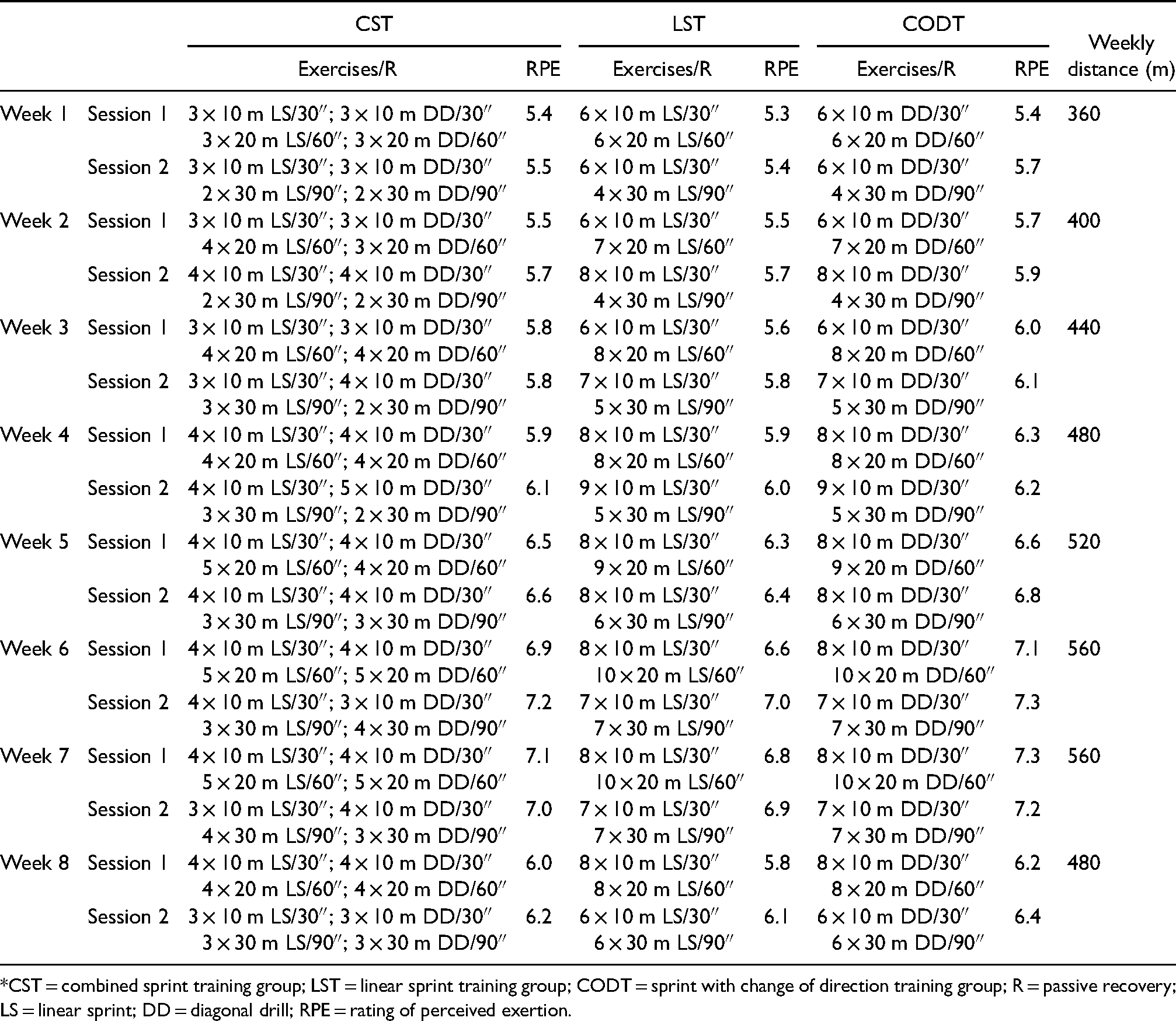
CST = combined sprint training group; LST = linear sprint training group; CODT = sprint with change of direction training group; R = passive recovery; LS = linear sprint; DD = diagonal drill; RPE = rating of perceived exertion.
Relative and absolute reliability measures for the assessed variables.*

S10 = 10 m linear sprint; S20 = 20 m linear sprint; FS10 = flying 10 m linear sprint; COD = change of direction without ball; CODB = change of direction with ball; CMJ = countermovement jump; MAV = maximal aerobic velocity; ICC = intraclass correlation coefficient; SEM = standard error of measurement.
Statistical analysis
Data analyses were performed using SPSS version 20 for Windows (IBM Corp, Armonk, N.Y., USA). Values are presented as means ± SD. The normality of data sets was checked using the Kolmogorov-Smirnov test The internal consistency of the variables of interest was assessed using the intraclass correlation coefficient (ICC) and the standard error of measurement (SEM). Compound symmetry was tested using the Mauchly test. A two-way analysis of variance [4-conditions group (CST, or LST, or CODT, or CONT) × 2 times (T1 and T2)] with repeated measures (within-between interaction) was used to determine the differences between experimental conditions. When a significant difference was found, a Bonferroni post hoc test was used to determine the differences between groups’ means, correcting for the multiple comparisons. To determine the magnitude of differences, effect sizes (ES) were determined by converting partial eta squared to Cohen's d. 33 The magnitude of effect size was classified as trivial (< 0.20), small (0.20–0.49), medium (0.50–0.79), and large (0.80 and greater). 33 Moreover, pre- to-post change percentage was calculated for corresponding variation. A one-way ANOVA was applied to compare the anthropometric and physical performances at T1, and RPE scores between all groups. Statistical significance was set at p < 0.05.
Results
Normality of data and the homogeneity of variance were confirmed. The ICCs between the test-retest measurements ranged from 0.800 to 0.965 for all the physical measures, indicating good to excellent agreement between trials (Table 2). There were no significant baseline anthropometric or physical capability differences between the groups (all p > 0.05).
RPE scores collected at each training session during the whole training period were not different between all groups.
Absolute values resulting from the within and between-group analyses are displayed in Tables 3 and 4.
Linear sprint and change of direction performances at baseline (T1) and after the intervention period (T2) for all groups.*

Values are expressed as mean ± SD; CST = combined sprint training group; LST = linear sprint training group; CODT = sprint with change of direction training group; CONT = control group; S10 = 10 m linear sprint; S20 = 20 m linear sprint; FS10 = flying 10 m linear sprint; COD = change of direction without ball; CODB = change of direction with ball; ES = effect size.
A significant difference when comparing T1 and T2.
Significantly different from LST and CONT at T2; The statistical significance level was set at p ≤ 0.05.
Jumping and endurance-intensive performances at baseline (T1) and after the intervention period (T2) for all groups.*
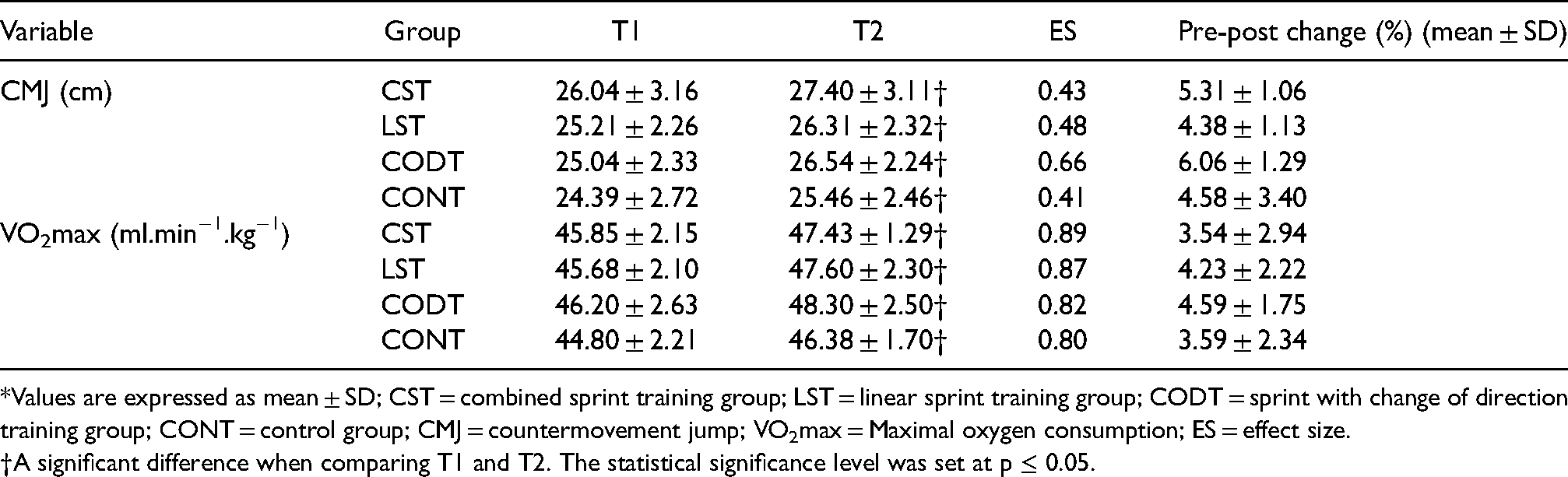
Values are expressed as mean ± SD; CST = combined sprint training group; LST = linear sprint training group; CODT = sprint with change of direction training group; CONT = control group; CMJ = countermovement jump; VO2max = Maximal oxygen consumption; ES = effect size.
A significant difference when comparing T1 and T2. The statistical significance level was set at p ≤ 0.05.
Trivial magnitude and non-statistically significant differences were observed between conditions in S10 (F3,72 = 0.08; p = 0.97, ES = 0), S20 (F3,72 = 0.03; p = 0.83, ES = 0) and FS10 (F3,72 = 1.30; p = 0.28, ES = 0.11) across the two times of measurement. Small magnitude and a main effect for time was identified with S10 (F1,72 = 8.16; p = 0.006, ES = 0.31), S20 (F1,72 = 4.06; p = 0.04, ES = 0.20) and FS10 performances (F1,72 = 12.01; p = 0.001, ES = 0.39) improved from pre- to post-test across all conditions (Table 3). In addition, a trivial magnitude and no interaction effect between condition and time was observed (F3,72 = 0.36, 0.12 and 0.40; p = 0.79, 0.95 and 0.75, all ES = 0, respectively).
For COD performance, there was a main effect of training group (F3,72 = 7.38; p < 0.0001, ES = 0.50, medium) with CODT elicited higher improvement in comparison to LST and CONT groups. Likewise, a main effect of time was recorded (F1,72 = 19.56; p < 0.0001, ES = 0.50, medium) in which COD performance improved from pre- to post-test A significant interaction effect was observed between training groups and time (F3,72 = 2.77; p = 0.048, ES = 0.26, small) with CODT group showed higher post-test performance than LST and CONT groups (all p < 0.0001, ES = 1.90 and 1.97, large) (Table 3).
For CODB performance, there was a main effect of training group (F3,72 = 4.17; p = 0.009, ES = 0.35, small) with CODT elicited higher improvement in comparison to LST and CONT groups. Likewise, a main effect for time was recorded (F1,72 = 14.30; p < 0.0001, ES = 0.43, small) with CODB performance improved from pre- to post-test Moreover, a significant interaction effect was observed between training group and time (F3,72 = 2.79; p = 0.046, ES = 0.27, small) with CODB performance improved from pre- to post-test for all conditions (all p < 0.05) and CODT showed higher post-test performance than LST and CONT groups (all p = 0.002, ES = 1.58 and 2.05, large) (Table 3).
For CMJ and VO2max, a trivial to small magnitude and no statistical interactions (F3,72 = 0.07 and 0.08; all p = 0.97, all ES = 0, respectively) or main training group effect were observed (F1,72 = 1.83 and 2.06; p = 0.15 and 0.11, ES = 0.18 and 0.21, respectively). However, a small magnitude and statistically significant main time effect was observed with CMJ and VO2max performances improved from pre- to post-test (F1,72 = 4.10 and 13.72; p = 0.004 and p < 0.0001, ES = 0.21 and 0.42, respectively) (Table 4).
Discussion
To the current authors' knowledge, this is the first study that examined the effects of different sprint training regimens with the ball on explosive, high-intensity and endurance-intensive performances among young soccer players during the in-season period. The present study showed that both control and experimental groups resulted in significant improvements in all physical abilities after the intervention. Moreover, greater COD and CODB performance enhancements were recorded in the training group using the COD modality compared to SLT and CONT.
Sprints as well as acceleration are of great interest for soccer coaches and players since they are fundamental performance components for soccer success. 34 The present study reported significant improvement in sprint performance for the different training groups. In this consideration, previous studies reported sprint performance enhancement (e.g. 10 and 20 m) in young soccer players after different training regimens using the ball.15,35 This result can be explained by the fact that these training regimens enhanced peripheral neuromuscular properties of the lower limbs’ muscles during the sprinting tasks.36,37 Moreover, as previously reported by Dello Iacono et al. 15 the ability to repeat a great number of sprints with or without turns (e.g. performing sprint efforts during 12 to 20 min per session) represented an optimal conditioning stimulus and increased the chances to induce greater adaptations among different experimental groups, considering the importance of horizontal-oriented force production and its application in linear sprinting performance in team sports.15,36,37 Likewise, this study incorporated exercises of straight-line running speed, change of direction runs, acceleration and deceleration executed with maximal effort. Thus, exercise protocols based on sport-specific drills have shown their positive effect on sprint performance. 38 In addition, the sprint performance improvements observed in CONT group was attributed to regular soccer training which can involve specific movement executed with maximal effort (e.g. straight-line running speed, acceleration and deceleration). 39 However, the lack of difference between experimental groups in linear sprint's tests can be probably due to the similarity between the training modalities and sprint tests. In fact, it was showed that the ability to perform fast straight-line sprints is dependent on stretch-shortening cycle, while COD and straight-line sprint both encompass an acceleration phase which includes similar technical factors. 40 Therefore, based on this evidence, it is difficult to confirm that one sprint training modality is more effective to improve straight-line sprint performance than the other. The results of the present study suggested that different sprint training programs using the ball can be considered as useful tool to enhance sprint performances, supporting the idea that usual sprint training modality is the approach to be recommended to improve sprint performance for either short distances or when improvements are demanded to be achieved for short periods of time. 41
On the other hand, the lack of difference between training groups observed in CMJ performance can be interpreted as a result of the training programs used in the present study. Previous studies have shown positive effects of various ball-training regimens on lower limbs’ power in elite young male soccer players.15,35 The CMJ performance's improvement could be explained by the stimulation induced by short and high-intensity efforts, mainly on the knee extensor muscles. 42 In fact, these types of efforts allowed the fast and efficient utilization of elastic energy in the stretch-shortening cycle and increased of lower limbs’ muscles strength, mainly engaged in explosive actions such as jumping. 42 Although the results of this study showed that the different training drills used were effective to induce significant improvements in jumping performances, the CODT regimen resulted in higher improvements (>6%). Future studies investigating the effect of longer training programs may be helpful to enhance vertical jump performance in young soccer players.
This is the first study which compared the effects of different sprint training modalities with ball on change of direction with and without the ball, therefore, direct comparisons with other studies are not possible. However, the significant differences in COD tests from the between-group analysis were expected and confirmed the principle of specificity. 43 In fact, higher improvement in COD and CODB speed performances after COD training compared with SLT and CONT may be the result of the repeated change of direction drills performed throughout the whole CODT. Furthermore, COD training program implementing movements that are biomechanically specific to the performance tasks, may be likely to induce improvements in performance measures, could represent therefore a suitable conditioning stimulus to stress the underlying athletic components of interest 15 Moreover, it was shown that the motor learning effects could be considered to be a potential confounding factor when assessing the ability to change direction, especially if the test is performed with a ball, 44 which provides further evidence that COD training with ball could induce positive improvements in young soccer players' technical ability.
This study also revealed a large magnitude and significant improvement in VO2max performance after the different ball-training programs. The present results are in accordance with those previously reported by other studies that indicated that different training protocols (e.g. high intensity interval training, SSGs, soccer specific technique training, ordinary soccer specific technique) could be effective and stimulate processes involving the transport and utilization of oxygen, positively affecting VO2max and aerobic fitness activity in young soccer players.15,45,46 However, the no significant difference in VO2max between groups was surprising because previous studies reported a connection between training exercises and testing procedures. 45 Since the ability to change direction was widely used in CODT and can mimic the movements performed during the 20-m shuttle run task, it was expected greater improvement in VO2max after CODT especially when compared with SLT.
In the present study, both experimental and control groups presented significant pre-to-post improvements in all physical tests. Despite the high magnitude improvement in COD with or without the ball recorded in CODT group, the significant recorded with the CONT group could highlight the supplementary effect of regular soccer practice on short-term aerobic and anaerobic fitness. Future investigations considering the evaluation of the external load (e.g. relative distance, high-speed distance, sprint distance, high-intensity efforts) imposed to youth players during soccer training may be useful to detect possible cause-effect relationships. In contrast, pre-to-post percentage of change for all measured variables within the experimental groups compared to the CONT group seems to be more promising. Along the same line, it is plausible to suggest that the training load utilized in the different ball-training modalities was sufficient to induce additional gains to those observed in the CONT group. However, it is also worth noting that our players' baseline values (e.g. FS10, S20, COD, CMJ, VO2max) were quite low compared with the average data previously reported in the same age-group,23,47–49 reflecting their modest training status. Thus, the players’ age and stage of development (e.g. biological maturation) should be considered as they have a great influence on soccer-related fitness improvements in youth players.50,51
Finally, we acknowledge some limitations in the study. First, the investigation lasted only 8 weeks, whereas longer periods of training may be required to achieve greater specific soccer fitness-related performance differences between groups during the in-season period. Moreover, the use of devices such as global positioning system (GPS) could be a more effective alternative to objectively quantify the external training loads achieved during training sessions. Finally, the results of our investigation are specific to young soccer players from the regional level and therefore the interpretation and generalization of these results to other population (e.g. elite soccer players) should be considered with caution.
In conclusion, all the ball-training programs seem to be effective for soccer-related fitness improvement in youth players during the in-season period. In fact, our results showed that our different conditioning methodologies, performed twice a week at equal volume, contributed to improve explosive, high-intensity and endurance-intensive performances. More importantly, CODT was more effective in conditioning explosive and high-intensity performances especially when was compared with SLT and CONT. Since the training exercise's modalities should mimic as close as possible the situations occurring during competition, 52 it would be of great importance to use sprint training with the ball modality in conjunction with other training programs within soccer players. This may be appealing coaches and physical trainers when trying to plan how to fit all the necessary training sessions during a training week where there may be limited available time to train. 53 Therefore, the sprint ball-training modality could possibly improve not only the physical performances but also some technical (e.g. dribbling, finishing) and tactical (e.g. counterattacking) aspects especially when COD exercises are included. In this regard, future investigations are encouraged to compare different training modalities with ball to investigate which are the most beneficial conditioning programs.
Footnotes
Acknowledgements
The authors gratefully acknowledge the participating players and their coaches for their enthusiasm and cooperation.
Declaration of conflicting interest
The author(s) declared no potential conflicts of interest with respect to the research, authorship, and/or publication of this article.
Funding
The author(s) received no financial support for the research, authorship, and/or publication of this article.
