



Abstract
The tackle is the in-game activity with the greatest risk for injury in collision sports. Qualitative match analysis has associated injury risk with tackle technique (e.g. tackle height, head position before contact). This exploratory study used gold-standard three-dimensional (3D) motion capture to investigate whether prior instructions to a tackler to execute different torso tackle types altered their tackle technique. Fifteen amateur-level rugby code players performed four sets of 10 tackle trials after instructions from an expert coach: two Australian National Rugby League (NRL) coaching manual instructions on upper and lower torso tackle height (UpperNRL, LowerNRL); and two novel variants that altered the tackler’s contact with the ball carrier’s upper torso (UpperPop) via a vertical ‘pop action’, or mid-torso (MidTorso) via increasing the contact height to the mid-torso. 3 D motion capture confirmed a favourable ‘head up and forward’ gaze focus on ball carrier before contact and a ‘straight back’ posture was more evident in UpperPop instruction than other instructions, with the least flexion for the head, trunk, trunk-pelvis, thoracolumbar and lumbopelvic (p < 0.01). MidTorso also attained a more optimal ‘head up and forward’ and a ‘straight back’ posture than a LowerNRL (p < 0.001). ‘Leg drive on contact’ revealed ankle, hip (p < 0.01) and thigh angles (p < 0.05) differences, likely to reflect the UpperPop ‘pop action’ instruction than other instructions. For coaches, this study demonstrated that amateur-level rugby-code players could follow instruction from an expert coach to execute tackling techniques within a session. Inclusion of tackle specific coaching instruction training program may be a viable injury reduction strategy.
Introduction
Tackling is the most common impact event in rugby league 1 and rugby union 2 (the ‘rugby codes’). Understanding how tackle technique characteristics of this in-game play affects team performance (i.e., executing an effective tackle)3–5 and injury risk6–8 has been extensively studied using two-dimensional (2 D) video match analysis. 9 This has identified tackle height3,6,7,10 (i.e. where on the ball carrier is contacted), ‘head up and forward’ gaze focus on ball carrier before contact,3,6,7 straight back posture,5,6 leg drive upon contact,3,5,8 and higher approach speeds prior to the tackle,11,12 as being associated with injury risk and/or tackler performance.
Concussion is one type of injury that occurs commonly during tackle events in the rugby codes.10,11,13–15 Suspected concussion and concussion events occurring in match play have been evaluated and characterised via 2 D video qualitative analysis in the rugby codes.10,11,16–19 Modification of concussion risk has also been qualitatively evaluated by reviewing tackle characteristics in known concussion events;2,7,8,10–12 this has led to recommendations for reducing such risks during the tackle.10,11
Tackle height has been categorised as first point of contact on the ball carrier upper (above the ball carrier’s hip) or lower (below the ball carrier’s hip) body.10–12 Most head impact injuries occur during an upper body, as opposed to a lower body, tackle,10,12,17 with the majority of head impact injuries sustained by the tackler rather than the ball carrier.11,12 An upper body tackle can be subdivided into a high tackle (i.e., illegal tackle, defined as contact on or above the line of the ball carrier’s shoulder) or a torso tackle (defined as contact between the ball carrier’s hips and shoulder). 2 D video analysis suggest that making torso tackles,20,21 the most common tackle, 22 reduces the tackler’s injury risk. 21 High (illegal) tackles possess the greatest risk for injury and account for 26-31% of concussion injuries, while 50-51% of concussion injuries occur from legal torso tackles (active and passive shoulder), albeit with lower risk than high (illegal) tackles. 10
Rugby code organisations offer several injury reduction programs such as BokSmart 23 (www.boksmart.com), RugbySmart 24 (www.rugbysmart.co.nz/) and NRL Tackle Safe 25 (www.playrugbyleague.com/), which include online coaching instruction of safer tackling techniques and concussion risk. Translation of this knowledge by coaches to their players often fails in practice 26 and the evidence to support the effectiveness of these rugby injury reduction programmes to reduce concussion risk is weak. 27 This research is either anecdotal (based on opinion), 23 focuses the management of concussion using a qualitative in-match sideline concussion check tool, 28 or employed an intervention program aimed at reducing concussion risk.10,29,30 In professional English Championship rugby a simple intervention to reduce the incidence of concussion, by reducing the height of an illegal tackle did not reduce the concussion incidence. 10 Tacklers were concussed at higher rates in the intervention period than pre-intervention period. 10 The effectiveness of the tackle clinics, RugbySmart Community Concussion Initiative 31 and NRL Tackle Safe program, 25 to reduce concussion risk remains unknown.
Evaluating tackle technique9,32 or identifying signs of concussion 19 via a qualitative 2 D video approach is fraught with difficulties that makes between-study comparison difficult. Studies employing this 2 D video approach have been limited by their inconsistency or lack of definitions of the tackle technique-based criteria, 9 an issue only recently addressed in a rugby video analysis framework. 33 There are also difficulties in 2 D video analysis in identifying signs of concussion 19 as well as coding the event,19,32 and limited sample sizes. 9 This subjective qualitative approach suffers from poor reliability to undertake in-game evaluation of tackle technique9,32 and identify signs of concussion. 19 A quantitative 2 D video approach for calculating multiplanar kinematics has limited reliability as it is prone to perspective error when the motion recorded occurs outside the plane of measurement. 34 The “gold standard” for quantitatively evaluating complex multiplanar movement technique is three-dimensional (3 D) motion capture analysis. 35 However, the practicality of employing 3 D motion capture analysis (time, space, and cost) has led to a limited number of studies that have employed this gold standard method to investigate tackling technique,36–39 and only one study has assessed whether a tackling technique can be modified within a single session by coaching video instruction. 40
The objective of this exploratory study aimed to investigate whether the delivery of prior instructions from an expert coach to a tackler to execute different tackle types altered their tackling technique. It was hypothesised that when instructed to contact the upper torso, the tackler would employ a more head up and forward head posture before contact and upright torso as opposed to a fully bent at waist position at contact when instructed to contact a lower torso height.
Method
Participants
Fifteen adult male (n = 15) amateur or semi-professional rugby league or rugby union players were recruited from grade competitions across the Greater Sydney Metropolitan region. All participants were injury free at the time of testing and injury history was not recorded. Recorded player characteristics included: rugby code played (i.e., rugby league or rugby union), age first participated in the sport(s), years of experience playing the sport(s), highest level of played in the rugby code(s), current age at the time of data collection, current competition level at the time of data collection, and playing position(s). Sample size calculations revealed 14 participants were sufficient for two-tailed t-test with an error probability and statistical power of 95% using G*Power software. 41 The power calculations were based on the tackler’s trunk flexion at contact, performing an upper, and lower, torso tackle. 36 Written informed consent was provided by each participant prior to their participation in data collection session. The study design and methodology were approved by The University of Newcastle Human Research Ethics Committee (H-2017-0285).
Experimental procedures
Two participants were involved in each data collection session. After providing informed consent, both participants completed a sporting participation questionnaire and had their anthropometric measurements recorded (i.e. height, body mass, and pelvis, xyphoid, and chest depths) for later input into a mathematical model. One participant was then randomly allocated as the ball carrier, the other participant the tackler. A static trial of both participants in an anatomical standing position was recorded. Participants were then instructed, under the guidance of an expert coach, to perform four sets of 10 trials of four different tackling instructions. All tackles were one-on-one, front-on, torso tackles. Two tackle instructions were based on the NRL coaching manual 42 with the tackler contacting the ball carrier on the lower torso (LowerNRL) or upper torso (UpperNRL). Two novel variants of these NRL tackle instructions were also conducted. The tackler was instructed to vary how they contacted the ball carrier’s; (i) upper torso (UpperPop) via a vertical ‘pop action’; and (ii) mid torso (MidTorso) via slightly increasing the contact height from lower to mid torso and redirecting the ball carrier into a vertical and backward direction. The participants always performed 10 trials of the recommended technique instruction first (LowerNRL or UpperNRL) followed by 10 trials of the variant technique instruction (MidTorso or UpperPop). With conflicting evidence pertaining to whether a tackle technique differs between dominant and non-dominant shoulder engagement,37,43 each of the 10 trials consisted of five dominant shoulder engagements by the tackler followed by five trials of non-dominant shoulder side engagements by the tackler.
Prior to performance of each of the four front-on torso tackle instructions, the tackler and the ball carrier were instructed by the expert coach on how to perform the specific technique and then executed several familiarisation trials of that technique with coaching feedback. At the completion of the 40 tackle trials, the participants swapped roles, performed another static trial in the anatomical position, followed by another 40 tackling trials. The total experimental protocol duration was approximately three hours.
Expert coach
A recently retired dual international rugby league and rugby union representative player with experience in coaching junior and senior rugby league and rugby union players was the expert coach for this study. The non-traditional front-on tackle technique instruction (UpperPop, MidTorso) used in this study was developed by this expert coach. The objective was to modify how the tackler engages and executes contact with the ball carrier: (i) upper torso (UpperNRL vs UpperPop); (ii) or increase the height at which the tackler contacted the ball carrier from lower to mid torso, and redirecting the ball carrier into a backward only direction to a backward and vertical direction (LowerNRL to MidTorso). The expert coach attended all sessions and provided coaching instruction to all participants prior to them engaging in the data collection session, as well as providing guidance and feedback to the participants throughout the session.
Tackling trials
Each one-on-one, front-on torso tackle commenced with the tackler and ball carrier approximately four metres apart in a stationary position. The participants were instructed to run simultaneously towards each other making contact at 80% game intensity. These instructions aimed to standardise the approach speed to limit the confounding factor of tackler and ball carrier speed.11,12 The 80% intensity resulted in a slow tackle speed, as per the definition of walking or jogging into the tackle. A slow tackle speed has been previously reported as the most common (74%) match play tackle speed. It is also the most frequent speed for match play injuries (64%). 2
The participants were instructed not to complete the tackle to the ground due to 40.5% of tackles not taken to the ground in rugby union, 44 most tackle injuries occurring during player contact rather than ground contact, 22 and the concern of the skin mounted retroreflective markers causing an injury. The tackles were performed on 20 m2 matted area consisting of a 1000 × 1000 × 40 mm jigsaw mat underlay and 2000 × 1000 × 40 mm Tatami Judo mat (Southern Cross Mats, Sydney, NSW & Melbourne, Victoria). Participants were given 30 seconds rest between each trial and approximately five minutes rest between each tackle technique (i.e., after 10 trials).
The technique instruction for the traditional, one-on-one, front-on, torso tackle as outlined in the Australian National Rugby League (NRL) Coaching Manual 42 and Tackle Safe program. 25 These manuals instruct the tackler to approach the tackle as upright as possible, then drop the body position by bending at the knees while keeping the shoulders higher than the hip level. Outlines that contact should be then made with the shoulder, the head of the tackler should be positioned to the ball carrier’s side, and alignment of the neck with the spine should be maintained with the head up and straight. The instructional manual also outlines strong leg drive along with the ball carrier momentum should be employed to take the ball carrier to the ground. The Tackle Safe program 25 recommend a tackle height in accordance with previous research 45 and define torso contact as either ‘green zone’ (lower torso), ‘orange zone’ (mid torso) and ‘red zone’ (upper torso). The tackle height defined the tackle type in this study as: upper torso (UpperNRL, UpperPop), mid torso (MidTorso) and lower torso (LowerNRL), respectively. The UpperPop tackle technique instruction differs from UpperNRL instruction because just prior to engaging in contact with the ball carrier, the tackler lowers their body position and then executes a vertical ‘pop action’ to contact the ball carrier on the upper torso and redirect the ball carrier’s forward motion into a vertical direction. The rationale for the UpperPop instruction was to redirect the ball carriers’ motion into a vertical direction as opposed to thwart the horizontal opposing direction of the ball carrier. In addition to the difference in torso contact height between MidTorso and LowerNRL instruction, the MidTorso instruction focused on redirecting the ball carrier into a backward and vertical direction, whereas the LowerNRL instruction only focused on redirecting the ball carrier in a backward direction. The rationale of this MidTorso was to allow the tackler improved positional awareness of the attacking player(s) by modifying their body position to a more head up and forward posture and partially bent over posture before contact, then to contact the ball carrier torso above their centre of gravity and redirect the forward motion ball carrier’s into a vertical direction. A video animation of each tackle instruction variation can be seen in Appendix 1.
Data collection
Retroreflective markers were attached to both the tackler and the ball carrier participants on each of their feet, shanks, thighs, pelvis, trunk, forearms, upper arms, hands, and heads using the marker set of Schaefer et al. (2019). 46 The markers were affixed to the surface (skin or shoe surface) with double sided wig tape and the skin was sprayed with Tuf-Skin (Cramer Products Inc., Gardner, Kansas, United States). The whole body three-dimensional kinematic of both participants for each tackle trial was recorded with 15 Oqus 700+ motion capture cameras (300 Hz; data collection volume 10 m × 10 m × 6 m) using Qualisys Track Manager software (v.2018.1, Qualisys AB, Göteborg, Sweden).
Three-dimensional data analysis was conducted with Visual 3 D software (Version 6, C-Motion, Germantown, MD, USA) with the raw kinematic data interpolated with a cubic spline and then filtered by an 18 Hz cut-off frequency, zero phase fourth order low pass Butterworth digital filter prior to calculating kinematic variables. The segmental masses and inertial properties were modelled per the protocol of Schaefer et al. (2019). 46 A local Cartesian coordinate system (x-axis mediolateral; y-axis anterior-posterior; and z-axis superior inferior directions) to calculate joint and segment angles was employed.
In accordance with Kawasaki, Tanabe, Tanaka 36 three stages of the tackle were identified, in the following order of appearance: two steps prior to contact (Step 2); one step prior to contact (Step 1); and contact between the tackler and ball carrier (Contact). Each stage was defined according to the procedures outlines in Appendix 2 and confirmed on visual inspection. At each of these three events, joint angles (ankle, knee, hip, lumbopelvic [lumbar segment relative to the pelvis segment], thoracolumbar [lumbar segment relative to the thoracic segment], Trunk-Pelvis [trunk segment relative to the pelvis segment]), and segment angles (thigh segment, pelvis segment and trunk segment relative to the laboratory coordinate system) were reported for the tackler. 46 The approach speed and speed at contact of each player was defined as their resultant centre of mass velocity at the time of pre-contact (defined as the maximum value prior to contact) and at contact, respectively.
Statistical analysis
All discrete variables were checked to ensure the assumptions of normality of distribution and sphericity were satisfied before the means and standard deviations were calculated for all kinematic variables for four tackle techniques. This study executed a series of repeated measure analyses of variance (RM ANOVA) using Statistica (v.13.3, StatSoft Inc., Tulsa, OK, USA) to ascertain if any significant changes (p < 0.05) occurred within the means of any outcome variable(s) between the four tackle instructions (LowerNRL, MidTorso, UpperNRL, UpperPop). A RM ANOVA was performed for the approach and contact speed, and each sagittal plane angles at each of the three events (step 2, step 1, contact), of which involved the following number of factors. The ‘type’ factor represented the four different types of tackle technique instructions. The ‘dominant shoulder side’ factor represented the tackler using either their dominant or non-dominant shoulder side to engage body contact with the ball carrier. A ‘lower limb’ factor represented the tackler’s rear lower limb (the foot that made foot-ground contact at Step 2) and lead lower limb (the other foot that made foot-ground at Step 1). It should be noted that it is coached that the lead lower limb should be the same side as the shoulder side engagement to the body contact (i.e. right foot, right shoulder side engagement), but this does not always occur and thus the lead limb is typically the tackler’s foot closest to the ball carrier. Three factors (type ×dominant side × lower limb) for the ankle, knee, and hip angles. Two factors (type × dominant side) for the trunk joint angles (lumbopelvic, thoracolumbar, trunk-pelvis), segment angles (thigh, pelvis, trunk, head), contact speed and approach speed.
Upon determining any significant main effect(s) or interaction(s), Tukey post hoc tests were conducted to identify the tackle instructions where such main effect(s) or interaction(s) occurred. The use of factorial ANOVAs, when several dependent variables are assessed, manages experimental-wise error and permits tests of individual variables when significant effects are identified. 46 When more sources of variance (i.e. type of tackle variant, dominant/non-dominant side shoulder, and leading or rear lower limb) are measured, the result when considering experimental error should be a lower variance. 47 Partial eta square was used for effect sizes and defined as trivial (<0.099), small (0.099–0.0588), moderate (0.588–0.1379) and large (>0.1379). 48
Results
Participant characteristics
The participants (mean age: 24.3 ± 6.1 years, height: 1.8 ± 0.1 m, body mass: 91.4 ± 12.8 kg) played either rugby union (n = 8), rugby league (n = 2), or both (n = 5), in either a forward (n = 8) or back (n = 7) position. Playing experience ranged from 4 to 30 years (12.7 ± 6.3 years), with club rugby (n = 9) the highest level achieved, followed by regional (n = 3), state (n = 2) and national (n = 1) level.
Approach speed/speed at contact
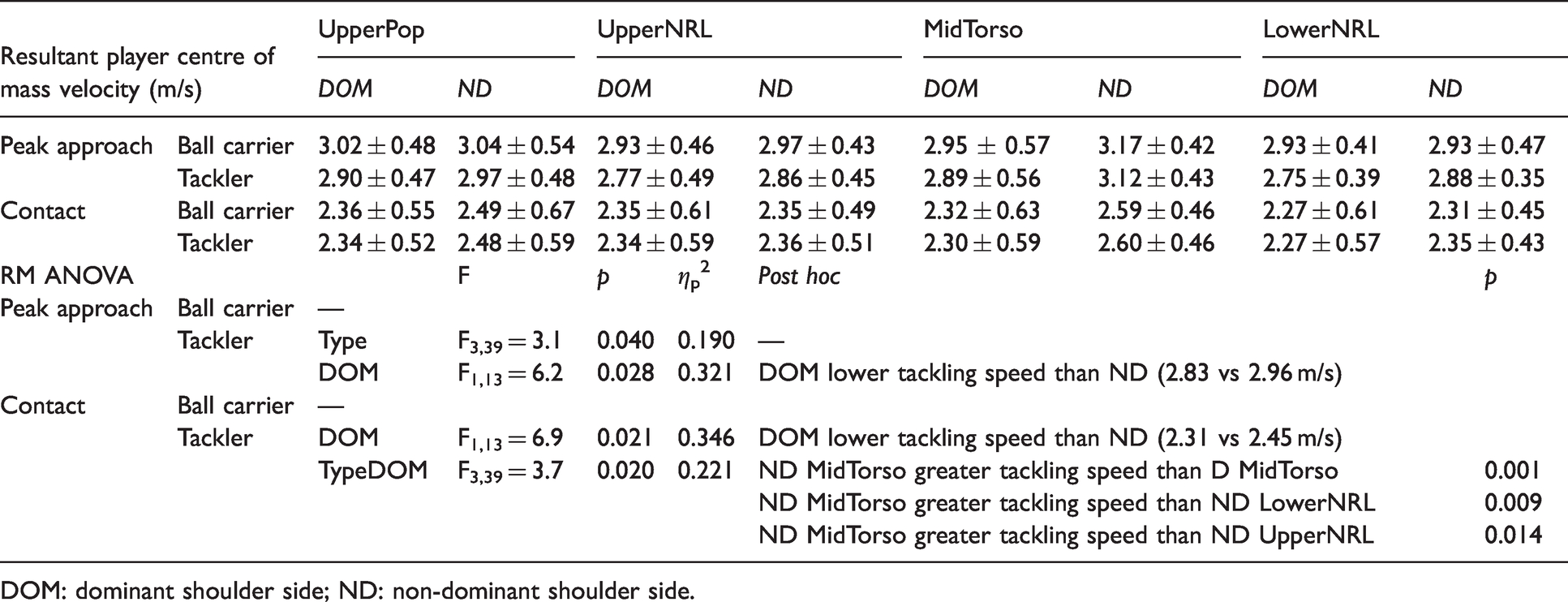
Ball carriers’ approach speed and speed at contact were consistent across all conditions (Table 1). Peak approach speed for the tackler revealed a significant main effect of instruction type, yet the difference could not be ascertained. The tackler’s approach speed and speed at contact revealed a significant main effect of dominant shoulder side, with a higher tackler speed when engaging in the tackle with their non-dominant shoulder side. A type*dominant shoulder side interaction revealed that contact speed remained unchanged for the non-dominant shoulder side UpperNRL and LowerNRL, and the dominant shoulder side MidTorso. For the MidTorso instruction, non-dominant shoulder side, participants significantly increased their speed at contact compared to the these other conditions (Table 1).
Resultant centre of mass velocity (mean ± SD and RM ANOVA results) of the tackler and ball carrier across the four tackle instructions
DOM: dominant shoulder side; ND: non-dominant shoulder side.
Kinematics at the time of step 2, step 1 and contact
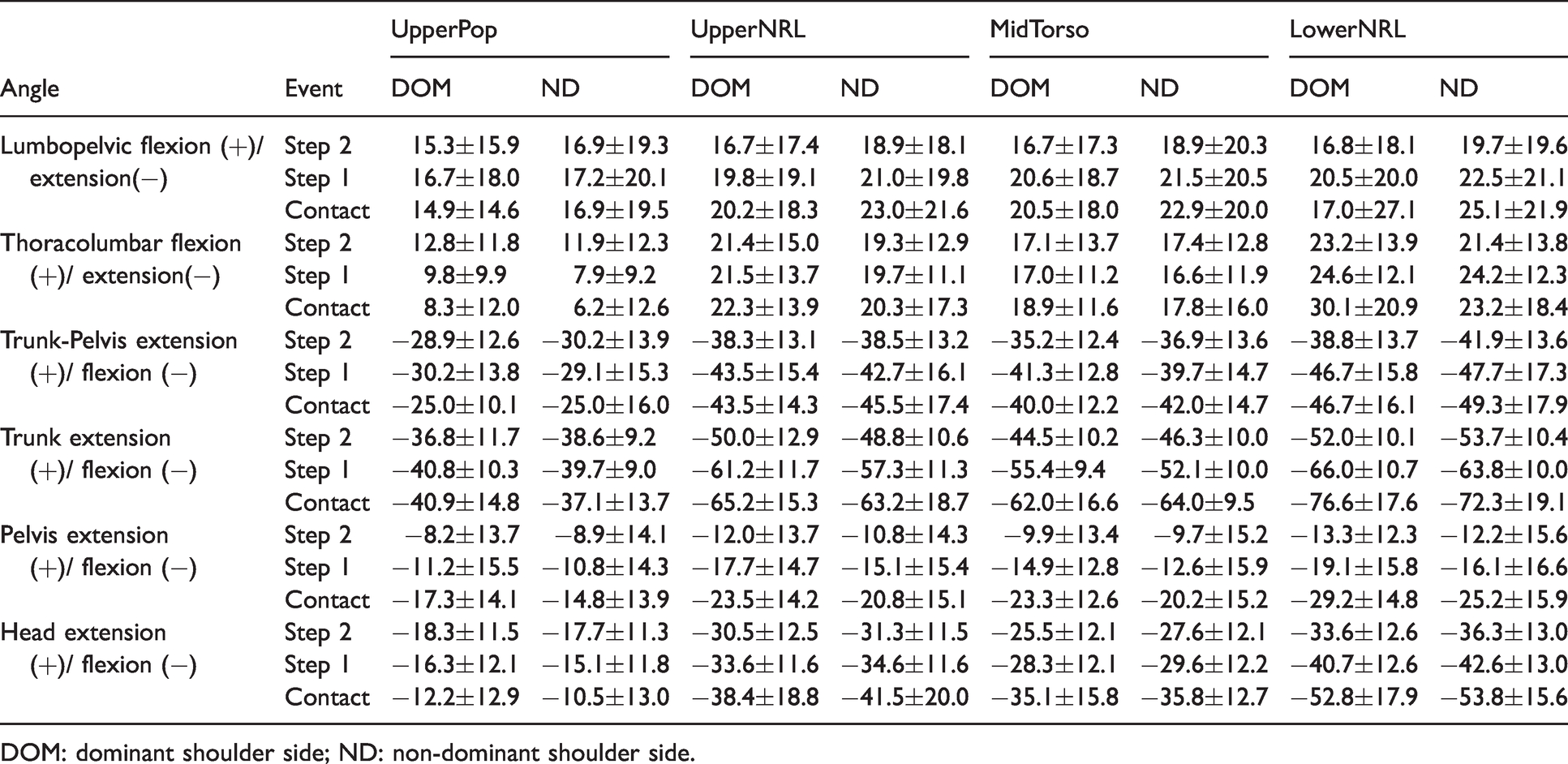
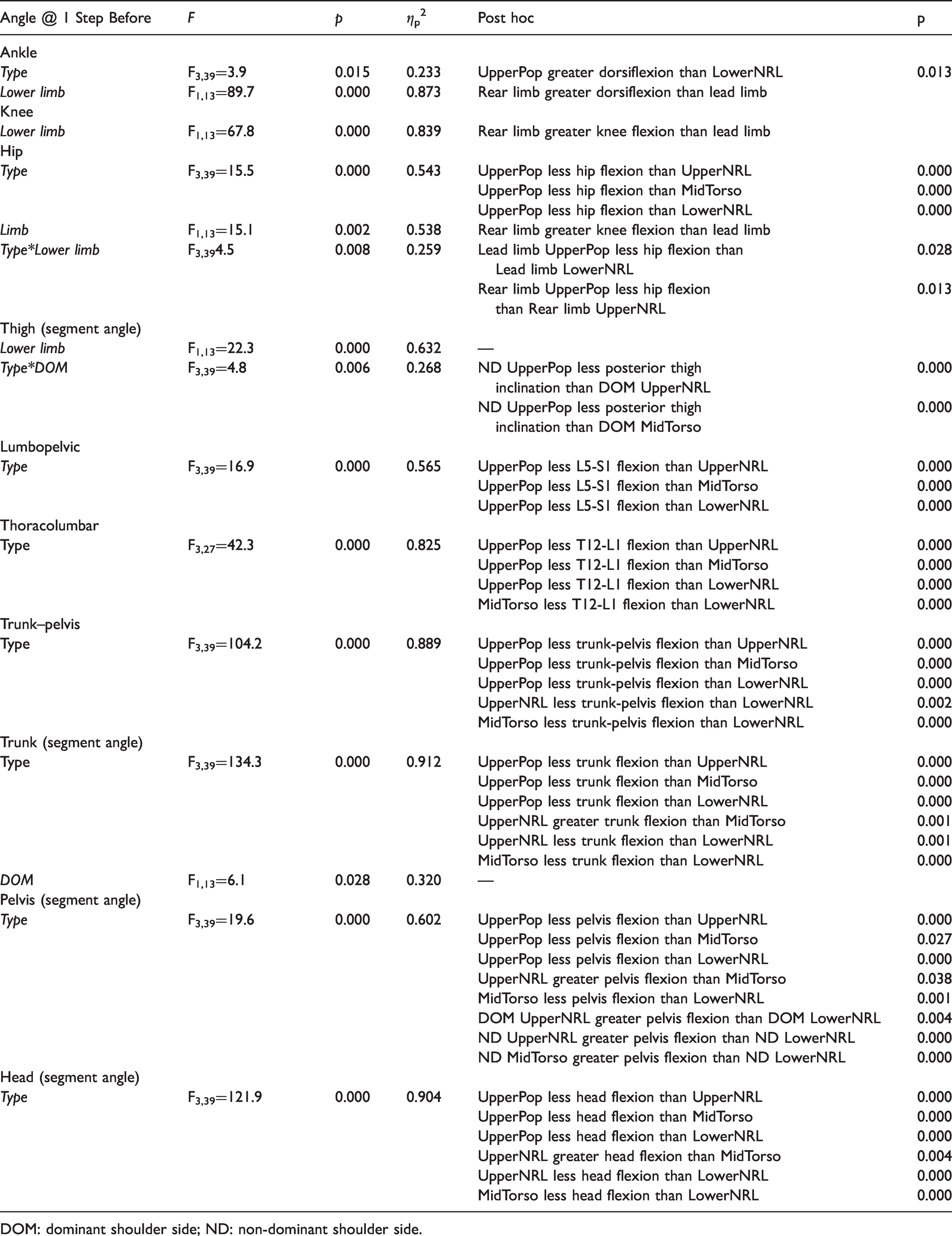
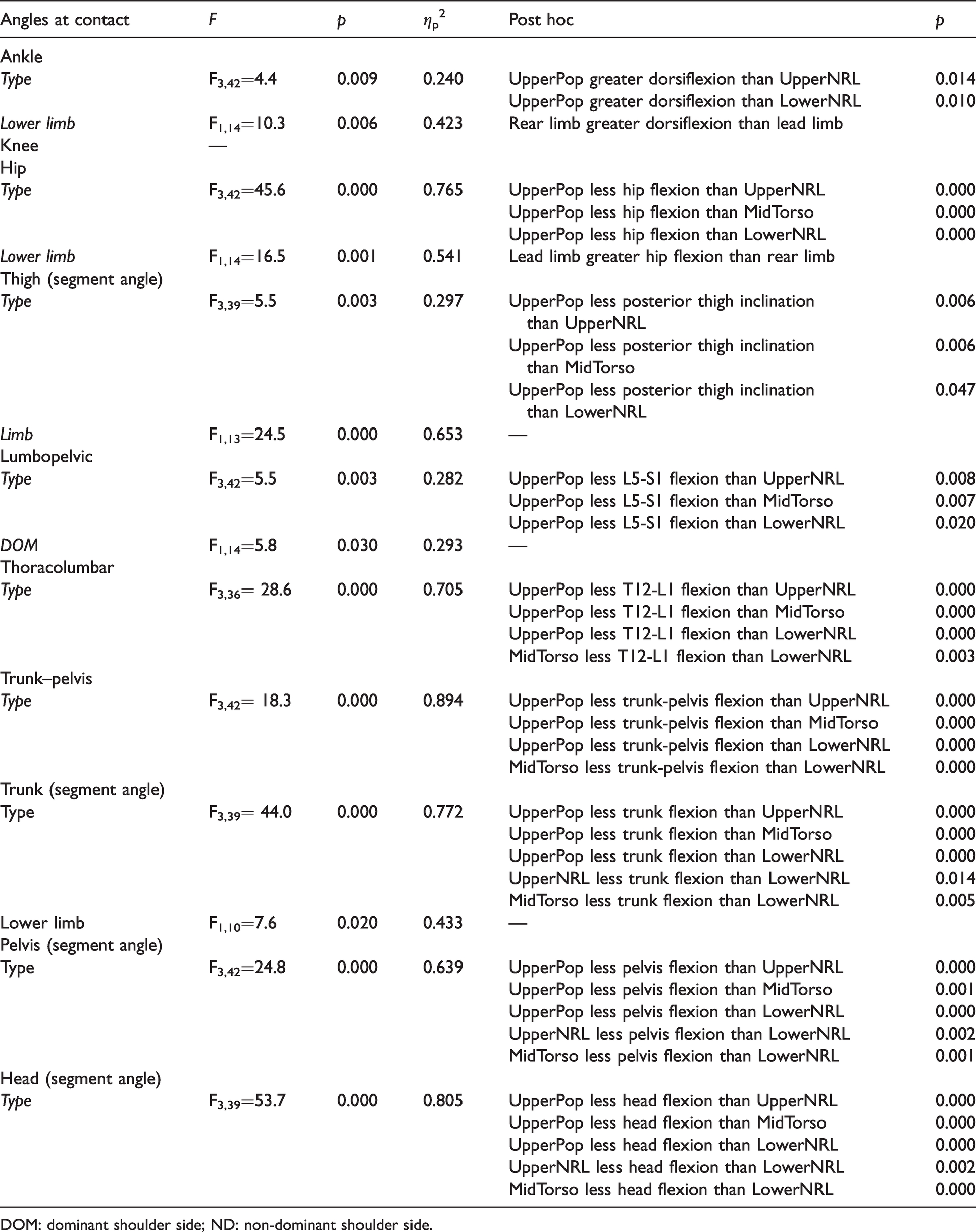
Tackler kinematics at three key events across the four tackle techniques are shown in Tables 2 (lower limb angles) and 3 (head and torso angles). Tables 4 to 6 summarize the main effects and interactions for all angles two steps prior to contact, one step prior to contact and at contact, respectively.
The tackler’s lower limb angles (mean ± SD) at three key events across the four tackle instructions.

DOM: dominant shoulder side; ND: non-dominant shoulder side.
The tackler’s torso and head angles (mean ± SD) at three key events across the four tackle instructions.
DOM: dominant shoulder side; ND: non-dominant shoulder side.
Results of the RM ANOVA of the main effect and interactions for the tacklers joint and segment angles at two steps before contact.

Results of the RM ANOVA of the main effect and interactions for the tacklers joint and segment angles at one step before contact.
DOM: dominant shoulder side; ND: non-dominant shoulder side.
Results of the RM ANOVA of the main effect and interactions for the tacklers joint and segment angles at contact.
DOM: dominant shoulder side; ND: non-dominant shoulder side.
UpperPop displayed the least flexion for the head (step 1, contact), trunk (step 2, step 1, contact), trunk-pelvis (step 2, step 1, contact), thoracolumbar (step 2, step 1, contact), lumbopelvic (step 1, contact), pelvis (step 1, contact), hip flexion (step 1, contact) and thigh (contact) when all techniques were compared. In addition, UpperPop also showed less pelvis flexion at step 2 than UpperNRL and LowerNRL, and greater ankle dorsiflexion than UpperNRL at contact and LowerNRL at step 1 and contact. LowerNRL displayed the most head flexion (step 1, contact), trunk flexion (step 2, step 1, contact), trunk-pelvis flexion (step 1, contact), pelvis flexion (step 1, contact) when all techniques were compared. It was also observed that the LowerNRL exhibited greater thoracolumbar flexion at step 2, step 1 and contact than UpperPop and MidTorso, and greater pelvis and trunk-pelvis flexion at step 2 than MidTorso.
Discussion
This study was the first to employ 3 D motion capture analysis to determine whether the kinematics of the tackler differed after specific prior instruction was provided from an expert coach to an individual to modify their torso contact in one-on-one, front-on torso tackle within a single coaching session. We found that the changing torso tackle instruction led to significantly different joint and segmental angles. The study’s hypothesis was partially supported with the UpperPop instruction, but not the UpperNRL instruction, leading to the tackler displaying a more ‘head up and forward’ and upright torso posture than when given lower torso contact instructions of the MidTorso and the LowerNRL.
Engaging with the non-dominant shoulder side compared to the dominant shoulder side during a tackle has been associated within increased shoulder injury risk. 49 It has been shown that tacklers utilise greater lateral trunk flexion and less head flexion to position their body/head away from the ball carrier when executing tackles with their dominant shoulder side compared to non-dominant side. 37 Yet this present study failed to observe these differences, nor any dominance shoulder side effects on the sagittal plane kinematics of the tackle either prior to or during the tackle for any of the four instructions. The only minor dominance effect observed was a significantly faster tackler speed at contact in the non-dominant shoulder side using the MidTorso technique compared to the dominant shoulder side MidTorso instruction, and the non-dominant shoulder side LowerNRL and UpperNRL instructions.
Head posture
The head position up and forward gaze focused on the ball carrier 33 is recommended during tackling23,42 to allow players to see one another and respond to late changes in position. 50 This head posture is associated a lower tendency for the tackler sustaining concussion 7 or Head Injury Assessment (HIA), 6 and was best attained in the UpperPop instruction in this study. In the other three tackle instructions (i.e., UpperNRL, MidTorso and LowerNRL), a head down gaze pointing towards the ground 33 was progressively adopted, with increased head flexion observed, beginning two steps before contact. This is a common action observed in match play. 7 Of these three instructions, LowerNRL exhibited the least optimal head posture, as the tackler’s head was in a significantly more head down posture at contact than in the UpperNRL and MidTorso instructions. In contrast, in UpperPop instruction the tackler attained a head up and forward position prior to contact and continued to reduce their amount of head flexion from two steps before contact through to contact. This finding suggests the UpperPop instruction achieves the most optimal ‘head up and forward’ posture and supports previous coaching recommendations that a ‘head up and forward’ posture should be maintained throughout the tackle. 7
Tackle height and trunk position
Tackle height has been linked with injury.10–12,17,51 With a lower tackle height, the tackler flexes their trunk more 52 thus altering their trunk posture going into the tackle10,36 from anywhere between 0° to 90° of trunk flexion at contact during a game. 52 Trunk posture has been categorised as either upright (no flexion), partially bent (30°–60°) or fully bent (>60°), 10 or alternatively as an upper (<80°) or lower (>80°) body tackle. 52 Three of the four instructions used in the present study would be classified as having a full bent trunk posture despite all being upper body tackles (LowerNRL mean 74.5 ± 4.8°; MidTorso mean 63.0. ± 3.0°; UpperNRL mean 64.2 ± 3.0°), while UpperPop instruction would be categorised as an upper body tackle with a partially bent trunk posture (39.0 ± 3.7°).
Using only the tackler trunk position to first point of contact on the ball carrier’s body may also be problematic, as the physical height of the ball carrier will alter the tackler’s contact height for a given trunk position. Based on the trunk posture findings in LowerNRL and MidTorso instructions in this study, suggests that the tacklers were able to adhere to the expert coach’s instructions to alter their torso contact location in the LowerNRL and slighly higher torso contact location around the lumbar region of the tackler in the MidTorso. Comparing the upper torso instructions, the UpperPop instruction utilised a more upright trunk orientation, indicated by less trunk-pelvis and trunk flexion angles two steps before contact to contact, compared to the UpperNRL instruction. This trunk posture difference in upper body instructions is likely to reflect the vertical ‘pop action’ coaching instruction in the UpperPop instruction in which the tackler attempts to limit the forward progression of the tackler by reorientating the ball carrier in a vertical upward trajectory rather than horizontal backward trajectory. This highlights that a tackler can modify not only their height but also how that they modify their tackle technique when they contact the same location on the ball carrier.
Back posture
A ‘straight back’ posture or neutral spine during tackling is recommended, as it increases the chances of gainline success 5 as well as a reducing the risk of head injury. 6 The tacklers in this study adopted a straighter back posture in the UpperPop instruction compared to the three other instructions, as demonstrated by lower lumbopelvic, thoracolumbar flexion two steps before contact through to contact. Of the two instruction targeting the lower torso, lower thoracolumbar flexion in the MidTorso instruction compared to the LowerNRL instruction two steps before contact suggests the tackler attained a more optimal ‘straight back’ posture in the MidTorso than the LowerNRL instruction. Less thoracolumbar flexion was also shown for the MidTorso instruction compared to the LowerNRL instruction, as well as for UpperPop compared to UpperNRL instruction, suggesting that the tackle instruction produced a more optimal ‘straight back’ than the traditional technqiues instructions (UpperNRL, LowerNRL) for approximately the same tackle heights.
Leg drive at contact
‘Leg drive upon contact’ for the tackler can improve tackle performance by increasing the likelihood of a gainline success 5 and tackle success, 3 while reducing their risk of head contact and thus risk of concussion.7,8 Measuring the height of the knee lift3 is used to assess ‘leg drive upon contact.’ The current study observed no differences across all four instructions for knee joint mechanics. It should be noted that the expert coach did not provide the tackler with any instructions with regards to leg drive, which likely contributes to this study’s findings. In assessing other lower limb variables that may characterise leg drive, this study observed less posterior thigh inclination, greater ankle dorsiflexion, and less hip flexion in the lead and rear lower limbs from one step before contact and contact in the UpperPop instruction, but not in any other instructions. The different strategy involving the ankle, thigh, and hip is likely to reflect the vertical ‘pop action’ instruction in the UpperPop, and may also be due to a shorter step length taken, compared to the other tackle instructions. The notion of step length could not be verified as step length was not analysed in this current study.
Limitations
There were several limitations in the current study. First, this study is an exploratory proof of concept study, and these study’s results can only be considered preliminary and require replication in larger sample sizes with the inclusion of an uninstructed control group. Second, this study only investigated a one-on-one, front-on torso tackle in a controlled and relatively static environment compared to match-play, and thus the findings of this study cannot be extrapolated to tackles that accommodate factors such as the number of tacklers, approach direction, playing position, player skill level, playing experience, age or tackles taken to ground. Third, during the initial pilot testing of this study it was discovered that an outdoor setting replicating a game/training environment was not feasible due to varied sunlight conditions. Despite specialised outdoor filters being applied to the cameras to optimise camera settings this challenge was unable to be overcome. In addition, using a large retroreflective marker set on two participants performing a fast dynamic movement in an outdoor environment was also found to result in poor quality three-dimensional kinematic data. Therefore, the study was performed in an indoor laboratory (i.e. a controlled environment) with foam mat surfacing rather than outdoor grass. The extent to which (if any), the artificial environment may have influenced the ball carrier’s and tackler’s capability to perform the tackle instructions is unknown. Fourth, the tackle speed was limited to a slow tackle speed. This study cannot ascertain if an increase in the tackling speed prior to contact would alter tackling technique and thus the results of this study. Fifth, tackle instructions was confined to a single session. It remains unknown whether a long term coaching period will influence retention of these technique instructions. This also has implications for the findings, particularly the instructions used in the two modified tackle techniques (UpperPop, MidTorso), which would have been the least familiar to the players. It is plausible that repeated exposure and practice to the coaching instruction would alter some of the kinematic findings as the players become more comfortable and competent with the variations. Sixth, injury history was not obtained in this study and it remains unknown if previous injury altered player’s movement patterns, even after injury has resolved. Future longitudional research should assess the learning of and retention of such instructions of expert coaching, after allocated period(s) as well as transfer test(s) to match play conditions. It is also recommended a larger sample size include more rugby league and union players of various skill levels, age, as well as female players to see if results can be replicated and generalised to the rugby codes with characteristics that differ from the current sample.
Conclusion
This exploratory study revealled that kinematic characteristics of tackles are significantly different when players are instructed in technique by an expert coach in a single session. Differences in torso posture during tackling between different instruction highlighted that the height at which the tackler contacted the ball carrier on the torso could be modified. A ‘head up and forward’ posture as well as a straight back’ posture was attained by the tackler’s in the UpperPop instruction. For coaches, this study offers preliminary evidence that the inclusion of tackling specific instruction within their training program may alter a players technique, and may be a viable injury reduction strategy. Future research should be focused on identifying the most optimal tackling technique and whether targeted tackling coaching inteventions can actually reduce the injury risk of a tackler and improve the tackler’s game performance.
Supplemental Material
sj-pdf-2-spo-10.1177_1747954121996946 - Supplemental material for Can prior instruction successfully alter the tackle type executed by a player?
Supplemental material, sj-pdf-2-spo-10.1177_1747954121996946 for Can prior instruction successfully alter the tackle type executed by a player? by Suzi Edwards, Timana Tahu, Matthew Buchanan, Ross Tucker, Gordon Fuller and Andrew Gardner in International Journal of Sports Science & Coaching
Footnotes
Declaration of conflicting interests
The author(s) declared the following potential conflicts of interest with respect to the research, authorship, and/or publication of this article: Matthew Buchanan and Suzi Edwards, declare that they have no conflict of interest. Andrew Gardner, Ph.D. serves as a scientific advisor for hitIQ, Ltd. He has a clinical practice in neuropsychology involving individuals who have sustained sport-related concussion (including current and former athletes). He has been a contracted concussion consultant to Rugby Australia (2016–2020). He has received travel funding or been reimbursed by professional sporting bodies, and commercial organisations for discussing or presenting sport-related concussion research at meetings, scientific conferences, workshops, and symposiums. He has received research funding from the National Rugby League (NRL) for the Retired Players Brain Health research program. Previous grant funding includes the NSW Sporting Injuries Committee, the Brain Foundation (Australia), an Australian–American Fulbright Commission Postdoctoral Award, a Hunter New England Local Health District, Research, Innovation and Partnerships Health Research & Translation Centre and Clinical Research Fellowship Scheme, and the Hunter Medical Research Institute (HMRI), supported by Jennie Thomas, and the HMRI, supported by Anne Greaves. Ross Tucker is a research consultant to World Rugby (Pty) Ltd, the governing body for Rugby Union globally. Timana Tahu is a transition officer with National Rugby League School to Work program.
Funding
The author(s) disclosed receipt of the following financial support for the research, authorship, and/or publication of this article: Research support from the National Rugby League (NRL) Rugby League Research Committee (RLRC) for the examination of rugby-style tackle techniques.

Supplemental material
Supplemental material for this article is available online.
References
Supplementary Material
Please find the following supplemental material available below.
For Open Access articles published under a Creative Commons License, all supplemental material carries the same license as the article it is associated with.
For non-Open Access articles published, all supplemental material carries a non-exclusive license, and permission requests for re-use of supplemental material or any part of supplemental material shall be sent directly to the copyright owner as specified in the copyright notice associated with the article.
