




Abstract
This study examined the relationships between differing types of motivation and the flow state and possible gender differences. A sample of 94 junior elite tennis players (44 boys and 50 girls), ages 11 to 14 years (12.05 ± 1.2) completed the French Flow State Scale-2 (F FSS-2) and the Sport Motivation Scale (SMS) questionnaires. Results reported a moderate link between intrinsic motivation and flow state (r = 0.44, p < 0.05). Amotivation was negatively related to all dimensions of flow state except for transformation of time (r = -.02, p <0.05). An independent-sample t-test analysis indicated that girls had stronger intrinsic motivation than boys to know (t = 1.95; p <.05; d = .59), and to accomplish (t = 2.14; p <.04; d = .64) and also had better extrinsic motivation identified-regulation (t = 3.71; p <.01; d = 1.11). No meaningful differences were found between girls and boys in their general flow state (t = .18; p <.86; d = .04). In conclusion, our findings suggest that intrinsic motivation can contribute positively to improving the flow state in young tennis players.
Introduction
Sport participation is of critical importance in the development of a physically active and healthy lifestyle in adolescents as several studies have reported a bidirectional association between higher levels of sports participation or physical activity and improved psychosocial functioning.1–6 It has been argued that sport has some potential benefits for young people more than in just the physical aspects, such as building character, developing strategic and analytical thinking, leadership skills, goal setting and risk taking. It also has been shown that it prepares young people for adult life. 7 One factor that may predict the participation of young people in sport is the involvement in enjoyable experiences. Among these, the state of flow has been identified by research. 8
Flow in physical activities and sport is reflected by an enjoyable immersion in the task at hand that is often associated with feelings of intrinsic motivation and a heightened sense of self. 8 Even though sport psychology has studied several negative psychological experiences such as the anxiety-performance relationship 9 and various sources of stress in athletes, 10 it has also addressed positive perspectives such as enjoyment, 11 satisfaction, 12 and flow. 13
As a multifaceted experience, flow is most commonly conceptualised as a combination of nine dimensions (shown in italics).14,15 Flow usually occurs in situations identified as providing a challenge-skills balance, where individuals subjectively perceive that they are required to perform beyond their normal capabilities, in the belief that the task is achievable. Hence, individuals in flow require clear goals to achieve a flow state, while also receiving unambiguous feedback regarding their progression towards these goals. There is a complete concentration on the task (with no extraneous or distracting thoughts) which can lead to a merging of actions and awareness. A loss of self-consciousness in the form of an absence of negative thoughts or doubt can also occur, as can a sense of control over the performance or outcome of the activity, and a transformation of time. The combination of these eight dimensions leads to the autotelic experience, which results in flow as an enjoyable and intrinsically rewarding experience.
Swann et al. 16 have summarised the factors that facilitate and inhibit the occurrence of flow. Some facilitating factors are optimal motivation and arousal, positive thoughts and emotions, and positive feedback, whilst the preventing factors have been identified are the lack of motivation and confidence, negative feedback, negative thoughts and emotions and poor performance. Specific forms of motivation seem to be facilitators, as shown by the positive associations between dispositional flow and intrinsic motivation and identified regulation.17,18 It has also been shown that intrinsic motivation can help to identify the flow state. 19
The term “flow experience” refers to a common autotelic state related to the intrinsically rewarding experience felt during an activity. Therefore, it describes a person's intrinsic motivation to increase their efforts in their favourite activities, and it is an intrinsically enjoyable experience. 8
There is an increased recognition that intrinsic motivation is an important aspect for an athlete to get into flow.20–24 Research has shown that intrinsic motivation is positively associated with flow, and motivation facilitates flow states. Thus, the association of flow and intrinsic motivation, enjoyment and focus on the task has been shown by different studies.24–28 In this context, intrinsic motivation to experience stimulation with flow has been characterised more broadly than simply as experiencing stimulation. 29
Three forms of extrinsic motivation are also thought to be present in sport. 29 The traditional understanding of extrinsic motivation occurs when athletes receive rewards such as medals and trophies. A second type of extrinsic motivation occurs when athletes attend practice sessions, for example, when to do otherwise would result in a feeling of guilt or anxiety. The most self-determined form of extrinsic motivation is self-identity, which occurs when an athlete performs out of free will but does so to obtain personal extrinsic goals such as winning an important role. 29 Amotivation refers to the state of individuals who see no connection between their actions and its consequences. 29 It has been indicated that an individual who is intrinsically motivated should theoretically be more likely to experience flow because of their interest in the task at hand. 19 High motivation to engage in the activity is an important flow facilitator for elite athletes. 24 Consequently, it can be assumed that intrinsic motivation would positively predict flow state.
Flow has been studied both in recreational settings as well as with top elite athletes, studies have concluded in general that elite athletes are more likely to experience flow 30 either during training or during competition than recreational athletes.18,31,32 In addition, research has shown that highly skilled individuals are more likely to achieve flow than less skilled people. 31
Tennis is an anaerobic sport with aerobic breaks usually lasting 2–4 h, and requires repeated, high-intensity bouts interspersed with standardised rest periods. 33 Among other relevant variables, research has emphasised the importance of gender as a crucial factor that determines player differences in performance34,35 A limited number of studies have investigated the optimal flow states in tennis players. For example, a study 30 which investigated the psychological antecedents of flow in competitive tennis players found that players in flow or boredom states had a better quality of experience than those in apathy or anxiety states. The validity of the nine-factor flow model in tennis competition, the differences in flow state between athletes who won or lost their games, the link between flow and subjective performance, and the flow dimensions as predictors of performance outcome were also studied.36,37 In these studies, it was found that the relationship between psychological correlates and flow in tennis competitions revealed that imagery and confidence accounted for 34.2% of the variance in dispositional flow. Another study of 31 female professional tennis athletes examined differences between flow in training and during competitions and reported that professional tennis players experienced flow more often in training than during competitions. 38 This difference might have arisen because competitive settings have more disrupting factors that influence flow than during training settings. It was concluded that flow was related to optimal performance, but that this optimal performance was not necessarily associated with a winning performance. Another study measured flow repeatedly during a two-set tennis-training match among two junior players to examine the relationship between flow and performance outcomes. It was found that there were similar patterns between flow and performance measurements, and it was concluded that there was a positive association between flow state and performance since stronger flow experiences were linked to better performances. 39 A study aimed to explore external feedback modalities to induce flow state in tennis by designing a series of wearable device concepts and concluded that these proposals could assist in inducing the flow state. 40 Finally, the effect of imagery interventions on the flow state in tennis players has also been studied. In one study with advanced players, it was concluded that the on-court imagery intervention could be implemented during training sessions to improve the flow state of tennis players. 41 In another study with a junior player it was also concluded that the use of imagery had a positive effect on the flow state and the performance over time. 42
Even though there are other possible valid and interesting options for comparison between flow state and issues such as the players’ level of play, their ranking, volume of training, age, etc., the fact that research in tennis has emphasised the importance of gender as a crucial factor that determines player differences in performance and that there is obviously a gap in the literature regarding studies that have dealt with flow in tennis and its relationships with player gender and motivation is the main reason why the authors have specifically chosen these concrete relationships as a subject of this study. To our knowledge, no quantitative studies have explored the experience of flow in tennis and its relationships with the types of motivation in young elite tennis players according to their gender. Therefore, in this study, the research question was to explore the relationships between the experience of flow and motivation in Tunisian young boys’ and girls’ elite tennis players during a competitive period.
Specifically, our research had two main objectives: first, to study the effect of gender on motivation and flow state, and second, to assess the relationship between different types of motivation and the flow experience.
Methods
Participants and procedure
Ninety-four (44 boys and 50 girls) junior elite Tunisian tennis players (age: 12.05 ± 1.2; range 11 to 14 years) participated in the study. The study was conducted according to the declaration of Helsinki and the protocol was approved by the institutional ethics committee and the medical staff of the Tunisian Tennis Federation. All participants and their parents/guardians reviewed and signed written consents before data collection.
The rationale for the selection of the participants was based on practical reasons since they were identified among those best ranked female and male junior competitive players in the country. Participants trained for 9–13 h a week and all had been involved in regular training programmes for 6–9 years. All players frequently competed in national tennis tournaments (range: 10 to 15 per year) and had national (range 1- to 12) and international (African) (range 8–20) rankings.
The participants had to complete a series of questionnaires one hour after the competition match. The fact that the research was done during a tournament is a practical one. Since the players came from different locations around the country, it was decided that the best time to have access to all of them was during a competition in which all were present.
The head researcher ensured that the participant responses were based on their experiences during the last competition match of the qualifying tournament for the Arabic Championships (from 26th July 2019 to 3d August 2019). The participants received an explanation of the nature of the questionnaires and were given instructions on how to fill them in. Given the relatively young age of the participants in the study, they were provided with specific explanations on those terms of the questionnaires that they identified as most challenging to understand. To ensure that they correctly understood these psychological terms, they were also given the chance to ask questions at any time during the session. This process avoided the possibility of having a lack or incomplete understanding of these terms by the participants. Questionnaires were distributed in the following order: 1) Demographic Information, 2), French Flow State Scale-2 (F FSS-2) and 3) Sport Motivation Scale (SMS). Participants spent between 20 and 30 min completing the entire set of questionnaires. The measures were administered during face-to–face meetings in small group settings. All players were considered healthy, with no injury or history of pain, at the time of testing.
Instruments
French flow state scale-2 (F FSS-2)
The F FSS-2 is a French version of Flow state Scale-2 (FSS-2) developed by Jackson and Eklund 43 and validated in French by Fournier et al. 44 This instrument assesses the nine theorized dimensions of flow, as described by Csikszentmihalyi 21 and supported in qualitative research with athletes. 31 The survey consists of 36 items equally distributed into nine scales that evaluate the following dimensions: Challenge-Skill Balance, Action-Awareness Merging, Clear Goals, Unambiguous Feedback, Concentration on Task, Sense of Control, Loss of Self-Consciousness, Time Transformation and Autotelic Experience. A combination of these data provides an overall measure of flow. Players responded to items on a 7-point Likert scale ranging from one (not at all) to seven (very much so).
According to the scores used in the questionnaire, it was considered that a mean score between 1.0 and 3.5 suggests that the player did not enter a flow state during the match, a score between 3.6 and 4.4 suggests the player achieved a moderate degree of flow, while a score greater than 4.5 indicates a high degree of flow.
Sport motivation scale (SMS)
The SMS 29 measures seven forms of motivation. There are three intrinsic motivation subscales: (a) motivation to know (e.g. “for the pleasure of discovering new training techniques”), (b) accomplishment (e.g. “for the pleasure I feel while executing certain difficult movements”), and (c) to experience stimulation (e.g. “the pleasure I feel in living exciting experiences”). There are three extrinsic motivation subscales: (a) introjection (e.g. behaviours are reinforced through guilt or anxiety), (b) to be identified (e.g. “for the prestige of being an athlete”), and (c) external regulation (e.g. behaviour is controlled by rewards). The seventh subscale of the SMS is amotivation (e.g. “I don't know anymore, I have the impression, I’m not capable of succeeding in sport”). The stem for each question was ‘‘Why do you practice your sport?’’ Athletes were then required to rate the extent to which the items explained their participation motives on a 7-point Likert scale anchored by from “does not correspond at all” (1) to “corresponds exactly” (7) with the midpoint of “corresponds moderately” (4).
Statistical analysis
Data are expressed as mean and the standard deviation measures of normality were assessed using the Shapiro-Wilk test, with data not normally distributed when p <.05. In this case, the Mann-Whitney U test was performed. An independent samples t-test was applied to determine significant differences in all the values of all scores between groups (boys vs. girls). Effect size (ES) were calculated for all comparisons and determined according to Cohen's d and classified as small (.00 < d <.49), medium (.50 < d <.79) and large (d >.80). 45 Internal consistency was measured using the Cronbach alpha and composite reliability. Values of ≥.7 were considered satisfactory and values of ≥.8 were considered as having high reliability. 46 Relationships between component scores of motivation and flow state were assessed using Pearson's product–moment correlation and Structural Equation Modelling. This statistical technique was used to measure and analyze the linear causal relationships among variables, while simultaneously accounting for measurement error. The magnitude of correlation coefficients was considered as trivial (r <.1), small (from.1 to <.3), moderate (from.3 to <.5), large (from.5 to <.7), very large (from.7 to <.9), nearly perfect (from.9 to <1) and perfect (r = 1). 47 The analysis was carried out using the Statistical Package for the Social Sciences (SPSS) software version 20 and the Structural Equation Modelling was performed using AMOS SPSS version 23. Statistical significance was set at p <.05.
Results
Regarding the reliability statistics, the SMS and F FSS-2 demonstrated mean Cronbach alpha values of.80 and.90 respectively. The majority of subscales showed coefficients greater than.70, indicating an acceptable level of internal consistency.
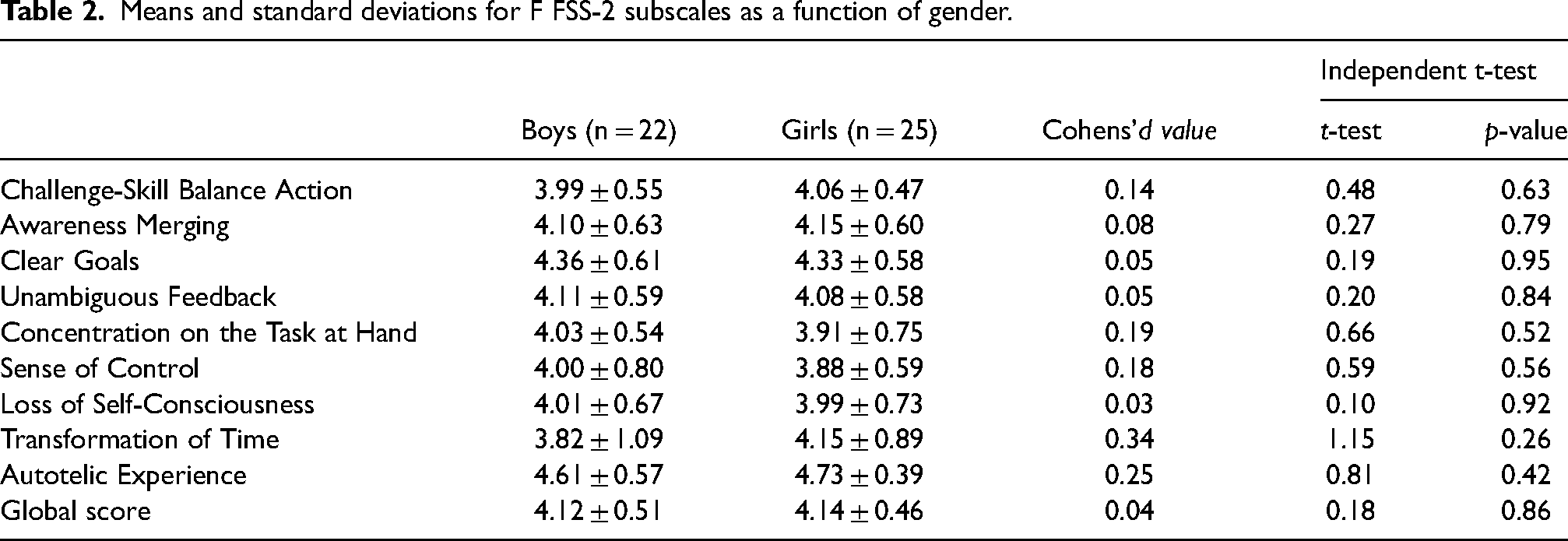
The descriptive statistics for the entire sample revealed high score of intrinsic motivation (M = 5.56), a moderate score of extrinsic motivation (M = 4.38) and a low score of amotivation (M = 2.12). Flow state was moderately high (M = 4.13). A lower dimension “sense of control” (M = 3.94) and a higher value for dimension “autotelic experience” (M = 4.68) was determined.
In the between-group differences in measures of motivation, independent-samples t-test analysis revealed significant differences between mean motivation scores of boys and girls for the variables of intrinsic motivation to know (t = 1.95; p <.05; d = .59), intrinsic motivation to accomplish. (t = 2.14; p <.04; d = .64) and extrinsic motivation identified-regulation (t = 3.71; p <.001; d = 3.71). Girls tennis players had stronger intrinsic motivation to know to accomplish and extrinsic motivation identified-regulation (Table 1).
Means and standard deviations for SMS subscales as a function of gender.

In the between-group differences in measures of F FSS-2, no significant differences between boys and girls in the nine F FSS-2 subscales (p >.05) were found (Table 2).
Means and standard deviations for F FSS-2 subscales as a function of gender.
As per the correlational analyses between motivation and flow state, intrinsic motivation (to know, to accomplish and to experience stimulation) was moderately correlated (r = .30 to.46) with the global score of flow, and more particularly with some dimensions (challenge-skill balance action, awareness merging, unambiguous feedback, concentration on the task at hand, sense of control and loss of self-consciousness). In addition, negative moderate correlations (r = -.31 to -.45) were observed between amotivation and all dimensions of flow except for loss of self-consciousness and transformation of time (Table 3).
Correlation between factors of the SMS and F FSS-2.
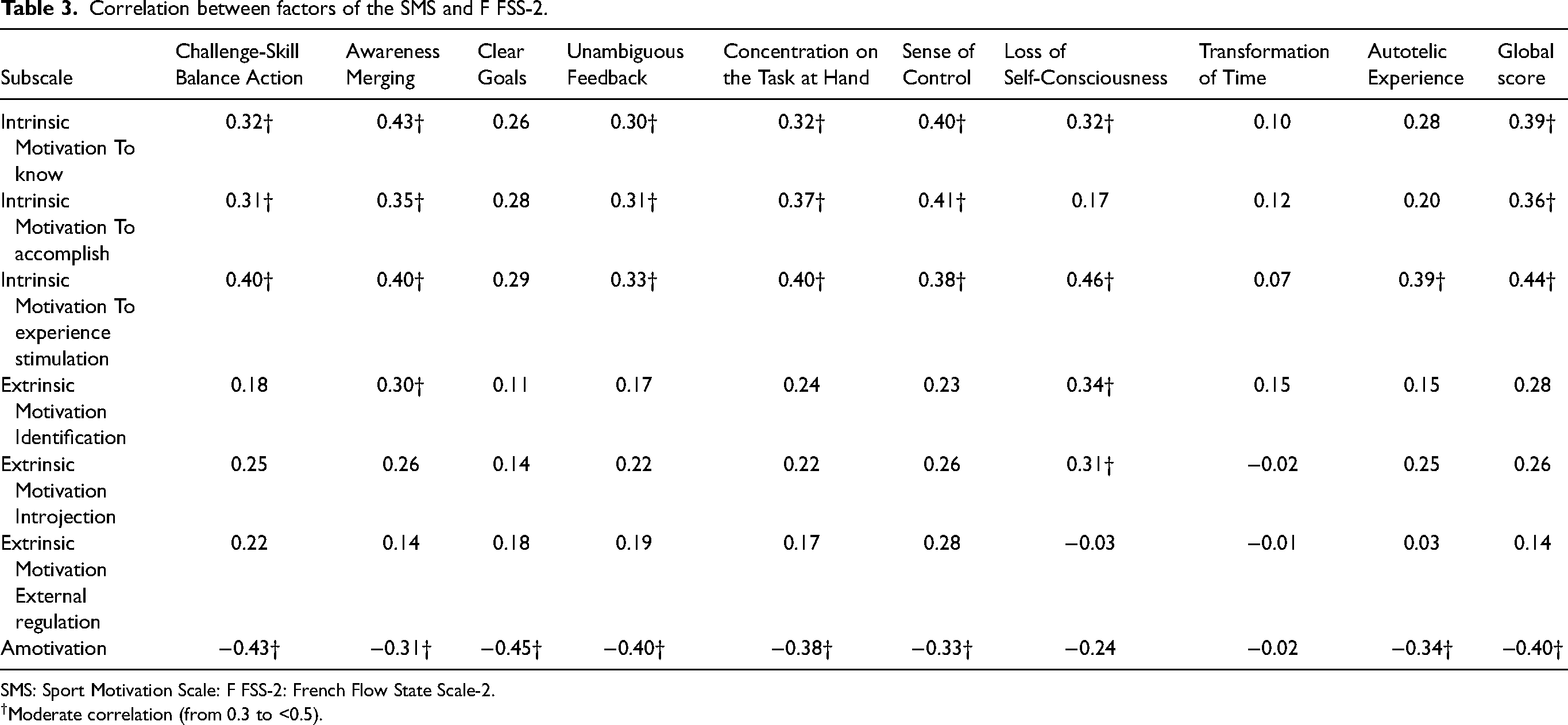
SMS: Sport Motivation Scale: F FSS-2: French Flow State Scale-2.
Moderate correlation (from 0.3 to <0.5).
The causal model suggests a significant causal link between motivation and flow state, with a standardised regression coefficient of.44 (Figure 1). The adjusted Chi-square value (CMIN/df) was 1.12 (p <.001). Therefore, according to this model, it is suggested that the occurrence of motivation as a cause produces a flow state as an effect. On the other hand, the structural equation model was judged to also have an acceptable goodness of fit. The value of the RMSEA, in turn, attained an empirical threshold (.05 or less than.08) and reached a value of.05 with an acceptable interval. The values of the incremental indices (TLI and CFI) were.96 and.97, respectively.

Path diagram of the confirmatory analysis results concerning the associations between the SMS subscales motivation and F-FSS2 subscales. SMS: Sport Motivation Scale; AMOT: Amotivation; EMEreg: Extrinsic motivation external regulation; EMIntro: Extrinsic motivation introjection; EMIden: Extrinsic motivation identification; IMA: Intrinsic motivation to accomplish; IMS: Intrinsic motivation to experience stimulation; IMK: Intrinsic motivation to know. F FSS-2: French Flow State Scale-2; AE: Autotelic Experience; TT: Transformation of Time; LSC: Loss of Self-Consciousness; SC: Sense of Control; CTH: Concentration on the Task at Hand; UF: Unambiguous Feedback; CG: Clear Goals; AM: Awareness Merging; CSB: Challenge-Skill Balance Action.
Discussion
Our research had two main objectives: first, to study the effect of gender on motivation and flow state, and second, to assess the relationship between different types of motivation and the flow experience. A significant difference between boys and girls was found on the subscale scores of motivational orientations. Higher scores on the intrinsic motivation (e.g. to know, accomplish) and extrinsic motivation in girls as compared to boys (p <. 05) were also found. In a study with handball junior players, it was reported that girls were more intrinsically motivated than their boys’ counterparts. 48 In contrast, several studies have found different results. A research with collegiate athletes reported that males showed significantly higher levels of extrinsic motivation, specifically with respect to external regulation (obtaining measurable rewards) as compared to female athletes. 49 These results were similar to those with young volleyball athletes which concluded that boys scored higher than girls did on intrinsic motivation, 50 and those with Iranian competitive athletes which showed that male athletes scored higher than their female counterparts on intrinsic motivation with respect to internal regulation, and also scored higher on external motivation with respect to external regulation, and on total external motivation. 51 Finally, a multicultural study with middle school-aged athletes also reported that intrinsic motivation was greater in males than females. 52
In the current sample of tennis players, the participants showed an average level of flow state. This is in line with the results of a study which revealed that young tennis players exhibit a high level of optimal mood. The authors stated that the different emotional experiences young athletes have during training or competition positively affected their motivation for success and they developed their motivation both internally and externally in a positive way. Therefore, it was revealed that they show a moderate level of dispositional flow unlike the research findings. 53
In our study we found no significant gender differences in the general flow state, which is similar to the findings of Russell 54 in a study with collegiate athletes and that of Murcia et al. 55 who found no meaningful differences between male and female adolescents in terms of general dispositional flow. However, some studies support the hypothesis that activities which enhance flow may differ for males and females. For example, Csikszentmihalyi & Schneider 56 found that girls achieve higher levels of flow during classroom activities than boys. In another study, 57 it was found that women report more micro-flow experiences in everyday activities.
These results confirm the previous findings from studies conducted in various countries and cultures 21 who suggested that the flow experience is universal and cuts across genders and ages. 8 It has also reaffirmed some other empirical research findings that are generated from small college student samples, according to which gender did not play role in the subjective experience of flow.54,58
As per the relationship between flow and various types of motivation, our findings show significant correlations among the three types of intrinsic motivation and the flow experiences. Specifically, intrinsic forms of motivation showed significant correlations with five out nine factors of Flow State Scale (FSS) (challenge/skill balance, action-awareness merging, unambiguous feedback, concentration on task and sense of control), as also in the global flow experience. The notion that intrinsic motivation and flow states are related is not new. In fact, it has been suggested that flow is likely to occur more often when people are highly interested in what they are doing, 19 and that intrinsic motivation is likely to develop as a result of flow experiences. 8 The flow dimension of autotelic experience, defined as an intrinsically rewarding experience, not surprisingly showed the strongest relationship with intrinsic motivation to experience stimulation. In other words, the positive relationship of flow state with intrinsic motivation, which has been demonstrated in many studies (Fournier, et al. 2007; Kowal & Fortier, 1999; Murcia, et al. 2008),44,55,59 illustrates that intrinsic motivation is the determinant of the flow state. Furthermore, the results of a study by Ersöz & Eklund 60 suggest that some dimensions of dispositional flow were positively related to intrinsic regulation, identified regulation, and introjected regulation, and inversely associated with external regulation and amotivation. However, only intrinsic regulation was significantly related to all nine dimensions of flow.
The results of our study imply that an intrinsically motivated player may experience more states that are positive and enjoys all moments of the competition, showing that intrinsic motivation shares common characteristics with the flow experience. These associations imply that there were positive correlations between intrinsic motivation to experience stimulation and the Flow State Scale except for the dimension of “transformation of time”. It has been suggested that intrinsic motivation to experience stimulation, such as feeling excited and intense and being totally immersed in the activity, is similar to flow. 29 The positive correlation between the sense of control and intrinsic motivation provides further evidence of this association in that athletes motivated by intrinsic reasons usually feel competent enough to achieve their goal during the competition, which is in accordance with the suggestions of Deci & Ryan. 19 Furthermore, the correlations indicate that intrinsically motivated athletes are highly focused on the task at hand and have a stronger sense of how well they perform. Finally, another association is that the positive correlation between intrinsic motivation to experience stimulation and autotelic experience dimension suggests that athletes who participate for intrinsic rewards usually enjoy their participation more than when it is not the case. 21
In our study, however, there were poor correlations between external types of motivation and the flow experience, indicating that athletes who are competing for extrinsic forms (e.g. external regulation and introjected regulation) will not experience high levels of positive experiences. In this context, it is important to mention that identification, as a proximal factor to intrinsic types of motivation and which is the most self-determined type of an external form of motivation, showed a low but positive correlation with the global flow state. When athletes internalise their behaviours, this will provide the opportunity for more positive quality experience. 19 Amotivation may have a negative and debilitative effect to flow experience. Amotivated athletes may feel incapable of accomplishing the desired results and find no meaning in continuing their efforts. 19 The element of “transformation of time” obtained the lowest value, which is in line with other studies32,61-63 and may be due to it not being part of an athlete's flow experience. However, not all athletes report time transformation. Losing the sense of ordinary time may depend on whether keeping track of time is part of the sport, so that this dimension of flow may not be universally experienced. 15
Limitations of the study and further directions of research
This research has one limitation that can be considered; the age of the players participating in the study and how their level of understanding of the psychological elements tested could influence the results obtained. Further research which includes different samples of players of varying skill levels, ages, ranking, training volume and categories is needed to achieve a more in-depth view of the relationships between the different dimensions of motivation and the flow state in tennis. The use of mixed methods research designs by combining quantitative and qualitative strategies could provide valuable information on the relationships of these relevant psychological constructs for sports performance in general and tennis play in particular.
Conclusion
The results of our study indicate a positive relationship between the flow state and intrinsic motivation. Gender differences were identified in the dimensions of intrinsic motivation to know, in the intrinsic motivation to accomplish, and in the extrinsic motivation identified-regulation, but not in the flow state. Therefore, from a practical application perspective for both coaches and practitioners it may be important to implement both on- and off-court tennis specific programmes that will help players to develop intrinsic motivation to increase the likelihood of experiencing the flow state. These programmes may start from very young ages (e.g, 10 & under) using games and fun exercises. Specifically, these programmes may include off-court exercises conducted by psychologists or the coaches themselves. These exercises can be done at different times throughout the tennis season and should be tailored to the gender of the players according to our results. The mental skills programme should also include on-court sessions devoted to the training of motivation and the facilitation of flow state in young tennis players. Finally, this study has helped to provide a better understanding of the positive psychological aspects related to junior tennis play. By having insight on the mental challenges that junior players experience both in practice and competition, and the relevance of having the adequate motivation that will elicit a flow state, sport psychologists and coaches will be able to assist them in effectively navigating through competitive junior tennis.
Footnotes
Acknowledgements
The authors thank all the athletes, their parents and the staff of the institutional ethics committee and the medical staff of the Tunisian Tennis Federation.
Declaration of conflicting interests
The author(s) declared no potential conflicts of interest with respect to the research, authorship, and/or publication of this article.
Funding
The author(s) received no financial support for the research, authorship, and/or publication of this article.
