




Abstract
Athletes display differing sleep habits to non-athletic populations; similarly, differences occur in sleep habits between athletes from different sports. There is currently limited research investigating the differences in sleep habits and behaviors between different levels of competition within the same sport. A total of 224 rugby union athletes (109 academy, 38 semi-professional, 84 professional) completed the Athlete Sleep Behavior Questionnaire and the Pittsburgh Sleep Quality Index. Professional athletes displayed a significantly longer self-reported sleep duration compared to semi-professional and academy athletes (7 h 52 min ± 51 min vs. 7 h 16 min ± 1 h 15 min vs. 7 h 19 min ± 1 h 12 min, p < 0.01). Pittsburgh Sleep Quality Index global scores revealed a significantly lower (p = 0.04, d = 0.3) score for professional athletes (5.2 ± 2.5 AU) than academy athletes (6.0 ± 2.7 AU). Individual components of the Pittsburgh Sleep Quality Index revealed significant differences (p < 0.05) between groups for sleep duration and daytime dysfunction. No significant differences (p > 0.05) were observed between levels of competition for the Athlete Sleep Behavior Questionnaire global score; however, significant differences (p < 0.05) were observed for 6 of the 18 items. This study was the first to investigate sleep behaviors across multiple levels of competition in rugby union athletes. Professional athletes displayed longer sleep duration compared to semi-professional and academy level athletes. Additionally, results highlighted that differences exist between levels of competition for specific sleep behaviors. This study identified that sleep behaviors could be improved for all levels of rugby union athletes.
Introduction
Elite athletic performance is underpinned by the ability to recover from the stress placed upon the body via training and competition. 1 Sleep plays an essential role in recovering from training and competition 2 and has been suggested to be the best psychological and physiological recovery tool accessible to athletes. 3 However, despite the importance of sleep for elite athletes, research has shown that athletes often display worse sleep patterns and behaviors than the general population.3–6 Additionally, athletes appear to face a unique set of challenges that can affect gaining adequate sleep. 7 To date, research has focused on the differences in sleep behaviors between athletes and the general population; however, limited research has focused on how sleep behaviors differ between levels of competition within the same sport and collision-based athletes.
Prior research conducted by Driller et al. 7 reported differences between athletes and non-athletes on the Athlete Sleep Behavior Questionnaire (ASBQ), a questionnaire tailored specifically to athletes and designed to assess sleep behaviors. The athlete population reported higher scores in 10 of the 18 items of the ASBQ which included; higher use of stimulants, more frequent training or competition late at night, more often sleeping in foreign environments, and travel impeding a consistent sleep-wake routine, which have all been previously suggested to impact on athletes sleep negatively. 8 Additionally, researchers have suggested other sleep disturbances, including increases in core temperature and cortisol,9,10 increased muscle fatigue and soreness, 11 hydration status, 12 and scheduling of training and competition 13 may also affect sleep in athletes.
Research has suggested that poor sleep (<7 h) in athletes can be detrimental to performance and recovery. 14 Prior research has shown that a lack of sleep can negatively affect training 15 skill execution, 16 skill development, 17 and reaction time. 18 Additionally, a lack of sleep has been linked to a higher instance of illness and injury.19,20 Moreover, researchers suggest that athletes may require more sleep than the general recommendations to recover from the effects of training and competition. 2 Despite the adverse implications of not gaining adequate sleep, rugby union athletes appear to obtain less than the 7–9 h of sleep recommended per night in adult populations. 21 Indeed, Dunican et al. 22 reported that professional rugby union athletes during the off-season obtain an average of 6 h 30 min sleep per night when measured via polysomnography. Shearer et al. 23 reported that following a match, rugby union athletes displayed a sleep duration of 6 h 2 min and rugby union athletes commonly display sleep disorders and excessive daytime sleepiness 22 . Conversely, research has highlighted that gaining more sleep supports increases in performance and reduces stress hormones24, 25 in rugby union athletes.
Whilst the research has highlighted that athletes are required to contend with a specific set of sleep challenges, it is currently unknown how those challenges impact rugby union athletes across different levels of competition. In many team sport athletes, such as rugby union, athletes are typically required to progress through multiple levels of competition to reach an elite level. 26 Each level of rugby union has its own unique set of environmental and physical challenges, and it is unlikely that factors affecting sleep are uniform across all levels of competition. For example, professional rugby union players sleep may be impacted to a greater extent by higher training loads 11 and more frequent travel. 27 Conversely, sleep in the academy and semi-professional rugby athletes may be more greatly impacted by training schedules needing to fit around work and study commitments than their professional counterparts.
Understanding how to improve sleep in rugby union athletes is of interest to practitioners and researchers. A better understanding of sleep behaviors across different competition levels in rugby union athletes may help practitioners and researchers better understand the nuances of sleep challenges specific to each competition level in rugby union. Additionally, normative data may provide future sleep education guidelines specific to each competition level within rugby union athletes. Therefore, this study aimed to characterize and determine the sleep habits of male rugby union athletes across different levels of competition including the academy, semi-professional, and professional athletes.
Methods
Participants
A convenience sample of 224 male rugby union players participated in the current investigation. The participants included 109 academy level players (mean age ± SD, 19.7 ± 2.4 y) who compete in either age-group provincial level or local club competition, 38 semi-professional level players (24.6 ± 4.2 y) who compete in a provincial competition for 6 months of the year, and 84 professional players (24.6 ± 3.7 y) who compete in international and provincial competitions full time. According to the guidelines proposed by McKay et al., 28 our participants would be classified as world-class, elite, and highly trained for professional, semi-professional and academy rugby players, respectively. All participants were aged between 18 and 37 years at the time of taking part in the study. Informed consent was obtained by all participants before completing the questionnaires. Ethical approval was obtained from University of Waikato Human Research Ethics committee (HREC#2017-19).
Procedures
The participants were asked to fill out two sleep questionnaires: the ASBQ and the Pittsburgh Sleep Quality Index (PSQI). The questionnaires were administered via an online electronic survey (Google forms, Google LLC, CA, USA) and were filled out by the participants in a single session. Participants were all in the in-season phase of the competition when completing both questionnaires. Both questionnaires asked participants to answer questions relating to their normal sleep behaviors over the previous month, in accordance with official instructions for each questionnaire. In addition, participants were required to report their current level of competition at the time of taking part in the study; the options included club, provincial, super rugby, and international. The participant's responses were broken down into these categories for analysis purposes. To ensure that the correct athletes from each competition classification were filling out the questionnaire, each team/group of athletes was targeted individually and sent the link, with team coaches assisting in the classification for each athlete.
Athlete sleep behavior questionnaire
The ASBQ is an 18-item questionnaire that asks questions about sleep habits and behaviors thought to be of common concern for elite athletes. 7 The questionnaire was designed as a tool to identify areas of practical improvement to sleep behaviors rather than a clinical screening tool. The questionnaire asks participants how frequently specific behaviors occur; never, rarely, sometimes, frequently, always. Each response is weighted from 1 = never to 5 = always (Table 1). A global score is produced at the end of the questionnaire by summing the answers from each of the 18 items. Global scores can range from 18 to 90, and it is suggested that a global score of ≤ 36 would equate to good sleep behaviors, with a score of ≥ 42 equating to poor sleep behaviors. 7 The ASBQ has been shown to be a valid measurement tool, with moderate to large correlations being seen between the ASBQ and existing sleep questionnaires. 7 Furthermore, it has also been shown to have acceptable levels of test-retest reliability (ICC = 0.87) when administered twice within a week. 7
Global scores for the ASBQ, PSQI questionnaires, self-reported sleep duration from the PSQI questionnaire and p-value and effect size comparisons between academy, semi-professional and professional athletes. Data shown as mean ± SD unless otherwise stated.
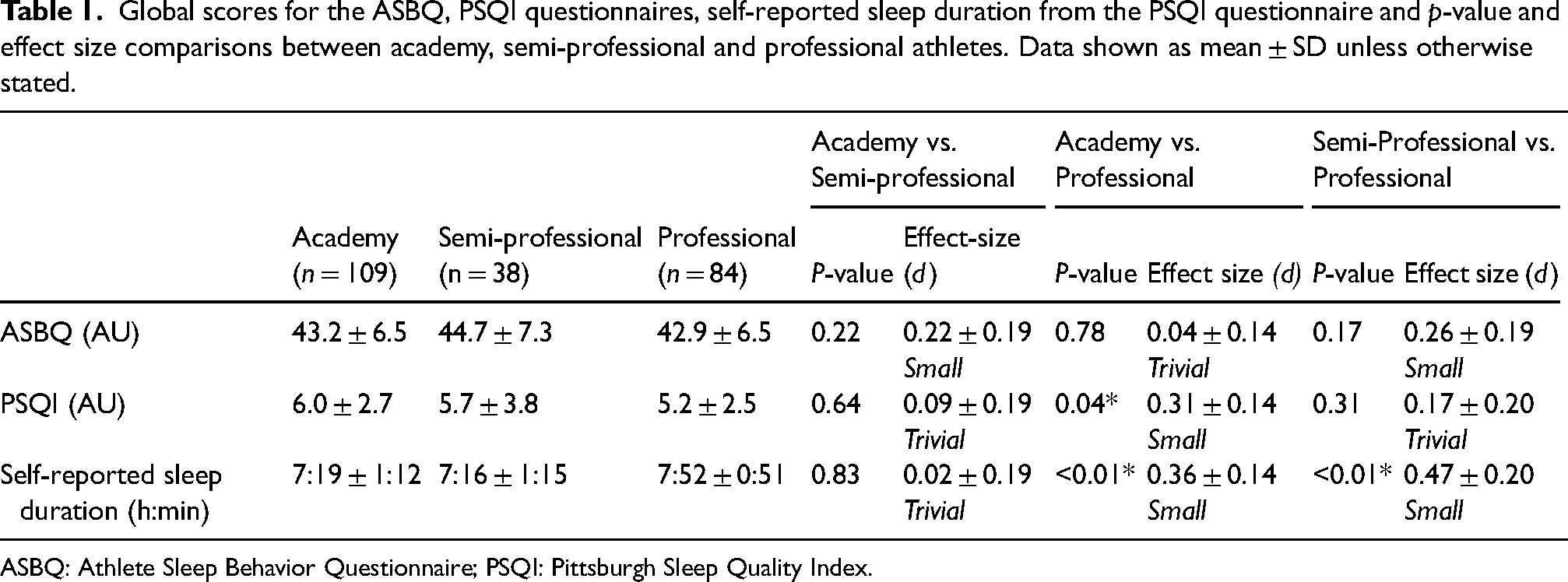
ASBQ: Athlete Sleep Behavior Questionnaire; PSQI: Pittsburgh Sleep Quality Index.
Pittsburgh sleep quality index
The PSQI is a commonly used 19-item self-rated questionnaire that is designed to assess sleep quality and disturbances over a one-month period. 29 The questions are grouped into seven component scores which consist of (1) sleep duration, (2) sleep disturbance, (3) sleep latency, (4) daytime dysfunction, (5) habitual sleep efficiency, (6) subjective sleep quality, and (7) sleep medication. All seven components are each equally weighted on a 0–3 interval scale. and are summed to produce a global score for the PSQI. Global scores range from 0 to 21, with higher scores indicating worse sleep quality. It is suggested that a global score of > 5 equates to having severe sleep difficulties in at least two areas or moderate sleep difficulties in more than three areas outlined above. 29 The PSQI has been shown to have acceptable levels of reliability and validity with diagnostic sensitivity of 89.6% and specificity of 86.5% to distinguish between “good” and “poor” sleepers. 29
Statistical analyses
Descriptive statistics are shown as means ± SD unless otherwise stated. Statistical analysis was performed using SPSS V26.0 (IBM Corporation; Chicago, IL, USA). Comparison of athletes was performed for ASBQ and PSQI Global scores using independent sample t-tests. Global scores were normally distributed as assessed by Shapiro-Wilk's test (p > 0.05). There was homogeneity of variances between groups, as assessed by Levene's test for equality of variance (p > 0.05) no outliers existed in that data as assessed by inspection of a boxplot. Additionally, each item for the ASBQ and PSQI questionnaires were compared between groups using a multivariate analysis of variance (MANOVA) with statistical significance set at p < 0.05. Where a significant difference between groups occurred, post-hoc tests were applied using a Bonferroni correction for multiple comparisons to establish where the differences existed. For the MANOVA, playing standard (academy, semi-professional or professional) served as independent variables while components of each questionnaire were used as dependent variables. Effect sizes (Cohen's d) were calculated between academy, semi-professional and professional athletes for each questionnaire item. They were interpreted using thresholds of 0.2, 0.5, and 0.8 for small, moderate, and large, respectively. 30
Results
Analysis of PSQI global scores showed a significantly lower (p = 0.04) score between the academy and professional athletes associated with a small (d = 0.31 ± 0.14) effect size favoring professional athletes (Table 1). No significant differences were observed between academy, semi-professional, and professional athletes in ASBQ global score (p = 0.60). However, analysis of individual components of the PSQI questionnaire showed significantly lower component scores (p < 0.05) between groups for 2 of the 7 components, again favoring the professional athletes (Figure 1). Furthermore, each item of the ASBQ was analyzed for differences between groups. The analysis revealed significant differences (p < 0.05) between groups for 6 of the 18 items in the ASBQ questionnaire (Figure 2). Self-reported sleep duration from the PSQI questionnaire revealed longer sleep duration in the professional athletes compared to both the academy (p < 0.01) and semi-professional athletes (p < 0.01, Table 1).
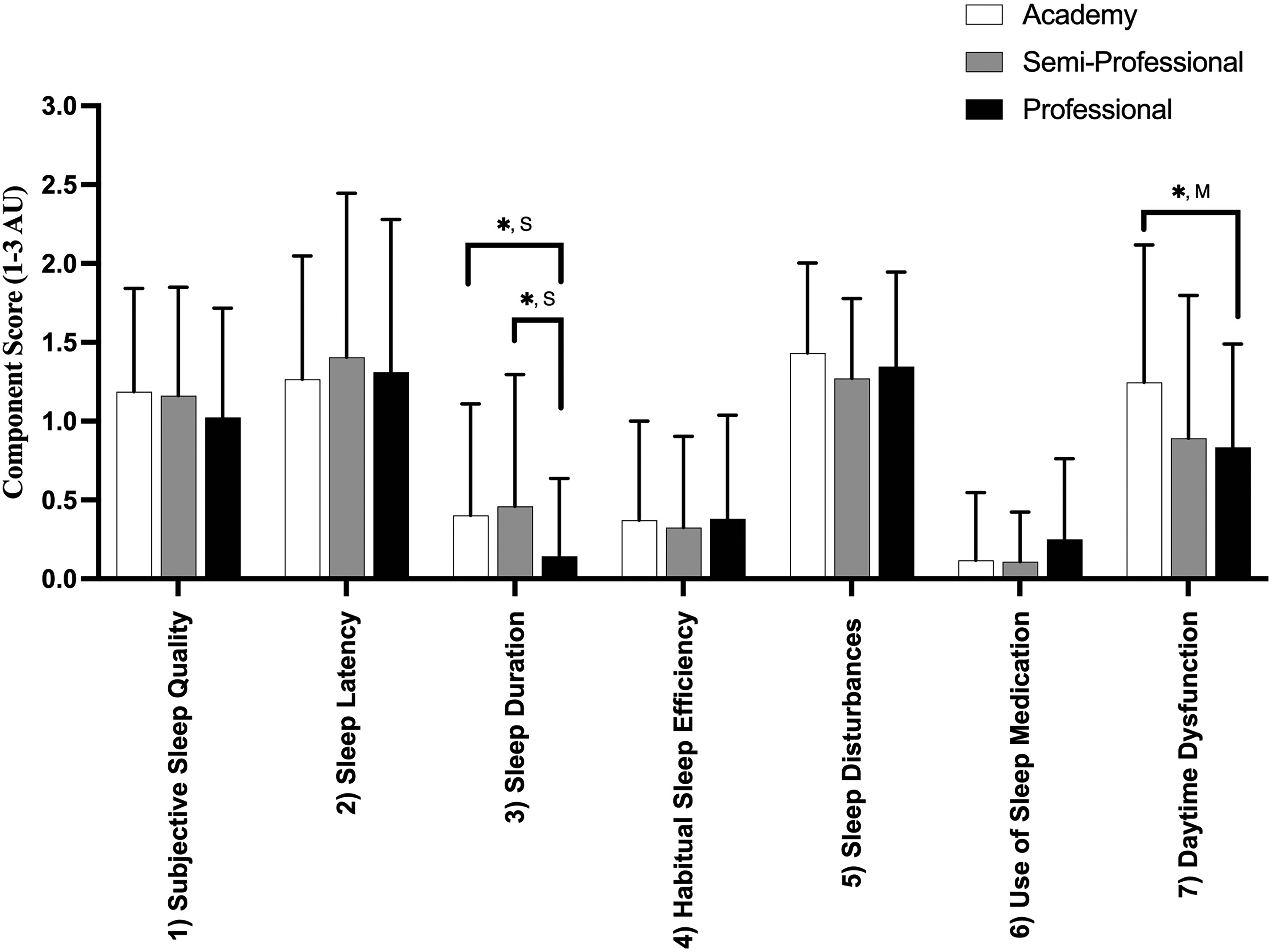
Mean scores out of 3 for academy athletes (n = 109), semi-professional athletes (n = 38), and professional athletes (n = 84) for all 7 components of the Pittsburgh Sleep Quality Index (PSQI) questionnaire. * indicates significance (p < 0.05). S = small effect size, M = moderate effect size. NB. A lower score indicates a more desirable sleep behavior.

Mean scores out of 5 for academy athletes (n = 109), semi-professional athletes (n = 38), and professional athletes (n = 84) for 6 of the 18 items of the ASBQ where significant differences between groups were observed. *Indicates significant difference. NB. A lower score indicates more desirable sleep behavior. ASBQ: Athlete Sleep Behavior Questionnaire.
Discussion
This investigation aimed to characterize differences in sleep behaviors and challenges across academy, semi-professional, and professional rugby union athletes. Key findings highlighted that sleep challenges are inconsistent across each level of competition, indicating professional, semi-professional, and academy-level athletes each have specific sleep challenges to cope with. Additionally, the results highlighted that despite sleep durations meeting sleep guidelines (>7 h), rugby union athletes may display sub-optimal sleep quality as a result of poor sleep behaviors, irrespective of competition level. Overall, the findings from this study suggest that rugby union athletes at different levels of competition display differing sleep behaviors.
Professional athletes displayed significantly longer self-reported sleep duration compared to academy and semi-professional athletes. The professional athlete group in the current study reported a longer average sleep duration of 7 h 52 min than previously reported self-perceived sleep durations in professional rugby league athletes of 7 h 16 min 31 and 7 h 6 min during a game week in professional rugby union athletes. 32 Numerous factors can influence sleep duration in rugby union athletes; however, the differences in sleep duration observed may be in part caused by differences in training schedules. Prior research has suggested that early morning and late-night training can negatively affect sleep duration.13,33 Sargent et al. 13 have shown that a reduction in sleep occurs when training starts before 08:00 h. Additionally, late-night training after 18:00 h is commonly associated with later sleep onset and less total sleep obtained.33,34 Academy and semi-professional rugby union athletes are often required to train around work and study commitments. These commitments require training to be scheduled early morning (before 08:00 h) or evening (e.g., after 18:00 h), potentially limiting the sleep duration. Conversely, professional rugby union players are rarely required to train before 08:00 h or late at night, providing professional athletes greater opportunity to optimize sleep duration.
Despite professional athletes displaying longer self-reported sleep duration, individual items of the ASBQ highlighted professional rugby union players displayed counter-productive behaviors to optimal sleep. The results showed that muscle twitching during sleep might be a pertinent issue affecting sleep among professional athletes compared to academy rugby union athletes. Professional athletes are required to withstand greater training demands compared to academy and semi-professional rugby union athletes. Al-Attar et al. 35 reported academy rugby union athletes complete ∼7.9 km in total running distance within a week, and semi-professional rugby union athletes cover ∼16.2 km per week. Comparatively, total running distance in professional rugby union athletes of ∼23.0 km has been reported. 36 Increased training load has been suggested to increase muscle fatigue, which can potentially cause greater movement and more awakenings during sleep therefore negatively affecting sleep. 11 Consequently, higher training loads experienced by professional athletes may explain increased muscle twitching during sleep observed in the current investigation.
Moreover, results from the current study showed that professional rugby union players are more frequently required to sleep in foreign environments (e.g., hotels). This finding may be attributed to an increase in domestic and international travel required due to the current nature of playing rugby at a professional level. 37 Unfamiliar sleep locations have been previously associated with poor sleep quality, possibly caused by a lack of comfort or familiarity within the environment. 38 Prior research on professional rugby league athletes has shown that sleeping in foreign environments caused a decrease in total sleep time and a decrease in sleep efficiency compared to sleeping in their home environment. 39 Furthermore, domestic and international travel can lead to travel fatigue and jet lag which have both been shown to negatively affect the quality and quantity of sleep in athlete populations. 40 Therefore, due to the travel requirements for professional rugby union athletes, practitioners should aim to implement specific strategies pre, during, and post domestic and international travel to minimize the adverse effects upon sleep. 40
Our findings identify that problems falling asleep may affect sleep duration amongst semi-professional athletes due to thinking or worrying about sporting performance. Thinking or worrying about sporting performance whilst in bed has previously been reported to affect athletes” sleep.7,41 In the current investigation, semi-professional athletes displayed higher instances of thought about their sporting performance whilst in bed compared to professional athletes. Self-reflection of practice is important for learning and understanding amongst athletes and has been reported to improve awareness of factors that limit and improve performance, 42 improve decision-making skills, and better understand team and individual roles. 43 We posit that due to semi-professional athletes often being required to train later at night, athletes may be reflecting upon their training performance whilst in bed because of the proximity in which training and bedtime occur for this population. It is important to note that due to semi-professional athletes training at night, it is also possible that increased cardiac autonomic activity observed after training may also have an effect on sleep onset latency. 44 Additionally, although the proximity of competition and sleep may be relevant for professional athletes due to being required to compete at night. 45 Both questionnaires ask about sleep habits over a month; therefore, we suggest that professional athletes don’t identify thoughts about performance whilst in bed as a habit as this only occurs once a week in season. Conversely, semi-professional athletes are required to train late at night multiple times a week, forming a habit.
Sleep environments are an important aspect of maximizing sleep quality. 46 Aspects of the sleep environment that have been shown to impact sleep quality cited by Caddick et al. 46 include light, noise, and temperature. The current investigation suggests that the sleep environment may affect sleep amongst academy and semi-professional rugby union athletes. Academy and semi-professional athletes reported higher incidence of sleeping in a less than ideal environment than the professional rugby union cohort. This finding suggests that for academy and semi-professional athletes improving their sleep environment via methods of reducing the amount of light, noise and controlling temperature to be conducive to sleep may help to improve their sleep.
The use of electronic devices such as laptops, tablets, and phones in the hour leading up to sleep has been suggested to affect sleep quality and quantity.47,48 The current study identified that academy-level players reported more frequent use of light-emitting technology in the hour leading up to bed than professional-level players. Exposure to blue-light emitting technology has been shown to alter homeostatic sleep regulation by suppressing melatonin's nocturnal release, which may delay sleep onset. 49 Interestingly, the academy players also displayed greater daytime dysfunction compared to professional players. Driller and Uiga 48 showed that using light-emitting technology for an hour before bed may increase sleepiness the following morning. Additionally, Bowler and Bourke 47 suggested the use of technology disrupts sleep onset and can affect daytime dysfunction the next day. Therefore, the increased use of light-emitting technology seen in the academy players may in part explain the increase in daytime dysfunction observed in academy level athletes. Furthermore, while not investigated in the present study it must be noted that the type of activity engaged in on technology can also contribute to difficulties falling asleep. 50 Indeed active engagement in media such as video games or social media posting increased sleep onset latency compared to passive engagement (watching TV or movie). 51
Results from the global scores for PSQI and ASBQ in the current study revealed that all levels of rugby union exceeded the suggested thresholds previously outlined by Driller et al. 7 and Buysse et al. 29 Buysse et al. 29 suggested that a PSQI global score of > 5 indicates “poor” sleep behaviors. A score of > 5 would indicate serious sleep difficulties in at least two components of sleep outlined in the questionnaire or moderate disturbances in at least three components of sleep described in the questionnaire. 29 Additionally, a ASBQ global score that equals or exceeds 42 has been deemed to equate to “poor” sleep behaviors. 7 The global scores indicate that rugby union athletes display “poor” sleep behaviors irrespective of competition level. These findings highlight that sleep behaviors can be improved across all levels of competition in rugby union athletes and further methods or strategies of improving sleep quality in rugby athletes are needed. Targeting maladaptive sleep behaviors via the use of the ASBQ may allow practitioners and researchers to use specific interventions that help rugby athletes to change habits associated with individual items.
Due to the nature of collecting data in professional athlete populations, there are a number of limitations in the current study which were difficult to control. Sleep duration was obtained via subjective measures, with athletes self-reporting their sleep duration. This potentially resulted in over-estimation of sleep duration. 31 Whilst the use of objective data via actigraphy or polysomnography would have provided more accurate information on sleep quantity, collecting this objective data on 224 athletes across numerous locations and training environments was not possible. We also acknowledge that this study was limited to only male athletes across these three competition levels. Future research should aim to compare male and female rugby union players and their sleep behaviors across different levels of competition.
Conclusion
The current investigation showed that rugby union athletes at different levels of competition display differing sleep behaviors. However, the results highlighted that on average all rugby union athletes met current guidelines for sleep duration (7–9 h per night) but demonstrated poor sleep quality irrespective of competition level. Sleep disruption amongst professional rugby union athletes is suggested to be susceptible to the use of ergogenic aids, increased frequency in awakenings, prolonged awakenings at night, and travel leading to being required to sleep in unfamiliar environments. Semi-professional athletes sleep appears to be most impacted by the use of ergogenic aids when in training and competition and thought or worry about sporting performance whilst in bed. Furthermore, semi-professional and academy athletes sleep appears to be impacted by a poor sleep environment. Finally, our results showed that academy players sleep might be largely affected by the use of electronic devices in the lead up to bed, causing greater daytime dysfunction. This information may be helpful to tailor future sleep education and allowing practitioners to target suboptimal sleep behaviors relevant to each level of competition in rugby union athletes.
Footnotes
Declaration of conflicting interests
The authors declared no potential conflicts of interest with respect to the research, authorship, and/or publication of this article.
Funding
The authors received no financial support for the research, authorship, and/or publication of this article.
Ethical approval
Ethical approval for this article was obtained from the University of Waikato Human Research Ethics committee (HREC#2017-19).
Informed consent
Informed consent was obtained by all participants before completing the questionnaires
