




Abstract
Embracing a tailor-made approach to training, the aim of this study was to understand how ongoing adaptation and planning of training sessions (through bidirectional feedback between planning and assessment) contrasts with a more rigid planning with only 4-weeks adaptations, and how those differences impact on learning trajectories. A longitudinal, randomized design with a qualitative analysis was conducted during a full season with 24 girls from a U-13 volleyball team: an experimental group (E.G.) had daily adjusted planning and a contrast group (C.G.) had 4-weeks adjusted planning. Data analysis considered reflective diaries, field notes, video analysis and ongoing assessments using Game Performance Assessment Instrument, to gain a deeper understanding of athletes’ progression and identify their struggles. Based on ongoing and punctual assessment (through GPAI) the planning of the two groups diverged significantly in content and drill structure. Ongoing assessment allowed to solve, in E.G., unpredictable issues as well as develop flexible planning to adapt the specific drills and re-adapt the content. Those adaptations occurred in many ways such as: type of the drill, setting goals and changing the content of the session. In C.G., 4 weeks adaptations were permitted to moderate the extending disparities between rigid planning and ongoing adaptations, aiming to balance the group's levels. Our findings highlighted the importance of bidirectional feedback between assessment and planning, informing the coaches to possible adaptation of the training. Given the differences in learning rates, unforeseen circumstances and players’ characteristics, flexible planning and assessment is paramount to effectively steer the learning process.
Introduction
The paramount importance of planning in teaching-learning activities has been recently highlighted in the literature.1,2 Despite the common practice of planning several weeks or months in advance,3,4 it is challenging to predict the outcomes of pre-planned activities as learning inherently follows a nonlinear path.5,6 Moreover, it is acknowledged that acquisition, adaptation or refinement of skills requires internal transformations which can manifest in divers ways.7,8 Thus, it may be important to turn planning into a flexible and dynamic process rather than a rigid and fixed structure. The literature suggests that flexible planning combined with ongoing assessment of the learners is one of the keys to addressing their current needs and plan appropriately the subsequent activities.9–11
Concomitantly, assessment plays a crucial role in the learning process by providing coaches with ongoing feedback about learners’ individual progress.12,13 Embracing intra- and inter-individual variability,14,15 assessments should address different doubts in various points throughout the year and cater to the specific challenges faced by learners in each class. 16 Regular assessment ensures an adaptable and responsive approach, enhancing the effectiveness of planning and fostering continuous improvement in learning experiences (i.e., formative assessment).17,18 To better support every learner, accountability systems, an instructional strategy that promotes learners’ responsibility for behavior, task involvement and outcomes, offer guidance for adapting the criteria of learning task, thereby intertwining planning and assessment of learning contents.19,20
The feedback is recognised as a critical factor in the learning process, offering valuable insights that contribute directly to it. These insights are not solely associated with external responses, such as those provided by a coach or teacher, but also encompass the athlete's motor performance. Bidirectional feedback provides the coach with important information to the coach in various areas, such as the readiness to practice 21 pedagogical procedures, 22 and the athletes’ evolution. 11 Therefore, the interplay between planning and assessment must be explicitly framed as an intentional pedagogical intervention involving the ongoing adaptation of the training sessions according to the context requirements (e.g., facilities available, learners’ response to each learning content). 23 Recent studies have highlighted the intricate and dynamic nature of the teaching-learning process. 24 While Loureiro, Mesquita 25 emphasized the significance of bidirectional feedback in understanding athletes’ development and addressing challenges, there remains a lack of research investigating the long-term impact of ongoing adaptations and planning. Longitudinal studies exploring the interplay between planning and assessment are notably scarce in literature.
Longitudinal studies offer a holistic perspective, enabling researchers to track how coaching strategies adapt over time based on ongoing, bidirectional feedback that influences athletes’ learning trajectories.11,26 The application of the Game Performance Assessment Instrument (GPAI) was particularly significant in the experimental group, where it functioned as a key accountability system, ensuring that learning tasks were consistently aligned with players’ evolving needs. 27 This assessment tool has been recently applied in volleyball research to evaluate specific training programs,28,29 but it has never been utilized as a flexible and adaptable assessment tool. By integrating both informal and formal assessments, these studies have the potential to highlight the sustained effectiveness of individualized coaching approaches. This ongoing adjustment of the process components to address emerging challenges in the daily practice fostered a more responsive and dynamic teaching-learning environment.
This dual assessment approach enhances the learning process, offering valuable insights for coaches, educators, and researchers aiming to optimize long-term development in sports and education. Accordingly, this study sought to explore how a teaching-learning process that is planned and tailored daily (E.G.) contrasts with a pre-planned process that is only adapted every four weeks (C.G.). The findings emphasize the importance of flexibility and real-time adjustments in coaching, demonstrating how ongoing feedback mechanisms can significantly improve the effectiveness of training programs by providing valuable information to coaches and educators.
Methodology
Study design
An experimental longitudinal study with parallel randomization was implemented, since this approach ensures that various conditions or interventions are allocated randomly and concurrently across different subsets of participants or experimental units.30,31 Moreover, it helps maintain balance and truthiness of the investigation, enhancing the validity of the investigation conducted. 31 The researcher had a professional relation with the sporting organization where the investigation took place, acting as the coach of the team under investigation. As insider-researcher, it was possible to monitor and adapt the pedagogical intervention differently for the two groups (experimental and contrast), 32 as well as to investigate in-depth the ongoing planning and assessment process and their adaptations. Thus, a dual role of coach-as-experimenter (CE) was played. 33
Were followed the CONSORT guidelines, 34 adapted for qualitative analysis. In the E.G., information emerging from the process was used to change the overall planning daily (i.e., each training session constituted an assessment, potentially with immediate effects on planning). Conversely, the C.G. had 4-weeks adaptations, i.e., the planning was re-adjusted only after periods of ∼ 4 weeks. For both groups, a complementary objective assessment instrument was revised at pre-established periods of ∼1 month for both groups.
The main author was not blinded to the interventions, but the remaining research team was. The trustworthiness of this pedagogical intervention was ensured through a 13-weeks feasibility protocol with a comparable group of participants and context. 25 The data was collected in the training facilities of a club with national relevance, throughout 20 weeks and totaling 60 training sessions. The study followed the Declaration of Helsinki and was approved by the Ethics Committee of the University of Porto (CEFADE 30 2021).
Research paradigm and the role of the coach-as-experimenter
A qualitative approach with an interpretative paradigm was used. 35 We constantly interpreted the meanings and individual experiences of the training group. Alongside, we accepted the importance of contextual interferences in athletes’ learning and the responsibility of reflection throughout the implementation. We adhered to views of ontological relativism and epistemological constructionism. 36 Thus, it was assumed the occurrence of multiple and subjective realities, and knowledge was conceptualized as a construction dependent on the nature of individual-environment interactions. 37 An interpretative paradigm was used since the knowledge and the interpretation of the incoming information were performed ongoingly. 38
As a CE, the intentions were to attain a close and deep engagement with athletes so that learning could emerge naturally. 39 The goal was to being intimately involved in daily practices to bring knowledge and experience into the research process. Consequently, the outcome of each competitive match was not perceived as the goal, but as an integral part of a demanding and ongoing developmental journey for all involved. At the same time, research findings were directly applied to the coaching practices making the research more applicable and relevant to real-world scenarios.
Pedagogical intervention procedures
Both groups (i.e., experimental and contrast) belonged to the same team and practiced three times per week (∼90 min per session). The practices took place in the same facilities and were supervised by the same coaches (one of whom was the CE). Therefore, training conditions and the coaches’ personality did not affect the trustworthiness of the results. Likewise, the volleyball-specific Game Model (GM) 1 that served as the set of baseline ideas to support the exercises used in training 40 started out the same for both groups. Every training practice was considered an assessment moment, where the coaching staff collected data to adjust the subsequent planning (daily in the E.G., and with 4-week delay in the C.G.). Figure 1 portrays this planning-assessment process.
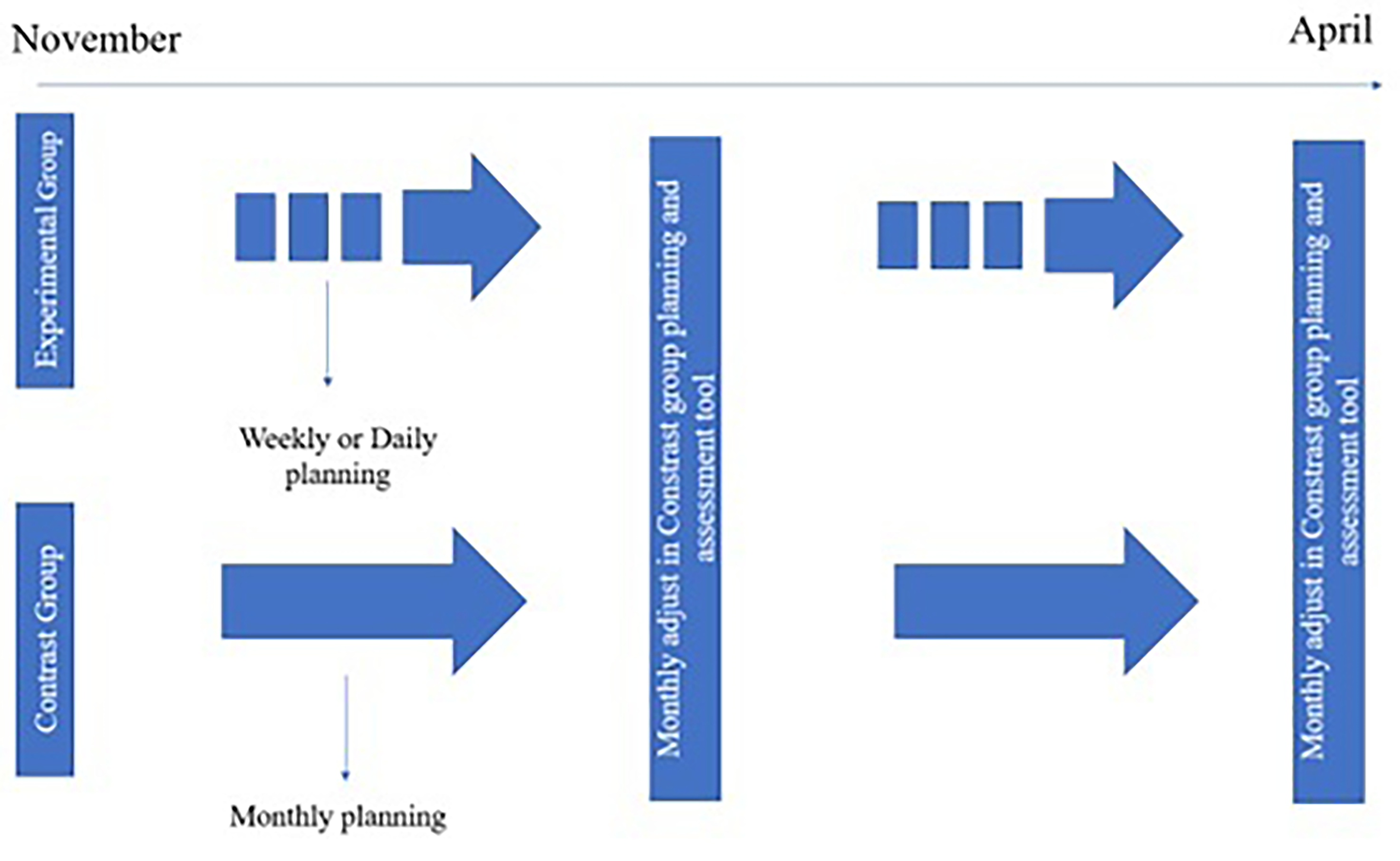
Timeline example of pedagogical interventions.
Complementarily, both groups were formally assessed once per week using the GPAI 41 during the last practice of the week (i.e., Saturday), in 4 vs. 4 games lasting 10 min. The GPAI is a flexible tool providing a holistic overview of athletes’ performance and showing high levels of reliability when applied to volleyball (ICC∼0.9).42,43 Given the qualitative nature of the investigation, the quantitative GPAI results were not the primary focus of the study. Our main objective was to develop an assessment tool tailored to the needs of the athletes, thereby the reliability on assessment using GPAI was not an issue. The GPAI allows for the assessment of each technique as either “appropriate” or “inappropriate” across four distinct categories: i) efficacy; ii) efficiency; iii) decision -making and iv) adjustments. In these games, the E.G. played against the C.G, and the game was recorded by a Sony HD camera positioned at the top of the court, with 3 meters in height, so it was possible to clearly see both sides of the court. Each 4-weeks, the GPAI was updated to fit the athletes’ current needs and difficulties (e.g., different parameters in efficiency, decision-making and adjustment).
Participants and context
The CE had more than 10 years of experience coaching youth teams, a M.Sc. in High Performance Sports Training, and a Level 3 coach certification (highest level in Portugal). The club where the research took place is one of the most representative youth teams, with more than 300 athletes and over 100 national titles in volleyball. The club possesses high-level training facilities that favor data collection.
The participants were eligible by purposively, 44 according to the following criteria: i) belong to the U13 female mini volleyball team; ii) regular attendance on the 3 weekly practices; iii) homogeneous level of volleyball. So, the participant group had the following characteristics (n = 24, age 12.82 ± 0.38 years) with 2.61 ± 1.55 years of practice experience and Level 2 according to the Participants Classification Framework. 45 The athletes and their parents were fully informed of the research goals and signed an informed consent form. Anonymity was ensured (e.g., pseudonyms) and athletes were informed of the possibility of withdrawing at any moment. Figure 2 synthesizes the study flow chart.
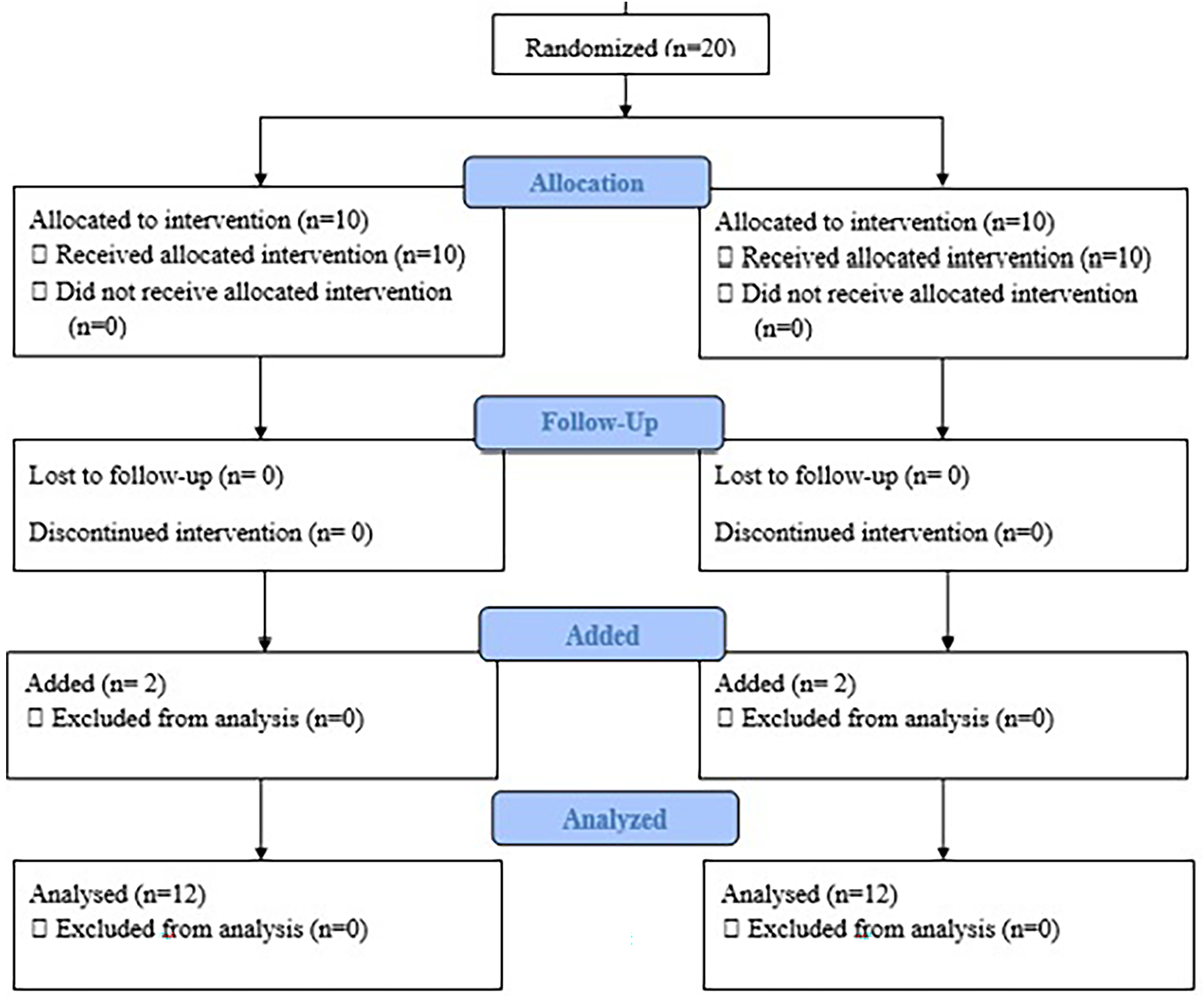
CONSORT adapted sample flowchart.
The 24 athletes were randomized into two groups: the E.G. and C.G. Upon randomization (1:1 allocation ratio), the E.G. was composed of 12 athletes (12,86 ± 0,34 years old) and the G.C. of 12 athletes (12,8 ± 0,39 years old). 46
Data gathering
To gain a comprehensive and deep understanding of the pedagogical process, a variety of data sources were used. The use of diverse sources, tried to mitigate the subjectiveness inherent to the assessment, and reinforce the collaborative work on investigation. That variety of sources englobes both formal (e.g., GPAI and Video Analysis) and informal assessment moments (e.g., Reflexive Diary, Field Notes, Meeting)
Reflexive diary (RD) written by the CE, reflecting the perceptions and difficulties felt during the teaching-learning process,
47
namely the reasons for all the planning adaptations. The RD was written daily and served to reflect about substantial changes performed in the planning and reporting of any special event that occurred. Field Notes (FN) written from the training sessions,
48
which helped to understand how the planning was adjusted into training procedures. Meetings between coach and research group to check and re-adapt the planning process as well as the assessment tool (i.e., GPAI). The main thoughts emerging from these meetings were also registered in the RD. The initial version of GPAI was used in a previous pilot investigation.
25
All the five versions of GPAI can be consulted in the supplementary material. Coaching writing from game analysis - Weekly GPAI - was applied to both groups. Alongside, adjustments to the GPAI, and the reasons underlying it, were registered in the RD. Video Analysis (VA) adapted from Mesquita, Coutinho
49
also helped to recall some perceptions of the athletes’ reactions to the training stimulus (e.g., if they communicated after a mistake) and specific behavior after a coaching intervention during practice.
Data analysis
Thematic analysis (TA) was chosen to examine the data gathered because it enabled the researcher to identify, analyse, and report patterns (themes) within an extensive data set. 50 The six phases of the TA process were completed. As described by Braun and Clarke, 50 the first stage involved data immersion through the continuous (re)reading of transcripts, enabling the researcher to become familiar with the content. The second stage included an inductive line-by-line open coding to identify the main constructs and critical thoughts under investigation. In the third stage, codes were grouped into sub-themes and themes considering the chronological sequence of the events. Next, the themes were revised to ensure they matched the data content. The fifth level involved working back and forth between data and theory to name and define themes suitably and lastly the synthesis of the data. An inductive approach was employed to develop fresh explanations that comprehensively addressed the nuances arising from data. 51
Methodological rigor
To maintain a balance between closeness and distance, various procedures were implemented, including the coach creating a supporting and balanced environment by sincerely expressing his intentions to enhance and enrich the athletes’ learning experiences. 52 Weekly meetings between the CE and the research team provided methodological rigor during the intervention as they were also volleyball coaches and experts in sports pedagogy. The opening and sharing of planning, assessment tools (GPAI), reflections (RD and FN) and practice videos (VA) enabled the data triangulation contributing to the methodological rigor and quality of the investigation 53 ; Still, a direct connection was kept between coaches, athletes, and parents, to engage them in the process. These procedures enhanced the rigor of the study, maintaining the truthiness.
Results
In this study, the planning and assessment for the E.G. were dynamic and adjusted daily based on athletes’ specific needs. The C.G. followed a pre-established planning and assessment schedule, adapted each 4 weeks. Throughout the process, the emergence of alternative plans (within the E.G.) or 4-week adaptations (within the C.G.) reflected a tailored and process-oriented coaching approach. Randomization was bypassed only during 3 practices, representing approximately 5% of the total training sessions to prioritize building a strong and united group, emphasizing the values inherent to a team sports, i.e., the pragmatic nature of this study sometimes clashed with its design. This adjustment was made to align with the ecological validity of the study, which required flexibility to accommodate real-life challenges. Ongoing, informal assessments enabled the creation of cooperative situations in the E.G. and C.G. strengthening the team and adjusting the practice situations according to the fragilities of each group.
The role of ongoing feedback and adaptive planning in enhancing learning consequences
For the E.G., only broad learning goals were planned at the beginning of the month, like tactical behaviors in specific game phases (e.g., setting in side-out). “We notice some factors of setting that are not yet completely developed. The flexibility of the E.G. allows the coaching staff to adapt the focus for those specific issues, such as shoulder orientation to the first contact and footwork for setting, according to what occurs in daily practice. #1, RD November 2022
In the C.G., as next exemplified, learning goals were planned with much more detail to deliver a comprehensive 4-week structure for the learning activities (e.g., set after positive service-reception, defensive displacement). However, in the C.G., the focus of setting remains on the pre-established details such as hand position and contacting the ball high.” #2, RD November 2022
Formal assessment, through GPAI, as well as the informal assessment of the coaching staff (i.e., generic overview at the end of each training session) allowed the daily adaption of learning content and/or tasks design, through individual criteria, for the E.G “T.M. [E.G.] has reached high index on serve efficiency in last formal assessment, the technique was correct, and she could consistently serve with a certain level of aggressiveness However, her decision-making is more often inappropriate, as T.M. serves to often towards the better receiver, or always to the same zone. To try to address this gap the coaching staff is adapting some rules in small-sided games, as example: in a 3 vs.3 game the player that pass was not able to attack.” #1, GPAI, January 2023
While C.G. practiced with generic goals established with the 4 week established paths (i.e., delayed adaptations). This procedure is depicted in the next excerpt: “L.T. as well as other players of their group [contrast-group] revealed low levels of efficiency in serve action, during the formal assessment. However, the specific adjust in the training drill was just possible on the following month. During that period coaches tried to mitigate the fragility with specific feedback during the game-related situations.” #2, GPAI, January 2023
The fragilities detected in the E.G., namely technical issues and decision-making in the setting action, were identified daily and assessed informally. Thus, appropriate learning tasks were re-designed to address it. In the C.G., planning was followed for the remainder of the month regardless of the weaknesses identified through ongoing informal assessments. The next excerpt clarifies this procedure: “During the first two weeks of November we adapt the setting tasks according to different weaknesses. One small group inside the E.G. performs tasks based on the technical aspects where the coaching staff focuses their attention on hands position and displacement. The remaining athletes of the E.G. perform learning tasks that involve decision-making. For instance, the setting has ben was adapted according to some blocking or attacking behavior. In the C.G., the planning remains as intended and could only be changed at the end of the month.” #1, FN November 2022
Customized training based on real-time feedback
Based on weekly GPAI assessments, which showed that some players rarely perform the block action, even during tactical game situations that required it (i.e., expressing an inappropriate decision-making), the coach acknowledged the need for developing two different plannings within the experimental group. Doing so, the coach worked to appropriate the learning tasks according to players’ needs in the blocking action, as demonstrated in the next excerpt. “Some players had high levels of appropriate decisions in blocking assessment [e.g., 6 appropriate decisions to 1 inappropriate]; however, some players expressed inappropriate decisions. This leads to think these players should experiment different training plannings.” #3, GPAI, January 2023
In the C.G., such tailored adaptations were not experienced until the end of the month. So, in this specific group of players, all the players experienced the same training drill without the immediate “small group adaption” “The C.G. still did not experiment this kind of revision responding to the daily assessment.” However, in the planning of the subsequent month, the coaches took into consideration the need to create different tasks according to the drill. So, when the main goal was to practice block, other drills were planned to the players that need to focus on the defense i.e., to smaller players. #4, GPAI, January 2023 “F.C. has constantly low levels of efficiency in serve action. As well as other players of their group, the coaching staff plan to adapt the learning tasks on the next month to try to correct those issues, specifically in the toss and hand contact with the ball” #5, GPAI, January 2023
Relying on ongoing assessments to tailor subsequent practice sessions has facilitated the development of novel approaches to engage each athlete across various volleyball drills (e.g., changing the setting practice from analytical to game-related format). Conversely, adhering strictly to pre-determined plans may hinder adaptability and flexibility, instead fostering improvement within a more structured environment. Nevertheless, this approach can even attribute greater players’ responsibility. “(…) during November, some players wonder why they were doing the same type of drills, while the other group (experimental) changed into different tasks. In this point the big goal was to show to the players that they had many issues to solve in every drill. So, even when the coaches did not adapt their planning, they can benefit and improve in all actions”. #2, FN November 2022
During February the planning focused on spiking action as the main learning content for both groups. The assessment through GPAI enabled the coaching staff to identify many technical issues in players (e.g., spike approach, arm swing). Thus, the coaching staff decided to shift the planning from game-like tasks to more analytical tasks in the E.G. “(…) GPAI assessments showed the low efficiency in spiking action in a group of players from E.G. However, coaches expect a better performance as the spiking exercises were performed in connection with the setters and in a game-like approach [previously, in E.G.]. Nevertheless, in the E.G., the staff adapted to more analytical drills (for most athletes of that group) to work on the spike approach and the arm swing.” #2, RD, February 2023
The C.G. kept the learning tasks for the remaining of the month as pre-planned. The next two excerpts illustrate how both groups followed different pathways: “(…) as the pre-planned training drills adopt a more game-related approach to practice spike actions, the C.G. continues to emphasize this method. Minor adjustments were made in the repetition of certain actions during the 4 × 4 game situations in practice.” #3, RD, February 2023
Adaptations and challenges in planning procedures
The disparities between the rigid plan and its ongoing adjustments persisted throughout the season. This was since modifications to the plan often led to the emergence of new challenges, which required further adaptation in subsequent actions. This iterative process unfolded over time. “So far, it is possible to highlight some adaptations used and the consequent operationalization in practice sessions. The coaching staff have started to use more analytical exercises to fix some issues, which was not part of the training routine; the use of small-sided games as an easier way to start the practice to distinct groups with different purposes. #3 FN, February 2023
Ensuring that the C.G., the delayed adaptation of the planning process becomes crucial to pursue similar goals and for maintaining balance between groups in preparing future seasons. “In a more structural point of view, the remodeling of the game model according to athletes’ characteristics (e.g., the blocking starting points, and offensive system). Which occurred in different timings, due to the difference in the flexibility of planning between groups.” #4 FN, February 2023
Within the E.G., differences in terms of expertise levels were noticed during the informal assessment. Thus, in this group, the learning tasks were re-planned and re-designed. In meticulous detail, the tasks retained their original structure, with distinct accountability criteria tailored to each player based on their level of expertise, as outlined below: “As coaches are underlying the distinct levels of expertise in different athletes, is important to create different goals within the same drill. So, in the same serve and pass drill, some athletes had to score 3 points in serve to reach their goal, at the same time other athletes are trying to serve 3 times in a row correctly to reach their individual goal. Has been an important strategy to adapt those goals during the practice, according to the daily reaction of the players.” #4, RD, January 2023 “(…) only 3 athletes from the E.G. have conditions to block in game situations; it is urgent to create a moment where they will perform a specific blocking exercise while the other athletes do some passing and setting; (…) coaches will build a small-sided game where some athletes have more blocking tasks, and other a more defense focused (…).” #5, RD, March 2023
Adaptations in C.G., during the practice, occurred solely in extreme situations when the players expressed their frustration about the inability to achieve the proposed goal. This led to an internal struggle for the coaching staff, dealing with the necessity of adaptation and the desire to introduce nuances to the drill, conflicting with the pre-established planning process. “During the last practice, the proposed task should be adapted to different players inside the C.G., J.T. done the three positive passes in lateral platform quickly while F.C. took too long to do the same drill. In that case it would be better for the players if we were able to adapt the goals, and even the drill during the practice. The coaches had to communicate more with F.C., to show her some caring and avoid the demotivation feeling.” #4 FN, February 2023
Discussion
This research explored contemporary topics in the literature, such as flexible planning and ongoing assessment, using a robust study design: a longitudinal randomized trial. Its primary aim was to investigate the disparities between two teaching-learning processes: one characterized by daily planning and adjustment (E.G.) and the other by 4-week pre-planning with minimal adjustment (C.G.). In the E.G., planning and assessment were dynamic and tailored daily to athletes’ specific needs, while the C.G. adhered to a predetermined 4-week plan with occasional adaptation. The emergence of alternative plans within the E.G. and 4-week adaptations within the C.G. underscored a coaching approach that prioritized tailoring and process orientation.
The flexibility in the planning approach of the E.G. led to many adaptations over the season in contrast with C.G. The capacity to adapt the teaching-leaning process in the E.G. facilitated planning that addressed athletes’ needs and allowed for changes to tasks (sometimes even within the same training session), which did not occur in C.G. (except each 4 weeks). The flexibility in planning and the difficulty in applying strict planning strategies are highlighted in recent literature.1,11
In fact, different players react in different ways to the same training stimuli, i.e., they respond in a non-linear manner to training. It was observed that players exhibited varied reactions and improvements to the same training drills. Even the expertise acquired in different tasks, such as back setting or spiking approach, showed notable differences among players. This non-linearity in sports training is supported by many investigations, e.g.,6,54,55 and highlights the important role of ongoing assessment in charting the course of an athlete's development. This ongoing assessment, being more subjective, was derived from the observation of the daily practices, during which coaches took notes about the players’ improvements and issues during the practice drills.
Besides the ongoing assessment from daily practices, formal assessment also supported the learning process. Ongoing assessment enable the coaching staff to adapt the subsequent practices of the E.G. and to take notes for future adaptations in C.G. Formal assessment provided a different perspective on the process offering useful and complementary information, specifically, in a similar context (4 vs. 4 formal game) identifying the evolutions and difficulties presented by players. In a sense, this investigation exemplifies the theoretical concept elucidated by Collins, Taylor 56 underscoring the intricacies of the teaching-learning process and emphasizing the necessity for guided approaches. At times, adjustments were even made within the practice session, with drills being adapted and goals modified accordingly. The importance of ongoing assessment and formative assessment (i.e., transforming the assessment information into useful content to subsequent learning moments) is growing and gaining prominence compared to formal and punctual assessment in learning process.11,57
The flexibility of the formal assessment system is underscored by its adaptation every 4-weeks in response to informal assessments and the reflections of coaches. This adaptability ensures that the assessment remains relevant and responsive to the evolving needs and progress of the players. This aligns with ideas previously suggested by Atkinson and Brunsdon 16 in scholarly context. Moreover, this iterative process of modification resulted in the development of five distinct versions of GPAI, each tailored to address specific aspects of the player's learning path over time. These adaptations encompassed various sides such as decision-making skills, efficiency aspects, and adjustment behaviors, demonstrating a nuanced understanding of player development. This flexibility and modification over time represents a significant update compared to earlier studies that used GPAI, particularly in Volleyball.58,59
Accountability systems help individual athletes develop awareness of their development by setting specific goals and targets. In the context of volleyball drills, this can be implemented through a structured system that caters to different skill levels and individual objectives, such as setting varied goals withing the same exercise or training drill. Furthermore, the type of task could be adapted using different rules and/or accountability criteria to better engage every athlete. 20 This corroborates other findings that highlight how different athletes respond differently to various types of pedagogical task.26,60 Following the concept of appropriateness, 27 accountability systems should extend beyond individual responsibility to encompass the adaptation of practices within a collective framework. This investigation broadens the notion of accountability, incorporating the idea that players should not only be responsible for their own actions but also adjust their practices to alignment with collective goals. This expanded perspective is supported by several studies,19,20 which emphasize the importance of adapting individual actions to fit within a collective context.
During the season, we encountered several unpredictable situations beyond our control, reflecting the real-world nature of our longitudinal investigation (e.g., unavailable facilities, social issues within the team). These challenges provided valuable learning opportunities, arising both from unplanned activities (e.g., gym closures leading to joint practices with the male team) and planned events with unforeseen outcomes (e.g., official competitions). For example, practicing with the male team required adapting our strategies to block and defend against stronger spikes. Monthly planning focused on the planning process, enabling the creation of fixed learning tasks tailored for that month, while ongoing planning was more athlete-centred, allowing continuous adaptation to immediate needs and circumstances. These situations demanded constant adaptations throughout the season, and helped to develop a broader perspective, fostering out-of-the-box thinking and continuous reflection throughout the process.61,62
Limitations
Our findings on flexible planning and assessment are specific to this context and should not be generalized to other circumstances. Further investigations could adopt similar approaches across different levels of expertise and age groups. Furthermore, we restricted the formal assessment to the application of GPAI. Future studies may explore the use of additional assessment tools to evaluate their flexibility and provide coaches with a broader range of options.
Conclusions
Ongoing assessment, guided by the coach as a crucial inside participant, identifies ideas, content, and drills for practice that should be incorporated into the planning. Throughout the season, players’ needs fluctuate, requiring the assessment tools to address a range of different questions. The GPAI has demonstrated its value as a versatile tool, providing flexibility and adaptability to better meet the changing needs of the players. The longitudinal nature of the study allowed for a deeper analysis of the intricate cooperation between assessment and planning. Which emphasizes the coach's role in facilitating ongoing adaptations within flexible planning, required for effective practice.
Supplemental Material
sj-jpg-1-spo-10.1177_17479541241307554 - Supplemental material for Operationalising flexible planning coupled with ongoing assessment strategies. A pragmatic, longitudinal randomized study in U13 female volleyball team
Supplemental material, sj-jpg-1-spo-10.1177_17479541241307554 for Operationalising flexible planning coupled with ongoing assessment strategies. A pragmatic, longitudinal randomized study in U13 female volleyball team by Manuel Loureiro, Isabel Mesquita, Ana Ramos, Patrícia Coutinho, João Ribeiro, Filipe Manuel Clemente, Fábio Yuzo Nakamura and José Afonso in International Journal of Sports Science & Coaching
Supplemental Material
sj-jpg-2-spo-10.1177_17479541241307554 - Supplemental material for Operationalising flexible planning coupled with ongoing assessment strategies. A pragmatic, longitudinal randomized study in U13 female volleyball team
Supplemental material, sj-jpg-2-spo-10.1177_17479541241307554 for Operationalising flexible planning coupled with ongoing assessment strategies. A pragmatic, longitudinal randomized study in U13 female volleyball team by Manuel Loureiro, Isabel Mesquita, Ana Ramos, Patrícia Coutinho, João Ribeiro, Filipe Manuel Clemente, Fábio Yuzo Nakamura and José Afonso in International Journal of Sports Science & Coaching
Supplemental Material
sj-jpg-3-spo-10.1177_17479541241307554 - Supplemental material for Operationalising flexible planning coupled with ongoing assessment strategies. A pragmatic, longitudinal randomized study in U13 female volleyball team
Supplemental material, sj-jpg-3-spo-10.1177_17479541241307554 for Operationalising flexible planning coupled with ongoing assessment strategies. A pragmatic, longitudinal randomized study in U13 female volleyball team by Manuel Loureiro, Isabel Mesquita, Ana Ramos, Patrícia Coutinho, João Ribeiro, Filipe Manuel Clemente, Fábio Yuzo Nakamura and José Afonso in International Journal of Sports Science & Coaching
Supplemental Material
sj-jpg-4-spo-10.1177_17479541241307554 - Supplemental material for Operationalising flexible planning coupled with ongoing assessment strategies. A pragmatic, longitudinal randomized study in U13 female volleyball team
Supplemental material, sj-jpg-4-spo-10.1177_17479541241307554 for Operationalising flexible planning coupled with ongoing assessment strategies. A pragmatic, longitudinal randomized study in U13 female volleyball team by Manuel Loureiro, Isabel Mesquita, Ana Ramos, Patrícia Coutinho, João Ribeiro, Filipe Manuel Clemente, Fábio Yuzo Nakamura and José Afonso in International Journal of Sports Science & Coaching
Supplemental Material
sj-jpg-5-spo-10.1177_17479541241307554 - Supplemental material for Operationalising flexible planning coupled with ongoing assessment strategies. A pragmatic, longitudinal randomized study in U13 female volleyball team
Supplemental material, sj-jpg-5-spo-10.1177_17479541241307554 for Operationalising flexible planning coupled with ongoing assessment strategies. A pragmatic, longitudinal randomized study in U13 female volleyball team by Manuel Loureiro, Isabel Mesquita, Ana Ramos, Patrícia Coutinho, João Ribeiro, Filipe Manuel Clemente, Fábio Yuzo Nakamura and José Afonso in International Journal of Sports Science & Coaching
Footnotes
Declaration of conflicting interests
The authors declared no potential conflicts of interest with respect to the research, authorship, and/or publication of this article.
Funding
The authors disclosed receipt of the following financial support for the research, authorship, and/or publication of this article: This project was financed by the Portuguese Foundation for Science and Technology (EXPL/CED-EDG/0246/2021). CIFI2D is financed by the Portuguese Foundation for Science and Technology, under the DOI https://doi.org/10.54499/UIDB/05913/2020.

Supplemental material
Supplemental material for this article is available online.
Notes
References
Supplementary Material
Please find the following supplemental material available below.
For Open Access articles published under a Creative Commons License, all supplemental material carries the same license as the article it is associated with.
For non-Open Access articles published, all supplemental material carries a non-exclusive license, and permission requests for re-use of supplemental material or any part of supplemental material shall be sent directly to the copyright owner as specified in the copyright notice associated with the article.


