




Abstract
Multidisciplinary working is perceived as best practice within elite football. However, our knowledge of decision-making as a collaborative team and the contextual realities experienced by multidisciplinary practitioners during decision-making processes requires scholarly attention. This study aimed to explore multidisciplinary decision-making and communication in an English Premier League (EPL) academy, adopting an interpretive case study approach. Data were collected using semi-structured interviews with 10 EPL practitioners who formed a multidisciplinary team. Data were analysed through a process of thematic analysis. Findings highlighted challenges surrounding the use and interpretation of data amongst multidisciplinary practitioners when making key decisions (i.e., to retain, loan or release academy players). We also found an increased appreciation of the contribution of player care staff within the multidisciplinary team, which was highly valued in the decision-making process. Finally, we highlighted the importance of developing trust and credibility within working relationships in multidisciplinary teams, and related challenges faced following an increase in remote and hybrid working. The findings have important implications for the development of multidisciplinary teams in elite sport and professional football academies, along with suggestions for future research to further our understanding of multidisciplinary working.
Introduction
Working collaboratively across performance support disciplines as part of a multidisciplinary team (MDT) is often suggested to be best practice in the pursuit of optimal athletic performance in elite sport environments.1,2 Moreover, utilising a multidisciplinary approach to identifying and developing talent within professional football academies has been widely advocated.3–5 Indeed, recent empirical research has sought to discuss the benefits of working in a multidisciplinary manner. For example, Kelly et al. 6 evidenced the strength of a multidisciplinary approach when assessing the holistic development of youth football players ‘playing up’ (i.e., a 13-year-old player in the U14 age group being moved up to play in the U15 age group) in academy age groups in professional football clubs. The work of Rollo et al. 7 highlighted opportunities for a multidisciplinary approach to injury rehabilitation in professional football, whilst also noting that further research is required to understand the impact of such an approach on the speed or effectiveness of the rehabilitation process. More recently, Pass, Nelson and Doncaster 8 found that the delivery of periodised training programmes in a professional football academy was negatively influenced by a range of contextual factors such as the resistance of evidence-based recommendations for practice from individual staff within the MDT.
Within the literature, a wide variety of terms are used to define collaborative working between numerous disciplines (i.e., coach, video analyst, strength and conditioning coach, sport scientist, psychologist, physiotherapist etc.) in performance environments. 1 Furthermore, several terms are used interchangeably such as, interdisciplinary teams, multidisciplinary teams, and transdisciplinary teams. 1
Considering the performance environment of a professional football academy, The Premier League developed the Elite Player Performance Plan (EPPP) as a strategy to ‘foster a working environment (e.g., a professional football academy) that promotes excellence, nurtures talented young players, and systematically converts talent into more and better home-grown players'. 9 Academies are audited against a classification system and are graded as either category 1, category 2, category 3 or, category 4, as outlined in Table 1. As part of the EPPP, academies were required to adopt a multidisciplinary approach, outlined as ‘the process by which the various support services are linked around the coaching programme so as to provide holistic support for each player at an academy’. 9
EPPP academy classification system (adapted from The Premier League 9 ).

An important factor in the EPPP strategy is the need for practitioners to work collaboratively. Relatedly, a number of studies have advocated that without a multidisciplinary approach within professional football academies, making holistic, critical decisions that impact the development of players becomes challenging.10–12 Indeed, such critical decisions become paramount at key points in a player's development journey where players are provided with a ‘multidisciplinary review on a 6/12-week basis’. 9 Furthermore, such multidisciplinary reviews will be considered when making decisions on whether to retain, loan out, or release an academy player. Consequently, this context will be the empirical focus of this study.
Whilst a multidisciplinary approach may be perceived as best practice, our knowledge of the social interactions of multidisciplinary teams (MDTs) during key decision-making processes (i.e., the selection, retention, loan, or release of professional football academy players) is limited.1,13 This paucity of research is surprising given that organisational decision-making amongst MDTs has been outlined as a prominent influence on the effectiveness of performance sport environments, and therefore requires further scholarly attention, 14 particularly given the increase in MDTs working to support players across a variety of age groups. In addition, Sporer and Windt 15 suggested that the contextual environment (i.e., the sport, cultural background, objectives of the performance team, financial constraints, staffing etc.) in which the MDT operates will have a considerable influence on the organisational working practices of that MDT. Furthermore, Dowling, Reeves, Littlewood, Nesti and Richardson 16 have highlighted the unique context, culture, and practices of professional football academies. However, little is known about the contextual realities of working in MDTs and the impact such realities have on the social interactions of staff and the subsequent impact of this on the decision-making process.1,15 That is, additional insight is required to understand the contextual nature of best practice of MDTs during decision-making processes.1,13 Finally, Burns and Collins 1 have suggested that an investigation into the personal and professional qualities of individuals required to work and interact effectively in an MDT in elite sporting environments requires further attention. For example, whilst communication has been evidenced as an important attribute to work effectively in a multidisciplinary manner17,18 the social nuances of communication within MDTs requires further empirical attention. 19
Furthermore, Arnold et al. have called for the sampling of ‘additional sport science and management personnel in elite sport’ 20 when exploring decision-making in MDTs. Specifically, there has been a call for the inclusion of ‘performance lifestyle advisors’ and ‘wellbeing’ staff, who are part of the MDT, in the sample of future MDT research. 20 For example, given the emphasis placed on the sociological influences on talent (i.e., positive relationships with staff, supportive family life, city/town of residence) within the youth development phase of professional football academies, 21 sampling lifestyle and welfare staff becomes pertinent. Consequently, exploring the perspectives of a variety of stakeholders who are part of the MDT would be beneficial in enhancing our understanding of the contextual nature of multidisciplinary working and communication during key decision-making moments within a professional football academy.1,7,19
Therefore, the aim of this study was to explore the reported cognitions of multiple participants that engage in interactions (i.e., within multidisciplinary disciplinary team meetings) to better understand the organisational communication process in an English Premier League (EPL) academy. Specifically, the project was guided by the following three research questions: RQ1: How do the multiple participants individually report cognitions in relation to with others in the MDT meetings in a Premier League football Academy? RQ2: What are the reported individual contextual realities and challenges within MDT meetings in a Premier League football Academy, when seeking to collaboratively work towards a collective outcome (i.e., decisions on Premier League football academy players’ employment regarding selection, retention, loan, or release etc.)? RQ3: What are the reported individual personal and professional qualities required to effectively communicate when working towards multidisciplinary decisions?
Methodology
Research design
Adopting an interpretative case study approach, 22 we sought to understand participants’ experiences of multidisciplinary decision-making within an EPL category one academy. Furthermore, the study was guided by a social constructionist epistemology and a relativist ontology. That is, we assume that multiple truths exist, as opposed to one singular truth, and perceive knowledge as being socially constructed, driven by the collective interpretation of social actors. 23 Given the desire to understand individual participant experiences of a social phenomenon, such as their professional relationships with colleagues, the contextual realities of these relationships and communication processes, this research design was chosen to generate the required data set.
Case setting and participant sampling
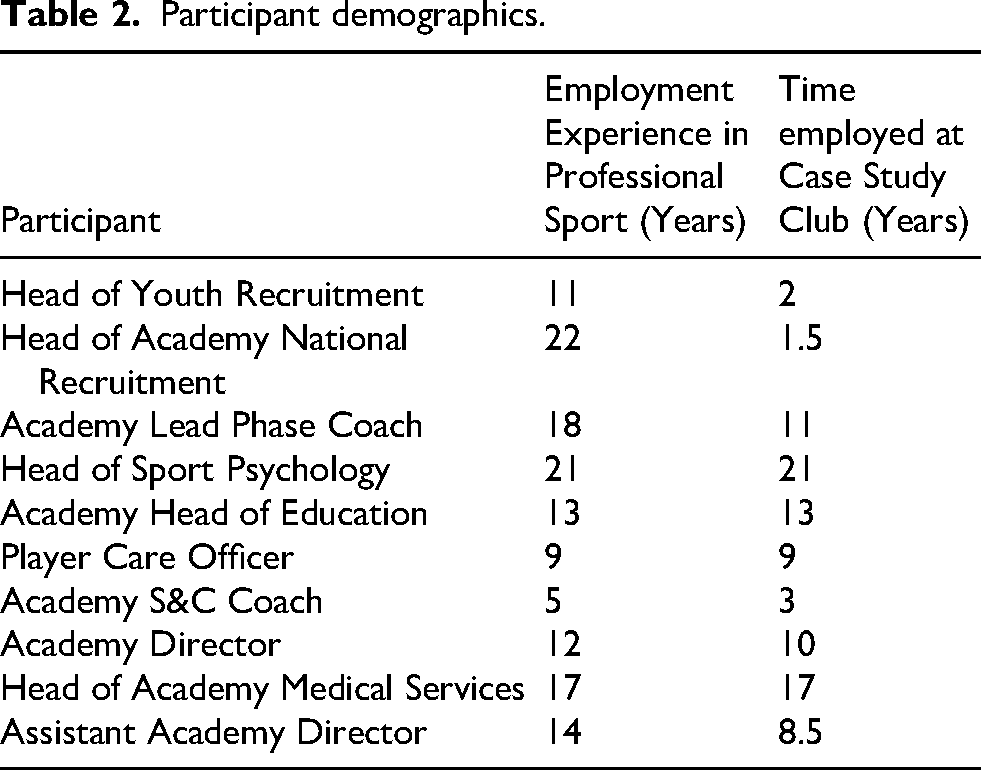
The academy of an EPL football club (Taldev academy – pseudonym) was the single site of the case study.24,25 Following institutional ethical approval (ETH-2223-1090), the sampling of the club was convenient and purposeful in nature, given the professional relationships that existed between the research team and the academy of the club, and the opportunity to explore the focus of our research in depth. 25 Upon gaining informed, organisational consent and access being granted from the football club, a participant inclusion criterion was created. Specifically, we approached participants who had significant experience of key decision-making processes regarding talent identification and development (i.e., the signing, retention, release of, or decision to loan out, academy players) within the academy multidisciplinary team, reflecting the call for a wider range of stakeholders from the MDT to be included within the sampling process.1,20 Additionally, participants had to have held their post in the academy for a minimum of one academy season to ensure sufficient experience of the phenomenon under investigation (i.e., MDT decision-making and communication practices). Following individual, voluntary informed consent being provided, a total of ten (n = 10) participants took part in the study (see Table 2). Participation was voluntary, and pseudonyms were used to protect the anonymity of the case study site, the participants and any other key individuals or football clubs discussed within the interview.
Participant demographics.
Data collection
Data were collected using semi-structured interviews conducted by the primary researcher, with a pilot interview being conducted with a colleague of the primary researcher who had experience of the topic under investigation. Each participant agreed to take part in one interview, with an average interview time of 45 min. In total, circa 8 hours of interview data were collected. All interviews either took place at the training ground in which the academy was situated, or on Microsoft Teams in a virtual format. Each in situ interview was conducted in a private room at the training ground of the club, at a pre-determined time to suit the individual. Virtual interviews were also arranged at the convenience of the participant. As was the case with in-person interviews, rapport was established during the virtual interviews by ensuring the participants were aware of the purpose of the study, the opportunity to pass on questions they felt uncomfortable answering and asking introductory questions about the participant's background that are ‘easy’ to answer. 26 Moreover, the primary researcher had experience of working as a performance analyst in MDTs, further increasing the level of rapport between participant and researcher. Consistent across both in-person and virtual interviews, participants were urged to share their thoughts, feelings, and challenges regarding their experiences of decision-making within the MDT as part of an interview guide devised with the research aim and key research questions in mind. 27 Specifically, interview topics focused on the participant's conceptualisation of talent across different stages of development within the academy, the challenges faced around working in a collaborative manner in an academy setting, making key decisions around retaining, loaning or releasing an academy player and the challenges associated in doing so within an MDT. Additionally, the primary researcher prompted each interviewee to elaborate where possible and provide specific examples of experiences encountered to gather a richer data set. 28
Data analysis
A process of thematic analysis was conducted to identify patterns or contrasting elements within the data, 29 using QSR NVIVO 14.23 to organise and manage the data and the thematic coding process. Indeed, within previous research focussing on MDT's, 20 talent identification and development,28,30 thematic analysis has been highlighted as a useful tool for generating empirical understanding.
Both the second and third authors assumed the roles of critical friends to ensure a reflexive procedure, allowing for a discussion around the interpretations being made regarding the data set.19,31,32 To begin, the primary researcher became familiar with the data, drawing preliminary, analytical interpretations of the data relating to the meaning participants attached to their experiences and conceptual understandings from the literature. Utilising a pattern-based approach, data extracts were then selected across all ten interviews and grouped together into sub themes and overarching themes. This stage was influenced by the design of the key research questions and the overall aim of the study to understand the contextual realities associated with multidisciplinary decision-making and the personal and professional qualities required to work in such an environment. Following this, critical discussions amongst the research team resulted in the final themes being produced during the writing up phase.19,28,29
Establishing qualitative rigour
The work of Tracy 33 has helped us to reflect on criteria for judging qualitative research. Specifically, we ask readers to consider the worthiness of the topic (i.e., whether or not the topic is judged to be of timely and significant interest), rigour and richness of data (i.e., the context, sample, data collection and analysis process undertaken), credibility and resonance (i.e., the ‘thick description’ of, and use of, member reflections or triangulation within the data analysis process) and contribution (i.e., whether or not the study provides a level of conceptual, theoretical, methodological or applied implications).
Considering elements of the above criteria, the research team sought to ensure qualitative rigour through extensive discussions throughout the research process, from the conceptualisation of the literature and research questions to the interpretation of the data through continuous reflective discussions. The research team had extensive experience of working in professional sport and talent development environments. Such applied experience enriched our understanding of the research focus and the case study setting in which we were interested. 34 This experience also allowed for the reworking of themes to develop an insightful interpretation of the story of the data that was contextually representative of the case study setting.19,35 Whilst member checking never took place as an approach to ensure trustworthiness, participants were offered the opportunity to review their individual interview transcripts as a method of good practice. In addition, the final write-up of the findings was also shared with the participants.
Results & discussion
Findings highlighted four overarching themes that are outlined below. Table 3 details how the raw data were organised into sub themes and overarching themes.
Factors affecting the process of decision-making in multidisciplinary teams in talent development environments.

Personal agendas
As is the case with best practice amongst a range of MDTs,
1
an emphasis is placed on all practitioners at Taldev academy to be comfortable providing their input when discussing key decisions related to player development. The inclusion of pastoral roles in the MDT, in addition to the more traditional sport science support staff, was perceived to be of importance when considering the holistic development of each player within Taldev academy. As stated by the Head of Academy Education, ‘we are part of those reviews now which is great, we can support those conversations.’ Specifically, the Academy Director outlined that: If you’re in a meeting and you are discussing the player, you want to hear the reasons behind why they are being scored the way they are. Is there something going on in the background with their family or personal life? (Academy Director) I’d like to think we set the parameters clear from the start. Staff understand that you could go into those meetings and those discussions with a view, but also a respectful acceptance that somebody else might have a different view. We want to encourage checking and challenging where people are not quite agreeing. Let's hear from everybody to try and see if there's a reason that we have come to this conclusion. It opens up for an overall discussion on whether we are going to retain, release or put them on loan, and if they are going on loan, why do they need to go on loan? (Assistant Academy Director) I’ve managed to get around the table with staff and be considered as part of the MDT. I have to be quite strong in meetings because I remember when I first started, it was… “player care is fluffy” or “just there to pat them [players] on the back” and “we need resilient players.” Whereas that's not the case now. (Player Care Officer) An example I have is last Sunday when the U23's trained on Friday and were off on the Saturday but needed to be in at 08:30 on the Sunday. So, my conversation with the coach was, “is there any flexibility in that 08:30 start? The boys are going to go home on the Friday at lunchtime, they don’t drive, they’re relying on parents or public transport to come in on Sunday because the hosts don’t have them on Saturday night”. “Of course, there is, let's push that back.” So those conversations are happening all the time. (Player Care Officer)
Contextual challenges of using and interpreting data
The use of data (i.e., match performance data, GPS and physiological testing data) to inform the decision-making process is standard practice within the MDT at Taldev academy. However, participants highlighted that while the data is useful, ‘you have got to use some context when you are assessing the players.’ To understand this contextual influence, a wider variety of perspectives from several specialist disciplines within the MDT is required. The Academy Strength and Conditioning Coach outlined that: You can have a player who is unbelievable from the testing point of view. So, in isolation, they do good in a physical sense. But on the pitch with a ball at their feet, it doesn’t translate, or vice versa. If we only went on what we see from numbers, sometimes it would not give us the full picture. (Academy Strength & Conditioning Coach)
Another challenge that became evident within the MDT at Taldev academy was the ability to use and reflect on historical data sets from academy players to avoid repeating a ‘wrong’ decision regarding a player: The biggest challenges? Making sure that you are assessing and benchmarking across historical cases where you can learn. Sometimes, we have released a player who has gone on to do well. You could look back at some of that data and cross reference it to a situation that you’re dealing with now, so that you don’t make the same mistake again. (Academy Director) If you release a player and they’ve gone and kicked on, it is quite easy then to pinpoint and say, “well, why did you not keep them?” But in fact, it [their development] might have been because that individual left the programme. As well, in the decision-making process it is typically not just one person involved… We can plan some of those bumps. Whether it's appropriate or not, but we can be a bit more structured. Naturally, some of those players will have some bumps, but if we're all aligned on the purpose, the outcome. This individual, what they need to learn from it. And support and challenge that individual and be consistent with it and not be, it's a bump for one week and then it's the complete opposite. Let them go through that process and figure out what they need to do and also knowing what individual support they might need. (Assistant Academy Director) What tends to happen, if you’re not careful, is because people have an outcome that sometimes they want, or that is their bias, they try and latch on to any bits of data that they think supports it, rather than see the data as something there for us to assess. (U16 Coach) For example, if somebody has got a KPI for their area of work that they have or they get judged on… ‘five scholarships a year, per season’… that can affect somebody's decision-making process. (Head of National Recruitment)
Building relationships and understanding different departments
In discussing the professional and personal qualities of working as part of the MDT at Taldev academy, participants discussed the importance of having mentors who you can ‘go and get guidance from and talk things through’ as outlined by the Head of Academy Education. Additionally, forming and supporting a positive environment was emphasised: You are going to meet people that are quite draining, quite negative. Just be careful how much time and energy you spend with people that want to tell you nothing is good enough. Make sure you have got enough energy for those conversations because two things happen. One, it either just drains your energy and it goes in the wrong direction or, you become it. You become one of those people who bring the environment down. (U16 Coach)
Participants gave significant attention to the need to understand the role and purpose of different departments within the MDT, whilst also building relationships with key individuals within those departments. Interestingly, the Head of National Recruitment suggested that: Developing an understanding of what other departments do will help you. It helps with credibility. It helps you understand why people are saying what they are saying…and helps you to make smarter decisions because you’ll understand other areas that contribute to somebody being an elite athlete. (Head of National Recruitment)
Indeed, the Head of National Recruitment continued to provide further detail on how effective relationships may be developed, stating that: I think a physical presence around the training ground is key. Building relationships with the coaching department, sports science and medicine department. Have a good understanding of what you’ve got in the building. Have a good understanding of where those players fit in, in other people's opinions. (Head of National Recruitment)
Moreover, the Player Care Officer highlighted the benefits of having relationships with different specialists to increase the volume of information available to the player care department to inform their decision-making: You know what the journey should look like for a player that's going to go right through the academy. You need to build relationships with staff, coaches, physio's, strength and conditioning, because we work off a lot of information. A physio will get a lot of information while they’re treating the player, data insights will get a lot of information while they’re scouting the player and talking to the family. So, they’ve already given me information before we’ve signed them. Relationships with staff are as important as your relationships with these players and their families. (Player Care Officer)
Understanding the elite player profile
Finally, participants discussed the importance of understanding the profile of an EPL player and what this profile looks like [technical, physical, psychological, tactical, social attributes] at various stages of the player development journey (i.e., under 11, under 15, under 18 etc.). Specifically, the Head of National Recruitment outlined that: You’re trying to raise people's awareness. Raise people's awareness to when they’re coaching at games and they’re playing at Hannington (pseudonym). If it's one of the bigger teams, look at their players. Try and raise people's awareness to what a genuine, great player looks like. (Head of National Recruitment) People differentiating between having high standards and just being negative… “I’m just going to work with A grade players [top rated young players].” Well, if I look back at the ones that are having a career now, at some point, they were almost all C's and D's [lower rated young players]. (U16 Academy Coach)
In addition, whilst specific disciplinary knowledge of player performance is beneficial, participants at Taldev academy also highlighted the importance of multidisciplinary practitioners understanding the complex nature of talent development in general. Reflecting on the above data then, ‘grade A players’ were at one point ‘grade C and D's’ supporting the notion that player development is far from linear, highly individual to the profile of the player and fraught with challenge. 28 Consequently, multidisciplinary practitioners may improve their ability to contribute to the collaborative decision-making process around retaining, loaning, and releasing an academy player by better understanding the multi-faceted nature of talent development.
Conclusion
This study sought to explore multidisciplinary decision-making in an EPL academy. In addressing RQ1, we found that there were issues around the use of data to inform decision-making within the MDT. That is, at times, interpretation of the data and understanding the context surrounding the data presented challenges amongst staff, with particular emphasis on limiting staff bias. Academy management may explore opportunities to upskill MDT staff members to improve their ability to evaluate data with a view to enhancing key decision-making. 37 Indeed, Strudwick has suggested that ‘practitioners who are trained to think critically about all aspects of performance will gain an advantage over competitors’. 45 Specifically, there was a desire to benchmark historical data sets generated from testing and assessing previous, ‘successful’ players who had progressed to receive a professional contract. However, questions around the reliability and validity of such data sets when informing key decisions (i.e., retain, loan or release) made on academy players were raised. Indeed, whilst benchmarking historical data sets may provide a useful tool to make decisions on current academy players, further, longitudinal research is required to evaluate the efficacy of such an approach to influence key decisions within MDTs and inform a best practice approach. Furthermore, academy environments are susceptible to frequent organisational change, resulting in significant staff turnover.19,32,40,41 Consequently, maintaining consistent, longitudinal benchmarking becomes problematic due to differing subjective opinions, and the preferences for alternative datasets. Indeed, the present study provided further support for the notion of non-linear player development and the need to support and plan ‘bumps in the road’.38,39,46 Future work should further explore how quantitative (in game & training metrics) and qualitative (observations & interviews) data may be used to further understand non-linear player trajectories. Here, longitudinal retrospective development profiles combined with player and coach interview data provides an avenue for a deeper understanding of talent development.
In addition, we also found that there was an increased importance placed on the inclusion of player care staff in key multidisciplinary decisions. Similarly, player care staff at Taldev academy felt their practice had improved since becoming part of the MDT. By having access to a wider range of multidisciplinary knowledge and information, participants noted an improvement in their own, disciplinary working practices and decision-making. Such findings emphasise the importance of including player care and wellbeing staff within MDTs in professional football academies to support the holistic nature of player development. 4
In addressing RQ2, we found that being ‘quite strong’ and assured when communicating and providing disciplinary input within MDT meetings was a required professional quality. This was of particular importance for player care staff in instances where other multidisciplinary practitioners held sceptical perceptions of the role of player care in contributing to player development. Consequently, as reflected in the work of Martin, O’Donoghue, Bradley and McGrath, 47 such professional qualities and behaviours aimed at building and maintaining relationships should be reflected on and developed by practitioners wishing to work in related roles within professional football academies.
An ability to harness a responsibility to maintain a positive working environment within the MDT was also perceived as a required professional quality. Subsequently, novice practitioners should be cautious of staff members who are ‘quite draining’ and ‘quite negative’ and endeavour to not let such demeanour and negativity affect their working environment or practice. Moreover, Alfano and Collins have encouraged the development of ‘critical social skills linked to the awareness of self and others’ 17 for practitioners when communicating and interacting in MDTs with Nelson, James, Nicholls, Parmer and Groom 44 also advocating for educating practitioners around the social features of performance analysis work.
Finally, findings also evidenced the importance of having a ‘presence’ at the training ground to develop professional working relationships within MDTs. Indeed, these relationships were perceived to contribute to the development of trust between practitioners. However, with the increase in remote working in organisations, such as professional football academies, this becomes challenging 48 when attempting to communicate and collaborate effectively. Considering this, further qualitative, observational research may be beneficial in understanding the impact of in-person, remote or hybrid working on the effectiveness of MDTs and the impact on professional working relationships between high performance practitioners in professional football academies.
Footnotes

Ethical considerations
Institutional ethical approval (ETH-2223-1090) was obtained from the University of Derby.
Consent to participate
Individual, voluntary informed consent was provided by the research participants, participation was voluntary, and pseudonyms were used to protect the anonymity of the case study site, the participants and any other key individuals or football clubs discussed within the interview.
Declaration of conflicting interests
The author(s) disclosed no potential conflicts of interest with respect to research, authorship, and/or publication of this article.
Funding
The authors received no funding support for the research.
Data availability
The datasets generated during and/or analysed during the current study are not publicly available due to the protection of participant anonymity and other third parties or organisations discussed in the data.
Generative artificial intelligence disclosure statement
Microsoft 365 Copilot GPT-4 was used to proofread for general spelling and grammatical errors in the preparation of this manuscript.