




Abstract
This randomized controlled trial compared the effects of training load regulation based on horizontal jump (HJ) performance using minimal individual differences (MID) with a pre-planned neuromuscular training control on physical fitness in young soccer players. Nineteen Brazilian youth players were allocated into a regulated group (RG) and a control group (CG). After a familiarization period, HJ reliability was assessed to determine each player's MID, which was then used to guide the RG's training adjustments over six weeks, while the CG followed a traditional training plan. Performance tests included countermovement jump (CMJ), HJ, sprinting (10–30 m), and maximal running speed in the 30–15 Intermittent Fitness Test (V-IFT), assessed at baseline (T0), mid- (T1), and post-intervention (T2). Internal load was monitored using session rating of perceived exertion (sRPE), acute-sRPE, monotony-sRPE, and strain-sRPE. At baseline, performance levels were similar between groups. The RG showed a significant improvement in HJ at T2 (T2 > T0; p = 0.042, ES = moderate), while both groups improved in V-IFT at T1 (p < 0.001, ES = moderate-large) and T2 (p < 0.001, ES = moderate). The RG presented more total jumps during training than the CG (p = 0.007, ES = large). In conclusion, regulating training load based on HJ performance and MID approach led to better improvements in HJ distance for the RG compared to traditional training. The findings suggest that coaches and researchers could consider HJ performance-based regulation to adapt and individualize neuromuscular training loads.
Keywords
Introduction
The constitutive definition of training load refers to a more comprehensive concept that captures the real amount of physical training undergone and experienced by athletes, rather than merely adhering to the originally planned regimen, known as training prescription. 1 In this framework, the term ‘load’ is a general expression, modulated by training stimulus, akin to how various other research domains have incorporated ‘load’ to describe different scenarios (e.g., allostatic load, cognitive load, musculoskeletal load, etc.). 2 It is important to note that training load does not strictly quantify physical measures as in mechanics, where the term ‘load’ is used. Instead, it acts as a label for a sport science conceptual framework.2,3 Additionally, the operational definition of training load encompasses a range of diverse measures, including the indicators of external (i.e., measures related to what the athletes do, such as distance/accelerometry-based variables and number of jumps) and internal training load (i.e., the psychophysiological responses to external load, for example, rating of perceived exertion – RPE, and heart rate). 2
The prescription of external load and the internal load responses to this dose directly affect the acute and chronic training effects. These effects can be measured across a myriad of domains, including several variables (e.g., performance, physiological, subjective, cognitive, biomechanical). 4 Moreover, the improvement of sports performance outcomes depends on these training effects. Therefore, adequate training prescription, tailored by individual and contextual factors and based on daily load monitoring, is crucial for optimizing both acute responses and chronic performance changes. 5 Traditionally, periodized training is based on two principles (among others) 6 : i) the need to systematize the variation of training stimuli; and (ii) the attempt to predict the direction, magnitude, and timing of the training effects. Within this framework, programming involves devising precise training regimens intended for execution during each training period or phase. 7 While periodization entails introducing variations, it is important to note that not all varied training programs adhere to periodization. Programs with variations can lack periodization when those variations are not pre-established but instead arise from continual process monitoring and analysis (i.e., referred to as largely unprogramed variation or short-term programming, such as within a training week). 6
Therefore, other forms of training programming have been proposed to assist coaches and practitioners. In this context, regulation can be considered an adequate approach and implies adapting training to individual athlete's responses on a day-to-day or week-to-week basis.8,9 Regulation is the process used to appropriately manipulate training load based on the athlete's individual readiness status, which can be measured on a daily basis. 9 For instance, in autoregulatory progressive resistance exercise loading, athletes modify their workouts based on the count of repetitions accomplished. This approach has been shown to be effective compared to pre-periodized training without auto-regulation among team sport athletes. 10 Consequently, training targets can be constantly assessed, allowing for real-time monitoring, while averting any unwelcome buildup of training load. 11
A previous study suggested that vertical jump (i.e., countermovement jump-CMJ) could be used to regulate plyometric training load in young futsal players. 11 In addition, utilizing the CMJ height and the minimal individual difference (MID), an individual's typical measurement error and the associated confidence interval 12 has been proposed as a means to manage plyometric training load. 13 However, the daily use of CMJ height requires expensive instruments (e.g., force or contact platforms) or relatively time-consuming data extraction procedures for large groups of athletes (e.g., valid apps or video capture). In contrast, the horizontal jump (HJ) offers a valid, reliable, and low-cost alternative that is also practical for daily use in soccer environments. HJ performance is strongly associated with sprint acceleration and lower-limb power in soccer players,14,15 and the transference effects of horizontally oriented plyometric training further reinforce its ecological validity.14,16 The test can be performed with minimal equipment (e.g., tape measure) in a short time frame, allowing multiple players to be assessed simultaneously without interfering with regular training schedules. This makes it feasible for youth academies and semi-professional clubs, where resources are limited but daily monitoring remains essential. Therefore, the HJ represents not only a simple and low-cost alternative, but also a practical, feasible, and sport-specific solution that can be readily implemented in real-world soccer teams, aligning with recent recommendations for accessible, field-based monitoring tools.2,4 However, its application to induce improvements in physical fitness in young soccer players has yet to be investigated.
Although randomized controlled trials are considered to have the highest level of scientific evidence for experimental studies, conducting this type of study in soccer settings presents challenges. However, it has been suggested that more of these studies are warranted. 17 This randomized controlled trial aimed to compare the effects of training load regulation based on horizontal jump (HJ) performance using minimal individual differences (MID) with a pre-planned neuromuscular training control on physical fitness in young soccer players. Our working hypothesis was that using regulation of neuromuscular training through HJ distance with the associated MID to monitor and adjust the training load would improve neuromuscular performance in U17 players. This approach was hypothesized to result in superior neuromuscular adaptations than pre-periodized plyometric training without regulation process.
Methods
Experimental design
This study was a randomized controlled trial conducted during the preseason period in young soccer players. The trial was designed and reported in accordance with the Consolidated Standards of Reporting Trials (CONSORT) guidelines. 18
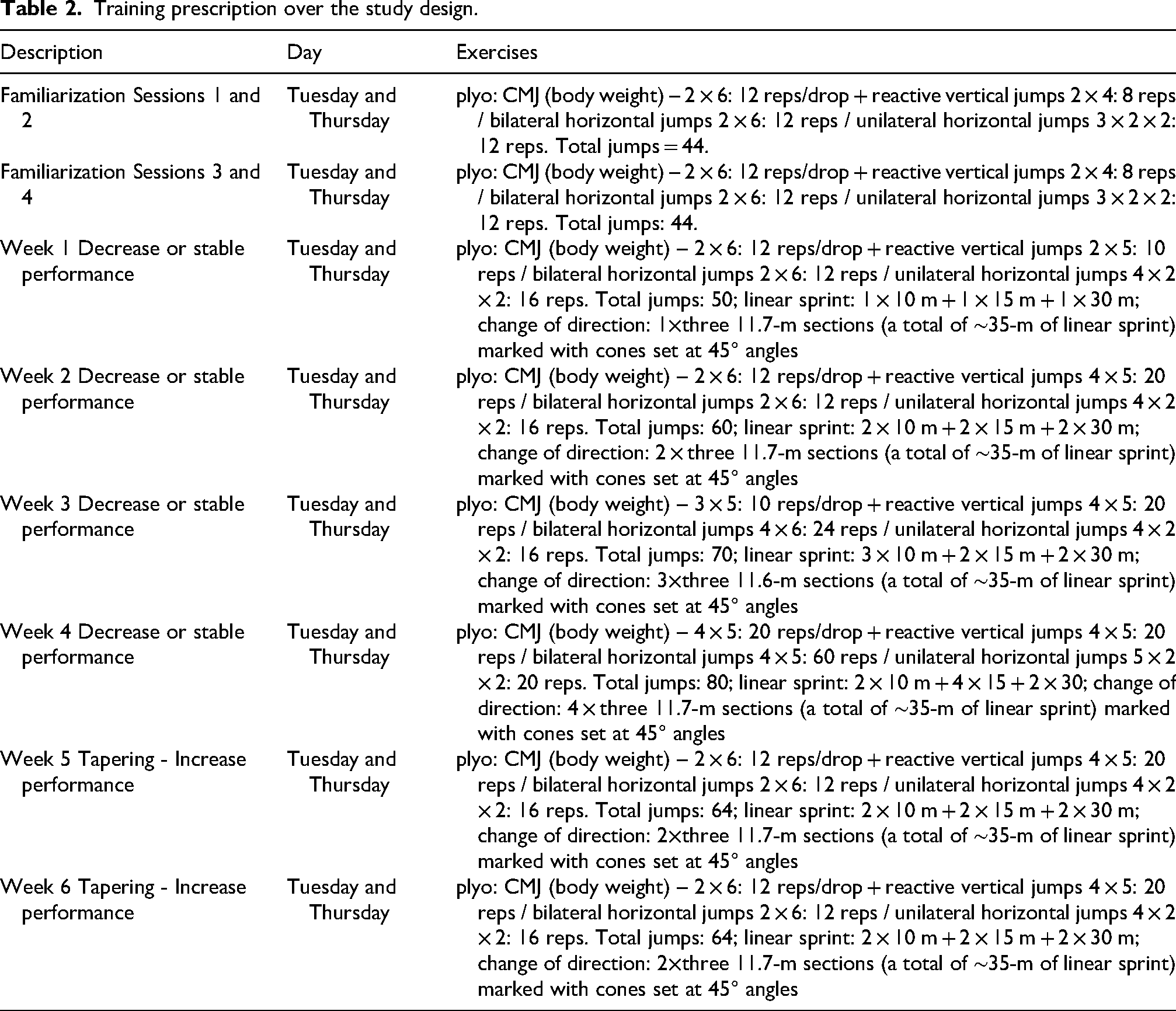
The participants underwent familiarization with plyometric training (vertical and horizontal jumps – see Table 2), adapted from previous study. 19 No lower limb training was permitted during the familiarization process. Subsequently, two reliability sessions occurred following a 24-h interval after the final familiarization session. In each session, post-warm-up (i.e., composed by 1 set of five countermovement jump + 1 set of five bilateral horizontal jump), participants completed six HJ. This facilitated the computation of the individual's typical measurement error along with their corresponding confidence intervals (defined as MID). The use of six repetitions was based on previous studies indicating that multiple trials improve test–retest reliability while avoiding excessive fatigue.15,19
The MID was calculated following the procedure proposed by Claudino et al. (2016). 12 After two familiarization/reliability sessions, the standard deviation of the difference scores (SDdiff) was computed for each player. The typical error of measurement (TEM) was then calculated as TEM = SDdiff/√2. Finally, the MID was determined by multiplying the TEM by the t-distribution factor for a 90% confidence interval (1.761). Thus, only changes exceeding this threshold were interpreted as true performance changes beyond normal variability.
The HJ distance was assessed using a measuring tape. The average of six jumps was utilized for analysis. The participants were randomly assigned to a regulated (RG) and a control group (CG). Both groups engaged in 6-weeks of training program, which included exercises such as CMJ, drop jumps, bilateral single-leg hops, unilateral single-leg hops, linear sprints, and soccer specific training (e.g., small-sided games). A schematic representation of a typical weekly training regimen and total training duration is presented in Table 1. The players trained 4 or 5 times a week, totaling 29 sessions, and all training sessions took place during the afternoon. The neuromuscular training program was applied two times per week and was performed before technical-tactical training. The researchers did not interfere in the coaches’ technical-tactical planning. During all sessions, RPE was monitored and the duration of the training session in minutes was also recorded for subsequent internal training load quantification. The objective of the preseason period for weeks 1–4 was to elicit an overloading, with an expected reduction or maintenance of physical fitness, while the goal for weeks 5 and 6 was to observe an increase of physical fitness due to a reduction in volume (tapering).
Schematic representation of a weekly training regimen and total training duration during the preseason phase for U17 soccer players.
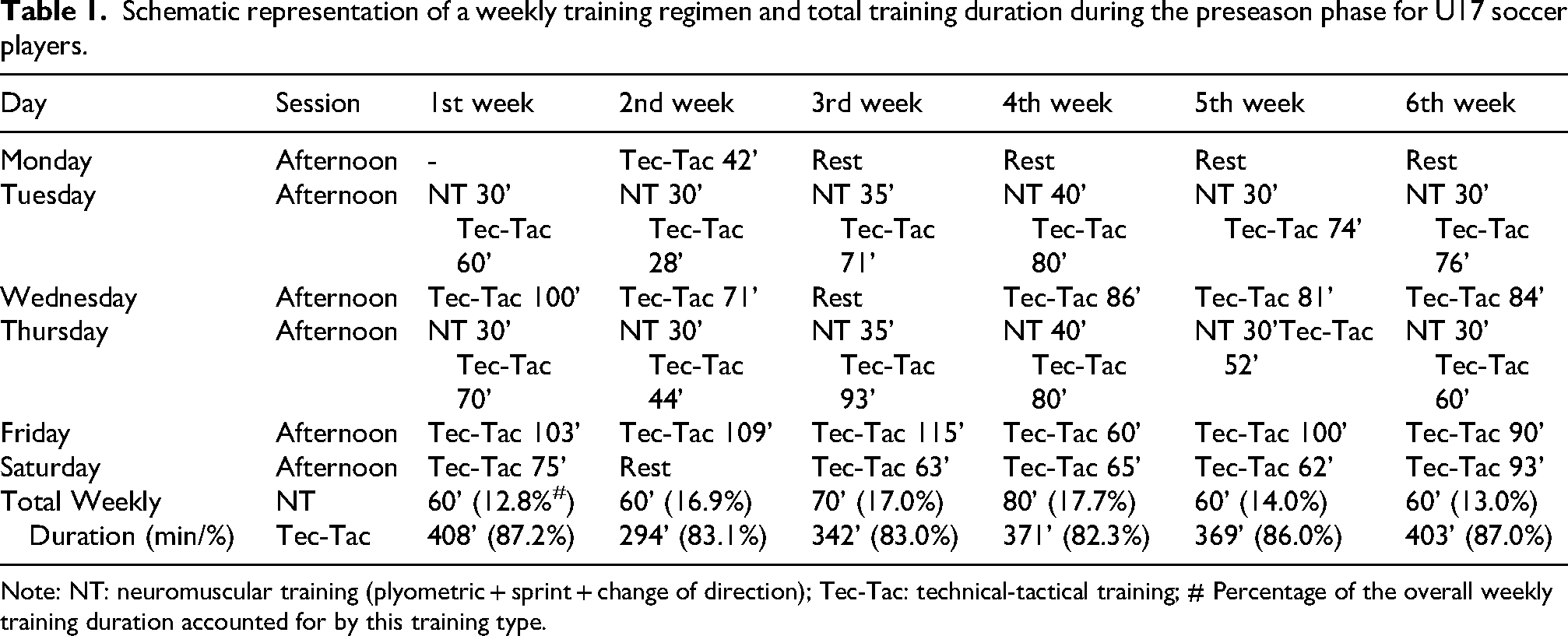
Note: NT: neuromuscular training (plyometric + sprint + change of direction); Tec-Tac: technical-tactical training; # Percentage of the overall weekly training duration accounted for by this training type.
Training prescription over the study design.
In the RG, the horizontal jump distance (six repetitions) was assessed and its associated MID was calculated before the commencement of each neuromuscular training session. This assessment was performed after the previously mentioned warm-up. When necessary, training loads were adjusted by 40% relative to the pre-planned load (see Figure 1). This threshold was based on previous experimental evidence demonstrating that substantial changes in jump volume are necessary to meaningfully modulate neuromuscular adaptations in team sport athletes. 11 Additionally, systematic reviews and meta-analyses on plyometric training in soccer have indicated that effective interventions often employ moderate-to-large manipulations of jump volume (∼30–50%), which are associated with greater improvements in physical performance. 20 Therefore, the 40% adjustment served as a practical strategy to ensure that load changes were large enough to exceed trivial variations, while remaining feasible and safe for youth players.
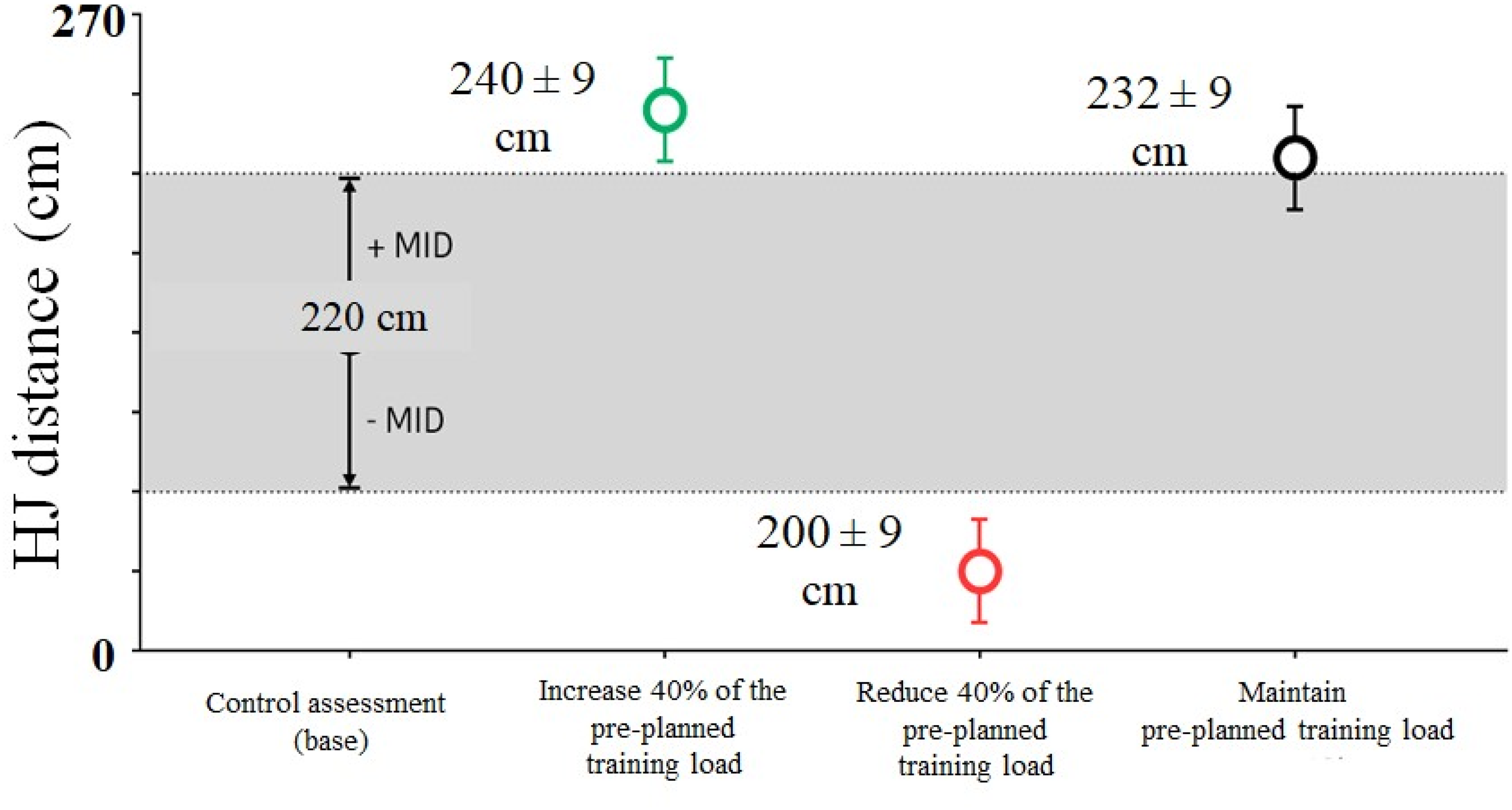
Example of regulating training load according to horizontal jump performance and minimal individual difference (MID) assessed before the training session.
Three testing moments were conducted to measure physical fitness: the first assessment occurred after the familiarization and reliability period (T0); the second assessment took place after the 4th week of intensified training (T1); and the third assessment occurred at the end of the 6th week of tapering (T2). The physical fitness assessments were performed after at least 48 h of the last training session, including measures of horizontal jump, vertical jump (CMJ height), sprint (0–10 m and 0–30 m), and aerobic fitness performance (30–15 Intermittent Fitness Test).
Participants
A power analysis was performed based on the results from a previous study with same experimental design. 11 Using an “effect size f” of 0.31, “α err prob” of 0.05, “power (1-β err prob)” of 0.95, “number of groups” of 2, “number of measurements” of 3 and “corr among rep measures” of 0.933444 in the G*Power software (version 3.1.9.7), it was estimated that 6 subjects per group were needed. Twenty regional level U17 male outfield soccer players (15.5 ± 0.8 years; height 172 ± 2.3 cm; body mass 62.5 ± 5.2 kg) participated in this study and were randomly assigned to either a regulated group (RG; n = 10) or a control group (CG; n = 10). The randomization process was conducted in ten blocks. Each block resulted in the allocation of two participants per group, ensuring balanced recruitment in the study and promoting similarity in initial measurements between groups. The horizontal jump performance was also considered to each group composition. Previous studies reported that this strategy reduces the risk of bias and is considered a quality criterion in experimental designs that aim to investigate comparisons between groups.21,22
Inclusion criteria were outfield U17 players who were medically cleared and available for the entire preseason. Exclusion criteria included any condition that prevented participation in high-intensity training/testing, and non-compliance defined a priori as attendance in <80% of the 12 neuromuscular training sessions and 29 technical-tactical training sessions. Athletes who did not meet this compliance threshold were excluded from the post-intervention analysis. For this reason, one participant of the CG was excluded from the sample. Therefore, the final sample size was composed of RG (n = 10) and CG (n = 9). The eligibility criteria were i) age (between 15 and 17 years), ii) sex (male players), iii) athletic experience (at least two years of competitive soccer), iv) health status (free of known diseases, or chronic illness, or any injury), and v) training background (experience in plyometric training). This information was obtained by applying a questionnaire to the players. No players were excluded from the sample based on eligibility criteria.
The players were informed of the experimental risks and signed an informed assent form before the investigation. In addition, written informed consent was obtained from parents or legal guardians. Ethics approval was obtained from the Ethics and Research Committee of Centre of Physical Education and Sports (Federal University of Espirito Santo, Brazil) and conducted in compliance with the ethical principles of the Declaration of Helsinki.
Internal load monitoring
To enhance accuracy in responses and reduce errors, the Borg's scale (CR10) was introduced to the team for familiarization daily over a two-week period. Roughly thirty minutes after the conclusion of the entire training session, which comprised both the neuromuscular and technical-tactical components, players were prompted with the question, “How was your workout?”. Internal load, assessed through session-RPE (sRPE), was measured in arbitrary units (a.u.). This was achieved by multiplying the adapted version of Borg's CR10 score 23 by the duration of the training session or match. 24 Consequently, the following internal load indicators were derived 24 : acute s-RPE (i.e., acute load), training monotony, and training strain.
Familiarization process and training program
The training program is detailed in Table 2. The neuromuscular training (plyometric + sprint + change of direction) was performed in accordance with a previous review 20 : intensity of effort at maximum, along with adequate technique, with a rest period of 5 s between repetitions and a rest period of 30 s between sets. Additionally, a 48-h recovery period between sessions was considered. A reduction of 20% of the jumps was applied during the tapering period for both groups (week 5 and 6). In addition, both groups performed pre-planned training during the tapering period. The neuromuscular training was vertically and horizontally orientated, with emphasis on HJ, such as suggested in a previous systematic review. 16 The technical-tactical training was composed mainly using small-sided games.
Physical fitness assessment
Sprint test - 10-m and 30-m
To determine the mean of sprint performance, three 10 m and 30 m sprint linear tests were conducted. Three sets of photocells (Speed Test Fit®, Cefise, Nova Odessa, SP, Brazil) were placed at 0, 10, and 30 meters along the track. Players initiated the test from a stationary position 0.3 meters behind the starting line. Following the assessor's signal, the players performed the test distance three times at maximum speed, being verbally motivated to maintain all-out effort until the finish line. 25 A 3-min recovery interval was provided between attempts, and the average of the three tests was computed for analysis.
Vertical jump test
The vertical jump height was determined using the CMJ technique. 26 The players were instructed to execute a downward movement followed by a full extension of the knees. The CMJ was performed with hands fixed on the hips. All jumps were executed on a contact platform (Ergojump System®, Cefise, Nova Odessa, SP, Brazil). The acquired flight time (t) was utilized to calculate the elevation height of the body's center of gravity (h) during the vertical jump (i.e., h = g × t2 × 8−1, where g = 9.81 m·s2). A total of three trials were conducted with a 15-s interval between them. The average of the CMJ trials was used for analysis. 27
Horizontal jump test
The horizontal jump was executed following the methodology of a previous study. 14 Players positioned themselves at a designated ‘starting’ point previously marked with tape. Upon the evaluator's approval, participants initiated the jump by swinging their arms and flexing their knees to achieve maximum forward displacement. Upon landing, participants were instructed to stick with both feet, and the jump's length was measured using a tape measure. The measurement was taken from the ‘initial’ position to the point of contact (i.e., the back of the heel of the nearer foot). Three jumps were performed with a 30-s interval between each repetition. Ultimately, the jump's length was determined by calculating the average of the distances achieved in the three attempts. 15
30–15 intermittent fitness test
The test protocol encompassed 30-s runs (between two lines positioned 40 meters apart) interspersed with 15 s of passive recovery. 28 The initial speed for this test was set at 10 km·h−1 and incremented by 0.5 km·h−1 after each successive 30-s stage. Speed control was made through an audio signal. The test was concluded either when the participant voluntarily ceased due to exhaustion or when the individual failed to reach the subsequent 3-meter zone (adjacent to the marked line) upon three consecutive beeps. The final speed achieved in the test was utilized for analysis (i.e., V-IFT in km·h−1).
Statistical analysis
Data distribution was confirmed through visual inspection and the Shapiro-Wilk test, with no violations of these assumptions found. Consequently, data were described as mean and standard deviation (SD). These data were analyzed using a two-way ANOVA to compare physical measures over time (T0: pre-training, T1: mid-training, and T2: post-training) and between groups (RG and CG). Independent sample t-tests were used to compare internal load values between the RG and CG on a week-to-week basis (e.g., week 1 RG vs. week 1 CG). An independent t-test was also applied to compare the accumulated total internal load across the 6 weeks between groups. Additionally, the magnitude of effect (ES) was calculated using Cohen's d. 29 The ES was interpreted as trivial (< 0.2); small (0.2–0.6); moderate (0.6–1.2); large (1.2–2.0); very large (2.0–4.0); and nearly perfect (>4.0). A significance level of p < 0.05 was adopted. All statistical analyses were conducted using SPSS software, version 22.0.
Results
All players in the regulated and control groups completed the planned 12 neuromuscular training sessions and 29 technical-tactical training sessions during the preseason intervention. The training load for RG was adjusted in six sessions (i.e., increased 40% of the number of jumps). The training load of the 1st and 2nd sessions was not adjusted for RG. Four players of the RG increased the number of jumps previous the 3rd, 4th, 5th, and 6th sessions. Five players of the RG increased the number of jumps previous the 7th and 8th sessions. CG performed pre-planned training in all sessions.
There were no significant differences between groups at baseline (i.e., T0) in performance measures (Table 3). HJ increased only for RG (T2 > T0; p = 0.042; Δ% = 8.1; ES = 0.78, moderate). In addition, both RG and CG presented higher V-IFT at T1 (p < 0.001; Δ% = 8.8–9.4; ES = 1.09–1.15, moderate-large) and T2 (p < 0.001; Δ% = 7.0–7.6; ES = 0.92–0.99, moderate) compared to T0.
Descriptive data (mean (standard deviation)) of physical measures according to the time and group.
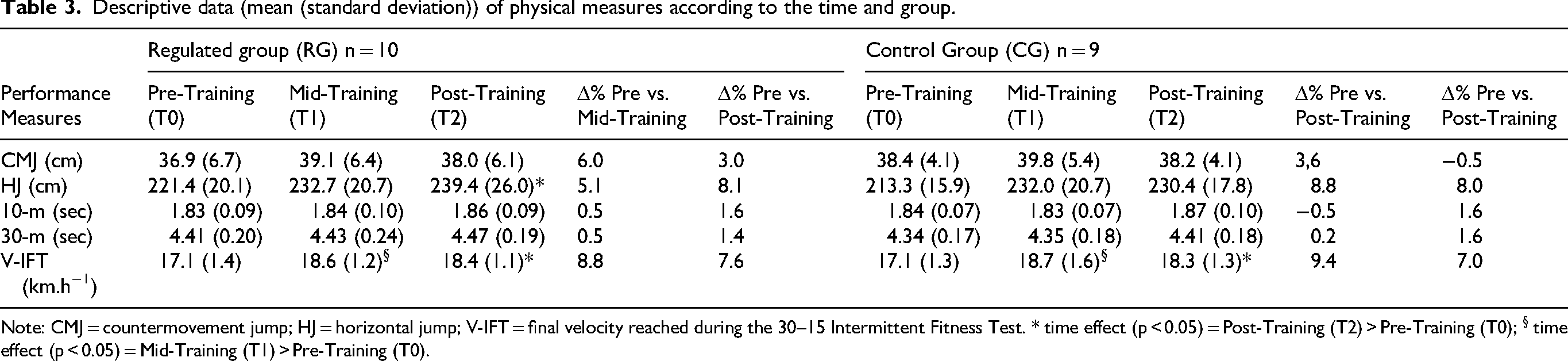
Note: CMJ = countermovement jump; HJ = horizontal jump; V-IFT = final velocity reached during the 30–15 Intermittent Fitness Test. * time effect (p < 0.05) = Post-Training (T2) > Pre-Training (T0); § time effect (p < 0.05) = Mid-Training (T1) > Pre-Training (T0).
The acute-sRPE (Figure 2A), training monotony (Figure 2C), and training strain (Figure 2D) were similar between groups for each week and for accumulated period (p > 0.05). Initially, a descriptive analysis revealed a 60% increase in the external load (number of jumps) over the first 4 weeks (week 1: 50 pre-planned jumps vs. week 4: 80 pre-planned jumps). Throughout the observation period, the RG displayed a greater accumulated number of jumps than the CG (t = 3.490, p = 0.007; Δ% = 7.0; ES = 1.52, large) (Figure 2B). From weeks 1 to 4, the RG exhibited a higher increase in the number of jumps per week (Δ% = ranging from 2.0–12.0% for pairwise comparisons in weeks 1 and 4, respectively) compared to the GC. The tapering period (weeks 5–6) presented a decrease of ∼ 20% for CG and ∼30% for RG in total jumps (week 4: 80 pre-planned jumps vs. weeks 5–6: 64 pre-planned jumps) (Figure 2B).
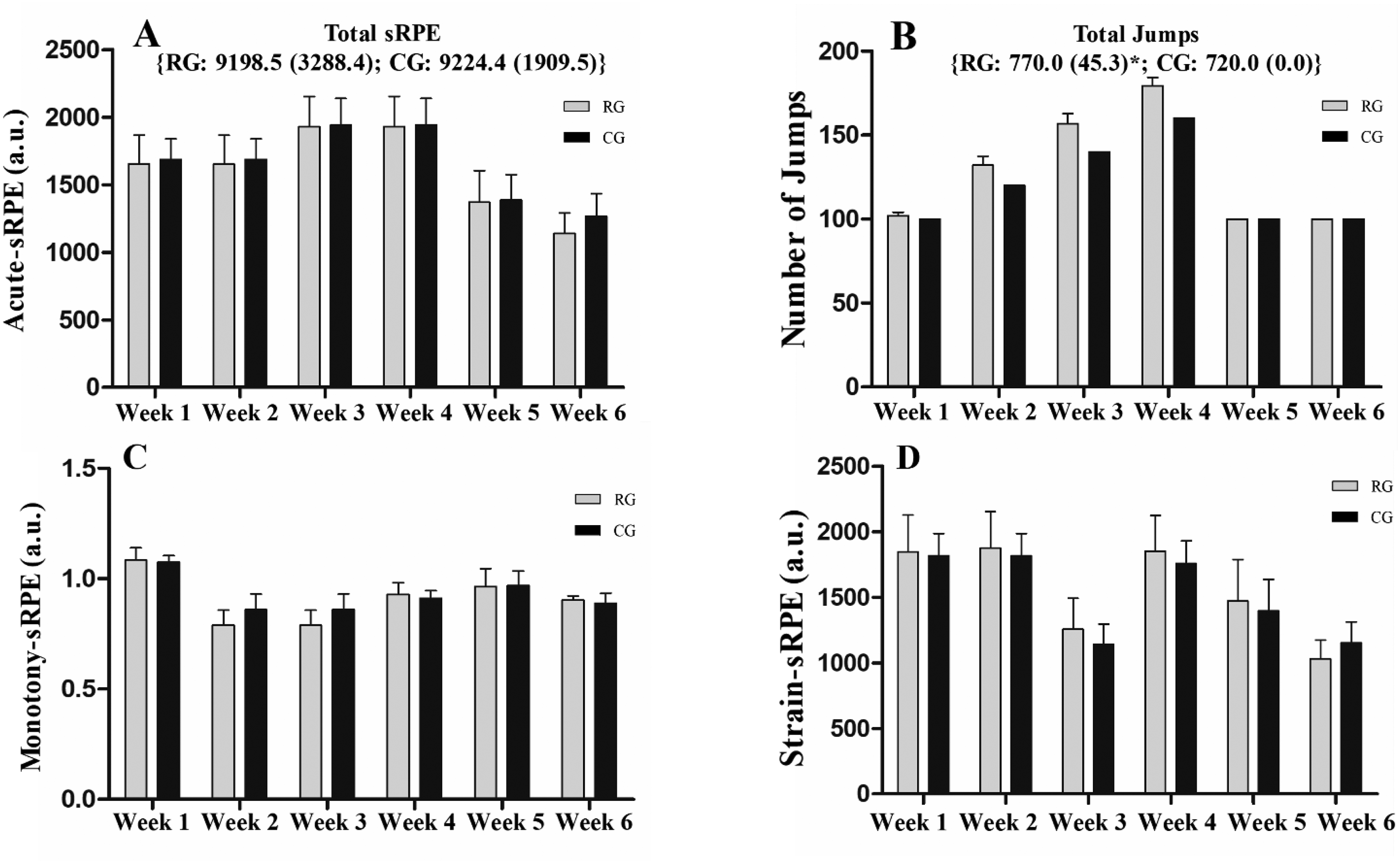
Mean ± SD estimates for acute-sRPE (A), number of jumps (B), monotony-sRPE (C), and strain-sRPE (D) between groups according to each week. * = Significant difference (p < 0.05); RG > CG. Gray bar: Regulated Group; Black bar: Control Group.
Discussion
This study used the pre-training session HJ performance and MID to regulate plyometric training load in young soccer players. The main findings were: i) the internal training load measures (i.e., acute s-RPE, monotony, strain) did not differ between groups over the training program; ii) the accumulated external load related to the number of total jumps was greater for RG compared to CG; iii) aerobic fitness improved in both groups after the training program (T2 = T1 > T0); iv) only the RG improved the HJ performance after the preseason period; v) the other performance measures did not improve after the training in either group.
The approach used in this study to increase the external training load (e.g., total jumps) was similar to previous studies.11,30 In addition, this study decreases the external load volume during the tapering period, while maintaining intensity. A preceding meta-analysis revealed that, across various sports and training approaches, a tapering phase characterized by a reduction in training volume (while maintaining intensity) appears to be the most effective strategy for optimizing competitive performance among elite athletes. 31
The findings of the present study showed that these approaches to increase (weeks 1–4) or decrease (weeks 5–6) neuromuscular training load might have aided improving the aerobic fitness (i.e., V-IFT, see Table 3) of young soccer players for both groups (RG and CG). Previous studies have highlighted the potential of plyometric training interventions to enhance aerobic capacity in young soccer players.32,33 Alongside this, it is essential to also consider the impact of specific aerobic-dominant training typically during the preseason (e.g., technical-tactical sessions). 34 Moreover, it becomes evident that stressing both the aerobic system (i.e., training program with predominance on technical-tactical abilities) and the neuromuscular system could be a significant factor to explain the observed improvements.35,36 This suggests that the results are due to a multifactorial cause-effect relationship, rather than being solely attributed to neuromuscular training.4,35 Another explanatory factor for these results is a contribution the neuromuscular system to the final speed reached at the end of the 30–15 Intermittent Fitness Test (vIFT). 37
In this study, the RG presented a higher cumulative external load than the CG (see Figure 2). However, the accumulated internal load measures (i.e., s-RPE over the 6 weeks training program) did not differ between groups. Personalizing the training load individually by utilizing MID-adjusted HJ performance within the RG allowed for tailored external load modifications that correspond with biological conditions and the predetermined training objectives. Therefore, despite the RG experiencing a higher external load compared to the CG, the internal load responses remained consistent and had similar responses during the 6 weeks of training for both groups. The proportion of neuromuscular training (∼12.8–17.7%) and soccer training (83–87.2%) can justify these responses (see Table 1).
The superior adaptation using HJ with MID before the training session can be confirmed by the improvements in HJ performance at the post-training period only for RG. In this study, the training program did not present positive effects on sprint performance (10-m and 30-m). Considering that one of the preseason training goals is the enhancement of players’ physical performance, studies often point the challenge of improving sprint performance in soccer, with some studies noting a stagnation or even a decline in sprinting capabilities post preseason in team sports.38,39 These results may be attributed to the concurrent effects of diverse training stimuli during the young soccer preseason period, which, while aimed at overall physical development, might not specifically target or effectively improve sprint performance. 34 However, it is noteworthy that the players investigated in our study managed to maintain sprint performance levels, possibly because neuromuscular training was effective in counteracting the typical preseason decline in speed and power ability, a significant achievement in the context of a high training volume preseason.39,40 The literature indicates that training strategies are more effective during the in-season due to lower volumes of general training,41,42 and their effectiveness increases when customized to the specific neuromuscular characteristics of each athlete or group. 14 Nonetheless, our individualized approach based on neuromuscular readiness using HJ performance and MID did not result in optimization of sprint and CMJ performance and did not show superior benefits to increase the 30–15 IFT performance.
The absence of improvements in both CMJ and sprint performance can be explained by several factors. First, our neuromuscular training program was predominantly oriented toward horizontal tasks (HJ, COD, sprint drills), which favors adaptations in horizontally directed force capacities and may explain the specificity of the HJ improvements. In contrast, vertical adaptations (CMJ) typically require higher volumes and protocols specifically designed with vertically oriented stimuli.14,16 Second, the relatively short duration of the intervention (6 weeks) and the conservative progression of volume in the initial weeks may have been below the threshold required to elicit significant gains in vertical jump or sprint speed, as systematic reviews highlight that longer interventions and larger manipulations of volume are often necessary for consistent improvements. 20 Third, the preseason context involves high concurrent loads, with substantial technical-tactical training, which may blunt neuromuscular adaptations and limit changes in power activities such as sprinting and CMJ.34,38 Taken together, these factors suggest that the improvements in HJ were likely driven by the horizontal orientation and autoregulation strategy, while the absence of changes in CMJ and sprint reflects the short duration, limited volume, and concurrent training demands of the preseason period.
This study presented some limitations that should be recognized. First, the 6-week training program duration based on plyometric training used in this study is considered inferior than recommended in a previous review (at least 7 weeks). 20 However, we opted to use the first 2 weeks of the preseason for familiarization sessions instead of initiating the neuromuscular training program. Second, the first 2 weeks of the training program were planned for 50 and 60 jumps per session, respectively (i.e., 100–120 jumps per week). These values were lower than those recommended for the abovementioned review (∼80 jumps per session or 140–240 per week). 20 The reason for this option was based on the performance level of the participants and the age group (i.e., youth and regional). To mitigate potential muscular discomfort that could affect the core training centered on small-sided games, we opted to commence the training program with a decreased number of jumps per session and per week. Third, this study collected RPE after the entire training session (neuromuscular + technical-tactical), which may have masked subtle differences specifically induced by the neuromuscular training. Future studies could collect RPE separately for each component or combine it with objective markers to provide more specific insights. Finally, another limitation is that the regulated group performed a higher total number of jumps across the intervention, which may have influenced the specific improvements observed in HJ performance. Since training volume is a recognized determinant of adaptation to plyometric training in soccer, 20 we cannot exclude the possibility that this greater exposure contributed to the gains in HJ performance. Importantly, however, this higher volume was not arbitrarily imposed but was the natural consequence of the regulation strategy, which enabled athletes with preserved neuromuscular status to tolerate greater loads. Future research should include a volume-matched group to better isolate the independent effects of autoregulation strategies from those of training volume.
However, this study presented some strengths, such as: i) to the best of our knowledge, this is the first study to propose the utilization of HJ with MID to regulate neuromuscular training load in young soccer players; ii) the results could directly impact the coaches and practitioners with a simple and low-cost method to regulate training load in neuromuscular programs for young soccer players. Nonetheless, most performance variables (CMJ and sprinting speed) were not positively affected by this approach compared to a pre-planned training approach.
To conclude, a short-term preseason of neuromuscular training, which combines regulating HJ performance using MID method, resulted in greater performance improvement in the HJ compared to a control group (i.e., pre-planned training) in U17 male soccer players. Consequently, the use of training load regulation induced to a higher total number of jumps. On the other hand, the internal load of both groups is similar throughout the neuromuscular training period.
Practical applications
From a practical perspective, our findings suggest that regulating neuromuscular training load through HJ performance and the MID criterion may serve as a feasible and low-cost complementary strategy, particularly in clubs and academies with limited financial resources but where load monitoring remains essential. This approach proved simple to implement and was associated with improvements in HJ performance, supporting its potential to individualize plyometric training volume according to players’ readiness. However, as no changes were detected in other performance measures such as CMJ and sprint, the use of HJ and MID should be interpreted with caution and not considered a stand-alone solution. In practice, combining this strategy with additional simple markers, such as session-RPE and wellbeing status, may offer practitioners a broader and ecologically valid framework to adjust training loads while maintaining accessibility in resource-constrained environments. Finally, further research is needed to explore the application of this method in other sports and with athletes of different ages, female soccer players, and competitive levels. Additionally, studies should also investigate the long-term effects of training load regulation based on HJ and MID on the physical fitness of young and professional soccer players.
Footnotes
Acknowledgments
We would like to thank the young soccer players and coaching staff for their collaboration and participation in the study.
ORCID iDs

Ethical approval
The ethical approval of the study was approved by the Human Research Ethics Committee (Centre of Physical Education and Sports, Federal University of Espírito Santo: 10954/2021) and was by ethical principles stated in the Declaration of Helsinki.
Consent for publication
Before the study began, all participants received informational sheets outlining the intention to publish, along with the option to receive copies of the submitted manuscripts.
Author contributions
Each author contributed to both the conceptualization and execution of the research project. B.B., V.R.S., M.G.J., and L.G.G processed the methodological assessment, performed analysis, and wrote and revised the original manuscript. J.G.C., F.S.F., and F.Y.N. wrote and revised the original manuscript. R.A. was involved in supervising the work. All authors have read and agreed to the published final version of the manuscript.
Funding
This study was financed, in part, by the Secretaria Nacional de Futebol e Defesa dos Direitos do Torcedor (SNFDT; Programa Academia e Futebol; edital 07/2022), Fundação de Apoio à Pesquisa do Espírito Santo (FAPES), and the Coordenação de Aperfeiçoamento de Pessoal de Nível Superior (financial code: 001).
Declaration of conflicting interests
The authors declared no potential conflicts of interest with respect to the research, authorship, and/or publication of this article.
Data availability
The datasets generated during and analyzed during the current study are available from the corresponding author upon reasonable request.