



Abstract
Research on 1-vs-1 duels in soccer has primarily focused on men's football, leaving coordination dynamics in women's matches largely unexplored. This study aimed to analyze spatiotemporal patterns influencing duel outcomes in women's soccer. Fourteen semiprofessional female soccer players completed 120 1-vs-1 trials under match-realistic conditions. Player and ball trajectories were recorded using a Kinexon© tracking system (25 Hz) and analyzed for the key coordination variables spatial positioning, acceleration, and speed at two critical time points: the Initiating Moment (attacker's deviation from horizontal axis) and the Last Contact (final attacking action or clearance). Results indicated that greater interpersonal distance and high entry speed favored attacking success, whereas defensive success was linked to shorter distances, effective mirroring, and balanced speed control. Attacker acceleration alone, especially at the early phase, proved insufficient without pre-established speed. Exploratory heatmap analyses suggest spatial tendencies: successful attacks displayed broader lateral movement and exploited left-sided breakthroughs despite players’ right-foot dominance, pointing to potential tactical asymmetries in defensive coverage. These findings underscore the importance of timing, spatial separation, and controlled speed rather than maximal acceleration alone. Practical implications include emphasizing entry speed, weaker-foot finishing, and defensive mirroring in training design. The study provides novel insights into women's 1-vs-1 duel dynamics and highlights gender-specific considerations for tactical and technical development.
Keywords
Few actions in soccer are as electrifying as a successful dribble. When players like Messi, Mbappé or Wirtz take on defenders 1-vs-1, they create moments that define matches and captivate audiences. These players stand out not only through their technical ability, but because they consistently succeed in those situations. 1 It is no coincidence that such dribblers are also among the most highly valued players in the world, a connection reflected in strong correlations between dribbling performance and market value.2,3 While several studies have investigated the dynamics of 1-vs-1 situations in men's soccer, there is currently no comparable research for the women's game.4–8 Given well-documented physical, physiological, and tactical differences between male and female players, it remains unclear how 1-vs-1 duels are structured in women's soccer and which coordination patterns determine their outcome – making this the objective of the present study.9–13
Dribbling, defined as a ball-controlled 1-vs-1 duel, is a core performance variable, especially in offensive play, and can serve as a marker of individual quality. 8 Within the complex dynamics of attacker-defender interactions, 1-vs-1 duels form dyadic systems characterized by momentary coordination between the players.4,14 Within this coordination, nonphysical variables such as interpersonal distance, relative speed, and acceleration are particularly relevant in determining whether the attacker breaks through or the defender stabilizes the situation.5,7 The attacker's goal in a 1-vs-1 situation is to break the momentary coordination with the defender and destabilize the dyadic system. The interaction typically culminates in a moment where the movement tendencies of both players align, creating a temporary state of equilibrium.4,6 To overcome the defender, the attacker must deliberately disrupt this balance by exploiting patterns of interpersonal movement, such as subtle changes in direction, timing, or speed. 5 The ability to do so successfully is closely linked to offensive performance. In contrast, the defender's objective is to maintain or re-establish this equilibrium and thereby prevent the attacker from breaking through. This requires stabilizing the dyadic coordination by resisting deception and maintaining control over key coordination variables, including movement speed, direction, and spatial positioning relative to both the attacker and the goal. Defensive success is often achieved by either regaining possession or constraining the attacker's options (e.g. by steering them into less dangerous areas).5,7
Besides spatial positioning, the temporal coordination between players is a key aspect influencing the outcome of dyadic duels. In this context, delayed movement has been shown to be a performance-enhancing strategy across various sports. For instance, experienced tennis players and rugby defenders benefit from postponing their movement initiation, reducing anticipation errors and improving decision-making. 15 In soccer, such delay allows defenders to resist deceptive cues and better maintain the balance of the dyadic system. However, this ability is not constant: fatigue can impair timing, causing defenders to react prematurely and become more susceptible to feints.
In addition to temporal aspects, spatiotemporal variables such as interpersonal distance, approach speed, and acceleration play a crucial role in shaping attacker-defender interactions.7,16 Dyadic coordination often emerges when players are in close proximity. Shorter distances restrict the attacker's options and increase defensive pressure, whereas greater distances allow for more time and space to act. Successful attackers are often characterized by high entry speed and minimal loss of control. To counteract this, defenders must match these movements with explosive acceleration. Notably, high acceleration of the attacker during the breakthrough moment is a strong predictor of success, while negative acceleration from defenders is more common in failed attempts. 7
Despite growing interest in the fine-grained mechanics of 1-vs-1 situations, existing studies focus almost exclusively on men's soccer. To date, the coordination dynamics of attacker-defender dyads in women's soccer remain largely unexplored. Yet, comparative analyses suggest that notable differences exist. While metrics such as ‘ground duels’ highlight differences in duel frequency and success rates, these findings also point to more general differences in physicality, speed, and intensity between male and female players. 17 Male players consistently cover more high-speed distance during matches across all thresholds above 15 km·h⁻¹, with effect sizes ranging from 0.7 to 1.4. 9 For example, the average distance covered at >27 km·h⁻¹ was 107 ± 13 m for men and 20 ± 4 m for women. Explosive and intermittent endurance capacities (e.g. sprint and jump performance) also show large to extremely large gender differences, with effect sizes up to 2.45 in Bundesliga players. 10 VO₂max values are about 12–23% lower in women, depending on whether athletic or general populations are compared, and maximum heart rate, sprint speed, and jump height are consistently lower as well.11–13,18 Furthermore, women rely more on aerobic metabolism and show a reduced contribution of anaerobic energy systems during high-intensity efforts.10,18 These physiological and performance-related disparities imply that the capacity to generate and maintain explosive accelerations - a key factor in destabilizing dyadic coordination during 1-vs-1 duels - is more limited in female players. Likewise, greater aerobic reliance and faster onset of fatigue may affect temporal precision and the ability to respond rapidly to deceptive or sudden movements by the opponent. As a result, attacker–defender interactions in women's soccer may be characterized by different timing and spacing dynamics, with successful performance relying more on anticipatory positioning and controlled speed modulation than on maximal acceleration alone. This provides a theoretical rationale for examining systematic differences shape attacker–defender interactions in women's soccer, particularly in terms of timing, spacing, and acceleration behavior.
Against this background, a more detailed understanding of spatiotemporal coordination patterns in women's soccer is needed. This study therefore aims to analyze the relationship between key coordination variables (spatial positioning, acceleration, and speed) and the outcome of attacker-defender dyads in women's soccer. Based on previous findings in men's soccer and general principles of dyadic coordination, we expect that a greater interpersonal distance between attacker and defender at the moment of the last ball contact (e.g. shot or clearance) is positively associated with the probability of winning the duel. Furthermore, we expect that larger angles between the attacker and the defender, as well as between the attacker and the goal, at the moment of the last contact are associated with a higher probability of a successful breakthrough. Regarding acceleration, we expect that a higher value of the attacker at the moment of the breakthrough is associated with increased success. Finally, we expect that a higher approach speed of the attacker at the moment of the breakthrough is positively associated with the probability of winning the 1-vs-1 duel.
Methods
A priori sample size estimation was conducted using G*Power software (version 3.1.9.4) assuming a small to medium effect size (f = 0.30), an alpha level of 0.05, and a statistical power (1 − β) of 0.80 for a bivariate correlation analysis. 19 The analysis indicated that a minimum of 84 trials would be required. The present study included 120 trials, exceeding this threshold. However, it should be noted that individual players participated in multiple trials, leading to a nested data structure with partially dependent observations. While this may reduce the effective sample size, the analyses were conducted on a trial level and results should be interpreted accordingly, primarily as exploratory correlations.
Participants
14 female soccer players (mean ± SD, age: 24.9 ± 5.52 years; height: 170 ± 8.2 cm; body mass: 62.4 ± 6.09 kg) participated in this study. According to the Participant Classification Framework proposed by McKay et al. (2022), our sample, competing in Germany's 3rd division, would be categorized as Tier 3 (Highly Trained /National Level) athletes. 20 The sample included two goalkeepers, four defenders, five midfielders, and three forwards. On average, participants had 16.9 ± 6.27 years of club-level playing experience and trained approximately six hours per week. All players reported being right-foot dominant. Prior to data collection, all participants provided informed consent. The study was approved by the local ethics committee and complied with the guidelines of the Declaration of Helsinki. 21
Procedures
To replicate game-realistic conditions, all trials were conducted on artificial turf. The pitch dimensions used in the study were determined based on insights gained from a preceding pilot study. The playing area was divided into two distinct zones and is illustrated in Figure 1. The Playing Zone, measuring 10 × 15 meters, extended from a point 26 meters in front of the goal line up to the penalty spot. From there, the Target Zone, measuring 10 × 11 meters, began and extended to the goal line. 5 This zone was only accessible to the attacker during the final phase of play and included the goalkeeper.
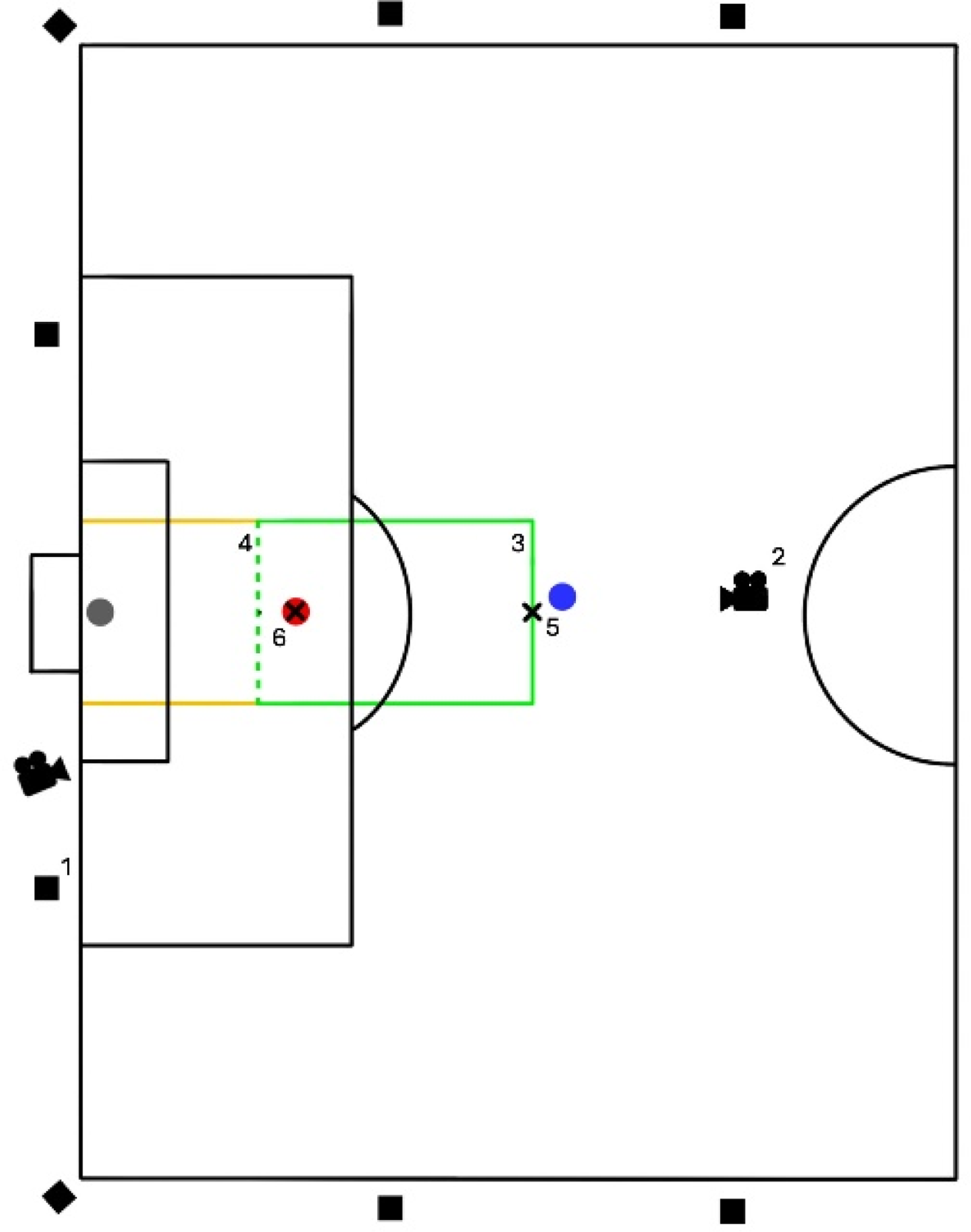
Visualization of the experimental setup. (1) anchor; (2) camera; (3) Playing Zone; (4) Target Zone; (5) starting position attacker (“x” next to the blue dot); (6) starting position defender (“x” inside the red dot); blue dot: attacker; red dot: defender; grey dot: goalkeeper.
Each trial began with the attacker starting centrally at the back of the field (26 meters from goal), while the defender was positioned slightly offset near the penalty spot. During each trial, players could move freely within the field boundaries but were not allowed to exit the zone laterally. Upon entering the Target Zone, the attacker was permitted only one final ball contact. The goalkeeper was allowed to intervene only within this final zone. A trial was deemed complete when the attacker took her final shot, the ball went out of bounds, the defender gained controlled possession, or a 15-s time limit was exceeded. Before testing, all players completed a standardized soccer-specific warm-up. A total of 120 trials were conducted, divided equally between two groups of seven players. Each group completed 60 trials. Goalkeepers remained in goal throughout all trials, while the six field players were paired using a systematic round-robin rotation, creating three matchups per round. Within each rotation, the starting order of the three pairings was randomized to minimize order effects; however, the mirrored return matches followed the same pairing sequence for logistical consistency and to avoid overlapping player assignments. This procedure ensured that each player faced every other player exactly four times: twice as attacker and twice as defender (Table 1). After every six trials, a short rest and re-pairing period (1 min) was introduced. To reduce fatigue effects, a five-minute hydration break followed after every 30 trials.
Overview of the procedure.

Data collection & processing
The Kinexon© tracking system was used for data collection. Local positioning systems, including Kinexon©, have been the subject of validation in multiple studies. 22 The exact positions were tracked with transponders worn by each player. A standard size soccer ball with a built-in transponder was used to record the movement of the ball. Additionally, two cameras placed on tripos captured the trials for further analysis (Figure 1). The x- and y-coordinates from all players and the ball were collected at 25 Hz. The raw position data was later exported as csv-file.
Prior to further analysis of the collected data, all trials were classified into distinct categories based on their outcome. Similar to Duarte et al., the trials were classified as either successful or unsuccessful attacks. 5 Based on further distinctions within these categories, all trials were additionally subdivided into one of four specific outcomes. The first outcome category was defined as a won trial resulting in a goal. Won trials that concluded with a shot on goal but without scoring were classified into the second outcome category. The third outcome category included trials that were not won by the attacker and in which the defender did not gain ball possession. These included balls played out of bounds, exceeded field boundaries, and trials in which the time limit was surpassed. The fourth outcome category comprised trials lost by the attacker, where the defender successfully gained controlled possession of the ball.
Two key moments relevant to the analysis were identified within each trial: (1) the moment at which the defender breaks out of their horizontal approach axis, defined as the Initiating Moment, and (2) the moment of either the attacker's last ball contact or the defender's initial clearance action, which was defined as the Last Contact. 7 For both key moments and the intervening interval, coordination patterns were examined in this study, defined as the spatiotemporal relationships between attacker and defender and quantified through the following key variables: spatial positioning, acceleration, and speed. Spatial positioning captures the absolute and relative spatial arrangement of a player within the environment and comprises three sub-variables: (i) Interpersonal distance, computed framewise as the Euclidean distance between attacker and defender. The values at the Initiating Moment and the Last Contact correspond to the instantaneous distances at these respective time points, while for the intervening interval, the minimum Euclidean distance observed between the time points was used to represent the closest spatial proximity during the duel; (ii) Relative angular configuration, captured by the attacker–defender angle (defined as the deviation between a horizontal reference line through the defender and the line connecting defender and attacker) and the attacker–goal angle (defined as the deviation between a horizontal reference line through the goal center and the line connecting goal center and attacker). Angles were expressed as absolute degrees to quantify deviation magnitude irrespective of side; and (iii) Positional density maps (heatmaps), generated by aggregating x–y samples across trials within each outcome category to visualize spatial occupancy of attackers and defenders. These heatmaps served as descriptive visualization only and were not included in the inferential correlation analyses. Speed and acceleration were derived from the positional data using frame-to-frame displacement and its temporal derivative, respectively.
Statistical analysis & visualization
Data Processing and Statistical analyses were conducted using Python (version 3.10.14). To account for the repeated-measures structure of the data, where each player contributed multiple trials, associations between coordination variables and trial outcomes were examined using repeated-measures correlation. 23 This method estimates the common within-individual association between the measured coordination variable and the trial outcome while controlling for inter-individual variability between the players, thereby providing a more accurate measure of the underlying relationship in longitudinal or repeated-measures designs. Based on conventional guidelines in individual differences research, correlations above 0.10 are considered small, above 0.20 as medium, and correlations of 0.30 or higher are regarded as large effects. 24 An alpha level of 0.05 was used to evaluate statistical significance, and for each coordination parameter, p-values and 95% confidence intervals were computed to assess the strength and reliability of the observed associations.
In addition to statistical analysis, visualizations of player movements were created to enhance interpretability. These included heatmaps, which display positional data density through color gradients and allow for intuitive comparisons of movement behavior across successful and unsuccessful trials.25,26
Results
Graphical representations of individual data points with correlations are presented in Figures 2–5. Full results of the repeated-measures correlation analyses, including r, 95% confidence intervals, degrees of freedom, and p-values, are provided in Table 2. Heatmaps illustrating player positional densities across outcomes are shown in Figure 6.
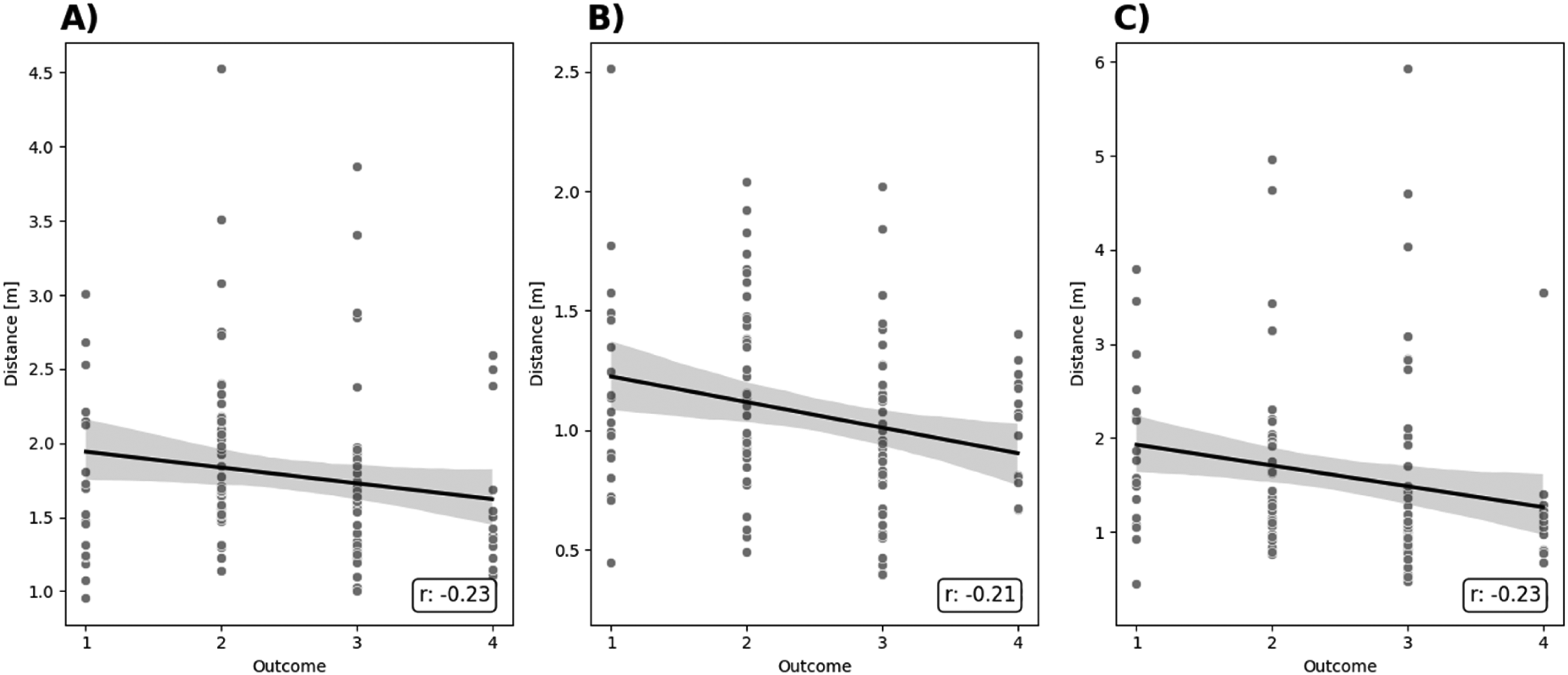
Correlations of distance. (a) Distance between attacker and defender at the Initiating Moment; (b) minimum distance between attacker and defender between the Initiating Moment and the Last Contact; (c) distance between attacker and defender at the Last Contact; r: repeated measures correlation coefficient of the respective parameter.
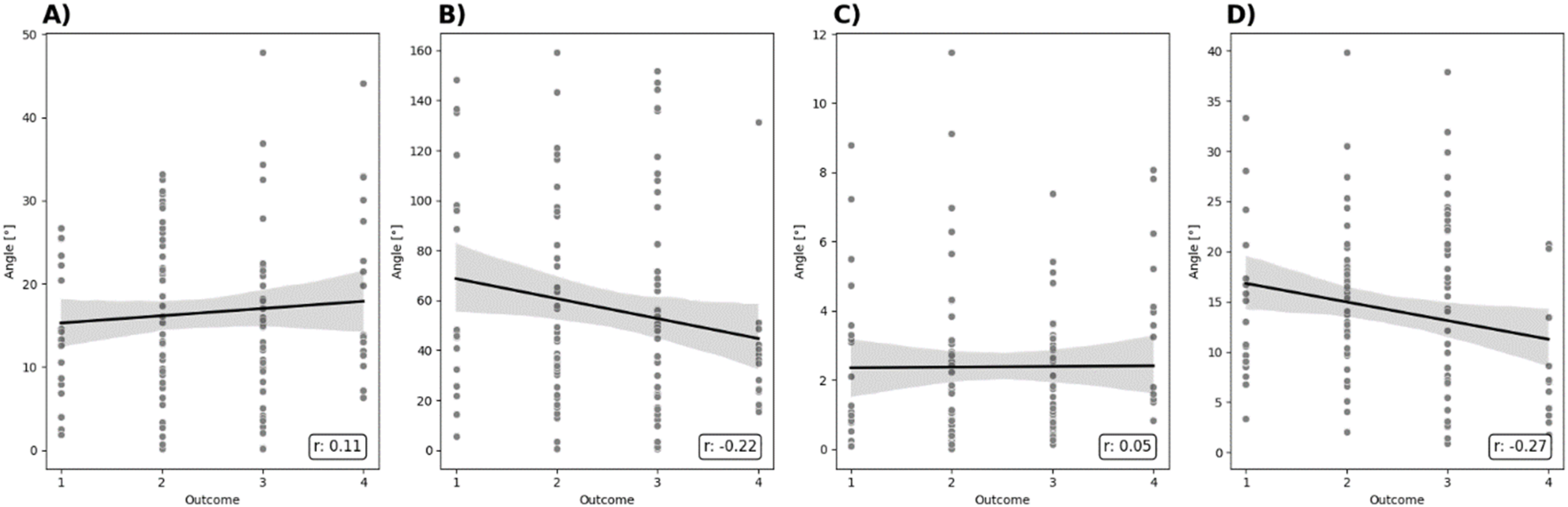
Correlations of angles. (a) Angle between attacker and defender (as the vertex) at the Initiating Moment; (b) angle between attacker and defender (as the vertex) at the Last Contact; (c) angle between attacker and center of the goal (as the vertex) at the Initiating Moment; (d) angle between attacker and center of the goal (as the vertex) at the Last Contact; r: repeated measures correlation coefficient of the respective parameter.
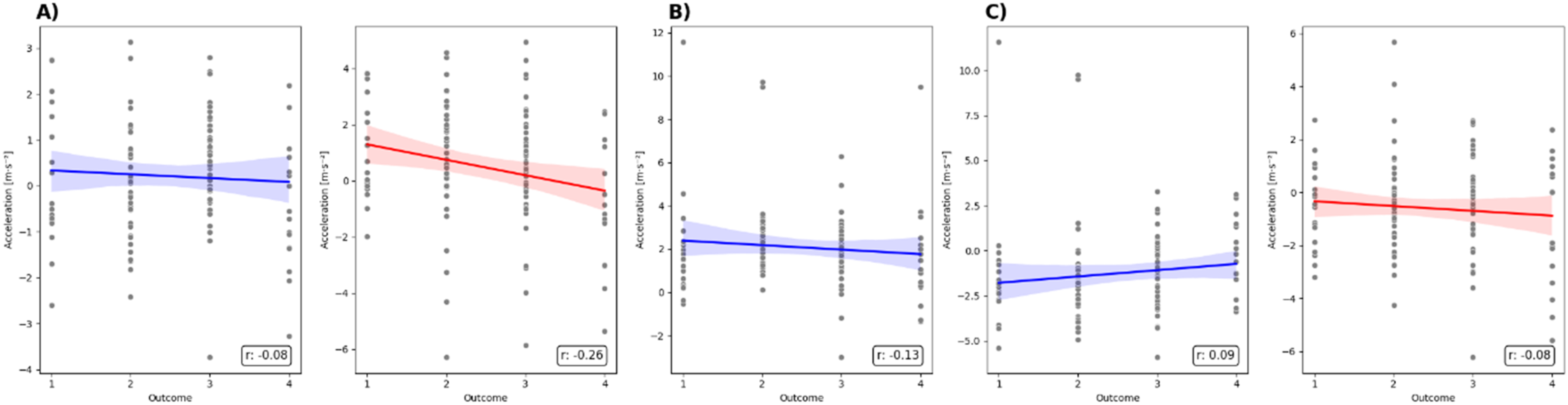
Correlations of acceleration. (a) Acceleration of attacker (blue) and defender (red) at the Initiating Moment; (b) maximum acceleration of the attacker between the Initiating Moment and the Last Contact; (c) Acceleration of attacker (blue) and defender (red) at the Last Contact; r: repeated measures correlation coefficient of the respective parameter.
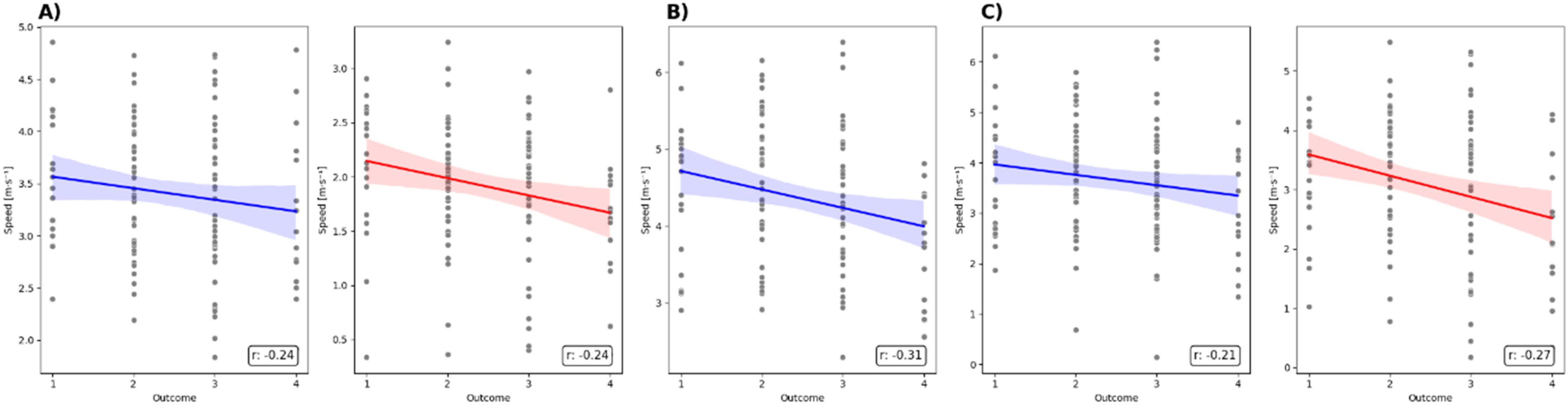
Correlations of speed. (a) Speed of attacker (blue) and defender (red) at the Initiating Moment; (b) maximum speed of the attacker between the Initiating Moment and the Last Contact; (c) speed of attacker (blue) and defender (red) at the Last Contact; r: repeated measures correlation coefficient of the respective parameter.

Spatial distribution of player positions across all outcomes. Blue areas indicate the positional density of attackers; red areas represent the positional density of defenders.
Inferential statistics.
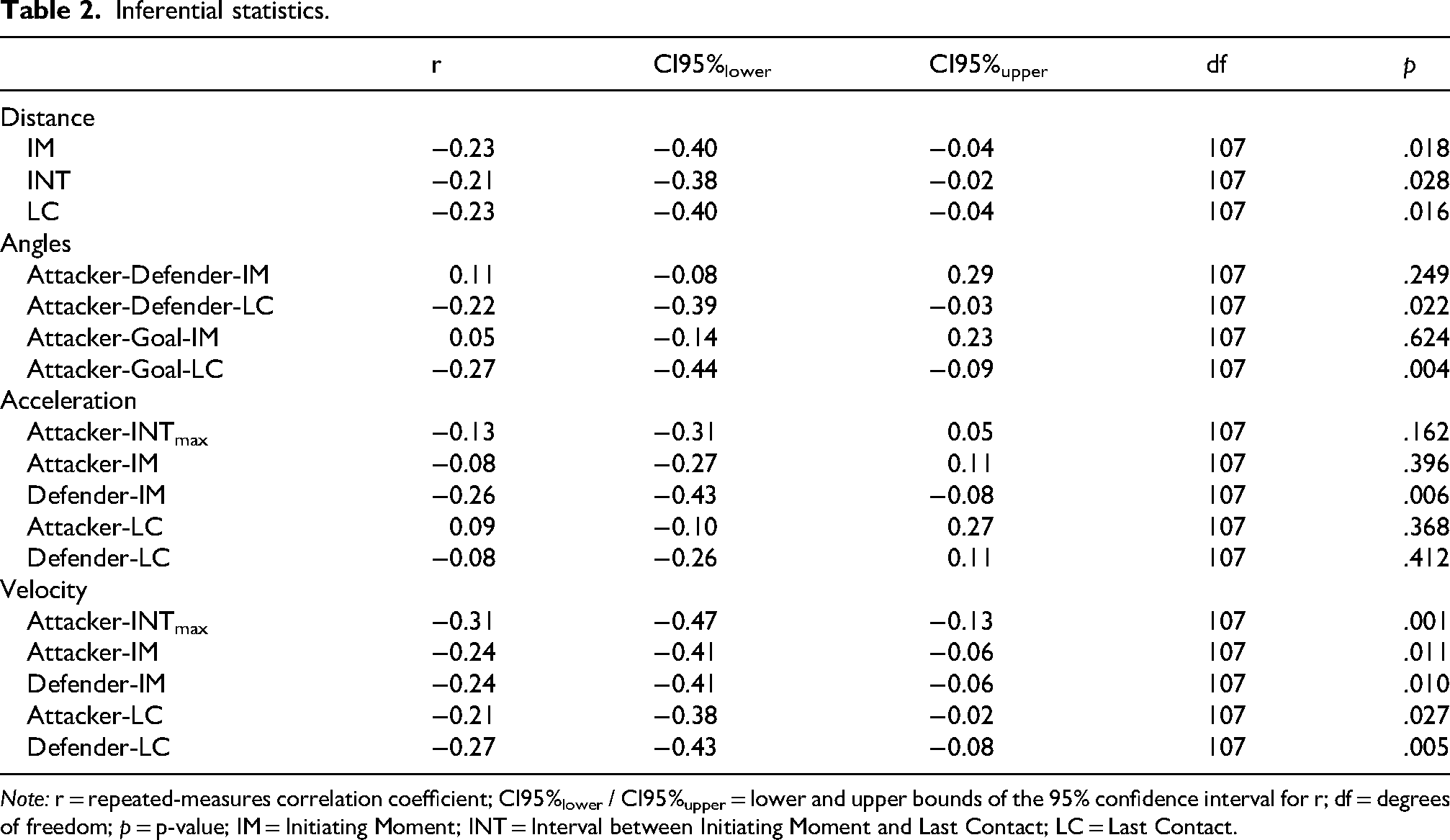
Note: r = repeated-measures correlation coefficient; CI95%lower / CI95%upper = lower and upper bounds of the 95% confidence interval for r; df = degrees of freedom; p = p-value; IM = Initiating Moment; INT = Interval between Initiating Moment and Last Contact; LC = Last Contact.
Spatial positioning
The results for the variable distance are presented in Figure 2, showing significant medium negative correlations with the trial outcome at the Initiating Moment, the Last Contact, and for the minimum distance between attacker and defender between the Initiating Moment and the Last Contact.
The heatmaps presented in Figure 6 illustrate distinct differences in the movement patterns of players across the four outcome categories. In Outcomes 1, 2, and 3, both attackers and defenders demonstrate a noticeably wider spatial distribution compared to Outcome 4. In the latter, movement is highly concentrated around the defender's initial position, with the attacker's activity largely confined to a limited zone and rarely extending beyond it. Outcome 3 displays the most dispersed movement pattern. The spatial distribution extends widely across both flanks, reaching significantly to the right and left of the goal. Additionally, both the attacker and the defender tend to approach the goal more closely in this scenario than in any other.
In contrast, Outcome 2 shows a comparatively narrower movement pattern. Here, the spatial distribution is more symmetrically balanced between both sides, with attackers advancing more steeply towards the goal. Notably, there is also a greater presence of open space, illustrated in blue, which remains uncovered by the defender's red heat signature. Outcome 1, meanwhile, reveals a more centralized movement pattern in comparison to Outcomes 2 and 3. Attackers still exhibit outward movement similar to that observed in Outcome 2, but their spatial reach is somewhat reduced. On the right side, attackers are more inclined to shoot and less frequently approach the goal closely. On the left side, attackers move closer to the goal than on the right side or in Outcome 2, though their movements remain less expansive than those observed in the latter scenario.
Results regarding the angles are presented in Figure 3. At the Last Contact, both the angle between attacker and defender and the angle between the attacker and the center of the goal showed significant medium negative correlations with the trial outcome. In contrast, no substantial correlations and significance were found at the Initiating Moment. Both the angle between attacker and defender and the angle between the attacker and the goal line lacked a meaningful relationship with the trial outcome.
Acceleration
Findings related to acceleration are visualized in Figure 4. At the Initiating Moment, the attacker's acceleration showed a trivial and non-significant correlation with the outcome. In contrast, the defender's acceleration at the same moment revealed a significant medium negative correlation. The maximum acceleration of the attacker between the Initiating Moment and the Last Contact exhibited a small but non-significant negative correlation. At the Last Contact, the attacker's and defender's acceleration showed trivial correlation with the outcome.
Speed
Speed data are presented in Figure 5. The attacker's and defender's speed at the Initiating Moment demonstrated a medium negative correlation with the outcome. At the Last Contact, medium negative correlations were observed for both the defender and the attacker. The attacker's maximum speed between the Initiating Moment and the Last Contact was largely correlated with the outcome. All speed parameters reached statistical significance.
Discussion
While key variables of 1-vs-1 situations in men's soccer have already been examined in several studies, no studies to date have investigated their impact on attacker-defender dyads in women's soccer.4–8 Addressing this gap, the present study aimed to analyze these variables within the context of women's soccer, with particularly attention given to two critical time points: the Initiating Moment and the Last Contact.
Spatial positioning
Interpersonal distance plays a pivotal role in determining trial success. The present findings align with previous research indicating that shorter distances at the Initiating Moment are associated with reduced attacker's success. The heatmaps further support this, showing that in the two outcomes where a shot was taken, there is a tendency toward more open blue space (normally overlaid and obscured by the red distribution of the defender's movement) indicating greater spatial separation between the players compared to less successful outcomes. Caetano et al. and Headrick et al. attribute this to spatial pressure: by closing the distance, defenders restrict the attacker's available options and can guide them into suboptimal shooting positions.6,16
This is further reflected in the angles observed in the current study: at the moment of the shot, the angle between the attacker and the center of the goal is narrower in Outcome 1 (14.0° ± 7.9°, mean ± standard deviation) than in Outcome 2 (15.8° ± 7.2°), indicating that the attacker is pushed further outward in the latter (see also Figure 6). In Outcome 3, player distribution appears even more dispersed across the field, suggesting effective mirroring by the defender. By maintaining close alignment within the dyadic interaction, the defender prevents the attacker from breaking through and either forces them out of bounds or causes a turnover due to the high spatial pressure.4,5 In contrast, Outcome 4 displays a more centralized spatial distribution, with less open blue space visible on the heatmap. This outcome is characterized by the defender regaining possession of the ball, a scenario that often coincides with shorter interpersonal distances; an observation that was also reflected in the correlation analysis. Moreover, it becomes apparent that defenders often recover the ball near their initial positions, suggesting that lower initial speed by the attacker at the Initiating Moment might have limited the ability to effectively disengage from the dyadic structure. Furthermore, spatial distribution patterns in Outcomes 1 and 2 indicate that attackers tend to be more successful when passing the defender on the left side, despite all participants being right-footed. This apparent contradiction can be explained by defensive behavior: defenders tend to close down the attackers’ dominant right side more aggressively, while they may strategically allow access to the weaker left side, where shot opportunities are generally less promising. Consequently, attackers tend to approach more frequently on the left, where the shot angle is narrower and the distance to the goal is shorter.
Acceleration
High acceleration by the attacker during the Initiating Moment does not automatically lead to more successful outcomes. Its effectiveness seems to depend to a considerable extent on the speed already reached at that point and the attacker's technical ability. If the player enters the situation with low speed, even a strong acceleration may come too late to significantly influence the outcome. In such cases, the player lacks the necessary momentum to exploit the acceleration effectively. However, when a high speed has already been achieved, additional acceleration may enhance the attacking pressure on the defender. What should not be overlooked, however, is that high acceleration can also be counterproductive, as it may impair control and reduce the attacker's ability to effectively manage the interaction during this critical phase; even though the overall risk of losing control due to excessive speed may be lower in women's soccer, where peak velocities and acceleration values tend to be lower than in the men's game.8,10,11 For the defender, high acceleration at the Initiating Moment is associated with more favorable outcomes for the attacker, possibly due to a delayed defensive response caused by the attacker's high speed. 7 At the Last Contact, acceleration appears to play a less decisive role. The capacity to decelerate effectively before the shot, enabled by earlier speed and spatial advantage, may outweigh the need for rapid acceleration in this final phase.
Speed
Speed seems to be a relevant factor even during the early approach phase.. At the point of deviation from the initial running axis, referred to as the Initiating Moment, higher velocities are associated with more successful outcomes. In particular, the closer the attacker's maximum speed occurs to this moment, the more favorable the result. The defender's speed also appears to be linked to successful outcomes, as maintaining balance in the dyadic interaction requires mirroring the attackers’ movement, including their speed. 4 This finding may be particularly relevant in the context of women's soccer, where maximum sprint speeds and acceleration rates tend to be lower compared to male athletes.10,11,18 These physiological differences could potentially affect the window of opportunity for breaking away from the defender, making positional timing and movement precision even more critical.
By contrast, at the Last Contact, speed assumes a subordinate role. As also shown by Leser et al., attacker speed during the shot attempt is noticeably higher in trials that result in a shot compared to less successful outcomes. 7 However, this difference can likely be traced back to earlier phases of the duel: the higher speed of the attacker in more successful outcomes reflects the necessity of passing the defender in order to create a viable shooting opportunity. This greater speed likely allows the attacker to gain more time and space by distancing themselves from the defender, enabling them to decelerate before the shot – an important factor for better shot control and accuracy. Therefore, this dynamic appears to be relevant even in women's soccer, despite the generally lower absolute running speeds.9,12,18 The observation that defenders exhibit relatively higher speeds compared to attackers at the Last Contact in Outcomes 1 and 2 supports this notion, indicating that defenders are attempting to close the gap, while the attacker, having already broken the dyadic system through superior speed and positioning, can prepare the shot more calmly. In less successful outcomes, where the attacker fails to sufficiently distance themselves from the defender, speed does not decrease prior to ball loss. Instead, the attacker must often shoot while still moving at high speed, which, aside from reducing control, is further complicated by the defender's proximity and ability to intervene, making successful execution more difficult.
Summary and practical implications
Summarizing the results, the study offers several practical implications for the design of training and tactical strategies in women's 1-vs-1 situations:
- Train entry speed: Emphasize not only sprint capacity but the ability to enter duels with timing and directional control, as high initial speed appeared to be more influential than acceleration alone. - Exploit spatial separation: Encourage off-ball movement and timing to create greater distance before the duel begins, which may increase the chance of successful outcomes. - Develop weaker foot usage: Attackers tended to be more successful when passing on the left, despite being right-footed. Training should address finishing with the non-dominant foot and using body deception. - Defensive control over aggression: Defenders might benefit from avoiding premature acceleration and focus on mirroring the attacker with balance and lateral responsiveness. - Prioritize spatial and positional awareness: Given that technical and tactical control appeared to be more influential than pure physical superiority, training should integrate game-realistic scenarios with angle and space optimization.
Limitations
Nevertheless, certain limitations must be acknowledged. The statistical power estimation was based on the number of trials rather than independent participants. Because multiple observations were nested within players, the effective sample size may be overestimated, which should be considered when interpreting the strength and generalizability of the observed associations. Moreover, the sample consisted of 14 semi-professional German players, most of whom were right-foot dominant. Therefore, the findings may not generalize to professional or international players or to samples with different distributions of footedness. In addition, while repeated-measures correlation appropriately accounts for within-player dependency, it does not fully capture the hierarchical structure of the data. Future studies with larger samples should therefore consider mixed-effects modeling to further validate and extend the present findings. 27 ,28 Furthermore, the duels were conducted in an isolated setting, which – despite the imposed time constraints and the inclusion of a goalkeeper – cannot fully replicate the complexity of actual match situations. Finally, outcome categorization may occasionally be influenced by isolated, nonsystematic errors. For instance, a mishit shot or a player slipping may result in ball loss, regardless of favorable coordination dynamics leading up to that point. Similarly, goalkeeper performance can significantly alter the distinction between Outcome 1 (goal) and Outcome 2 (saved shot), further complicating interpretation.
Conclusion
In summary, the key variables previously shown to influence 1-vs-1 duel success in men's soccer also play a role in women's soccer. However, the moderate correlations observed suggest that their impact may be less pronounced than in comparable studies involving male players. Moreover, subtle differences in acceleration behavior were identified among female athletes. These findings may be attributed to gender-specific factors such as distinct decision-making processes or movement strategies. Future research directly comparing male and female players using an identical study design could offer deeper insights into these nuances.
Footnotes
Acknowledgements
We used the Generative AI tool ChatGPT for language improvements in the form of minor grammar and style edits.

Ethical considerations
The study was approved by the local ethics committee and conducted in accordance with the Declaration of Helsinki.
Consent to participate
All participants provided written informed consent after being briefed on the procedures.
Consent for publication
All participants provided written informed consent after being briefed on publication.
Funding
The research was supported by the German Research Council (DFG, Deutsche Forschungsgemeinschaft, ME 2678/26-2) to the last author.
Declaration of conflicting interests
The authors declared no potential conflicts of interest with respect to the research, authorship, and/or publication of this article.
Data availability
The tracking and video data used in this study contain sensitive personal information and are subject to strict data protection regulations. Due to these legal and ethical obligations, the data cannot be made publicly available. However, further information regarding the data can be provided upon reasonable request to the authors, subject to compliance with relevant data protection policies.