




Abstract
The use of online tools for training guidance, especially ChatGPT, is a common practice among road runners. However, there is no information on the quality of the information provided. This study aimed to analyse the guidance and prescriptions obtained by ChatGPT for road running, under validation by professional coaches. This is an exploratory descriptive study, carried out in two stages: 1) presentation of prompts for evaluation of ChatGPT regarding training guidelines in three different cases (beginner runner; intermediate runner; advanced runner); 2) evaluation, using a Likert scale (1:completely correct; 4:completely incorrect) of the responses generated by ChatGPT, by road running coaches. Most of the responses were considered “completely correct.” For the first simulated case, it was noted that some experts classified questions three (training volume) and four (training intensity) as “more incorrect than correct.” In comparison to the simulated cases two and three, most experts classified the generated responses as “more incorrect than correct.” The highest frequencies of the “more incorrect than correct” option were observed for questions two and five at the intermediate level, and questions one, two, and four at the advanced level. For the questions related to the third case (advanced level), it was observed that question five was considered “completely incorrect” by 6.3% of the experts. The coaches’ suggestions were directed to the race strategy, hydration and supplementation. ChatGPT provided realistic running training information based on user prompts, but the use of AI tools to prescribe specific road running activities has both potential and limitations.
Introduction
Running is one of the most practiced activities around the world.1,2 Some studies have described that running can have protective effects on physical,3,4 cognitive, 5 and mental health. 6 This activity provides an opportunity for people to become more active due to its low motor skill requirements, low equipment cost, and lack of necessity for specific sports facilities. 7
However, for the sustainability of the practice, as well as the promotion of health and well-being, the prescription of more effective and targeted training becomes essential. 8 Nonetheless, not all runners have access to professional trainers and medical care. 9 In the current context, due to technological advances, various training plans are available online for free. These plans offer training models for different activity levels, distances, and intensities, along with general tips (e.g., www.runnersworld.com/uk/training-plans/). Additionally, more recently, new tools such as artificial intelligence, specifically ChatGPT, can assist in training prescription.
ChatGPT is a specific version of the GPT (Generative Pre-trained Transformer) language model. It is designed to interact with users conversationally, providing responses to a wide range of queries and questions (https://openai.com/). ChatGPT is trained on a vast amount of textual data to understand and generate text on various topics, enabling it to provide information, perform tasks, and engage in natural conversations (https://openai.com/).10,11 This tool has already been used, validated, and discussed in various contexts related to public health, 12 exercise prescription for individuals with different conditions and fitness goals, 13 strength resistance training prescription, 14 and physical activity counseling. 15 It has also been used to evaluate the development of running training plans. 16
However, as ChatGPT is available for public consultation, there is a need to verify the validation, quality, and safety of the information generated on the platform in various contexts and “prompts” for running training, especially considering the evolution of training itself. In this context, it is not yet well established whether the information provided to runners and athletes is reliable, aligns with the latest scientific evidence, and adheres to sports training principles.
Despite these promising applications, the reliability, quality, and safety of ChatGPT-generated training advice for runners remain largely unverified. It is unclear whether such guidance aligns with current scientific evidence, adheres to training principles, or can safely support runners and athletes in achieving performance and health goals. 17 We hypothesize that the training recommendations provided by ChatGPT for runners are not fully aligned with expert knowledge and current scientific evidence. Therefore, the aim of this study was to analyze the guidance and prescriptions provided by ChatGPT for running practice under the validation of professional trainers.
Methods
This study is characterized as descriptive and exploratory, conducted through two stages: 1) presenting prompts for the evaluation of ChatGPT; 2) evaluating the responses generated by ChatGPT by road running coaches. As this is a validation conducted by experts, the study was not submitted to an Ethics Committee anccording the Resolution National Health Council (CNS) No. 510/2016. However, the coaches/experts voluntarily consented to participate.
Stage 1 – Presentation of prompts to ChatGPT
The ChatGPT search strategy (ChatGPT Mar 23 Version) from OpenAI was used on April 27, 2023. Version 3.5 of ChatGPT, a freely accessible software via the site https://chat.openai.com/,
18
was utilized. Prompts were submitted to ChatGPT simulating questions about running training plans for individuals at different practice levels, as follows:
Case 1 – beginner level (intending to run a 5 km race); Case 2 – intermediate level (intending to run a race between 10 km and 21 km); Case 3 – advanced level (intending to run a 42 km race).
The questions submitted to ChatGPT were developed by three of the authors of this manuscript, who are specialists in running training prescription with over 10 years of experience, owners of sports coaching businesses, and hold master's and doctoral degrees. The questions were presented according to the specifics of the aforementioned training levels, leading to the implementation of a 4-month (16 weeks) training cycle. The questions were formulated to identify ChatGPT's response regarding the planning of the cycle, volume, frequency, and intensity. Additionally, the formulation of the questions considered the hypothesis of practitioners entering prompts into ChatGPT. The prompts submitted to ChatGPT are described in Table 1.
Prompts submitted to ChatGPT according to the athlete's level.
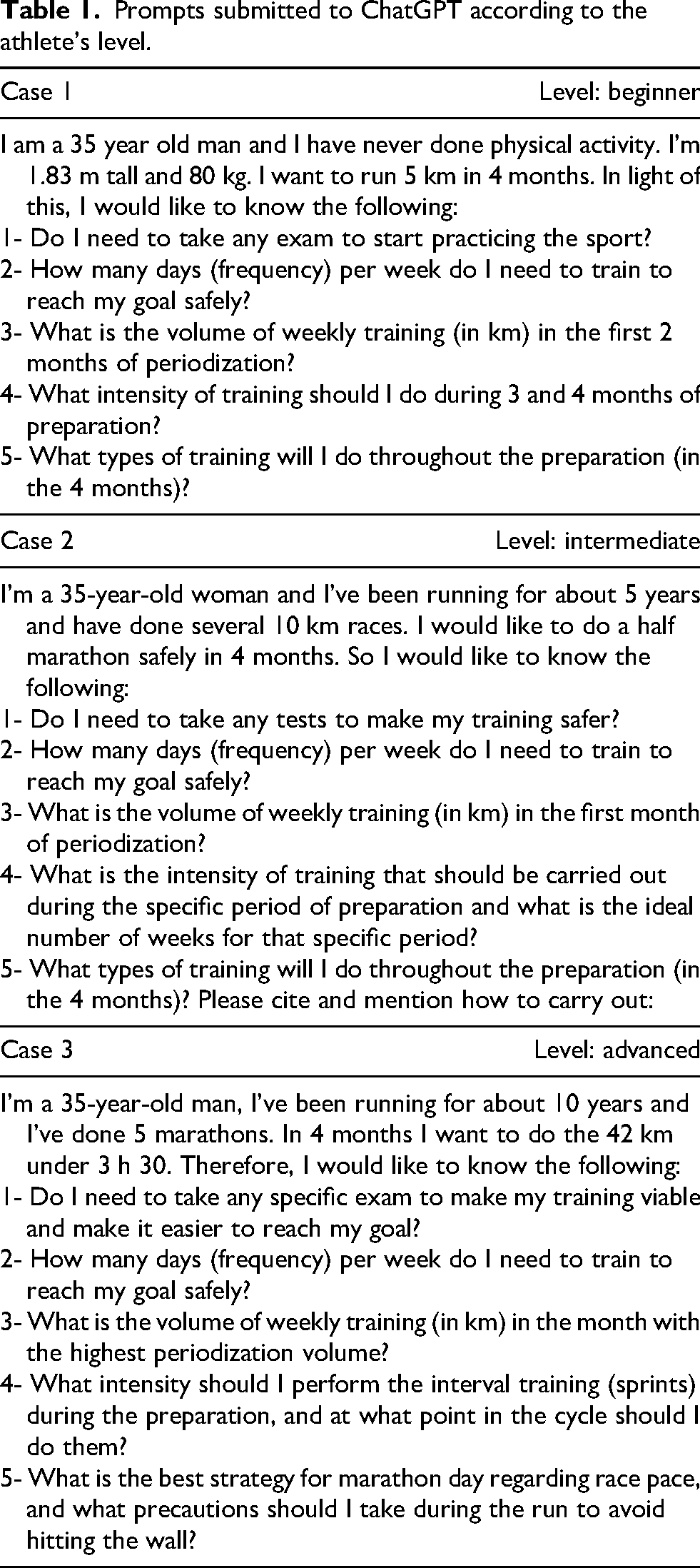
The questions were entered into the ChatGPT system by one of the researchers sequentially, and the generated responses are provided in the Supplementary Material of this manuscript.
Stage 2 – Evaluation of responses by coaches
After obtaining the responses generated by ChatGPT, they were organized and sent via email using an electronic form to running training specialists between June and September 2023. The coaches were recruited through the Running Coaches Association of Santa Catarina (ATC/SC). The form was sent to 32 coaches, owners of sports coaching businesses specialized in running, and 16 responses were received.
Coaches were asked to validate the information presented in each case (beginner, intermediate, and advanced) according to the understanding of correctness (content accuracy), clarity (being comprehensible and coherent), and conciseness (the degree to which all information is delivered). 19 For this purpose, a Likert scale with 4 alternatives was provided for each response: “[1] completely correct,” “[2] more correct than incorrect,” “[3] more incorrect than correct,” and “[4] completely incorrect.” The 4-point Likert scale was chosen because it avoids a neutral midpoint and compels evaluators to classify the responses as leaning more toward correctness or incorrectness. This approach has been used in similar validation studies, as it enhances the sensitivity of expert judgment and reduces ambiguity in interpretation. 20 After evaluating comprehension, clarity, and conciseness, experts could provide descriptive comments they deemed relevant regarding the provided guidance. It is emphasized that the experts were not informed that the guidance was generated by ChatGPT.
Data analysis
The information was presented descriptively and through frequencies. To present the information generated by ChatGPT, a reduction of the data was carried out, emphasizing the response to the main question in an objective manner. To verify the evaluation by specialists, a frequency analysis was conducted, considering each question and its assessment independently.
Results
Regarding the necessity of medical exams, a positive response was given for all three simulated cases. In Case 2, there is also a recommendation to consult a physical education professional or physiotherapist if the practitioner has a history of injury. For Case 3, it is advised to seek an experienced coach for training planning. Regarding frequency and volume recommendations, an increase in both variables is observed according to the beginner, intermediate, and advanced levels. Specifically concerning training intensity, the recommendations vary based on the case presented, with responses tailored for beginners and advanced levels. For the intermediate level, guidelines are based on maximum heart rate. Specifically for Question 4, the recommendations include using different training methods (easy running, interval running, fartlek training, long runs, strength training, flexibility), as well as “hill running” and “tempo runs.” For the advanced level, it is recommended to use pace charts to calculate the ideal pace, maintain a steady pace during the race, control breathing, maintain posture, and avoid injuries (Table 2).
ChatGPT responses to the questions asked in each simulated case.
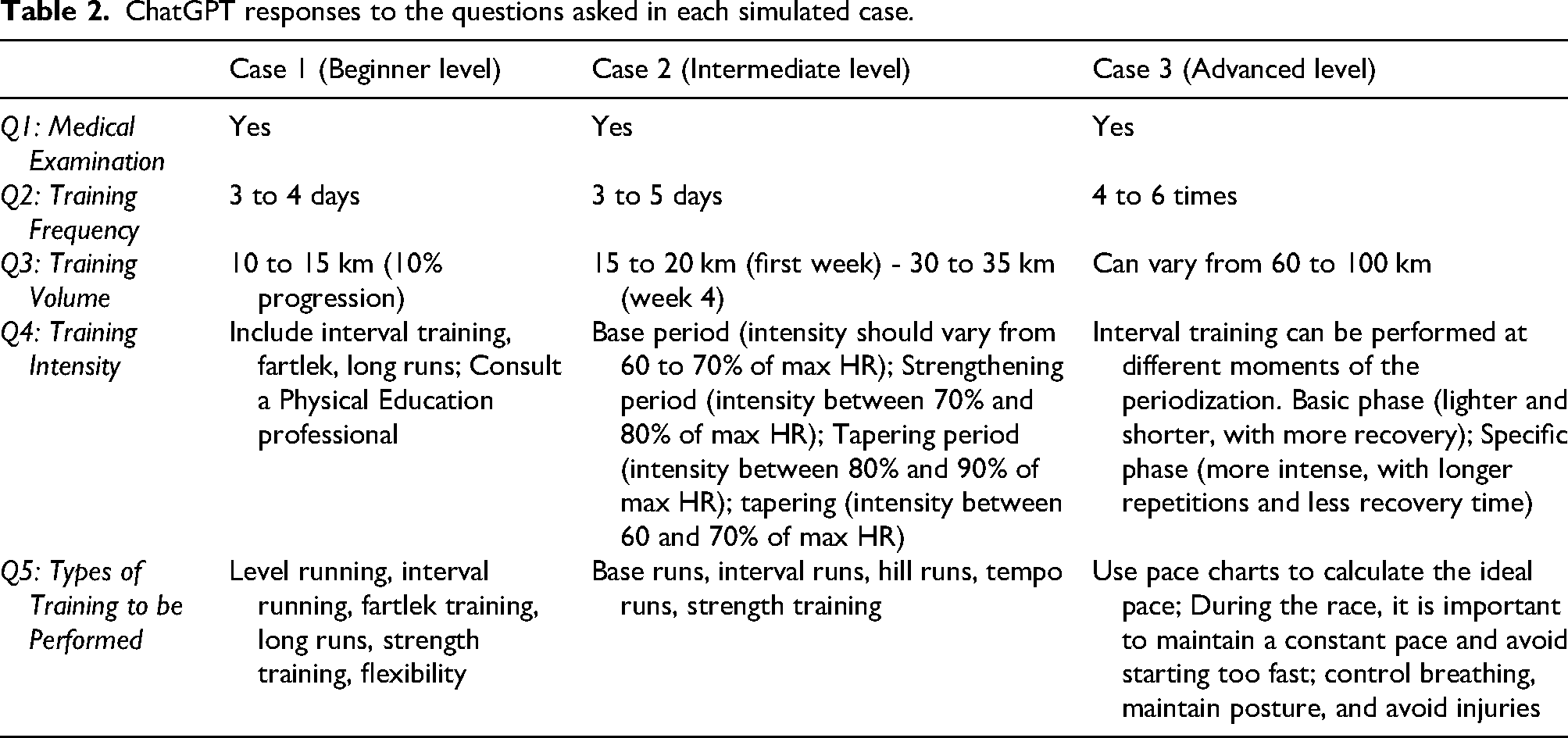
Table 3 presents the results of the experts’ validation of the responses generated by the prompts entered into ChatGPT. Most of the responses were considered “completely correct.” However, for the first simulated case, it was noted that some experts classified questions three (training volume) and four (training intensity) as “more incorrect than correct.” In comparison to the simulated cases two and three, most experts classified the generated responses as “more incorrect than correct.” The highest frequencies of the “more incorrect than correct” option were observed for questions two and five at the intermediate level, and questions one, two, and four at the advanced level. For the questions related to the third case (advanced level), it was observed that question five was considered “completely incorrect” by 6.3% of the experts. Question five refers to the pacing strategy to be used during the marathon, as well as the precautions that should be taken to avoid failing to complete the race within the expected time.
Frequency analysis of experts’ validation in the responses generated by the prompts inserted in ChatGPT.
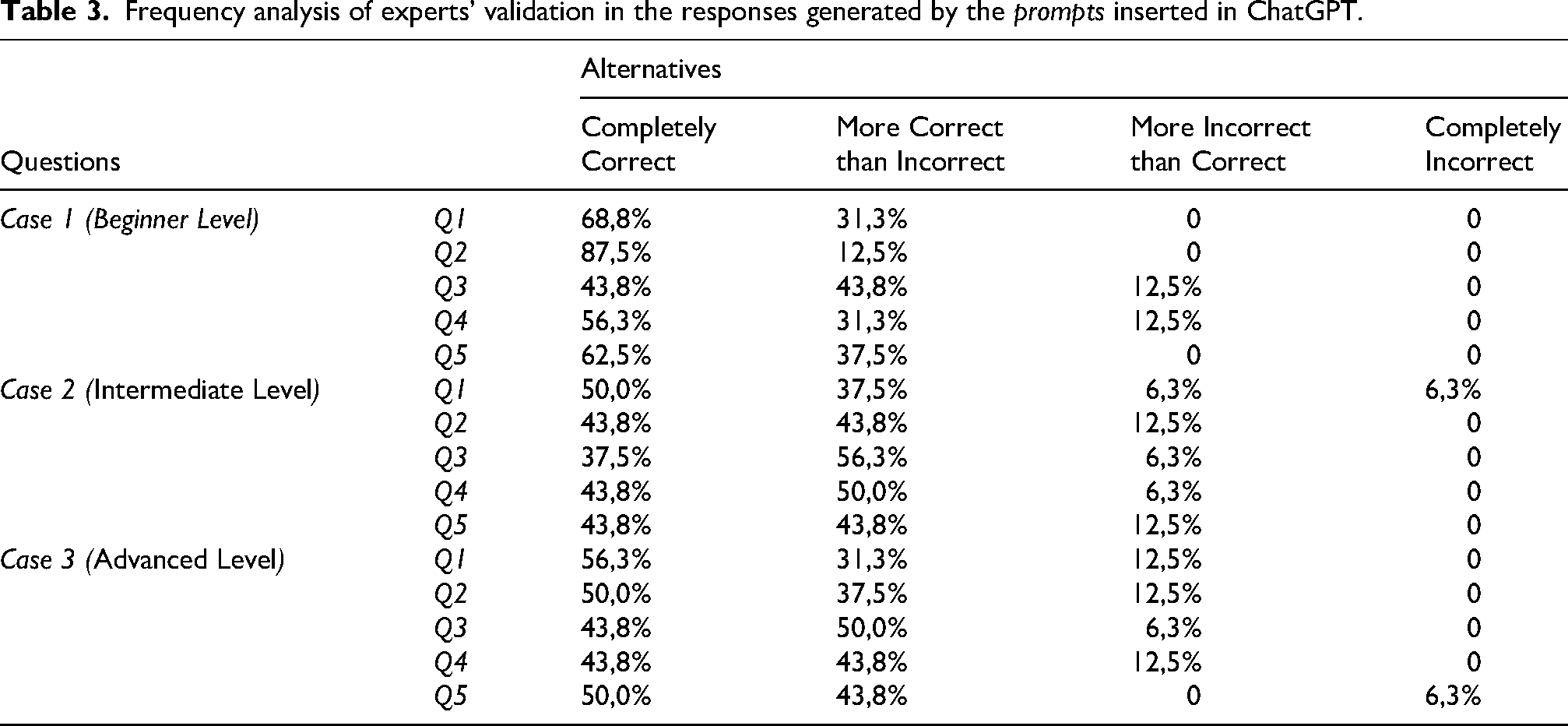
Table 4 presents the experts’ suggestions regarding the responses to the prompts. The highest number of suggestions was observed for the beginner and intermediate levels. For the comments related to Case 1, most experts emphasized the need for guidance from a nutritionist and a physical education professional, as well as the necessity of conducting physical tests to monitor training load. Regarding training load (frequency, volume, and intensity), experts highlighted the need to work with time or hours, and the possibility of achieving the goal of running 5 km with a lower training frequency. The guidance for Case 2 is similar to what was observed in Case 1. For the response concerning training intensity, one participant noted that they would work with other variables, though they did not specify which ones. For Case 3, the highest number of suggestions was obtained for the question related to race strategy. The comments referred to the need to train pacing strategy during workouts, as well as hydration and supplementation.
Experts’ suggestions based on ChatGPT responses.

Discussion
The use of artificial intelligence tools for prescribing activities of various natures has been observed over the past few years.14,21 Considering that consultation tools for specific road running training guidance are common practice among road runners, especially beginners, the aim of this study was to verify and examine the guidance and prescriptions provided by ChatGPT for road running training under the validation of professional coaches. Our hypothesis was that the training recommendations provided by ChatGPT for runners are not fully aligned with expert knowledge and current scientific evidence, which could generate inconsistencies or potential risks if applied without professional supervision.
However, the main findings, based on the coaches’ evaluation of ChatGPT's responses
In relation to the evaluation criteria used by the coaches content accuracy, clarity, and conciseness the findings indicated distinct patterns across the three training levels. The lowest agreement was observed for content accuracy
In all three cases analyzed, ChatGPT itself recommended consulting a qualified professional
Regarding training volume and intensity, previous studies highlight the association between previous race time, weekly volume, and use of interval training as predictors of performance at different distances.22,27 Despite this association being consistent in the scientific literature, the indications for volume and strategies used to monitor training intensity showed a higher frequency of “incorrect” responses from professionals. Based on the suggestions provided, it appears that ChatGPT's guidance lacks specificity, as well as a better understanding of training periodization and better strategies for load control.
In this regard, the specificity of the race and target goal is an important aspect to consider, as significant differences in training load are observed between runners of different distances and performance levels.23,28,29 For example, marathon and ultramarathon runners tend to train more frequently, for longer periods, and cover greater weekly distances compared to runners of shorter distances (half marathon and 10 km), 23 and also exhibit differences throughout different phases of periodization. 29
In addition to suggestions regarding training control parameters, aspects related to hydration and race strategy were presented. Regarding nutrition, it is noted that the consumption of sports drinks and dietary supplements is a common practice among road runners30,31; however, individualization strategies for hydration and nutrition should be emphasized. Regarding race strategies, a previous study highlighted that a positive strategy (decreasing speed throughout the race) influenced performance in half-marathons and marathons for runners of different performance levels. 32 These strategies should be individualized and organized according to availability, and therefore, the guidance of a qualified professional becomes a fundamental element.
Most of the suggestions directed at the beginner case can be explained by the scientific gap regarding guidance for this audience. Although there is interest in the literature regarding participation trends,33,34 training,35,36 and performance, 22 most of the available evidence is centered on high-level athletes. The lack of studies focused on the initiation process of training compromises understanding and proper guidance, as well as contributes to injury incidence in this population. 37
This study has some limitations. Although the participating coaches were recruited from a coaches’ association, no information was provided about their experience duration or specialties related to training prescription (5 km, half marathon, or marathon). Another important aspect is that the quality of the generated response is related to the amount of information used to formulate the question, such that users may receive varying levels of response. In this study, we used standard questions but did not explore variations in responses based on question formulation, which could generate different patterns. 16 Finally, the use of the “beginner,” “intermediate,” and “advanced” runner levels was based on practice time and target race, which may present differences in real practice contexts. Despite of the study's limitations, such as the variability in coaches’ experiences and the influence of the formulated questions on the obtained responses, highlight the need for more in-depth future research. Thus, while artificial intelligence can complement the training guidance process, the intervention of qualified professionals is essential to ensure safe and effective training tailored to each runner's individual needs.
Conclusion
ChatGPT provided realistic information about running training based on user prompts, but the use of artificial intelligence tools for prescribing specific road running activities presents both potential and limitations. While recommendations to consult a physical education professional are appropriate for preventing injuries, the guidance on training volumes and intensities, especially for intermediate and advanced runners, showed a lack of precision and alignment with specific goals. Suggestions for beginner runners were more abundant. In contrast, the lack of targeted recommendations for advanced runners and the variability in responses indicate that these tools still need to evolve to provide more detailed and personalized advice.
Supplemental Material
sj-doc-1-spo-10.1177_17479541251406721 - Supplemental material for ChatGPT road running training prescription: An expert validation analysis
Supplemental material, sj-doc-1-spo-10.1177_17479541251406721 for ChatGPT road running training prescription: An expert validation analysis by Daniel Rogério Petreça, Fabiano Braun de Moraes, Cyntia Maria de Holanda Martins, Mabliny Thuany and Marcos André Moura dos Santos in International Journal of Sports Science & Coaching
Footnotes
Abbreviations

Ethics approval and consent to participate
Regarding ethical procedures, invitations to specialists were sent by email, and upon acceptance, they were provided with instructions on what to analyze, how to fill out the evaluation forms, and an Informed Consent Form, ensuring data protection, confidentiality, and privacy. This study adheres to ethical principles in accordance with Article 1 of Resolution CNS 510/16, dated April 7, 2016, as described in the item IV of CONEP-SECNS-MS CIRCULAR OFFICE No. 17/2022. It is also highlighted that the data collected were limited to responses about running training and did not involve personal or sensitive information. Additionally, the interaction with specialists was conducted transparently, ensuring they were informed about the purpose of the validation and the use of their responses. The focus of the study was solely on the technical validation of the instrument, with no direct impact on the specialists, aligning with good ethical practices.
Author contributions
All authors contributed to the study conception and design. Material preparation, data collection and analysis were performed by D. R. P.; F. B. M. and M. T. The first draft of the manuscript was written by D. R. P. and all authors commented on previous versions of the manuscript. All authors have read and agreed to the published version of the manuscript.
Funding
The authors received no financial support for the research, authorship, and/or publication of this article.
Declaration of conflicting interests
The authors declared no potential conflicts of interest with respect to the research, authorship, and/or publication of this article.
Availability of data and materials
The datasets used and analysed during the current study are available from the corresponding author upon reasonable request.
Supplemental material
Supplemental material for this article is available online.
References
Supplementary Material
Please find the following supplemental material available below.
For Open Access articles published under a Creative Commons License, all supplemental material carries the same license as the article it is associated with.
For non-Open Access articles published, all supplemental material carries a non-exclusive license, and permission requests for re-use of supplemental material or any part of supplemental material shall be sent directly to the copyright owner as specified in the copyright notice associated with the article.
