



Abstract
Guided by Fredrickson's broaden-and-build theory of positive emotions, this study examined how nostalgic feelings toward past exercise experiences relate to two psychological resources—intrinsic motivation and cognitive flexibility, and whether these resources mediate the relationship between exercise nostalgia and exercise intention. A total of 324 responses were collected from individuals who reported nostalgic feelings about past exercise. Participants completed the validated self-report scales measuring exercise nostalgia, intrinsic motivation, cognitive flexibility, and exercise intention. A confirmatory factor analysis verified the internal consistency and construct validity of the measurement model. Mediation tests were conducted using Hayes's PROCESS macro (Model 6), with bias-corrected bootstrap confidence intervals to estimate indirect effects. Results showed that exercise nostalgia was positively associated with intrinsic motivation and cognitive flexibility, which were significantly associated with exercise intention. These findings underscore the potential of nostalgia-based strategies, particularly when combined with autonomy-supportive and varied training environments, to promote long-term exercise intention.
Introduction
In modern society, there is growing interest in enhancing personal well-being and quality of life, particularly through activities that satisfy individual needs. 1 Among these activities, sports and exercise are widely recognized as vital for improving physical and psychological health, thereby significantly contributing to overall life satisfaction. 2 Regular participation in physical activity has been positively linked to life satisfaction and subjective well-being, indicating that physically active forms of leisure play a pivotal role in fostering individual well-being.3,4
From a long-term perspective, it is essential to understand the psychological factors influencing sustained exercise participation and dropout risk. Therefore, identifying key factors that strengthen commitment to continued participation is critical. 5 Nostalgia has been suggested as one emotional factor that may support sustained exercise engagement. 6 It is defined as a sentimental longing for past experiences and is associated with positive memories that can energize future-oriented engagement, including exercise participation. 6 Conceptually, nostalgia is understood as a discrete, self-relevant, and socially embedded emotion grounded in autobiographical memory, rather than as diffuse positive affect.7,8 Notably, foundational accounts emphasize that nostalgia often contains both consoling and painful elements, underscoring its inherently ambivalent character. 9 Although nostalgia is characteristically bittersweet, converging evidence indicates that it is experienced as predominantly positive and is associated with approach-oriented motivation and psychological resources.7,8,10 This conceptualization distinguishes nostalgia from low-dimensional affective states or generalized moods, and instead frames it as a discrete emotional episode anchored in personally meaningful memories. Such framing provides a clearer affective-motivational rationale for why nostalgic reflection can support processes relevant to sustained exercise engagement.6–8,11,12
Building on this perspective, extant literature indicates that nostalgia serves not only as a sentimental recollection of past experiences but also as a motivationally consequential emotion that can orient individuals toward future goal achievement. 13 When individuals engage in nostalgic reflection, they often draw strength from positive memories, thereby fostering motivation to persist in the face of challenges.13,14 Similarly, Stephan et al. 15 demonstrated that nostalgia is positively associated with approach-oriented motivation, reducing avoidance tendencies and encouraging proactive engagement in tasks. Although some research has equated nostalgia with motivation, 16 empirical studies suggest that nostalgia functions as an affective catalyst within broader motivational processes rather than being synonymous with motivation. 17
Despite accumulating evidence that nostalgia can act as a motivational catalyst,15,18 its impact on intrinsic motivation, particularly in the context of exercise, remains underexplored. Intrinsic motivation refers to engagement in an activity for the inherent pleasure or satisfaction it provides, rather than for external incentives.19,20 In exercise settings, intrinsic motivation is a powerful predictor of long-term adherence and is significantly more influential than external rewards or pressures in promoting sustained participation and preventing dropouts.21,22 However, most existing research on nostalgia's motivational effects has focused on broader constructs or extrinsic motivators.23,24
Besides intrinsic motivation, cognitive flexibility has been identified as a key psychological resource for promoting exercise behaviors. Cognitive flexibility refers to the capacity to adapt one's thoughts and actions in response to changing circumstances or task demands 25 and is associated with improved problem-solving, resilience, and self-regulation across various domains. 26 In exercise contexts, individuals with higher cognitive flexibility may be better equipped to overcome barriers such as time constraints, fatigue, or environmental challenges, thereby making more adaptive choices and sustaining workout routines. 27 It can also facilitate the integration of new and diverse exercise strategies, such as varying workout intensities or exploring alternative physical activities, thus enhancing long-term adherence and overall enjoyment. 28 However, empirical studies directly examining the relationship between these constructs remain limited.
Despite growing acknowledgment that nostalgia, intrinsic motivation, and cognitive flexibility hold promise for understanding exercise behavior,13,27 direct empirical investigations examining their structural relationships remain scarce. Studies have primarily centered on nostalgia's overall influence or the broader dimensions of motivation, leaving notable gaps regarding the specific roles of intrinsic motivation and cognitive flexibility in sustaining long-term exercise participation. Moreover, few studies have integrated these constructs within a unified theoretical framework, limiting the development of comprehensive interventions for enhancing adherence to physical activity.
Drawing on the broaden-and-build theory,29,30 which posits that positive emotions broaden thought–action repertoires and build enduring psychological resources, we investigated whether exercise nostalgia is associated with exercise intention via intrinsic motivation and cognitive flexibility. Theoretically, this approach advances the understanding of nostalgia as a bittersweet yet predominantly positive, meaning-laden emotion that may support deeper, more self-determined exercise motivation and highlights cognitive flexibility's importance as a facilitator of adaptive behavior change. Practically, it offers insights into how exercise nostalgia may be linked to intrinsic motivation and cognitive flexibility, informing interventions that encourage long-term commitment to physical activity and overall well-being. By examining these underlying mechanisms, this study makes conceptual and practical contributions, by identifying pathways through which exercise nostalgia and related psychological resources may be associated with sustained exercise engagement.
Literature review
Broaden-and-build theory of positive emotions
Fredrickson's broaden-and-build theory29,30 argues that positive emotions offer more than momentary pleasant experiences; they expand one's thought–action repertoires and build enduring psychological and social resources over time.31,32 When individuals experience positive emotions—such as joy, contentment, or gratitude—they become more open to exploring new ideas, forming social connections, and undertaking behaviors they might otherwise avoid. 33 This theory distinguishes between two complementary processes, broadening and building, each playing a pivotal role in how positive emotions facilitate growth over time. 31 The broadening effect centers on the immediate, short-term expansion of one's thought–action repertoire. Those experiencing positive emotions (e.g., joy, hope, and contentment) tend to adopt a wider attentional scope, become more receptive to new ideas, and are more inclined to explore unfamiliar social or environmental contexts.30,33
Following this immediate expansion, the build process unfolds through repeated exposure to positive emotions. Over time, small positive experiences—such as enjoying a supportive group exercise setting or celebrating incremental fitness achievements—accumulate and strengthen enduring psychological and social resources.31,32 These resources include heightened resilience to setbacks, deeper social bonds and networks, and broader skills that extend beyond the original context. 34 Broaden-and-build cycles generate upward spirals of well-being, 32 as positive emotional states foster resource development, which promote further positive experiences and emotions.
Within this theoretical framework, nostalgia is conceptualized as a discrete, self-relevant emotion that can give rise to predominantly positive affective experiences, even though it is characteristically bittersweet.7,8 From a broaden-and-build perspective, the critical issue is whether such affective experiences evoke approach-oriented engagement and momentarily broadens attention and action repertoires, thereby allowing psychological resources to accumulate over time.29,30,32 Previous research indicates that nostalgia is typically experienced as predominantly positive despite its bittersweet tone and is reliably associated with approach motivation and perceived psychological resources.7,8,10 Accordingly, we position exercise-related nostalgia as an affective catalyst that can stimulate autonomous motivational expansion and adaptive cognition. Kersten and Cox 35 reported that exercise-related nostalgia enhances health motivation and physical activity. Van Dijke et al. 36 found that nostalgia elevates intrinsic motivation. Other studies have linked nostalgia to greater creativity and cognitive flexibility.37,38 Building on this evidence, this study conceptualized nostalgia as a trigger for an upward spiral. Nostalgia broadens thought–action repertoires, reflected in heightened intrinsic motivation and cognitive flexibility, and builds enduring resources that support sustained exercise participation (Figure 1). By empirically testing these pathways, we clarified how nostalgia contributes to long-term exercise adherence.

A hypothesized model.
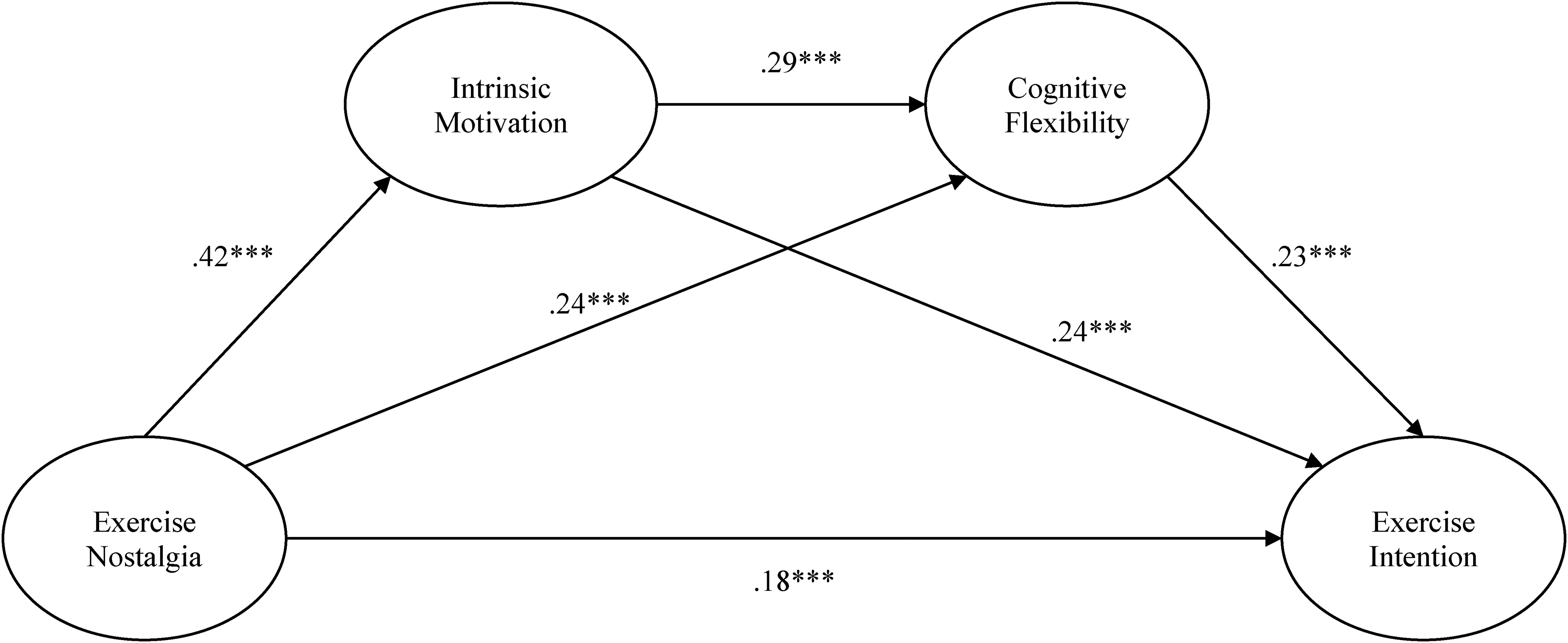
Results of testing the structural model. Note: Values on paths are standardized coefficients; ***p < .001 (2-tailed).
Exercise nostalgia
Nostalgia was once regarded as homesickness, but contemporary psychology defines it as a bittersweet, predominantly positive longing for meaningful past experiences. 6 Research on nostalgia in the field of leisure and exercise has been actively conducted across various disciplines, and recent international studies have begun exploring nostalgia specifically in the context of leisure.23,39 According to Cho, 40 nostalgia in this field can be defined as an emotional longing for positive past leisure experiences, which may be linked to an individual's behavioral intention to engage in future leisure activities.
Recent empirical studies indicate that exercise-related nostalgia functions not as passive recollection but as an affective catalyst for self-directed motivation and adaptive cognition. It strengthens intrinsic motivation, leading individuals to invest greater effort in inherently rewarding tasks. 36 Furthermore, it enhances goal pursuit and motivates behaviorally oriented changes in health practices. 35 Supporting this notion, Kersten et al. 41 demonstrated that recalling nostalgic memories of exercise significantly increased participants’ intentions to engage in physical activity the following week. Nostalgic reflection may help translate valued past exercise experiences into present-day intrinsic motivation by reinstating autonomy-, competence-, and relatedness-supportive cues embedded in autobiographical exercise memories.20,42 These findings suggest that nostalgia can contribute to behavioral expansion by facilitating exercise engagement and related self-directed motivational processes. 6
Nostalgia is also related to cognitive flexibility, a higher-order intellectual resource that enables individuals to generate alternative perspectives and reframe challenges. Experimental evidence is consistent with this proposition; specifically, reflecting on nostalgic experiences can increase state openness to experience, a theoretically relevant indicator of flexible cognition that supports perspective shifting and divergent thinking. 43 From a cognitive-broadening perspective, nostalgia has been theorized to broaden cognition by increasing openness to experience, thereby aligning with flexible, multi-perspective processing. 44 Related accounts also link nostalgia to divergent thinking, which reflects the capacity to generate alternative perspectives. 38
Drawing on the broaden-and-build theory,29,30 positive emotions broaden momentary thought–action repertoires and, over time, build enduring psychological resources. In the present framework, we conceptualize intrinsic motivation as the motivational manifestation of this broadening process, insofar as nostalgia-based reflection can make exercise engagement feel more self-endorsed and open individuals to a wider range of exercise-related actions and coping options.20,42 This broadened motivational orientation is then expected to support the development of cognitive flexibility as a downstream cognitive resource that facilitates adaptive self-regulation in exercise contexts.25–27 At the same time, because nostalgia is an autobiographical, self-relevant emotion that can promote openness and flexible engagement, it may also show a complementary direct association with cognitive flexibility, beyond its indirect influence via intrinsic motivation.7,8,44
Empirical evidence supports this proposition. For example, Stephan et al.
15
found that nostalgia amplifies approach motivation, promoting more adaptive responses to self-threatening tasks. Similarly, a four-week nostalgia intervention enhanced well-being and self-efficacy; mediation tests revealed that nostalgic reflection fostered a sense of resourcefulness, enabling participants to cope more flexibly with daily challenges.
45
Creativity-focused research shows that nostalgia enhances divergent thinking by increasing openness to experience,
44
a core marker of cognitive flexibility. Building on this, we argued that exercise-related nostalgia would similarly enhance cognitive flexibility by providing the positive affect and motivational openness needed to reinterpret barriers (e.g., time constraints and training plateaus) and generate innovative workout strategies. Accordingly, we proposed the following hypotheses:
Exercise nostalgia is positively associated with intrinsic motivation. Exercise nostalgia is positively associated with cognitive flexibility.
Intrinsic motivation and cognitive flexibility
Motivation is commonly regarded as the driving force that provides the energy and direction necessary to initiate, maintain, and regulate behavior. 46 Deci and Ryan 47 described motivation as a continuum ranging from amotivation (no intention to act) to progressively more autonomous forms of extrinsic regulation—external, introjected, identified, and integrated. Building on this framework, Ryan and Deci 20 emphasized that the continuum culminates in intrinsic motivation, a fully self-determined state in which behavior is driven by inherent interests and enjoyment. While extrinsically motivated action is instrumentally driven, intrinsically motivated action is undertaken for the inherent enjoyment and interest it affords; it flourishes when the basic needs for autonomy, competence, and relatedness are satisfied, as articulated in self-determination theory. 42
Previous studies in exercise settings have shown that intrinsically motivated participants demonstrate greater persistence, more positive affect, and superior long-term adherence than those driven by controlled regulation. 22 Such exercisers routinely experiment with new movements, vary routines, and explore different activities, 47 steadily broadening their thought–action repertoire. This expansion supports cognitive flexibility, defined as the capacity to shift perspectives and adapt strategies when situational demands change.25,48 Conceptually, cognitive flexibility comprises two complementary facets: generating multiple alternative perspectives and behavioral options (alternatives) and appraising challenges as manageable while selecting adaptive responses (control). 49 In this framework, the control facet reflects a cognitive resource for adaptive appraisal and decision-making, rather than a motivational regulation tendency. Such flexibility can be reflected in exercise contexts—for example, switching from treadmill running to interval cycling when time is limited, or applying pacing strategies learned in endurance sessions to high-intensity circuit training.25,48
Meta-analytic evidence corroborates the motivational pathway: intrinsically driven states consistently increased exploratory behavior and creative performance across laboratory and field settings.
50
A meta-analysis of 145 studies confirmed that autonomy-supportive (intrinsic) motivation reliably enhances creativity and other indicators of flexible cognition across laboratory and field contexts.
51
Experimental studies also support this pathway: individuals acting for intrinsic reasons generated more original solutions in divergent thinking tasks and displayed superior set-shifting on the Wisconsin Card-Sorting Test.
52
In the exercise domain, van Tilburg and Sedikides
44
demonstrated that nostalgia-induced increases in intrinsic motivation enhanced divergent thinking by increasing openness to experience, a trait closely aligned with flexible cognition. These studies suggest that intrinsic motivation broadens individuals’ thought–action repertoires and facilitates cognitive flexibility, enabling them to reinterpret barriers (e.g., time constraints or fitness plateaus) and experiment with new exercise approaches that keep activities enjoyable and sustainable. Accordingly, the following hypothesis was proposed:
Intrinsic motivation is positively associated with cognitive flexibility.
Exercise intention
The theory of planned behavior, a general model of human action, is widely applied in physical activity research, where exercise intention is the closest determinant of actual exercise behavior. 53 Research shows that nostalgic reflections can bolster this intention. Adults recalling meaningful past workouts reported stronger intentions to meet weekly activity guidelines than those recalling neutral events. 41 This was consistent with the evidence that nostalgia provides emotional comfort and social connectedness and reduces psychological barriers to future action. 7
Beyond this affective boost, autonomous motivation supplies motivational fuel. A meta-analysis of 56 physical activity samples revealed a medium-to-large positive link between intrinsic motivation and exercise intentions, which predicted greater adherence. 54 Similarly, a systematic review confirmed that feelings of autonomy and competence during an activity reliably translate into firmer future exercise plans. 22 Longitudinal evidence showed that intrinsic rewards predict intention-driven repetition during initiation and support habit maintenance as experience accumulates. 55
Intrinsic enjoyment also encourages curiosity-driven exploration, as individuals try new activities, vary routines, and seek novel challenges.
47
This exploratory stance cultivates cognitive flexibility, the executive capacity to shift mental sets, transfer rules across tasks, and adapt strategies when circumstances change.25,48 People with stronger set-shifting and updating skills translate self-determined motives into resilient exercise plans: they follow through on step-count goals and maintain intentions even when exercise benefits seem distant.
56
A prospective cohort study demonstrated that stronger executive function at baseline predicts greater alignment between intended and actual physical activity six months later.
57
Among university exercisers, flexible self-regulation skills amplified the relationship between intrinsic motives and adherence intentions.
58
These studies suggest that each construct makes a distinct, positive contribution to forming exercise intentions: nostalgia supplies affective and social reinforcement, intrinsic motivation provides self-endorsed energy, and cognitive flexibility equips individuals with adaptive planning skills. Accordingly, the following hypotheses were proposed:
Exercise nostalgia is positively associated with exercise intention. Intrinsic motivation is positively associated with exercise intention. Cognitive flexibility is positively associated with exercise intention.
Mediation effects
Exercise nostalgia carries a potent blend of positive affect and self-relevance. 7 By vividly reinstating past moments of mastery, enjoyment, and social bonding, it satisfies the core psychological needs for autonomy, competence, and relatedness. 59 In autonomy-supportive sport settings, this satisfaction translates into measurable gains in autonomous motivation.60,61 Field experiments showed similar effects when nostalgia was the catalyst; adults recalling a favorite workout felt more self-determined and, one week later, reported stronger plans to meet World Health Organization activity guidelines than neutral controls. 41 Nostalgia-induced increases in intrinsic motivation also relate to greater persistence among adolescent athletes 62 and higher weekly step goals in older adults with strong self-control resources. 63
Intrinsic motivation does more than energize behavior; it encourages playful exploration by prompting individuals to try new activities, modify routines, and seek novel challenges, thereby laying the foundation for cognitive flexibility.47,64 Laboratory research showed that intrinsically motivated participants outperform extrinsically motivated peers on set-shifting and idea-generation tasks after brief manipulations. 65 Longitudinal data indicate that flexible thinkers translate self-determined motives into resilient exercise plans: they maintain step-count targets when benefits feel distant 56 and show stronger intention–behavior correspondence in prospective studies. 66 Among university exercisers, self-regulatory flexibility strengthened the link between autonomous motives and adherence intentions, 58 while a Bayesian mediation model with older adults demonstrated that executive adaptability mediates the effect of intrinsic motivation on physical activity intentions. 67
Additionally, while studies have documented the direct effects of exercise nostalgia, intrinsic motivation, and cognitive flexibility on exercise intention,41,54 the broaden-and-build theory29,30 suggests that nostalgia may also indirectly strengthen intention through these two psychological resources. Specifically, nostalgia—as a discrete positive emotion—broadens the exerciser's thought–action repertoire, thereby heightening intrinsic motivation. This motivational expansion then cultivates cognitive flexibility, an adaptive resource that helps individuals adjust plans and overcome barriers.31,60,64 Together, intrinsic motivation and cognitive flexibility are hypothesized to transmit nostalgia's influence to exercise intention, illustrating the synergy between positive affect, motivational enrichment, and adaptive thinking. As these resources strengthen, they reciprocally generate further positive exercise experiences, amplifying long-term gains in intention and adherence.56,61,63 Beyond direct effects, exercise nostalgia is expected to elevate intrinsic motivation, which subsequently fosters cognitive flexibility; together, these resources should strengthen exercise intention. Based on this theoretical rationale, three mediation hypotheses were proposed:
Intrinsic motivation positively mediates the relationship between exercise nostalgia and exercise intention. Cognitive flexibility positively mediates the relationship between exercise nostalgia and exercise intention. Intrinsic motivation and cognitive flexibility positively mediate the relationship between exercise nostalgia and exercise intention.
Method
Study design and data collection
Participants were recruited through an online survey distributed via open online channels using convenience sampling. The target population was adult exercise participants who could recall a meaningful past exercise experience. Prior to data collection, this study received approval from the institutional review board of the authors’ affiliated university. All individuals were informed of the purpose of this study and voluntarily provided written informed consent. The data collection procedures complied with institutional and international ethical guidelines for research involving human subjects, and participants’ anonymity and confidentiality were strictly maintained. In total, 332 responses were obtained, of which 50.3% were female (167 participants), and the largest age group was 19–29 years (36.1%, 120). Regarding exercise experience, the largest proportion (44%, 136) reported more than 10 years of participation. Following Hair et al., 68 sample sizes of approximately 200 are often considered acceptable for moderately complex SEM; however, required sample size depends on model complexity, indicator loadings, and data characteristics. With 332 observations and 30 observed indicators (six latent constructs), our study exceeds common recommendations and provides adequate power for parameter estimation under typical conditions
Survey instrument
Exercise nostalgia was measured using the 33-item scale of Cho et al., 23 which includes five subscales: exercise experience (five items), environment (seven items), socialization (six items), personal identity (seven items), and group identity (eight items). Each item was measured on a 7-point Likert scale ranging from 1 (strongly disagree) to 7 (strongly agree). Sample items include ‘I feel nostalgic about my past enjoyable exercise experiences’ (exercise experience), ‘I feel nostalgic about the impressive weather during my favorite exercise activities’ (environment), ‘I feel nostalgic about the positive experiences shared with others during my favorite exercise activities’ (socialization), ‘I feel nostalgic about my identity as a fan of my favorite exercise activities’ (personal identity), and ‘I feel nostalgic about the unique characteristics of my exercise group’ (group identity). Intrinsic motivation was measured using the intrinsic motivation subscale of the exercise behavior regulation questionnaire developed by Wilson et al. 69 This subscale includes four items; each rated on a 5-point Likert scale ranging from 1 (strongly disagree) to 5 (strongly agree). Items include ‘I think exercise is a fun activity,’ ‘I participate in exercise because it is enjoyable,’ and ‘I enjoy the time I spend exercising.’ Cognitive flexibility was measured using the cognitive flexibility scale developed by Dennis and Vander Wal. 49 This scale comprises 20 items across two factors: alternatives (12 items) and control (8 items). Each item is measured on a 7-point Likert scale ranging from 1 (strongly disagree) to 7 (strongly agree). Sample items include ‘I consider various situations before making a decision’ (alternatives) and ‘I have difficulty making decisions when faced with challenging situations’ (control). Exercise intention was measured using items from Ajzen and Fishbein's theory of planned behavior scale. 70 This scale includes three items: ‘I plan to continue exercising over the next 12 months,’ ‘I will try to continue exercising over the next 12 months,’ and ‘I am determined to continue exercising over the next 12 months.’ Each item is measured on a 7-point Likert scale ranging from 1 (strongly disagree) to 7 (strongly agree).
Data analysis
This study employed a multi-step screening procedure to elicit exercise-related nostalgia. First, participants were asked to identify their favorite type of exercise. They were then asked whether they held positive memories associated with that exercise and whether they experienced feelings of nostalgia regarding those memories. This procedure served to ensure that subsequent nostalgia ratings reflected state-like exercise nostalgia tied to a specific exercise experience rather than a general tendency toward nostalgia. As a result, individuals who reported no nostalgic experiences were identified based on their self-rated nostalgia levels, and eight additional responses were excluded. In addition, univariate outliers were identified using absolute z-scores greater than 3.29, and multivariate outliers were identified when Mahalanobis distance exceeded the chi-square critical value at p < .001 (with degrees of freedom corresponding to the set of observed indicators used for screening), resulting in the exclusion of 24 cases. 68 To evaluate potential selection bias arising from case exclusion, we compared participants retained in the analytic sample with those excluded from the analyses. Group differences were examined for key demographic variables (e.g., age and exercise experience) as well as the primary study variables. The results indicated no meaningful differences in age, exercise history, or most focal constructs. Differences were observed only for exercise nostalgia and intrinsic motivation, which was expected given that participants reporting no nostalgic experiences were excluded and that extreme response patterns were removed during outlier screening. These findings suggest that case exclusion did not substantially alter the overall sample composition or threaten the substantive interpretation of the results. Consequently, 300 cases were retained for further analysis. Based on skewness and kurtosis, univariate normality was supported. The absolute values of skewness ranged from 0.00 to 1.22 (<|2.0|), and the absolute values of kurtosis (excess) ranged from 0.00 to 1.26 (<|7.0|), indicating that all observed variables satisfied the assumption of univariate normality.71,72 To evaluate the possibility of common method bias (CMB), both Harman's single-factor approach and the common latent factor (CLF) analysis were employed. The unrotated factor solution from Harman's test indicated that the first factor accounted for only 39.91% of the total variance, remaining well below the 50% criterion, suggesting that CMB is unlikely to distort the findings. 73 Moreover, the average squared loading from the CLF was .07, which falls well below the recommended threshold of .10, indicating that method-related variance was minimal. 74 Next, confirmatory factor analysis (CFA) was conducted to assess model fit, reliability, and validity of the measurement model. Model fit was evaluated using the root mean square error of approximation (RMSEA; values close to 0.06), the standardized root mean square residual (SRMR; values lower than 0.08), comparative fit index (CFI), and Tucker–Lewis index (TLI; values greater than 0.90). 75 Convergent validity was assessed via average variance extracted (AVE) and construct reliability (CR), with AVE values above 0.5 and CR values above 0.7 considered acceptable. 76 Finally, to examine the relationships between variables, the SPSS process macro (Model 6) proposed by Hayes 77 was used. Bootstrapping (5000 resamples) was conducted to verify the multiple mediating effects of intrinsic motivation and cognitive flexibility on the relationship between exercise nostalgia and exercise intention. Statistical significance was estimated using 95% bias-corrected bootstrap confidence intervals; mediation was considered significant if the interval did not include 0. 77 SPSS 27.0 and AMOS 27.0 were used for data analysis.
Results
Measurement model
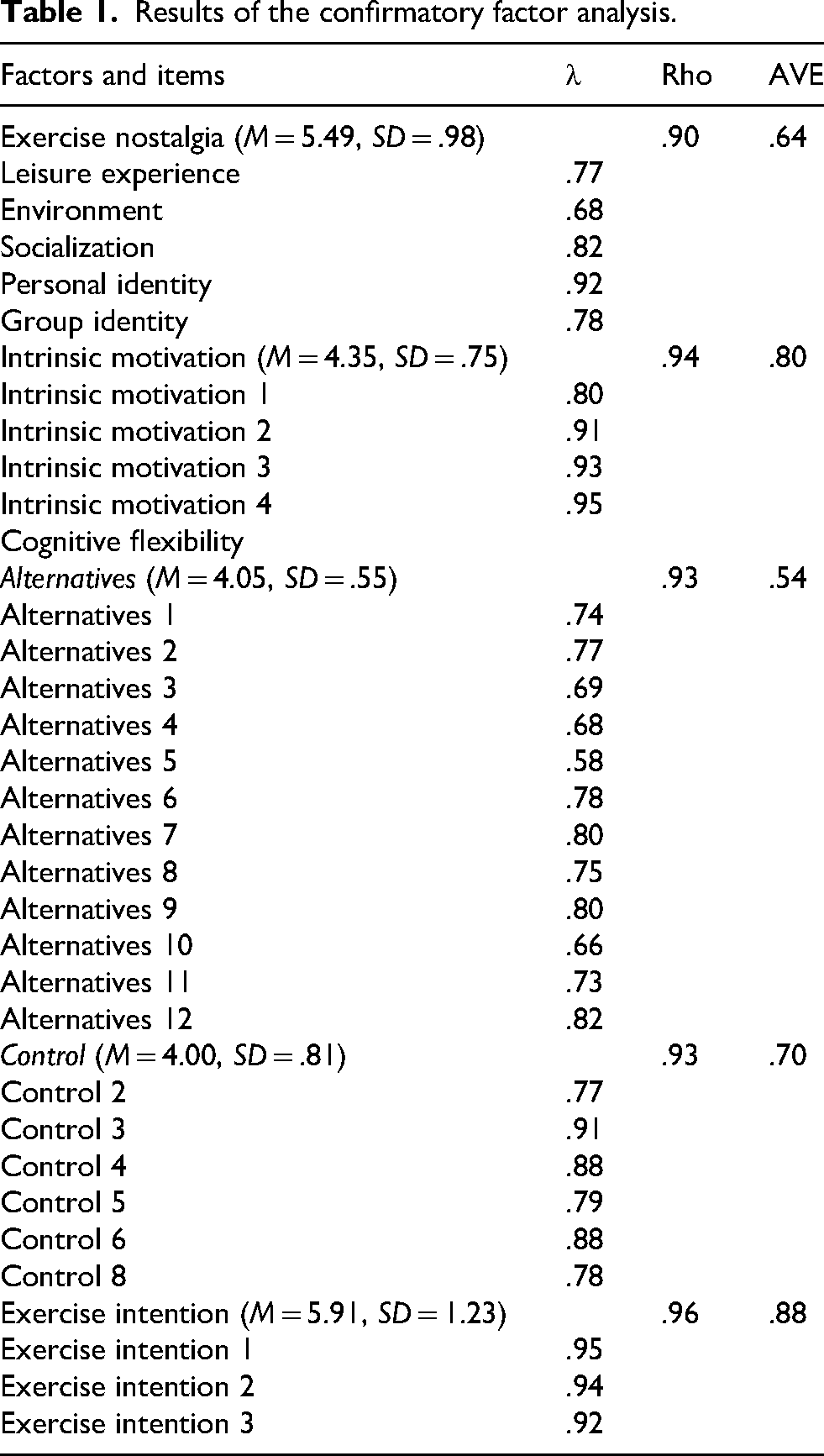
The measurement model comprised numerous latent variables and their associated observed indicators. In particular, the exercise nostalgia construct was conceptualized as a second-order factor encompassing five underlying dimensions and 33 observed indicators. Given the intricate nature of this hierarchical model, the potential for biased parameter estimates increases. 78 To mitigate this issue, this study applied an item parceling, a methodological approach shown to reduce model complexity and improve estimation precision. 79 Specifically, parcels were created by aggregating items within each of the five theoretically defined nostalgia dimensions, thereby preserving content coverage while reducing the number of observed indicators. Next, the CFA assessed the reliability and validity of the measurement model. The initial CFA results were unacceptable: χ2(df) = 1345.53(454), CFI = .89, TLI = .88, RMSEA = .08, and SRMR = .13. Consequently, two items from the control subscale were removed because they exhibited very low standardized factor loadings (λ < .40) and adversely affected the convergent validity and composite reliability of the scale. 80 Notably, both items were reverse-worded, which can induce method effects and response errors in self-report measures and, in turn, attenuate factor loadings.81–83 After removing these items, the control subscale showed improved psychometric performance while preserving its intended content coverage. The modified model showed improved fit indices: χ2(df) = 931.28(395), CFI = .93, TLI = .92, RMSEA = .07, and SRMR = .06. Additionally, the CR values for all constructs exceeded the recommended threshold of 0.70, indicating acceptable internal consistency. 76 Convergent validity was subsequently assessed using AVE; all AVE values were greater than 0.50, providing evidence of satisfactory convergent validity (Table 1). 84 Discriminant validity was verified by comparing the square root of the AVE values to the correlation coefficients. The square root of the AVE values exceeded the correlation coefficients, confirming discriminant validity (Table 2).
Results of the confirmatory factor analysis.
Correlations between and square root of AVE of all factors.
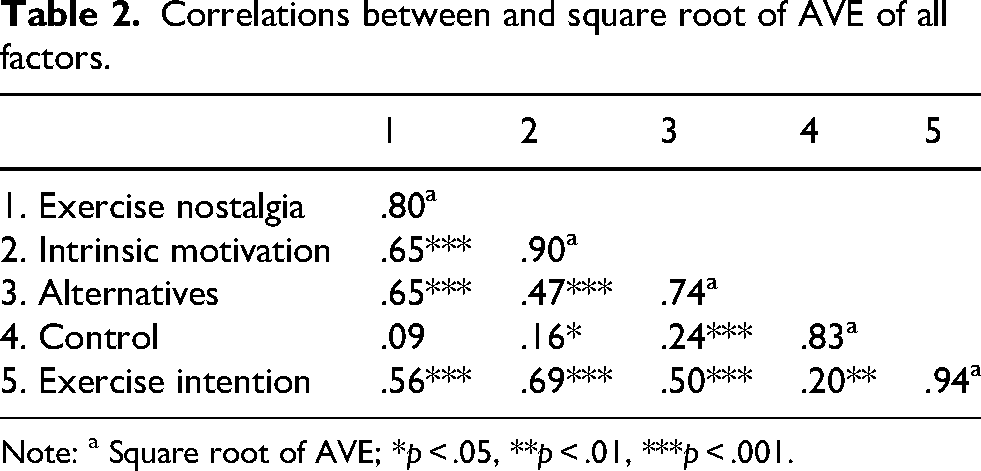
Note: a Square root of AVE; *p < .05, **p < .01, ***p < .001.
Structural model
This study analyzed the relationships among exercise nostalgia, intrinsic motivation, cognitive flexibility, and exercise intention among general exercise participants. To test the nine proposed hypotheses, bootstrapping analysis was conducted using Hayes's SPSS Process Macro Model 6 (Table 3). 77 The results revealed that exercise nostalgia showed significant positive associations with intrinsic motivation (H1: β = .42, SE = .04, z = 10.50, p < 0.001), cognitive flexibility (H2: β = .24, SE = .05, z = 4.80, p < 0.001), and exercise intention (H4: β = .18, SE = .04, z = 4.50, p < 0.001), supporting H1, H2, and H4. Additionally, intrinsic motivation was positively associated with cognitive flexibility (H3: β = .29, SE = .07, z = 4.14, p < .001) and exercise intention (H5: β = .24, SE = .05, z = 4.80, p < .001), supporting H3 and H5. Cognitive flexibility was also positively associated with significant exercise intention (H6: β = .23, SE = .04, z = 5.75, p < .001), supporting H6 (Figure 2). We investigated the indirect effects of the research model (Table 4). The results showed that exercise nostalgia had a significant indirect effect on exercise intention through intrinsic motivation (H7: β = .14, SE = .04, CI [.06, .22]) and cognitive flexibility (H8: β = .08, SE = .02, CI [.04, .13]). Moreover, when both mediators were considered simultaneously, the indirect effect remained significant (H9: β = .04, SE = .01, CI [.02, .06]; Table 4).
Hypothesis testing results for the relationships between key variables.
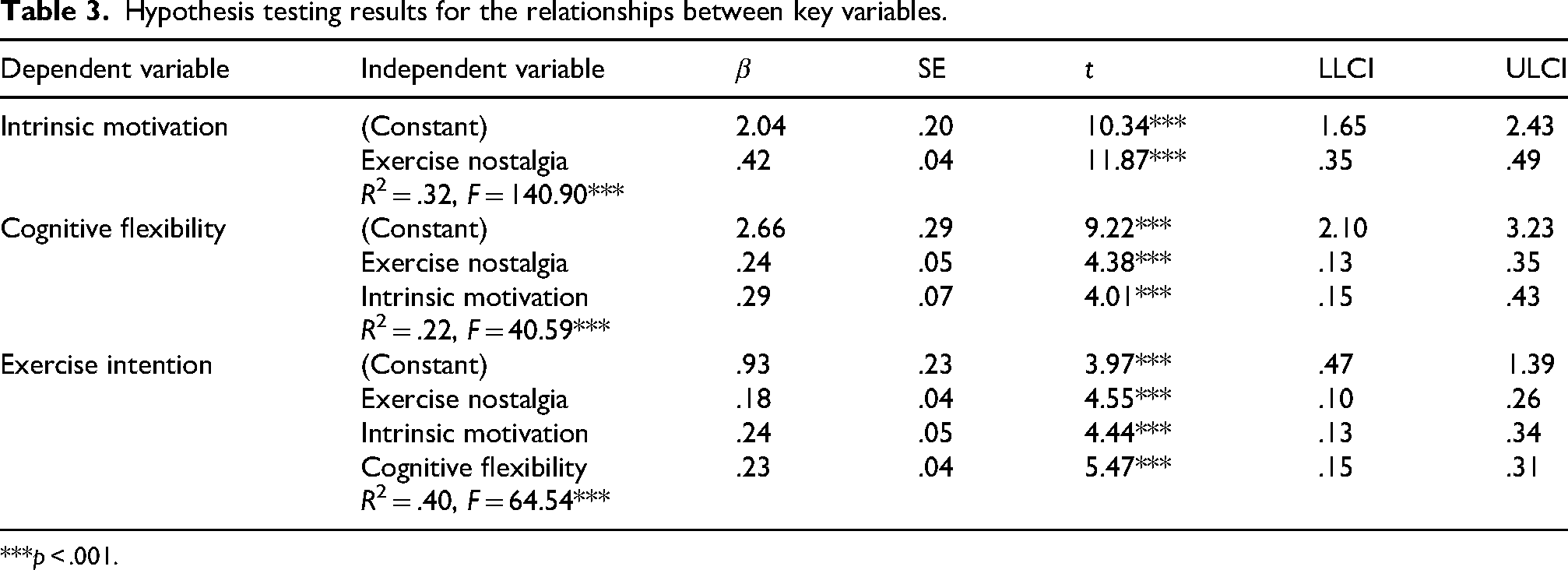
***p < .001.
Mediation analysis results.

Discussion
This study examined whether exercise nostalgia, a predominantly positive emotion evoked by meaningful past workouts, is associated with exercise intention, drawing on Fredrickson's broaden-and-build theory of positive emotions.29,30 The results showed that nostalgia directly and indirectly associated with exercise intention via intrinsic motivation and cognitive flexibility. All hypothesized pathways were supported, offering insight into the psychosocial and cognitive mechanisms through which fond exercise memories translate into future-oriented action. Specifically, the findings were consistent with the broaden-and-build framework: a positive emotional cue (nostalgia) may relate to broader motivational engagement (intrinsic motivation), and downstream cognitive flexibility, which in may turn support exercise intention. By extending the theory to nostalgic exercise experiences, this study enriches the conceptual understanding of how leisure-based positive emotions may be implicated in processes consistent with upward spirals of self-determined engagement and offers practically relevant implications for enhancing exercise participation and well-being in applied settings.
Theoretical implications
This study found that exercise nostalgia was associated with intrinsic motivation (H1), consistent with the broaden-and-build theory's29,30 claim that positive emotions broaden one's immediate motivational repertoire. Intrinsic motivation—driven by inherent interest, enjoyment, or personal value 47 —flourishes when one's experiences satisfy autonomy, competence, and relatedness needs. Nostalgia may reinforce or reactivate these need-satisfying cues. In an experimental study, participants who recalled a meaningful past workout reported stronger self-determined reasons for exercising than control participants who described an ordinary session. 41 Similarly, basic-process research showed that nostalgia heightens approach-oriented, self-determined striving. Stephan et al. 15 found that nostalgic reflection shifted motivation from avoidance to approach. Moreover, Stephan et al. 85 demonstrated that nostalgia-induced inspiration boosted intrinsic goal pursuit in a creativity task. Conceptually, nostalgia reinforces feelings of agency and efficacy—key ingredients of intrinsic motivation—by linking a valued past to one's current self. 86 A broad review confirmed this pattern, concluding that nostalgia reliably elevates autonomous, future-directed motivation across life domains. 14 Prior findings and the present results indicate that fond exercise memories expand the range of self-endorsed reasons for future activity, laying a motivational stepping-stone in an upward spiral toward sustained physical engagement.
Exercise nostalgia is also positively associated with cognitive flexibility (H2), showing that positive emotions not only widen motivational scope but also build durable cognitive resources. Cognitive flexibility, the executive capacity to shift mental sets, reappraise problems, and devise alternative action plans, 25 benefits from the broadened mindset engendered by nostalgia. For instance, Stephan et al. 15 found that nostalgic reflection promoted approach motivation and flexible goal reengagement. Classic affect–cognition experiments corroborated the mechanism by which positive mood broadens conceptual categories 87 and attentional scope, thereby aiding set shifting.88,89 In applied sport research, Memmert 90 reported that football players high in task enjoyment generated a wider range of tactical solutions during small-sided games—an on-field manifestation of flexible cognition. Together with the present findings, this evidence suggests that fond exercise memories may be linked to mental that can help individuals reframe barriers, modify routines, and sustain long-term engagement, thereby extending the broaden-and-build theory29,30 from motivational expansion to cognitive-resource construction.
Importantly, nostalgia is inherently a mixed emotion, and its motivational correlates may depend on whether a nostalgic experience is subjectively dominated by its ‘sweet’ or ‘bitter’ elements. Recent evidence indicates that more negatively valenced nostalgia can be associated with poorer daily well-being, whereas nostalgia experienced as predominantly positive is linked to more adaptive psychological outcomes, underscoring the importance of boundary conditions. 91 Moreover, nostalgia inductions may yield adverse affective consequences for certain individuals (e.g., habitual worriers), suggesting that nostalgia may not uniformly facilitate autonomous motivation or flexible cognition across people and contexts. 92 Accordingly, the present findings should be interpreted as reflecting exercise-related nostalgia when it is experienced as predominantly positive and approach-oriented.
This study also found that intrinsic motivation was positively associated with cognitive flexibility (H3). The self-determination theory argues that self-endorsed engagement fosters curiosity and exploration. 47 This exploratory activity support executive skills that enable individuals to shift strategies and reappraise constraints. 25 Field studies support our finding: university exercisers who reported stronger autonomous motives used a wider repertoire of attentional and self-regulatory strategies, 93 and adults pursuing intrinsic exercise goals displayed superior cognitive reframing in response to barriers. 94 Moreover, both intrinsic motivation and cognitive flexibility are associated with exercise intention (H5, H6). A meta-analysis of 56 physical activity samples found a medium-to-large link between autonomous regulation and intention. 54 Prospective evidence indicated that higher baseline executive function predicted greater alignment between physical activity intentions and behavior in six months. 57 Similar patterns emerged in health-risk cohorts, where flexible cognitive appraisals amplified the effects of intrinsic motives on planned activity. 95 These findings support the broaden-and-build view that nostalgia-fueled intrinsic motivation broadens thought–action repertoires, cultivates lasting cognitive resources, and produces resilient, context-sensitive exercise planning through their combined influence.
Beyond its strong direct association with exercise intention (H4), nostalgia was also indirectly related to intention through a sequential process involving intrinsic motivation and cognitive flexibility (H7-H9). This pattern is conceptually consistent with the broaden-and-build theory of positive emotions.29,30 Specifically, in the broaden stage, nostalgia expands participants’ thought–action repertoires by enhancing self-endorsed interest in exercise. In the build stage, this motivational engagement supports the development of cognitive flexibility, enabling individuals to reframe barriers and adapt exercise routines more effectively. Importantly, although intrinsic motivation and cognitive flexibility were specified as key mediators, nostalgia retained a meaningful direct association with exercise intention, indicating that its influence was not fully mediated. From a broaden-and-build perspective,29,30 this finding suggests that positive emotions may shape behavior through multiple, complementary mechanisms rather than a single fully mediated process. In addition to fostering motivational and cognitive resources, exercise-related nostalgia may directly inform intention by reinforcing self-relevant meaning or continuity with valued past exercise experiences. Notably, mediation analyses indicated that the two resource-based mechanisms jointly accounted for more than 50% of nostalgia's total effect on exercise intention. This proportion underscores the practical significance of the indirect effects and suggests that resource building represents a quantitatively meaningful route through which positive emotion contributes to future exercise engagement.
These associations provide empirical evidence for the cumulative dynamics within the upward-spiral framework articulated by Fredrickson and Joiner 32 ; an initial emotional spark may help set in motion autonomous engagement, which may support durable skills that further strengthen subsequent behavioral intentions. Prior studies offer converging support. Diary research has shown that weekly nostalgic prompts boosted activity plans, partly through autonomous regulation, 41 while longitudinal data have indicated that improvements in executive control enhance intention–behavior concordance over time. 96 Our findings extend this by testing a serial mediation model consistent with this spiral-like account. Nostalgia heightens intrinsic motivation, which fosters greater cognitive flexibility. Together, these resources strengthen exercise intentions, while nostalgia's direct motivational impact remains significant. These results are consistent with the view that exercise nostalgia not only delivers a momentary push but also may relate to a resource-building cycle that equips individuals with psychological tools for resilient, context-sensitive physical activity planning.
Practical implications
The present findings offer practical implications for health promotion, well-being, and cultural policy. While previous research established that nostalgia stimulates exercise participation, it rarely clarified how this emotion translates into behavior. This study found that nostalgia is associated with higher intrinsic motivation, which in turn is associated with cognitive flexibility and—alongside nostalgia's direct association with intention— is linked to stronger exercise intention. These results are consistent with a broaden-and-build interpretation in which fond memories may support behavior. Practitioners can leverage this mechanism by treating nostalgia as an activation lever rather than a mere byproduct of reflection.
Although nostalgia-informed interventions are not yet commonly applied in exercise or fitness contexts, the findings suggest that low-intensity reflective strategies may be feasible. Brief, self-generated prompts that evoke a salient workout memory may be feasible in practice. For instance, a two-minute writing prompt can invite participants to recall one meaningful or enjoyable past workout, note what made it meaningful and how it felt, and identify one element they might carry into their next session. In digital settings, a personal throwback playlist can be implemented as an optional memory cue that surfaces a personally meaningful playlist before a scheduled workout and allows users to start it as the session begins. A photograph displayed at the start of a session may serve a similar cueing function. Taken together, these low-intensity prompts may help evoke the initial affective impulse that the current model represents as a direct effect on exercise intention and conceptualizes as the starting point of a broader resource-building process. 41 To sustain this momentum, the nostalgic prompt should be followed immediately by autonomy-supportive goal negotiation, where participants choose the modality, intensity, and sequencing of activities. Trainers can provide informational feedback that frames effort as self-development rather than external compliance, thereby consolidating the surge in intrinsic motivation. 47
Once autonomous engagement is established, programs can foster the second resource—cognitive flexibility—through deliberate variability and problem-solving tasks. Tasks that require participants to adapt routines in response to time constraints, weather, or limited equipment encourage the set-shifting and reappraisal capacities shown here to mediate nostalgia's influence on intention. Evidence that executive control amplifies intention–behavior concordance 96 supports embedding adaptive drills within group classes, personal-training sessions, and app-based workouts. However, such applications should be viewed as conceptual pathways rather than immediate prescriptions. Future intervention studies are needed to test their real-world feasibility and determine how nostalgia, autonomy, and flexibility can be effectively sequenced across diverse populations and settings. Digital platforms are particularly well-suited to orchestrating this sequence: rotating nostalgia cues can prevent habituation, choice-based workout generators can deliver autonomy support at scale, and gamified flexibility challenges with real-time feedback can maintain the iterative learning cycle emphasized by the broaden-and-build framework. 32
Embedding nostalgia-informed practices within physical-education curricula offers a low-cost, policy-relevant avenue for strengthening motivational and socioemotional outcomes in youth. At the start of each term, students could complete a brief reflective assignment in which they assemble a movement-memory collage, with photographs, sketches, or short video clips that capture their favorite childhood games or meaningful physical achievements. Teachers or program designers, rather than individual trainers, may be better positioned to facilitate these reflective elements within existing lessons, ensuring age-appropriate and scalable implementation. Teachers would then guide a goal-setting session that connects these memories to the semester's skill objectives, scaffolding and encouraging students to translate positive affect into self-endorsed, developmentally appropriate activity plans.
This approach illustrates one way to operationalize the broaden-and-build sequence early in life: nostalgia provides an immediate emotional uplift, autonomy-supportive goal formulation may be linked to higher intrinsic motivation, and practice tasks tailored to students’ chosen memories cultivate adaptive self-regulation. From a policy perspective, this aligns with social-emotional learning mandates embedded in many national physical education standards, offering a practical way to build affective resources within existing instructional time without additional infrastructure or costs. 97 However, the present findings are based on adult exercisers with substantial exercise experience, with a large proportion reporting more than 10 years of participation. Accordingly, caution is warranted when generalizing these results to youth or novice exercisers, and future research should directly examine whether the observed relationships operate similarly across developmental stages and experience levels. In summary, by sequencing nostalgic activation, autonomy support, and flexibility training, practitioners can operationalize the upward-spiral mechanism documented in this study, equipping adults with the motivational energy and cognitive tools required for resilient, context-sensitive engagement in physical activity. Overall, the present study provides a conceptual foundation for integrating nostalgia as a motivational primer within broader health-promotion strategies while acknowledging that practical applications require further empirical validation and contextual adaptation.
Limitations and future research
This study has several limitations that offer meaningful directions for future research. First, its cross-sectional design limits causal inference. While the data are consistent with a broaden-and-build sequence—linking nostalgia to intrinsic motivation, cognitive flexibility, and exercise intention—longitudinal or experimental evidence is needed to verify temporal ordering and determine whether these resource pathways accumulate over time. Second, all variables were assessed by self-report, raising concerns about shared method variance and the accuracy of retrospective nostalgia recall. Future studies should integrate objective indices—such as accelerometer-derived activity metrics, behavioral flexibility tasks (e.g., task-switching paradigms), and ecological momentary assessments of nostalgic affect—to triangulate the present findings. Third, this study used intrinsic motivation and cognitive flexibility as mediators. However, other resources potentially activated by nostalgia—such as self-efficacy, social connectedness, or affective resilience—may compete with or augment the observed pathways. Testing these additional relationships using multi-mediator or moderated-mediation frameworks would offer a more comprehensive understanding. Finally, nostalgia was measured in its naturally occurring form; manipulating nostalgic intensity or content (personal vs. collective memories) could reveal the boundary conditions under which emotions most effectively catalyze self-determined engagement. Addressing these issues will enhance the theoretical understanding of nostalgia's role in exercise behavior and inform the design of targeted interventions that translate fleeting reminiscence into enduring, health-promoting action.
Footnotes

Ethical considerations
Ethical approval was obtained from the Institutional Review Board of Sungkyunkwan University (Approval No. [2024-05-036-004]).
Consent to participate
Informed consent was obtained from all individual participants included in the study.
Consent for publication
Not applicable.
Funding
The authors received no financial support for the research, authorship, and/or publication of this article.
Declaration of conflicting interests
The authors declared the following potential conflicts of interest with respect to the research, authorship, and/or publication of this article: Heetae Cho is a member of the Editorial Board of the International Journal of Sports Science & Coaching.
Data availability
The data that support the findings of this study are available from the corresponding author upon reasonable request.