




Abstract
This study examined the short-term effects of a 6-week Agility Training (AT) program involved combined decision-making and change-of-direction on physical fitness and simple reaction time in highly trained pubertal tennis players. Twenty-eight highly-trained pubertal tennis players were randomly assigned to an AT (n = 15) or an active control group (CG) (n = 13). The CG continued their standard tennis training, while the AT group replaced some tennis drills with agility exercises twice per week. Pre- and post-training simple reaction time, 5-m sprint speed, CoD speed, horizontal single right-leg hop-test for distance, single left-leg hop-test, and countermovement jump tests were assessed. Results indicated significant and large between-group differences at posttest in all physical fitness and simple reaction time measures (d = 0.98 to 1.18, p < 0.05). The within group pre-to-post analysis indicated significant and moderate to large improvements in all fitness measures in the AT group (d = 0.63 to 0.86, all p < 0.05). However, the CG showed small-tomoderate pre-to-post change in all fitness measures (d = 0.04 to 0.52,p > 0.05), despite these changes being statistically non-significant. To summarize, a short training program including agility tasks stands up to be more effective in improving measures of physical fitness and simple reaction time in highly-trained pubertal tennis players compared to regular tennis training.
Introduction
Tennis performance is shaped by an interaction of technical, tactical, psychological/social, and physical attributes. 1 Both elite and developing players must possess high levels of physical fitness to effectively apply their technical and tactical skills throughout a match.1–3 In support of this, Girard et al. 4 reported significant associations between competitive ranking and key physical qualities namely sprint speed, muscle power, and dominant-side strength in adolescent male tennis players. Furthermore, elite players typically demonstrate superior muscle power, speed, acceleration, change-of-direction (CoD) ability, and jumping performance compared with sub-elite counterparts. 5 These findings highlight the need for well-designed training programs that develop critical physical qualities from early stages of tennis development. 6
Several training modalities have shown effectiveness in improving physical fitness in tennis players. A recent systematic review and meta-analysis demonstrated that plyometric training enhances sprint speed, lower-extremity power, agility, and serve velocity. 7 Similarly, Xiao et al. 8 showed that exercise interventions including resistance, plyometric, high-intensity interval, and resisted-speed training produce beneficial effects on physical fitness outcomes in young tennis athletes. For instance, recent research emphasizes the need to tailor change-of-direction (CoD) and agility training to the developmental stage of youth tennis players. Maturation influences sprint, jump, and CoD performance, with post-peak-height-velocity athletes outperforming younger peers.8,9 This highlights the importance of integrating CoD work progressively and using refined, tennis-specific test batteries to assess both pre-planned and reactive agility. 10 Combined plyometric and agility training has been shown to enhance both CoD and reactive agility in young players. 11 Together, these findings suggest that youth tennis programs should adapt training to biological maturation, integrate physical and cognitive components, and employ sport-specific assessments. Our protocol, combining structured agility drills with reactive elements, aligns with these recommendations while addressing the limited longitudinal and interventional evidence in this population.
Although agility encompasses both physical and perceptual cognitive components, many youth tennis studies have focused predominantly on pre-planned change-of-direction (CoD) drills. However, effective on-court movement requires players to integrate multiple sources of information such as opponent kinematics, ball flight cues, and evolving tactical patterns before selecting and executing a directional response. This continuous perception–action coupling means that agility in tennis is fundamentally reactive rather than scripted. Accordingly, training tasks that incorporate decision-making demands (e.g., responding to visual or opponent-like cues, selecting movement directions in real time, or reacting to unpredictable stimuli) provide a more ecologically valid stimulus than drills performed along predetermined movement paths. Embedding such elements within agility practice may enhance not only physical CoD capacity but also the perceptual–cognitive skills that underpin effective court coverage, thereby addressing a gap in previous youth tennis research that has largely overlooked this integrated approach.
Despite the theoretical relevance of such perceptual-cognitive integration, evidence-based research investigating agility programs that explicitly combine decision-making and CoD tasks in highly trained youth tennis players is lacking. Meanwhile, agility has been identified as a critical component of tennis performance and one of the few physical fitness characteristics capable of predicting competitive ranking.1,3,4,11,12 This gap justifies the need to investigate training interventions that reflect the sport's perceptual and reactive demands.
Therefore, this study aimed to examine the short-term effects of a 6-week combined decision-making and CoD agility training program on simple reaction time, linear sprint speed, CoD speed, and jump performance in highly trained pubertal tennis players. Although tennis agility involves rapid whole-body movements in response to dynamic, sport-specific stimuli (e.g., reactive agility), the present study used pre-planned CoD, linear sprint, jumping, and simple reaction time tests, which are commonly applied in tennis conditioning. This approach captures key physical and motor components of agility while recognizing that tennis-specific reactive agility also requires additional perceptual and decision-making skills. We hypothesized that, compared with standard tennis training, replacing portions of regular practice with agility drills incorporating real-time decision-making would lead to superior improvements in physical fitness and reaction time measures.8,13,14
Methods
Participants
With reference to the study of Chaalali, Rouissi, Chtara, Owen, Bragazzi, Moalla, Chaouachi, Amri, Chamari 15 an a priori power analysis, with a type I error rate of 0.05 and 80% statistical power, was computed. The analysis indicated that 24 participants would be sufficient to observe a significant interaction effect (effect size Cohen's f = 0.62 for the sprint performance. Overall, 28 highly trained pubertal tennis players (both male and female) from a tennis club in Tunis, Tunisia, were enrolled in this study. Participants were randomly allocated to the agility training group (AT; n = 15) or the control group (CG; n = 13), with both groups including a similar distribution of male and female players. All participants had been actively engaged in systematic tennis training over the past 4 years. In addition, they were regularly competing in the National Tunisian championship and were nationally ranked. 12 Before the start of the study, all participants were regularly engaged in 90 min exercise sessions of standard tennis-specific training five times per week
During the time of the study, all players have the same daily school and tennis-training schedules. Additionally, participants were not engaged in any after-school activities or formalized strength and conditioning training programs. Before baseline testing, all players were examined by the physician of the sporting club to make sure that they were free from injury, and orthopedic limitations, or illness that might impair their ability to execute agility training or to perform physical fitness tests. Written informed consent to participate was obtained from all legal guardians, and written assent was obtained from the participants after a full explanation of the study objectives, procedures, potential risks, and benefits. Ethical approval for this study involving human participants was obtained from the Ethics Committee of the National Centre of Medicine and Science of Sports, Tunis (CNMSS-LR09SEP01). All procedures were conducted in accordance with the ethical standards of the institutional research committee and with the latest version of the Declaration of Helsinki. 16
Experimental approach to the problem
A two-group repeated measures experimental design was applied to assess whether a 6-week of bi-weekly in-season short-term agility training program including combined making decision and change-of-direction exercises would improve simple reaction time, and various measures of physical fitness in highly-trained pubertal tennis players relative to their peers who continued their regular in-season tennis-specific training regime. Participants were randomly assigned to either the agility training (AT) group or the active control group (CG) using a computer-generated random sequence. No stratification by sex or ranking was applied. Group allocation was concealed until the assignment was completed. Assessors were not blinded to group allocation, which is acknowledged as a limitation of the study. Pre and post training, simple reaction time, linear sprint speed, CoD speed, and jumping performance were assessed. Two weeks before baseline testing, two familiarization sessions were performed to get participants acquainted with the applied tests. A strength and conditioning specialist instructed the young tennis players on how to perform the tests.
The AT program was organized at the micro-cycle level, with sessions conducted twice per week (Tuesdays and Thursdays) over a 6-week period. Each session lasted 90 minutes. In the AT group, 20 minutes of the session were dedicated to agility and decision-making exercises, which replaced the passing, crossing, and ball-kicking components of the regular tennis-specific training. The remaining time was allocated to tennis-specific technical drills and small-sided games (45 minutes), as well as a standardized warm-up (15 minutes) and cool-down (10 minutes).
The CG performed the same total session duration and content distribution except that the 20 minutes allocated to the agility module in AT remained in the CG as regular technical–tactical tennis practice. For transparency, the 20-min block in CG typically contained stroke-development drills (e.g., multiball groundstroke repetition and controlled rally patterns), serve/return practice and supervised point-play designed to emphasize technique and tactical decision-making rather than structured CoD training. Coaches were instructed to avoid introducing new, structured, multidirectional footwork drills or reactive CoD protocols into the CG during the intervention period. Spontaneous multidirectional actions naturally occurring during stroke drills or point-play were not restricted, because these reflect normal tennis practice.
In addition, we took three steps to limit unintended contamination of the CG by agility-like content: (1) coaches received written and verbal instructions to keep the CG's training within standard technical–tactical activities and explicitly to avoid introducing structured CoD or reactive drills during the intervention period; (2) session logs captured the time and type of exercises performed so that any unplanned introduction of agility drills could be identified; and (3) the study team performed random session observations to independently verify protocol adherence. These procedures were intended to ensure the primary contrast between groups was the inclusion of the structured agility module.
Thus, total training duration and overall load were matched between groups, with the only difference being the inclusion of structured AT exercises in the experimental group.
Each player's body height and mass were collected respectively during the familiarization sessions. The maturity offset (MO) was calculated using the estimation equation established by Moore et al.. 17 The following equations were applied for males and females, respectively: (MO = –7.999994 + 0.0036124×age × height) and (MO = −7.709133 + (0.0042232 × age × height) (table 1). Maturity offset values for all participants are presented in Table 1. Participants were stratified by sex during randomization to ensure balanced allocation to the AT and CG. Additionally, sex was included as a covariate in the ANCOVA analyses to account for potential differences in growth and maturation between male and female participants. The physical fitness tests were performed in the following order: simple reaction time, jumping, sprint speed, and CoD speed and with approximately three minutes of rest between trials and tests.
Anthropometric characteristics of the included participants.

Notes: Data are presented as mean ± SD. AT = agility training group; CG = control group; BF = body fat; M = male; F = female; *Maturity offset = years from peak height velocity; APHV = age at peak height velocity. Participants were stratified by sex during randomization, and sex was included as a covariate in ANCOVA analyses to control for potential differences in maturation.
Simple reaction time
The simple reaction time test was conducted as previously outlined by Jarraya et al. 18 and Souissi et al.. 19 A colored geometric form (used as a target) was initially presented to the subject. The subject was then shown a sequence of different colored forms; whenever the target color appeared, the subject had to indicate its appearance and the computer calculated the simple reaction time (Figure a). The time between showing the figures was 300 ms and each subject had 20 target presentations. Higher scores reflect poorer performance.
Linear sprint speed
The 5-m linear sprint speed was assessed using photocell gates (Brower Timing Systems, Salt Lake City, Utah, USA; accuracy 0.01 s) placed 0.4 m above the ground. Participants started from a standing position 0.4 m behind the first infrared gate (Figure 1(b)). A rest period of approximately 3 minutes was provided between trials. The fastest time of two trials was retained for analysis. This test has been shown to be a reliable measure of short-distance sprint performance in youth tennis players. 20
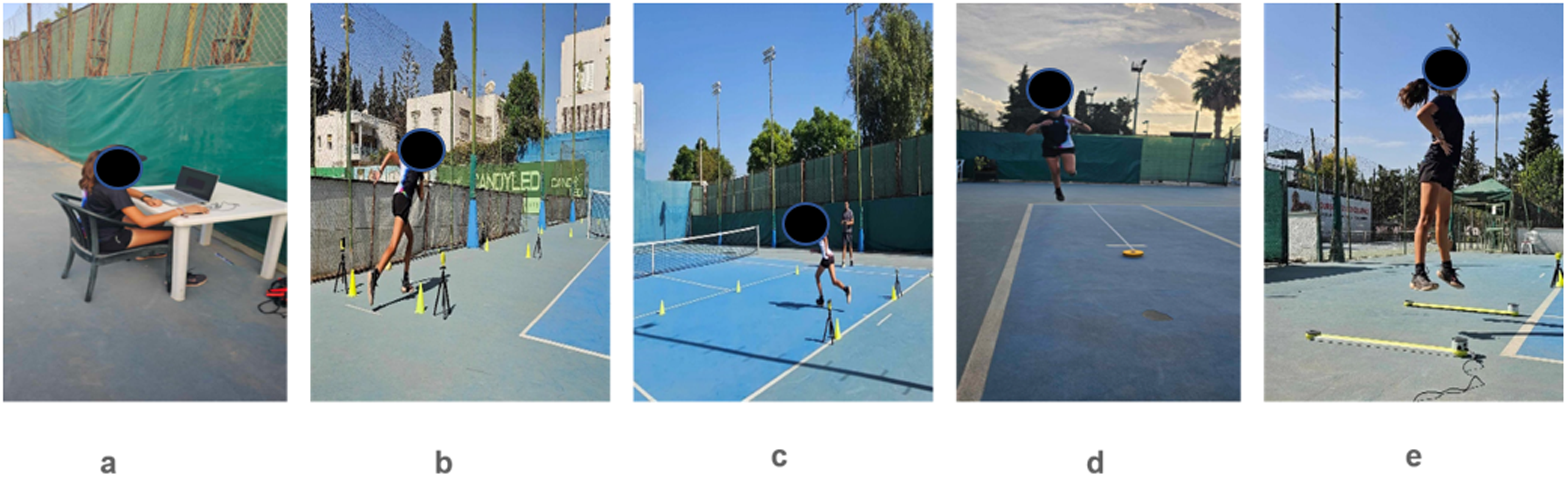
Schematic description of the applied simlpe reaction time, speed and muscle power tests. a: simple reaction time test, b: 5 m sprint test, c: change of direction speed test, d: horizontal single leg hop test, e: contremouvement jump test.
Change-of-direction speed
The T-half CoD test was conducted as previously outlined by Haj-Sassi et al.. 21 We have chosen this test as its displacement pattern is close to tennis (forward sprinting, left and right shuffling, and backpedaling). The test was performed in a tennis court with different types of angles (i.e., 90 and 180 °) as observed in a tennis match. 22 The T-half test was used to determine the speed with directional changes such as forward sprinting, left and right shuffling, and backpedaling. Participants began with both feet behind the starting line. At their discretion participants had to sprint forward to a cone fixed at 5 m and touch the base of the cone with his right hand. Facing forward and without crossing their feet, they had to shuffle to the left to a cone fixed at 2.5 m and touch the base of the cone with their left hand. Subjects then had to shuffle 5 m to the right to the last cone and touch the base of the cone with their right hand. They had to shuffle again to the left to the first cone and touch the base of the cone. Finally, participants had to run backward as quickly as possible to return to the starting line. The total distance covered was 20 m. Any participants who crossed one foot in front of the other, failed to touch the base of the cone, and/or failed to face forward had to repeat the procedure (Figure 1(c)). Each participant performed two trials with a 3 minutes rest after each trial. The best trial was recorded for further analysis.
Horizontal single leg hop tests
The horizontal single leg hop tests have been shown to evaluate lower-limb power performance requiring slow stretch-shortening-cycle action in accordance to the described protocol by Ramirez-Campillo et al.. 23 The test was executed using a 5 m fiberglass metric tape affixed to a wooden floor. Players were instructed to use their arms to aid in the jump phase, using a one-foot stand (right and left), and perform a fast movement (approximately 120° knee flexion angle) followed by a jump for maximal distance. If the players lost their balance and fell over, the trial was restarted after 3 minutes recovery period. All players were instructed to land in an upright position during the jumps and to bend their knees upon landing (Figure 1(d)). The test was executed two times for each leg, with the starting order of the right or the left leg randomly assigned, with a 3 minutes rest period between trials, and the best value was recorded for analysis.
Countermovement jump
The CMJ test was performed using an Ergo jump system (Ergojump apparatus; Globus Italia, Cologne, Italy) according to the procedure described by Hammami et al.. 24 Participants were instructed to keep their hands on their hips to minimize lateral and horizontal displacement during performance, to prevent any influence of arm movements on the vertical jumps and to avoid coordination as a confounding variable in the assessment of the leg extensors’ neuromuscular performance. 25 Participants were encouraged to perform the eccentric phase of the jump as quickly as possible to maximize vertical jump height (Figure 1(e)). Two trials were performed with approximately 3 minutes rest, and the best result was used for analysis.
Tennis training program
Both groups participated in the same tennis training program over the 6-week training period. Tennis training sessions for both groups included technical (e.g., forehand and backhand ground strokes, volleys, serve, drop and lob shots) and tactical (e.g., shot selection, defensive and offensive skills, court awareness) drills.
Agility training program
All details of the agility intervention are presented in Table 2. The training program was conducted on a standard tennis court, with participants holding their racket during all exercises. Agility sessions were integrated into the regular tennis training routine of the experimental group after a standardized warm-up, replacing 20 minutes of technical and tactical drills with decision-making and CoD exercises over a 6-week period.
Design of the agility training program in youth tennis players.
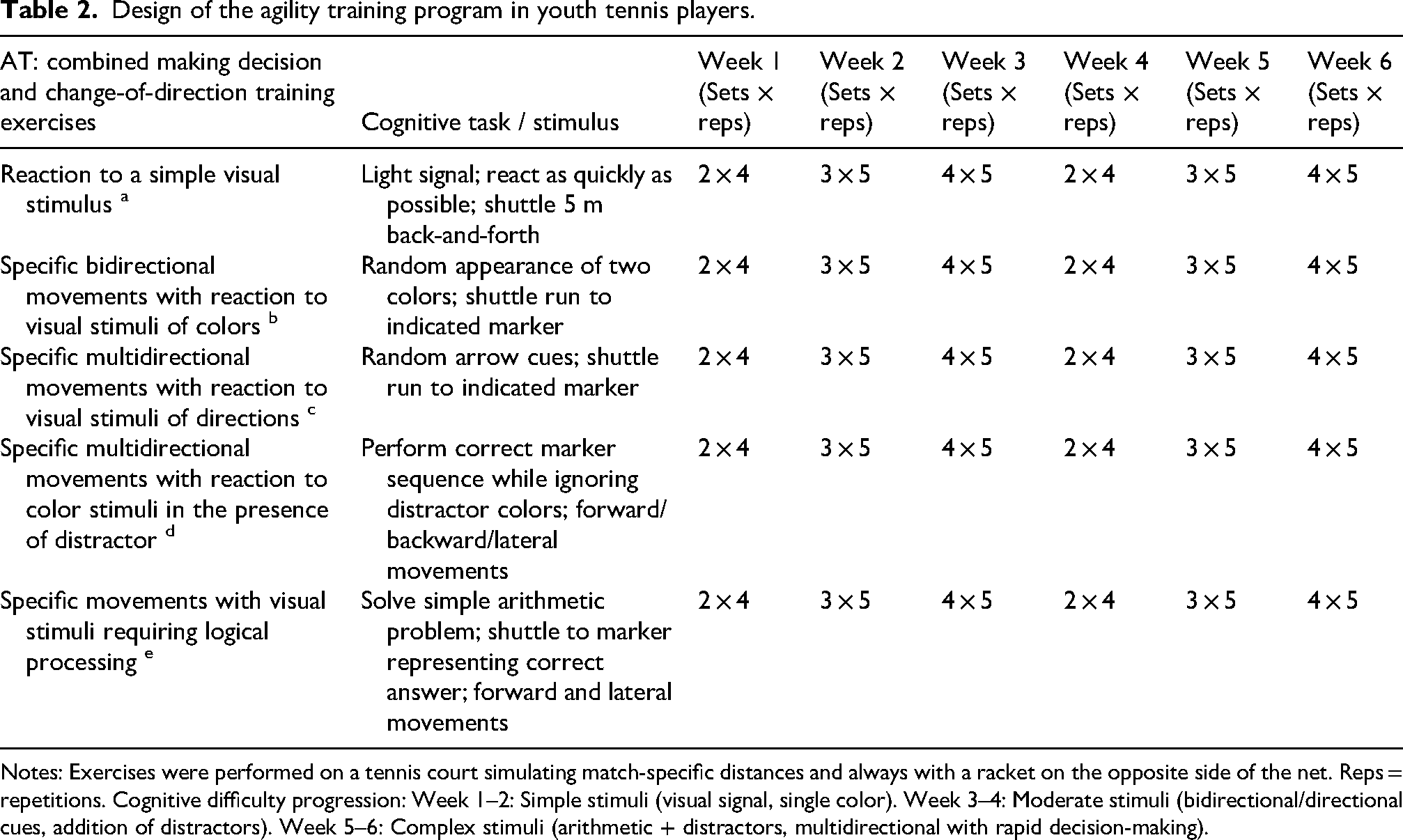
Notes: Exercises were performed on a tennis court simulating match-specific distances and always with a racket on the opposite side of the net. Reps = repetitions. Cognitive difficulty progression: Week 1–2: Simple stimuli (visual signal, single color). Week 3–4: Moderate stimuli (bidirectional/directional cues, addition of distractors). Week 5–6: Complex stimuli (arithmetic + distractors, multidirectional with rapid decision-making).
The agility exercises included: (i) reaction to a simple visual stimulus, (ii) bidirectional movements in response to colored stimuli, (iii) multidirectional movements in response to directional arrow stimuli, (iv) multidirectional movements with color distractors, and (v) movements in response to visual stimuli requiring simple arithmetic processing. All visual stimuli (colors and arrows) were presented by a coach using standardized cards positioned at consistent court markers. The distances covered during shuttle runs ranged from 5–7 m, and all movements were performed at maximal intensity, with strict instruction to maintain proper technique.
Progressive overload was applied by increasing the number of sets and repetitions for each exercise across the 6 weeks. Rest periods of 15 seconds between repetitions and 90 seconds between sets were implemented. The inclusion of distractor stimuli and arithmetic tasks was standardized by using predefined sequences and randomization to ensure consistency across participants and sessions, and the reliability of these tasks was verified during pilot testing prior to the intervention. After completing the agility training, participants resumed the remainder of their regular tennis training session.
Statistical analyses
Data were first tested for normality using the Shapiro–Wilk test. Between-group differences at baseline were assessed with independent t-tests. Given that some baseline measures differed significantly between groups, training effects were subsequently analyzed using ANCOVA with baseline values included as covariates. Effect sizes (d) were calculated by converting partial eta-squared from the ANCOVA output to Cohen's d. Within-group pre-to-post changes were evaluated using paired-sample t-tests, with effect sizes determined from means, standard deviations, and correlation coefficients using G*Power (version 3.1.6). Effect sizes were interpreted as small (0.00 ≤ d ≤ 0.49), moderate (0.50 ≤ d ≤ 0.79), and large (d ≥ 0.80).
Test-retest reliability was examined using Cronbach's model intraclass correlation coefficient (ICC) and coefficient of variation (CV). ICC values above 0.90 were considered high, 0.80–0.90 moderate, and below 0.80 low, while CV values below 5% were deemed acceptable. Ninety-five percent confidence intervals (CIs) were calculated for each ICC to account for sampling variability. The smallest worthwhile change (SWC) was derived from the pooled standard deviation of pre-training scores and expressed as a percentage for each performance variable.
To address the potential for multiple comparisons, we adopted a significance threshold of p ≤ 0.05 for all analyses. Although formal correction procedures (e.g., Bonferroni) were not applied, using ANCOVA with baseline covariates and focusing on effect sizes and SWC provides complementary information regarding practical and statistical significance, helping to reduce the risk of Type I error while retaining interpretability. Data are reported as group mean ± standard deviation for pre-tests and adjusted mean ± standard deviation for post-tests. All analyses were conducted using SPSS 20.0 (SPSS Inc., Chicago, IL, USA).
Results
All participants received treatment conditions as allocated. Thus, 28 youth tennis players completed the training program with an adherence rate of 100%. None reported any training- or test-related injuries. Table 3 displays the test-retest reliability analyses for all applied tests. The ICCs ranged from 0.89 [0.81–0.91] to 0.90 [0.82–0.93] indicating good reliability of all tests, with a CV < 5%. Furthermore, a paired t-test showed no significant differences between the scores recorded during the two trials for all measured variables.
Test-retest reliability of the applied simple reaction time, power, sprint and change-of-direction speed tests.
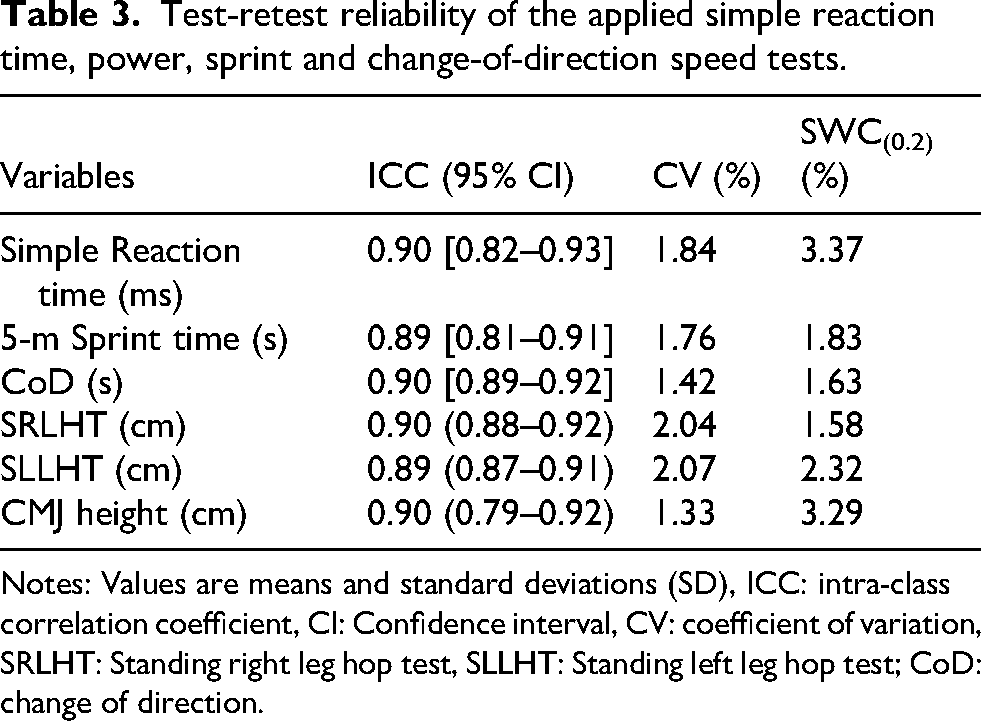
Notes: Values are means and standard deviations (SD), ICC: intra-class correlation coefficient, CI: Confidence interval, CV: coefficient of variation, SRLHT: Standing right leg hop test, SLLHT: Standing left leg hop test; CoD: change of direction.
Table 4 displays test data for all measures of physical fitness at pre- and post-intervention. There were no statistically significant baseline differences between the groups in chronological age, body height, body mass, maturity offset, and tennis experience.
Group-specific baseline and post-test performances in youth male tennis players.
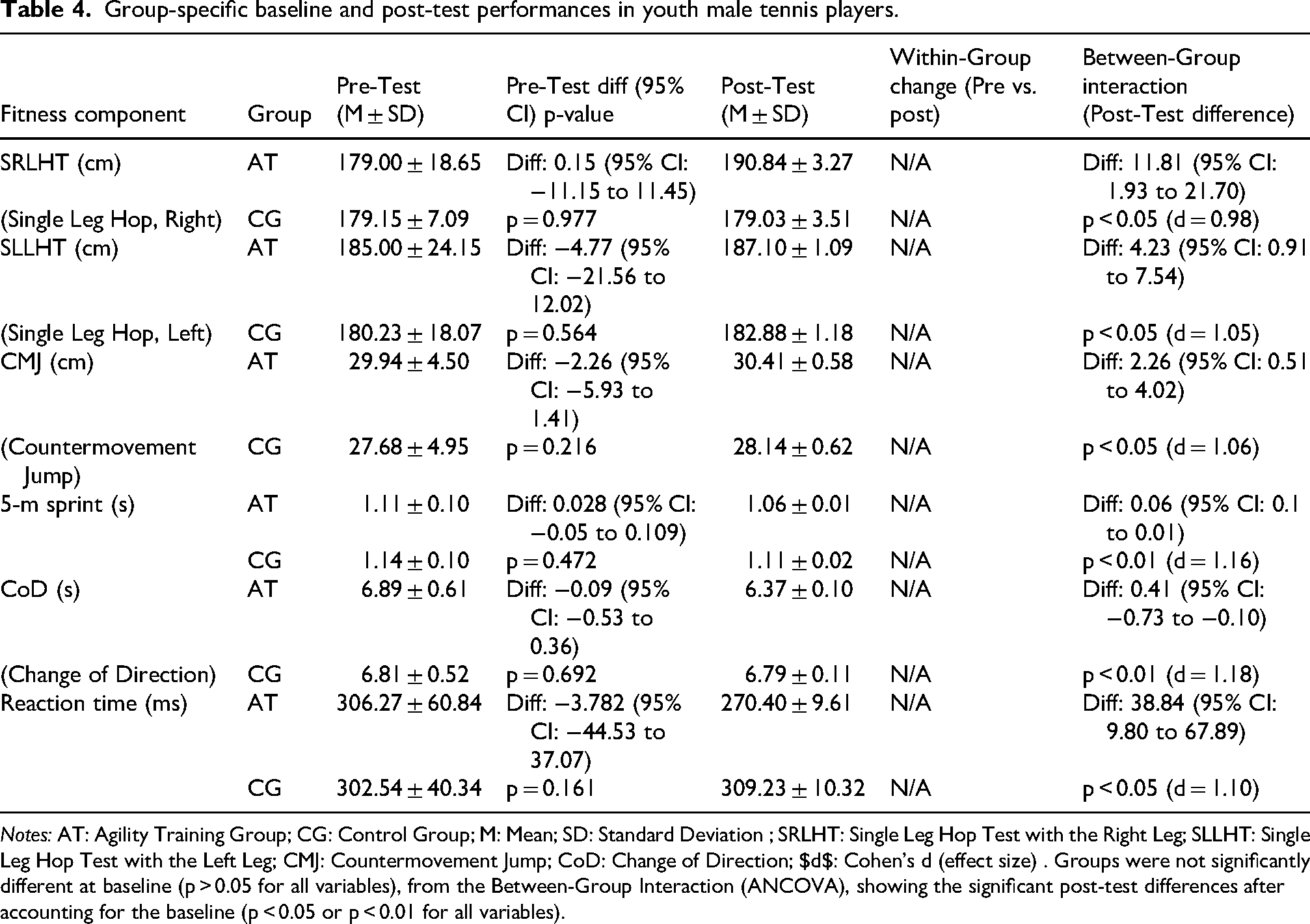
Notes: AT: Agility Training Group; CG: Control Group; M: Mean; SD: Standard Deviation ; SRLHT: Single Leg Hop Test with the Right Leg; SLLHT: Single Leg Hop Test with the Left Leg; CMJ: Countermovement Jump; CoD: Change of Direction; $d$: Cohen's d (effect size) . Groups were not significantly different at baseline (p > 0.05 for all variables), from the Between-Group Interaction (ANCOVA), showing the significant post-test differences after accounting for the baseline (p < 0.05 or p < 0.01 for all variables).
Individual responses, expressed as the percentage of participants exceeding the smallest worthwhile change (SWC), are presented in Table 4. In the AT group, the highest proportion of responders was observed for 5-m sprint (93.3%), CoD (93%), reaction time (80%), SRLHT (67%), SLLHT (60%), and CMJ (60%). In contrast, only 0–23% of participants in the control group exceeded the SWC for any performance measure. To strengthen the analysis, Fisher's exact tests were conducted to compare the proportion of responders between groups, confirming that the AT group had a significantly higher number of individuals showing meaningful improvements across all performance tests (p < 0.05).
Simple reaction time
Our statistical calculation indicated significant between-group differences at post training (d = 1.10 [Large], p = 0.011). The AT group demonstrated significant pre-to-post training enhancements (d = 0.69 [Medium], p = 0.019). However, the CG failed to show any significant pre-to-post changes (d = 0.20 [Medium]; p = 0.481).
Sprint speed test
ANCOVA results indicated a significant between-group difference at posttest for the 5-m (p = 0.007, d = 1.16 [Large]) sprint time (Table 3). The AT group achieved a significant pre-to-post training improvements (p = 0.000; d = 0.86 [Large]). However, no significant pre-to-posttest change was found in the CG (p = 0.118; d = 0.47 [small]).
Change of direction speed
Findings indicated significant between-group differences at post training (d = 1.18 [Large], p = 0.007). The AT group demonstrated significant pre-to-post training improvements (d = 0.74 [Medium], p = 0.015). However, the CG failed to show any significant pre-to-post changes (d = 0.52[medium]; p = 0.088).
Muscle power
The ANCOVA model revealed significant between-group differences at post-test in the SRLHT, SLLHT, and CMJ (p = 0.021, 0.015, and 0.013; d = 0.98, 1.05, and 1.06, respectively). Significant pre-to-post changes were detected in the AT group (p = 0.028, 0.011, and 0.011; d = 0.63 [medium], 0.79 [Medium], and 0.77 [Medium], respectively for the SRLHT, SLLHT, and CMJ test). However, the CG failed to reach any significant changes (p = 0.895, 0.692, and 0.351; d = 0.04 [small], 0.11[small], and 0.27 [small] for the SRLHT, SLLHT, and CMJ test, respectively).
Discussion
This study examined the short-term effects of a 6-week agility training program including combined making decision and change-of-direction exercises on measures of simple reaction time, linear sprint speed, CoD speed, and jumping performances in highly trained pubertal tennis players. Our findings showed that incorporating AT into the standardized tennis training led to moderate-to-large positive effects in simple reaction time, linear sprint speed, CoD speed, and jumping performance among highly trained pubertal youth tennis players. On the other hand, regular tennis training alone generated small-to-moderate changes in the fitness components measured, albeit statistically non-significant.
Reaction time is an important performance component in youth tennis because players must rapidly detect and respond to external cues during play.26,27 In our study, the AT group demonstrated meaningful improvements in simple reaction time (d = 0.69), with 80% of participants surpassing the SWC compared with 23% in the control group. These findings are broadly consistent with earlier work showing that training combining plyometric or agility elements with sport-specific tasks can enhance motor reactivity in young athletes.27,28 While much of this evidence comes from other sports, it suggests that agility-oriented training can positively influence basic reaction processes in tennis as well. However, as simple reaction-time tests involve highly constrained responses and are susceptible to learning effects, 29 the observed gains may reflect both genuine neuromuscular adaptations and improved task familiarity. This limitation should be considered when interpreting the magnitude and specificity of the improvements.
The improvement in simple reaction time likely reflects enhanced stimulus–response coupling and increased efficiency of neural processing within the central nervous system. 30 By repeatedly presenting consistent stimuli, AT may facilitate automaticity in motor responses. However, it is important to clarify that simple reaction time reflects motor reactivity rather than true decision-making ability. Future studies should include measures of choice reaction time, decision accuracy, or other cognitive–perceptual metrics to better capture tennis-specific decision-making adaptations.
A high level of sprinting and jumping performance allows tennis players to meet the physical demands of matches31,32 and serves as a marker for talent identification. 31 The current findings demonstrate that AT improved jumping (SRLHT, SLLHT, CMJ; p < 0.05, d = 0.98–1.06) and sprinting (5-m sprint; p < 0.05, d = 1.6) performance. Individual responses above the SWC were 67%, 60%, 60%, and 93%, respectively. While no prior studies have directly assessed AT effects on youth tennis, findings are consistent with research in other sports.15,28 For example, Chaalali et al. 15 reported improvements in sprint performance in youth soccer players following AT, highlighting enhanced neuromuscular integration and force production. In tennis, the improvement in sprinting and jumping may similarly reflect greater lower-limb power and efficiency, supporting rapid court movements and multi-directional performance.
Change-of-direction (CoD) speed is critical in tennis, 8 requiring rapid adaptation to unpredictable ball trajectories. Our results show a moderate improvement in CoD performance (ES = 0.74), with 93% of AT participants exceeding the SWC. AT likely enhanced both physical and perceptual–cognitive components, such as anticipatory postural adjustments, selective attention, and response inhibition, which are essential for rapid directional changes under varying conditions.14,33 Thus, the combined decision-making and CoD training program appears to promote both neuromuscular and perceptual–cognitive adaptations relevant to tennis performance.
Limitations
Some limitations should be noted. First, agility was not assessed as a dependent variable due to the lack of validated tennis-specific tests. Second, training load was not monitored using session RPE, and tennis-specific test batteries were only partially considered.3,34,35 Although training duration and overall content distribution were matched between groups, the absence of formal load monitoring (e.g., session-RPE or heart rate telemetry) prevents definitive conclusions regarding whether observed between-group differences are attributable solely to the qualitative nature of the agility training content or might also reflect subtle variations in internal physiological load. Additionally, while we cannot completely rule out facilitation or interference effects between AT and ongoing tennis drills, the inclusion of an additional group dedicated solely to agility training was not feasible for ethical reasons. Nevertheless, any such effects are likely minor and unlikely to have altered the overall outcomes. In addition, another limitation of this study is that it did not include a tennis-specific reactive agility test; thus, findings primarily reflect changes in pre-planned CoD, linear speed, jumping ability, and simple reaction time rather than reactive on-court agility. Future research should incorporate tennis-specific reactive agility tests (e.g., responding to video-presented opponent movements or live practice partner cues) and match-based performance indicators (e.g., displacement coverage, time to first step, or success rates in wide-ball retrieval scenarios) to quantify the transfer of laboratory-measured improvements to competitive on-court performance.
Furthermore, although we implemented coach training, session logs, and random fidelity checks to minimize contamination, some degree of overlap between regular tennis practice and agility-relevant movement is inevitable (e.g., multidirectional movement during point-play). Therefore, we cannot entirely exclude small, indirect improvements in CoD within the CG arising from normal practice; however, the CG did not receive systematic, progressive, or coach-led change-of-direction or reactive drills like those delivered to the AT group. Any remaining contamination would likely reduce the between-group contrast, making our reported effects conservative.
A further limitation of this study is the absence of systematic internal or external load monitoring. Although coaches recorded brief descriptive notes on session content (e.g., duration of drill blocks and general training focus), no formal measures such as session-RPE, heart-rate responses, or movement-based load metrics were collected. Consequently, we cannot determine whether between-group differences in training effects were influenced by variations in actual internal load. Implementing standardized load-monitoring procedures such as sRPE, GPS based movement data, or wearable inertial sensors would provide a clearer understanding of how different components of agility training contribute to performance adaptations and should be considered a priority for future research.
Finally, only simple reaction time was measured; future research should incorporate choice reaction time, decision-making accuracy, or other cognitive perceptual metrics to capture tennis-specific skill development more comprehensively.
Conclusion
The findings of this study indicate that a short-term agility training program combining decision-making and change-of-direction exercises can produce moderate to large improvements in physical fitness attributes among highly trained pubertal tennis players, exceeding those observed with regular tennis training alone. Specifically, the intervention elicited positive effects on simple reaction time, linear sprinting, CoD speed, and jumping ability. These results highlight the potential of agility training to enhance key performance components in this population. While standard tennis training may also yield some improvements in physical fitness, the addition of a brief, targeted agility component appears to augment these effects. Future research could explore maturity- and sex-specific responses to agility training in highly trained youth tennis players and investigate the underlying neuromuscular adaptations following short- and long-term interventions.
Footnotes
Acknowledgments
The authors would like to thank the participants for volunteering their time and effort for the study.

Ethical considerations
Ethical approval for this study involving human participants was obtained from the Ethics Committee of the National Centre of Medicine and Science of Sports, Tunis (CNMSS-LR09SEP01). All procedures were conducted in accordance with the ethical standards of the institutional research committee and with the latest version of the Declaration of Helsinki. 16
Consent to participate
Written informed consent to participate was obtained from all legal guardians, and written assent was obtained from the participants after a full explanation of the study objectives, procedures, potential risks, and benefits.
Consent for publication
Consent for publication of anonymized data and any potentially identifying information/images in an online open-access publication was also obtained from all participants and their legal guardians.
Funding
The authors received no financial support for the research, authorship, and/or publication of this article.
Declaration of conflicting interests
The authors declared no potential conflicts of interest with respect to the research, authorship, and/or publication of this article.
Data availability
The data supporting the findings of this study are available from the corresponding author (Dr. Raouf Hammami,