




Abstract
Research on coaching athletes with intellectual disability (ID) remains limited. This gap constrains coaches’ knowledge and capacity to adapt their practices to meet the support needs of athletes with ID. As a result, sport is often organised around normative expectations of physical and cognitive ability, which may contribute to athlete's experience of exclusion. The aim of this study was to explore how coaches understand their role in relation to athletes with ID, describe their relational work, and create adaptations that support athletes with ID participating in sport through sense of belonging and inclusion, as well as sport skill development.
Fifteen coaches (aged 45–68 years) working with athletes with ID participated in semi-structured digital interviews. Data were analysed using reflexive thematic analysis informed by the social relational model of disability and the relational competence model. The analysis resulted in three themes: Change of norms, Supporting trust, and Development of sport skills. Establishing trusting relationships enabled coaches to better understand athletes’ individual needs and to develop communication strategies that supported both social and sport skill development. Understanding athletes’ goals and needs further guided coaches towards more inclusive practices at multiple levels, including tailoring adaptations to make abstract concepts more understandable and adopting autonomy-supportive coaching approaches.
Taken together, this study illuminates that inclusion for athletes with ID depends on how their voice, influence, and resources are enabled within sport contexts, which impacts sport equity and athlete skill development. This knowledge can contribute to enhanced competence among coaches, sport clubs, and sport federations.
Introduction
The organised sports movement is one of the world's largest movements, engaging people of all ages across the globe every year. 1 Research indicates that participation in sports is linked to improved physical and mental health, enhanced self-esteem and self-confidence, and increased social inclusion and sense of community also for people with intellectual disability (ID).2–4 Given this extensive reach and positive health benefits, sports are not equally available to all people. People with ID are one group for whom participation in sports is considerably lower than in the general population.5–7 Barriers to physical activity and sport participation among people with ID are multifaceted, involving personal, familial, social, financial, and environmental factors. 8
The ID diagnosis is characterised by limitations in intellectual functioning (IQ < 70) and deficits in at least two domains of adaptive functioning (conceptual, practical, and social). 9 These limitations increase the need of social support in both physical activity, participation in organised sports and daily living in general. In Sweden individuals with ID have the right to attend adapted schools and receive support and services in accordance with the Act concerning Support and Service for Persons with Certain Functional Impairments (LSS). Both schools and social services are expected to provide opportunities for physical activity; however, support for leisure-time activity remains limited. A recent study showed that, for adolescents with ID, adapted schools provide structured support for physical activity comparable to that offered in mainstream schools; however, their leisure-time physical activity levels were significantly lower than those of their peers. 10 Similarly, the Swedish National Board of Health and Welfare reported low levels of leisure-time physical activity among individuals living in supported accommodation, highlighting personal support as a key facilitating factor. 11 This disparity suggests that exclusion from organised sport persists due to structural barriers, resulting in an unequal distribution of the health and social benefits of sport. Consequently, inclusion in sport may be understood as an issue of equity and social justice, rather than individual choice.
Many individuals with ID also experience reduced executive functioning, including working memory, inhibition, and self-regulation.12,13 These limitations may also hinder sport participation, and the acquisition and performance of sport-related skills, such as decision making, time perception, cooperation, and learning from experience.12,14 Consequently, athletes with ID often benefit from structured support, adapted instruction, and repeated practice opportunities to participate meaningfully in sport.
Enabling positive and adapted sport experiences for people with ID requires strong social and organisational support. Key actors include families, support staff, and coaches who possess the relational and pedagogical competence to adapt training, communicate clearly, and support skill development. Sport clubs also play a central role by fostering inclusive environments that prioritise participation and development over normative performance expectations.8,15–17 However, many sport clubs lack sufficient knowledge to create inclusive sport environments, often reflected in stereotypical attitudes and low expectations towards athletes with ID.16,17 In addition, coaches report structural barriers such as inaccessible facilities and limited resources and organisational support.18–20 Together, these conditions may restrict sport opportunities for athletes with ID and contribute to feelings of not “fitting in” within sport club contexts.21,22
Research and education focusing specifically on coaching athletes with ID remains limited. 14 This is notable given that inclusive and responsive coaching involves professional, interpersonal, and intrapersonal knowledge,23,24 and that coaches play a key role in enabling inclusion, well-being, and sport development among athletes. 25 The current study was the second part of a research project where where the first part explored the views of athletes. The results of the first part showed that athletes with ID emphasised the importance of being recognised and treated as athletes, and of receiving individualised support that strengthens both sport skill development and social belonging. 26 Nevertheless, coaches often rely on informal “learning by doing” and express a need for disability-specific education and mentorship.17,27,28 As a result, coaching practices may continue to reflect normative assumptions of ability, with consequences for participation and inclusion. 21
Taken together, previous research demonstrates barriers at the coach and organisational levels but offers limited insight into the everyday coaching practices that actually enable participation among athletes with ID. There is a need to better understand how coaches (a) interpret and negotiate their role in relation to athletes with ID, (b) engage in relational work to create supportive coach–athlete relationships, and (c) implement concrete adaptations that promote meaningful participation, belonging, and sport skill development.
Theoretical framework
How coaches understand (dis)ability and translate this understanding into coaching practice is shaped, consciously and unconsciously, by societal models of disability. 29 Different models offer distinct explanations of what disability is, its causes, and how society should respond. 30
Historically, the medical model has been the dominant framework. 31 It conceptualises disability as an individual limitation or deficit, a deviation from the norm that should be treated or corrected. However, it has been criticised for downplaying social and structural barriers such as discrimination, inaccessible environments, and negative attitudes. 32 In contrast, the social relational model of disability 33 conceptualises disability as arising in the interaction between the individual and their environment. While impairments may involve physical, cognitive, or psychological limitations, they become disabling only when environments, structures, and attitudes are not adapted. This shifts analytical attention from individual deficits to contextual conditions that enable or constrain participation.
Relational pedagogical theory emphasises relationships as fundamental to learning and development. 34 Applied to sport, this illuminates the coach–athlete relationship as central to learning and well-being and underscores the need for flexibility rather than fixed coaching templates across individuals and contexts.34,35 Building on this tradition, Aspelin 36 developed the relational competence model, drawing on Scheff's theory of social bonds.37,38 Relational competence refers to the ability to communicate with others and establish stable social bonds 36 and includes three sub-competences: communicative competence, differentiation competence, and socio-emotional competence.37,38
The analysis in the present study was informed by the social relational model of disability 33 and the relational competence model 39 to examine how coaches working with athletes with ID understand and enact relational competence in organised sport. These perspectives situate the athlete within a social context and direct attention to how coaches build relationships and adapt both the physical and social environment to enable participation and development. They also emphasise reflective practice, encouraging coaches to critically examine their assumptions and adjust their approaches to diverse needs. Accordingly, the aim of this study was to explore how coaches understand their role in relation to athletes with ID, describe their relational work, and create adaptations that support athletes’ participation in sport through experiences of belonging and inclusion, as well as the development of sport skills.
Method
Study overview
Data were collected in 2024 through semi-structured digital interviews (one interview per participant) and analysed using reflexive thematic analysis.40,41
The recruitment of participants/coaches was carried out through the social media channels of the Swedish Parasport Federations (Facebook and Instagram). In Sweden, the Parasport Federation organises sports for persons with ID at both elite and recreational levels and is responsible for the administration of Special Olympics Sweden. Coaches who expressed interest in participating were contacted via email, which included further information about the study and a consent form. Once the signed consent form had been received, an online interview was scheduled.
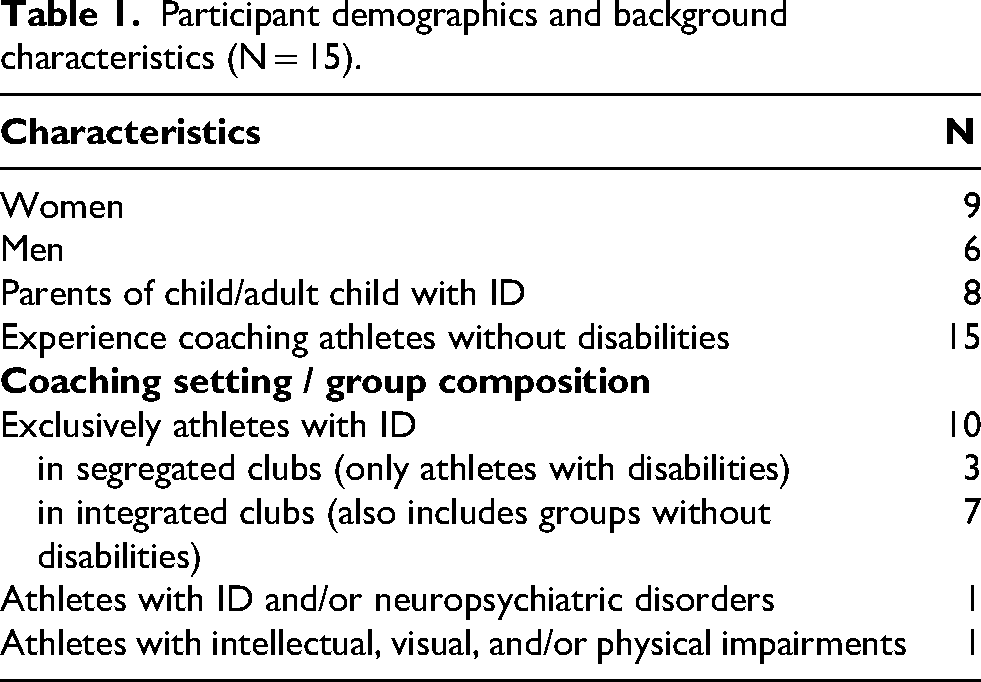
Fifteen coaches (aged 45–68 years old with ID coaching experience of 3–40 years) agreed to participate and met the following inclusion criteria: aged 15–70 years, and had been coaches for athletes with ID at least once a week for one year. Further descriptives of participants are shown in Table 1. The participants coached a broad range of individual and team sports, including alpine skiing, athletics, basketball, cross-country skiing, floorball, bowling, handball, judo, and swimming.
Participant demographics and background characteristics (N = 15).
Data collection
Semi-structured interviews were conducted online by two researchers (JO and MLO). One researcher led the interview, while the other observed, took field notes, and asked follow-up questions when needed. All interviews were conducted in Swedish and had an average duration of 67 min.
This dual-researcher approach supported reflexivity, ensured depth in data collection, and enhanced the credibility of the interview process. The interview guide (see Supplementary Material 1) comprised five thematic areas: (1) participant background, (2) the coach's role, sports club, and training group, (3) leadership and coaching practices, (4) training design and adaptations, and (5) perspectives on support needs in coaching athletes with ID. All interviews were audio-recorded using an Olympus voice recorder (DM-720). In parallel, audio files were automatically transcribed using Microsoft Teams (version 24215.1007.3082.1590). The automated transcripts were subsequently checked against the original recordings and carefully revised to ensure accuracy and completeness prior to analysis. This verification process enhanced data reliability and ensured that participants’ meanings were faithfully represented in the final dataset.
Data analysis and reflexibility
Data were analysed using reflexive thematic analysis, focusing on coaches’ experiences in relation to the study aim. This approach was chosen for its capacity to identify patterns of meaning across participants’ experiences and for its flexibility in exploring the relational and experiential dimensions of coaching. The analysis was guided by a relativist ontology and a social constructionist epistemology, assuming that reality is understood through multiple, context-dependent interpretations and that meaning and knowledge are produced through social interaction and communication.
Data coding was conducted inductively, following Braun and Clarke's six-phase process for reflexive thematic analysis.40–42 The authors familiarised themselves with the data through repeated readings of the interview transcripts, supported by reflexive journaling and analytic memo writing. Codes and themes were iteratively developed and refined through collaborative discussions. Researcher subjectivity was acknowledged as an analytic resource, and the authors’ combined professional and research experience in sport, disability, and inclusion supported nuanced interpretation of the data within the Swedish (para)sport context.
Ethical statement
This study was approved by the Swedish Ethical Review Authority (Dnr 2023-08126-01) and conducted in accordance with the Swedish Research Council's 43 guidelines for good research practice. All participants received written and oral information about the study's aims, procedures, and ethical considerations and provided informed consent prior to participation. All participants were informed of their right to withdraw from the study at any time without consequences. To protect participants’ integrity and confidentiality, all data were de-identified, and pseudonyms were used in transcripts and publications.
Results
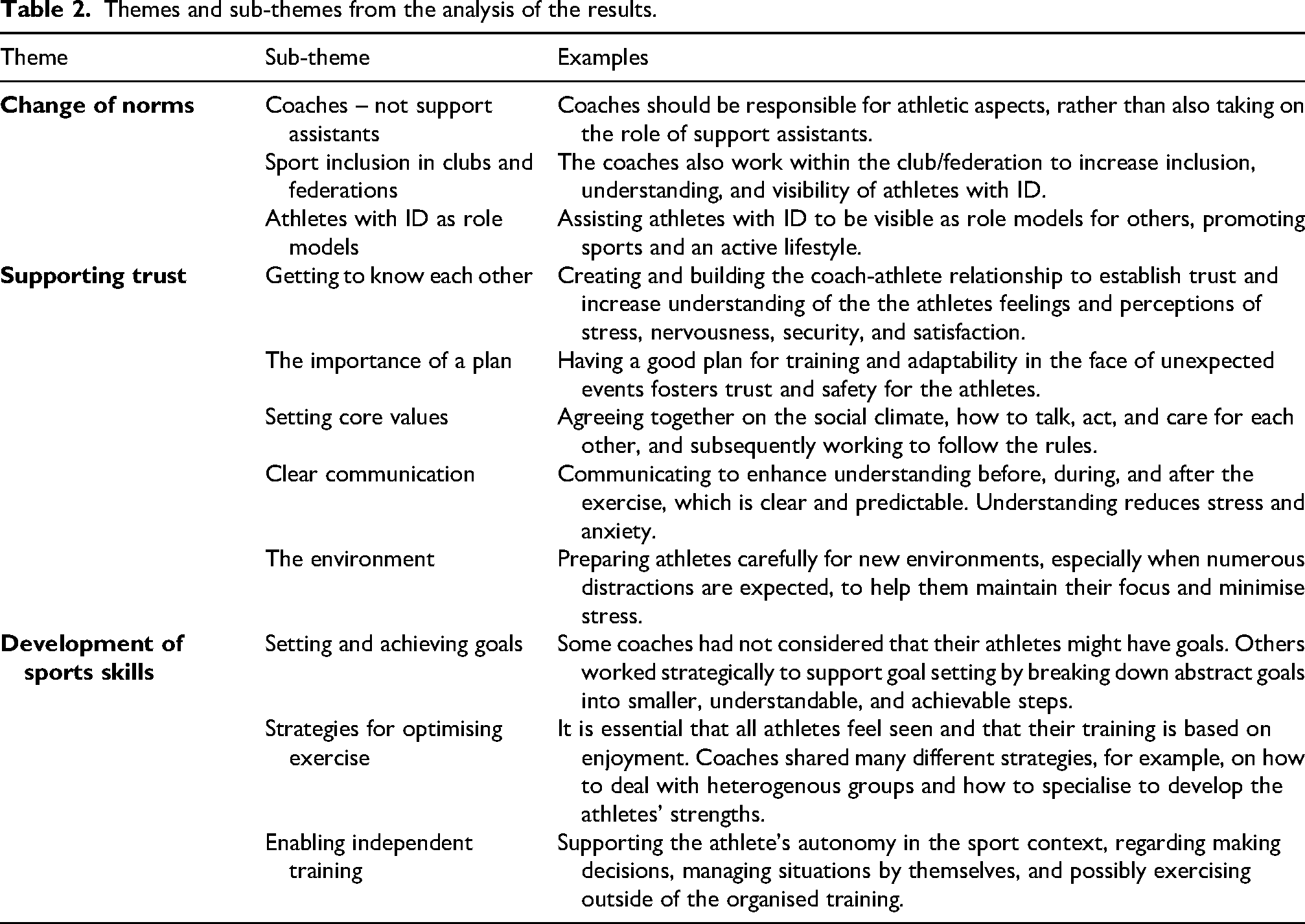
The reflexive thematic analysis, drawing on relational practices, yielded three themes that describe how coaches understand and describe their roles and actions: Change of norms, Supporting trust, and Development of sport skills, which were further broken down into sub-themes (Table 2).
Themes and sub-themes from the analysis of the results.
The results are presented below, accompanied by quotes that illustrate the themes and sub-themes. The quotes are marked with a number and the sex of the participants to indicate that they represent a diverse range of respondents.
Change of norms
The theme Change of norms emerged as an important area for the respondents, with the sub-themes Coaches – not support staff, Sport inclusion in clubs and federations, and Athletes with ID as role models. In this theme, the sub-themes focus on areas beyond sports training that are essential for equality in sports, ensuring equal conditions for athletes with disabilities compared to athletes without disabilities.
The sub-theme Coaches – not support staff emphasised the importance of focusing on the athletic aspects when coaching, rather than taking on a support assistant role. Respondents emphasise that it is easy to end up assisting with everything, but that as coaches, the primary goal is concentrating on the athletic side and how individuals can be supported to develop in the best possible way while helping the support assistants support the athletes. “We are coaches, not support staff, so we’re supposed to focus on the sport-specific stuff - that's what we do. Of course, if there's a snowstorm or thunder, hail and snow drifts, we can obviously drop them at the station or something if they don’t have their own transport.” (Participant 2, male)
The sub-theme Sport inclusion in clubs and federations demonstrated how coaches work towards increased inclusion and understanding of athletes with ID in their own clubs, and more generally, within their specific sport. This could involve, for example, including a separate class for athletes with ID at their local competition and raising awareness within clubs about the needs of athletes with ID regarding understanding and resources, such as sufficient training time, adequate physical space (e.g., swimming lanes), and an appropriate number of coaches to perform a proper training. “It's often a problem that the para classes get forgotten during the planning. … But if the class is there, and if he's [the athlete with ID] there, he competes with the others (without disabilities). But he still gets a medal in the para class.” (Participant 4, male)
Several coaches noted that their athletes with ID were initially not included on the same basis as other club members, but that increased visibility through competitions and media attention led to greater equity, including improved access to training space and time.
Further, coaches raised the issue that, in most cases, sports clubs only offer training one day a week for athletes with ID, emphasising that this reflects a common mindset within the sports community. In contrast, within training groups of non-disabled athletes, time and resource constraints are rarely framed as obstacles, as organisational practices routinely prioritise their participation. This highlights how normative sport structures tend to accommodate non-disabled athletes, while adaptations for athletes with ID are more frequently negotiated or questioned.
Respondents also note that many coaching colleagues working with non-disabled athletes lack this understanding, and emphasise that its development requires appropriate education and training. “What's needed is for coaches to gain more insight. I mean, I know this, and [fellow coach] knows about intellectual disabilities. But for others, if someone wants to become a coach for [parasport] or work with para-athletes, they should get training for that and develop an understanding for what's involved. We get it, but many regular coaches don’t – still.” (Participant 9, female)
The sub-theme Athletes with ID as role models emphasises the importance of making athletes with ID visible in sports, at both the recreational and elite levels. By illuminating their participation and achievements, this theme aims to challenge prevailing stereotypes and promote a broader societal understanding that athletes with ID have not only the legal right to participate in sports, but also the capability to excel in sports. Coaches highlight a shift in norms, where increasing media visibility and broader public awareness have contributed to a change in perceptions of what athletes with ID can achieve generally, not only in sports. “It's just important to highlight this group, to create role models—not just for other athletes but also to show the federation and others that this is for real. It's not just some kind of playtime.” (Participant 8, female)
Supporting trust
The theme Supporting trust emerged as an important area for the respondents with sub-themes Getting to know each other, The importance of a plan, Setting core values, Clear communication, and The environment.
The sub-theme Getting to know each other aligns with the social-relational model of disability, which emphasises the importance of coaches building a trusting and sustainable relationship with their athletes to gain a deeper understanding of their feelings and perceptions. Many coaches emphasised that the most crucial task is to build a strong relationship with their athletes, which creates a sense of security. When this sense of security is present, athletes are more likely to ask questions if they do not understand. “It's partly about this sense of security. When I’m there, if he doesn’t understand or can’t keep up, he can always turn to me and say, ‘Help explain to me, I didn’t understand’. It's much easier to do that with someone you feel very secure with than with a leader you don’t know well. But now, things have come so far that he feels very secure with the coaches he has, and it's no problem for him to say, ‘No, I didn’t understand’.” (Participant 6, male)
The sub-theme The importance of a plan emphasised the value of having a plan for the specific training, including who will do what, and an agreement to arrive there on time and be focused and engaged. If these things are not in place, the training session can become stressful for everyone, both athletes and coaches, which may lead to a lack of trust and safety. According to the interviewees, it should also be possible to be flexible and adapt the original plan to meet the athletes’ needs. “You have to be a bit more humble with this group as well, and be more flexible. You can't just go ahead and think, ‘I’m going to do it this way’. You have to listen. Sometimes, it might not work to do things one way, and then you have to adjust so it feels like you’re meeting their needs.” (Participant 12, female)
The sub-theme Setting core values showed how coaches, especially in team sports and specific parasport training groups, have created their own common rules together with athletes, which this study interprets as setting core values. These core values deal with the social climate, including how to talk, act, and care for each other. Building a shared core values framework fosters relationships and trust within the group of athletes, as well as with the coach/coaches. “Yes, but we talk a lot about how to treat others. They have created a kind of map about how to be a good friend and what our club stands for. We have worked a lot on that.” (Participant 1, female)
The sub-theme Clear communication illustrates how coaches prioritise communication strategies that help athletes understand what will happen in the training session, as insufficient or last-minute information may lead to confusion, stress, and anxiety. Coaches emphasised that clear communication is particularly important for athletes with ID. Clarity was achieved through strategies applied before, during, and after activities, including providing information in accessible formats and in advance, maintaining a predictable training structure, using adaptable communication tools such as visual (whiteboard, image support, coloured cones, visualtimer) and auditory aids (music or silence), demonstrations with their own body of how to do things, and in some cases sign language. A common approach was to limit the amount of information by focusing on one element at a time and gradually building complexity. “Clarity is incredibly important. As soon as things become a bit unclear, he gets anxious and nervous, and then things go wrong, and it's hard to focus on the training at all. Yes, often it's helpful to have a little preview of the whole plan, even if I’m not the one leading the training. The athlete feels much better hearing it in advance. Surprises are fun, but they can also be very stressful.” (Participant 6, male)
One of the coaches mentioned that duct tape was her most effective coaching tool, which she used to mark body parts (e.g., lifting a knee) to be involved in certain exercises or elements of the physical environment (such as the floor or a goal). This approach was intended to enhance her coaching by providing visual and tangible cues, making instructions easier for the athletes to understand compared to abstract verbal directions, such as “tape hand” instead of “right hand” or “aim to shoot at the tape” instead of “aim for the top corner”.
The sub-theme The environment addressed the ways in which the training environment affects athletes with ID. An environment with a lot of people, various things going on, and a high level of noise impedes communication and disturbs athletes’ focus during training by causing distraction, which also leads to stress. Clear communication is also sometimes necessary to prepare athletes for changes in the environment, such as a new arena for a match or a training camp. “We had never been there [competition venue] before - and we just had to throw in the towel [leave the place]. That's something we are working hard on now. We check the accommodation, collect together some pictures, and try to prepare them as much as possible.” (Participant 6, male).
Development of sport skills
The last theme, development of sport skills emerged as an important area for the respondents regarding coaching athletes with ID, regardless of the athletes’ goals, whether aiming for a pleasant social and physical activity once a week or aspiring to achieve a specific level of performance. This theme was composed of the sub-themes Setting and achieving goals, Strategies for optimising exercise, and Enabling independent training.
The sub-theme Setting and achieving goals reflects how coaches understand and work with goals together with their athletes, including goal setting and training towards these goals. About half of the interviewees discussed individual goals with their athletes, while others focused on establishing shared team goals.
Several coaches emphasised the importance of having clear and supportive communication with their athletes to address strengths and areas for improvement. These conversations were seen as essential for developing athletes’ skills and, most importantly, for ensuring that they are taken seriously in their sport. “You can see how much work they put in, you can see it in their effort to be better, you know, to develop. That's what really matters.” (Participant 8, female)
A few coaches were also surprised to realise that they had overlooked talking about goals with their athletes with ID, which they normally would have done with athletes without ID.
Several coaches explained the challenge of supporting the athletes to understand the level of training required for athletic improvement and development towards their goals. Because this is an abstract process that takes time, it can be challenging to convey to athletes with ID, particularly helping them to understand the link between training, skill improvement, and goal attainment. “We’ve probably not worked very effectively on this compared to non-disability sports, which are quite clear in their approach. There, it's all about, ‘What are your goals? Let's make a training programme’… For someone with an intellectual disability, it can be quite difficult to grasp the concept of, ‘You need to train these many times a week, for this many hours, to be this good’. Why should I be that good? What will I do then? And what happens after that?” (Participant 11, male)
However, through the focused work of the coaches, the abstract process of training to reach one's goals can be made clearer and more understandable. “To win a medal at a championship. It's not something everyone can do; it requires hard work to get there, and I think that was very difficult for X in the beginning. We’ve talked a lot about that, and I’ve drawn it out on a piece of paper, showing how [the process works] and outlining different sub-goals, trying to explain.” (Participant 6, male)
The sub-theme Strategies for optimising exercise highlights that athletes with ID often need more time to learn and that training groups including these athletes are typically more heterogeneous in terms of age and skill level than non-disability groups. Sessions progress step by step, beginning with simple activities and gradually adding load, technique, or tactics. This method draws on coaches’ experience, since, for example, a rising heart rate can trigger fear or stress. Training also often includes repeated exercises to create security and stability for the athletes. “And that's important—the training sessions almost always look exactly the same… And that's actually really important for creating a sense of security. If we come in and introduce a bunch of new exercises, it can be difficult for some, creating frustration and anxiety, which can turn into something negative and unenjoyable. So, we keep things quite similar almost every time.” (Participant 10, male)
Coaches who work with groups/teams of athletes with ID experience that it is also challenging to adapt the training when the group is heterogeneous. Many of the coaches adapt the training using a stepwise method; another solution is to offer the athletes different choices, such as the option to try an easier or a more challenging exercise. Others have more skilled athletes assist less skilled athletes (for example, passing them the ball) and ensure that the more skilled athletes receive challenges in another setting. “Nowadays, I often divide them into two groups, so that those who are a bit more skilled in this sport play on one side, while the others are on the other side. They might do the same drill or play a game, but it's slightly modified on the side where they are at a lower level.” (Participant 14, female).
If athletes with ID are to learn the same things as athletes without disabilities, it will take a longer time to develop all the skills needed to reach the same level. This reflects somewhat a normative understanding of learning. Some coaches choose to focus on earlier specialisation to enhance competence in a certain sport skill and believe that it may also enhance motivation. “In non-disability sports, this is referred to as specialisation—focusing on developing one's strengths and excelling in a specific area. This concept applies to any sport, but for this particular group, specialisation may come at an earlier stage.” (Participant 15, female)
The last sub-theme, Enabling independent training, is related to autonomy in the sports context. The coaches try to incorporate various training elements which give the athletes practice in making choices and decisions and managing situations on their own. This approach was emphasised as a key factor for success. “[We] work continuously with them so that they feel secure and confident. I usually say, ‘Today, we are going to try a competition warm-up, and you know that I may not always be there. So now, it's up to you to decide — each of you can choose two exercises’. They then explain to the others what we are going to do. We practise this regularly to ensure they feel comfortable leading their own competition warm-up when we are in different places.” (Participant 3, female)
At a later stage, the coaches encourage their athletes to train independently, which involves learning how to perform exercises safely, for example by reducing the risk of injury during strength training. These aspects are practised during coach-led training sessions, where the coaches adapt the necessary tools to the individual athlete.
One coach, who was also the athlete's father, emphasised the sense of independence and freedom he and the athlete experienced when the athlete was able to train independently without needing individual coaching support. “Yes, it provides much more flexibility. He can also schedule his training at a time that suits him, without being dependent on my availability.” (Participant 6, male)
Discussion
The overall aim of this study was to explore how coaches understand their role in relation to athletes with ID, describe their relational work, and make concrete adaptations that support athletes with ID in participating in sports. The analysis resulted in three themes: Change of norms, Supporting trust, and Development of sport skills, each accompanied by corresponding sub-themes (Table 2).
To challenge norms regarding sport inclusion and expectations for athletes with ID was important for the coaches. They engaged for their athletes not only by working with them as individuals but with the whole sports environment in the club, the federation, and wider society, advocating for changes in attitudes and inclusive competitions, and making efforts to influence how society and support persons perceive sports for persons with ID sports for persons with ID. Earlier research has shown that many coaches within non-disability sport perceive themselves as lacking the appropriate knowledge to work with persons with ID. 44 Consequently, coaches for athletes with ID become key actors in challenging existing norms and sharing knowledge with non-disability coaches to reduce misconceptions and fear within the broader coaching community. The current study showed how coaches promote their athletes with ID to serve as powerful role models, demonstrating that they are not only able to engage in sport but also do so with high levels of skill, commitment, and performance, thereby inspiring others and contributing to more inclusive norms and acceptance of diversity within sport and society. The coaches play a central role not only in supporting their athletes but also sharing knowledge and expertise with others within the sports club, which facilitates a smoother transition towards a more inclusive sporting environment in which individuals with ID can participate in sport according to their abilities. 45
Coaches expressed a wish to focus on coaching rather than acting as support assistants, yet they are often expected, explicitly or implicitly, to take on responsibilities beyond the sport itself when coaching athletes with ID, expectations that rarely arise when coaching athletes without disabilities. Because athletes with ID frequently rely on a support network (e.g., parents, support staff, or residential staff) to enable participation, coaches must also develop an understanding of and interact with this network. 14 However, research suggests that overprotective support persons may unintentionally restrict athletes’ opportunities for independence due to low expectations or emotional overprotection.46,47 Therefore, when an athlete is new to sport, it is essential for coaches to understand both the athlete and their support network, and, when necessary, to educate and support the support persons in order to foster trust and confidence in the athlete's potential.
The theme Supporting trust is consistent with the social–relational model of disability, which places the athlete at the centre and aims to create the most supportive environment possible based on their individual abilities. 33 This theme also emphasised the importance of coaches’ interpersonal knowledge 24 and communicative competence. 39 Their interpersonal abilities enable them to adapt their behaviour in interactions with their athletes, aiming to create optimal conditions, while their ability to communicate ensures mutual understanding between coach and athlete. In establishing this understanding, the current study demonstrated the importance of various communication methods, as well as the value of “checking in” with the athletes more frequently and asking open-ended questions (requiring an answer beyond a simple yes or no) to gain a deeper understanding of their emotions. This method has also been recommended by other studies as verbal and body language may be misunderstood in persons with ID.14,47,48 Developing a mutual understanding by learning to know each other is essential for building a relationship that enables insight into the athlete's need for support and adaptations. Here, communication with support persons can also be insightful when building the coach-athlete relationship 14 ; for example, understanding athleteśemotional response(s) after training or methods of communicating with athletes that may be used in other contexts. Grounding coaching practice in relational pedagogy fosters trustful coach–athlete relationships, creating a sense of security that promotes belonging and inclusion within sport. 49
The current study provided examples of concrete adaptations that can make abstract concepts more understandable, including easy-to-read text, visual supports (both images and videos), body language, and disseminating information well in advance. Building a sense of security when visiting new locations, such as by showing pictures and explaining what the place would look like, helped the athletes to feel more confident and prepared. This creates an environment in which the athletes feel secure and have trust in their coaches. It also supports a social climate where athletes feel comfortable asking questions when they do not understand what is expected of them or what will happen next, thereby preventing misunderstandings, stress and feelings of exclusion. Using a clear structure for training sessions gives predictability and will be beneficial for all athletes, regardless of whether they have an ID, other diagnosis, or no diagnosis. Therefore, working towards an inclusive and accessible environment should be encouraged, regardless of who is being coached.
The final theme, Development of sport skills, illustrated how the coaches worked to promote the athletes’ autonomy and their ability to make their own choices and independent decisions, enabling them to develop as athletes and build confidence based on their individual conditions associated with ID. This is emphasised in the relational competence model, which highlights the need for coaches to possess the sub-competence of differentiation (ability to regulate closeness and distance). For example, by creating an understandable training plan, coaches can support the athletes in making their own decisions and more independently choosing when they can train without being dependent on coach-led trainings. The sub-theme Setting and achieving goals illustrates how coaches work with goal setting for their athletes, adapting the process to make it understandable and achievable. These conversations were viewed as essential for developing athletes’ skills and their recognition within their sport, and were shaped by coaches’ responsiveness and sensitivity to the individual's capacity to comprehend and make sense of communication, as well as to their expressed wishes and goals, thereby contributing to meaningful participation and a strengthened sense of belonging. Coaches break goals down into concrete steps and focus on what athletes hope to gain from their sport participation. Goal setting is inherently abstract – requiring imagining the goal, planning how to achieve it, and perceiving time – which can be particularly challenging for athletes with ID. 9 Coaches play a crucial role in making this process comprehensible, thereby supporting motivation, meaningful participation, well-being, and a sense of belonging. To initiate goal setting, coaches often suggest suitable goals or sub-goals to provide concrete targets that guide development and progression. 50 Some coaches implement goal-directed training, using adapted communication to enhance understanding of both the goal and the process to reach it, such as visual aids with colour coding to indicate training load, with green for low and red for high intensity. Other coaches were surprised to realise that they had overlooked talking about goals with their athletes with ID, which they normally would have done for athletes without disabilities, revealing lower performance expectations consistent with findings by Sakalidis et al.. 45
Coaches also employed strategies to support athletes’ autonomy in sport, gradually developing decision making and responsibility through small, incremental steps in coach-led sessions, tailored to each athlete's abilities and level. The underlying belief is that all athletes with ID have the ability to increase their autonomy, but the goals are individual: some athletes may learn to make choices within coach-led sessions, while others may progress to training independently. Autonomy is recognised as a fundamental human right for people with ID and a key dimension of health, well-being, and participation, as emphasised in international frameworks such as the UN Convention on the Rights of Persons with Disabilities. 51 Research indicates that autonomy-supportive practices can enhance self-determination and promote bio-psycho-social well-being. However, further research is needed to clarify how autonomy is supported and experienced by individuals with ID in everyday contexts, including sport. Previous studies 52 highlight that autonomy support is complex, relational, and context-dependent, requiring adaptations tailored to individual needs. In sport and coaching, autonomy is relationally produced through interactions, expectations, and learning environments. Practices that support decision making, skill development, and meaningful participation may therefore play a crucial role in fostering both athletic growth and a sense of belonging among athletes with ID. Campbell and Stonebridge 14 highlight the value of non-linear pedagogy for autonomy-supportive practice in sports. The coach's relational competence in all three areas – communicative, differentiation, and socio-emotional – is needed to support athletes’ participation and encourage problem-solving rather than providing predetermined solutions, and thus, athletic development is enhanced in a more sustainable way. 53 Asking the athletes open-ended questions (requiring an answer beyond a simple yes or no) can draw the focus to self-reflection on “why” they are learning a certain thing rather than simply “what”, which could support sustainability and autonomy in sports. 14 However, this requires the relational understanding to pose questions which can be understood.
The current study identified notable gaps in the availability of coach education and training for coaches working with people with ID; consequently, ID competence in coaches is often acquired primarily through experience and learning by doing, a finding also reported by MacDonald et al.. 27 Limited education and reliance on learning by doing may result in coaching practices that are insufficiently adapted to athletes with ID, reinforcing ableist assumptions and contributing to experiences of exclusion and sport dropout. 21 The present study could support the knowledge base for development of coach education in this field. Adopting a universal design approach by integrating disability-related content into all coach education programmes could foster broader understanding across the sport community and promote inclusion at the training, club, and federation levels. 54 Increased awareness throughout the sport context may enhance athletes’ sense of inclusion from the outset.
Limitations
This study has several limitations. It focused solely on coaches’ perspectives and did not include the experiences of athletes or other stakeholders. The athlete's perspectives were addressed in an earlier phase of this research project and has been reported in a previous publication. 26 Participants were recruited exclusively through Parasport Sweden's social media channels. Consequently, the sample may represent a self-selected group of engaged coaches, which could have influenced the findings. As the study was conducted within a Swedish context, the transferability of the findings to other settings may be limited, particularly with regard to the organisation of sport for athletes with intellectual disabilities and their living conditions. Finally, the researchers’ prior involvement in sport, disability, and inclusion may have influenced both data collection and analysis. However, reflexive discussions were conducted throughout the research process. The research team had diverse backgrounds, spanning both research and practice in sport, special education, and healthcare, which enriched these discussions by incorporating multiple perspectives.
Conclusion
The results of the study identified three themes: Change of norms, Supporting trust, and Development of sport skills. Establishing a trusting relationship with athletes enabled coaches to better understand their individual needs and to develop communication strategies that supported both social and sport skill development. Such relationships also encouraged athletes to ask questions when aspects of training were unclear. Understanding athletes’ goals and needs guided coaches towards more inclusive practices at multiple levels, including tailoring adaptations to make abstract concepts more understandable and adopting an autonomy-supportive coaching approach.
Coach education and knowledge related to coaching athletes with ID remain limited. This study can contribute to enhanced knowledge and competence among coaches, sport clubs, and sport federations by illuminating that inclusion for athletes with ID depends on how their voice, influence, and resources are enabled within sport contexts, which impacts sport equity and athlete skill development.
Supplemental Material
sj-docx-1-spo-10.1177_17479541261451716 - Supplemental material for Building relations to identify the need for adaptations: Swedish coaches’ perspectives on sport inclusion of athletes with intellectual disability
Supplemental material, sj-docx-1-spo-10.1177_17479541261451716 for Building relations to identify the need for adaptations: Swedish coaches’ perspectives on sport inclusion of athletes with intellectual disability by Johanna Oskarsson, Eva Flygare Wallén, Kim Wickman and Marie Lund Ohlsson in International Journal of Sports Science & Coaching
Footnotes
Acknowledgements
The author gratefully acknowledges the participating coaches of the study.

Ethical considerations
This study was approved by the Swedish Ethical Review Authority (Dnr 2023-08126-01) and conducted in accordance with the Swedish Research Council's (2024) guidelines for good research practice.
Consent to participate
All participants received written and oral information about the study, explaining what participation in the study required and their rights, and after agreeing they signed an informed consent form before the interview. The written information was pre-approved by the Swedish Ethical Review Authority.
Participants were given information as part of the informed consent that their collected data and citations would be published in an anonymised fashion.
Author contribution
All authors together conceptualised the study. J.O. and M.O. conducted the interviews and analysis. K.W. and E.F.W. acted as critical friends in the analysis. All authors reviewed the results and contributed to their interpretation. J.O. wrote the initial draft of the manuscript. All authors contributed to the writing of the manuscript. All authors reviewed and approved the final draft of the manuscript.
Funding
This study was funded by the Swedish Research Council for Sport Science (grant number P2024_0090), Rolf and Gunilla Enström Research Foundation, and the cooperation agreement between Mid Sweden University and the municipality of Östersund.
Declaration of conflicting interests
The authors declared no potential conflicts of interest with respect to the research, authorship, and/or publication of this article.
Data availability
The data that support the findings of this study are available on reasonable request from the corresponding author. The data are not publicly available due to privacy or ethical restrictions.
Supplemental material
Supplemental material for this article is available online.
References
Supplementary Material
Please find the following supplemental material available below.
For Open Access articles published under a Creative Commons License, all supplemental material carries the same license as the article it is associated with.
For non-Open Access articles published, all supplemental material carries a non-exclusive license, and permission requests for re-use of supplemental material or any part of supplemental material shall be sent directly to the copyright owner as specified in the copyright notice associated with the article.
