




Abstract
This study compared physical and technical performance parameters of matches across three consecutive seasons (2020–2023) in the Turkish Super League (TSL). A total of 936 official matches were analyzed. Four physical and fourteen technical performance parameters were evaluated using one-way analysis of variance (ANOVA) applied to season-averaged match data. Performance parameters demonstrated overall improvements across the three seasons; total distance covered (TD) ∼6% corresponding to a large effect size (ES) (p < .001, η2 = 0.20), high-intensity running (HSR) ∼10% reflecting a medium ES (p < .001, η2 = 0.12), sprint ∼20.3%; however, this change was associated with a small-to-medium ES (p < .001, η2 = 0.10), maximal speed (MSS) ∼1.2% corresponded to a small ES (p < .001, η2 = 0.06). Offensive performance showed gains in expected goals (xG) ∼13%, box entries ∼7.2%, passes ∼3%, completed passes ∼2.6%, key passes ∼20% and completed key passes ∼17.5% (all p < 0.05). Defensive actions also improved, with interceptions ∼5% and duels ∼4%, though the magnitude of change corresponded to a small effect size (η2 ≈ 0.01). These findings suggest progressive enhanced physical and technical performance, indicating an overall increase in match intensity across seasons in the TSL.
Introduction
Football performance is a multifaceted construct shaped by physical, technical, tactical, and psychological components.1–4 Over the past decade, it has become evident that the match has undergone substantial structural changes. This development and transformation process has progressively attracted sports scientists’ attention, particularly to technical, tactical, and physical domains. Therefore, teams that adapt to the pace and tactical demands of modern football often demonstrate performance profiles that are associated with competitive success. Possibly, this is one of the reasons why physical performance has been extensively analyzed using advanced tracking systems, particularly GPS technology. Studies have consistently reported increases in total distance covered, high-speed running (HSR), and sprint metrics over time.5–8
In modern football, the increasing match tempo and the growing importance of transition phases (defensive-to-offensive and offensive-to-defensive) impose short-duration yet high-intensity physical demands on players.9,10 HSR and sprint actions frequently occur during attacking movements such as runs behind defensive lines or rapid ball circulation, and these actions are often observed alongside technical indicators reflecting offensive productivity, such as entries into the penalty area, key passes, and expected goals (xG).11,12 In this context, seasonal variations in physical performance profiles may coincide with changes in match tempo, transitional play frequency, and broader structural developments in teams’ playing styles.13–15 Although studies addressing these issues exist across various professional football leagues, longitudinal analyses that jointly examine physical and technical performance dimensions remain limited, and this gap is particularly evident in the context of the Turkish Super League (TSL).1,8,16–18
Previous longitudinal studies across various leagues have reported considerable changes in both physical (e.g., total distance covered, HSR)8,17–21 and technical (e.g., number of passes, successful pass rate)1,8,14,17,18 performance parameters. For instance, research conducted in the English Premier League revealed a 30–50% increase in HSR and sprint distances, along with a 40% increase in the number of passes over a seven-season period. 1
In addition, changes in physical demands have been shown to be position-specific, and that running with ball possession has been associated with team success,8,16,22 highlighting the potential interaction between physical and technical performance characteristics in football. 23 While most longitudinal studies have focused on European leagues,1,14,17,24–26 similar trends have also been reported in the Chinese Super League (CSL). Zhou et al. (2020) reported ∼10% increases in sprinting and HSR distances, alongside notable increase in crosses (∼23%), shots on target (∼12%), and entries into the opponent's penalty area (∼11%). Importantly, HSR increased when more out of possession, highlighting the growing defensive demands in modern CSL match play. 18 Despite this growing body of evidence, integrated longitudinal analyses jointly examining physical and technical performance remain scarce in the context of the TSL.
As a consistently competitive league among UEFA member associations, the TSL provides a valuable and underexplored context for evaluating performance trends using both physical and technical parameters. In this context, analyzing the seasonal evolution of physical and technical performance parameters in the TSL is crucial to understanding the dynamics of intra-league competition and establishing a foundation for international comparisons. Therefore, the present study aimed to investigate the seasonal evolution of physical and technical performance parameters in the TSL across three consecutive seasons (2020–2023), aiming to examine whether physical and technical indicators change across seasons.
Methods
Subjects
Specifically, teams competing in the TSL across three consecutive seasons (2020–2023) were analyzed using match-derived physical and technical performance metrics, with values averaged per match across both teams. Across three consecutive seasons (2020–2023), 21, 20, and 19 teams competed in the TSL, respectively. Teams played 40, 38, and 36 matches per season across the 2020–2023 period, yielding 420, 380, and 342 matches, respectively.
The final sample consisted of performance data collected from 26 professional teams over three seasons, with the match observations serving as the unit of analysis. A total of 936 out of 1.142 TSL matches from three seasons (2020 to 2023) were analyzed, while data from 206 matches were missing due to various factors such as the COVID-19 pandemic, earthquake-related disruptions, and unsuitable pitch conditions for some teams. Importantly, not all matches during the pandemic period were excluded; only those with insufficient or inconsistent data quality were omitted. This research was approved by the Scientific Research and Publication Ethics Committee of Trabzon University (Approval No: E- 81614018-050.04-2500057028; Date: 29 September 2025). In addition to this approval, permission to use the match-tracking data for scientific purposes was granted by Instat Limited, the company responsible for collecting and managing the TSL data.
Data processing
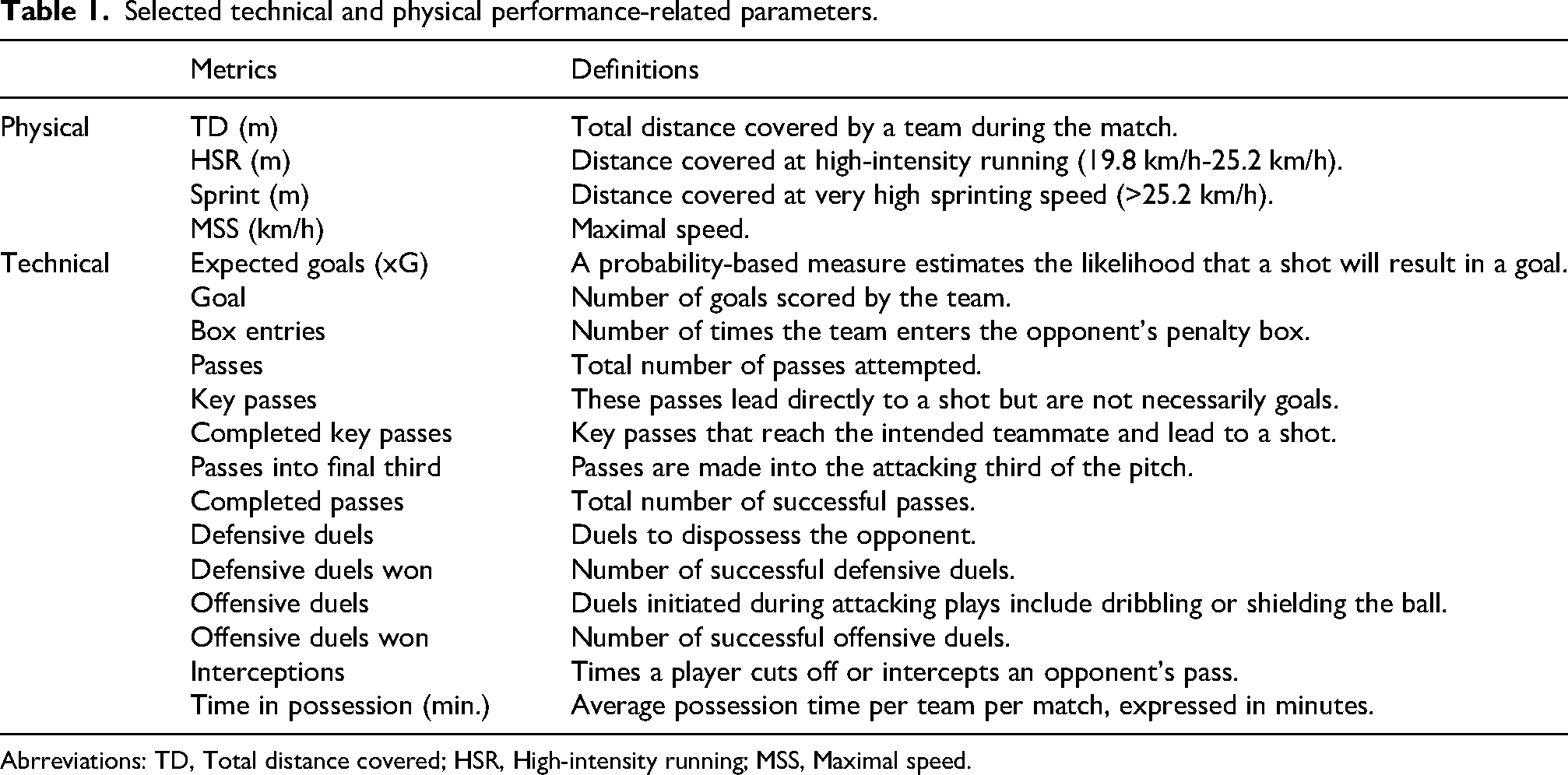
The technical-tactical and physical data were obtained using InStat football statistics system (InStat Limited, Limerick, Republic of Ireland), which employs an optical tracking technology operating at a sampling frequency of 25 Hz. The system's reliability was verified by its successful completion of FIFA's official test protocol for Electronic & Performance Tracking Systems, 27 which has been recognized as a valid and reliable platform for collecting synchronized match data in professional football.20,28–32 In line with previous research, a set of physical and technical performance-related variables were selected as dependent variables.8,14,17,18,21,33,34 The categories and definitions of these variables are detailed in Table 1. The running performance was examined considering the following variables = total distance covered (TD), the distance covered at HSR (19.8–25.1 km/h), and distance covered at sprint (>25.1 km/h).1,35,36 The selected speed thresholds were based on commonly accepted definitions in elite football performance research, HSR (19.8–25.2 km/h) and sprinting (>25.2 km/h) thresholds have been widely used to characterize high-intensity locomotor demands in professional football and to capture actions associated with rapid transitions and defensive line disruption.10,37 For the analysis of technical performance, the following variables were considered: xG, goal, box entries, passes, key passes, completed key passes, passes into the final third, completed passes, defensive duels, defensive duels won, offensive duels, offensive duels won, interceptions, and time in possession (min.).
Selected technical and physical performance-related parameters.
Abrreviations: TD, Total distance covered; HSR, High-intensity running; MSS, Maximal speed.
Statistical analysis
The unit of analysis in this study was the match. For each season, performance values were calculated as the mean of both competing teams per match, and the distribution of these seasonal averages was assessed for normality using the Shapiro-Wilk test. This analytical approach was adopted in line with a research design aimed at examining league-level performance dynamics rather than team-specific behaviours. Averaging the performance outputs of both teams within each match reduces match-specific contextual variability and enables a more balanced and representative evaluation of the physical and technical demands emerging across seasons within the competitive environment. Such an approach has been commonly employed in studies investigating league-wide performance trends in order to identify temporal changes in the structural characteristics of competition. Therefore, the findings of the present study should be interpreted as reflecting the evolution of performance trends at the league level, rather than differences attributable to individual team behaviours. To evaluate the effect of season on physical and technical performance variables, one-way analysis of variance (ANOVA) was applied, with season treated as the independent factor. When significant season effects were identified, Bonferroni-corrected post-hoc tests were conducted to determine pairwise differences between seasons. Effect sizes were quantified using eta squared (η2) to assess the magnitude of seasonal effects and were interpreted according to Cohen's recommended thresholds (0.01 = small, 0.06 = medium, and 0.14 = large).38,39 All effect sizes are reported together with their corresponding 95% confidence intervals, and all values presented in the text correspond exactly to those reported in the tables. Descriptive statistics are presented as mean ± standard deviation. The coefficient of variation (CV) was calculated based on match data as the ratio of the standard deviation to the mean and expressed as a percentage (CV = SD / mean × 100). 40 The study data were analyzed in the SPSS package program (IBM SPSS 21.0. Armonk, NY: IBM Corp.). The significance level in statistical analysis was set at p < 0.05. Graphs illustrating the seasonal changes in physical and technical performance metrics were created using GraphPad Prism (version 10.0; GraphPad Software, San Diego, CA, USA). Mean values per match (calculated as the average of both teams) were plotted across seasons (S1: 2020–2021, S2: 2021–2022, S3: 2022–2023), with error bars representing the standard deviation (SD).
Results
As presented in Table 2, the seasonal analysis of physical parameters demonstrated significant improvements between the 2020–2023 seasons (p < 0.001; CV range: 2.0%-22.1%). TD covered increased by ∼6%, increasing from 110,397.8 ± 4933.8 m to 116,897.8 ± 5312.5 m (F(2, 933) = 119.2, p < 0.001, η2 = 0.20, 95% CI [112696–113394]). HSR (19.8–25.1 km/h) and sprint (>25.2 km/h) increased by ∼10% and 20.3%, respectively (F(2, 933) = 65.0, p < 0.001, η2 = 0.12, 95% CI [7981–8100]). In addition, MSS improved by ∼1.16%, increasing from 29.3 ± 0.6 km/h to 29.7 ± 0.6 km/h (F(2, 933) = 27.3, p = < 0.001, η2 = 0.06, 95% CI [29.4–29.5]). These results indicate a consistent and significant enhancement in physical performance over the three-season period.
Seasonal averages of combined physical performance metrics per match (mean of both teams) in Turkish Super League, 2020–2023.

Abbreviations: ***p < 0.001; S1, 2020–2021; S2, 2021–2022; S3, 2022–2023; CV, Coefficient of variation; η2, Eta squared (effect size); MD, Meaningful difference; 95% CI for Mean, indicates the lower and upper bounds of the true mean at the 95% confidence level; TD, Total distance coveres (m); HSR, 19.8–25.1 km/h; Sprint, Speed over 25.2 km/h; MSS, Maximal speed; All values are presented as season-wise per-match means (mean ± SD).
Figure 1 illustrate seasonal changes in physical performance profiles across three competitive seasons (S1: 2020–2021, S2: 2021–2022, S3: 2022–2023) for (A) TD (m), (B) HSR (m), (C) Sprint (m), and (D) MSS (km/h). Values represent match averages calculated as the mean of both competing teams, with error bars indicating SD.
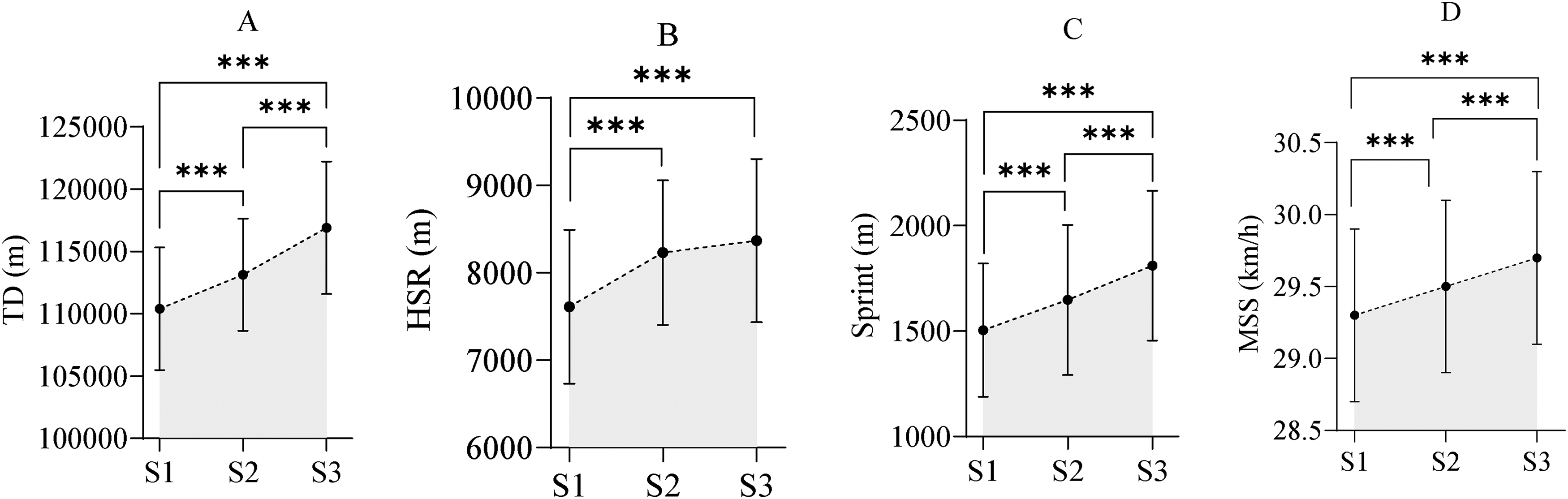
Seasonal evolution of physical performance profiles per match (mean of both teams). Note: ***p < 0.001; S1, 2020–2021; S2, 2021–2022; S3, 2022–2023; TD, Total distance coveres (m); HSR, 19.8–25.1 km/h; Sprint, Speed over 25.2 km/h; MSS, Maximal speed.
Table 3 summarizes the changes observed in several technical performance metrics across the three consecutive seasons in the TSL from 2020 to 2023. Statistically significant differences (p < 0.05) were identified, with the coefficients of variation (CVs) for the technical parameters ranging between 9.1% and 60.4%. Among these, key passes increased by ∼20%, from 6.5 to 7.8 (F(2,933) = 15.9, p < 0.001, η2 = 0.03, 95% CI [6.9–7.3]). Completed key passes increased by ∼17.5%, from 3.2 to 3.7 (F(2,933) = 8.7, p < 0.001, η2 = 0.02, 95% CI [3.3–3.5]). Time in possession (min.) increased by ∼3%, from 26.3 to 27.1 min. (F(2,933) = 7.9, p < 0.001, η2 = 0.02, 95% CI [26.5–26.9]). xG increased by ∼13%, from 1.4 to 1.6 (F(2,933) = 8.4, p < 0.001, η2 = 0.02, 95% CI [1.4–1.5]). Offensive duels won increased by ∼8%, from 33.2 to 35.8 (F(2,933) = 8.5, p < 0.001, η2 = 0.02, 95% CI [33.9–34.9]). Box entries increased by ∼7%, from 14.1 to 15.1 (F(2,933) = 9.5, p < 0.001, η2 = 0.02, 95% CI [14.4–14.8]).
Seasonal averages of combined technical performance metrics per match (mean of both teams) in Turkish Super League, 2020–2023.
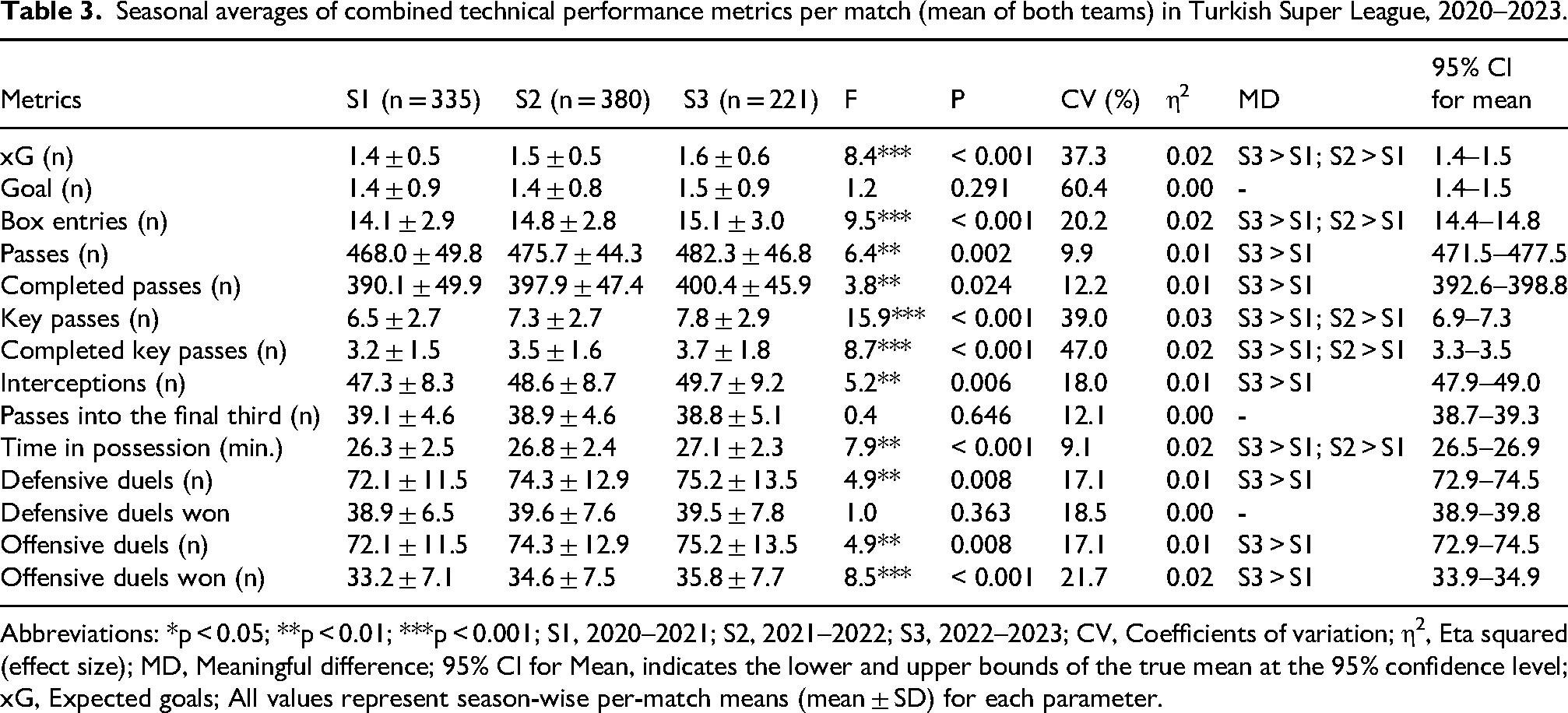
Abbreviations: *p < 0.05; **p < 0.01; ***p < 0.001; S1, 2020–2021; S2, 2021–2022; S3, 2022–2023; CV, Coefficients of variation; η2, Eta squared (effect size); MD, Meaningful difference; 95% CI for Mean, indicates the lower and upper bounds of the true mean at the 95% confidence level; xG, Expected goals; All values represent season-wise per-match means (mean ± SD) for each parameter.
Figure 2 illustrate seasonal changes in technical performance profiles across three competitive seasons (S1: 2020–2021, S2: 2021–2022, S3: 2022–2023) for (A) expected goals (xG), (B) goals, (C) box entries, (D) passes, (E) completed passes, (F) key passes, (G) completed key passes, (H) interceptions, (I) passes into the final third, (J) time in possession, (K) defensive duels, (L) defensive duels won, (M) offensive duels, and (N) offensive duels won. Values represent match averages calculated as the mean of both competing teams, with error bars indicating SD.
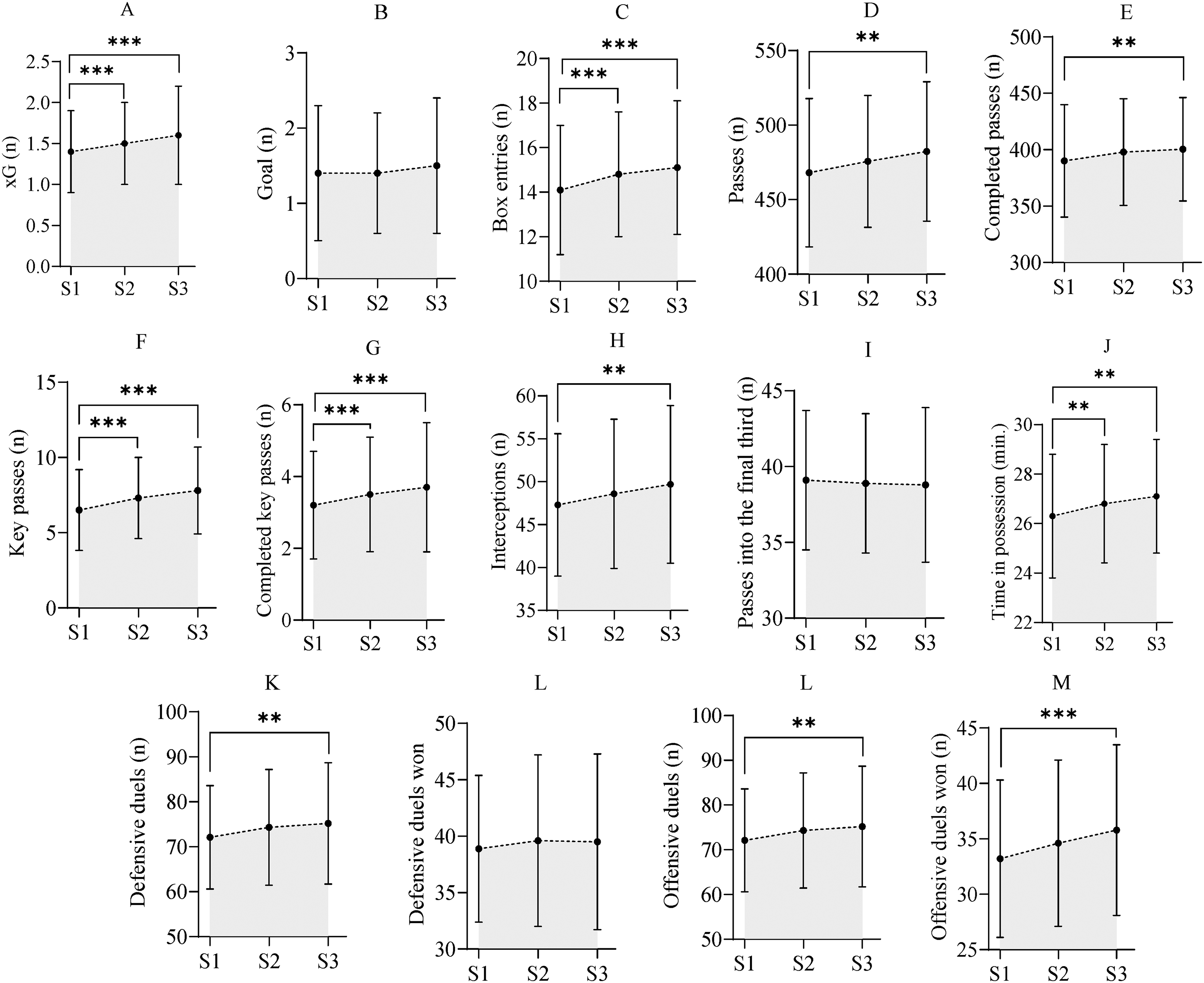
Seasonal evolution of technical performance profiles per match (mean of both teams). Note: **p < 0.01; ***p < 0.001; S1, 2020–2021; S2, 2021–2022; S3, 2022–2023; xG, Expected goals.
Discussion
To the best of our knowledge, this is the first study to examine the seasonal evolution of physical and technical performance parameters of teams competing in the TSL, specifically across the 2020–2023 seasons. The findings of the present study indicate a clear evolution in teams’ physical performance profiles across the observed seasons. Regarding the technical analysis, statistically significant increases were observed only in key passes and offensive duels won, whereas no significant change was found in other technical parameters. Over the course of the 2020–2023 TSL seasons, increases in players’ physical output were observed. These changes were accompanied by moderate-to-large effect sizes for TD (η2 = 0.20) and moderate effects for HSR and sprint distance (η2 = 0.12 and 0.10, respectively). In contrast, the change in MSS showed a smaller effect (η2 = 0.06), indicating that although statistically significant differences were detected, the magnitude of change in this parameter was relatively limited. These findings indicate a progressive increase in match-related physical demands over time. These results indicate a trend toward increasingly demanding match-play characteristics across the observed seasons, consistent with patterns reported in other elite leagues.
The progressive increase in physical demands observed across the 2020–2023 TSL seasons is consistent with recent evidence highlighting the growing role of tactical and contextual factors in shaping running performance in Turkish football. In particular, recent research conducted in the TSL has demonstrated that HSR outputs are strongly associated with tactical behaviors such as high pressing and counterattacking, as well as contextual factors including opponent quality and match location, rather than being explained by isolated physical factors alone. 41 These findings indicate that the observed increases in sprint and high-intensity metrics occurred alongside match contexts characterized by transition phases and pressing behaviours reported in previous literature. Accordingly, the evolution of physical performance in the TSL may reflect an adaptive response to changing match demands, showing similar directional tendencies to patterns reported in other elite competitions, although contextual differences between leagues should be taken into account when interpreting such comparisons.
Comparable upward trajectories have been documented in other professional leagues. In the CSL, Zhou et al. (2020) observed significant increases in sprint distance, number of sprints, and high-speed efforts between 2012 and 2017, which the authors interpreted as a reflection of increased tactical tempo and international influences. Similarly, Barnes et al. (2014) reported comparable increases in physical intensity demands in the English Premier League.
The observed changes in sprint-related performance reflect an acceleration of physical demands within the TSL. This is consistent with findings from Lago-Peñas et al. (2023), who reported longitudinal increases in high-intensity efforts among LaLiga players from 2012 to 2019. 17 In the context of performance-related outcomes, the association between sprint metrics and team success has also been validated. Chmura et al. (2022) demonstrated that teams in the German Bundesliga that accumulated greater sprinting distance with ball possession were more likely to secure higher league standings, emphasizing the competitive advantage of high-speed physical output. 8 Interestingly, a study by Aşçı, Köklü, and Alemdaroğlu (2024) examining physical performance in the TSL between 2015–2019 reported reductions in high-speed and metabolic power metrics across seasons. Overall, the increases in physical performance metrics observed between the 2020 and 2023 TSL seasons indicate a trend toward higher match-related physical outputs.
These findings underscore the importance of continuous monitoring, position-specific training, and adaptation to evolving match demands to maintain competitiveness in modern elite football.
Another dimension of the research is the examination of the change in technical performance over time in the TSL across three consecutive seasons (2020–2023). The observed changes in selected technical indicators reflect minor variations in offensive actions, rather than substantial modifications in match-play structure. However, despite statistical significance, the observed effects correspond to small absolute changes at match level (e.g., approximately 1–2 additional key passes or offensive duels won per match), and the effect sizes for most technical indicators were small (η2 = 0.00–0.03). Therefore, these differences should be interpreted cautiously when considering their practical implications for overall technical performance. Moreover, the relatively narrow 95% confidence intervals associated with these technical variables indicate a consistent directional trend across seasons; however, the small absolute magnitude of change suggests that these findings should be interpreted cautiously when informing training prioritization or match-related decision-making. Despite the modest magnitude of change at match level, these trends may coincide with broader tactical patterns reported in professional football. These findings align with trends reported in other elite leagues. For instance, in the Spanish LaLiga, data from 2012 to 2019 revealed a steady increase in key offensive actions such as final-third entries and goal-scoring opportunities. 17 Similarly, analysis of the CSL identified progressive increases in key passes, particularly in top-tier teams, suggesting that improvements in offensive phases are linked with increased performance expectations.18,21
Moreover, these technical evolutions may be partly attributed to improvements in tracking and tactical analysis technologies, such as the Amisco® and Prozone® systems, which allow for more precise feedback and individualized tactical preparation.22,42 As stated in the systematic review by Castellano and colleagues, such systems enable coaches to identify trends in technical and physical performance parameters that can shape training content and in-game decision-making. 42
From a performance analysis perspective, the observed enhancement in offensive duels won represents a modest absolute increase at match level and may not directly translate into proportional gains in goal scoring or expected goals. Despite the limited magnitude of change at match level, such metrics may still provide valuable contextual insights when analyzed alongside broader models that integrate both chance creation and finishing. 43 Their dual prediction model emphasizes the combined importance of pre-shot actions (e.g., successful duels, key passes) and post-shot efficiency (e.g., shot conversion), highlighting that improvements in upstream offensive metrics-like duels won-can significantly influence a team's overall attacking effectiveness, even if not directly reflected in xG or scoring rates.
When interpreted within the broader global football context, the seasonal changes observed in the TSL indicate a process of tactical and physiological adaptation to the increasingly high-tempo and transition-oriented nature of modern football. Contemporary match is characterized by elevated match tempo, the decisive role of transitional phases, and a higher frequency of high-intensity actions, reflecting not only greater physical demands but also the evolution of tactical structures and match models. In this framework, the trends identified in the TSL suggest a shift toward more dynamic and transition-based styles of play, with the overall findings indicating that the league's performance profile is progressively aligning with the global demands of modern professional football.
When interpreting the observed similarities between the TSL and other elite European leagues, considerations regarding generalizability and external validity should be taken into account. Differences in league structure, including the number of teams, prevailing styles of play, and schedule density, as well as methodological differences between measurement systems (e.g., optical tracking versus GPS-based systems and sampling frequencies), may influence both the magnitude of reported performance metrics and the extent to which results can be directly compared across leagues. Therefore, comparisons with other elite leagues should be interpreted as indicating similar directional tendencies in certain physical and technical performance variables rather than direct convergence or equivalence across competitive environments. It should also be acknowledged that several contextual factors known to influence match performance, such as match status, opponent quality, tactical formations, fixture congestion, seasonal phases, and environmental conditions, were not incorporated into the present analysis. Consequently, the observed seasonal trends should be interpreted primarily as descriptive patterns rather than causal explanations of performance changes. Building on these findings, future research should adopt integrated longitudinal frameworks that combine match-derived physical and technical performance data with training load information and key contextual variables (e.g., tactical formations, match status, opponent quality). Such approaches would enable a more precise examination of how evolving match demands translate into training adaptations and competitive success, thereby advancing the field beyond descriptive trend analyses toward a deeper understanding of the mechanisms underpinning performance evolution in professional football.
General evaluation
The analysis of physical and technical performance trends in the TSL over three seasons highlights a clear shift toward a more dynamic and physically demanding style of play. Notably, increased sprint load and MSS, reflect enhanced athletic capabilities and evolving tactical preferences. While offensive metrics such as xG, key passes, and goal attempts have improved, the stability in passing frequency and accuracy suggests that the league still favors direct play and quick transitions over structured possession. The observed trends suggest certain similarities with high-intensity leagues; however, such comparisons should be interpreted cautiously due to differences in league structure, match context, and measurement systems. Overall, the league demonstrates a trajectory of development consistent with international standards, signaling progress in physical performance and offensive efficiency.
Limitations
A key limitation of the present study relates to the analytical structure of the dataset. Because the analysis was based on season-averaged match data and ANOVA comparisons, the results primarily describe longitudinal trends at league level and do not allow modelling contextual variables, team-level effects, positional differences, or causal mechanisms.
All technical performance indicators were obtained from the same commercial tracking provider across the 2020–2023 seasons, and no changes in data processing models or algorithms were reported during this period. Therefore, methodological alterations are unlikely to explain the observed longitudinal trends. However, 206 matches were excluded due to missing technical data, with an uneven distribution across seasons (Season 1: 85; Season 2: 0; Season 3: 121). This imbalance may have influenced the estimation of season-averaged technical indicators and may introduce potential seasonal estimation bias, which should be considered when interpreting between-season comparisons, particularly regarding the magnitude of observed differences. This unequal distribution of excluded matches may introduce potential seasonal estimation bias, particularly when interpreting technical performance trends across seasons.
The absence of training load and training content data represents a major limitation of this study and prevents causal interpretation of the observed seasonal changes in match performance. In addition, several contextual covariates known to influence match performance such as match status, opponent quality, tactical formations, fixture congestion, seasonal phases, and environmental conditions were not incorporated into the present analysis. Building on the limitations identified in the present study, future research should move beyond descriptive seasonal comparisons and adopt integrated longitudinal designs that simultaneously incorporate match-derived physical and technical performance data with training load metrics and contextual variables such as tactical formations, match status, opponent quality, and fixture congestion. The integration of training exposure with match demands would enable a more mechanistic understanding of how evolving physical and technical requirements translate into performance adaptations over time. Such approaches are essential for advancing the field toward evidence-informed models that link competition demands, training processes, and competitive success in professional football.
Future research should adopt integrated longitudinal designs combining match-level physical and technical data with contextual variables (e.g., match status, opponent quality, and tactical formations). Such approaches, particularly using mixed-effects models, may provide deeper insight into the mechanisms underlying performance evolution in professional football. Future studies could also employ sensitivity analyses, for example by re-estimating seasonal trends using only seasons with complete datasets, to further evaluate the robustness of the reported trends.
Conclusion
This study presents significant findings on how physical and technical performance metrics evolved in the TSL. Overall, these findings provide descriptive insights into the seasonal evolution of physical and technical match demands in professional football. Future studies are recommended to further support these trends through more extensive long-term analyses.
Footnotes
Acknowledgments
The authors would like to thank Instat Limited for providing access to the data which underpins this study.
ORCID iDs

Consent to participate
Not applicable.
Consent for publication
Not applicable.
Ethical considerations
This research was approved by the Scientific Research and Publication Ethics Committee of Trabzon University (Approval No: E- 81614018-050.04-2500057028; Date: 29 September 2025).
Author contributions
A.Ç. and E.T. conceived the study, designed the methodology, supervised the project, and performed the statistical analyses. H.C. and O.M. contributed to the interpretation of the statistical results. E.I. and Ç.T. were responsible for data collection, preprocessing, and validation. F.N. and R.P. made substantial contributions to the development of the methodological framework, data interpretation, and manuscript revision. All authors contributed to drafting the manuscript, critically revised the content, and approved the final version for submission.
Funding
The authors received no financial support for the research, authorship, and/or publication of this article.
Declaration of conflicting interests
The authors declared no potential conflicts of interest with respect to the research, authorship, and/or publication of this article.
Data availability
The datasets generated and analyzed during the current study are not publicly available due to data protection policies but can be obtained from the corresponding author upon reasonable request.