




Abstract
This study examined developmental trajectories of vertical jump performance in young female basketball and volleyball players using Bayesian multilevel modeling. Eighty-one Brazilian female athletes (basketball: n
Introduction
Vertical jump performance is an important determinant of performance in basketball and volleyball, where athletes must repeatedly execute explosive movements throughout competition.1–4 The countermovement jump (CMJ) has become widely integrated into youth talent development programs for assessing lower-limb power, justified by its practical application and sensitivity to training adaptations. 5 However, developmental data on jump performance in youth athletes remain limited, 6 particularly among female populations who remain substantially underrepresented in sports science research.7–9
Female athletes’ historical underrepresentation has resulted in training guidelines primarily based on male data, inadequately addressing female-specific developmental needs.8–10 This gap is concerning given that adolescence represents a complex and dynamic period where physical capacities change substantially through growth, biological maturation, and training exposure. 11 Assessments of physical fitness in young female athletes must consider substantial variability in maturation timing and tempo,6,12 as biological maturation substantially influences physical characteristics and athletic aptitude. 13
Longitudinal studies are essential for describing developmental trajectories and discriminating relative contributions of growth, maturation, and training. 14 However, real-world youth sport contexts present methodological challenges including dropout rates, irregular assessments, missing data, and heterogeneous patterns.6,15,16 Currently, limited longitudinal data in youth sports are predominantly based on males,6,7 with basketball studies mostly using cross-sectional designs.17,18 These characteristics result in mixed longitudinal data requiring robust analytical approaches. Hierarchical/multilevel models with Bayesian inference are particularly suitable, allowing estimation of non-linear trajectories, incorporation of multiple variability levels, and inclusion of contextual predictors.
This study examined developmental trajectories of vertical jump performance in young female basketball and volleyball players using Bayesian multilevel modeling, considering chronological age and sport-specific training context influences on performance across adolescence.
Methods
Study design and sample
This mixed longitudinal study incorporated data from Brazilian youth basketball and volleyball programs collected between 2016
Basketball players were assessed during competitive seasons (2016
Basketball players competed in state-level competitions supervised by São Paulo and Santa Catarina federations. Volleyball players competed in regional and state-level competitions in Paraná. All participants trained 2
The study received university research ethics committee approval. Athletes and parents/guardians provided written informed consent. All measurements followed Helsinki Declaration ethical standards.
Procedures
Chronological age was calculated to 0.1 years by subtracting birth date from testing date.
Vertical jump was assessed using the CMJ test. 21 Jump height (cm) was measured using an optical system (Optojump, Microgate, Italy). Athletes started from upright standing position with hands on hips, performed a downward movement followed immediately by maximal vertical jump. Three trials were performed with 30-second rest intervals. Best jump height was retained to the nearest centimeter. Intra-observer technical measurement errors were previously reported: basketball sample—0.25 cm (stature), 0.42 kg (body mass); 16 volleyball sample—0.23 cm (stature), 0.11 kg (body mass), 1.5 cm (CMJ height) 22
Statistical analysis
We applied a two-level polynomial growth curve model to assess developmental changes in vertical jump performance across adolescence (a complete description of the model is given in the Supplementary Material). The model describes each athlete’s successive measurements over time, characterizing individual changes at each measurement point (level 1) and variations in trajectories between athletes (level 2). We considered chronological age coefficients up to the quadratic terms. To account for potential sport-associated variation, we introduced sport (binary variable: volleyball, basketball) as a population-level effect, allowing for the possibility of sport-based differences in athlete responses at level 2. We also examined interaction terms between sport and age to determine whether the trends of change in jump performance varied between volleyball and basketball players.
For interpretative convenience and to speed up computation, we standardized the outcomes by subtracting the sample mean and dividing by two sample standard deviations (SD). Standardization by 2
Given the potential for noise in physical fitness measures and the presence of imbalanced repeated measures data, we exercised caution in our interpretations. We used weakly informative priors to regularize our estimates. We used independent normal priors, Normal(0,2), for the population-level parameters (i.e., intercept and slopes) and exponential(1) priors for the group-level standard deviation parameters (full prior specification is provided in the Supplementary Material).
We used leave-one-out cross-validation (LOO-CV) and posterior predictive checks to compare and evaluate our models. The difference in LOO-CV score (
We evaluated whether
To assess robustness of findings to data structure and quality, we conducted two sensitivity analyses by re-fitting the main model under different inclusion criteria (see Supplementary Material): (1) excluding athletes with a countermovement jump range of more than 10 cm across observations (range restriction, n
The data presented in this study, and code necessary to reproduce the analyses and figures are available in a repository at https://osf.io/pqz86/.
Results
All models converged successfully. Posterior predictive checks confirmed models adequately captured observed data patterns, with simulated data distributions closely matching observed vertical jump performance across the age range. Analysis included 293 observations from 81 athletes for the age and sport model, and 285 observations when body size variables were included due to missing measurements.
Developmental trajectories revealed non-linear patterns across adolescence with important sport-specific differences (Figure 1). Both basketball and volleyball players demonstrated accelerated development during early-to-mid adolescence followed by deceleration in performance gains. Volleyball players reached peak improvement rate earlier (
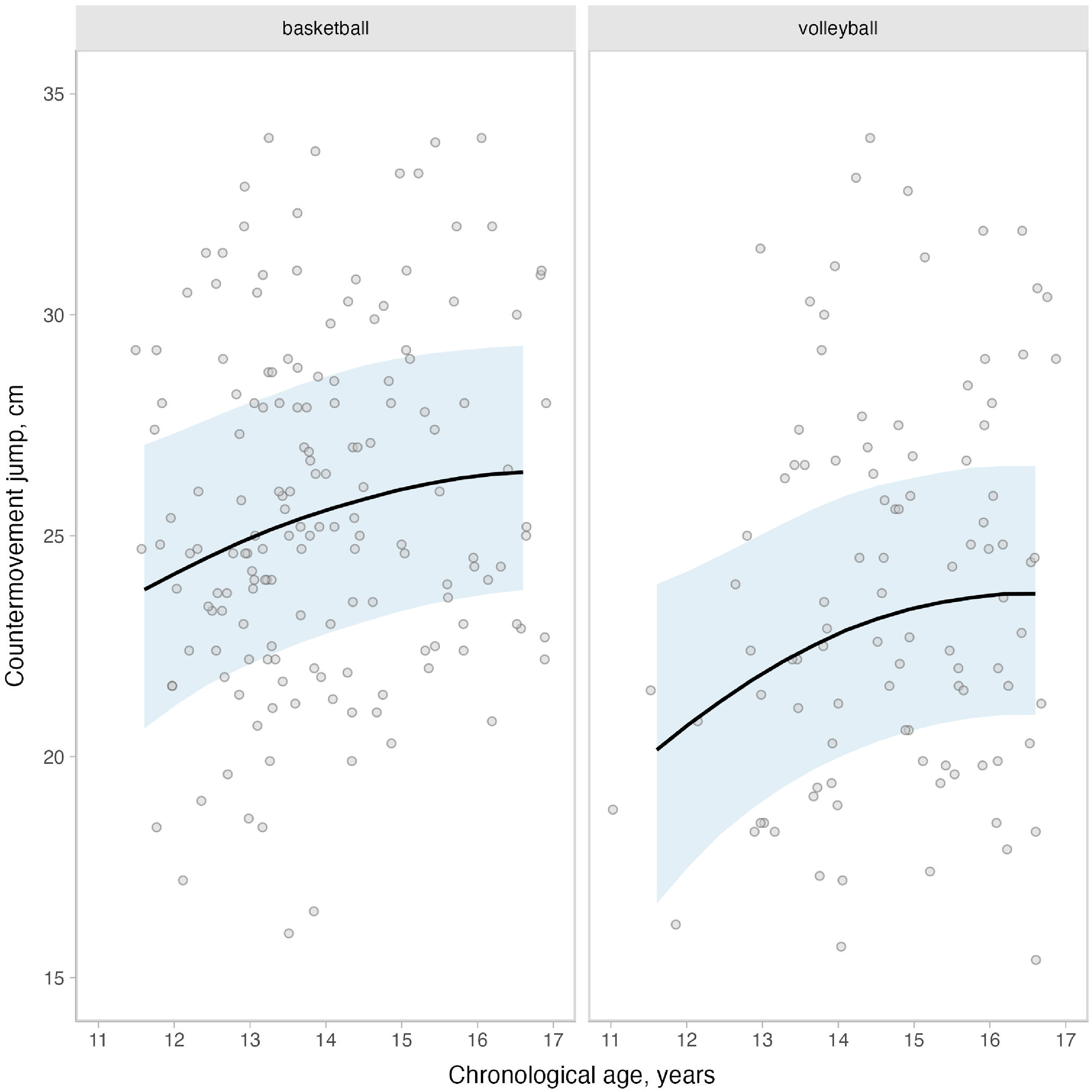
Developmental trajectories of vertical jump performance in young female basketball and volleyball players. Points represent individual observations. Black lines represent posterior mean trajectories, with shaded regions showing 68% credible intervals (CI).
For basketball players, the population-level trajectory was characterized by positive linear age effect (
Individual-level effects (group-level effects) revealed substantial between-athlete variability in baseline performance (
When adjusting for body size, the non-linear age-related pattern persisted and strengthened (
The varying intercept variance decreased when body size was included (
Our model specification constrained both sports to follow the same quadratic age relationship, with sport differences manifested through baseline offset. While we evaluated sport
Sensitivity analyses confirmed robustness of findings across data quality specifications (Supplementary Tables 3
Discussion
This study examined developmental trajectories of vertical jump performance in young female basketball and volleyball players using Bayesian multilevel modeling. Results revealed non-linear developmental patterns characterized by accelerated improvement during early-to-mid adolescence, followed by deceleration in performance gains. Visual patterns suggest possible timing differences, but a model including sport
Despite growing participation, female athletes remain underrepresented in sports science research, particularly longitudinal youth development studies.
7
Historical male-based research predominance has resulted in guidelines that may inadequately address female-specific developmental needs.
6
This study addresses this gap by providing longitudinal data on physical performance development in young female athletes across two popular team sports. Our observations of earlier performance plateaus (14
A key strength lies in using Bayesian multilevel modeling to handle challenges of longitudinal data collection in applied sport contexts. Real-world constraints—including athlete dropout, irregular assessments, and pandemic-related interruptions—result in incomplete and unbalanced repeated measures. Unlike traditional methods requiring complete data, our approach accommodates varying observations per athlete and explicitly quantifies uncertainty through credible intervals. 33 The multilevel structure simultaneously estimates population-level trends while accounting for substantial individual variability in performance,34,35 providing more nuanced representations than models assuming uniform trajectories. By modeling both population-level patterns and varying intercepts (individual deviations in baseline), our approach captures between-athlete heterogeneity while assuming common developmental trajectories within each sport. This is important in youth sport contexts, where athletes within the same age group may differ considerably in performance levels due to training history, biological maturation status, and training context.18,22,36 Given scarcity of longitudinal data in youth sports, this analytical approach advances methodological standards while accommodating practical realities.
The quadratic relationship between age and CMJ performance aligns with established adolescent development patterns and limited longitudinal data in youth team sports. 37 Initial rapid improvement during early adolescence likely reflects neuromuscular adaptations occurring post-puberty, with fat-free mass development typically continuing approximately one year after peak height velocity. 31 Subsequent deceleration, particularly evident in volleyball players after 14 years, contrasts with basketball players who maintained modest continued development through 15 years. This difference may reflect sport-specific factors—as female volleyball players approach adult stature, decreased relative net height-to-player stature may reduce functional demands for jump height development, particularly among taller players.19,22
Our data structure—mixed longitudinal design with variable assessment frequency (2
The persistence and strengthening of non-linear age effects after adjusting for body size confirms that developmental changes extend beyond simple growth-related increases. Body mass negatively associated with jump performance, while stature positively associated. These observations align with previous findings in young female basketball players, where leaner players demonstrated better performance during early adolescence,20,37 likely reflecting biomechanical challenges of propelling greater mass vertically. Near-zero associations between model residuals and body size descriptors validated our adjustment approach.38,39
While we did not directly assess biological maturation, previous cross-sectional observations suggest early-maturing female players are likely over-represented in youth basketball during early adolescence, though early advantages appear attenuated by late adolescence.17,36 Volleyball may attract or select athletes with different maturity status and accumulated training experience. 40 If basketball programs preferentially select early-maturing athletes who have already experienced peak growth by early adolescence, this could explain the more gradual developmental trajectory and continued modest improvements through age 15. If volleyball includes greater proportion of late-maturing athletes, the earlier peak rate at age 14 might reflect these athletes progressing through post-pubertal development during our observation window. These interpretations remain speculative without direct maturation assessment.
Lower baseline performance in volleyball players compared to basketball (
Substantial between-athlete variability in baseline performance (
An important strength of our study is the realistic data structure reflecting actual youth sport monitoring conditions. Rather than restricting analysis to “ideal” cases (athletes with perfect attendance and systematic assessment), we incorporated all available data, including athletes with variable participation patterns typical of youth sport contexts. Our sensitivity analyses demonstrate this yields interpretable, conservative estimates: developmental effects were ∼50% stronger in the subset with more intensive monitoring, while sport differences remained remarkably stable across all specifications (see Supplementary Material). This indicates our main findings provide realistic benchmarks applicable to typical youth sport settings, while also revealing the enhanced precision possible with more systematic protocols. Both perspectives are valuable—the former for immediate practical application under real-world conditions, the latter for understanding developmental potential under optimal monitoring.
Coaches and practitioners should recognize that physical fitness interpretations in adolescent female athletes must consider age-related developmental patterns, sport-specific contexts, and potential maturation-related selection effects. Training programs must address female-specific aspects rather than generalizing from male-based research. Performance expectations should be individualized and consider developmental trajectories rather than relying solely on chronological age or single-point assessments. Earlier plateaus observed in female versus male athletes highlight the importance of sex-specific normative data for guiding training and talent development practices.
While the Bayesian multilevel approach effectively accommodated our mixed longitudinal design with unbalanced data, more regular assessment schedules would strengthen inferences about individual trajectories. The study did not include direct biological maturation measures (e.g., age at peak height velocity, age at menarche), which would provide more precise estimates of maturation influence and allow empirical testing of maturity-related selection hypotheses. Training load, training history, and competitive experience were not quantified, limiting ability to disentangle specific contributions of training exposure from maturation effects. The varying intercept structure assumes common developmental trajectories within each sport; future research with more intensive repeated measures might explore whether varying slopes for age effects reveal meaningful individual variation in developmental rates.
The quadratic polynomial was selected based on theoretical expectations and data structure considerations. Preliminary exploration of cubic polynomials showed minimal improvement in fit with increased parameter uncertainty given sparse repeated measures. More flexible approaches (e.g., splines, GAMs) risk overfitting with irregularly-spaced observations. The quadratic specification provides an interpretable, parsimonious representation appropriate for our data structure.
Conclusions
This study provides important female-specific evidence for non-linear, sport-specific developmental trajectories of vertical jump performance in young basketball and volleyball players. Bayesian multilevel modeling accommodated incomplete data and irregular measurements, illustrating a methodologically robust approach for studying youth athlete development despite practical challenges of applied sport contexts. Physical fitness assessments in young female athletes must consider age-related developmental patterns, sport-specific contexts, and potential maturity-related selection effects. Training programs should address sex-specific developmental patterns rather than generalizing from male-based research, and practitioners should adopt individualized approaches considering developmental trajectories rather than relying solely on chronological age-based standards. This study contributes to the limited but critical evidence base needed to support young female athletes with approaches informed by female-specific data.
Supplemental Material
sj-pdf-1-spo-10.1177_17479541261455141 - Supplemental material for Developmental changes of vertical jump performance in young female basketball and volleyball players: A Bayesian multilevel modeling approach
Supplemental material, sj-pdf-1-spo-10.1177_17479541261455141 for Developmental changes of vertical jump performance in young female basketball and volleyball players: A Bayesian multilevel modeling approach by Fábio C Karasiak, Gabriel F Reis, Luciano G Galvão, Sandro Balbino Júnior, Thiago J Leonardi, Felipe G Mendes, André LA Soares, Ahlan B Lima, Carlos E Gonçalves and Humberto M Carvalho in International Journal of Sports Science & Coaching
Footnotes
Acknowledgements
The authors thank the patience and cooperation of the young athletes and coaches in the research project.
ORCID iDs

Ethical considerations
Ethical approval was obtained from the Research Ethics Committees of the Federal University of Santa Catarina (CAAE: 89424318.0.0000.0121) and University of Campinas (CAAE: 89424318.0.3001.5404).
Consent to participate
Written informed assent was obtained from all athletes, and written informed consent was obtained from their parents or legal guardians. Athletes were informed about the study purpose, confidentiality, and procedures.
Consent for publication
Not applicable.
Funding statement
The authors disclosed receipt of the following financial support for the research, authorship, and/or publication of this article: This work was partially supported by the Coordenação de Aperfeiçoamen to de Pessoal de Nível Superior (CAPES) – Finance Code 001, and the Programa UNIEDU/FUMDES Pós-graduação.
Declaration of conflicting interest
The authors declared no potential conflicts of interest with respect to the research, authorship, and/or publication of this article.
Data availability
Supplemental Material
Supplemental material for this article is available online.
References
Supplementary Material
Please find the following supplemental material available below.
For Open Access articles published under a Creative Commons License, all supplemental material carries the same license as the article it is associated with.
For non-Open Access articles published, all supplemental material carries a non-exclusive license, and permission requests for re-use of supplemental material or any part of supplemental material shall be sent directly to the copyright owner as specified in the copyright notice associated with the article.
