




Abstract
Performance Lifestyle (PL) is a career assistance programme within the British High-Performance System (BHPS) which aims to provide a wide-ranging holistic service to meet the varied needs of athletes competing in high-performance environments. A broad range of support has been identified including in regard to dual career, life balance, mental health and wellbeing, and transitions amongst numerous others. PL practitioners have supported professional athletes for over twenty years, however, there continues to be confusion and misunderstanding regarding what this discipline brings to elite programmes. The aim of this narrative review was to appraise, summarise and consolidate relevant literature discussing the PL discipline and how it currently supports athletes in their sporting and non-sporting commitments. The review reveals that athletes and practitioners describe PL support as beneficial, however, due to the expanded and holistic remit of provision, it is recognised that PL is delivered inconsistently driven by the diverse and highly contextual needs of the sport and its athletes. Athletes cite benefits in career planning, education, lifestyle management and psychological support. Yet despite various benefits, athlete engagement in services is only partial. Several disciplinary challenges were identified including how PL practitioners struggle with consistently promoting benefits in performance-driven contexts and in articulating the impact of PL work. This review indicates that PL benefits are primarily wellbeing and duty of care related with sporting outcomes less obvious. PL would benefit from future research investigating differences in applied practices between sports informing future programme resourcing and practitioner education initiatives.
Introduction
Performance Lifestyle (PL) is a career assistance programme (CAP) within the British High-Performance System (BHPS) and primarily supports athletes in Olympic and Paralympic sports. The objective of CAPs is to support athletes in their development, both personal and sporting, as they move and transition through their life in high-performance (HP) sport.1,2 CAPs have been a subject of research for many decades due to the range of issues athletes face during their careers. Previous research has identified concerns relating to transitions within sport, pressure to perform, career termination and a broad range of associated issues. 3 CAPs are pertinent when discussing PL because evidence suggests that the delivery of effective CAPs has been demonstrated to produce positive outcomes for athletes,4–7 indicating that the inclusion of CAPs within a HP programme is both appropriate and beneficial. Furthermore, previously published literature describes a taxonomy of CAPs, 6 the evolution of career assistance discourse, 7 and implications of cultural context. 8
PL is the successor to the Athlete Career and Education (ACE) programme which was a pioneering CAP originally created by the Victorian Institute of Sport in Melbourne (1990) and then adopted by the Australian Institute of Sport (1995). ACE went on to be licensed by other countries including the UK. Over time ACE developed into providing reactive support directly to athletes with little or no interaction with coaches or the sport governing body. 9 The title of ‘Performance Lifestyle’ was first introduced by UK Sport in 2004, with the strategic leadership of the discipline being taken over by English Institute of Sport, now the UK Sports Institute (UKSI) since 2009. PL was introduced to provide integrated support in addressing broader athlete needs including and beyond career and education.9,10 PL practitioners now work within an integrated multidisciplinary performance support team (PST) alongside coaches and other support staff to support athletes to minimise concerns, conflicts and distractions. 11 Contemporary PL services support athletes to develop specific skills (e.g., creating structure, maintaining perspective or developing broader identities) that help them to cope with the demands of HP and transferable competencies which support sustained success beyond competition. 9 However, despite PL being delivered for over two decades, there continues to be a paucity of associated research which clarifies role purpose, definition, and evolving relevance. One possible reason is that lifestyle factors are not consistently embedded within athlete development programmes or that alike provision uses different titles e.g., Player Development Managers in Rugby 12 or Player Care staff in professional football clubs. 13
Despite a dearth of research, significant investment specifically targeted into PL commenced in 2009 and totalled close to £1million for the London 2012 Olympic Games. 10 Additionally, over the same period the number of PL Advisors more than doubled. 10 The value of performance support services has been demonstrated at the Olympic and Paralympic Games in Rio in 2016 where UKSI staff worked with 93% of British medal winning athletes, in 31 of the 34 medal winning sports. 14 However, more recent figures indicate that PL provision has decreased across the Paris 2024 cycle15,16 indicating difficulties in maintaining provision. Despite these figures and the discipline's many years of delivery there has been no previous collation and review of existing research on PL to aid the understanding of HP stakeholders. This review is therefore of interest to stakeholders as, despite historically significant backing for PL as an independent discipline, current provision is delivered inconsistently and with difficulty in understanding what PL is and does. 9 In the United Kingdom (UK), PL has historically been centrally funded by UK Sport ensuring that all elite athletes have access to relevant support 16 with practitioners deployed by UKSI to support individual sports. Following a funding review in late 2025, PL is no longer centrally funded, highlighting the evolving landscape within the BHPS.
Given the functions of PL support, a broader understanding of the duty of care owed to athletes 17 and an established awareness of conflicts between sports performance goals and athlete needs,18,19 combined with historical PL investment and the new requirement for sports to pay directly for PL provision due to the removal of central funding, it is essential to develop a deeper understanding of contemporary PL provision. This review therefore aimed to summarise current literature and provide an appraisal as to the current state-of-play for the PL discipline. It is hoped that this review will (1) provide a comprehensive conceptual and practical overview of what PL is and delivers, enabling a deeper and more consistent understanding for all HP stakeholders; (2) present existing testimonies of athletes, practitioners and others with experience of PL to highlight real-world experiences; and (3) offer guidance specifically for sports organisations with responsibilities for the management of elite programmes, helping them to critically assess and refine current PL provision with a view to optimise delivery mechanisms.
Methods
Given the research objectives, a narrative review was appropriate as this allows for the inclusion of a variety of study methodologies, conceptualisations, and relationships.20,21 A narrative review was considered methodologically appropriate compared to other types of reviews, as current knowledge of PL is mainly based upon expert perceptions or descriptive accounts. Few empirical studies exist which contribute ‘harder’ evidence. As a result, this article seeks to provide an overview of published exploratory research rather than empirical evidence based on specific research questions. Narrative reviews should be seen as no less valuable than other approaches 22 and can complement other review types. 20 In this paper we sought to enhance review rigour by using the Scale for the Assessment of Narrative Review Articles (SANRA). 23 The SANRA approach requires that (1) the importance of the article is explicitly justified (2) aims are included, (3) the literature search (including search terms and inclusion criteria) is described, (4) key assertions are supported with references, (5) scientific reasoning is assessed, and (6) all appropriate evidence is presented. 23
An initial exploratory search for literature used a large language model to search the entire Semantic Scholar corpus covering over 126 million academic papers on 31st March 2025. The model was given the following prompt “How do high-performance athletes and practitioners in the United Kingdom perceive and understand the ‘Performance Lifestyle’ career assistance programme?”, identifying the 500 most relevant papers to this query. The search prompt was constructed with consideration to previously published research on this topic, and to ensure context. The prompt was limited to specifically focus on PL, rather than CAPs generally or indeed ACE, to ensure a focus on provision under the PL title. Furthermore, a geographical limit was considered warranted as PL is the name given to the service in the UK and allows for more contextual relevance e.g., attitudes within the UK HP system. Given the scarcity of PL research and with the aim to capture as much literature as possible, there was no restriction on study design. Only academic articles or books in the English language published since 2004 (the year the PL title was introduced) were considered. This initial search strategy provided efficient search capabilities and accelerated the early stages of review. However, the possibility for reduced search sensitivity through using a large language model alone was recognised. Therefore, in addition to the database search strategy and to ensure more comprehensive coverage, authors conducted a manual search of reference lists to include additional articles not originally identified.
Identified articles were then screened using the following criteria: (1) programme type (prompt: does the study examine the ‘Performance Lifestyle’ programme for elite athletes in the UK?), (2) study population (prompt: are the study participants high-performance athletes and/or practitioners in the United Kingdom?) (3) study focus (prompt: does the study examine perceptions, experiences, understanding, or attitudes toward the programme?), (4) published in English language, and (5) available as full-text from a peer-reviewed academic journal or book. All screening questions were considered together providing an initial and holistic judgement for inclusion. The authors then undertook a manual review of all papers, both ‘shortlisted’ and excluded, to confirm relevance and finalise included literature. A flow diagram describing the process of inclusion and exclusion of papers is shown in Figure 1.
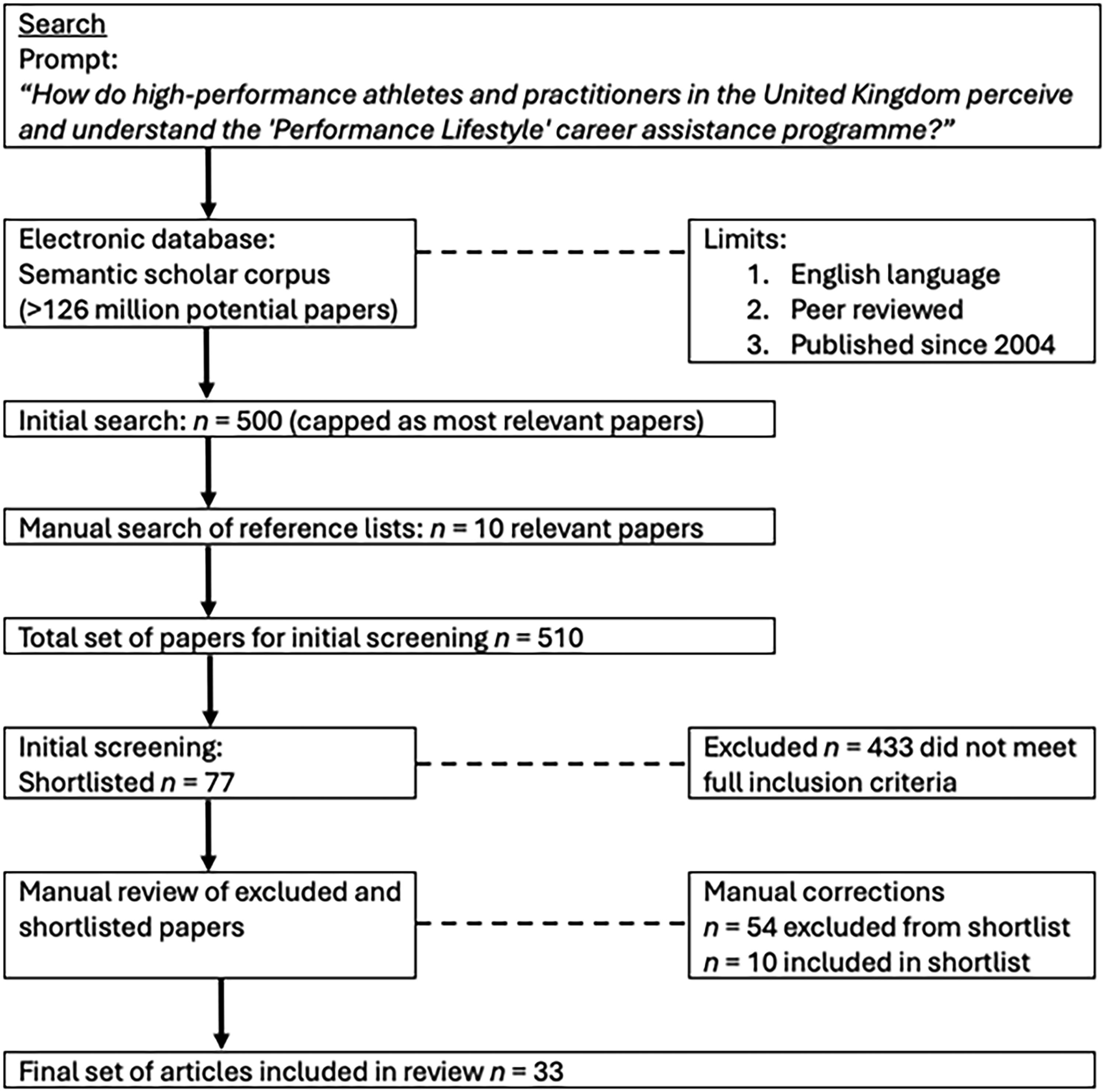
Flow diagram representing the process of inclusion and exclusion of papers.
Results
The initial search of literature identified the 500 most relevant papers to this query. A manual review of references listed identified a further ten papers created an initial set of 510 articles (Figure 1). Initial screening identified 77 articles which were determined to be sufficiently relevant to the review objective. After manual review, 33 papers were identified for a full analysis as they met the eligibility criteria for inclusion and presented an association between PL and elite sport (Table 1). These articles varied in scope, methodology, and type. Qualitative studies were the most common (14/33) followed by theoretical/position papers (8/33), mixed methods (5/33) and reviews (5/33). Quantitative studies were least common (1/33). Among the qualitative, quantitative and mixed methods studies, athletes were the most frequently investigated population (8/20), followed by mixed samples (5/20) and lifestyle practitioners (4/20). The mixed methods populations collectively contained a broad range of stakeholders including athletes, sports science and medicine practitioners, parents, team managers, teachers and university staff. A broad range of foci were identified across all papers with the largest topic incorporating different aspects of lifestyle (8/33) including athlete perspectives, practitioner experiences and critique of existing lifestyle initiatives. Dual career (7/33) and transitions (5/33) were the next most common foci.
Summarised literature discussing performance lifestyle provision in high-performance sport.

What is ‘lifestyle’ in HP?
PL provision is commonly discussed within a broader narrative of lifestyle support with papers highlighting a variety of components under this remit. Burns et al. 24 defined lifestyle simply as ‘what we do with our lives’ and emphasised aspects including training, balance, identity and self-image, while Devaney 25 stressed the necessity for lifestyle support in aiding transitions, education and helping athletes to manage competing demands. Athletes also identify other diverse ‘lifestyle’ concerns including dual career, balance, wellbeing, finance, and media amongst others.25–27 The lifestyle of elite athletes, particularly in a transnational context,28,29 has an impact on career development, identity, sense of home and their personal values. 30 The lifestyle of HP athletes has been recognised as leading to imbalance raising concerns regarding their wellbeing. 31 Athletes recognise the importance of ‘lifestyle’ as a key component of their success within a multidimensional framework that also includes interpersonal relationships and talent.24,32
Due to the above, support with lifestyle issues is considered as a key strand of support in athlete CAPs. 6 CAPs allow sporting organisations to establish the best environment for their athletes to develop a more balanced identity, better life skills and facilitate better career transition e.g., retirement. 33 Such support programmes should be culturally competent with PL following a European cultural context. 30 PL is now commonly delivered as part of the PST in HP environments16,34 and is commonly identified as the primary source of support for athletes in their development. 27
What does PL do?
PL evolved from the ACE programme, an internationally influential CAP adopted by numerous countries including the UK. 30 ACE UK originally provided an arguably narrow focus on personal development including education and employability with an aim to facilitate a smoother transition upon retirement.10,26 UK Sport rebranded ACE to PL in 2004 to ensure that performance was the main focus of the programme.10,26,30 Since this rebrand, and with an intended focus to support winning, PL services expanded from traditional help with education and career to include other areas of the athletic lifespan. PL now supports mental health, wellbeing, life balance, finance, integration, time management and conflict management.10,16,26 Despite the expanded service provision and the performance focus, most literature continues to connect PL to more traditional areas of educational, vocational or dual career support18,35–37 which is reflective of a traditional European discourse of career assistance. 30 However, it is recognised that this perspective is dated and not reflective of contemporary evolved practice. Perhaps this explains why student-athletes are a commonly studied population with PL linked to support in managing time and balancing performance and educational commitments.38,39 Vickers 39 suggests that support in these areas builds an athlete's resourcefulness and ability to cope. Ultimately, PL services in the areas mentioned above are regularly connected to supporting effective transitions, including those which take place within career39,40 and in retirement from sport.27,41
Ashfield et al. 9 emphasise a duty of care rationale that underpins PL support, which aligns with the importance of positive transitions and indicates that PL facilitates balance between sporting and non-sporting lives for individual and performance benefit. Duty of care is fundamental to supporting athlete wellbeing with PL support key to assisting mental health and happiness as part a holistic approach.9,42 PL may therefore support other areas of the PST with health-related concerns e.g., sleep behaviours, 43 however, this may be problematic in regard to role clarity potential raising concerns about roles and responsibilities and ultimately, PL's place within the PST. Due to the expanded and holistic remit of provision, it is recognised that in practice PL roles are inconsistent and diverse driven by the highly contextual needs of the sport and the individual.9,27 Poucher et al. 27 indicates that PL supports the development of hobbies, volunteering, education, employment, finance and identity, while Pavlidis et al. 37 discuss the need for practitioners to address topical issues in HP such as doping and betting. So, while there appears to be a common philosophy which guides PL as an athlete support service, the applied practice of PL services may in fact be directed by existing PST provision to facilitate better integration and reduce ambiguity for stakeholders.
Link to psychology
Existing literature outlines how PL is informed by or associated with psychology.9,16,27,31,44,45 Ashfield et al. 9 discuss the connection of PL to positive psychology, highlighting how practitioners support athletes in areas of passion (either obsessive and potentially detrimental or harmonious and helpful), maintaining or regaining perspective, balance for wellbeing, and positive emotions for flourishing. Furthermore, Burns et al. 24 emphasise how psychological attributes, skills and strategies are instrumental in coordinating all aspects of life including lifestyle practices. Consequently, obscurity of disciplinary boundaries may contribute additional confusion for stakeholders. Indeed, issues between PL and sports psychology have been referenced with overlapping workstreams and jurisdictional ambiguity.16,45
Athletes commonly state that they do not discuss their sport with their team's sports psychologist, perhaps indicating that their concerns are not strictly performance related. 32 The nature of sports psychology support may indeed be much broader than simply winning, possibly indicating that an opportunity for PL to contribute to traditionally psychological areas e.g., athlete wellbeing is warranted. 32 PL delivery and associated practitioner education should therefore be grounded within psychological theory. 46
The confluence of these disciplines has contributed to evolution of associated HP delivery models. For example, professional football's Elite Player Performance Plan (EPPP) indicates that lifestyle management forms part of a holistic sports science and medicine strategy and progressions in guidelines now indicate that lifestyle should be incorporated under psychological development programmes alongside other more traditional aspects such as mental skills training and stress management. 47 Other models combine PL and sports psychology within the same department, in some cases labelled as a psychosocial team, to ensure synergy in provision and to enable more holistic support to athletes.6,8,44,48
Testimonies
There is limited empirical research which explores PL and the majority of existing research is qualitative meaning that our understanding of the discipline and associated impact is mostly based upon testimonies of athletes and practitioners.9,42,49,50 Accounts from athletes indicate the importance of PL in preparing for major games, preparing for retirement, managing educational or professional development responsibilities alongside training and competing, and support with finance and media.9,26,49,50 Practitioners highlight the importance of athlete testimony and how this can develop both athlete interest and engagement in PL services. 27 Ashfield et al. 9 provide an account of a head coach who recognises the benefit of PL services to individual athletes through developing their skills and perspective and suggest that this can have an impact on performance but does not suggest in what manner. The same paper provides testimony of a sports psychologist who referenced benefits of aligning messages with PL to promote education, values and culture.
Despite the above accounts, there is no clear consensus that PL is meeting its intended focus of supporting sports performance. Killoughery et al. 44 interviewed PL practitioners who indicated that the discipline aids performance by removing athlete distractions, supporting athletes to be happier, and by retaining talented athletes with HP programmes. That said, Holden et al. 16 also studied PL practitioners from the BHPS and found that practitioners struggle to deliver within a performance narrative as PL doesn’t directly align with sports performance. Consequently, the issues of role clarity, disciplinary boundaries and evidence of impact may lead to a variety of implications for disciplinary delivery which are discussed below.
Delivery challenges
The above sections seek to outline what PL does, the underlying reasons for such provision and to outline evidence of disciplinary benefits. Existing literature also highlights three main issues in disciplinary delivery including PL awareness and acceptance, practitioner time, and a conflict between winning and wellbeing outcomes.
Awareness and acceptance
A lack of role clarity and associated disciplinary boundaries cause disciplines to compete over time and tasks.16,51 The crossover with psychology has been stated above, however, PL practitioners have indicated that the requisite level of understanding of the discipline doesn’t exist in HP environments affecting stakeholders and creating barriers. 44 Devaney et al. 52 suggested the need for lifestyle practitioners to be immersed within the performance environment as opposed to on the periphery of the support structure but highlighted that such integration is not readily embraced. As a result, athlete engagement is reduced due to limited awareness of what PL offers or because it fails to meet specific athlete needs. 26 Evidence nonetheless indicates that ample support is available prompting recommendations to reconsider how support is communicated to athletes and delivered. 27
Due to this lack of understanding, differing expectations exist between stakeholders resulting in the need for PL practitioners to ‘sell’ the service to athletes and colleagues in their respective HP environments, to define what PL does and the value it brings. 16 The ability for practitioners to do this effectively may have a direct impact on their disciplinary delivery with coach support, or lack of, considered crucial.10,16,36,44
Time
Practitioner time is determined by various factors including the philosophy of the programme/head coach amongst others such as programme size, goals and funding. 53 Literature highlights practitioner time as a major concern to effective PL delivery.16,44 Lifestyle concerns, and the underlying philosophy of PL, requires that athlete-practitioner relationships are close and meaningful to ensure trust and confidentiality which facilitates athletes to disclose issue or needs.39,52 Several studies highlight however that meaningful relationships are affected by a lack of space and time,16,39 with the part-time nature of PL practitioners being regularly referenced.27,44,53 These relationships are further complicated by high athlete to practitioner engagement ratios 44 and the diversity of athlete's lifestyle issues which result in significant variation in practitioner roles 27 . Limited contact time may be associated with perceptions of PL having reduced value39,44 and may relate to reported high turnover of PL staff. 53 Practitioner turnover and reduced access to lifestyle support is considered detrimental to performance and wellbeing. 25
Philosophical conflict and role title
The rebrand to PL was intended to ensure a focus on performance outcomes,10,26 however, this title may be misleading as there is little evidence to support this orientation. Studies highlight how there ought to be an intentional distance between PL and performance goals in order to facilitate meaningful engagements with athletes44,52 However, a lack of proximity to coaches leads to the service being deprioritised impacting delivery and effectiveness. 16
Literature indicates that PL does not directly align with performance outcomes, instead favouring wellbeing and duty of care components.16,44 Campbell & Rudd 54 provide a clear example of this where PL specifically focused on wellbeing rather than performance outcomes, leading to an increase in athlete engagement. It must be stated however that this account relates to an acute need during the COVID-19 pandemic. Such philosophical conflict results in difficulties for PL practitioners finding their place within the PST highlighting the need for support to be seen holistically and extend beyond the dominant performance narrative. 27
Practical implications
The aim of the current review was to appraise relevant literature within the context of PL as a CAP for athletes within the BHPS. Findings provide insights into the experiences of athletes, practitioners and coaches, highlighting the diversity of perceptions associated with PL delivery. The experiences and associated perceptions of athletes indicate that PL delivery is warranted and beneficial. Support has been identified in a broad range of areas including dual career, life balance, mental health and wellbeing, finance, media, identity, life skills, self-image, career transition, time management and conflict management.10,16,24–27 Athletes’ perspectives demonstrate the importance of PL in navigating challenges both inside and outside of sport49,50,52and appreciation for PL's caring agenda. 50 Furthermore, athletes express the importance of lifestyle practices to their sporting success.24,32 The perceptions of athletes regarding the perceived benefits of PL services does not in itself prove their significance in advancing sports performance or improving medal attainment, however, these perceptions are nonetheless important in understanding athlete expectations and the structural or environmental conditions necessary to facilitate success.
The delivery challenges highlighted in this review suggest that PL delivery is suboptimal and not aligned with the disciplinary rebrand. The contemporary version of PL is indeed much broader than its original ACE form, however, the title of ‘Performance Lifestyle’ may be a misnomer and a contributing factor to the issues identified. Practitioners highlight their concerns in fulfilling an obligation to demonstrate their performance impact, 16 however, such expectation is reasonable given the designation of the service and its inclusion within the PST. Furthermore, recent athlete perspectives indicate multifaceted barriers to engaging in support, many of which are underpinned by a focus on sports performance. 55
Issues of disciplinary purpose and role clarity may consequentially affect the resourcing of PL, particularly since the removal of central funding for PL services. With individual sports now required to fund PL roles directly, the absence of a clear alignment in supporting medal attainment may lead to programme funders or decision makers to favour investment into services with a clearer impact to performance goals. As such, PL may in future continue to operate as a mostly part-time function with resources prioritised to other support disciplines. Decision makers may struggle to justify providing additional time to PL with an unknown outcome when it could be allocated to physiotherapy or strength and conditioning for example, which have more overt performance benefits. The argument for PL as a duty of care related discipline, instead of performance related, appears stronger. Evidence of the duty of care priority is provided by reflection on the COVID-19 pandemic during which the acute needs of athletes, including practical issues such as deferring studies or work and existential concerns such as searching for meaning and perspective, increased service engagement. 54 The practical issues outlined align with managing effective transitions and the existential concerns are wellbeing related, both of which fall under the remit of duty of care. The case acts as an example of a broader view that PL is not primarily a performance support service.
Issues associated with practitioner time reflect challenges present within normal working conditions. Under typical conditions, practitioners indicate that more contact time with athletes is required to develop meaningful relationships ensuring athlete disclosure and more impactful support. However, a lack of time may result in further issues during periods of acute need. The Campbell & Rudd 54 case study suggests that during an acute period additional athletes engage with the service who may not have engaged under normal conditions. If so, this means that the foundations of trust and a close relationship have not been established which potentially impacts the effectiveness of PL support during a critical period. Literature suggests that PL practitioners are already starting off on the back foot and a ‘cold’ relationship may not be conducive to facing acute issues. The practitioner in the Campbell & Rudd 54 case study indicated burnout within a few weeks of the acute period and a need to create distance with athletes as a result, which appears paradoxical. Consequently, this example prompts broader questions regarding the adequacy of existing PL frameworks and resourcing in meeting athlete needs when they present. If PL is considered to be a performance support service, then its potential impact under such conditions appears limited. The example of a global pandemic may represent a unique case, however, if existing as a duty of care related service, then the ability to enact this care appropriately requires that effective delivery is paramount. The removal of central funding raises new concerns regarding future provision and whether individual sports will maintain PL provision at current levels and ensure sufficient resource to fulfil duty of care responsibilities. Funding concerns are situated at a time when athletes indicate need for more psychosocial support and particularly during a post-Olympic period. 56
The needs of individual athletes are likely to vary based on numerous factors and may include age, gender, ethnicity, financial position, education, and marital status amongst many others. Correspondingly, individual programmes may have particular needs which PL supports creating significant variation in service provision across sports. The confluence of these factors may be a contributor to the obscurity and conflict highlighted within this review. Differences in provision at a programme level may be evidenced by recent UKSI recruitment for PL roles which use different job titles across sports. 57 Two roles used the title of PL ‘practitioner’ supporting sports including Athletics, Cycling, Judo, Shooting, and Weightlifting. Another role with Rowing however used the title of PL ‘coach’. PL postholders rely on coaching and mentoring skills 44 and qualifications are used by UKSI to differentiate between ranks of PL staff with professional coaching and mentoring qualifications or accreditations associated with the higher rank of ‘coach’. Differences in job titles may however reflect the nuances in provision between sports and further research is needed to understand why Rowing is seeking a higher rank PL coach and the other stated sports are not. Currently, limited examples exist of provision within particular sports.
The contextualised nature of PL emphasises a responsibility for education on disciplinary services and indeed benefits at a programme level. While UKSI can provide an overarching view of the disciplinary philosophy, 58 translating principles into practice is more difficult due to dominant performance narratives and resistant cultures within the BHPS. 16 PL practitioners report needing to continually sell disciplinary services to stakeholders including athletes, coaches and programme leaders 16 highlighting that UKSI messaging regarding PL lacks clarity and conviction. Review findings suggest that PL suffers from the confluence of a lack of trust and depth in relationships, both with athletes and across the PST, and a lack of systematic space and deprioritisation against sports performance priorities. Consequently, the sports specific context of provision must be understood and promoted by the sports themselves. Recent funding changes provide leaders with opportunity to review disciplinary philosophy, potential contributions that PL can make at a programme level and to strategise tailored provision. Involving coaches, as a key stakeholder, is considered important in improving awareness and acceptance, to align expectations and improve synergy. Based on the findings from the current review, developing a unique narrative aligned to sporting needs with input from relevant stakeholders including coaches, Performance Directors and Heads of Performance Support is advised. Furthermore, communicating this tailored narrative through an integrated strategy which moves beyond previous UKSI messaging and is aligned to key events e.g., programme inductions is warranted.
The current review facilitates sports organisations and specifically those with responsibilities for the management of elite programmes, to appraise existing athlete support provision with a view to optimising their delivery mechanisms. Furthermore, a review of existing provision should relate to the practice of PL and other PST disciplines which ought to apply their services holistically and in an interdisciplinary fashion. 59 A framework for disciplinary synergy should be deliberately developed for each sport which identifies common athlete challenges and how these can be supported holistically by dovetailed services. Leaders of elite programmes ought to consider relevant athlete development literature including holistic lifespan 60 and holistic ecological 61 perspectives to support understanding of associated provision across the PST, and to inform and align support between sporting and non-sporting domains. In addition, the evolving nature of European athlete career discourse 62 and learning from global CAPs 63 including those which follow a different cultural tradition, identifies area of future development e.g., potential gaps in services provision and access to provision across the athlete lifespan.
This review was undertaken while PL remained centrally funded by UK Sport, during which practitioners were recruited by UKSI and deployed to sports. However, this review, and the removal of central funding, leads to questions about future development of the discipline. Ongoing, sports will be required to fund any PL roles directly and given the issues outlined above, it could be suggested that PL staff should be employed directly by individual sports allowing freedom in tailored recruitment criteria, ongoing training and professional development. Furthermore, it is worth considering other models such as Player Development Managers in Rugby who sit within player unions or Player Care staff who are employed directly by professional football clubs.
Limitations of current literature and future research directions
Narrative reviews are not without limitations. While this review aids our understanding of PL as a discipline and current practice, it may be considered as less rigorous than a systematic review. Authors sought to mitigate this by presenting a transparent process and by adhering to the SANRA approach. 23 This review included use of a large language model as a literature-search and screening tool to provide efficiency and accelerate the review process. However, it is recognised that this method includes limitations as search coverage is limited to the databases and sources accessible through the underlying Semantic Scholar corpus. Furthermore, this model does not evaluate the methodological quality of included papers. Authors used manual literature searches and manual screening to mitigate these limitations. The authors recognise the existence of bias through inclusion or exclusion of research framed by subjective author interpretations driven by their expertise. Authors recognise a reliance on non–peer-reviewed sources in this review, which provide insights into a field that lacks empirical studies. Non–peer-reviewed sources include practitioner authored books or organisational publications, which are insightful but may promote individual or organisational narratives without critical review and therefore must be recognised as a limitation.
Developing our understanding of the contextual needs of each sport represents an important prospective area of research. By doing so, it will be possible to highlight variation in practitioner's applied roles and athlete needs. Subsequently, more targeted and precise provision could be trialled within particular programmes with a view to improving impact, informing future funding and resourcing discussions. Insights from key decision makers within elite programmes, e.g., Performance Directors, regarding the nature of PL's contribution to performance outcomes is currently lacking and is critical to align services with programme strategy. Engaging these decision makers in developing a specific PL narrative for their sport may help to address some of the concerns raised within this review, e.g., practitioners needing to continually sell the service to programme athletes and staff. 16 Implementing contextual narratives may better align PL delivery and improve disciplinary synergy. Additionally, developing case studies using collaborative action research methodology may provide impactful evidence of how PL can contribute to programme organisational improvement.
Future research directions should examine athlete cohort factors within particular HP programmes and analyse impacts to PL delivery. One factor future research could consider is an athlete's educational background given research highlighting differences in the educational profile of Olympic athletes across sports. Hockey, Rowing and Rugby are sports with high proportions of privately educated athletes. 64 In contrast, athletes competing in Athletics, Boxing, or Taekwondo are likely to have attended public schools. 65 Privately educated athletes within Olympic programmes appears to be a developing trend with one third of Team GB athletes for the Paris 2024 Olympic Games being privately educated representing an increase of 9% since the Rio de Janeiro 2016 Olympic Games.66,67 The proportion may change further with the inclusion of Cricket for the Los Angeles 2028 Olympic Games. Athlete education may influence which areas of the PL delivery framework are applied within particular sports and result in significant differences in provision between sports such as Hockey and Rowing, and Boxing or Athletics respectively. Furthermore, delivery disparities may result in differing requirements for practitioner skillsets or experience further informing practitioner education pathways.
The perspectives of programme leaders or decision makers, coupled with a deeper understanding of athlete needs may better inform future resourcing with PSTs. For example, certain athlete cohorts may indicate a reduced need for PL support and therefore demonstrate lower engagement levels. Combined with insights from programme leaders, some sports may determine that part-time PL provision is sufficient while others may require more than one full time member of dedicated PL staff, addressing the concern associated with time highlighted by this review. Optimising the financial resources allocated to elite programmes is critical given pressures to achieve immediate medal targets and the associated dependency for continued funding. 68
Conclusion
The current review appraised relevant literature within the context of PL as a CAP for HP athletes. Assessments of PL, its activities and outcomes remain limited in quality and quantity of literature. Insights from stakeholders indicate that PL delivery is beneficial in supporting athletes in a range of sporting and personal life domains. Applied PL delivery will vary between sports and the needs of the athletes within those programmes, however, currently little is known about applied practices between sports. As such, the current review suggests there is need to provide greater understanding in common working practices across sports, perhaps through the development of case studies or vignettes. Although UKSI has published six key delivery areas within their PL delivery framework, having more contextualised understanding of applied practice within individual sports highlighting the discipline's impact to intended outcomes would be beneficial. Future research is needed to understand the application and importance of PL within specific programmes facilitating future programme resourcing and practitioner education initiatives.
Footnotes

Ethical considerations
Formal ethical approval was not required in accordance with prevailing standards for secondary research as this review did not involve the collection of new data from human participants or animals.
Consent to participate
Not applicable as this narrative review did not include any primary data collection involving human participants or animals requiring consent to participate.
Consent for publication
Not applicable. No individual person's data are reported in this article that would require specific consent for publication.
Funding
The authors received no financial support for the research, authorship, and/or publication of this article.
Declaration of conflicting interests
The authors declared no potential conflicts of interest with respect to the research, authorship, and/or publication of this article.
Data availability
Data sharing is not applicable to this article as no new data were created or analysed in this study.