




Abstract
This research investigates the protective mechanisms against burnout and turnover intentions among sports team coaches, focusing on the interplay between environmental and individual psychological resources. Based on a structural model involving 320 coaches, the study explores how perceived social support from both within and outside the sporting environment influences psychological safety, job satisfaction, and mental well-being. The findings demonstrate that social support is a fundamental antecedent that significantly enhances psychological safety and buffers against the high-pressure demands of competitive coaching. Psychological safety, in particular, acts as a significant mediator, fostering a secure professional environment and thereby reducing the cognitive load and emotional exhaustion associated with performance-contingent job security. Furthermore, the analysis reveals that high levels of psychological resilience, job satisfaction, and overall well-being are negatively correlated with the intention to leave the profession. By integrating the Job Demands-Resources (JD-R) and Conservation of Resources (COR) theories, the study highlights that external support systems are essential for cultivating the internal resilience necessary to mitigate burnout. Ultimately, the paper argues that sports organisations must prioritise the development of supportive and psychologically safe climates to ensure the long-term health and retention of coaching staff.
Keywords
Introduction
Coaches as leaders are an important element of athletic performance in sports, shaping the environment through their leadership skills,1,2 strategic decisions, 3 and the social support they provide. 4 Coaches in the sports performance context play critical roles in fostering mental resilience,5,6 ensuring team cohesion, 7 and guiding athletes toward long-term goals and learning.8,9
The responsibilities in this demanding environment place significant pressure on the coaches.10,11 In this context, not only are athletes expected to perform well, but coaches are expected to do so as well, resulting in a sense of being pressed for time and the need to produce successful competitive outcomes to maintain job security. 12 Adding to this burden are pervasive job insecurity, often tied to short-term, uncertain contracts, 13 and a livelihood that is fundamentally reliant on the variable performance of their athletes.14,15 Moreover, coaches must navigate numerous external dynamics largely beyond their control, such as sudden administrative changes within the sports organisation 16 and the ever-present media scrutiny that amplifies both success and failure.17,18
Furthermore, a perceived lack of control over external dynamics—such as sudden administrative decisions or negative media representation—can foster feelings of helplessness and isolation, profoundly affecting their self-efficacy and job satisfaction. 19 These compounded pressures take a significant toll on a coach's psychological well-being. 20 They frequently experience elevated stress and anxiety stemming from chronic contractual uncertainty and the immediate, high-stakes nature of performance-dependent employment. 21 This environment often leads to emotional exhaustion, a core component of burnout, as they struggle to manage the relentless demands without adequate rest or security.10,22 These challenges in maintaining a work-life balance can lead to adverse outcomes, such as burnout 22 and turnover intention. These issues not only affect coaches on an individual level but also have profound implications for the overall success and sustainability of sports organisations.10,20
To mitigate these pervasive mental health challenges, coaches require robust organisational support mechanisms, 19 including clearer contractual frameworks 23 and access to specialised sports psychology resources to develop coping strategies. 24 Crucially, fostering strong professional and personal social support networks is essential to ensure mental resilience, emotional regulation, and sustainable long-term engagement in their demanding profession.25–27
Coaches need to cultivate positive relationships with their athletes, family members, friends, peers, and supervisors to help them cope with stress and strain. 26 Such support systems can help alleviate stress, increase self-esteem, and buffer the effects of demanding workloads on individuals.25,27 Interpersonal emotion regulation within relationships can prevent burnout and promote psychological resilience. 26
Despite inherent volatility and psychological risk, not all coaches succumb to these negative outcomes. This suggests the presence of critical protective resources and intrinsic capabilities that mitigate the impact of occupational stressors.26–28 These protective factors include the pursuit of non-work interests,26 an internal locus of control, and positive psychological capacities such as ‘grit.'26,27 Furthermore, satisfaction with social support and satisfaction with life balance have been identified as the strongest protective determinants of mental health and well-being. 28 Identifying and developing these factors is vital for promoting the longevity and efficacy of coaching across the high-performance spectrum by providing coaches with the resources they need to thrive under pressure and by supporting the profession's continued reward and enjoyment in the long term. 26 Despite the established need for resources, research has yet to fully integrate and empirically test the complex interplay of both individual and environmental protective factors—specifically, how different sources of social support and psychological safety translate into resilience, job satisfaction, and ultimately, buffer against burnout and turnover intention in this population.
To address this gap, the current study proposes and tests a comprehensive structural model to delineate the pathways through which social support (both within and outside of sport), psychological safety, and job satisfaction safeguard the psychological well-being of sports team coaches. This investigation offers novel insights by simultaneously examining these dynamics, thereby providing a robust evidence base for designing targeted interventions to support the long-term sustainability and efficacy of the coaching profession.
Risk factors of coach burnout and turnover intention
Several inherent and environmental conditions are potent risk factors that significantly increase the likelihood of adverse outcomes. These factors generally fall into three categories: high job demands, low resources, and organisational/interpersonal conflicts 29
High quantitative and qualitative job demands
High demands refer to the physical, psychological, social, or organisational aspects of the job that require sustained physical and/or mental effort and are therefore associated with specific physiological and psychological costs. 30 The sports calendar often necessitates excessive working hours, irregular schedules, and continuous travel. This time-based conflict between work and personal life depletes the coach's energy reserves, directly leading to chronic fatigue and emotional exhaustion, the hallmark dimension of burnout. 31 The fundamental performance-contingent nature of the coaching profession means self-worth and job security are directly tied to winning.32,33 This constant scrutiny and the requirement to deliver immediate results create intense cognitive and emotional labour, which is a powerful predictor of both stress and subsequent burnout. 34
Lack of organisational resources and support
Risk is amplified when the demands exceed the resources the organisation has to meet them. 35 The absence of sufficient resources is often as damaging as the presence of excessive demands. 36 As previously discussed, short-term, uncertain contracts and the vulnerability to immediate dismissal following poor results create a state of chronic anxiety and hypervigilance. 31 This persistent uncertainty is a major stressor that fuels turnover intention as coaches seek more stable employment.36,37 When coaches feel their decisions regarding training, selection, or strategy are consistently overruled or undermined by administrative bodies, their sense of professional control diminishes.13,36 This perceived lack of autonomy is directly linked to feelings of helplessness and frustration, accelerating the process of depersonalisation (cynicism towards the job), which is a core feature of burnout. 35
Interpersonal and role conflict
Conflicts arising from the complex social environment of sports further erode a coach's well-being and commitment. 38 Coaches often perform multiple, conflicting roles (e.g., mentor, manager, tactician, psychologist). Role ambiguity occurs when the expectations for these different roles are unclear, leading to inefficient effort and stress39,40 Role conflict arises when satisfying one role (e.g., meeting management demands) makes it challenging to satisfy another (e.g., maintaining athlete well-being). 40 This constant ethical and practical dilemma is highly demanding on emotional resources and fosters feelings of inadequacy. 39 Strained or negative relationships with athletes—marked by lack of respect, trust, or engagement—can lead to significant emotional withdrawal from the job. 41 The energy required to manage rugged or resistant team dynamics contributes substantially to emotional exhaustion and can serve as a final trigger for turnover intention.38,39
These interconnected risk factors, operating through the chronic strain of high effort and low reward, fundamentally compromise the coach's ability to cope, ultimately leading to the debilitating psychological state of burnout and the resulting behavioural outcome of turnover intention.
Building coach sustainability with protective factors against adversity
Given the substantial psychological demands and environmental stressors coaches face, understanding the mechanisms that shield them from adverse outcomes, such as burnout and turnover intention, is paramount for both individual well-being and organisational sustainability. The following factors serve as critical protective resources that mitigate the negative impacts of chronic occupational stress through various psychological and social pathways.
Psychological safety (PS)
Psychological Safety refers to the shared belief that the team environment is safe for interpersonal risk-taking; specifically, that one will not be humiliated or punished for speaking up with ideas, concerns, mistakes, or questions.42,43 In the coaching context, this extends beyond the team unit to encompass the coach's relationship with the organisational leadership (e.g., Athletic Directors, Club Managers). 44 Within sport, supportive coach behaviours and high-quality coach–athlete relationships are central mechanisms through which psychologically safe environments are created.45,46 When coaches perceive high psychological safety, they are more likely to: High PS is associated with lower cognitive and emotional load related to self-monitoring and defensive behaviours.
Coaches feel secure in their jobs and relationships, allowing them to focus mental energy on performance-related tasks rather than self-preservation. 47 This security acts as a buffer against anxiety and the emotional exhaustion associated with fear of failure or criticism, thereby reducing the risk of burnout. 48 Furthermore, feeling safe to voice concerns about workload or contractual issues can proactively address the root causes of turnover intention. 49
Perceived available social support (in sport and out of sport)
Social support involves the perception or experience of being cared for, esteemed, and part of a network of mutual obligation. 50 It is crucial to delineate support received within the sporting environment (e.g., from peers, athletes, or direct management) and outside the sporting environment (e.g., from family, friends, or non-sporting social circles), as they fulfil distinct coping functions.51,52
Perceived available support in sport is a type of support that often takes the form of instrumental aid (e.g., resource sharing, practical help with training) or informational support (e.g., feedback, advice on strategy).51,53 This directly alleviates the task-related pressures and feelings of isolation stemming from high responsibility.53–55 Knowing that colleagues understand unique job-related stressors and are available to help is associated with a reduced sense of being overwhelmed, which is a major driver of burnout.56,57
Perceived available support outside sport usually provides emotional support and a sense of identity unrelated to competition results.20,57,58
This non-contingent support acts as a powerful psychological resource for restoration and distancing. It allows coaches to detach their self-worth from performance outcomes, buffering the acute stress and anxiety caused by job insecurity and media scrutiny.20,57 A robust non-sporting life provides work-life balance and a stable foundation when professional life is volatile, significantly counteracting emotional exhaustion and feelings of helplessness.54,57
Job satisfaction
Job satisfaction is commonly defined as a positive emotional state resulting from the appraisal of one's job or job experiences. 59 For coaches, this involves satisfaction with both structural aspects of their role (e.g., pay, management) and relational aspects (e.g., colleagues, daily work with athletes), which recent work in youth sport education settings has highlighted as central to staff attitudes and retention. 60 Job satisfaction acts as a direct antidote to turnover intention, with higher work satisfaction predicting lower intentions to leave among sport coaches and youth sport leaders. 48 When coaches feel valued and content with their work environment and compensation, they tend to develop a stronger affective commitment to the organisation. 49 This contentment reduces the psychological impetus to seek alternative employment, even under high performance and emotional demands. 48 Furthermore, satisfaction with the job itself can help contextualise or override temporary stressors, buffering the impact of stress on burnout and subsequent turnover intentions in coaching and sport service contexts.60,61
Psychological well-being (PWB)
Psychological well-being is a multidimensional construct encompassing positive emotions, life satisfaction, and the development of one's full potential (e.g., Ryff's dimensions: autonomy, purpose in life, and personal growth).36,62 Unlike resilience, which focuses on adaptation to stress, PWB describes an overall state of optimal functioning 38 High levels of PWB serve as a crucial antecedent resource that enhances coping capacity. Coaches who report higher PWB possess greater energy reserves and cognitive flexibility, enabling them to appraise demands as challenges rather than threats. 20 This positive emotional state buffers against the transition from occupational stress to chronic emotional exhaustion.36,54 Moreover, PWB provides a strong sense of meaning and purpose in the coaching role, which directly counteracts the depersonalisation and cynicism central to burnout and strengthens the commitment necessary to reduce turnover intention.31,60,62
Psychological resilience (PR)
Psychological resilience is defined as the capacity to maintain relatively stable, healthy psychological and physical functioning in the face of significant risk or stress.63,64 It is not merely “bouncing back”, but also the ability to adapt successfully to adversity in a dynamic, context-dependent manner.63,65 High resilience enables coaches to reframe challenges (e.g., a loss or contract uncertainty) as opportunities for learning rather than catastrophic threats, thereby supporting optimal performance under pressure.63,66 Psychological resilience functions as a comprehensive internal resource that shapes how a coach appraises and responds to stressors, particularly through challenge-focused appraisals and meta-cognitive regulation.63,65 This cognitive flexibility reduces the likelihood that stressors will feel overwhelming, helping prevent stress from escalating into emotional exhaustion and depersonalisation, key dimensions of burnout. 65 Resilience also empowers coaches to engage in more problem-focused coping, directly addressing issues such as poor work–life balance or contractual ambiguity, and thereby reducing the risk of turnover intention driven by feelings of powerlessness.63,65,67
Aims of the study and the hypothesised model
We aimed to examine how different layers of support and internal resources function as protective factors against adverse outcomes (burnout and turnover intention) among sports team coaches. Specifically, we investigate (a) the direct and indirect effects of perceived social support (in and outside of sports) on burnout and turnover intention, and (b) the mediating roles of psychological safety, mental well-being, job satisfaction, and psychological resilience in these relationships. For these purposes, we developed a comprehensive structural model (see Figure 1) to test the complex relationships among all variables.
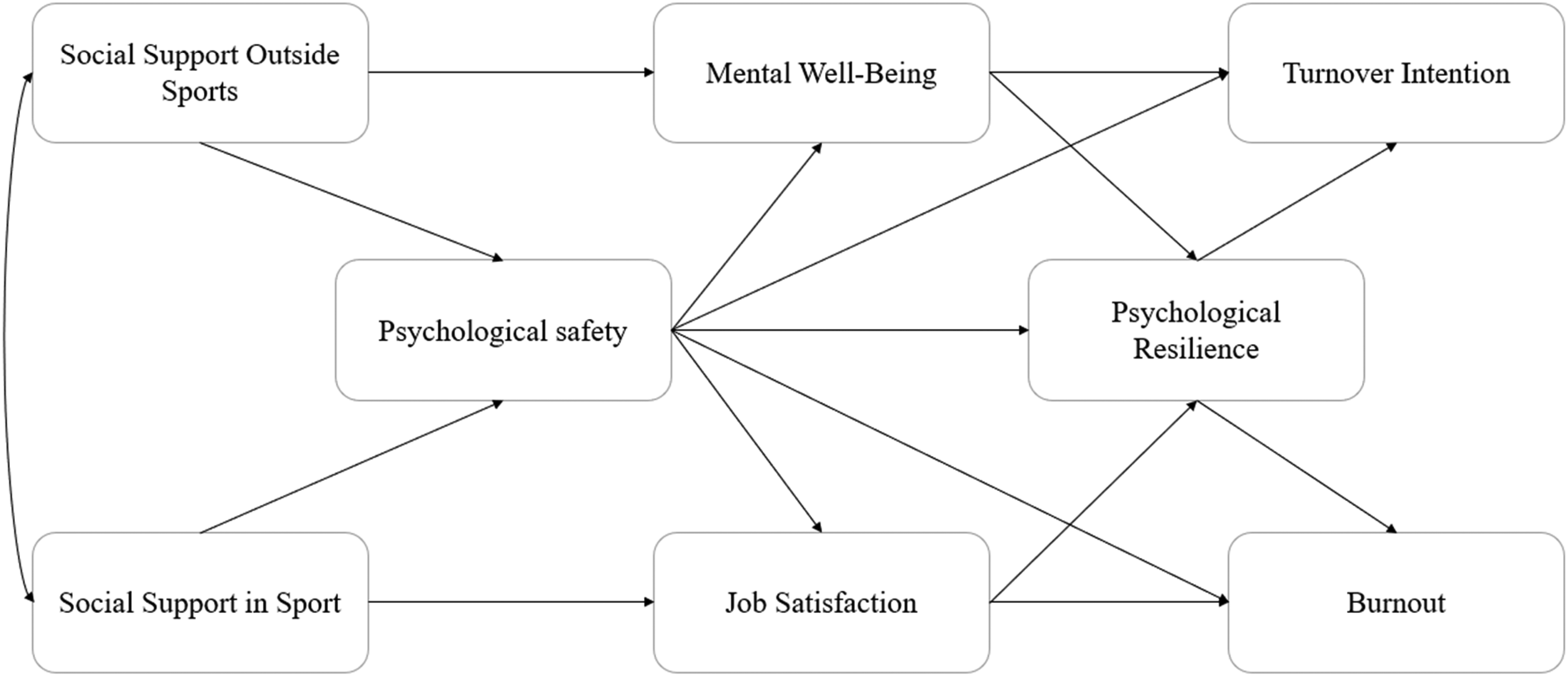
The hypothesised model showing the interplay between social support, psychological safety, job satisfaction, psychological resilience, mental well-being, turnover intention, and burnout.
Based on the Job Demands–Resources (JD-R) model and conservation of resources (COR) theory, we propose a chain of positive resource accumulation that ultimately mitigates strain outcomes. Unlike traditional corporate roles, the coaching profession is characterised by high-performance-contingent job insecurity, constant public scrutiny, and the emotional labour of managing athletes’ dynamics. Therefore, the theoretical foundation for the hypothesised relationships is primarily drawn from the Job Demands-Resources (JD-R) model.30,68 In line with the JD-R framework, the coaching environment triggers two distinct processes: the health-impairment process, where chronic job demands exhaust physical and mental resources leading to burnout, and the motivational process, where job resources lead to higher engagement and well-being. 13 Our model focuses on reinforcing the motivational process to counteract the health-impairment process.
In the volatile coaching environment, where job demands often include irregular working hours, high-stakes competition, and intense emotional demands, and the immediate threat of contract termination following poor results, the JD-R model posits that job strain (leading to burnout and turnover intention) results from an imbalance in which insufficient job resources do not adequately meet high job demands. While the proposed research model focuses on the resource-driven motivational process, it is explicitly designed to address the unique stressors of the coaching context. In this context, we propose that the effectiveness of social support is not universal but is governed by a coach-specific boundary condition: psychological safety. Specifically, the resources selected for this model (e.g., social support and psychological safety) are conceptualised as “buffers” that intervene in the health-impairment process triggered by these pervasive coaching demands. In this study, we refine the JD-R application by positioning psychological safety not merely as a workplace climate variable, but as a critical “boundary resource” that allows coaches to navigate the inherent risks of tactical failure without the immediate fear of professional obsolescence. By doing so, psychological safety serves as a catalyst, transforming external social support into functional job resources, effectively shielding the coach from the erosive effects of high-performance demands.
Similarly, Conversation of Resources (COR) theory 69 suggests that individuals strive to obtain, retain, and protect their valued resources. Resources (such as social support and psychological safety) initiate a motivational process that leads to positive outcomes (such as job satisfaction, resilience, and engagement). According to COR theory, resources do not exist in isolation but tend to aggregate in “resource caravans.” We propose that environmental resources, such as social support and psychological safety, create a caravan that, in turn, fosters personal resources, such as resilience and well-being. For coaches, social support from both sport and non-sport domains serves as a primary reservoir of resources, helping prevent “resource loss cycles” triggered by competitive losses or administrative pressure. By focusing on these specific resource chains, the model accounts for the high demand of coaching; it investigates how coaches can sustain their psychological capital amid the chronic stress of elite performance environments. By identifying psychological safety as the central gatekeeper, our model addresses a unique theoretical refinement in the sport context: external support translates into internal resilience only when the coach perceives a safe environment in which to exercise their professional agency. We propose a sequential process in which initial external resources (Social Support and Psychological Safety) facilitate the acquisition and maintenance of internal personal resources (Mental Well-being, Job Satisfaction, and Psychological Resilience), which ultimately act as robust protective buffers against resource loss and the resulting strain (Burnout and Turnover Intention).
Our hypothesised model posits that perceived social support served as an initial resource, positively influencing a coach's foundational security and workplace satisfaction (H1). Given the isolated nature of the head coach role, Social Support in Sport and Outside of Sport were hypothesised to positively affect Psychological Safety (H1a), and Social Support in Sport was also hypothesised to positively affect Job Satisfaction (H1b).
From a COR perspective, this represents the initial stage of a gain spiral, where external support provides the necessary safety net for further resource development. Moving sequentially, we proposed that Psychological Safety, as a fundamental environmental resource that mitigates the cognitive load of performance pressure, would foster the development of crucial internal resources (H2), directly enhancing Mental Well-Being and Job Satisfaction (H2a), and contributing to higher Psychological Resilience (H2b). This association reflects the JD-R's motivational process, in which a supportive environment (a resource) enhances internal psychological states, thereby reducing the likelihood of strain. In this sequence, psychological safety and resilience are treated as the primary defensive mechanisms against the burnout-inducing effects of competitive stress.
The model further predicted that these positive emotional and cognitive states would collectively contribute to a coach's ability to adapt and thrive under pressure (H3), specifically that Mental Well-Being and Job Satisfaction would both positively impact Psychological Resilience (H3a). In terms of strain outcomes, we hypothesised that all internal resources would exert direct protective effects (H4), meaning that Psychological Resilience, Mental Well-Being, and Job Satisfaction would negatively affect Burnout and Turnover Intention (H4a). This is consistent with the JD-R model's premise that sufficient resources can attenuate the negative outcomes of high job demands by preventing depletion of the coach's energy.
Finally, we hypothesised that the protective effect of the initial resources (Social Support and Psychological Safety) on strain would be significantly transmitted through the internal psychological resources (Mental Well-Being, Job Satisfaction, and Psychological Resilience) (H5), such that Social Support (in and outside of sport) would indirectly associate with low level of Burnout and Turnover Intention through this mediating chain of resources (H5a). This indirect path provides a distinct, coaching-specific mechanism explaining how psychological safety serves as the critical boundary enabling professional longevity despite the high risk inherent in sports coaching. In our hypothesised model, burnout and turnover intention were positioned as parallel outcome variables representing the final stage of the strain process. While we acknowledge the well-established literature suggesting that burnout often precedes and triggers turnover intention, our study aimed to capture the collective impact of psychological resources on these two distinct facets of occupational strain. By treating them as concurrent outcomes, we observed that resources such as resilience and job satisfaction simultaneously mitigate both internal psychological erosion (burnout) and external professional withdrawal (turnover intention).
Materials and methods
Participants
We recruited 320 team sport coaches (
Procedure
The survey was conducted using Google Forms after obtaining necessary institutional approval from the Social Sciences and Humanities Ethics Committee (Approval No. 250022, Decision No. 21, 16.02.2025). The online form was distributed to the coaches, and the study's purpose was clearly explained to them. Participants were informed that their responses would remain confidential, no personal identification would be possible, and participation was entirely voluntary. After providing this information, participants were sent a survey link and completed the form at their convenience.
Measurements
Perceived available support (outside sport)
The Perceived Available Support Scale, developed by Schwarzer and Schulz 70 and adapted into Turkish by Kapıkıran and Acun-Kapıkıran, 71 was used to assess perceived social support. The scale comprises two subscales: emotional support (e.g., ‘There are some people who truly like me’) and instrumental support (e.g., ‘I know some people upon whom I can always rely’). In the instructions section of the form, coaches were asked to respond to each item by considering their significant others outside the sports context (e.g., friends, parents, siblings). The items were rated on a scale from 0 (none) to 4 (a lot).
Perceived available support in sport
The Perceived Available Support in Sport Questionnaire (PASS-Q), developed by Freeman et al. 53 and adapted into Turkish by Şenel and Sakallı, 72 was used to assess perceived social support in sport. The measurement has four dimensions consisting of 16 items, including emotional support (e.g., ‘…provide you with comfort and security’), esteem support (e.g., ‘…reinforce the positives’), information support (e.g., ‘…give you constructive criticism’), and tangible support (e.g., ‘…help with travel to training and matches’). We instructed coaches to rate each item, considering significant others (athletes, assistant coaches, officials, etc.), to evaluate their sports environment. Participants prefixed each item of the measurement with the statement “If needed, to what extent would someone…” and rated it on a scale of 0 (not at all) to 4 (very much).
Psychological safety
We used the Psychological Safety Scale developed by Edmondson, 42 which consists of 7 items, to assess coaches’ perception of psychological safety within their teams. The scale contained items such as “It is safe to take a risk on this team” and “If I make a mistake on this team, it is not held against me.” The psychometric properties (reliability and/or validity) of the psychological safety scale were acceptable in previous studies.73,74 As there was no Turkish version of the adapted scale for sport (see Yener, 75 for the translated version with non-athletes), we use this version to assess coaches’ perceptions of their environment. We ran a CFA to assess its structure and found an acceptable fit (χ2(10) = 39.918, χ2/df = 3.89, CFI = 0.93, RMSEA = 0.08, SRMR = 0.08).
Mental well-being
The Warwick-Edinburgh Mental Well-being Scale Short Form, developed by Tennant et al. 76 and translated into Turkish by Demirtaş and Baytemir, 77 evaluates mental well-being. The Warwick-Edinburgh Mental Well-being Scale Short Form is a 7-item scale consisting of positive statements (e.g., ‘I have been feeling optimistic about the future’), rated on a 5-point Likert scale (1 = never; 5 = always). When responding, participants are asked to consider their experiences over the past two weeks.
Job satisfaction
Job satisfaction was measured using the Job Satisfaction Subscale of the Michigan Organisational Assessment Questionnaire, comprising 3 items. The scale was developed by Cammann et al. 78 and adapted into Turkish by Çevirgen and Üngüren. 79 The scale includes both positive and negative statements (e.g., ‘All in all, I am satisfied with my job’), and each item is rated on a scale of 1 (Strongly disagree) to 7 (Strongly agree) in our study.
Psychological resilience
We used The Brief Resilience Scale, developed by Smith et al. 80 and translated to Turkish by Doğan, 81 to assess coaches’ psychological resilience. It is a self-assessment tool with six items on a 7-point Likert scale. Higher scores indicate greater psychological resilience after reverse-scoring the relevant items (e.g., ‘I have a hard time making it through stressful events’). In our study, each item is rated on a scale from 1 (strongly disagree) to 7 (strongly agree).
Turnover intention
The Turnover Intention Scale, developed by Wayne et al. 82 and adapted into Turkish by Küçükusta, 83 evaluates employees’ intentions to leave their current job. The scale consists of 3 items (e.g., ‘I often think about quitting my job’). We used a rating scale from 1 (never) to 5 (always). Higher scores indicate a greater intention to leave the organisation.
Burnout
The Burnout Scale-Short Form, adapted from Pines and Aronson's 84 21-item measurement tool by Malach-Pines 85 and translated into Turkish by Çapri, 86 evaluates burnout levels. The scale consists of 10 items (e.g., “_tired”), rated on a 7-point Likert scale (1 = never; 7 = always) by writing a number following the emotional state. Higher scores indicate higher levels of burnout. The scale has been widely used in organisational and psychological research and has demonstrated strong psychometric properties.
Analysis
Statistical analyses were conducted using SPSS 27.0 and AMOS 24.0 software. Initially, data screening was performed to identify missing values and outliers. Normality was assessed using skewness and kurtosis; all variables fell within the acceptable range of ±2, confirming a normal distribution. Descriptive statistics, including means and standard deviations, were calculated, and Pearson correlation analysis was used to examine preliminary relationships among the study variables.
To ensure the robustness of the structural model, the potential for multicollinearity was rigorously evaluated. Variance Inflation Factor (VIF) and tolerance values were examined for all predictors. The results indicated that VIF values ranged from 1.15 to 2.10, well below the conservative threshold of 5 (and even the stricter threshold of 3). Furthermore, tolerance values were consistently high (all > 0.40), far exceeding the common cut-off point of 0.10. These psychometric indicators confirm that mental well-being, resilience, and job satisfaction are distinct constructs with sufficient unique variance, so multicollinearity is not a concern in this study.
Common Method Bias (CMB) was addressed through both procedural and statistical controls. Several rigorous procedural remedies were implemented during the data collection phase. To reduce evaluation apprehension and social desirability bias, participants were explicitly informed that their responses would remain completely anonymous and confidential. It was emphasised that there were no “right” or “wrong” answers to encourage honest reporting. Additionally, the survey was designed to create psychological distance between independent and dependent variables by utilising different response formats and, where possible, counterbalancing the order of scales. As a post-hoc statistical check, Harman's Single-Factor Test was performed. The results revealed that the first emerging factor accounted for only 26% of the total variance, which is well below the 50% (or the more stringent 40%) threshold. This suggests that CMB does not pose a pervasive threat to the validity of the findings.
Finally, a two-step approach to Structural Equation Modelling (SEM) was adopted. First, the measurement model was tested using Confirmatory Factor Analysis (CFA) to verify the validity and reliability of the constructs. Second, the structural model was tested to evaluate the hypothesised relationships between perceived social support, psychological safety, mental well-being, resilience, job satisfaction, burnout, and turnover intentions. Model fit was assessed using various indices, including the Chi-square/df ratio, Comparative Fit Index (CFI), Tucker-Lewis Index (TLI), and Root Mean Square Error of Approximation (RMSEA).
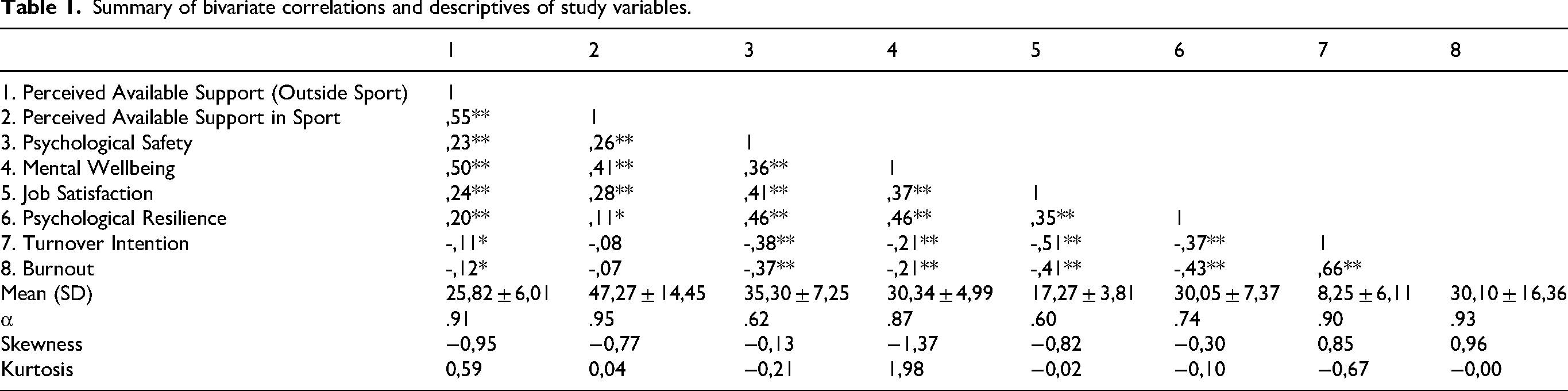
Summary of bivariate correlations and descriptives of study variables.
Results
Descriptive and correlation
As shown in Table 1, perceived available support outside sport showed an apparent convergence with perceived available support in sport (r = 0.55, p < 0.01). It was also positively related to psychological safety (r = 0.23, p < 0.01), mental well-being (r = 0.50, p < 0.01), job satisfaction (r = 0.24, p < 0.01), and psychological resilience (r = 0.20, p < 0.01). In the opposite direction, higher support outside sport was associated with slightly lower turnover intention (r = -0.11, p < 0.05) and burnout (r = -0.12, p < 0.05). A broadly similar pattern emerged for perceived available support in sport, which was positively associated with psychological safety (r = 0.26, p < 0.01), mental wellbeing (r = 0.41, p < 0.01), job satisfaction (r = 0.28, p < 0.01), and—more modestly—psychological resilience (r = 0.11, p < 0.05). However, its associations with the more adverse outcomes were weak and not statistically significant, for both turnover intention (r = -0.08, p > 0.05) and burnout (r = -0.07, p > 0.05). Psychological safety occupied a central position in the correlation pattern: it was positively related to mental well-being (r = 0.36, p < 0.01), job satisfaction (r = 0.41, p < 0.01), and psychological resilience (r = 0.46, p < 0.01), while demonstrating moderate negative associations with turnover intention (r = -0.38, p < 0.01) and burnout (r = -0.37, p < 0.01).
Mental well-being, in turn, aligned with more favourable work-related and personal resources, correlating positively with job satisfaction (r = 0.37, p < 0.01) and psychological resilience (r = 0.46, p < 0.01). At the same time, better well-being was associated with lower turnover intention (r = -0.21, p < 0.01) and lower burnout (r = -0.21, p < 0.01). Job satisfaction appeared particularly relevant to retention-related attitudes: it was strongly and negatively associated with turnover intention (r = -0.51, p < 0.01) and also negatively associated with burnout (r = -0.41, p < 0.01). Its positive association with psychological resilience was moderate in size (r = 0.35, p < 0.01). Psychological resilience was consistently associated with low levels of strain and withdrawal, and showed negative associations with turnover intention (r = -0.37, p < 0.01) and burnout (r = -0.43, p < 0.01). Finally, turnover intention and burnout were closely intertwined, with a strong positive association between them (r = 0.66, p < 0.01).
Path analysis
The indicators revealed a good fit for our model (Figure 2): [χ2 (9) = 18.038, χ2/df = 2.00, CFI = 0.98, TLI = 0.98, RMSEA = 0.05 (95% C.I.: 0.01–0.09), SRMR = 0.03].
The standardised coefficients of the hypothesised model.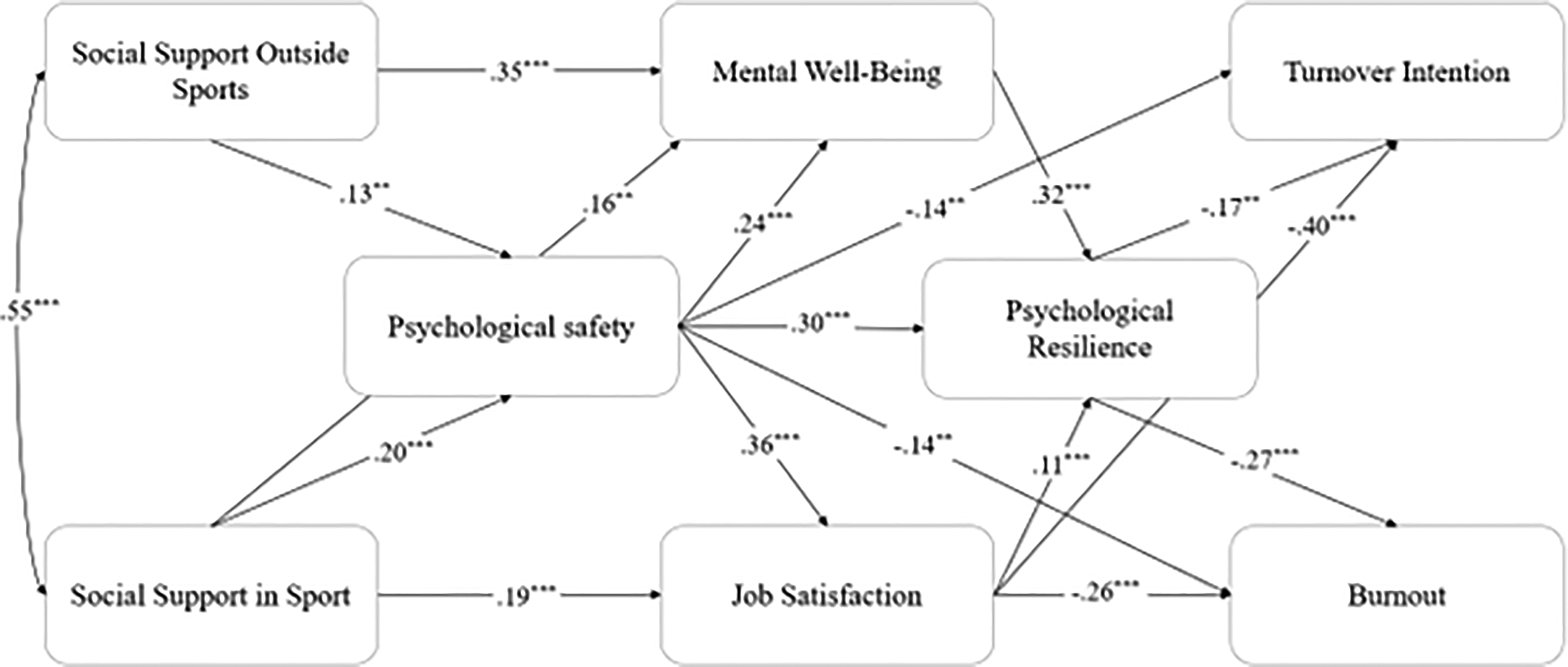
The structural equation model was utilised to empirically test the comprehensive set of hypothesised relationships detailing the flow of resources among sports team coaches. The analysis of the standardised regression weights and the mediated pathways provided strong evidence supporting the core tenets of the Job Demands–Resources (JD-R) model and the Conservation of Resources (COR) theory within this professional context.
Direct effects: the foundation of resource accumulation
The investigation into the direct paths supported the sequential initiation and accumulation of resources, which form the protective backbone of the model:
Social support, irrespective of its source, played a crucial role in establishing initial resources. Social Support in Sport was supported as a significant and positive predictor of Psychological Safety (β = 0.197, p = 0.006), demonstrating that a supportive work environment directly fosters a coach's sense of security and ability to take interpersonal risks within their team or organisation. Furthermore, Social Support in Sport also exhibited a strong positive association with Job Satisfaction (β = 0.189, p = 0.002), highlighting its immediate contribution to cognitive contentment with the job role. In parallel, Social Support Outside Sport was the most robust external predictor, strongly linked to the coach's general emotional health, as it predicted Mental Well-Being (β = 0.355, p < 0.001).
Supported as a vital intermediary resource, Psychological Safety is significantly associated with the development of key internal psychological assets. It was a potent predictor of Job Satisfaction (β = 0.362, p < 0.001), indicating that feeling safe is foundational to a positive evaluation of the job. Similarly, it significantly enhanced Mental Well-Being (β = 0.238, p < 0.001). Crucially, Psychological Safety also significantly predicted Psychological Resilience (β = 0.303, p = 0.001), suggesting that a secure environment is paramount for cultivating the coach's adaptive capacity.
Within the model, Mental Well-Being emerged as a notable psychological driver of coping and a significant positive predictor of Psychological Resilience (β = 0.318, p < 0.001). This supports the idea that emotional health is instrumental in a coach's ability to bounce back from the profession's demanding challenges. However, the direct path from Job Satisfaction to Psychological Resilience was not statistically significant (β = 0.105, p = 0.103), suggesting that resilience relies more on the coach's emotional state and sense of security than on their cognitive contentment with their duties.
All psychological resources tested demonstrated significant protective effects against strain. Job Satisfaction showed the strongest direct protective influence, powerfully reducing both the coach's Turnover Intention (β = -0.401, p = 0.001) and Burnout (β = -0.263, p < 0.001). Psychological Resilience provided a significant protective layer, with negative associations with Turnover Intention (β = -0.170, p = 0.002) and Burnout (β = -0.277, p = 0.001). Finally, even in its direct form, Psychological Safety was significantly and negatively associated with Turnover Intention (β = -0.142, p = 0.011) and Burnout (β = -0.137, p = 0.022).
Indirect effects
The analysis of indirect effects supported the conclusion that external and initial resources successfully transmit their protective influence through a sequence of internal psychological resources, thereby demonstrating the full operationalisation of the COR theory.
Social support outside sport
The benefits derived from non-work support were effectively channelled into professional protection via internal resources. Social Support Outside Sport significantly and negatively predicted Burnout via the chain Mental Well-Being and Psychological Resilience. This path represents a critical conversion of general emotional health into work-specific adaptive capacity (β = -0.085, 95% CI = [-0.161, −0.040]).
The positive statistical impact of Social Support Outside Sport was transmitted solely through Psychological Safety, which significantly and negatively predicted Turnover Intention (β = -0.019, 95% CI = [-0.053, −0.001]). This effect was significantly extended through the Psychological Safety and Psychological Resilience chain (β = -0.019, 95% CI = [-0.044, −0.007]).
Social Support Outside Sport also exerted a protective effect on Burnout through the chain Psychological Safety and Job Satisfaction (β = -0.033, 95% CI = [-0.083, −0.002]). Beyond strain mitigation, Social Support Outside Sport significantly and positively predicted the accumulation of Psychological Resilience through the Mental Well-Being mediator (β = 0.138, 95% CI = [0.071, 0.229]).
Social support in sport
Support obtained directly within the coaching environment demonstrated highly effective mediation through work-related resources. Social Support in Sport significantly and negatively predicted Burnout, with Job Satisfaction as the sole mediator (β = -0.056, 95% CI = [-0.106, −0.023]), underscoring that a supportive workplace is key to reducing exhaustion through increased contentment.
Social Support in Sport significantly and negatively predicted Turnover Intention through Psychological Safety alone (β = -0.012, 95%CI = [-0.027, −0.003]). Crucially, the complex chain Social Support in Sport, Psychological Safety, Job Satisfaction, and Turnover Intention was highly significant (β = -0.032, 95% CI = [-0.055, −0.013]), supporting the idea that safety and satisfaction jointly drive turnover intention.
Social Support in Sport significantly and negatively predicted Burnout via the Psychological Safety-Psychological Resilience chain (β = -0.019, 95% CI = [-0.040, −0.006]). A similar protective effect on Burnout was found through the Mental Well-Being and Psychological Resilience chain (β = -0.015, 95% CI = [-0.033, −0.004]). Social Support in Sport significantly and positively predicted the accumulation of Psychological Resilience via Psychological Safety alone (β = 0.030, 95%CI = [0.011, 0.055]) and via Job Satisfaction alone (β = 0.010, 95%CI = [0.000, 0.026]).
Discussion
We sought to determine the protective effects of layered social support and internal psychological resources against burnout and turnover intention among sports team coaches. Grounded in the Job Demands–Resources (JD-R) model30,68 and Conservation of Resources (COR) theory, 69 our findings partially support the view that coaches’ well-being and retention are strongly shaped by the accumulation and interaction of external (social support, psychological safety) and internal (mental well-being, job satisfaction, psychological resilience) resources in a highly demanding performance environment11,15,20,22
The central role of social support as an initial resource
Consistent with previous work highlighting the importance of social ties for coping and mental health,50–52 both perceived available support outside sport and in sport emerged as key starting points in the resource chain. As in earlier research on coaches and high-level performers,25–27 higher perceived social support was positively associated with mental well-being, job satisfaction, and psychological resilience, and linked to lower indicators of strain.
Perceived support from non-sporting networks was associated with mental well-being and resilience, and showed modest yet statistically significant inverse correlations with burnout and turnover intention. These findings are consistent with literature suggesting that external social systems offer critical emotional security and non-contingent validation, fostering a multifaceted identity that transcends professional performance and employment status.20,54,57 Such non-sporting ties may be significant for coaches whose working conditions are characterised by job insecurity13–15 and intense performance pressure.12,32
Perceived support in sport, while strongly related to other resources, was only weakly and non-significantly correlated with burnout and turnover intention at the bivariate level. Nonetheless, path analysis demonstrated that support in sport exerted its protective effects predominantly through work-focused mechanisms such as psychological safety and job satisfaction. This is in line with research showing that context-specific support in sport often takes instrumental and informational forms,53,55,56 directly associated with task overload and feelings of isolation in day-to-day coaching.25,54,57 Taken together, our findings support the view that different sources of support fulfil distinct but complementary functions20,51,52 and that both are needed to sustain coaches in volatile performance settings.26,28
Psychological safety as a core environmental resource
In line with conceptualisations of psychological safety as a shared belief that interpersonal risk-taking will not lead to humiliation or punishment,42,43,47 psychological safety occupied a central position in our model. It was positively associated with mental well-being, job satisfaction, and psychological resilience, and negatively associated with both burnout and turnover intention. These results resonate with recent sport-specific work indicating that psychologically safe climates emerge from supportive leadership and high-quality coach–athlete relationships,1,44 and that the broader organisational environment can either buffer or amplify stress for coaches35,38
Structural pathway evaluations indicated that social support in sport was a significant predictor of psychological safety, which in turn was related to enhanced job satisfaction, mental well-being, and resilience, while showing inverse associations with burnout and turnover intention. This observed configuration is consistent with the theoretical frameworks of the JD-R and COR models, suggesting that context-specific resources may facilitate motivational processes and the incremental accumulation of further psychological assets.30,68,69
In a context where coaches routinely face high quantitative and qualitative demands13,34 and exposure to uncontrollable external pressures such as administrative changes and media scrutiny,16–18 psychological safety may allow coaches to shift cognitive and emotional resources away from self-protection and towards learning, collaboration, and problem-solving.
Internal resources: mental well-being, job satisfaction, and resilience
Our findings underline the importance of mental well-being as a central psychological driver within the resource chain. In line with broader conceptualisations of psychological well-being and optimal functioning,36,62 higher mental well-being was associated with greater resilience, higher job satisfaction, and lower strain. Moreover, mental well-being transmitted the positive influence of both social support outside sport and psychological safety to resilience and burnout, consistent with research suggesting that well-being enables challenge-focused appraisals and adaptive coping in coaches.15,20,27
Job satisfaction emerged as a particularly potent protective resource against turnover intention, echoing prior findings in sport and organisational settings.48,49,59
In our model, job satisfaction emerged as a strong negative predictor of both turnover intention and burnout, and served as a significant mediator of the relationships between social support in sport, psychological safety, and these outcomes. This is consistent with research indicating that satisfaction with the structural and relational aspects of the job (e.g., pay, leadership, daily work with athletes) underpins staff retention and commitment in sport organisations,60,87 and can offset the impact of demanding work conditions.22,61
Psychological resilience, conceptualised as the capacity to maintain or regain functioning in the face of stress,63–65 also played a meaningful role in buffering strain. Higher resilience was associated with lower burnout and turnover intention, and its development was supported by psychological safety and mental well-being, as well as, to a lesser extent, job satisfaction. These findings dovetail with research indicating that resilient coaches and performers are more likely to reframe stressors as challenges, engage in problem-focused coping, and preserve a sense of control and purpose.88–90 In coaching contexts marked by chronic job insecurity, role conflict, and ethical tensions,13,39 such resilience appears critical for preventing emotional exhaustion and depersonalisation.36,65 Notably, the non-significant direct pathway from job satisfaction to resilience suggests that the latter may be more contingency-dependent on emotional well-being and perceived environmental safety than on cognitive evaluations of work conditions. This nuance accords with contemporary conceptualisations of resilience as a dynamic, multi-dimensional process underpinned by specific personal and contextual enablers, rather than being a mere derivative of general job contentment.63,65,90
Burnout and turnover intention as outcomes
Consistent with previous studies in sport and other high-demand occupations,29,37,61 burnout and turnover intention were strongly correlated and similarly influenced by resource deficiencies. Our results demonstrate that all internal resources—mental well-being, job satisfaction, and resilience—as well as psychological safety, contributed directly or indirectly to reducing these outcomes. This pattern supports the idea that burnout and turnover intention emerge not only from high demands but from a sustained imbalance in which resources are insufficient to meet those demands.29,35 According to the JD-R model, this imbalance triggers the “health-impairment process,” where chronic exhaustion of emotional and cognitive resources leads to professional erosion. 91 In our study, psychological safety and job satisfaction function as critical job resources that intercept this process, effectively preventing the conversion of job demands into burnout.
Moreover, the mediation findings indicate that both social support outside sport and in sport are negative predictors of burnout and turnover intention, with these relationships primarily mediated by psychological safety, mental well-being, job satisfaction, and resilience. This is consistent with COR theory, 69 suggesting a potential alignment with “gain spirals,” in which initial resource gains (e.g., feeling supported) are associated with the accumulation of further protective capacities.28,36 Specifically, the “resource caravan” concept within COR theory suggests that resources do not exist in isolation; instead, they aggregate and reinforce one another. 92 Our findings illustrate such a caravan, where external social support acts as a catalyst for environmental (psychological safety) and personal (resilience, well-being) resources. In high-performance coaching, where resource loss cycles can develop through chronic stress, job insecurity, and media pressure,12,14,18 promoting such gain cycles appears crucial for long-term sustainability.15,26,38
The presence of these resource caravans provides a “safety net” that allows coaches to recover from performance-related losses without falling into a “loss spiral,” where one setback leads to a rapid depletion of all psychological capital. 92 While burnout and turnover intention were conceptualised as parallel outcomes in our structural model to observe the simultaneous protective effects of psychological resources, it is important to note their high intercorrelation (r = .66). This finding aligns with the notion that burnout often serves as a primary driver of turnover intention in sports coaching. By treating them as concurrent strain outcomes, this study highlights that resource depletion among coaches manifests as both psychological exhaustion and a desire to leave the profession.
Practical implications
The current findings suggest several interrelated targets for intervention within sports organisations. First, programmes and policies that intentionally strengthen both in-sport and out-of-sport social support may be vital. In line with previous recommendations, clubs and federations should implement structured peer-support networks and formal supervisor mentoring programs, with a particular focus on junior coaches, who report higher levels of perceived isolation. This could include scheduled monthly “support circles” and initiatives that respect coaches’ non-sport lives and family responsibilities, such as flexible scheduling for non-competitive duties.
Second, given the central role of psychological safety as a key mediator in our model, leadership development and relationship-focused initiatives are likely to have cascading benefits. Specifically, federations should provide “Psychological Safety Training” for athletic directors and head coaches, focusing on practical techniques to foster open communication, establish “no-blame” zones for honest technical mistakes during training, and implement anonymous feedback channels to ensure coaches feel safe expressing concerns without fear of professional retribution.
Third, enhancing job satisfaction was found to be a robust predictor of reduced turnover intentions; therefore, clubs must move beyond broad climate improvements toward concrete contractual security. This includes providing multi-year contracts where feasible, ensuring transparent performance-based bonuses, and establishing clear career progression pathways to mitigate professional uncertainty, which is often associated with coaches’ decisions to leave the field. Finally, interventions that target mental well-being and resilience—such as providing access to sports psychologists for staff (not just athletes), integrating reflective practice sessions into the weekly coaching schedule, and offering structured coping workshops during high-pressure competitive periods—are aligned with existing calls to adopt a more systematic, resource-focused approach to coach mental health. By grounding these practices in the specific psychological drivers identified in this study, organisations can more effectively buffer against burnout and retain their coaching talent.
Limitations and future directions
While our cross-sectional design allows us to test complex structural relationships, it does not permit strong causal inferences. Longitudinal or intervention studies are needed to confirm the proposed resource chains and to examine how changes in social support, psychological safety, or internal resources over time affect burnout and turnover intention. Additionally, although the current study treated burnout and turnover intention as parallel outcomes to explore the simultaneous impact of resources, burnout is widely recognised as a significant predictor of turnover intention. Future research should therefore investigate the potential mediating role of burnout within these structural pathways to more precisely map the sequential relationship between psychological strain and professional retention. In addition, the sample was drawn from a single national context (Türkiye) and was predominantly male. This gender imbalance reflects the current professional and sociocultural landscape of team sports in Türkiye, where coaching roles in these specific branches remain male-dominated due to long-standing structural barriers. Consequently, the findings primarily capture the experiences of male coaches, and caution should be exercised when generalising these results to female coaches or different cultural environments.
Furthermore, although subgroup analyses (e.g., regarding gender, professional vs amateur status, or level coached) were considered, they were not performed due to significant disparities in group sizes. From a statistical standpoint, conducting subgroup analyses or multi-group structural equation modelling with highly disproportionate samples—such as the small number of female coaches relative to the large male cohort—would yield insufficient statistical power and potentially biased parameter estimates. This could risk the overall validity and stability of the structural model. In addition, although our sample comprised team sport coaches with varying levels of experience and competition levels, future work could explore whether these dynamics differ across sports, organisational structures, and employment conditions.
Moreover, while the present study prioritised specific protective factors, it did not explicitly model the interaction between job resources and job demands, which remains a fundamental tenet of the Job Demands-Resources (JD-R) theory.68,91 Our model focused on psychological and environmental resources to highlight their potential buffering effects; however, it did not account for other potentially relevant job resources, such as role clarity and autonomy, or specific job demands, including excessive workload and emotional labour. Integrating these demands alongside a broader range of job design characteristics into future JD-R–based models may provide a more nuanced understanding of how organisational and interpersonal conditions jointly shape coaches’ well-being and retention.
Certain measurement properties of the scales warrant consideration. Several constructs were assessed using short scales (e.g., 3 items for job satisfaction and turnover intention), with some reliability estimates around the .60 threshold. While these are acceptable for short scales in social sciences, we performed Confirmatory Factor Analysis (CFA) and examined item-total correlations to ensure structural integrity. For both psychological safety and job satisfaction, item-total correlations were consistently above the acceptable threshold, supporting that each item significantly contributed to its respective latent construct. Moreover, the CFA confirmed a robust factor structure for these scales within our specific sample of Turkish coaches. Also, despite the strong fit indices, it is acknowledged that other equivalent or alternative structural models might also fit the data. Future research could explore alternative pathways to further refine the understanding of these dynamics.
Conclusion
Our findings demonstrate that sports team coaches’ burnout and turnover intentions are shaped by a layered constellation of external and internal resources. Both social support outside sport and within sport serve as important antecedents of psychological safety, mental well-being, job satisfaction, and resilience. By examining these variables within an integrated structural model, this study provides an empirical application of JD-R and COR frameworks specifically tailored to the coaching context. Rather than suggesting a fundamental shift in these established theories, the results illustrate the specific sequential mechanisms through which environmental support is internalised as personal resources to protect against strain. Supporting coaches with robust social, organisational, and psychological resources appears essential not only for their individual health, but also for the long-term sustainability and effectiveness of high-performance sport environments.
Footnotes

Ethical considerations
This study was approved by the Social Sciences and Humanities Ethics Committee at Mugla Sitki Kocman University (Approval No. 250022, Decision No. 21, 16.02.2025). All procedures performed in studies involving human participants were in accordance with the ethical standards of the institutional and/or national research committee and with the 1964 Declaration of Helsinki and its later amendments, or comparable ethical standards.
Consent to participate
Informed consent to participate was obtained electronically from all individual participants included in the study prior to data collection.
Consent for publication
Not applicable.
Funding
The authors received no financial support for the research, authorship, and/or publication of this article.
Declaration of conflicting interests
The authors declared no potential conflicts of interest with respect to the research, authorship, and/or publication of this article.
Data availability
The datasets generated and/or analysed during the current study are not publicly available due to participant privacy and ethical restrictions, but are available from the corresponding author (Dr Ender Şenel) on reasonable request.