




Abstract
Baseball involves a dynamic confrontation in which the batter uses the pitcher's kinematics to support swing decision. However, replicating this representative perceptual information during real-world (RW) practice is difficult, as pitchers have a restricted number of maximum-effort pitches they can safely deliver. Virtual reality (VR) practice, where a batter faces a virtual pitcher, has been proposed to be an effective practice tool to provide representative perceptual information and train swinging decision. This study examined the transfer effects of supplementing RW batting training with VR practice on swing decision in baseball players. Twenty highly trained male baseball players were randomly assigned to either a pseudo-representative real-world only (RWG) or a RW plus representative VR (RW + VRG) batting practice condition. Throughout the six-week intervention, both groups completed their regular weekday training sessions. For the RW + VRG, a portion of their regular practices was replaced with 12 twenty-minute sessions of VR batting practice. Decision making was assessed pre- and post-intervention using a VR pitch recognition (PR) test and plate discipline during a real batting (RB) test. Bayesian analyses revealed moderate evidence for greater performance improvement following RW + VRG practice compared to the RWG practice, as observed in the PR test (BF = 4.4) and Z-swing % in the RB test (BF = 4.15). These exploratory findings suggest that VR batting practice is a promising complementary tool for enhancing swing decision-making.
Introduction
Successful performance in baseball batting relies on the athlete's capacity to make timely and accurate decisions based on relevant visual cues such as the pitcher's movements (e.g., pitching arm movements, wrist position, grip, and release point) and the ball kinematics. 1 However, in regular real-world (RW) baseball batting practice, batters rarely face pitcher-delivered pitches, thereby limiting their exposure to visual cues. This limitation arises from the limited number of pitches that pitchers can safely throw with maximum effort during practice or competition. 2 Consequently, RW training activities typically involve hitting pitches delivered by a pitching machine, front tosses from a teammate, or balls placed on a stationary tee.3,4 Such activities do not include task-specific visual information (perceptual fidelity) and lack perception-action coupling, therefore making them pseudo-representative.
Technological advancements now allow video projections of pitchers on a screen, enabling the creation of batting practice activities with perceptual fidelity. The use of this tool for batting practice, including perception-action coupling, has shown promising benefits for improving batting performance. 5 However, the limited portability of those systems has spurred interest in developing portable virtual reality (VR) systems that provide affordable and accessible ways to simulate virtual pitching scenarios in practical contexts.6,7 Yet, empirical evidence supporting the effectiveness of these systems remains limited, 8 including only one preliminary study showing that portable VR practice did not benefit pitch recognition (PR). 9 This finding could be explained by the fact that the virtual task used for practice in the study did not require a batting action and thus lacked perception-action coupling, a factor known to be crucial for the design of representative practice and the transfer of sport-specific skills.10,11
This brief report investigated the transfer effect of supplementing RW practice with VR batting practice, incorporating perceptual fidelity and real batting movements, on swing decision in baseball players. We hypothesized that due to the higher representativeness (i.e., task-specific visual information combined with perception-action coupling), the addition of VR practice to RW training will enhance swing decision-making, as assessed using a PR test in VR and a real batting (RB) test.
Method
Participants
Twenty highly trained 12 male baseball players, aged 15 to 20 years old (mean = 17.2, SD = 1.1), were recruited from a provincial developing baseball program. They reported having played baseball for an average of 10.9 years (SD = 2.6, range 5–14 years). The research protocol (#102835) received approval from the Bishop's University Research Ethics Board, and all participants provided written informed consent before participation.
Equipment
Procedure
Pre- and Post-tests
Data were collected during the pre-season practices (March-June). Participants completed a PR test in VR and a RB test in a counterbalanced order. In both tests, they faced fastballs, breaking balls and off-speed pitches delivered in a randomized order. The swing decision was assessed in both the PR and RB tests. The PR test was conducted in a VR environment using Win Reality software (Win Reality, USA) and a Meta Quest 2 headset (Meta platforms, USA). This test consisted of observing, from the first-person perspective, 20 pitches delivered by a virtual pitcher. All pitches were delivered by the same virtual right-handed pitcher, selected to match the participants’ competitive level using the following software filters: age 16–20 years, college playing level, and pitching velocity between 70 and 95 mph (see Figure 1A for more details). Participants were required to identify pitch type, pitch location, and ball endpoint. Pitch type and pitch location were multiple-choice questions, with the participant using the controller to point to and select one of the available response options displayed on the screen. The ball endpoint was assessed by having participants use the controller to indicate, in the virtual environment, where they estimated the ball crossed home plate, with the strike zone visible on the screen. A decision-making accuracy score was then computed by averaging the z-scores of the three variables. Although the PR test does not require a motor response and therefore does not engage perception-action coupling, it nevertheless allows for the isolated assessment of an individual's ability to identify pitch type and location and has been found to correlate with batting performance. 13
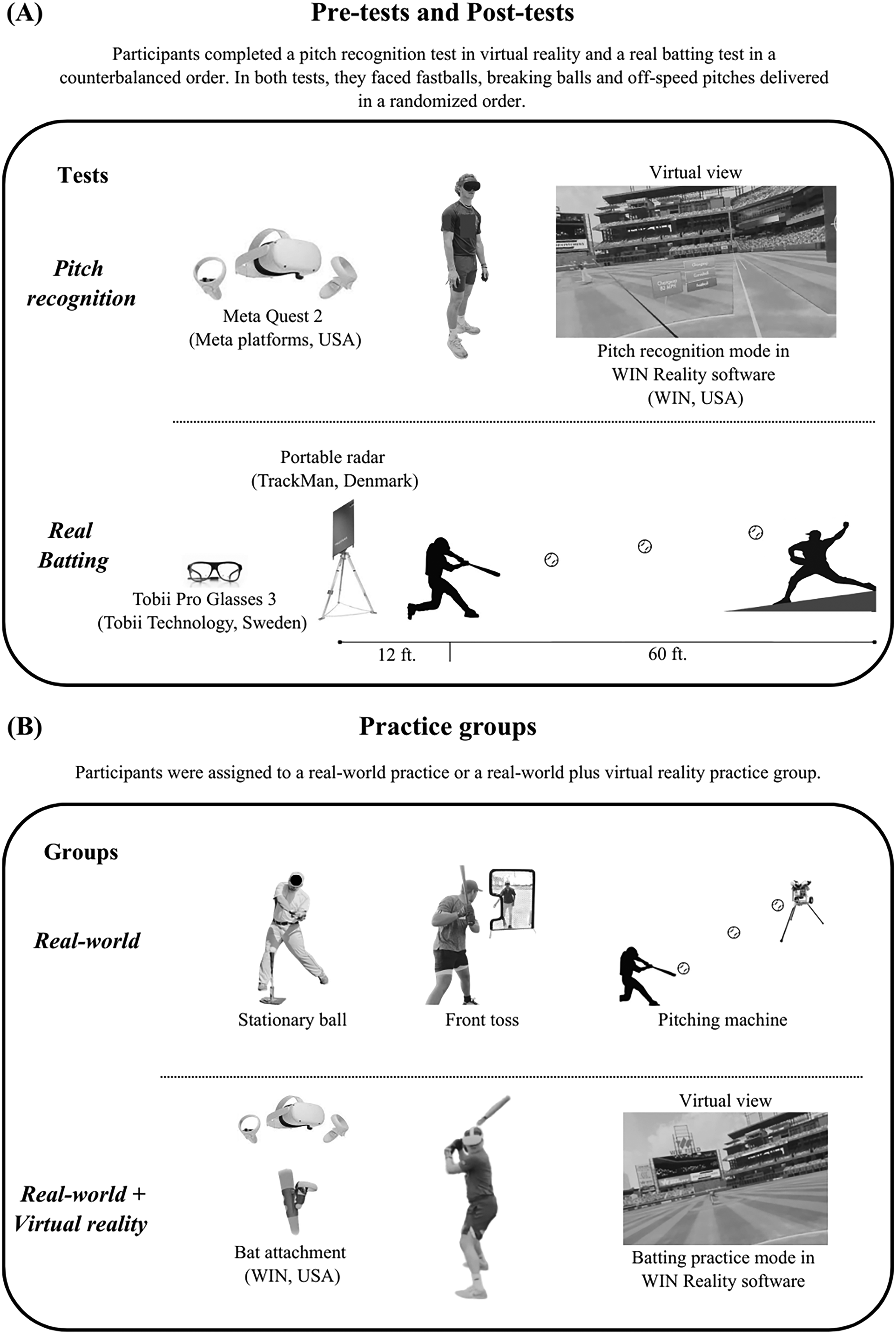
Schematic representation of the (A) pre- and post-tests and (B) practice groups.
In the RB test, participants had to bat at pitches delivered by a real pitcher. On average, participants faced 20 pitches (SD = 11.7) and 15 real pitchers, all matching the participants’ level, age, and experience, were needed to deliver all the pitches in the RB test. Participants were instructed to swing only at strikes, and plate discipline was quantified using the following measures. Z-swing %, defined as the number of swings at pitches inside the strike zone divided by the number of pitches seen inside the strike zone (strikes), 14 with higher values indicating a greater ability to swing selectively at strikes. O-swing %, defined as the number of swings at pitches outside the strike zone divided by the number of pitches seen outside the strike zone (balls), 14 with lower values indicating a greater ability to withhold swings at balls.
During the RB test, participants wore an eye tracker recording gaze behaviour at 100 Hz following a 5-s calibration. Data were analysed using Tobii Pro Lab software. For each trial, we measured the number and duration of fixations and saccades, and the search rate was calculated as the total number of fixations divided by their total duration. 15 In addition, the onset of the predictive saccade was identified as the first saccade following the ball release by the pitcher. 16 Because this saccade occurs prior to pitch arrival, its onset time is expressed as a negative value.
Practice
Throughout the six-week intervention, the RW group (RWG, n = 10) and RW plus VR group (RW + VRG, n = 10) completed their regular weekdays training sessions (Monday-Friday), which each lasted 3.5 h and included activities such as fielding, strength and conditioning, and batting stationary balls, front tossed balls, or balls delivered by a pitching machine. For the RW + VRG, a portion of their regular practice during the six-week intervention was replaced with VR practice (Figure 1B). Participants completed 12 VR sessions in total (approximately 20 min each; two per week). Each session consisted of facing 40 pitches from the same virtual pitcher, either right- or left-handed, matched to the participants’ skill level using the same filters applied in the PR test. Pitchers differed across practice sessions. Pitches included fastballs, breaking balls, and off-speed pitches presented in a randomized order. Successful bat-ball contact produced software-generated bat-ball sound, bat vibration, and visual feedback on hit distance and direction.
Participants with participation rate to training sessions inferior to 75% were removed from the analysis (n = 2, in RW + VRG). Due to participants availability and schedule restriction, fourteen participants completed the RB test in both the pre- and post-tests (RW + VRG = 6, RWG = 8), and gaze behavior data was collected for twelve participants (RW + VRG = 6, RWG = 6).
Statistical analysis
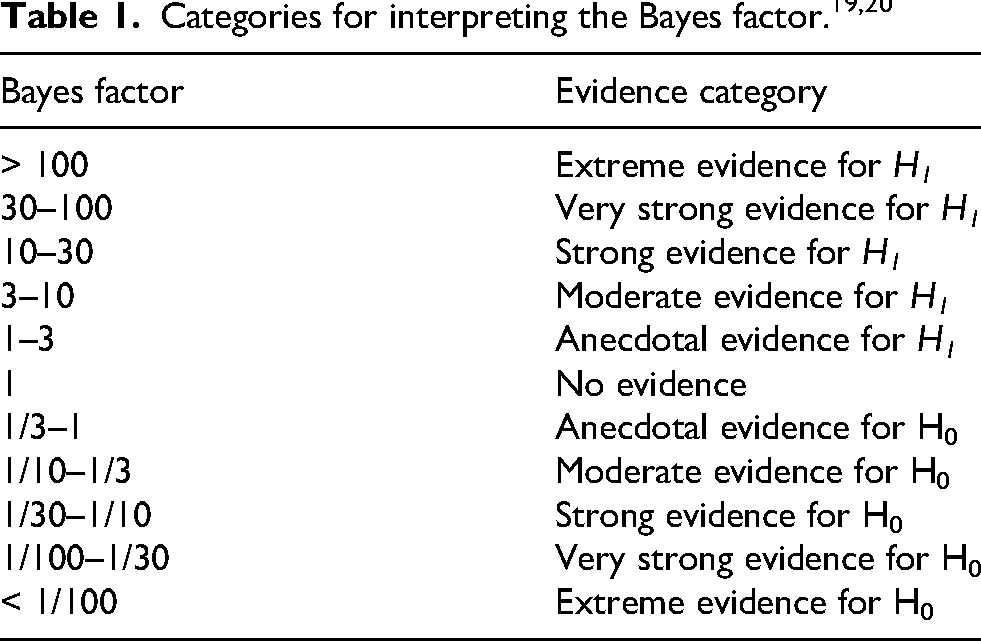
For all dependent variables, the within-participant difference from pre- to post-test (Δ) was calculated as: Δ = post-test − pre-test. To alleviate the problem associated with sensitivity to sample size inherent in frequentist analysis, we adopted a Bayesian approach, which also allows the quantification of the evidence in favor of both the null and alternative hypotheses. 17 Bayesian t-tests comparing each variable between groups were computed in JASP software. Based on previous evidence,5,9 we expected a small effect size and therefore used a Cauchy prior distribution centered at 0.2 and with a width parameter of 0.2. 18 The analysis returns a Bayes Factor, a continuous measure of evidence, with values > 3 generally considered a meaningful level of support for H1 (Table 1).
Results
For the RB test, the analyses revealed a moderate level of evidence, corresponding to our predefined interpretative framework for a meaningful difference, thus supporting a greater improvement for the RW + VRG compared to the RWG in Z-swing % (BF = 4.15, Figure 2A). Conversely, the data for O-swing % provided anecdotal evidence for the null hypothesis (H0, BF = 0.58, Figure 2B). For the PR test, the analysis similarly revealed moderate evidence supporting a greater improvement for the RW + VRG compared to the RWG (BF = 4.4, Figure 2C). For the visual variables, the analysis revealed anecdotal evidence supporting H0 for number of fixations (BF = 0.82, Figure 2D), fixation duration (BF = 0.79, Figure 2E), saccades duration (BF = 0.73, Figure 2H), and predictive saccades (BF = 0.74, Figure 2I). In contrast, anecdotal evidence supporting H1 was found for search rate (BF = 1.11, Figure 2F) and number of saccades (BF = 1.12, Figure 2G).
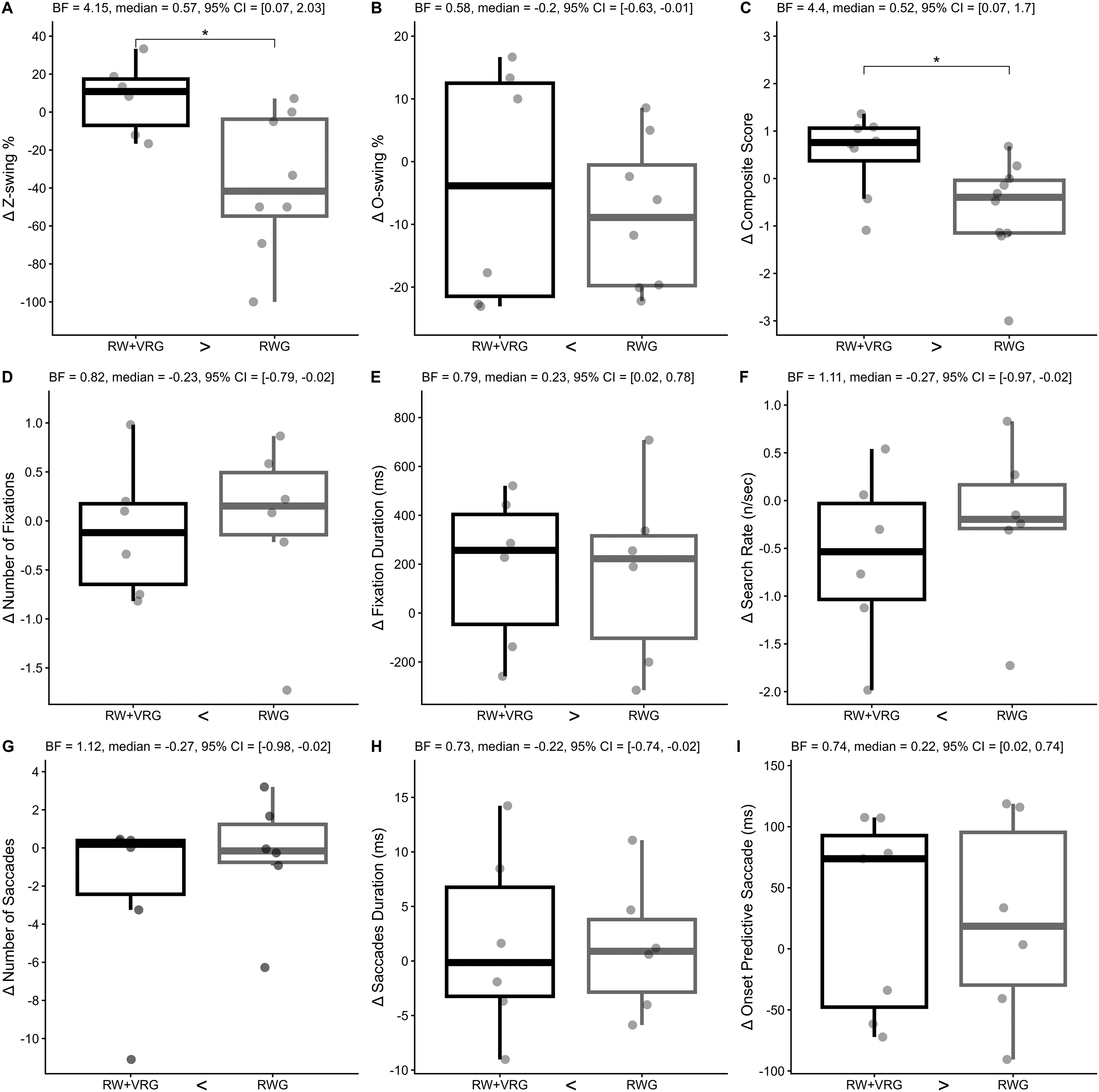
Boxplots illustrating the change from pre-test to post-test (Δ) for the real-world plus virtual reality (RW + VRG) and real-world (RWG) groups for the plate discipline variables in the real batting test (A and B), the virtual pitch recognition test (C), and the gaze behavior (D to I) in the real batting test. The symbols < and > on the x-axis indicate the a priori direction of the alternative hypothesis (H1), and the * symbol identifies a Bayes Factor > 3. Bayes Factors (BF), the median of the posterior distributions, as well as the 95% credible intervals are also reported.
Discussion
Results from the RB test revealed that adding representative VR batting practice to RW practice resulted in improved Z-swing % but no change in O-swing %, compared to RW practice alone. These results suggest that players improved their plate discipline: they became more likely to swing at strikes while maintaining control over pitches outside the strike zone. Consistent with this pattern, greater gains were also observed for the RW + VRG in the PR test compared with the RWG. This increase in decision-making performance can be attributed to the perceptual and action correspondences afforded by VR practice, as proposed by the Modified Perceptual-Training 11 and Representative Learning Design 21 Frameworks.
Focussing specifically on the perceptual component, the VR environment replicated the pitchers’ throwing kinematics and the associated ball trajectories, thereby preserving both stimulus and perceptual-cognitive correspondence of the throwing task. This supported the perceptual conditions under which batters identify cues and make timely swing decisions in real batting performance context. Additionally, because pitch characteristics varied both within and across practice sessions, the VR practice condition exposed participants to increased variability in pitch speed, pitch type, pitcher handedness, and pitching kinematics. In contrast to the representative batting practice afforded by VR, the exclusive use of stationary balls, front tosses and pitching machine by the RW group may have resulted in a reduced perceptual correspondence and specific exposure. This likely limited batters’ opportunities to learn to associate the pitchers’ kinematics with specific ball trajectories. In addition, the training modalities used during RW practice rarely required participants to make swing-inhibition decisions, as most balls to swing at were located within the strike zone.
Beyond perceptual correspondence, VR practice also preserved perception-action coupling in the batting task by requiring participants to swing at pitches and providing haptic and visual feedback contingent on successful bat-ball contact. This contrasts with a previous baseball VR practice study that failed to produce transfer effects when the participants’ motor responses in practice required button presses instead of actual batting motion, 9 thereby primarily training decision-making declarative knowledge rather than procedural knowledge. In our VR practice, requiring participants to execute a batting motion in response to representative stimuli preserved the motor correspondence of the task, 21 which may have enhanced the batters’ ability to integrate sensory information with movement execution under realistic temporal and spatial constraints, ultimately promoting transfer effects.
In terms of gaze behavior, the absence of meaningful differences between groups suggests that, although VR practice benefits swing decision, these improvements cannot be attributed to changes in gaze behaviour. This finding may be explained by the fact that participants were highly-trained baseball players who may have already exhibit expert-like gaze characteristics, such as fewer fixations of longer duration and delayed predictive saccades.16,22 Alternatively, changes in gaze behavior may require longer VR practice, or the use of VR-only protocols, to emerge. The observed improvements in decision-making performance may instead reflect the RW + VRG's enhanced ability to extract relevant cues by directing gaze toward specific areas of interest that were not captured by the gaze metrics examined in this study. To further understand the effect of VR practice on gaze behavior, future research should investigate longer VR batting practice protocols, include novice participants, and analyse areas of interest.
We acknowledge that our deliberate decision to recruit highly-trained athletes limited the sample size, and increased the likelihood of dropouts due to school commitments, training schedules, and national team participation. To mitigate this, we initiated the experiment in the middle of the off-season, with the added benefit of minimizing potential confounding effects associated with participating in games and competitions. Future studies are needed to confirm these preliminary findings and should consider a larger sample size and be initiated at the beginning of the off-season to reduce participant dropouts and ensure an adequate final sample size. Additionally, further research should isolate and identify the specific effects of VR batting practice on swing decision-making by including a VR-only group and a VR placebo group.
To conclude, these findings suggest that VR batting practice may be a promising complementary tool for enhancing swing decision-making on pitches within the strike zone among highly-trained baseball batters. Until additional evidence from larger and more diverse samples becomes available to further substantiate these results, we encourage baseball practitioners to supplement their batting training with activities that preserve the perception-action coupling inherent to the task.
Footnotes

Author contributions
Author 1 contributed to the study conception, funding application, data collection, statistical analysis, and manuscript writing. Author 2 contributed to the study conception, funding application, and manuscript writing. Author 3 contributed to the data collection. Author 4 contributed to the study conception, funding application, statistical analysis and manuscript writing. All authors participated in manuscript revision and approved the final version for publication.
Ethical considerations
The research protocol (#102835) received approval from the Bishop's University Research Ethics Board.
Consent to participate
All participants provided written informed consent before participation.
Consent for publication
Not applicable.
Funding
The authors disclosed receipt of the following financial support for the research, authorship, and/or publication of this article: This study was supported by the Ministère de l’Éducation du Québec, Baseball Québec, and Mitacs (IT37470).
Declaration of conflicting interests
The authors declared no potential conflicts of interest with respect to the research, authorship, and/or publication of this article.
Data availability statement
The data that support the findings of this study are available from the corresponding author, upon reasonable request.