




Abstract
Motor–cognitive dual-task paradigms (DTPs) reflect the interaction between cognitive and motor demands during match play. However, evidence in youth football remains fragmented. This systematic review synthesizes research on DTP in competitive youth football, focusing on assessment tools, acute performance effects, and training interventions. A systematic search was conducted in PubMed, Web of Science, and Scopus from inception to October 2025 following PRISMA 2020 guidelines. Thirteen studies were included. Results indicate that motor–cognitive dual-task tests show good validity and reliability, effectively discriminating between competitive levels and talent status. Acutely, dual-task conditions consistently lead to immediate performance decrements; notably, secondary motor tasks induce significantly greater physical and tactical costs than cognitive tasks. Longitudinal studies demonstrate that dual-task training results in superior improvements in physical, technical, and tactical performance compared with conventional training, likely due to enhanced attentional efficiency. In conclusion, DTP provides a valid and ecologically relevant framework for holistic performance evaluation and development in youth football.
Introduction
Football is a complex team sport characterized by high perceptual, cognitive, and motor demands. Performance does not emerge from isolated physical or technical attributes but from the continuous interaction between cognitive processes and motor execution under temporal pressure.1,2 In particular, perceptual–cognitive demands and decision-making processes play a key role, 3 while motor execution under dynamic conditions is equally critical, 4 In youth football, this coupling is even more critical, as performance criteria are inherently multidimensional, reflecting a dynamic interaction between motor skills and executive functions.5,6 In this context, football represents a natural dual-task (DT) environment. Players must simultaneously perceive environmental information, make tactical decisions, and execute precise motor actions. 7 This functional coupling is conceptualized within the DT paradigm (DTP), which refers to performing two tasks simultaneously under limited attentional resources.8,9 A key metric in this framework is the dual-task cost (DTC), defined as the performance decrement observed under concurrent task conditions compared to single-task execution. Cognitive load refers to the amount of mental resources required to process task-relevant information and is influenced by task complexity and the volume of information that must be extracted from the environment. In contrast, DT demand reflects the requirement to perform two tasks simultaneously, typically combining cognitive and motor processes, which imposes increased attentional and working memory demands. Performance decrement (i.e., DTC) represents the observable outcome of this interaction, arising from competition for limited attentional resources when task demands exceed processing capacity. In football science, DTPs are increasingly used to discriminate skill levels, assess attentional demands, and evaluate training-induced adaptations under representative performance conditions.10,11
To further clarify how these DT demands are operationalized in football contexts, it is important to distinguish between different types of DT demands. DT conditions may involve: (i) cognitive-specific tasks, such as mental calculations or memory-based activities not directly related to the game. For example, players may be required to perform arithmetic operations or memorize sequences of numbers or letters while executing football-specific actions, introducing an external cognitive load unrelated to the game context. These tasks can be implemented across a wide range of training and testing environments, including technical drills, small-sided games (SSGs), conditioned matches, or structured circuits, as well as in controlled laboratory or field-based assessment settings; (ii) football-specific perceptual–cognitive tasks, such as tracking opponents or processing tactical information. These tasks may be implemented in both representative field-based contexts and controlled experimental settings. In field-based scenarios, such as small-sided games, players may be required to monitor and recall tactical information (e.g., the number of passes completed by the opposing team), thereby embedding cognitive demands within the natural dynamics of play. In contrast, laboratory-based or technology-assisted tasks, such as multiple object tracking (MOT), require players to track several moving stimuli on a screen, isolating perceptual–cognitive processes while maintaining sport-relevant informational demands; and (iii) motor interference tasks, which require the simultaneous execution of an additional motor action that competes with the primary football task. For instance, players may be asked to maintain the balance of an external object (e.g., a ball on a cone) while performing football actions, creating direct competition for motor control resources. Similarly to cognitive-specific tasks, these motor interference tasks can be implemented across a range of training and testing contexts, including SSGs, technical drills, conditioned matches, or circuit-based exercises, where players must perform an additional motor action (e.g., balancing an object while moving or passing) alongside football-specific skills. Taken together, this framework allows the classification of the included studies according to the type of DT manipulation, providing a more comprehensive and structured understanding of cognitive–motor interactions in youth football.
Building on this conceptual framework, it is also important to consider the current state of the evidence in this field. Despite the growing interest, DT research in football remains fragmented and insufficiently consolidated. Much of the theoretical foundation originates from clinical domains (e.g., Parkinson's disease or fall prevention) or other open-skill sports. 12 Within football, existing studies are highly heterogeneous, ranging from the validation of assessment tools to the evaluation of chronic training interventions. Furthermore, previous systematic reviews have addressed DT across multiple sports without focusing specifically on the unique constraints of football or the specificities of youth developmental stages. 13 As suggested by Wu 13 there is a clear need for sport-specific syntheses to enhance the applied value of DTP in professionalized academy settings.
In addition to these conceptual and empirical gaps, it is necessary to consider the developmental context in which these paradigms are applied. The age range of 10–19 years is particularly relevant for this analysis, as it encompasses key developmental stages in youth football. During adolescence, players undergo substantial biological, neuromuscular, and cognitive maturation.14,15 This includes marked improvements in executive functions (e.g., inhibitory control, working memory, and cognitive flexibility) and perceptual–motor integration.16–18 These processes are critical for efficiently coordinating perception, decision-making, and motor execution under dynamic conditions. From approximately 10–12 years of age, players are progressively exposed to structured and competitive environments in which training tasks increasingly reflect the cognitive–motor complexity of match play.19,20 In this context, DTP are particularly relevant, as they allow the assessment and manipulation of players’ capacity to manage concurrent cognitive and motor demands during a phase in which these abilities are still developing. The upper age limit reflects the transition to senior or professional football, a stage characterised by increased performance demands and early professionalisation pathways. 21
Given these considerations, this systematic review aims to synthesize and critically appraise the evidence on motor–cognitive DTP in competitive youth football players (10–19 years). The review addresses three complementary perspectives: (i) the development and validation of DT tests for performance assessment and talent identification; (ii) the acute effects of DT conditions on football-specific performance; and (iii) the chronic effects of cognitive–motor DT training interventions. This work represents the first systematic effort to provide a sport- and development-specific synthesis of how DTP are assessed, manipulated, and trained in youth football.
Materials and methods
Search strategy
This systematic review followed PRISMA 2020 guidelines 22 and was prospectively registered in PROSPERO (CRD420251122429). A comprehensive search was performed across Web of Science, PubMed, and Scopus for articles published from database inception to 25 October 2025. This timeframe captures the emergence and evolution of motor–cognitive DTP in sports science. Following recent calls for sport-specific evidence, 13 this review focuses exclusively on competitive youth football. Detailed search strings are provided in Table 1.
Search strategy in databases.
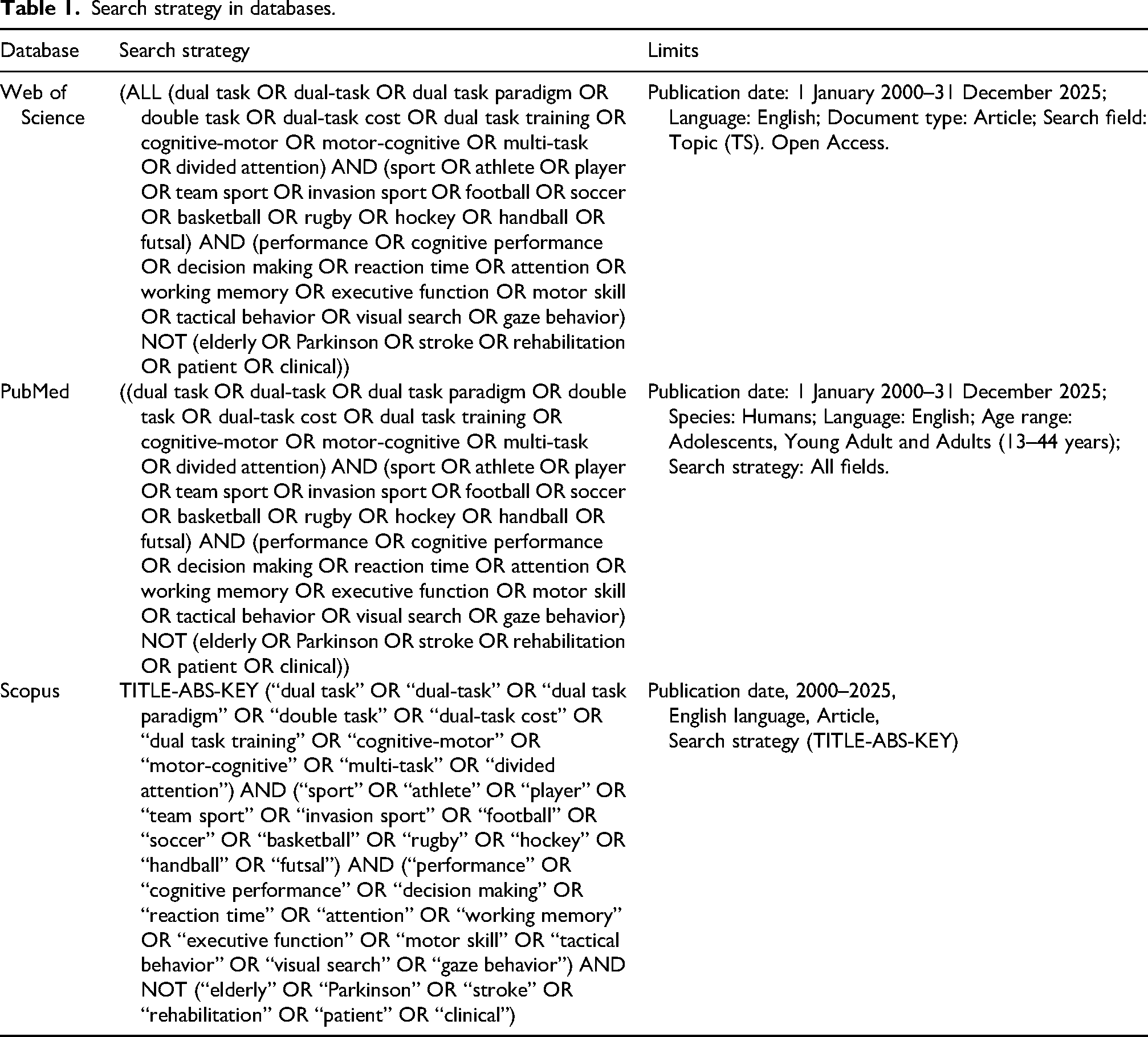
The search strategy was designed to maximise sensitivity. While the review specifically focuses on players aged 10–19 years, broader age filters (e.g., ‘Adolescents’ and ‘Adults’ in PubMed) were initially applied during the database search to ensure that studies with mixed-age cohorts or those transitioning into early professional stages were not overlooked. Subsequently, a rigorous manual screening process was conducted to include only those studies where the mean age or the analysed subgroups fell within the predefined 10–19 year range.
Criteria used for selection
Studies were included if they met the following criteria: (i) original research (cross-sectional, quasi-experimental, or RCTs) published in peer-reviewed journals; (ii) participants were federated youth football players (10–19 years) training in organized environments (e.g., professional academies or regional leagues); (iii) implementation of a motor–cognitive DTP involving football-specific motor components; and (iv) reported at least one physical, technical, tactical, or cognitive outcome measure. Exclusion criteria included: (i) non-football cohorts or adult populations (>19 years); (ii) clinical or sedentary populations; (iii) cognitive/perceptual tasks lacking a motor component; and (iv) grey literature (e.g., theses, conference proceedings) was excluded to ensure the inclusion of peer-reviewed studies with established methodological quality and to maintain consistency in the level of scientific evidence analysed.
Reliability and extraction of data
Two independent reviewers (JMRL and JAV) conducted the screening and data extraction process. Extracted data were cross-checked to ensure accuracy and consistency between reviewers. All retrieved articles were initially screened by title and abstract. In cases of discrepancy regarding study eligibility that could not be resolved through consensus, a third expert reviewer (PALR) acted as an adjudicator to make the final decision. Extracted data included: study design, sample characteristics (age, competitive level), DT protocol details (motor and cognitive task descriptions), and primary outcomes (e.g., DTC), reliability coefficients, or performance changes). To facilitate synthesis, studies were categorised into three thematic blocks: (i) validation and reliability of DT assessment tools; (ii) acute effects of DT conditions on performance; and (iii) chronic adaptations following DT training interventions. Although studies were categorised according to their primary objective, some investigations addressed multiple aspects of DTPs (e.g., assessment and acute effects). In such cases, studies were assigned to the most relevant category for synthesis purposes, while their findings were discussed across sections when necessary. This was the case for Latorre, 23 which was included in both the assessment and acute effects sections due to its dual focus.
Evaluation of the validity and reliability of the evidence
Methodological quality was independently assessed using the Joanna Briggs Institute (JBI) Critical Appraisal Tools. 24 Any disagreements between the primary reviewers were resolved through consultation with a third author (PALR). Specific checklists were used for analytical cross-sectional (8 items), quasi-experimental (9 items), and randomized controlled trials (13 items). Studies were categorized by their score: low (≤49%), moderate (50–74%), or high quality (≥75%).
Results
The study selection process is illustrated in Figure 1. The database search identified a total of 1523 records. After removal of duplicates (n = 26), 1497 records were screened by title and abstract, of which 1472 were excluded. Twenty-five full-text articles were subsequently assessed for eligibility. A total of 13 studies met all inclusion criteria: 11 studies were identified through primary database searching and 2 additional studies were included through citation searching of the retrieved articles. The included studies were categorised into three analytical domains according to their primary objectives: (i) development and validation of motor–cognitive DT assessment tools (n = 5), (ii) acute effects of DT conditions on football-specific performance (n = 5), and (iii) chronic effects of cognitive–motor DT training interventions (n = 4). One study 23 addressed both assessment and acute effects and was therefore discussed in both categories; however, it was included only once in the overall study count (Figure 1).
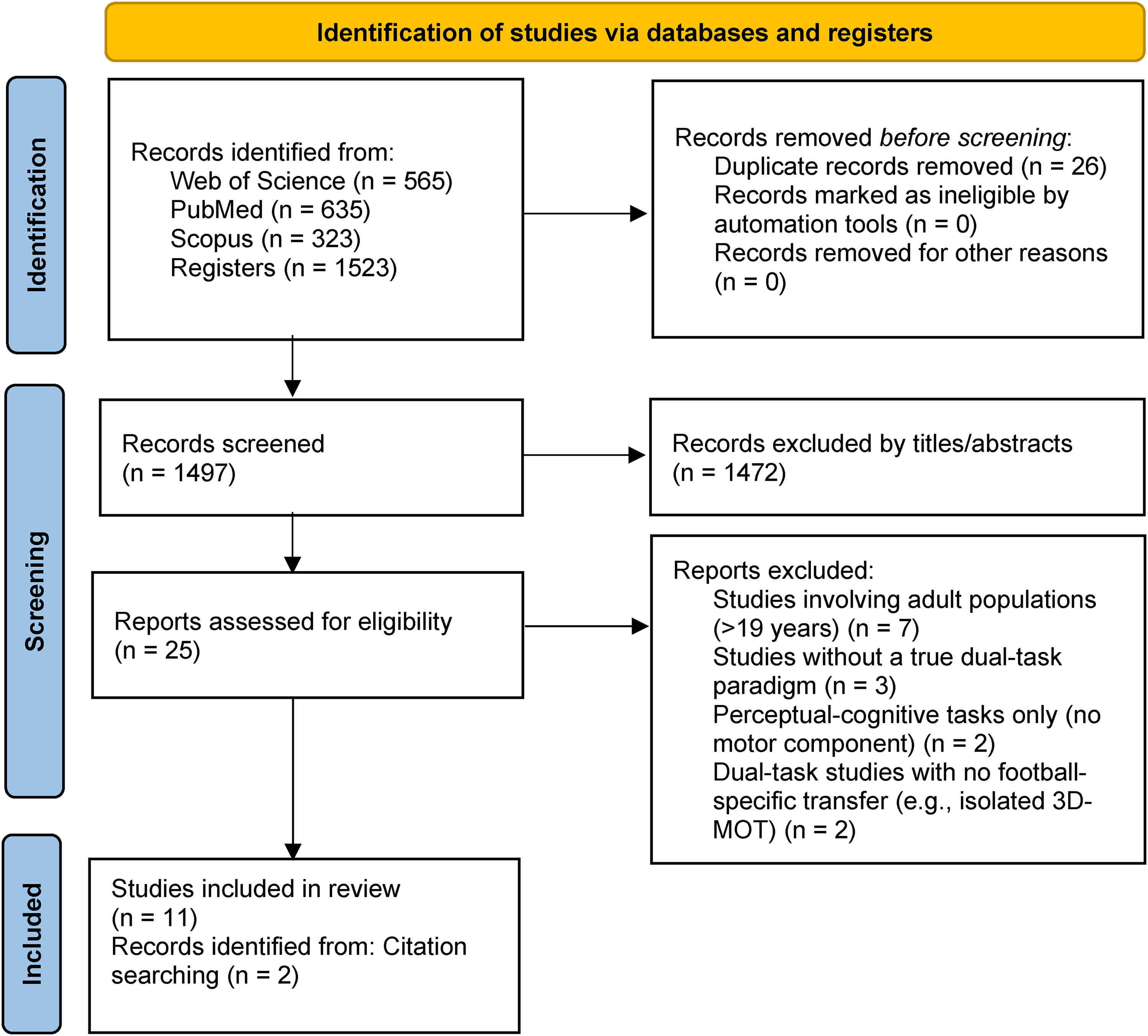
Flow chart of the systematic review.
The methodological quality of the included studies is summarised in Table 2. Overall, the evidence demonstrated a generally robust level of rigor. Eight studies (62%) were classified as high quality (HQ), four studies (31%) were classified as moderate quality (MQ), and one study (8%) was categorised as low quality (LQ). Validation and acute experimental studies generally demonstrated higher methodological scores, while longitudinal interventions were occasionally limited by small sample sizes or short intervention durations.
Joanna Briggs Institute checklist criteria for each study type.
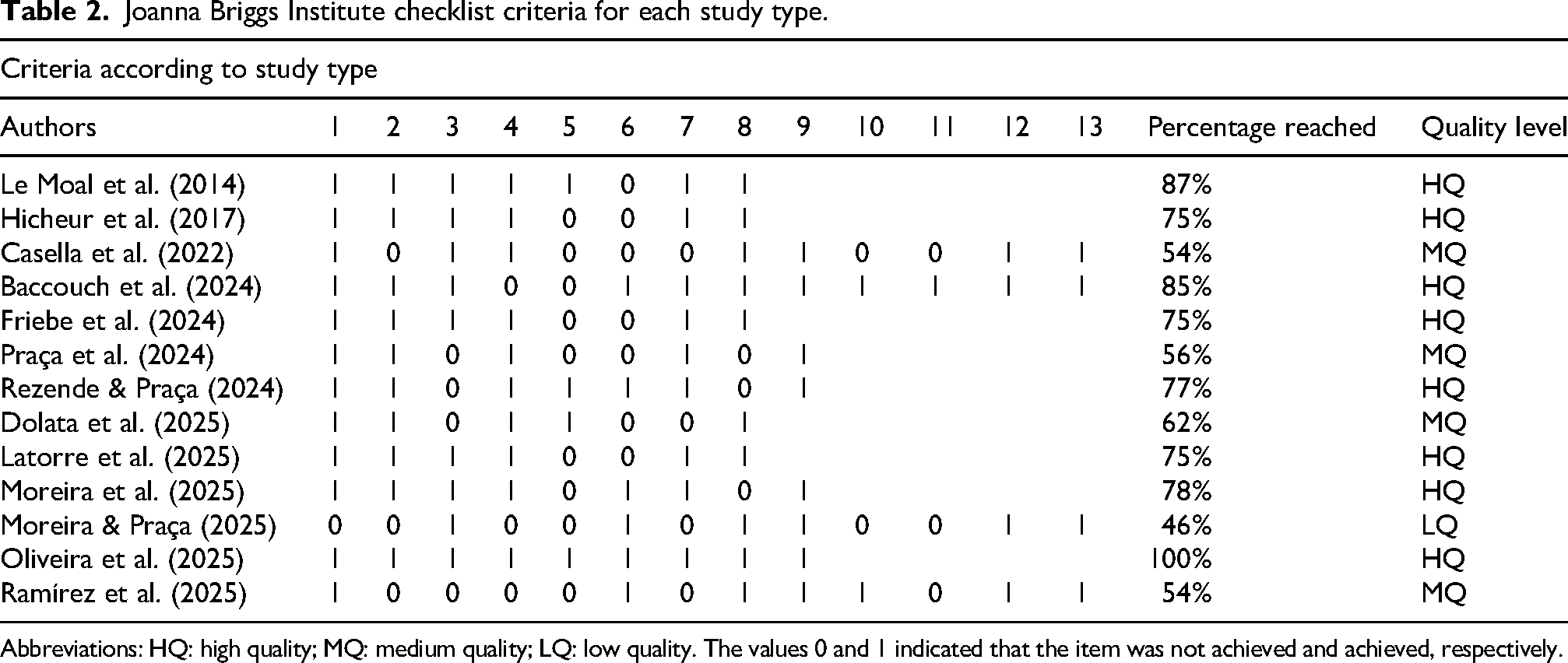
Abbreviations: HQ: high quality; MQ: medium quality; LQ: low quality. The values 0 and 1 indicated that the item was not achieved and achieved, respectively.
Selected studies
Motor–cognitive DT tests for performance assessment and talent identification in youth football
Five studies were included in this subsection, all focusing on the development, validation, or reliability of soccer-specific motor–cognitive DT tests in youth football players (Table 3). These studies primarily aimed to assess players’ ability to simultaneously process cognitive information while executing sport-specific motor actions, thereby providing ecologically valid tools for performance evaluation and talent identification. In terms of specific findings, the Loughborough Soccer Passing Test (LSPT) was validated in youth football players and proved effective in discriminating between players of different competitive levels (elite, sub-elite, and non-elite), even without extensive prior familiarization, supporting its applicability in performance assessment contexts. 25 Elite players exhibited very high test–retest reliability in the LSPT (r = 0.96), suggesting stable performance under repeated testing conditions.
Motor–cognitive dual-task tests for performance assessment and talent identification in youth football.
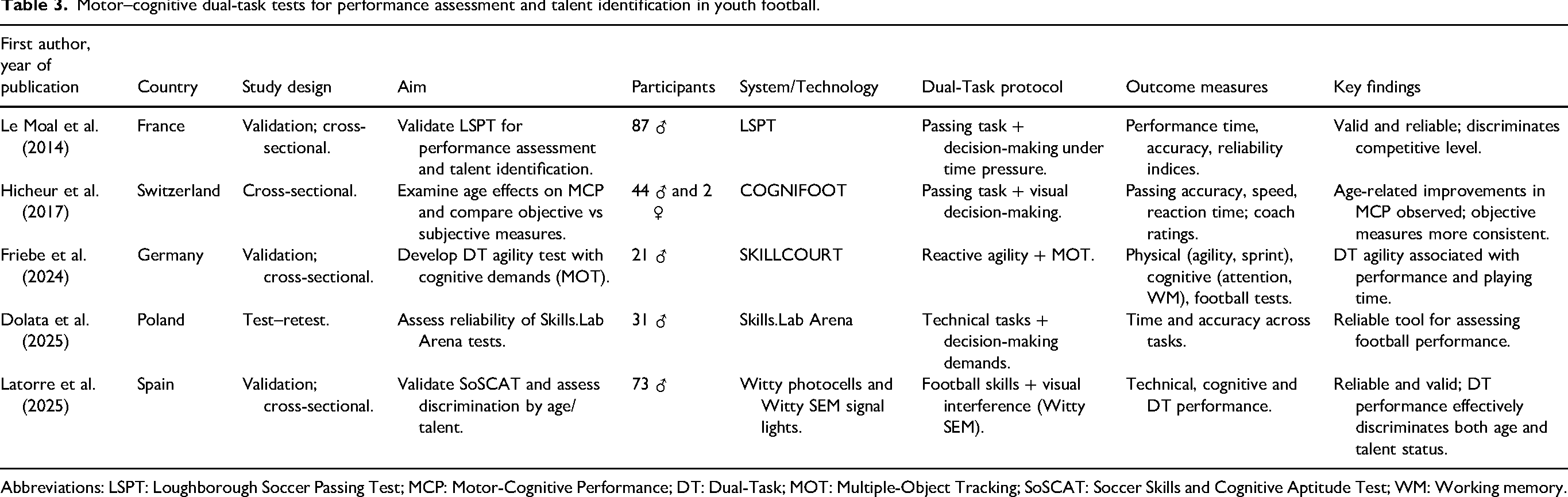
Abbreviations: LSPT: Loughborough Soccer Passing Test; MCP: Motor-Cognitive Performance; DT: Dual-Task; MOT: Multiple-Object Tracking; SoSCAT: Soccer Skills and Cognitive Aptitude Test; WM: Working memory.
The COGNIFOOT system quantified Cognitive–Motor Performance (CMP) during short-passing tasks and identified a clear age-related improvement in elite youth players. Passing accuracy, speed, and reaction time improved linearly with age, and objective CMP scores closely matched mean evaluations from expert coaches, while individual coach ratings were more variable, suggesting greater discriminative precision of the technological assessment. 26
In the SKILLCOURT system, DT conditions were implemented by combining MOT with reactive agility tasks. While single-task agility performance was moderately related to attention and reaction speed, the DT condition additionally captured executive functions such as working memory and cognitive flexibility, highlighting that agility performance in elite youth players is strongly influenced by cognitive factors. 27 Similarly, the Skills. Lab Arena assessed passing, shooting, ball control, and integrated motor–cognitive abilities within a large-scale interactive environment. The tests indicated good reliability (ICC = 0.71–0.91) and sensitivity to performance changes across conditions, supporting their applicability for football-specific assessment. 28
Finally, the Soccer Skills and Cognitive Aptitude Test (SoSCAT) showed high reliability (ICC = 0.908) and sensitivity in dynamic testing conditions. When visual interference was introduced, players classified as high-talent exhibited the lowest DTC and the best overall performance. Notably, significant differences between talent levels were observed exclusively under DT conditions with visual interference, whereas single-task performance failed to discriminate between groups. This indicates that motor-cognitive DTP reveal performance constraints that remain latent during isolated motor testing. 23
Acute effects of DT conditions during soccer-specific tasks
Five studies examined the acute effects of introducing DT conditions during football-specific activities, including small-sided games (SSGs) and standardized testing situations (Table 4). Notably, although Latorre 23 was primarily included in the previous subsection as a validation study, it was also considered here because one of its central aims was to analyze the immediate performance effects of visual interference within a motor–cognitive DTP.
Acute effects of dual-task conditions during football-specific tasks.
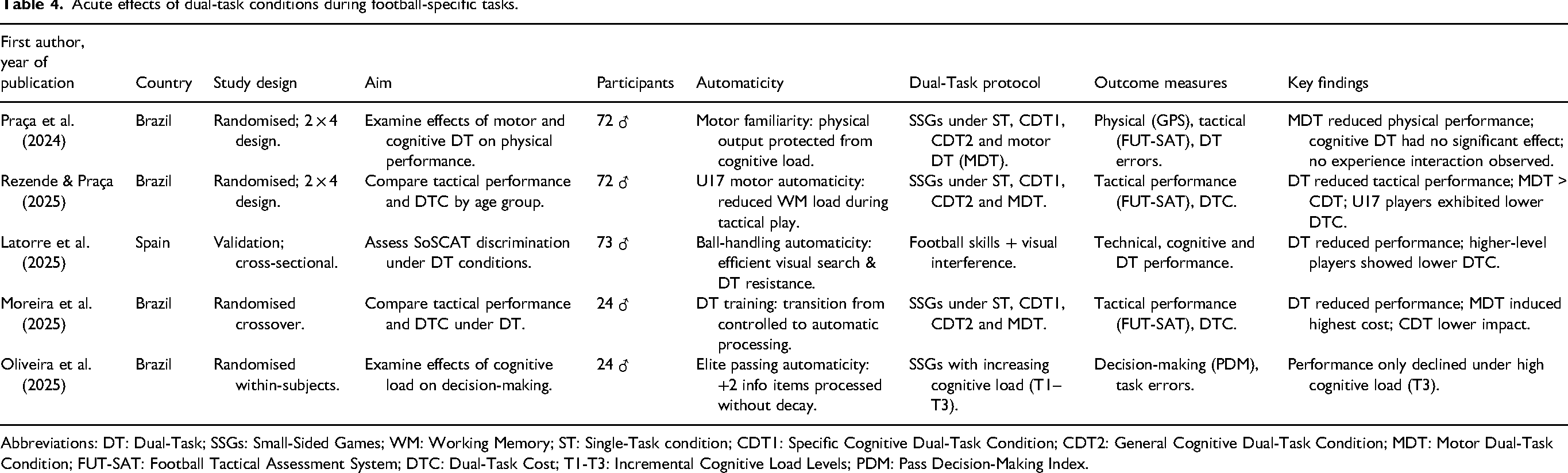
Abbreviations: DT: Dual-Task; SSGs: Small-Sided Games; WM: Working Memory; ST: Single-Task condition; CDT1: Specific Cognitive Dual-Task Condition; CDT2: General Cognitive Dual-Task Condition; MDT: Motor Dual-Task Condition; FUT-SAT: Football Tactical Assessment System; DTC: Dual-Task Cost; T1-T3: Incremental Cognitive Load Levels; PDM: Pass Decision-Making Index.
Across studies, acute DT effects were typically quantified as DTC in physical, tactical, or decision-making variables. Regarding physical performance, Praça et al., 29 analyzed U13 and U17 players during SSGs using GPS-derived metrics. While DT manipulations affected both age groups similarly, a clear main effect of experience was observed, with U17 players outperforming U13 players, particularly in high-intensity running and acceleration actions. Motor DT conditions significantly reduced physical performance, whereas cognitive secondary tasks generally did not affect physical outputs, irrespective of their contextual specificity.
In terms of tactical performance, experience level moderated the magnitude of DTC. More experienced players (U17) showed lower impairments in tactical principles related to penetration and concentration, whereas less experienced players (U13) exhibited lower costs in off-the-ball width and length, delay, and defensive balance. Consistently, motor secondary tasks (e.g., carrying an object) induced greater tactical and physical costs than cognitive tasks, regardless of the contextual specificity of the cognitive load.30,31
Acute effects were also evident in standardized motor–cognitive testing contexts. Under visual interference, performance decreased compared with single-task execution, with older players (U18) and high-talent groups demonstrating lower DTC and smaller execution time decrements, indicating greater tolerance to concurrent cognitive–motor demands. 23 In addition, Oliveira et al., 32 showed that passing decision-making accuracy declined only under the highest cognitive load condition, while moderate cognitive demands did not impair performance, suggesting the existence of a tolerable cognitive threshold.
Overall, acute DT conditions consistently induced immediate performance reductions compared with single-task execution. These effects varied according to the type of secondary task, with motor interference generally producing greater physical and tactical costs than cognitive load. Age, experience, and talent status further modulated acute DTC, with more experienced players showing a greater capacity to manage concurrent cognitive and motor loads.
Chronic effects of cognitive–motor DT training on physical, cognitive, and tactical performance in youth football
Four longitudinal intervention studies investigated the chronic effects of cognitive–motor DT training programme in youth football players (Table 5). Across age groups, DT training interventions were associated with improvements across multiple performance domains. In younger players, Casella et al., 33 showed that a psychokinetic cognitive–motor training programme applied to 10-year-old footballers led to greater improvements in executive functions than motor-only training. Specifically, the experimental group demonstrated superior gains in planning ability and visual search performance, suggesting added benefits of early cognitive–motor stimulation.
Chronic effects of cognitive–motor dual-task training on physical, cognitive, and tactical performance in youth football.
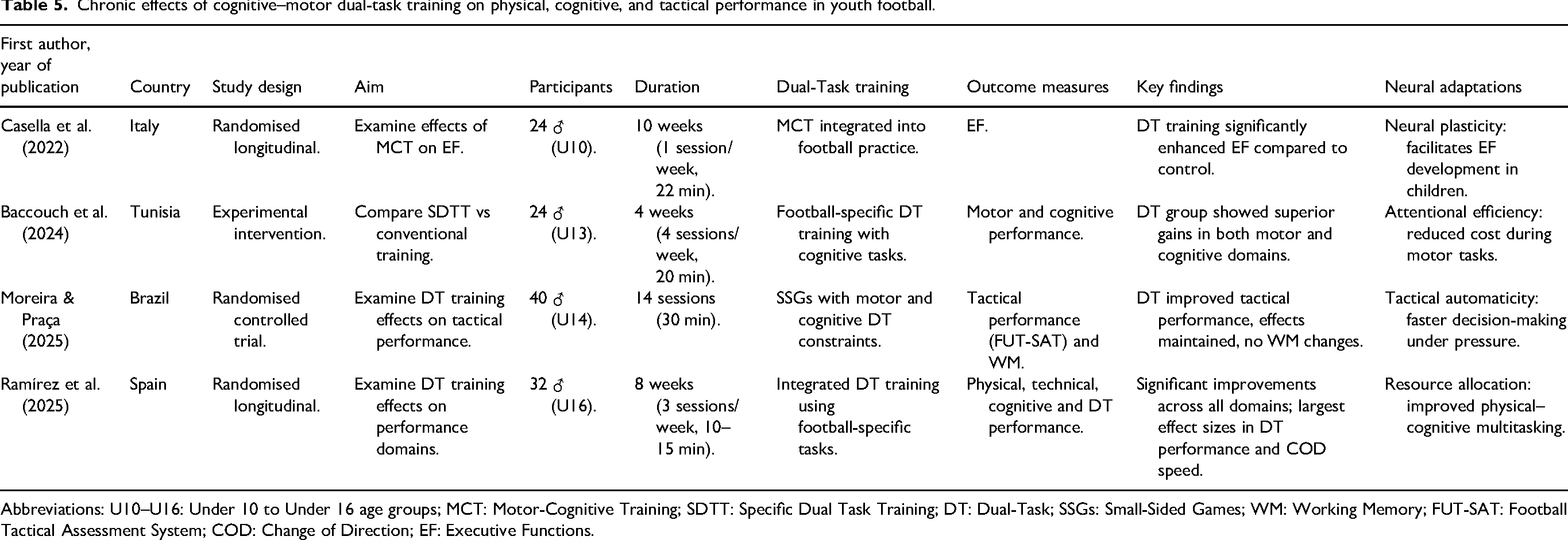
Abbreviations: U10–U16: Under 10 to Under 16 age groups; MCT: Motor-Cognitive Training; SDTT: Specific Dual Task Training; DT: Dual-Task; SSGs: Small-Sided Games; WM: Working Memory; FUT-SAT: Football Tactical Assessment System; COD: Change of Direction; EF: Executive Functions.
In adolescent players, similar effects were reported following structured DT interventions. Baccouch et al., 34 found that, compared with conventional training, a specific DT training programme in U13 players resulted in improvements exclusively in the DT group. Significant gains were observed in change-of-direction ability, cognitive flexibility, and inhibitory control, whereas no meaningful changes occurred following conventional football training.
DT principles embedded within game-based training also demonstrated clear tactical benefits. When DT constraints were integrated into small-sided games, the experimental group exhibited superior tactical performance in the trained principle of off-the-ball width and length at both post-test and retention. Notably, improvements in tactical behavior following DT training occurred independently of changes in general working memory capacity. This suggests that adaptations may be driven by enhanced task-specific attentional efficiency rather than a general expansion of cognitive resources. 35
More comprehensive adaptations were reported following longer interventions. An eight-week dual cognitive–motor training programme in U16 players led to significant improvements across physical, technical, cognitive, and DT performance variables, while the control group showed no improvements or declines in some measures. Notable gains were observed in performance under visual interference, DTC, change-of-direction ability, sprinting, jumping, dribbling, short passing, and working memory-related measures. 11 Overall, these findings suggest that relatively brief but systematic DT training interventions can induce broad and transferable performance adaptations in youth football.
Discussion
The purpose of this systematic review was to synthesise the available evidence on motor–cognitive DTP in youth football from three complementary perspectives: assessment, acute performance effects, and training adaptations. Building on these results, the following discussion interprets the findings within a broader theoretical and applied context. This integrative approach reflects the structural reality of football performance, in which players continuously execute motor actions while perceiving information, making decisions, and anticipating game dynamics. From this perspective, football represents a natural DT environment in which movement execution is inseparable from ongoing cognitive processing. Overall, the findings indicate that DT approaches provide a potentially valid and ecologically relevant framework for assessing and training performance in youth football. Motor–cognitive DT tests appear to capture this interaction more effectively than isolated physical or technical measures, supporting their use for holistic performance evaluation and talent identification. In addition, evidence from acute DT studies highlights how different motor and cognitive secondary tasks impose distinct performance costs. These findings provide valuable insight into players’ cognitive–motor capacity limits and inform the design of training interventions.
Conceptualising football as a natural DTP underpins the high ecological validity of emerging motor–cognitive assessment tools. 10 Football performance is inherently characterised by continuous perception–action coupling. Players must execute motor actions while simultaneously processing dynamic environmental information. Assessment approaches that integrate cognitive and motor demands may therefore offer a more representative depiction of match performance.25,28 Accordingly, motor–cognitive DT tests have demonstrated strong discriminatory potential across age groups, competitive levels, and talent status, supporting their value for performance profiling and talent identification in youth football. The development of assessment tools that embed cognitive demands within football-specific actions represents a methodological advance over isolated physical or technical tests. By requiring players to manage decision-making, attentional control, or stimulus discrimination alongside sport-specific motor execution, DTP may provide a more sensitive evaluation of performance under constraint. In this context, some evidence suggests that players who perform similarly in isolated technical tasks may exhibit differentiated performance under DT conditions. For example, the introduction of visual interference (e.g., SoSCAT) or additional cognitive load (e.g., LSPT) appears to increase task demands. This may reveal performance differences that are not evident under single-task conditions.23,25 However, the extent to which these differences reflect underlying neural efficiency or other factors (e.g., experience or familiarity with task constraints) remains unclear. Overall, the enhanced realism and task representativeness of these approaches may improve the sensitivity of performance evaluation and support their application within talent identification and monitoring processes in youth football.23,26–28
Evidence from acute experimental studies consistently suggests that introducing DT conditions during football-specific activities leads to immediate performance decrements relative to single-task execution, commonly quantified as DTC. In youth football, this acute deterioration appears to reflect increased attentional and working memory demands. Importantly, these performance decrements should not be interpreted solely as negative outcomes, as they may also reflect adaptive responses to increased task complexity and cognitive–motor demands. In this context, acute reductions in performance may represent a functional response to the redistribution of limited attentional resources, which can promote motor skill automatization and more efficient perceptual–cognitive processing over time. From a learning perspective, these temporary decrements may act as a stimulus for longer-term adaptations, supporting the development of implicit learning strategies and improved performance under pressure. Its magnitude varies according to the nature of the secondary task and the performance domain assessed (tactical, cognitive, or physical).30–32 Across studies, motor secondary tasks tended to elicit greater performance impairments than cognitive secondary tasks, particularly in tactical behavior and physical outputs.29–31 This pattern has been interpreted as a consequence of structural interference, whereby motor secondary tasks compete with the primary football task for shared sensorimotor resources. However, this interpretation should be considered with caution. Not all studies have examined identical task constraints or outcome measures. This may partially explain variability in the magnitude of DTC reported. In contrast, cognitive secondary tasks generally induced smaller decrements, especially in physical performance, suggesting that cognitive load may be manipulated without necessarily compromising external physical demands. Nevertheless, this effect appears to depend on task complexity. Moderate cognitive demands did not significantly affect decision-making performance. In contrast, higher cognitive loads resulted in measurable decrements in accuracy. 32 This indicates the presence of a potential cognitive threshold beyond which performance deteriorates. Player-related factors also seem to modulate acute DT responses, although findings are not entirely consistent. More experienced or higher-level players often exhibited reduced DTC, 23 particularly in tactical principles related to ball progression and spatial organization. 31 This may reflect greater motor automatization and more efficient attentional allocation.10,36 However, these experience-related differences were less evident in physical performance responses. This suggests that the influence of expertise may be domain-specific rather than generalised across all performance variables. Additionally, it is important to consider that the age range examined (10–19 years) encompasses distinct developmental stages. Early adolescence is characterized by ongoing maturation of cognitive and perceptual–motor functions, whereas later stages involve greater automatization and efficiency in information processing. This developmental variability may partly explain why younger players tend to exhibit higher DTC and less stable performance, while older players show greater robustness under DT conditions. In addition, contextual factors such as task familiarity, environmental constraints, and training background may influence DT responses and should be considered when interpreting findings. Finally, limited differences were observed between more and less contextualized cognitive secondary tasks. This finding suggests that, once the nature of the secondary task is defined, the type of cognitive demand may be less influential than previously assumed. From an applied perspective, these findings provide useful guidance for manipulating cognitive and motor load during training. However, further research is needed to clarify how different task characteristics interact to influence performance under DT conditions.
Longitudinal intervention studies further extend these findings by suggesting that repeated exposure to cognitive–motor DT training may lead to meaningful and transferable adaptations in youth football performance. Across studies, DT interventions were systematically integrated into regular training routines using football-specific drills, small-sided games, or structured cognitive–motor tasks, with relatively brief training doses ranging from 10 to 30 min per session over periods of 4 to 10 weeks.11,33–35 Despite this moderate volume, improvements were reported across multiple domains, including executive functions (e.g., inhibition, flexibility, planning), change-of-direction ability, technical execution, tactical behaviour, and DT efficiency. However, the extent and consistency of these adaptations varied across studies. This variability likely reflects differences in training design, duration, and outcome measures. While several studies reported improvements in both cognitive and football-specific performance variables, others showed more selective adaptations. This suggests that transfer effects of DT training may be task- and context-dependent rather than uniform. Importantly, some studies indicated that performance gains were not confined to laboratory-based cognitive outcomes, 27 but extended to football-specific indicators.1–3 Nevertheless, the mechanisms underpinning this transfer remain unclear. For example, the observation that tactical improvements occurred without significant changes in general working memory capacity suggests that DT training may not necessarily enhance global cognitive capacity. Instead, it may improve task-specific attentional efficiency and perceptual–motor integration. Intervention timing within training sessions varied across studies, with DT content implemented at the beginning, 11 middle, 34 or end of sessions. 33 No clear superiority of one approach over another was established. Similarly, although interventions incorporating DT constraints into small-sided games appeared to produce robust tactical transfer and retention effects, 35 direct comparisons with other training formats remain limited. Collectively, these findings suggest that DT training can be feasibly embedded within youth football practice without increasing overall training load. It may promote adaptations aligned with the cognitive–motor demands of match play, reinforcing the relevance of integrating both motor and cognitive constraints during training. However, given the relatively short intervention periods and methodological variability across studies, these conclusions should be interpreted with caution.
However, despite the growing body of evidence supporting the relevance of motor–cognitive DT approaches in youth football, several critical issues remain insufficiently addressed. First, the durability of training-induced benefits remains unclear, as few studies have examined whether cognitive, tactical, or motor gains are maintained following periods of reduced exposure or detraining. Second, although acute DT studies provide valuable insights into the magnitude and nature of DTC, there is still limited understanding of how different types of secondary cognitive demands should be optimally selected and progressed. This is particularly relevant for tasks varying in informational load and football-specific relevance. Moreover, the timing of DT implementation within training sessions represents an underexplored variable. Whether DT constraints are more effective during warm-up phases, within the main technical–tactical content, or under fatigue conditions at the end of sessions remains largely unknown. Finally, while sport-specific technologies offer promising opportunities to operationalize DT training in representative environments, further research is required to establish their feasibility, ecological validity, and added value for player development in football academies. Addressing these gaps will be essential to translate DT research into evidence-based and sustainable training strategies.
Practical applications
Based on current evidence, motor–cognitive DTP offer several practical implications for youth football. Motor–cognitive DT tests can be used as ecologically valid tools for talent identification and for monitoring player development across the season, particularly through changes in DTC. From an applied perspective, coaches can implement DT constraints through specific training designs. For example, cognitive-specific tasks (e.g., colour- or number-based decision rules) can be integrated into passing drills or rondos to increase attentional demands without substantially reducing physical output. In contrast, motor interference tasks (e.g., carrying objects or performing additional coordination tasks) may be used to increase overall task difficulty, although these are more likely to compromise physical and technical performance. DT training can be embedded within common football activities such as SSGs, which represent a highly suitable context for integrating DT demands while maintaining sport specificity. For instance, players may be required to monitor and recall contextual information (e.g., the number of passes completed by the opposing team in specific zones), apply rule-based constraints (e.g., number of touches determined by external cues such as bib colour), or perform concurrent cognitive tasks (e.g., simple arithmetic operations guided by visual signals) during play. Motor interference tasks can also be incorporated to further increase task complexity and promote the automatization of motor skills. Examples include performing rondos or SSGs while maintaining balance of an external object, or introducing perceptual constraints (e.g., partial visual occlusion) to increase processing demands. In addition, psychokinetic or cognitively integrated drills may be used to directly couple perception, decision-making, and motor execution. These may involve dribbling tasks with visual stimuli requiring rapid directional responses, or shooting exercises in which players must process sequential information (e.g., colours or numbers) before executing the final action. A progressive approach is recommended, starting with low cognitive load (e.g., single information cues) and gradually increasing complexity by adding multiple stimuli, reducing decision time, or combining cognitive and motor demands. DT tasks can be implemented across different phases of the session, including technical warm-ups, the main part through conditioned games, or under fatigue conditions to better replicate match demands. This flexibility allows coaches to systematically manipulate cognitive load while maintaining football specificity, thereby promoting decision-making, perceptual–cognitive adaptation, and performance under realistic game constraints.
Limitations and strengths
A key strength of the present review is its sport-specific and development-focused approach, providing the first systematic synthesis exclusively centred on motor–cognitive DTP in competitive youth football. This represents a relevant advancement, as previous reviews have typically examined DTPs across multiple sports without addressing the specific constraints of football or the developmental context of youth players. By integrating assessment tools, acute performance effects, and training interventions, the review offers a holistic perspective aligned with the DT nature of football performance. Furthermore, the proposed conceptual framework allows a structured classification of DT demands, facilitating a clearer interpretation of how different task types influence performance and training adaptations. Several limitations should also be acknowledged. The number of available studies remains limited, and substantial methodological heterogeneity exists regarding task design, training dose, outcome measures, and player characteristics. This variability precluded meta-analytic procedures and restricts direct comparisons across studies. In addition, most intervention studies involved relatively short training periods and small samples, with limited evidence on retention or long-term transfer effects. In addition, the reporting of participant characteristics across studies was not always consistent, particularly regarding contextual variables such as training frequency and definitions of competitive level. This variability may influence the interpretation and comparability of findings. The predominance of male samples also limits the generalizability of the findings. Finally, the exclusion of grey literature may have led to the omission of potentially relevant findings in this emerging field.
Conclusions
This systematic review indicates that motor–cognitive DTP offer an ecologically relevant framework for assessing and training performance in competitive youth football. DT assessments appear sensitive to differences in age, experience, and talent, while acute DT conditions consistently induce performance decrements that depend on task characteristics and player expertise. Longitudinal evidence suggests that systematic cognitive–motor DT training may support improvements across multiple performance domains. However, methodological heterogeneity and limited long-term evidence warrant cautious interpretation. Overall, motor–cognitive DT approaches represent a promising complement to traditional methods for performance development and talent identification in youth football.
Footnotes

Ethical statement
This study is a systematic review and did not involve direct interventions with human participants or animals.
Consent to participate
Not applicable.
Consent for publication
Not applicable.
Funding
The authors received no financial support for the research, authorship, and/or publication of this article.
Declaration of conflicting interests
The authors declared no potential conflicts of interest with respect to the research, authorship, and/or publication of this article.
Data availability statement
The data that support the findings of this study are available from the corresponding author on reasonable request.