




Abstract
Post-activation performance enhancement (PAPE) is widely used to acutely improve neuromuscular performance; however, the effectiveness of combining blood flow restriction (BFR) with bodyweight squat exercise remains unclear. This study aimed to determine whether adding BFR to a bodyweight squat–based conditioning protocol enhances PAPE responses in countermovement jump (CMJ) performance in female recreational athletes. Twenty healthy female participants (age: 19.1 ± 1.1 years) completed a randomized crossover design involving BFR (KAATSU C4 device, cycle mode) and non-BFR conditions. Both conditions consisted of a bodyweight squat protocol (3 × 10 repetitions), followed by CMJ assessments at baseline and at 3, 6, and 9 min post-exercise. Jump height, relative maximal power (RMP), and rate of force development (RFD) were measured using a force plate. A significant main effect of time was observed for jump height (p = .001), and a significant main effect of condition was also identified (p = .020). However, no significant condition × time interaction was found (p = .853). No significant effects were observed for RMP or RFD (p > .05). These findings suggest that the bodyweight squat protocol alone was sufficient to elicit a PAPE response, whereas the addition of BFR did not provide meaningful improvements in CMJ performance. Practitioners aiming to acutely enhance jumping performance may therefore prioritize the bodyweight squat protocol used in this study without the addition of BFR.
Introduction
Post-activation performance enhancement (PAPE) has emerged as an effective strategy to acutely improve neuromuscular performance following a high-intensity conditioning activity performed prior to a high-velocity, power-dominant task, such as the countermovement jump (CMJ).1,2 Given the ongoing discussion regarding PAPE and the closely related phenomenon of post-activation potentiation (PAP), it is important to clearly distinguish between these concepts. PAP is typically described as an acute enhancement in performance lasting up to ∼20 min following heavy resistance or ballistic activity and is commonly assessed in laboratory settings using electrically evoked twitch responses.3,4 Mechanistically, PAP is largely attributed to phosphorylation of the myosin regulatory light chains, which enhances actin–myosin sensitivity and force production. 5 In contrast, PAPE is associated with a broader range of mechanisms, including voluntary activation, increased muscle temperature, and neural factors unrelated to myosin phosphorylation, often without direct assessment of twitch responses.6,7 These mechanisms collectively contribute to transient improvements in force- and power-producing capacity following a conditioning activity, making PAPE highly relevant in applied sport settings.
Given the multifactorial nature of PAPE, its manifestation largely depends on the characteristics of the conditioning stimulus. Various modalities, primarily resistance-based and plyometric exercises, can elicit different neuromuscular responses and influence the magnitude of the PAPE effect. 8 Thus, understanding how these modalities affect neuromuscular activation and performance is essential for optimizing PAPE protocol design. Theoretically, a wide range of conditioning activities may induce PAPE, 9 although recent evidence suggests that resistance-based and/or plyometric exercises performed at moderate-to-high intensities, combined with multiple sets and sufficient recovery intervals, are particularly effective. 10 Moreover, the magnitude and time course of PAPE responses are influenced by several factors, including sex, muscle fiber composition, strength level, training background, and type of muscle action.11,12 Although recovery duration has been shown to influence short-term performance following conditioning activities, optimizing the balance between potentiation and fatigue remains critical,13,14 particularly given its implications for performance outcomes and injury risk. 15 From a mechanistic perspective, the acute performance response following a conditioning activity is thought to depend on the dynamic interaction between fatigue-related mechanisms and potentiation processes. While fatigue may transiently impair force- and power-producing capacity immediately after exercise, subsequent recovery may allow potentiation-related mechanisms, such as enhanced motor unit recruitment and increased muscle temperature, to predominate.3,8,13 Thus, the timing of post-conditioning performance assessments may substantially influence the magnitude and direction of the observed PAPE response.
Despite these well-established approaches, simpler and more accessible conditioning strategies may represent a logical alternative for eliciting PAPE responses without requiring high external loads or specialized equipment. Interestingly, bodyweight squat exercises may serve as a practical and widely accessible conditioning strategy for eliciting PAPE responses. 16 The squat closely reflects the biomechanical and neuromuscular demands of many sport-specific movements, particularly those involving coordinated hip and knee extension. 17 A recent systematic review and meta-analysis including 303 participants and 606 observations demonstrated that explosive bodyweight conditioning activities can improve subsequent performance outcomes such as vertical jump and sprint tasks. 18 Nevertheless, evidence regarding the effectiveness of controlled bodyweight squat protocols for eliciting PAPE responses remains limited. These findings highlight the practical relevance of bodyweight-based conditioning strategies for athletes, coaches, and rehabilitation professionals, as bodyweight squat exercises can be easily implemented in both laboratory and field settings without the need for specialized equipment. Traditional PAPE protocols often rely on high-intensity loading strategies that may induce substantial neuromuscular fatigue, potentially delaying the optimal potentiation window or limiting practical applicability in certain populations and settings. 19 Consequently, alternative approaches capable of eliciting favorable neuromuscular responses with lower mechanical demands have gained increasing interest.
In recent years, blood flow restriction (BFR) has gained increasing attention as a method to augment neuromuscular responses during resistance exercise and conditioning protocols, 20 although its safety and effectiveness depend on several key variables, including arterial occlusion pressure, exercise intensity, duration, and appropriate equipment usage. 21 BFR enables individuals to achieve substantial physiological stress and muscular activation while using relatively low external loads (performed at 20–40% of one-repetition maximum [1RM]).22,23 This technique involves the application of external pressure to proximal limbs, partially restricting arterial inflow and venous return, thereby creating a hypoxic and metabolically stressful environment. 24 Previous research has demonstrated that applying BFR during resistance exercises, such as lunges, may improve subsequent jump performance compared to non-BFR conditions. 25 In squat-based movements, which require coordinated activation of the hip and knee extensors, the addition of BFR may provide an additional neural–metabolic stimulus.26,27 Supporting this notion, integrating BFR into a squat-based conditioning activity may further enhance the neuromuscular stimulus and potentially improve performance beyond traditional PAPE protocols.28,29 However, despite this mechanistic rationale and some positive findings, the effectiveness of BFR for enhancing acute performance remains inconsistent across studies. Therefore, combining BFR with accessible conditioning activities such as bodyweight squats may represent a practical strategy to enhance acute performance, particularly in applied sport settings where time-efficient and equipment-minimal interventions are preferred. Nevertheless, it remains unclear whether such benefits extend to low-load or bodyweight-based PAPE protocols.
In the context of bodyweight squats, where mechanical load is relatively low, BFR-induced hypoxia and metabolite accumulation may facilitate greater recruitment of higher-threshold motor units that might not otherwise be fully activated. 30 Importantly, most previous studies have primarily focused on jump height when assessing CMJ performance, whereas additional performance indicators such as relative maximal power (RMP) and rate of force development (RFD) may provide a more comprehensive understanding of neuromuscular performance and its acute responsiveness to PAPE interventions.31,32 This limitation further complicates the interpretation of BFR effectiveness, as improvements in underlying neuromuscular function may not be fully captured by jump height alone. Such uncertainty is particularly evident in the limited and inconsistent findings related to bodyweight-based PAPE protocols combined with BFR. Additionally, female participants remain underrepresented in the literature, as most studies examining PAPE and BFR interactions have been conducted in male or mixed samples,33–36 despite known sex-related differences in neuromuscular characteristics and performance responses. 37
To date, no study has specifically examined whether BFR provides additional benefits when integrated into a bodyweight squat–based PAPE protocol, particularly in trained female populations. Therefore, the aim of this study was to determine whether the addition of BFR to a practical bodyweight squat–based PAPE protocol enhances acute CMJ performance in female recreational athletes. It was hypothesized that, although BFR may increase neuromuscular activation during the conditioning activity, it would not result in meaningful additional improvements in CMJ performance compared to a non-BFR condition.
Materials and methods
Participants
An a priori power analysis was conducted using G*Power (version 3.1.9.2; Universität Düsseldorf, Germany) to determine the required sample size based on expected changes in CMJ jump height reported in a comparable crossover PAPE study. 13 Assuming a within-participant effect size of Cohen's dz = 0.60, a two-tailed significance level of α = 0.05, and a desired statistical power (1 – β) of 0.95 for a within-subject crossover design, the analysis indicated that a minimum of 15 participants would be required.
Twenty healthy female recreational athletes (age: 19.1 ± 1.1 years; height: 1.64 ± 0.06 m; body mass: 56.5 ± 8.2 kg; body mass index: 21.1 ± 2.1 kg·m−2; training age: 6.3 ± 1.5 years) completed the study protocols. Participants were recruited from a faculty of sports sciences affiliated with a local state university and reported engaging in muscle-strengthening activities at least two days per week (6.8 ± 1.6 training hours per week), consistent with established definitions of recreationally active individuals. 38 All participants reported regular inclusion of both jump-based and resistance-based exercises (e.g., squat, lunge) within their training routines and were therefore familiar with the study procedures and measurements.
Participants were eligible for inclusion if they were at least 18 years of age, enrolled as students in a sports sciences department, and engaged in regular physical activity, defined as at least 150 min of moderate-intensity activity or 75–150 min of vigorous-intensity activity per week. Additionally, participants were required to be free from musculoskeletal pain or injury during the study period and to regularly perform lower-limb exercises. Participants were excluded if they were unable to participate in training for more than one consecutive month, had undergone lower-limb surgery within the previous year, or presented with any medical condition, pain, or injury during the data collection period. All participants were instructed to refrain from alcohol consumption, the use of ergogenic aids, and any strenuous physical activity that could influence performance outcomes throughout the study period.
All participants received detailed information regarding the experimental procedures, including the study duration, BFR application, and potential risks. They were instructed to maintain their habitual dietary intake on testing days and to refrain from strenuous exercise for 24 h prior to each measurement session. Written informed consent was obtained before participation. The study was approved by the Health Sciences Scientific Research and Publication Ethics Committee of Karamanoğlu Mehmetbey University (Approval ID: 05-2025/74; date: 07.05.2025).
Procedures
This study was conducted over a two-week period using a randomized crossover design comprising two experimental conditions: blood flow restriction (BFR) and non-BFR. Data collection took place during the spring semester of the 2025–2026 academic year.
Participants who met the inclusion criteria provided written informed consent and attended an initial group session in which detailed information about the study procedures was provided, including BFR application, exercise protocol, and CMJ assessment within the crossover design framework. A separate familiarization session was not required, as participants were regularly engaged in similar exercises and were familiar with CMJ testing. However, a pilot session was conducted 3–7 days before the first experimental session to accustom participants with the BFR device and procedures, ensure proper cuff placement and tolerance to the applied pressure, and standardize the bodyweight squat protocol under BFR conditions. Anthropometric measurements were also obtained during this session.
Following the initial visit, participants were randomly assigned to begin with either the BFR or non-BFR condition using an online randomization tool. The allocation sequence was based on participant characteristics to ensure balanced distribution across conditions. Due to the visible nature of the BFR cuffs, participant blinding was not feasible. However, participants were not informed of the study hypotheses or any expected superiority between conditions in order to minimize expectancy effects. The same study investigators (EG, AU, and BK) supervised all conditioning activities and conducted performance assessments; therefore, assessor blinding was not implemented. To minimize potential bias, standardized verbal instructions were provided across all sessions. CMJ performance was assessed using a portable force plate, which is considered the gold standard for evaluating vertical jump performance.
Both conditions involved the same bodyweight squat protocol designed to induce a PAPE response. Before each condition, baseline CMJ performance was recorded. The conditioning protocol was then performed under either BFR or non-BFR conditions, followed by CMJ assessments at 3 min (R3), 6 min (R6), and 9 min (R9) post-intervention. A minimum washout period of 48 h was provided between conditions. The overall experimental design is illustrated in Figure 1.
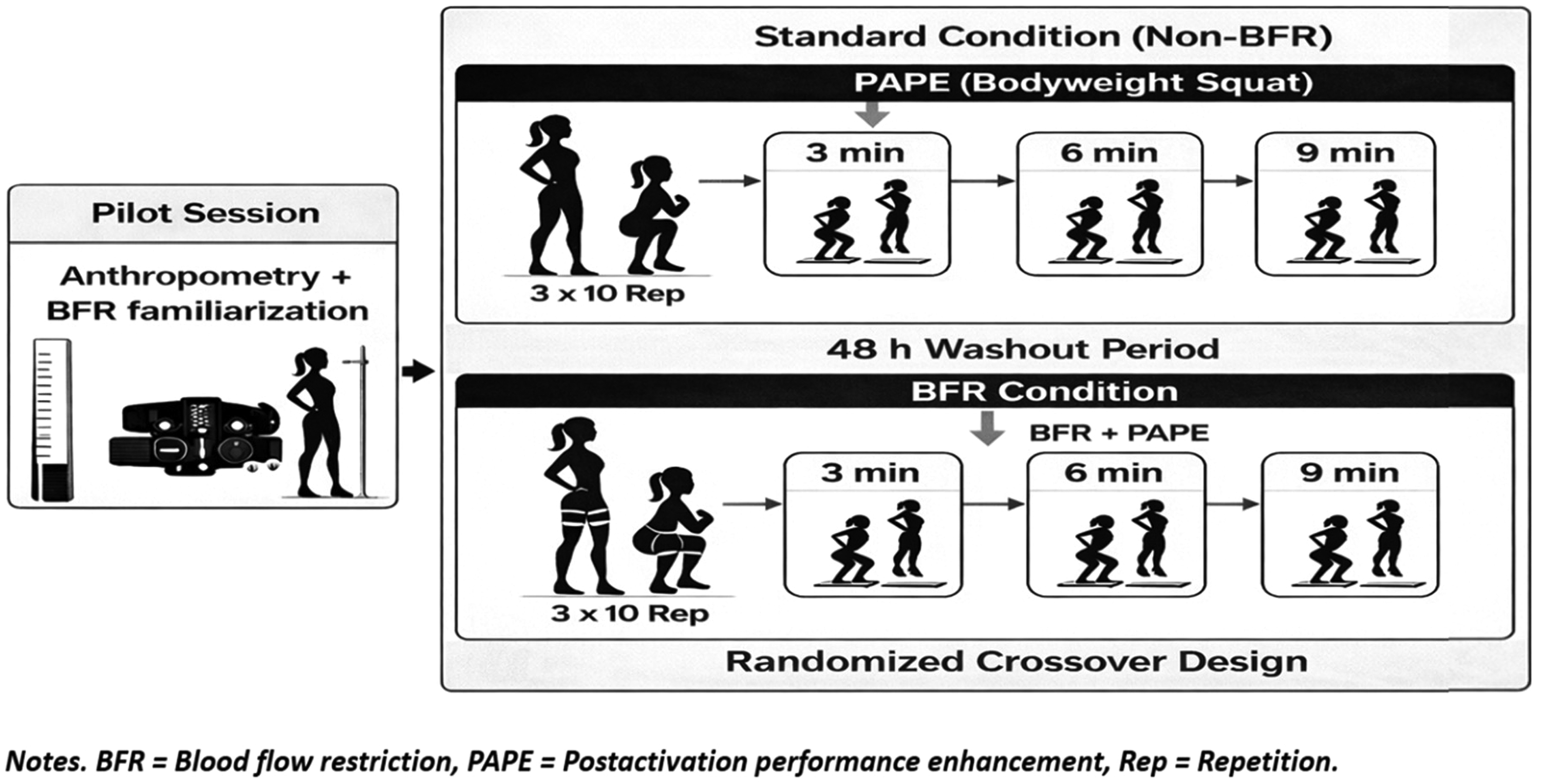
Schematic representation of the experimental design.
Environmental conditions, including lighting, ambient temperature, and the force plate surface, were standardized across all sessions and controlled within the Exercise Physiology Laboratory of the Faculty of Sport Sciences at Karamanoğlu Mehmetbey University. These conditions were consistently monitored and maintained by the laboratory supervisor throughout all sessions. All measurements were conducted within a consistent daily time window (14:00–16:00) to minimize potential circadian influences on neuromuscular performance. Compliance with these instructions was verbally confirmed prior to each testing session.
Post activation performance enhacement (PAPE) protocol
A bodyweight squat–induced PAPE protocol was implemented as the conditioning activity. This approach was informed by recent meta-analytic evidence indicating that bodyweight-based stimuli can positively influence performance outcomes. 18 Participants first completed a standardized warm-up consisting of 5 min of general activity followed by task-specific movement preparation. Subsequently, they performed three sets of 10 repetitions of parallel squats, with 30 s of rest between sets. 16
During the squat exercise, the descent phase continued until the knee joint reached approximately 60°–70° of flexion, after which participants returned to an upright position through full extension. Hands were positioned on the hips throughout the movement to ensure standardization. Movement tempo was controlled by the investigators, with both the eccentric (descending) and concentric (ascending) phases performed over approximately 1 s each. The PAPE protocol was identical across both BFR and non-BFR conditions, with the only difference being the application of BFR.
Practical blood flow restriction (BFR)
The KAATSU C4 device was used to apply BFR during the PAPE protocol. Prior to cuff application, participants’ resting blood pressure was assessed using a standard sphygmomanometer to confirm values within the normal range (SBP: ∼123 mmHg; DBP: ∼76 mmHg). 39 The device's pneumatic elastic bands (AirBands) were positioned proximally on both thighs.
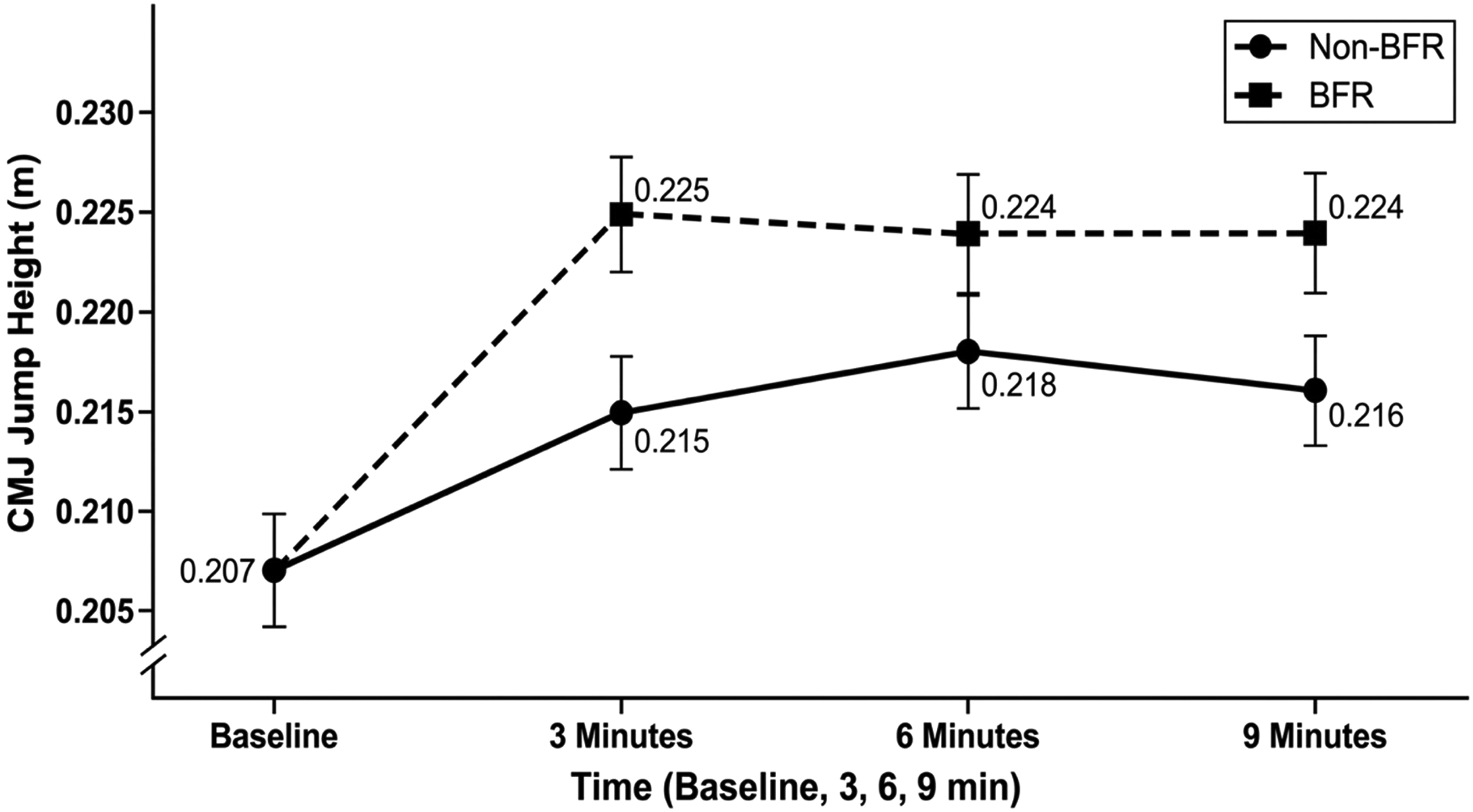
Time-course changes in countermovement jump height under BFR and non-BFR conditions. Data are presented as mean ± standard error. Time points were slightly offset for clarity.
BFR was applied using the device's automated “cycle mode,” which induces rhythmic inflation and deflation throughout the conditioning protocol. Specifically, the system alternates between approximately 20–30 s of gradual inflation and 5 s of deflation, resulting in controlled, oscillatory compression of the limbs. 40 Unlike continuous occlusion protocols, this cyclical approach intermittently restricts venous return while allowing partial arterial inflow, thereby avoiding sustained vascular compression during exercise. The progressive inflation profile may also reduce discomfort compared to abrupt pressure application, particularly during dynamic movements.
A fixed cuff pressure of 160 mmHg was applied in accordance with manufacturer guidelines for lower-limb application in trained individuals. Individual limb occlusion pressure (LOP) was not determined in the present study. Although current recommendations advocate for pressure prescription relative to LOP, 41 a standardized fixed pressure was selected to ensure consistency across sessions within the randomized crossover design. As each participant served as their own control, comparisons between conditions were not confounded by inter-individual variability in applied pressure.
The cuffs remained active throughout the squat-based conditioning protocol and were removed immediately upon completion of the exercise, prior to the post-intervention recovery assessments. Reporting of the BFR device and application parameters was conducted in accordance with recent methodological guidelines. 42
Countermovement jump (CMJ) assessment
Prior to baseline CMJ assessments, participants performed a standardized warm-up lasting approximately 5 min, consisting of dynamic stretching exercises targeting the major lower-limb muscle groups. No additional warm-up was performed before the post-PAPE trials, as participants had already completed the conditioning activity. CMJ performance was assessed bilaterally using a portable piezoelectric force plate (Kistler, Winterthur, Switzerland; model 9260AA6; sampling rate ≈400 Hz; dimensions: 600 × 500 × 50 mm) positioned on a flat, rigid surface.
Each trial began with the participant standing upright in the center of the force plate, with legs fully extended and hands placed on the hips. Participants then performed a rapid countermovement to a self-selected depth followed by a maximal vertical jump. Each jump was completed with a bilateral landing on the force plate. A trial was considered valid when performed in accordance with the prescribed technique and confirmed using the Kistler Measurement, Analysis & Reporting Software (MARS). From valid trials, jump height (derived from take-off velocity), RMP, and RFD were extracted using MARS to provide a comprehensive assessment of jumping performance.
Baseline CMJ performance was assessed using three maximal trials, separated by standardized rest intervals. The highest jump height was retained for analysis, as it is considered to best reflect maximal voluntary performance. 43 Post-conditioning CMJ performance was assessed using a single valid trial at each recovery time point to preserve the integrity of the recovery intervals and minimize additional fatigue.
Statistical analyses
All statistical analyses were performed using SPSS (version 21.0; IBM Corp., Armonk, NY, USA). Data are presented as mean ± standard deviation (SD). Normality of the data distribution was assessed using the Shapiro–Wilk test. The assumption of sphericity was evaluated using Mauchly's test, and when violated, Greenhouse–Geisser corrections were applied. A two-way repeated-measures analysis of variance (ANOVA) was conducted to examine the acute effects of the PAPE protocol under BFR and non-BFR conditions on CMJ performance. The within-subject factors were condition (BFR vs. non-BFR) and time (baseline, 3, 6, and 9 min post-exercise). Dependent variables included jump height, RMP, and RFD. Where significant main effects or interactions were identified, Bonferroni-adjusted pairwise comparisons were performed. Effect sizes were reported as partial eta squared (η2p) for ANOVA outcomes and Cohen's dz for pairwise between-condition comparisons at each post-exercise time point. Partial eta squared values were interpreted according to conventional thresholds (0.01 = small, 0.06 = medium, 0.14 = large). Statistical significance was set at p < .05.
Results
Table 1 presents the descriptive statistics (mean ± SD) for CMJ performance variables at baseline and across the recovery period under both BFR and non-BFR conditions.
Descriptive statistics for jump height, RMP, and RFD across time in BFR and non-BFR conditions (mean ± sd, n = 20).
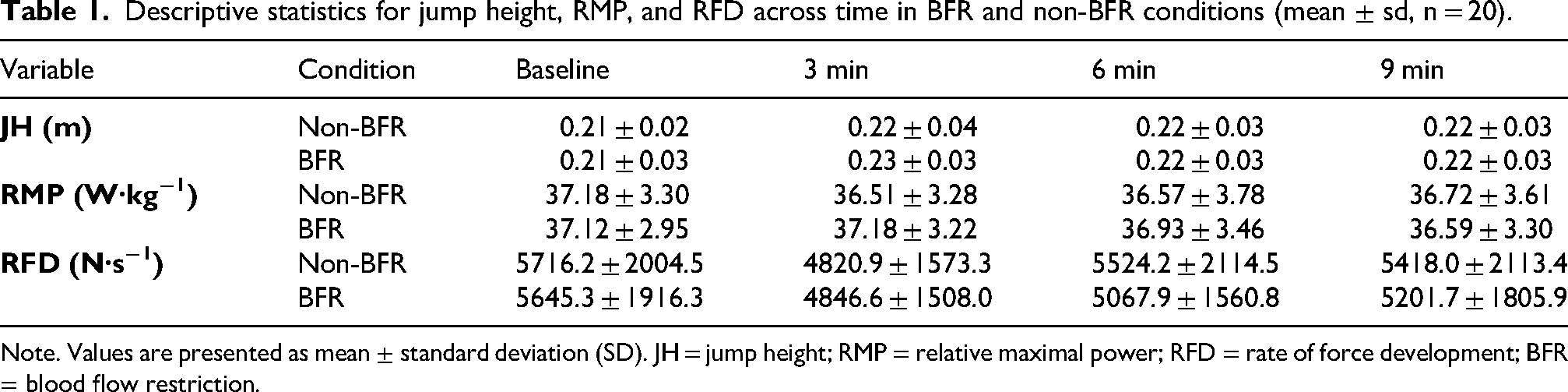
Note. Values are presented as mean ± standard deviation (SD). JH = jump height; RMP = relative maximal power; RFD = rate of force development; BFR = blood flow restriction.
The results of the two-way repeated-measures ANOVA (condition × time) are summarized in Table 2.
Two-way repeated-measures ANOVA for jump height, RMP, and RFD.
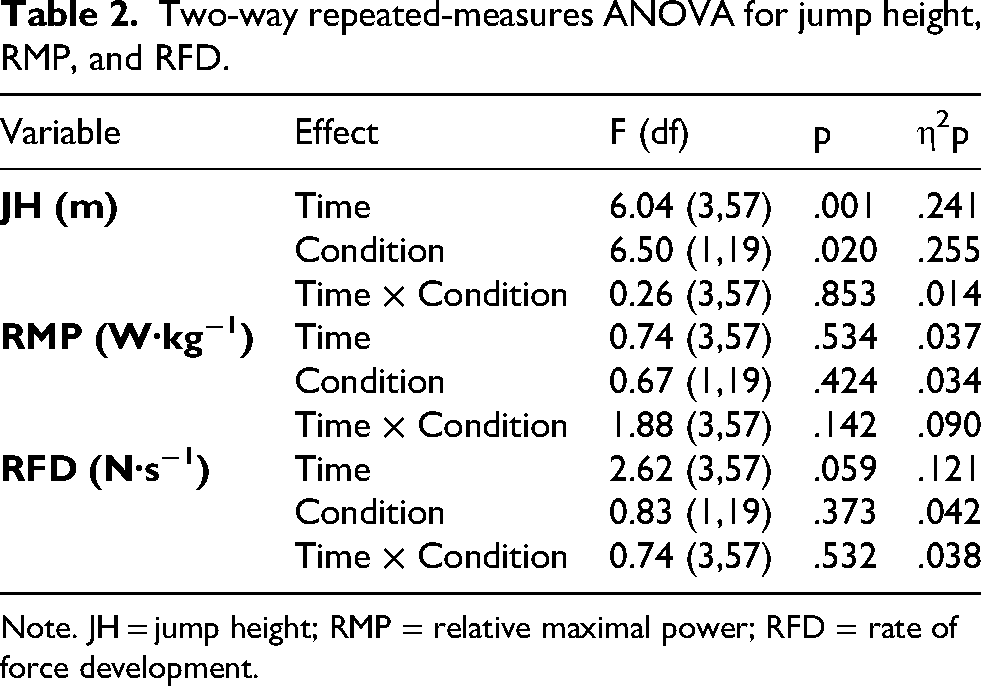
Note. JH = jump height; RMP = relative maximal power; RFD = rate of force development.
A significant main effect of time was observed for jump height, F(3,57) = 6.04, p = .001, η2p = .241, indicating changes across the recovery period. A significant main effect of condition was also identified, F(1,19) = 6.50, p = .020, η2p = .255, reflecting overall differences between the BFR and non-BFR conditions. However, the condition × time interaction was not significant, F(3,57) = 0.26, p = .853, η2p = .014, indicating a similar temporal pattern across conditions. Bonferroni-adjusted pairwise comparisons did not reveal significant differences between post-exercise recovery time points within either condition (all p > .05).
In contrast, RMP remained stable across conditions and time, with no significant main effects of time, F(3,57) = 0.74, p = .534, η2p = .037, or condition, F(1,19) = 0.67, p = .424, η2p = .034, and no significant interaction effect, F(3,57) = 1.88, p = .142, η2p = .090. Similarly, RFD showed no statistically significant changes, although a marginal main effect of time was observed, F(3,57) = 2.62, p = .059, η2p = .121. Neither the main effect of condition, F(1,19) = 0.83, p = .373, η2p = .042, nor the interaction effect, F(3,57) = 0.74, p = .532, η2p = .038, reached significance. Exploratory between-condition effect size analyses revealed small-to-moderate effects favoring the BFR condition at 3 min (Cohen's dz = 0.32), 6 min (Cohen's dz = 0.47), and 9 min (Cohen's dz = 0.51).
Given that jump height was the primary outcome and exhibited significant main effects of time and condition, its temporal profile is illustrated in Figure 2.
Discussion
This study aimed to investigate the effect of combining a bodyweight squat exercise with BFR on PAPE responses in CMJ performance in female recreational athletes. The main findings indicate that although CMJ performance changed over time, the inclusion of BFR did not produce meaningful improvements in jump height, RMP, or RFD compared with the non-BFR condition. These findings support our initial hypothesis and suggest that BFR does not confer a clear additional benefit when combined with low-load, bodyweight-based conditioning activities.
The observed main effect of time for jump height indicates that the bodyweight squat protocol itself was sufficient to induce a PAPE response, likely mediated by increases in muscle temperature, enhanced neural drive, and improved voluntary activation.3,9 Although previous meta-analytic evidence has shown that explosive bodyweight conditioning activities can improve subsequent performance outcomes such as vertical jump and sprint performance, 18 the present findings suggest that even a controlled bodyweight squat protocol may be sufficient to elicit a measurable potentiation response. However, the magnitude of this improvement should be interpreted with caution. Traditional PAPE protocols employing moderate-to-high external loads often report larger performance enhancements, albeit at the cost of increased neuromuscular fatigue and potential injury risk. 19 In this context, the practical relevance of bodyweight-induced potentiation remains open to discussion, as the relatively modest gains observed may not translate into meaningful performance advantages in high-performance settings. Therefore, bodyweight protocols may be best viewed as a practical and low-risk alternative, particularly in populations where minimizing fatigue or mechanical load is a priority, rather than as a direct substitute for higher-intensity PAPE strategies. Importantly, although a significant main effect of both time and condition was observed for jump height, the absence of a condition × time interaction is critical. This indicates that while performance changed over time and differed between conditions overall, the temporal trajectory of change was similar in both BFR and non-BFR conditions. From a practical perspective, these findings suggest that the specific bodyweight squat protocol implemented in the present study did not produce greater PAPE responses with the addition of BFR. Notably, the magnitude of change across time points was small and comparable between conditions, further supporting the limited additional effect of BFR under the present experimental conditions. It is also noteworthy that the absolute changes in jump height were small, despite the presence of moderate-to-large effect sizes. This apparent discrepancy may reflect the relatively low variability inherent to the within-subject crossover design, rather than a substantial practical improvement in performance. Beyond these considerations, it is also plausible that the relatively small magnitude of the potentiation response itself limited the ability to detect any additional benefit of BFR. When the baseline PAPE effect is minimal, the scope for further enhancement may be inherently constrained, making it more difficult to observe condition-related differences. In contrast, larger potentiation responses, such as those typically reported following higher-intensity conditioning activities, may provide a greater window for detecting any additive effects of interventions like BFR. For example, enhanced subsequent performance following BFR combined with single-leg squat exercises has previously been reported, which may reflect the greater neuromuscular and metabolic demands imposed by unilateral exercises compared to the bilateral bodyweight squat protocol used in the present study due to the redistribution of force and loading requirements across a single limb. 25 Thus, the absence of a BFR-related advantage in the present study should be interpreted with caution, as it may reflect not only the inefficacy of the intervention under these conditions, but also the limited sensitivity of the experimental context to reveal small additive effects.
This interpretation is further supported by the absence of meaningful changes in RMP and RFD, indicating that the lack of BFR-related effects was consistent across multiple mechanical indicators of CMJ performance. The lack of change in RFD warrants particular consideration. Although RFD is commonly used as an indicator of explosive neuromuscular function, its relationship with vertical jump performance is not always straightforward. Miller et al., 44 reported that the association between RFD and jump height may be weaker than expected, suggesting that other factors may play a more prominent role in determining jumping performance. Interestingly, a transient decrease in RFD was observed at the early recovery time point (3 min), followed by a return toward baseline values at later time points. Although this change did not reach statistical significance, it may indicate a short-term influence of fatigue immediately following the conditioning activity. Such a fatigue-related response could partially attenuate the expression of explosive force, thereby limiting the magnitude of improvement in jump performance. This observation aligns with the concept that PAPE reflects a balance between potentiation and fatigue, 14 particularly in low-load protocols where the potentiation stimulus may be modest. Furthermore, methodological factors may have influenced the sensitivity of RFD in the present study. RFD was derived directly from the force plate software without a standardized calculation window, which may limit its reliability and comparability. Additionally, RFD adaptations are often more evident in higher-load resistance training contexts, 36 whereas the present study utilized a low-load, bodyweight-based protocol with BFR. Collectively, these factors may explain the absence of significant changes in RFD.
RMP also provides important insight into the mechanical output of the CMJ, reflecting the ability to generate force relative to body mass. Given that CMJ performance is strongly influenced by power production rather than displacement alone, 45 the lack of improvement in RMP suggests that the observed time-related changes in jump height were not accompanied by meaningful enhancements in underlying mechanical output. This finding further reinforces the interpretation that BFR did not provide an additional ergogenic stimulus beyond that induced by the conditioning activity itself.
Taken together, the findings suggest that the PAPE response observed in this study was primarily driven by the characteristics of the conditioning stimulus itself, particularly its mechanical load and intensity, 46 rather than by additional metabolic stress induced by BFR. Although BFR is known to increase neuromuscular activation and metabolic stress under low-load conditions, the present results indicate that these physiological responses did not provide additional benefits for the specific bodyweight squat–based PAPE protocol implemented in this study. This highlights an important distinction between physiological activation and functional performance outcomes. Methodological aspects related to BFR application may also help explain the present findings. Previous research indicates that PAP responses and neuromuscular adaptations are influenced by factors such as occlusion pressure, cuff characteristics, and protocol design.47,48 In the present study, a fixed cuff pressure of 160 mmHg was applied based on device specifications, 44 and LOP was not individually determined. Given that current recommendations emphasize individualized pressure prescription relative to LOP to reduce inter-individual variability, 41 it is possible that variability in relative occlusion influenced the effectiveness of the BFR stimulus. However, it is important to note that the absence of individualized pressure prescription also reflects common practice in applied settings, where determining LOP may not be feasible due to time constraints, equipment availability, or practitioner expertise. From this perspective, the present protocol was intentionally designed to reflect a practical and easily implementable approach, rather than a tightly controlled laboratory optimization. Accordingly, while individualized occlusion may enhance the precision and potentially the effectiveness of BFR interventions, the present findings suggest that, under more ecologically valid conditions, non-individualized BFR does not appear to confer additional benefits for acute PAPE responses. This distinction is important, as demonstrating effectiveness under field-based conditions would have considerable practical value, whereas the current results indicate that such benefits may not readily translate outside optimized laboratory settings. Beyond these considerations, the relatively simple and ecologically valid design of the present study may serve as a practical foundation for future research. The applied protocol provides a baseline model that can be systematically extended through the incorporation of individualized occlusion pressures, higher mechanical loading, or alternative recovery strategies, thereby facilitating a more precise understanding of the conditions under which BFR may meaningfully augment PAPE responses.
In addition, the use of the KAATSU cycle mode represents a novel methodological approach. This system alternates between inflation and deflation phases, providing intermittent rather than continuous restriction. While this approach may improve comfort and reduce the risk of improper application, 40 it may also attenuate the overall physiological stimulus. Consequently, the applied BFR stimulus may have been insufficient to induce additional potentiation beyond that elicited by the conditioning activity itself. However, this interpretation remains speculative and requires further investigation. Comparisons with previous studies reveal both similarities and discrepancies. For example, Zheng et al., 36 reported improvements in jump performance following a low-load BFR squat protocol; however, their design included external loading and longer recovery durations, which may have facilitated greater potentiation. In contrast, studies employing bodyweight or submaximal protocols have reported mixed findings, likely due to differences in exercise selection, loading conditions, and recovery strategies. These inconsistencies further support the notion that the effectiveness of BFR in PAPE contexts is highly context-dependent.
Strengths and limitations
The present study has several notable strengths. First, it focuses on female recreational athletes, a population that remains underrepresented in the PAPE and BFR literature. Given known sex-related differences in neuromuscular characteristics, including fatigue resistance and motor unit recruitment strategies, the findings provide valuable population-specific insights. Second, CMJ performance was assessed using multiple variables (jump height, RMP, and RFD), allowing for a more comprehensive evaluation of neuromuscular performance beyond a single outcome measure. This strengthens the robustness of the conclusions. However, several limitations should also be acknowledged. The a priori power analysis was based on a within-subject comparison rather than on the condition × time interaction tested in the repeated-measures ANOVA. Therefore, the study may have been underpowered to detect small interaction effects, and the non-significant interaction should be interpreted with caution. While the fixed cuff pressure used in the present study (i.e., 160 mmHg) was comparable to pressures previously applied in successful BFR protocols, 25 the use of a non-individualized pressure rather than one relative to each participant's arterial occlusion characteristics may still have introduced inter-individual variability in the magnitude of the BFR stimulus. Additionally, the relatively low mechanical demands of the bilateral bodyweight squat protocol may have limited the potential to detect additive potentiation effects associated with BFR. Finally, the sample consisted of recreationally trained females, which may limit the generalizability of the findings to other populations, including trained or elite athletes.
Conclusions
The present findings do not support an additional effect of BFR when combined with a bodyweight squat–based PAPE protocol under the present conditions in female recreational athletes. Although performance improved over time, these changes were independent of BFR application, as reflected in jump height, RMP, and RFD during the CMJ. These results suggest that, under low-load conditions, BFR does not confer a clear additional benefit in enhancing explosive performance beyond that achieved through the conditioning activity alone. From a practical perspective, bodyweight squat–based PAPE protocols may be effectively implemented without BFR, particularly in contexts where simplicity and accessibility are prioritized. Future research should further investigate the interaction between mechanical load, BFR application, and individual characteristics to better define the conditions under which BFR may be beneficial.
Footnotes
Acknowledgments
We thank all athletes for their time, effort, and dedication to this study.

Ethical considerations
The study was approved by the Health Sciences Scientific Research and Publication Ethics Committee of Karamanoğlu Mehmetbey University (Approval ID: 05-2025/74; date: 07.05.2025).
Consent to participate
Written informed consent to participate was obtained from all participants.
Consent for publication
All participants provided informed consent for publication.
Author contributions
Research concept and study design: Y.M., E.G.; Literature review: E.G., B.K., M.G.; Data collection: E.G., B.K., A.U.; Data analysis and interpretation: Y.M., M.G.; Statistical analyses: Y.M.; Writing of the manuscript: Y.M.; Reviewing/editing a draft of the manuscript: E.G., B.K., A.U., M.G.
Funding
This study was derived from data generated within a project funded by the Scientific and Technological Research Council of Türkiye (TÜBİTAK) through the 2209-A University Students Research Projects Support Programme (Project No: 1919B012410662).
Declaration of conflicting interests
The authors declared no potential conflicts of interest with respect to the research, authorship, and/or publication of this article.
Data availability
The data that support the findings of this study are available from the corresponding author upon reasonable request.