We present a model for the corrective and preventive maintenance of a system. The latter is based on a bivariate policy that replaces the system either at age or after the failure, whichever comes first. A repair follows each of the first failures, restoring the system operational state, but with a lower reliability than before failing. We present two scenarios with constant and time-dependent repair costs. The results reveal that systems with low initial reliability can greatly benefit from the bivariate policy. The advantage decreases for poor quality repairs. We also obtain conditions to obtain the optimum number when is given. This result is helpful to assess whether a system should be replaced sooner than originally planned.
Systems are usually repaired several times before being replaced. The extended time of use thus obtained must be weighed against the costs derived from failures and repairs to determine the optimum time for system renewal. Both, preventive and corrective maintenance are becoming increasingly important in the current world, where sustainability is driving the need to extend the life of all types of equipment.
The positive effect of maintenance on reliability is a general assumption in most models. It ranges from the minimal repair, that restores exactly the same reliability previous to failure, to system renewal and any other reliability level in between. However, the possibility of maintenance that leaves the system in a worse condition than before failing has received little attention in the literature. Cha et al.1 justify this assumption by the negative effects of previous repairs, environmental and internal shocks, etc. Badía et al.2 mention the lack of either adequate resources or properly trained maintainers as a reason for this poor maintenance.
The maintenance of roads and pipes shows this adverse effect. Potholes on highways are a serious safety risk to drivers, and they are constantly patched. It is also common to see the same point of the road being repaired repeatedly. This occurs because the patch is less reliable than the original pavement3 or because the asphalt layer thickness is not optimal.4 Khahro5 highlights the impact of a low-cost pavement management. The increasing use of recycled materials in pavements6 also leads to the assumption that these materials are less reliable when they are used in patches. Maintenance models have to assume the possibility that high-quality maintenance may not be carried out due to either limited budgets or studies that fail to detect the actual road deterioration.
Age replacement is a basic strategy for avoiding failures. Thus, the system is replaced when it fails or when it reaches a specified age, , whichever comes first. However, some systems cannot be maintained periodically, but are better maintained at a random time, for example when a working cycle is completed,7 when a software update is available8 or after failures.9 The works of Mituzani et al.,8 Zhao and Nakagawa,10 and Badía et al.2 consider the combination of random and periodic or age-based replacement.
The minimal repair assumption implies that the system recovers its functional state, but the failure rate remains undisturbed, equal to that of a system of the same age (as-bad-as-old). Potential industrial applications are found in systems consisting of a large number of components and a failed system is restored to the operating condition by replacing only the failed component. The non-homogeneous Poisson process (NHPP) models failures in systems undergoing minimal repairs.11 It is useful to overcome the memoryless assumption when the deterioration process is not Markovian.12 Overlooking heterogeneity between systems when analyzing failure data can lead to inaccurate estimations.13 The generalized Pólya process (GPP) extends the NHPP by assuming that time varying environments affect the reliability of systems.2,14 System functionality can be restored in different ways. For example, the component that replaced the failed one can be new or refurbished, or the maintenance team can have different levels of expertise. This variability in the quality of the repair is responsible for a heterogeneous population of systems and it must also be taken into account when designing maintenance policies; otherwise, they will not achieve the desired result. In particular, assuming that a minimal repair applies and, thus, a failure process following a NHPP, can overestimate the reliability of a system that is actually in a worse-than-old condition rather than as-bad-as-old. Unobserved heterogeneity between systems cannot be controlled and it is modeled by a frailty, . is a random variable which takes a particular value for each system over its entire life, but changes between systems, explaining their differences. Therefore, assuming a mixture of non-homogeneous Poison processes (MNHPP) can be more realistic than using a single NHPP. In terms of managerial implications, a MNHPP can account for deficient maintenance and provide a dramatically different timescale for replacing a system. The relevance of considering heterogeneous populations in maintenance has recently been highlighted in Lee et al.15 and Santos and Cavalcante.16
This paper presents two models that combine random and non-random maintenance of a system that undergoes minimal repairs after each of the first failures. The system is replaced after the first of the following two events occurs: the failure or reaching age . Thus, the system is no longer used when either its age or failure history induces high maintenance costs. This policy emulates the usual procedure of maintainers. Random replacement after failures protects against frequent failures. This is particularly useful when failures happen in the early stages due to hidden defects that occur during the design stage or the manufacturing process or due to refurbished components.17 Regarding road maintenance, it eliminates the potholes that appear in new roads due to a defective pavement or insufficient asphalt layer thickness.
The models in this paper differ from those in previous references in the following major assumptions:
We assume a MNHPP for the time to the failure, which is an extension of the GPP repair process. The mixture is the result of differences in the quality of repairs. Thus, this new model accounts for random variability in repairing conditions, as well as time-varying reliability, which is more general than that in Badía et al.2
In model 2, we introduce time-dependent repair costs, , in contrast to the constant value, , of model 1. This second assumption provides further insight into the comparison between deterministic and random preventive replacement.
From the point of view of real applications, we extend the idea of low quality maintenance in Santos and Cavalcante,16 by considering successive repairs that restore the operational state of a system but with lower reliability than before the failure occurred (worse-than-old).2 The consequence is that the occurrence of failures increases after each repair. This effect leads to the resurfacing of long sections of roads, for example. In addition, the bivariate maintenance policy is a useful strategy to determine the maximum usage time of a component subject to low-quality maintenance. The maintainer can decide when no further repairs are cost-effective and replace the component with a new one.
This paper is organized as follows: Section 2 presents the key concepts of the MNHPP, which models the repairs in models 1 and 2. Section 3 contains the model building that leads to the cost function under the two scenarios, constant repair cost and time-dependent repair cost. It also presents the analysis of the conditions under which an optimum policy exists. The corresponding proofs as well as some basics on stochastic ordering, are in the Appendices A1, A2 and A3. The classical univariate policies, and , are presented in Section 4. The sensitivity analysis in Section 5 analyzes the range of application of models 1 and 2 when comparing the optimum bivariate policy, , with the corresponding classical univariate, and . The conclusions are summarized in Section 6.
MNHPP repair model
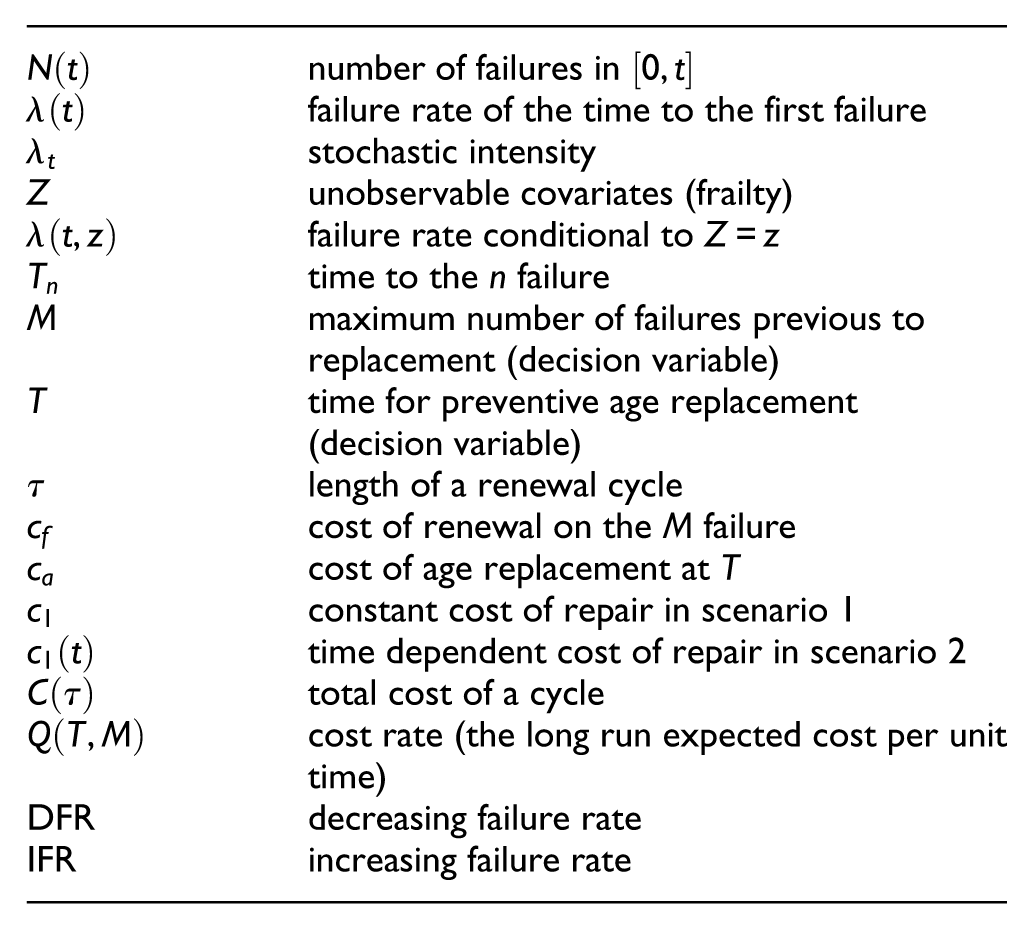
First, we introduce the notation that will be used throughout this paper:
number of failures in
failure rate of the time to the first failure
stochastic intensity
unobservable covariates (frailty)
failure rate conditional to
time to the failure
maximum number of failures previous to replacement (decision variable)
time for preventive age replacement (decision variable)
length of a renewal cycle
cost of renewal on the failure
cost of age replacement at
constant cost of repair in scenario 1
time dependent cost of repair in scenario 2
total cost of a cycle
cost rate (the long run expected cost per unit time)
DFR
decreasing failure rate
IFR
increasing failure rate
Let be a counting process with the number of events in . In addition represents its filtration, that is, the history of the process given by and with the epoch time of the th event in the counting process.
The stochastic intensity, , of a counting process , is defined as
Observe that is the conditional probability of failure in an infinitesimal interval, , given the previous history of failures of the system. Hence, the intensity rate is similar to the failure rate concept although accounts for the effect of the past failures in the current reliability of the system. In addition, assuming that repairing conditions cannot be perfectly controlled, but instead change randomly between systems, provides a more realistic model for failures, which are expected to occur more frequently in systems under low quality maintenance. The frailty, , accounts for such heterogeneity in the counting process of the failures. is assumed to be a non-negative random variable that leads to a mixture of counting processes. The work in Brown et al.13 is concerned with the choice of the frailty.
In what follows we assume that the frailty, , has a multiplicative effect on the failure rate:
is the failure rate when , whereas the failure rate of the time until the first failure, , serves as baseline intensity. When , the failure rate is higher than the baseline. On the contrary, leads to a reduction in the failure rate.
We consider the particular case of a MNHPP as in Cha and Finkelstein.18 They provide an expression for the stochastic intensity (chapter 4, page 109) that, for the multiplicative model , turns out to be
with being the cumulative baseline intensity:
The stochastic intensity in equation (1) explains both the time aftermath, which is generally adverse for most systems, and random effects that can aggravate or alleviate the former. Note that for the expression in equation (1) corresponds to the intensity function of a non-homogeneous Poisson process which in turn describes the counting process of the failures for a system under minimal repair.
In what follows we will consider a system that is repaired after failing and keeps on working until the following failure. The mixed non-homogeneous repair process (MNHPP) is defined next.
Definition 1.The counting process with being the number of failures in , is given by a MNHPP repair model with baseline intensity and frailty , if () corresponds to the epoch time of the mixed non-homogeneous Poisson process with intensity in (1).
The main property of the MNHPP repair process is given in the following proposition.
Proposition 1.Let be a MNHPP repair model. Then its stochastic intensity, , increases with .
The result holds since
is increasing in .
Proof. Consider the ratio for :
The Cauchy-Schwartz inequality states:
thus, , and the result follows.
Therefore, is also increasing with . The previous proposition implies that, although the system recovers its functionality after each repair, its condition is worse than before failing. Hence, the worse-than-old condition can be interpreted as the result of a mixture of minimal repairs in heterogeneous populations. This worse-than-old condition makes the difference between the MNHPP repair model and the minimal repair.
Furthermore, the MNHPP repair model is an extension of the GPP repair process considered in Lee and Cha.19,20 In the particular case that the baseline failure rate in the NHPP be and the frailty, , a gamma random variable with scale parameter and shapeparameter , it follows that
and then from equation (1) the stochastic intensity of the mixed NHPP process is
which is also the stochastic intensity of the generalized Pólya process (GPP) with parameters , 1, .
Model building
We consider a one component system undergoing a single type to failure that is minimally repaired after every failure with being the hazard rate of the time to the first failure. The higher , the greater the risk of failure.
Definition 1 in Badía et al.,2 states that the Generalized Pólya Process with parameters is a non-homogeneous Poisson process with rate equal to . The corresponding probability of failures in is a Poisson distribution with mean . The MNHPP in this paper and the corresponding repair process also extend the NHPP, which in turn emerges under the minimal repair. The probability of failures when is
That is, the probability of failures in for a non-homogeneous Poisson process with rate equal to .
Then, the unconditional probability of failures is
with the density function of . Thus, the failure process, , is given by a mixture of non-homogeneous Poisson processes.
Each time the system fails, a minimal repair restores the system back to function. Proposition 1 states that the random effect of the repair given by , leaves the system in a worse-than-old condition.
The following assumptions also apply to the maintenance procedure:
The system is replaced on the failure or at age whichever comes first.
Repair times are considered to be negligible.
The cost of preventive replacement on the failure and at age are, respectively, and .
Although working times of most systems are finite, the study of optimum maintenance policies is simpler when an infinite time span is considered.21 Since we do not assume that the system must fulfill a specific task within a given period, the objective function to be analyzed is the incurred cost per unit of time in an infinite interval. The key theorem of the renewal reward processes22 guarantees that this function is equivalent to the next one:
with and being, respectively, the length and the cost of a renewal cycle. In addition and are decision variables. Therefore, given the costs of repair and replacement as well as the rest of parameters defining the failure process, the optimum values and minimizing have to be obtained.
Let be the random time until the -th failure. Its density function is given by:
and the process of failures, , verify
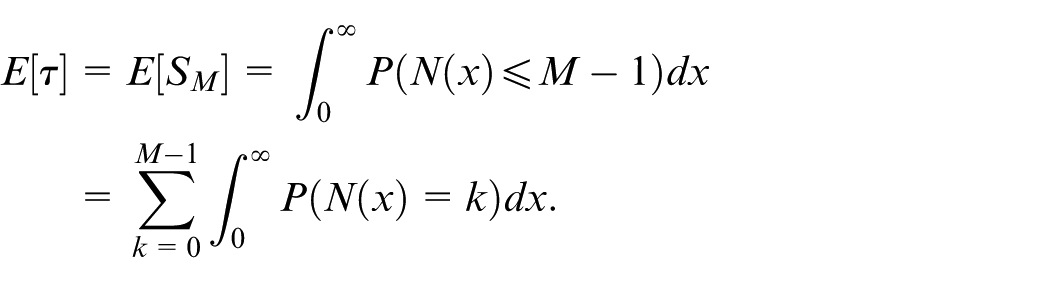
Hence the probability that the failure occurs no later than is equivalent to the probability that failures occur at least before .
Then, the length of a renewal cycle
and its expected value
with .
In contrast with the renewal on the failure, the renewal at age is a planned maintenance. Therefore, the maintainer has time to prepare a less expensive replacement in advance than in the case of a random replacement, leading to consider . However, since replacement on the failure implies that the system has not reached age , it may retain a residual value as a second-hand unit. Therefore, there may be cases where .
We will analyze two scenarios:
Scenario 1: The cost of repair is constant.
Scenario 2: The costs of repairs are time dependent.
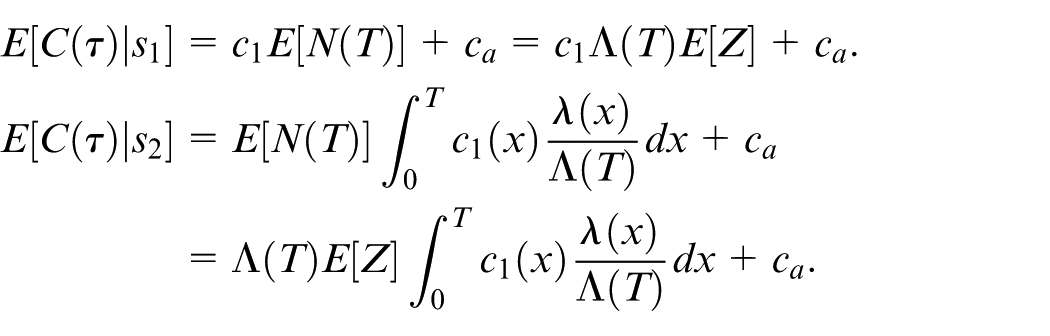
Scenario 1: Constant repair cost. Let be the unitary cost of repair.
The cost of a cycle is
accounts for the number of failures occurring until . , are the indicator variables of replacement at or on the failure, respectively.
The expected cost of a cycle is
The cost function in scenario 1 is
with the mean cycle length, , and its corresponding expected cost, , in equations (5) and (6), respectively.
Scenario 2: The costs of repairs are time dependent, with the unitary cost.
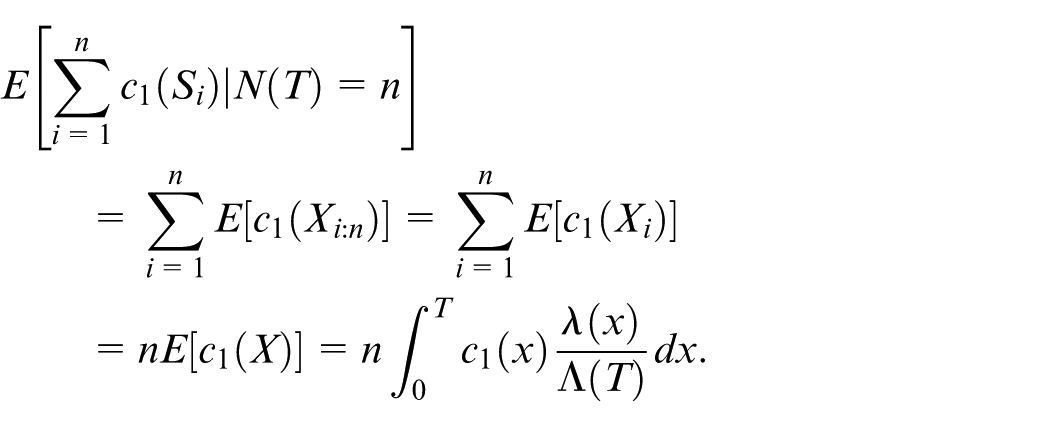
Assume that failures have happened in , then the order statistics , representing the corresponding times until they occur, are independent random variables with probability density function .
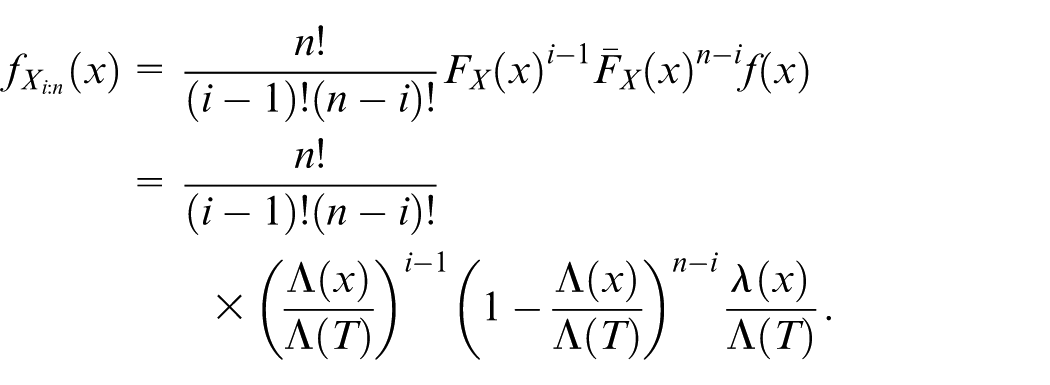
Moreover, consider a sample of size from a random variable , the density function of the th order statistics, , is:
For
The renewal at occurs if there is not more than failures in . The corresponding probability is .
In addition, the times between consecutive failures, , are independent random variables with density function .
The mean cost incurred due to the repair of failures :
The renewal after failures happens in case that . The corresponding probability is .
The mean cost derived from the repair of the first failures is as follows:
Observe that in case of being a gamma random variable with scale parameter and shape parameter and , then the cost functions in scenarios 1 and 2 extend that in Lee and Cha20 assuming and in the case of scenario 1 and for scenario 2.
We aim at obtaining the optimum policy in both scenarios, that is, (, ) minimizing and the corresponding (, ) for .
Optimum number of repairs,
This section concerns the existence of an optimum minimizing , for a given , in scenarios 1 and 2. The first result provides the algorithm to obtain , simplifying programming tasks. The second serves to explore conditions under which there exists .
The notation below is used in what follows
The following two results show the applicability of this model. First, Proposition 2 presents the strategy for computing the optimum , if it exists, when is given. It applies in both scenarios.
Proposition 2. Let for a given . If the function given next
is decreasing in , and it verifies the following condition
The next theorem states sufficient conditions for the existence of an optimum in each scenario when the age replacement time is given. This information keeps the maintenance team aware of systems that need to be replaced earlier than planned.
Theorem 1.For a given age replacement time , the following results hold:
Considerin scenario 1 with. If either of the following conditions applies
Observe that if is a gamma random variable with scale parameter and shapeparameter , then is log concave for and DFR otherwise. Therefore, if is increasing in and the conditions in apply for .
In addition, its density function verifies that is increasing in for and, hence, the conditions in hold. Thus, conditions in Theorem 1 for scenario 1 extend the results in Lee and Cha20 (see Proposition 3).
Theorem 1 has interesting applications for maintainers when the age for replacement of a system, , is given. For example, this is useful when represents an amortization period. The corresponding bivariate policy takes into account the resulting reliability of the system after successive repairs. In the case of low quality repairs, the optimum policy may be an earlier replacement than indicated by the amortization period. Regarding the sufficient condition , it seems to be a reasonable assumption when inspection is an expensive procedure. In addition, it trivially holds if . As mentioned previously, cases in which the system retains a residual value as a second-hand unit can imply that .
Comparison with univariate policies
In this section we present the classical univariate maintenance models, age replacement () and replacement after a given number of failures () assuming a MNHPP repair model. A comparison of the optimum cost derived from the three models gives light about the conditions under which the bivariate maintenance outperforms the other two.
Next we present the corresponding expressions of the cost function in scenarios 1 and 2.
Age replacement at T. M =
The length of a cycle is (non-random). The mean number of repairs is that of the mixture of non-homogeneous Poisson processes. In addition to the replacement cost, the cost derived from repairs until have to be considered. It follows that
The cost of a cycle in scenarios 1 and 2 are respectively:
with and being the corresponding cost functions in the two scenarios.
The optimum values minimizing and are denoted, respectively, by and .
Replacement after failures.
The cycle verifies and therefore it presents a random length, but the incurred cost is deterministic. It follows that
with in .
The length of a cycle can be alternatively expressed as follows:
The corresponding cost in scenario 1:
and the cost function
Regarding scenario 2 and in equation (7), the expected cost of repairing a failure in is
Observe that verifies that . Considering , it follows that
Replacement on the failure when there is at least one repair makes no sense if the expected cost of repair is infinite. The assumption below is required for the expected cost derived from repairs in a cycle to be finite in scenario 2:
and, thus, the expected cost of a cycle is
The cost function in scenario 2:
Now and denote the optimum number of failures previous to replacement minimizing and , respectively.
Aiming at giving additional insight about the advantages of a bivariate policy, and have to be compared with the univariate policies in both scenarios.
Numerical example
In this section we carry out a sensitivity analysis for both scenarios. We obtain and compare the corresponding optimum policies for the univariate and bivariate maintenance. Thus, we give light on how the decision variables depend on the parameters of the model, as well as about the conditions under which the cost of the univariate maintenance is no longer larger than that of the bivariate policy. It is important to note that the use of a bivariate strategy for replacement adds extra complexity for maintainers. Therefore, these results are useful to indicate when a simpler maintenance based on just one of the two can be applied.
The baseline hazard rate is given as follows
with . If then . Therefore, the parameter models the pace of the first failure. The higher , the more prone the system is to an early failure. This can be the result of different causes such as hidden defects, poor installation of the system, refurbished units used as spare parts, etc.
The mixing variable follows a gamma distribution with density function:
with , and the Euler function:
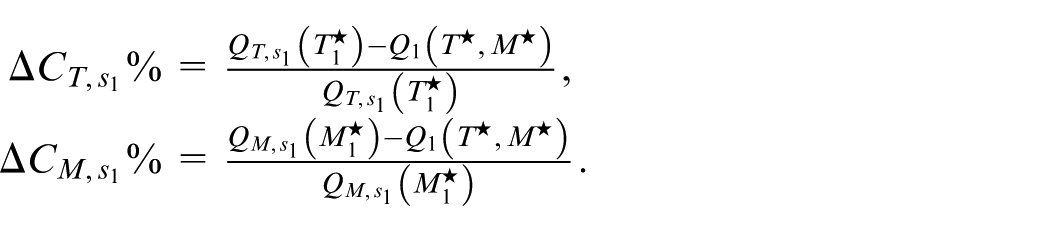
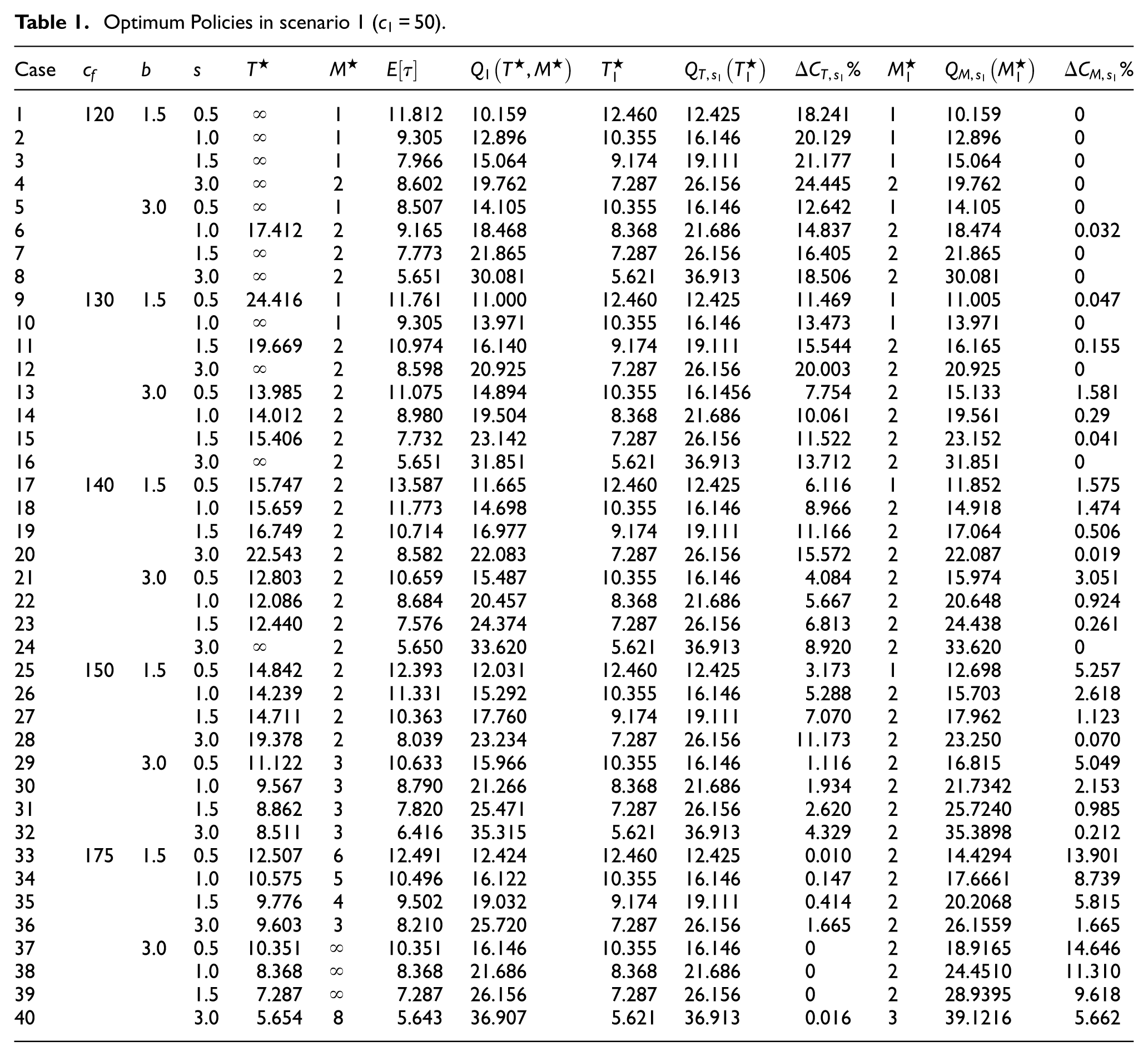
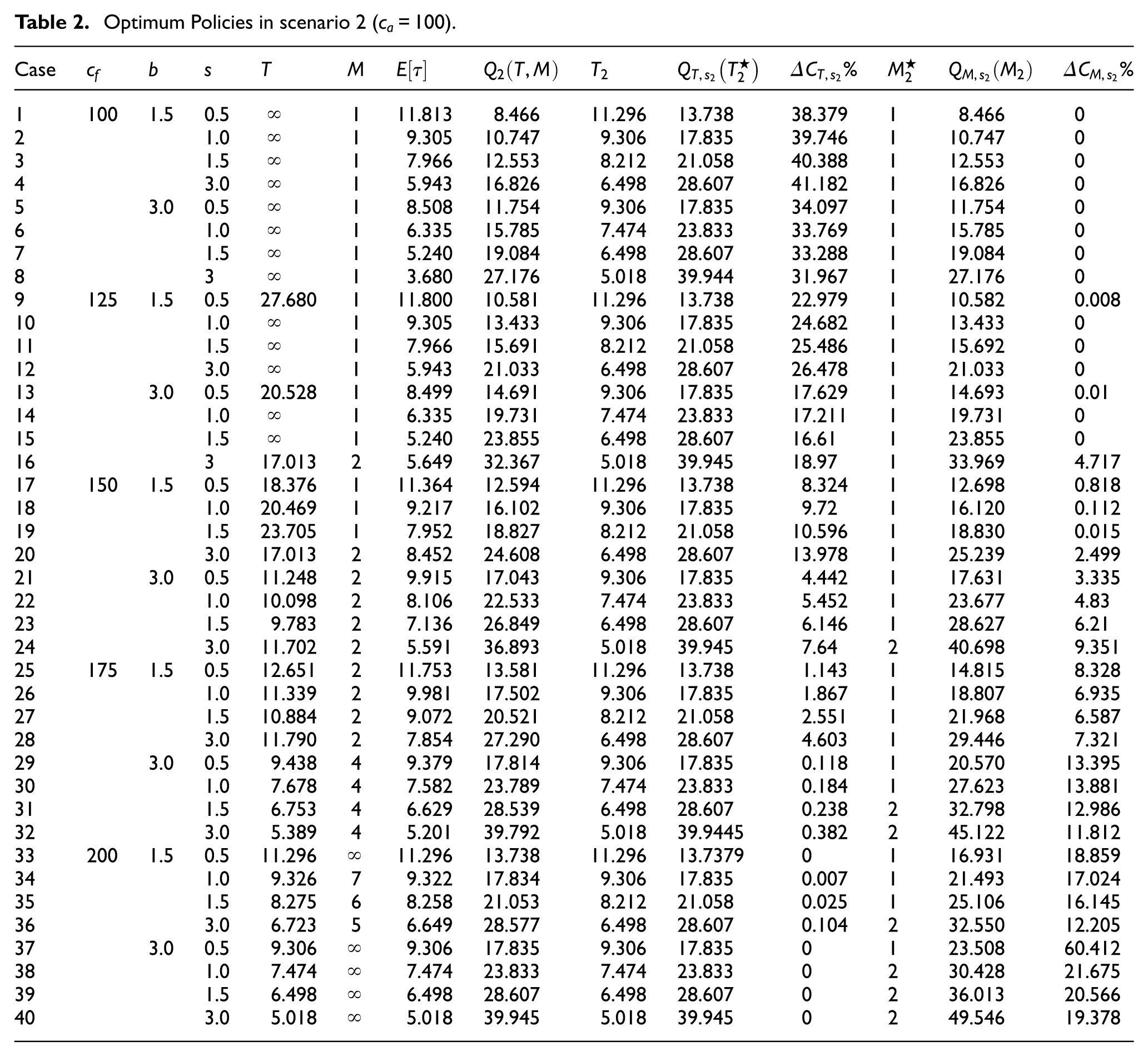
In what follows we will assume and . Tables 1 and 2 are obtained for and corresponding to scenario 1 and 2, respectively. Both contain the optimum bivariate policy , the optimum cost as well as the univariate policies and along with the corresponding optimum costs, and , for (scenario 1) in Table 1 and (scenario 2) in Table 2. Table 1 also contains the following information for comparison purposes with the univariate policies:
to compare with age replacement and replacement on the failure, respectively. Table 2 presents a similar study in scenario 2. The larger any of the two quantities above, the greater the advantage of the bivariate over its univariate competitors.
Optimum Policies in scenario 1 ().
Case
1
120
1.5
0.5
1
11.812
10.159
12.460
12.425
18.241
1
10.159
0
2
1.0
1
9.305
12.896
10.355
16.146
20.129
1
12.896
0
3
1.5
1
7.966
15.064
9.174
19.111
21.177
1
15.064
0
4
3.0
2
8.602
19.762
7.287
26.156
24.445
2
19.762
0
5
3.0
0.5
1
8.507
14.105
10.355
16.146
12.642
1
14.105
0
6
1.0
17.412
2
9.165
18.468
8.368
21.686
14.837
2
18.474
0.032
7
1.5
2
7.773
21.865
7.287
26.156
16.405
2
21.865
0
8
3.0
2
5.651
30.081
5.621
36.913
18.506
2
30.081
0
9
130
1.5
0.5
24.416
1
11.761
11.000
12.460
12.425
11.469
1
11.005
0.047
10
1.0
1
9.305
13.971
10.355
16.146
13.473
1
13.971
0
11
1.5
19.669
2
10.974
16.140
9.174
19.111
15.544
2
16.165
0.155
12
3.0
2
8.598
20.925
7.287
26.156
20.003
2
20.925
0
13
3.0
0.5
13.985
2
11.075
14.894
10.355
16.1456
7.754
2
15.133
1.581
14
1.0
14.012
2
8.980
19.504
8.368
21.686
10.061
2
19.561
0.29
15
1.5
15.406
2
7.732
23.142
7.287
26.156
11.522
2
23.152
0.041
16
3.0
2
5.651
31.851
5.621
36.913
13.712
2
31.851
0
17
140
1.5
0.5
15.747
2
13.587
11.665
12.460
12.425
6.116
1
11.852
1.575
18
1.0
15.659
2
11.773
14.698
10.355
16.146
8.966
2
14.918
1.474
19
1.5
16.749
2
10.714
16.977
9.174
19.111
11.166
2
17.064
0.506
20
3.0
22.543
2
8.582
22.083
7.287
26.156
15.572
2
22.087
0.019
21
3.0
0.5
12.803
2
10.659
15.487
10.355
16.146
4.084
2
15.974
3.051
22
1.0
12.086
2
8.684
20.457
8.368
21.686
5.667
2
20.648
0.924
23
1.5
12.440
2
7.576
24.374
7.287
26.156
6.813
2
24.438
0.261
24
3.0
2
5.650
33.620
5.621
36.913
8.920
2
33.620
0
25
150
1.5
0.5
14.842
2
12.393
12.031
12.460
12.425
3.173
1
12.698
5.257
26
1.0
14.239
2
11.331
15.292
10.355
16.146
5.288
2
15.703
2.618
27
1.5
14.711
2
10.363
17.760
9.174
19.111
7.070
2
17.962
1.123
28
3.0
19.378
2
8.039
23.234
7.287
26.156
11.173
2
23.250
0.070
29
3.0
0.5
11.122
3
10.633
15.966
10.355
16.146
1.116
2
16.815
5.049
30
1.0
9.567
3
8.790
21.266
8.368
21.686
1.934
2
21.7342
2.153
31
1.5
8.862
3
7.820
25.471
7.287
26.156
2.620
2
25.7240
0.985
32
3.0
8.511
3
6.416
35.315
5.621
36.913
4.329
2
35.3898
0.212
33
175
1.5
0.5
12.507
6
12.491
12.424
12.460
12.425
0.010
2
14.4294
13.901
34
1.0
10.575
5
10.496
16.122
10.355
16.146
0.147
2
17.6661
8.739
35
1.5
9.776
4
9.502
19.032
9.174
19.111
0.414
2
20.2068
5.815
36
3.0
9.603
3
8.210
25.720
7.287
26.156
1.665
2
26.1559
1.665
37
3.0
0.5
10.351
10.351
16.146
10.355
16.146
0
2
18.9165
14.646
38
1.0
8.368
8.368
21.686
8.368
21.686
0
2
24.4510
11.310
39
1.5
7.287
7.287
26.156
7.287
26.156
0
2
28.9395
9.618
40
3.0
5.654
8
5.643
36.907
5.621
36.913
0.016
3
39.1216
5.662
Optimum Policies in scenario 2 ().
Case
1
100
1.5
0.5
1
11.813
8.466
11.296
13.738
38.379
1
8.466
0
2
1.0
1
9.305
10.747
9.306
17.835
39.746
1
10.747
0
3
1.5
1
7.966
12.553
8.212
21.058
40.388
1
12.553
0
4
3.0
1
5.943
16.826
6.498
28.607
41.182
1
16.826
0
5
3.0
0.5
1
8.508
11.754
9.306
17.835
34.097
1
11.754
0
6
1.0
1
6.335
15.785
7.474
23.833
33.769
1
15.785
0
7
1.5
1
5.240
19.084
6.498
28.607
33.288
1
19.084
0
8
3
1
3.680
27.176
5.018
39.944
31.967
1
27.176
0
9
125
1.5
0.5
27.680
1
11.800
10.581
11.296
13.738
22.979
1
10.582
0.008
10
1.0
1
9.305
13.433
9.306
17.835
24.682
1
13.433
0
11
1.5
1
7.966
15.691
8.212
21.058
25.486
1
15.692
0
12
3.0
1
5.943
21.033
6.498
28.607
26.478
1
21.033
0
13
3.0
0.5
20.528
1
8.499
14.691
9.306
17.835
17.629
1
14.693
0.01
14
1.0
1
6.335
19.731
7.474
23.833
17.211
1
19.731
0
15
1.5
1
5.240
23.855
6.498
28.607
16.61
1
23.855
0
16
3
17.013
2
5.649
32.367
5.018
39.945
18.97
1
33.969
4.717
17
150
1.5
0.5
18.376
1
11.364
12.594
11.296
13.738
8.324
1
12.698
0.818
18
1.0
20.469
1
9.217
16.102
9.306
17.835
9.72
1
16.120
0.112
19
1.5
23.705
1
7.952
18.827
8.212
21.058
10.596
1
18.830
0.015
20
3.0
17.013
2
8.452
24.608
6.498
28.607
13.978
1
25.239
2.499
21
3.0
0.5
11.248
2
9.915
17.043
9.306
17.835
4.442
1
17.631
3.335
22
1.0
10.098
2
8.106
22.533
7.474
23.833
5.452
1
23.677
4.83
23
1.5
9.783
2
7.136
26.849
6.498
28.607
6.146
1
28.627
6.21
24
3.0
11.702
2
5.591
36.893
5.018
39.945
7.64
2
40.698
9.351
25
175
1.5
0.5
12.651
2
11.753
13.581
11.296
13.738
1.143
1
14.815
8.328
26
1.0
11.339
2
9.981
17.502
9.306
17.835
1.867
1
18.807
6.935
27
1.5
10.884
2
9.072
20.521
8.212
21.058
2.551
1
21.968
6.587
28
3.0
11.790
2
7.854
27.290
6.498
28.607
4.603
1
29.446
7.321
29
3.0
0.5
9.438
4
9.379
17.814
9.306
17.835
0.118
1
20.570
13.395
30
1.0
7.678
4
7.582
23.789
7.474
23.833
0.184
1
27.623
13.881
31
1.5
6.753
4
6.629
28.539
6.498
28.607
0.238
2
32.798
12.986
32
3.0
5.389
4
5.201
39.792
5.018
39.9445
0.382
2
45.122
11.812
33
200
1.5
0.5
11.296
11.296
13.738
11.296
13.7379
0
1
16.931
18.859
34
1.0
9.326
7
9.322
17.834
9.306
17.835
0.007
1
21.493
17.024
35
1.5
8.275
6
8.258
21.053
8.212
21.058
0.025
1
25.106
16.145
36
3.0
6.723
5
6.649
28.577
6.498
28.607
0.104
2
32.550
12.205
37
3.0
0.5
9.306
9.306
17.835
9.306
17.835
0
1
23.508
60.412
38
1.0
7.474
7.474
23.833
7.474
23.833
0
2
30.428
21.675
39
1.5
6.498
6.498
28.607
6.498
28.607
0
2
36.013
20.566
40
3.0
5.018
5.018
39.945
5.018
39.945
0
2
49.546
19.378
As increases, so does , but decreases. The higher cost of replacement on failure impels age replacement by reducing and increasing . Therefore, the relevance of the age replacement increases. Under this condition, the finite value of prevents the system from exceeding . Very large values of the ratio can result in (cases 37–39 in Table 1 and 37–40 in Table 2). On the contrary, as the ratio decreases, replacement based on the accumulated number of failures becomes more profitable than age replacement at , and therefore is observed more frequently. In fact, the cases considered where lead to .
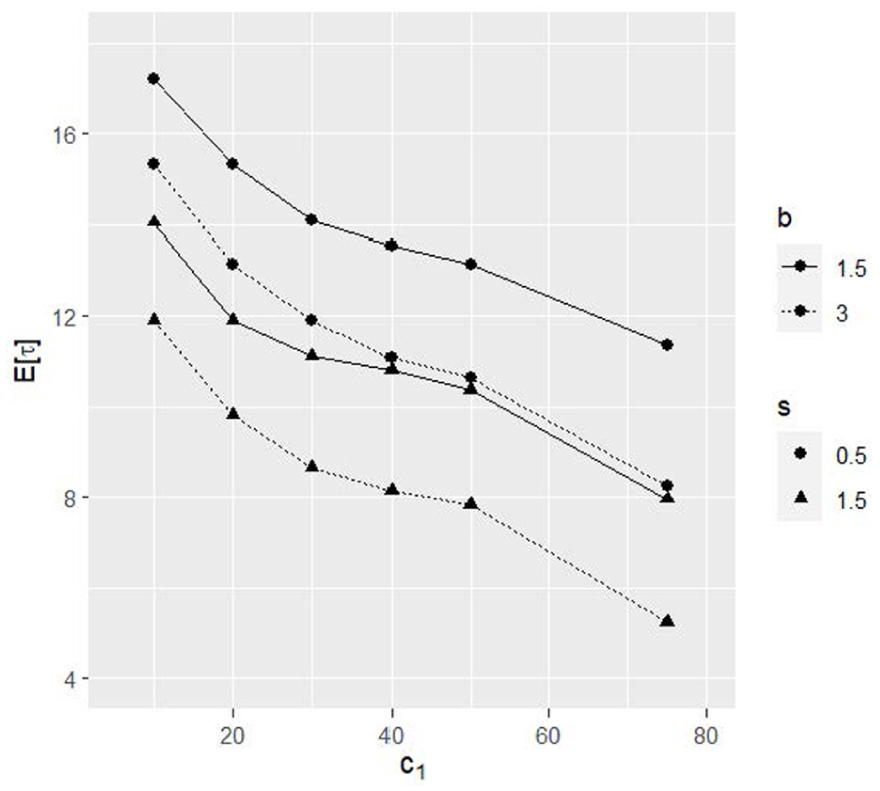
The higher , so is the initial failure rate of the system, leading to a decrease in expected length of a renewal cycle. The stochastic intensity of the failure process increases with and also leads to a reduction in . Therefore, the starting condition of a recycled component is critical when considering its use as a second-hand system. Poor repairs can also interfere with the purpose of extending the life of a system. Figure 1 illustrates this result, which must be considered when either recycled units are used as spares or the quality level of repairs drops. The comparison of the bivariate policy with the age replacement in scenarios 1 and 2 reveals that the cost reduction induced by the former decreases with . This means that the additional replacement on the failure is less advantageous the lower the quality of repairs is. This result is reversed in both scenarios when increases. Therefore, the bivariate policy is clearly superior to the age replacement in systems with low reliability when they start to work.
Mean length of a renewal cycle under different values of , , and .
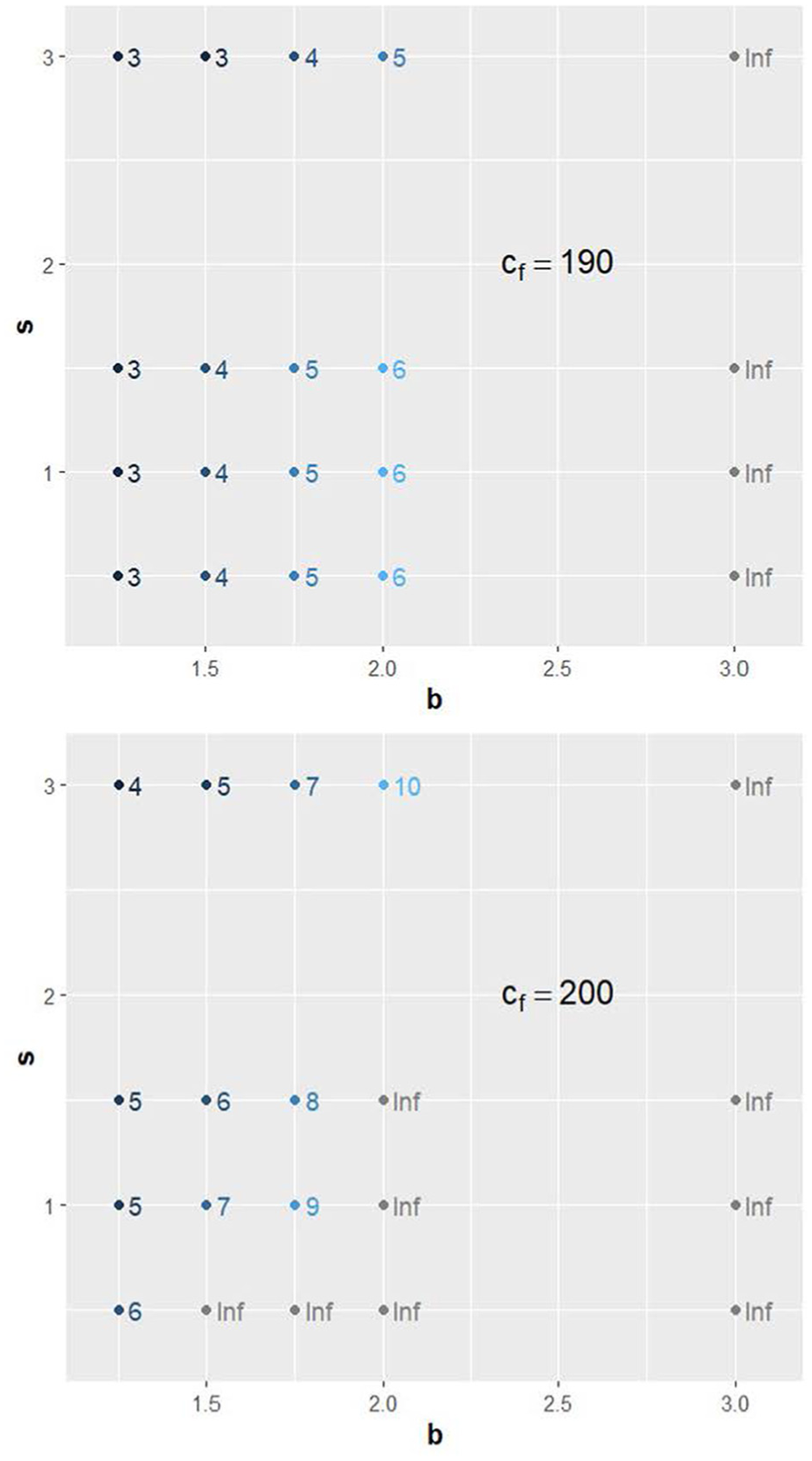
Notwithstanding that the bivariate policy outperforms the univariate maintenances in most cases, the sensitivity analysis also gives some insight into the conditions leading to either, or being infinite. If so, the optimum cost of the univariate policy is equal to that of the bivariate policy. Table 3 provides further information on the interaction effects of the three parameters, , , and in determining the optimum policy in scenario 2. If and are fixed, for and for (cases 5, 9, 13, 14, and 15). When is fixed, increasing leads to a decrease in , with some cases where drops to . This behavioris reversed when is fixed and increases. Figure 2 shows these results. Thus, the additional protection of the bivariate policy is more advantageous the lower the initial reliability of the system is. The bivariate policy tends to match an age replacement for large values of the parameter , which is the shape parameter of the mixing distribution . According to equation (3), the larger , the worse the repair. In summary, a good maintenance is key for keeping systems operational. However, in case of a very low quality of repairs, the results do not show a clear gain in a more complex maintenance. An earlier age replacement might be sufficient.
Optimum Policies in scenario 2 ().
Case
1
1.25
0.5
12.261
3
12.062
12.864
11.863
6
11.857
12.887
2
1.0
10.519
3
10.202
16.526
9.937
5
9.903
16.595
3
1.5
9.633
3
9.216
19.364
8.874
5
8.826
19.494
4
3.0
8.510
3
7.797
25.861
7.517
4
7.308
26.203
5
1.50
0.5
11.443
4
11.387
13.729
11.296
11.296
13.738
6
1.0
9.570
4
9.474
17.802
9.326
7
9.322
17.834
7
1.5
8.570
4
8.441
20.991
8.275
6
8.258
21.053
8
3.0
7.726
3
7.097
28.392
6.723
5
6.649
28.577
9
1.75
0.5
10.893
5
10.876
14.520
10.843
10.843
14.522
10
1.0
8.983
5
8.952
18.964
8.886
9
8.885
18.976
11
1.5
7.954
5
7.910
22.462
7.823
8
7.820
22.488
12
3.0
6.609
4
6.416
30.643
6.194
7
6.182
30.733
13
2.00
0.5
10.471
6
10.466
15.255
10.455
10.455
15.256
14
1.0
8.560
6
8.550
20.042
8.524
8.524
20.046
15
1.5
7.529
6
7.514
23.823
7.474
7.474
23.833
16
3.0
6.043
5
5.974
32.711
5.858
10
5.857
32.750
17
3.00
0.5
9.307
9.307
17.836
9.306
9.306
17.835
18
1.0
7.474
7.474
23.833
7.474
7.474
23.833
19
1.5
6.498
6.498
28.607
6.498
6.498
28.607
20
3.0
5.018
5.018
39.945
5.018
5.018
39.945
in scenario 2.
Conclusions
Replacing systems rather than repairing them when they fail or deteriorate, has been a common practice since the last decade of the last century. Nonetheless, this practice is no longer acceptable for sustainability reasons that lead to extend the use of components and systems by appropriate maintenance. This paper presents a bivariate maintenance policy based on both the age, , and the number of failures, . The combination of a deterministic and a random replacement generally gives additional protection to the system, since waiting for the age replacement at , may not be worthwhile in a system with a high frequency of failures. Therefore, a preventive maintenance after the failure, which occurs before the planned age replacement at , can be profitable from an economic point of view. However, poor quality maintenance can reduce the useful life of a system. There is unobserved heterogeneity between systems that seem to be identical due to differences in the quality of their maintenance. This variability is modeled by a frailty, , which leads to a MNHPP in the failure process, which, in turn, is derived from a variety of minimal repairs carried out on failure. The value of is specific to each system and remains constant throughout its life, but varies between systems depending on the quality of maintenance. This paper focuses on designing a maintenance policy that is valid for a heterogeneous population of systems. We analyze the consequences of low quality maintenance in the optimum policies under two scenarios with constant or time-dependent repair costs, respectively. The higher these costs, the earlier the system replacement implying a serious inconvenience to extend the time of use. We also provide sufficient conditions guaranteeing the existence of a finite in each of the two scenarios when is not a variable decision but a parameter in the model. This result, the maximum number of cost-effective repairs to be carried out, can serve as an indicator that an earlier replacement of the system, that is before the initial horizon at , iseconomically advantageous. Apart from the sensitivity analysis, the numerical study also addresses the comparison of the bivariate policy with the univariate ones, based only on the age or the number of cumulated failures . The initial reliability of a system when it starts to work is critical to determine the upcoming maintenance. The lower the initial reliability, the sooner the system will be replaced. Thus, the condition of a component that is to be used as a second-hand system is relevant to determine how it should be maintained. In fact, recycled units with low reliability levels can greatly benefit from the bivariate policy. The analysis reveals that some conditions can lead maintainers to use univariate maintenance policies, which are simpler to apply. Thus, is more likely to occur when the ratio is low, whereas tends to happen either when the former ratio is high or the mean quality of repairs decreases.
Footnotes
Appendix A1. Basics
Consider a random variable
A random variable is
The following properties apply
is less or equal than in
The following chain of implications concerning stochastic orders holds
Appendix A2. Auxiliary results
Let be a gamma random variable with shape parameter and scale parameter 1.
Lemma 1., with*=st, hr, rhr, lr.
Proof. It follows that
is increasing in , thus which implies the st, hr and rhr stochastic orders.
Lemma 2. Let non null positive functions such that is decreasing. If , then
Proof. If is decreasing, then verifies the condition for the bivariate characterization of likelihood ratio stochastic order in Shanthikumar and Yao23 and the result follows.
Next, we define some auxiliary functions:
For and :
The previous identity follows since
Proof. is decreasing in if
Next, we verify that Conditions in Lemma 2 hold:
Thus, the inequality in equation (11) is derived from Lemma 2.
Lemma 4.Letandbe random variables with probability density functionsandgiven, respectively, as follows
and
Ifis an increasing function infor, thenand.
Proof. increasing in for , implies that which is one of the assumptions in Lemma 2.
Since the following equality applies
then, is equivalent to
From Lemma 1 and the relation between the likelihood and usual stochastic orders, it follows that is decreasing. Thus the previous inequality is derived from Lemma 2.
Likewise, , thus iff
From Lemma 1, is decreasing and conditions in Lemma 2 apply.
Note: Observe that .
Remark 1. The following alternative expression for and also apply:
Lemma 5.Let be a random variable, then:
The proof of this result can be found in Cuadras24 and Joe.25
Lemma 6.Letbe a homogeneous Poisson process with failure rateanda non negative random variable independent from the process and density function, it follows that
Proof. The preservation of the ageing classes given in (a) are well known results (see Grandell26).
Case (b) is based on the following property stated in Shaked and Shanthikumar27: If , then . Let and since the following identity applies
is decreasing in and so is , therefore the conclusion holds.
Moreover, we have that :
The change leads to the last identity in the foregoing expression.
The identical distribution of and is used along with Lemma 6 (a) to derive the ageing properties of .
Remark 3. The use of Lemma 6 (b) is based on the following identity:
where is a uniform random variable on the interval independent from the Poisson process.
Lemma 7.
is the inverse function of.
Proof. and the change lead to
Calculations in the following Lemma involve the numerator of the cost function in scenario 2, denoted as C(T,M). Thus, with in equation (7).
Lemma 8.If, it follows that
Proof:
The first expression in the last line is obtained after the change .
Appendix A3. Existence of optimal policies in scenarios 1 and 2
Consider the following function
After basic calculations we obtain
If the following condition applies
then
implies that only the age replacement at occurs and, from the univariate policies in Section 4, we have
In addition
and the next property follows:
is decreasing in iff
Proof of Proposition 2. From equation (14) is decreasing in and, hence, . In case that , it follows that . From equation (12), is also decreasing in and the conclusion holds for .
Condition (9) leads to (13) and, if , there exits such that . Let . Since is decreasing in , it follows that for and for . Then, from equation (12) it follows that is decreasing for and increasing for and the result holds with .
Proof of Theorem 1. (Scenario 1). The expression of in equation (6) for scenario 1, leads to
In addition, according to Remark 2, the following identity holds
and, considering Lemma 7, the function in equation (8) can be also expressed as follows
Next, we prove that if holds, then assumptions in Proposition 2 for scenario 1 apply. First, we obtain that equation (8) is decreasing in :
Hence,
is decreasing in since is assumed to be increasing under conditions and .
The following alternative expression for equation (8) leads to prove that this function is decreasing in under conditions in Theorem 1.
Under assumptions in , is increasing in for , then from Lemma 6 (b), it follows that . Hence, is decreasing in and so is equation (16).
Next, we prove that the limiting condition (9) in Proposition 2 holds under assumptions in Theorem 1. Condition , the stochastic order in and being a decreasing function apply under assumptions and , leading to the following inequality
In addition, according to Remark 1, it follows that
The last inequality applies since
In addition, the following function derived from Remark 2, can be expressed in the two next alternative ways that serve to prove that it is bounded either under conditions or .
For log concave (condition in ), in equation (18) is decreasing in by Lemma 6 (a) and Remark 2.
For DFR (condition in ), is DFR by Lemma 6 (a) and Remark 2. Hence, in equation (19) is decreasing in .
Therefore, applying equation (17), the product tends to zero when tends to infinity and, thus, equation (9) applies. Therefore, conditions in Proposition 2 are fulfilled either or holds.
Proof of Theorem 1(Scenario 2). Now we consider scenario 2 with . Applying Lemma 8 we have
The previous identity and Lemma 7 lead to
The following properties hold:
Therefore, under conditions given in for scenario 2, the result in equation (14) follows.
Regarding the foregoing expressions, the last one in the first line is obtained after the change of variable in the integral. Thus, and .
The inequality in the third line follows applying Lemma 5 (b), since is increasing and is decreasing. Furthermore
Lemma 8 and the previous inequality lead to
The last inequality follows since the assumption and being increasing functions in Theorem 1 , implies that , are both decreasing. In addition, follows from the assumption , in Theorem 1 and Lemma 4.
Hence, when tends to infinity, condition (9) holds. Thus, Proposition 2 applies under assumptions of scenario 2 in Theorem 1 .
Acknowledgements
The authors thank the anonymous reviewers whose helpful comments significantly improved the final version of this paper.
ORCID iD
Francisco Germán Badía
Funding
The authors disclosed receipt of the following financial support for the research, authorship, and/or publication of this article: The work of F. G. Badía and M. D. Berrade is supported by the Spanish Ministry of Science and Innovation and the Spanish National Agency for Research under Projects PID2021-123737NB-I00 and PID2024-155364NB-I00, respectively. The work of H. Lee was supported by Hankuk University of Foreign Studies Research Fund of 2024 and the National Research Foundation of Korea (NRF) grant funded by the Korea government (MSIT) (No. RS-2023-00240817).
Declaration of conflicting interests
The authors declared no potential conflicts of interest with respect to the research, authorship, and/or publication of this article.
References
1.
ChaJHFinkelsteinMSLevitinG.On the delayed worse-than-minimal repair model and its application to preventive replacement. IMA J Manag Math2023; 34(1): 101–122.
2.
BadíaFGBerradeMDChaJH, et al. Optimal replacement policy under a general failure and repair model: minimal versus worse than old repair. Rel Eng Syst Saf2018; 180: 362–372.
3.
WangTDraYASSCaiXP, et al. Advanced cold patching materials (CPMs) for asphalt pavement pothole rehabilitation: state of the art. J Clean Prod2022; 366: Art. no. 133001.
4.
ZouchMYeungTGCastanierB.Optimizing road milling and resurfacing actions. Proc Inst Mech Eng O J Risk Reliab2012; 226(O2): 156–168.
5.
KhahroSH.Defects in flexible pavements: a relationship assessment of the defects of a low-cost pavement management system. Sustainability2022; 14(24): 16475.
6.
HuangYBirdRHeidrichO.Development of a life cycle assessment tool for construction and maintenance of asphalt pavements. J Clean Prod2009; 17(2): 283–296.
7.
NakagawaT.Maintenance theory of reliability. Springer, 2005.
8.
MituzaniSZhaoXNakagawaT.Age and periodic replacement policies with two failure modes in general replacement models. Rel Eng Syst Saf2021; 214: Art. no. 107754.
9.
ZongSChaiGZhangZG, et al. Optimal replacement policy for a deteriorating system with increasing repair times. Appl Math Model2013; 37: 9768–9775.
10.
ZhaoXNakagawaT.Optimization problems of replacement first or last in reliability theory. Eur J Oper Res2012; 223: 141–149.
11.
HøylandARausandM.System reliability theory. Models and statistical methods. Wiley, 1994.
12.
SafaeiFTaghipourS.An availability-constrained integrated maintenance–monitoring model for a system with failures following an NHPP. IEEE Trans Rel2024; 73(2): 937–951.
13.
BrownBLiuBMcIntyreS, et al. Reliability evaluation of repairable systems considering component heterogeneity using frailty model. Proc Inst Mech Eng O J Risk Reliab2023; 237(4): 654–670.
14.
LiuPWangGJ.Generalized polya-process-based reliability analysis for systems working under dynamic environment. IEEE Trans Rel2024; 74(1): 2146–2156.
15.
LeeKLLanLHChienYH, et al. Probabilistic and cost analyses of a renewable warranty with an inspection policy for a discrete operating item from a heterogeneous population. Appl Math Model2021; 100: 138–151.
16.
SantosACDCavalcanteCAV. A study on the economic and environmental viability of second-hand items in maintenance policies. Rel Eng Syst Saf2022; 217: Art. no. 108133.
17.
BerradeMDCalvoEBadíaFG.Maintenance of systems with critical components. Prevention of early failures and wear-out. Comput Ind Eng2023; 181: Art. no. 109291.
18.
ChaJHFinkelsteinMS.Point processes for reliability analysis. Springer, 2018.
LeeHChaJH.A bivariate optimal replacement policy for a system subject to a generalized failure and repair process. Appl Stoch Model Bus2019; 35: 637–650.
21.
NakagawaTFinkelsteinS.A summary of maintenance policies for a finite interval. Rel Eng Syst Saf2009; 94: 89–96.
22.
RossSM.Stochastic processes. 2nd ed.Wiley, 2008.
23.
ShanthikumarJGYaoDD.Bivariate characterization of some stochastic order relations. Adv Appl Probab1991; 23: 642–659.
24.
CuadrasCM.On the covariance between functions. J Multivar Anal2002; 81: 19–27.
25.
JoeH.Multivariate models and dependence concepts. Chapman & Hall, 1997.