



Abstract
Daejanggeum (DJG) is a popular Korean television serial drama that boosted the Korean Wave cultural phenomenon in the mid-2000s and led to screen-tourism in South Korea, attracting international visitors to many DJG filmed locations. This study examines the relationship between level of media exposure, audience involvement and on-site screen-tourism experiences. Data were collected at the Daejanggeum Theme Park, an outdoor DJG film set in Yangjoo, South Korea. A total of 701 international tourist visitors completed a survey in Chinese, Japanese and Thai. The study validated a three-dimensional scale of audience involvement and a three-dimensional scale of on-site screen-tourism experiences. This study found that the level of media exposure significantly influenced both audience involvement and on-site screen-tourism experiences; audience emotional and behavioural involvement with DJG significantly affected their on-site screen-tourism experiences.
Keywords
Introduction
In the past decade, more and more scholars and industry practitioners have become interested in understanding the close relationship between popular media and tourism, especially the screen-tourism phenomenon. Although various terms have been used to refer to this new form of tourism (e.g. film-induced tourism, Beeton, 2005; movie-induced tourism, Riley et al., 1998; media-related tourism, Busby and Klug, 2001; popular media-induced tourism, Iwashita, 2006; and media pilgrimage, Couldry, 1998), it can be literally named as screen-tourism (Connell and Meyer, 2009; Kim, 2010; Kim S et al., 2009). The generic term screen-tourism is adopted in this study to describe tourist visits to a destination or place as a result of the destination being featured or portrayed as background or foreground of media productions on the big or small screen.
Beeton (2010) postulated that the screen-tourism literature has a rather business-oriented focus on issues such as destination marketing, public image and economic impacts and lacks cross-disciplinary collaboration and understanding to develop the field further. Crouch et al. (2005: 1) suggested that ‘there are many connections, overlaps and disjunctions between tourism and the media and equally between the disciplines of tourist and media studies’. Because the screen-tourism phenomenon presents a complex and intersecting range of social, cultural and touristic practices around various popular media forms, there is an inherent need for tourism researchers to look beyond their own disciplines such as by investigating a relevant body of literature from the media and communication studies including television, audience reception and film studies.
Theoretical frameworks on audience reception and media effects offer insights on audience responses to and engagement with media productions such as television drama serials, by conceptualizing and operationalizing important psychological concepts such as parasocial interaction (Horton and Wohl, 1956; Rubin and McHugh, 1987; Rubin et al., 1985), identification (Burke, 1950; Cheney, 1983; Conrad, 1988), transportation (Green and Brook, 2000; Oatley, 2002; Slater and Rouner, 2002) and audience involvement (Kim and Rubin, 1997; Papa et al., 2000; Perse and Rubin, 1988, 1989; Rubin, 1985; Rubin and Perse, 1987b; Sood, 2002; Sood and Rogers, 2000). In particular, audience involvement has been regarded as an important construct of media uses and effects and as a characteristic of proactive audiences that purposefully seek and experience the media to fulfil certain expectations and needs. Furthermore, audience involvement is considered as a motivated state of expectation and of the felt importance of messages (Greenwald and Leavitt, 1984), an active psychological participation in media content processing (Rubin and Perse, 1987a), an individual’s direct personal experience during message reception (Rubin and Perse, 1987b) and the level of personal relevance perceived in a media message (Perse, 1990).
Television dramas and soap operas have been the focus of numerous studies assessing audience involvement (Kim and Rubin, 1997; Papa et al., 2000; Perse and Rubin, 1988, 1989; Rubin, 1985; Rubin and Perse, 1987b; Sood and Rogers, 2000). However, this literature has rarely been drawn on in screen-tourism and destination image studies (Kim S et al., 2009). Yet, previous screen-tourism literature suggests that emotional association and attachment to filmed locations through gripping storylines lead audiences to identify themselves with the characters in a film or soap opera (Riley and Van Doren, 1992; Riley et al., 1998). As this mediated relationship intensifies through regular media exposure, audiences not only begin experiencing feelings of intimacy with the characters, they also often immerse themselves in the mediated context, albeit vicariously, and react to the actors as if they were real people in their immediate physical environment.
Similarly, scholars in screen-tourism have studied vicarious involvement and experience (Kim and Richardson, 2003; Riley and Van Doren, 1992; Riley et al., 1998; Schofield, 1996), empathic involvement (Kim and Richardson, 2003), emotional experience (Couldry, 1998) and celebrity involvement (Lee et al., 2008). Two recent qualitative studies on screen-tourism experiences at television drama filming locations (e.g. the set of Coronation Street in UK and Nami Island of Winter Sonata in Korea) suggested that personal emotional engagement or involvement not only form personalized memory and attachment but also create new touristic spaces and contextualized anticipated touristic experiences at the film locations (Couldry, 1998; Kim, 2010). However, little empirical research has yet identified the extent to which audience involvement with a (serialized) television drama affects their actual on-site screen-tourism experiences at its former filming locations in the context of the screen-tourism phenomenon.
To fill the gap, this study addresses the paucity of empirical research on the impact of audience involvement on screen-tourism experiences by applying Sood’s (2002) audience involvement theoretical framework and measurement scale to experiences reported at tourism destinations. More specifically, this study examined the underlying dimensions of audience involvement in the context of screen-tourism associated with television drama and how the level of media exposure and audience involvement influences tourist behaviour including on-site touristic experiences at its film locations.
Film, television drama and screen-tourism
Scholars have studied the relationships between film, television and tourism since the early 1990s when screen-tourism became an identifiable phenomenon in the tourism discipline. However, it is often assumed that large-screen and usually ‘big-budget’ films are interchangeable with small-screen dramas and soap operas produced for television (Kim S et al., 2009). The widespread use of the term film tourism (e.g. Hudson and Ritchie, 2006a, 2006b) or film-induced tourism (e.g. Beeton, 2005, 2006) also downplays the impact of television programmes on screen-tourism (Connell and Meyer, 2009). Consequently, the screen-tourism literature has mainly focused on cinematic releases with a lack of attention to popular television drama, but for a few exceptions (e.g. Beeton, 2001; Couldry, 1998; Mordue, 2009; Kim, 2010; Kim S et al., 2009). Although both can have significant audience impact, the nature and general characteristics of small-screen, mainly television drama are so distinctive that its associated viewing experiences and the ways in which these may influence its subsequent screen-tourism locations and experiences might be different from film.
Similar to Beeton’s (2005) argument, television drama provides its producers with huge canvases upon which they can dramatize almost every important aspect of narrative and character, whereas only a few hours’ running time are assigned to film. While quantity does not necessarily denote quality, with more time it does allow a richer storyline to encompass different and multifarious events in television drama (Creeber, 2001). What is even more important is that television drama often puts the everyday lives of people and their problems, however big or small, at the centre of storylines (Carroll, 1996; Hobson, 2003; Livingstone, 1990). The domestic and personal narratives and dialogues focus on the major themes touching on human beings’ common interests, such as love, jealousy, hatred, ambition, death, friendship, marriage, divorce and the lust for money (Carroll, 1996; Creeber, 2001; De Bens and De Smaele, 2001). Furthermore, the serialization of television drama can generate a deeper sense of audience involvement that is identifiable, empathetic and discursive to the audience as the story develops over time (Creeber, 2001; Newcomb, 1974; Valaskivi, 2000). There is also a ‘cliff-hanger’ at the end of each episode to hold the audience in suspense until the next episode, and to encourage them to watch again and again (Hobson, 2003; Valaskivi, 2000). The openness of television drama, with a progression from episode to episode, also provides viewers with a continuous feed of facts, encouraging them to use their imaginations to anticipate what might come next.
These unique televisual media characteristics and inherent dynamics distinguish television drama from film. The audience is then developed over a longer period of time, generating a loyal fan base and more nuanced relationships with the television drama. This is achieved through a series of milestone events, compelling characters, emotionally arousing theme music and other components of the drama (Kim, 2010). Thus, a successful television drama can expect greater audience reaction through much stronger audience involvement. Media and communication scholars have studied audience involvement as mediated imaginary face-to-face vicarious interaction between audience individuals and television drama (e.g. Bae and Lee, 2004; Kim and Rubin, 1997; Levy and Windahl, 1984, 1985; Liebes and Katz, 1986; Papa et al., 2000; Perse, 1990; Perse and Rubin, 1988; Rubin, 1985; Rubin and Perse, 1987b; Rubin et al., 1985; Sood, 2002; Sood and Rogers, 2000).
Audience involvement and post-viewing behaviour
According to Levy and Windahl (1985: 112), audience involvement has two meanings: ‘first, the degree to which an audience member perceives a connection between him or herself and mass media content; and, second, the degree to which the individual interacts psychologically with a medium or its messages’. The concept of audience involvement attempts to understand the active audience’s viewing experiences in a way of more experientially oriented entertainment experience associated with instantaneous responses to media content in terms of ongoing feelings and emotions. Although similar concepts and approaches have been proposed to study audience involvement, most media effects scholars examined audience involvement as parasocial interaction. More recent research on audience involvement studied the affective, cognitive and behavioural dimensions of parasocial interaction and suggested that the conceptualization of parasocial interaction was viewed as one component of audience involvement, in particular with the genre of entertainment-education soap operas (Bae and Lee, 2004; Papa et al., 2000; Rubin and Perse, 1987b; Sood, 2002; Sood and Rogers, 2000).
The concept of parasocial interaction first appeared in a paper by Horton and Wohl (1956), where it was defined as an imaginary sense of intimacy by an individual audience member with a media figure. Previous studies have examined parasocial interaction mainly with television soap opera characters (Kim and Rubin, 1997; Papa et al., 2000; Perse and Rubin, 1988, 1989; Rubin, 1985; Rubin and Perse, 1987b; Sood, 2002; Sood and Rogers, 2000), television newscasters (Levy, 1979; Perse, 1990; Rubin et al., 1985) and popular television performers (Rubin and McHugh, 1987). These studies treated parasocial interaction as a shorthand for cognitive and affective audience reactions (Schiappa et al., 2005), interpersonal involvement (Rubin et al., 1985), affective bonds (Kim and Rubin, 1997) and an essential component of audience involvement (Sood and Rogers, 2000).
These studies suggest that repeated exposure and parasocial interactions with media personas, particularly those experienced through a long-running television drama, may lead audience members to begin experiencing feelings of intimacy with the characters. As this mediated relationship intensifies over time, audiences not only invest an enormous amount of time watching episodes on a regular basis, they also develop a strong emotional connection with and personal concern for the characters’ well-being, ‘dialoguing’ with them and imitating their behaviour.
Moreover, some audience members attempt to collect memorabilia or trivia about the characters and purchase products related to these media figures such as posters, DVDs, original sound tracks and so forth (Ferguson, 1992). Some audience members with a high degree of parasocial interaction often seek personal contact with a media character or else by letter, telephone or some other means in order to affirm their audience loyalty to the character and the programme (Giles, 2002; Horton and Wohl, 1956; Sood and Rogers, 2000). Analogously, from a screen-tourism perspective, it is often assumed that such personal viewing experiences through gradually intensified identification, empathy, connectedness and parasocial interaction may induce an audience’s interest in joining fan groups, attending their meetings and/or visiting filming locations, creating the audience’s anticipated and actual screen-tourism experiences. Kim (2010) summarized the ways in which screen-tourism locations and their associated tourist experiences are (re)produced, contextualized and performed through production and consumption of a serialized Korean television drama entitled Winter Sonata. As Couldry (1998) suggests, becoming a screen-tourist justifies the audience’s time and emotional investment in the television drama and screen-tourists are likely to recall their memorable moments in the drama and feel attached to the screen-tourism locations (Kim, 2010).
Notwithstanding such theoretical discussion on the interrelationships between the level of audience involvement and screen-tourism related tourist perceptions and experiences, little work has been carried out to examine the application of quantitatively driven research methods. This study therefore proposes that level of exposure to, and audience involvement with, television drama positively influence the audience’s screen-tourism experiences at its former filming location(s). The interrelationships of these constructs are shown in Figure 1. Hence, the following hypotheses are put forward:
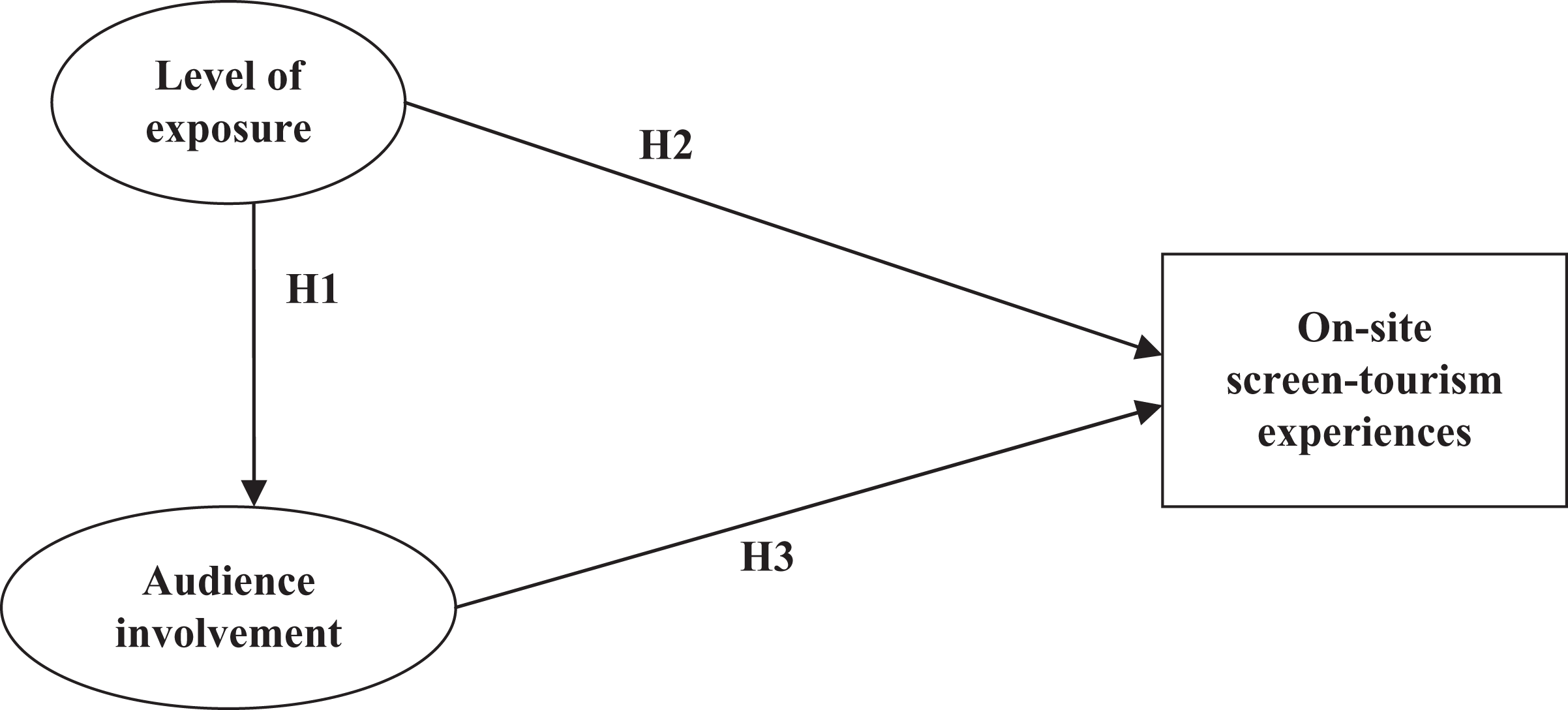
Hypothetical model of the relationships between level of exposure, audience involvement and screen-tourism experiences.
H1: The level of media exposure will have a positive effect on the experienced audience involvement with DJG.
H2: The level of media exposure will have a positive effect on the on-site screen-tourism experiences at DJG filming locations.
H3:Audience involvement with DJG will have a positive effect on the on-site screen-tourism experiences at its filming locations.
This study adopted Sood’s (2002: 156) multidimensional definition and conceptualization of audience involvement: ‘the degree to which audience members engage in reflection upon, and parasocial interaction with, certain media programmes, thus resulting in overt behaviour change. Audience involvement can be seen as being composed of two main elements: (a) reflection (critical and/or referential), and (b) parasocial interaction (cognitive, affective, behavioural participation or any combination of these) with the media.’
Hallyu, Daejanggeum and screen-tourism in South Korea
In relation to the screen-tourism phenomenon, the recent emergence and international popularity of Korean popular culture and its apparent impact on inbound tourism is notable. This Korean cultural phenomenon, Hallyu (known in English as the Korean Wave), refers to a new wave of Korean-generated popular cultural products that extends throughout South and East Asia and beyond (Kim S et al., 2009). It has been studied by scholars from different disciplines such as media and communication studies (Hanaki et al., 2007; Kim D et al., 2009; Shim, 2006), cultural studies (Dator and Seo, 2004) and tourism studies (Kim, 2010; Kim et al., 2007; Kim S et al., 2009; Su et al., 2011).
While the concept of Hallyu is broadly encapsulating a variety of popular cultural activities and expressions including television dramas, movies, music, computer games and fashion, the nexus of the Hallyu phenomenon lies in the circulation and popularity of television dramas. With a growth of 72.8% over 2004, the export of television dramas represented a 92% (US$101.6 million) share of the total export of media programmes (US$123.4 million) in 2005 (MCT, 2006). This figure is estimated to be worth more than three times the cost of importing foreign television programmes into Korea. In 2005, the major importing countries were mainly in Asia, particularly Japan (60.1%), Taiwan (11.4%), China (9.9%) and the Philippines (3.7%). New markets such as Mexico, Brazil, Turkey, Jordan, Tanzania, Cambodia, Mongolia, Uzbekistan and Russia also began to gradually increase their imports of Korean television programmes in 2005 (MCT, 2005, 2006).
Among Korean television drama exports, Daejanggeum (hereafter DJG), known in English as Jewel in the Palace, was the most popular. DJG is an epic television serial about the journey of a court lady who eventually became a court chef and the first female royal physician. It is set in late 15th- to the early 16th-century Korea, based on references from the Annals of the Chosun Dynasty. It recounts the story of a female doctor named Seo JangGeum, who achieved unparalleled skills as a cook in the royal kitchens before becoming a royal physician. The outdoor film set, Daejanggeum Theme Park, located in Yangjoo, Gyeonggi province, South Korea, has become the most popular tourist destination associated with screen-tourism among international audiences. As of June 2006, Daejanggeum Theme Park had attracted over 189,000 international visitors since opening in November 2004 (KNTO, 2005b, 2006). The visitors were mainly Taiwanese, Chinese (both mainland and Hong Kong), Malaysian, Japanese and Thai (KNTO, 2005a, 2005b, 2006).
Method and measurement
Data for this study were collected through a survey questionnaire. Major variables in the questionnaire were level of media exposure, audience involvement and on-site screen-tourism experiences at former filming locations. The level of media exposure was measured using two items (i.e. number of episodes viewed and number of repeat viewings) that were adapted from Sood (2002) and Sood and Roger (2000). Audience involvement was measured using Sood’s (2002) five-dimensional scale (affectively oriented interaction, cognitively oriented interaction, behaviourally oriented interaction, referential reflection and critical reflection) for the following reasons. First, Sood’s audience involvement scale was purposely developed for entertainment-education media programmes (in fact most Korean television dramas contain entertainment-education messages) by synthesizing and conceptualizing previous studies on audience involvement (see Levy, 1979; Liebes and Katz, 1986; Papa et al., 2000; Rubin and Perse, 1987a; Rubin et al., 1985; Sood, 2002; Sood and Rogers, 2000), so that it is considered a comprehensive instrument for measuring audience involvement. Second, the validity and reliability of the scale had already been tested in Sood’s study.
With minor modifications, a total of 29 items were selected and a five-point Likert scale (1 = strongly disagree to 5 = strongly agree) was utilized to measure the construct. For example, ‘I liked hearing the voice of my favourite character(s) in my home’, or ‘I really missed DJG and my favourite character(s) whenever I was unable to watch it’ indicate an emotional/affective involvement. Items that pertain to a behavioural involvement included: ‘I sometimes made remarks to my favourite character(s) while watching DJG’ and ‘I arranged my schedule around DJG so as to have a regular relationship with the programme’. Items measuring a cognitive involvement included ‘When a character in DJG expressed an opinion, it helped me make up my own mind about the issue’. Scales to measure referential and critical reflection included: ‘I felt that my favourite character(s) were like people I know’, ‘I felt that DJG portrayed real life lessons and practices that I could personally relate to’ and ‘I had suggestions for making improvements to DJG’.
A 20-item scale of on-site screen-tourism experiences was generated from a review of previous qualitative studies (Chen, 2004; Couldry, 1998). Visitor information and details about the facilities provided in the Daejanggeum Theme Park brochure were also taken into account. On-site screen-tourism experiences were measured on a five-point Likert scale (1 = strongly disagree to 5 = strongly agree) and included items such as: ‘I was excited to be able to be at the film locations of DJG in person’; ‘It was a great opportunity to see the locations, and it gave me a good insight into the amount of time, work and expense it took to make the drama’; ‘I immediately recognized all the things as they had appeared on the screen’; and ‘As if I was the main character, I was so excited to re-enact some scenes from DJG in person’. Respondents were asked to indicate their levels of agreement on each item based on their own touristic experiences during their visit to the Daejanggeum Theme Park.
The survey questionnaire was initially written in English, then translated into Chinese, Japanese and Thai, and checked by respective first language speaking academics. The revised versions of survey questionnaires were double checked by a group of UK residents and postgraduate students originally from those language-speaking countries including Taiwan, China, Japan and Thailand. Rather than taking the conventional back-translation protocol (Iwashita, 2003; Livingstone, 2003), these steps ensured the comparability of the measures translated into multiple languages with their respective linguistic and cultural nuances which helped participants understand the questions and select appropriate answers.
Sampling and data collection
Before the main survey, a pilot study was undertaken from 5 May to 10 July 2007. An advertisement to recruit volunteer participants for the pilot study was placed on the bulletin board of seven online fan clubs associated with Daejanggeumincluding Lee Young Ae Malaysia Fan Club, Lee Young Ae Singapore Fan Club, Lee Young Ae Philippines Fan Club, Chicago Korean Drama Fan Club, London Korean Links and KoreanWiz. The two main objectives were to confirm the reliability of the scale and the validity of the content of the questionnaire, and to retain or delete items from the scales. The criteria for participating in the pilot study were (1) people who had already watched at least some episodes of DJG; and (2) people who were of Asian descent including Japanese, Chinese, Thai and so on, given that a sample from a relevant population of interest is still preferred (Netemeyer et al., 2003). A total of 101 people participated in the survey and 83 completed the questionnaire, which constituted the final sample for the factor analysis. As a result, nine items were deleted from the audience involvement scale, leaving 20 items as the final measurement of the construct; while two items from the on-site screen-tourism experiences were deleted, leaving a set of 18 items in the main survey. The remaining items all passed the thresholds of communality, factor loading and anti-image correlation with good internal consistency (Hair et al., 1998; Netemeyer et al., 2003).
The main on-site survey was conducted at the Daejanggeum Theme Park, the main filming location for DJG, on both weekdays and weekends, from 22 August to 1 October 2007. Convenience sampling was used, as it was not physically possible to control for each and every visitor’s movements at the theme park. The respondents selected for this study consisted of only Asian tourists including Japanese, Chinese, Taiwanese and Thai who already watched DJG in their home countries. A total of 754 questionnaires were collected and the response rate was 67%. Among the collected questionnaires, 53 were excluded because of missing data accounting for more than 25% of total questions answered (Sekaran, 2003). Therefore, the final sample consisted of answers from 701 on-site visitors.
The nationalities of the respondents were Taiwanese (23.1%), Thai (24.0%), Chinese (25.4%) and Japanese (27.5%). There was a considerably higher presence of female respondents (68.5%) than male respondents (31.5%). In terms of age, 4.8% of the respondents were under the age of 20; 28.5% were between age 20 and 29; 21.5% were between age 30 and 39; 22.8% were between age 40 and 49; 16.8% were between age 50 and 59; and 5.6% of the respondents were 60 or older. The large majority were highly educated (77.7%): 62.4% of the participants had completed their undergraduate degrees, while 15.3% of them had attained a postgraduate or higher degree.
Data analyses and results
The data in this study were analysed by exploratory factor analysis (EFA) and multiple regression analysis using SPSS 17.0. A series of EFAs were conducted to identify the underlying dimensions of the two key variables, audience involvement and on-site screen-tourism experiences at the former filmed locations. Next, reliability coefficients with extracted domains were calculated to measure the internal consistency among the items. Finally, a series of multiple regression analyses were used to test the relationships between level of media exposure, audience involvement and on-site screen-tourism experiences proposed in the research hypotheses. Furthermore, a one-way analysis of variance (ANOVA) was used to empirically identify what if any differences actually exist in audience involvement and on-site screen-tourism experiences among the audiences of four nationalities (i.e. Chinese, Japanese, Taiwanese and Thai) associated with screen-tourism destinations. A post-hoc Scheffe test was chosen and conducted on univariate statistics (ANOVAs), because it is generally regarded as the most conservative procedure for controlling family-wise error rates at the .05 level (Howell, 1992).
Exploratory factor analyses
The Kaiser–Meyer–Olkin (KMO) test and Bartlett’s test of sphericity were computed to assess the appropriateness of factor analyses to the data. The KMO value was .963 and Bartlett’s test was significant at the .001 level, indicating that the factorability of the matrices was appropriate (Hair et al., 1998). Principal component factor analysis with Varimax rotation method was employed to identify the underlying dimensions of the audience involvement experienced with DJG. With no initial item elimination, the analysis yielded a three-factor solution, accounting for 62.2% of the total variance with all factor loadings ranging from .498 to .774 as well as all communalities from .414 to .741. The three-factor solution was deemed adequate according to the acceptable Eigen values and the satisfactory amount of total variance explained. These findings provided evidence for the construct validity of the scale used in the main study (Churchill, 1979). The three factors were subsequently renamed ‘emotional involvement’, ‘behavioural involvement’ and ‘referential reflection’. The results of the reliability test indicated that the three factors all had meritorious internal consistency and reliability with a high Cronbach’s α coefficient of .917, .879 and .849 respectively.
Similarly, an exploratory principal component analysis with a Varimax rotation was performed to determine the dimensional structure of on-site screen-tourism experiences at the Daejanggeum Theme Park. Bartlett’s test of sphericity was statistically significant at the level of .001 (p < .001) and the KMO measure of sampling adequacy (.952) largely exceeded the minimum value (.60), suggesting that the measures of the on-site screen-tourism experiences were appropriate for factoring. The factor loadings were all greater than .40, ranging from .494 to .807. The analysis rendered a three-factor solution, accounting for 61.8% of the variance. The three factors were subsequently renamed ‘Prestige and privilege’ with nine items, ‘Intimacy and memory’ with five items and ‘Beyond screen, sensory experience and re-enactment’ with four items. The reliability tests indicated that all three dimensions of on-site screen-tourism experiences had very good internal consistency with a high Cronbach’s α coefficient of .899, .852 and .824 respectively.
Hypotheses testing
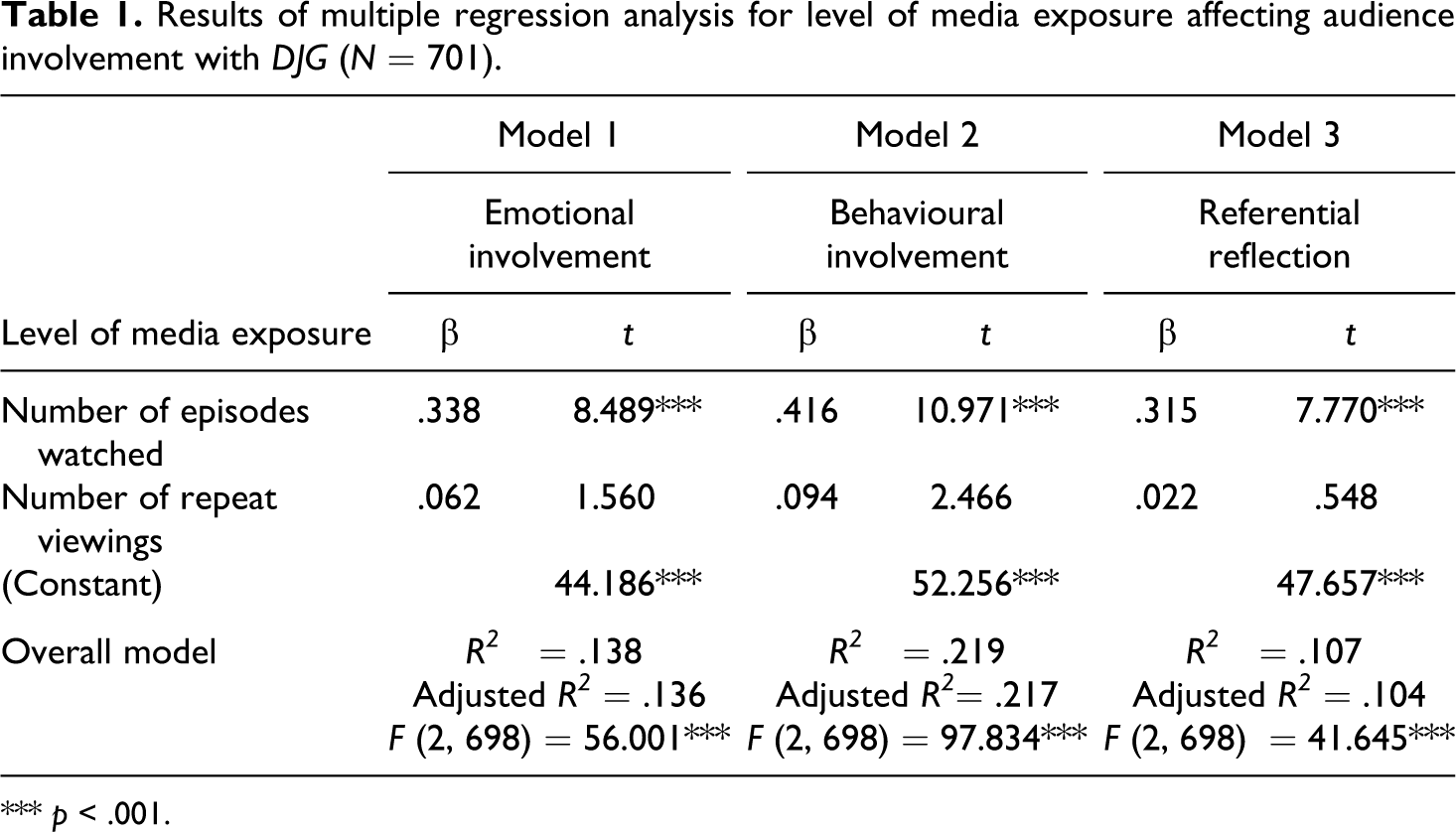
A series of multiple regression analysis were conducted to test the hypothesized relationships among the variables (see Figure 1). As shown in Table 1, in all three regression models, the overall model fit indices were statistically significant, indicating that the level of media exposure to the television drama serial DJG was statistically significant in estimating audience’s emotional, behavioural and reflective involvement (p< .001). The multiple R coefficients indicated that the correlation between the total level of media exposure and the combined audience involvement scale is moderate to strong across the models (all multiple Rvalues ≥ .30).
Results of multiple regression analysis for level of media exposure affecting audience involvement with DJG (N = 701).
*** p< .001.
According to the R2 statistics, Model 1 accounted for 13.6% of variance in the dependent variable, which is the international audience’s level of emotional involvement with DJG, while Model 2 explained 21.7% of the total variance in behavioural involvement and Model 3 explained 10.4% of the variance for the estimation of referential reflection. Furthermore, it is interesting to note that the number of episodes watched was the only statistically valid factor that had a significant impact on all the dimensions of audience involvement (p< .001) across the three models. The results supported H1, that there was a positive relationship between the level of media exposure to a television drama serial and audience involvement. The respondents with a high level of media exposure were likely to engage in a high level of audience involvement in terms of emotional, behavioural and reflective involvement. This is consistent with prior audience studies and media effects literature.
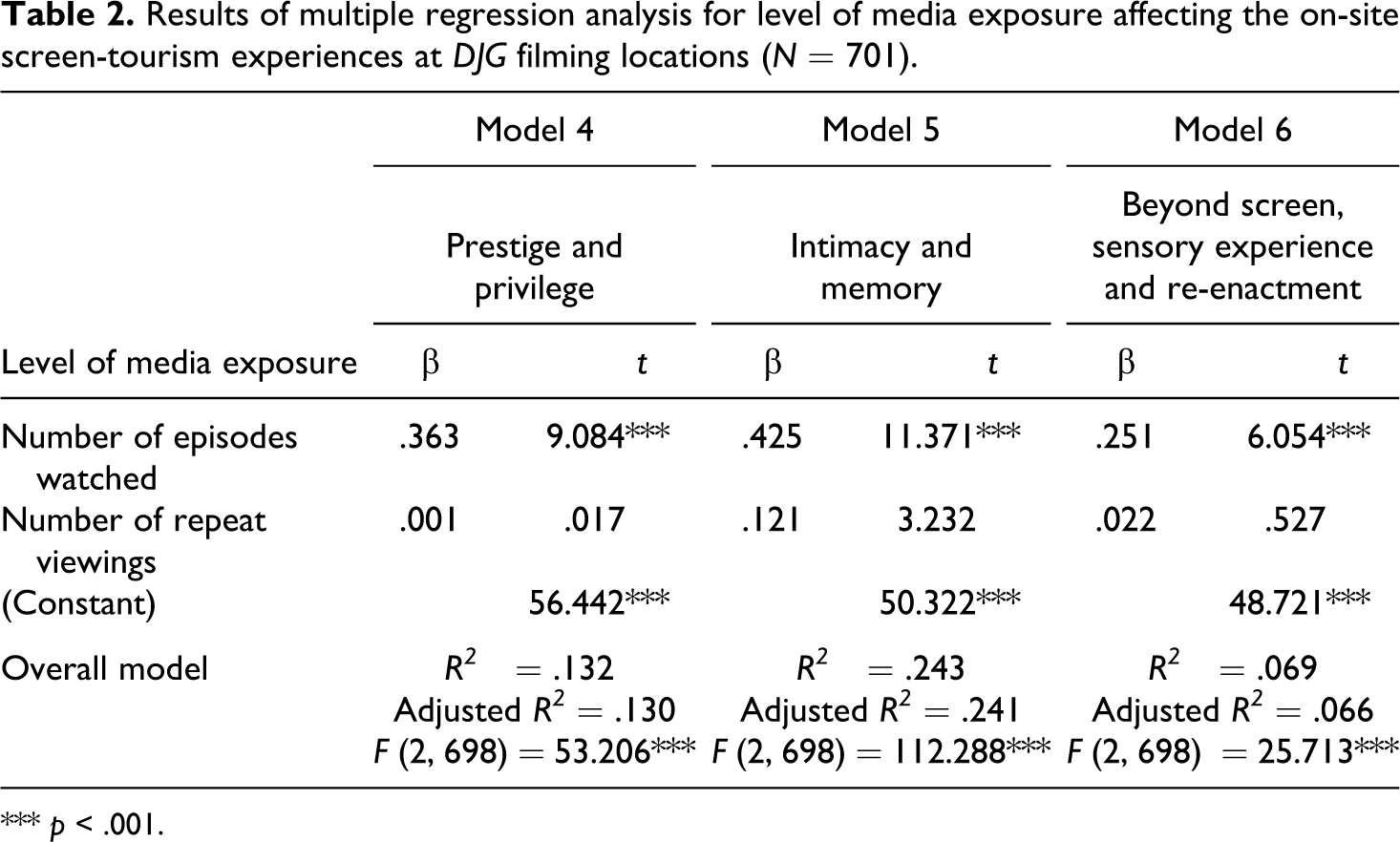
Results of the multiple regressions also supported H2, that the level of media exposure to a television drama serial was positively related to on-site screen-tourism experiences. A summary of the three regression models (i.e. Models 4, 5 and 6) is presented in Table 2. The regression results indicated that the overall model fit indices were statistically significant (p< .001). Both the number of episodes watched and the number of repeat viewings were found to be significant predictors of on-site screen-tourism experiences.
Results of multiple regression analysis for level of media exposure affecting the on-site screen-tourism experiences at DJG filming locations (N = 701).
*** p < .001.
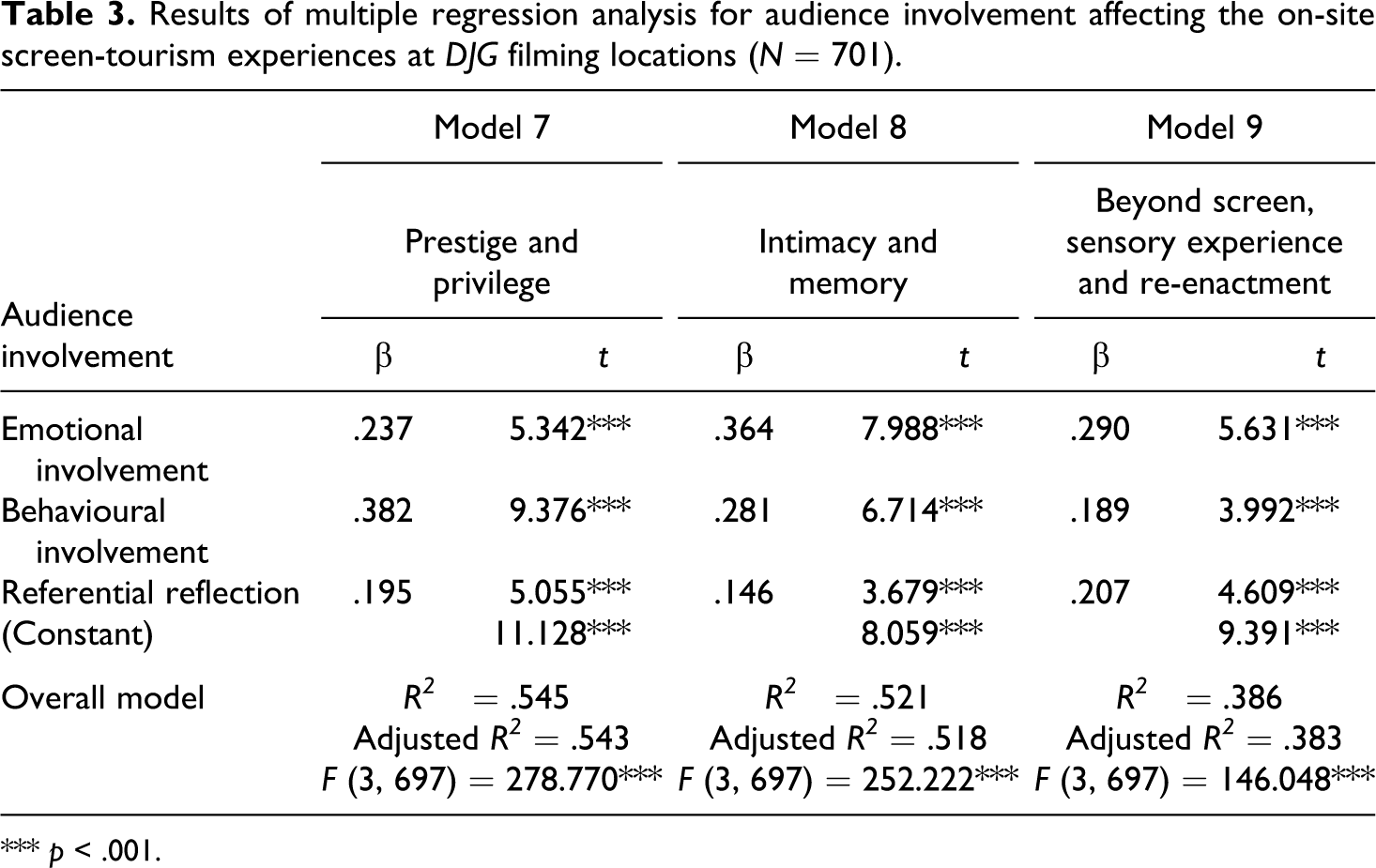
The results of the last three regression models (i.e. Models 7, 8 and 9) are presented in Table 3 and show that emotional involvement, behavioural involvement and referential reflection were consistently significant predictors of on-site screen-tourism experiences at DJG’s filming locations (p< .001). These findings suggest that the more audiences engaged with DJGemotionally, behaviourally and reflectively, the more positively they perceived their on-site screen-tourism experiences at its former filming locations. Another interesting finding was that behavioural involvement (β = .382, p < .001) was the most substantial contributor to ‘prestige and privilege’ related on-site screen-tourism experiences, whereas emotional involvement made the largest unique contribution to both ‘intimacy and memory’ and ‘beyond screen, sensory experience and re-enactment’ related to on-site screen-tourism experiences (β = .364, p < .001 and β = .290, p < .001, respectively). Therefore, H3, which postulated that a positive relationship existed between audience involvement and on-site screen-tourism experiences, was supported in this study. The screen-tourists with a high level of audience involvement driven by emotional and behavioural response to DJG were likely to score highly on their on-site screen-tourism experiences in all aspects (i.e. prestige and privilege; intimacy and memory; and beyond screen, sensory experience and re-enactment).
Results of multiple regression analysis for audience involvement affecting the on-site screen-tourism experiences at DJG filming locations (N = 701).
*** p < .001.
Audience involvement and screen-tourism experiences differences by nationality
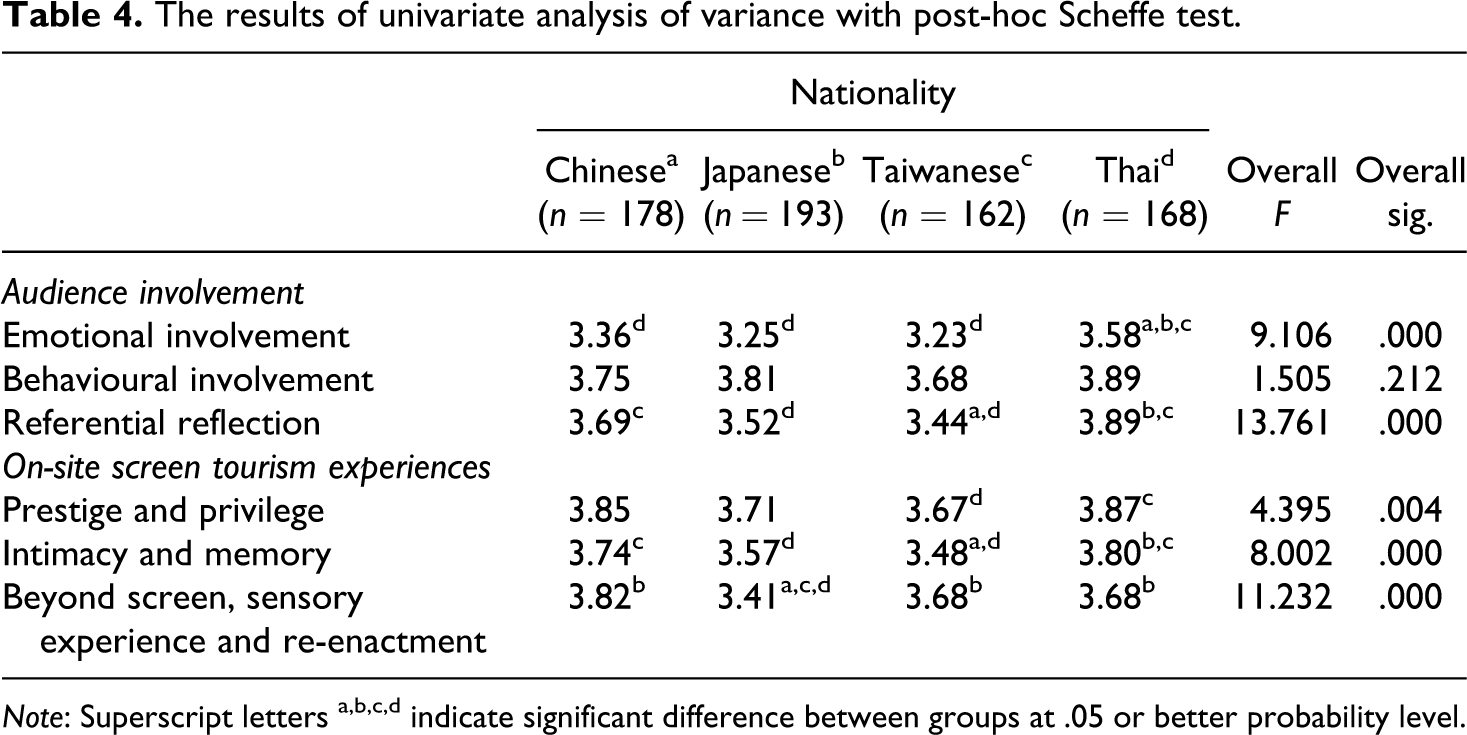
One-way ANOVA with a post-hoc Scheffe test was used to examine differences in the underlying dimensions of audience involvement and on-site screen-tourism experiences among the four groups (i.e. Chinese, Japanese, Taiwanese and Thai). Table 4 shows mean scores of the items of audience involvement and on-site screen-tourism experiences for each group and group differences on each dimension at the .05 significance level. Univariate F-ratio statistics showed that statistically significant differences were found for all dimensions of on-site screen-tourism experiences and for only the emotional involvement (F = 9.106, p < .001) and referential reflection (F = 13.761, p < .001) dimensions of audience involvement.
The results of univariate analysis of variance with post-hoc Scheffe test.
Note: Superscript letters a,b,c,d indicate significant difference between groups at .05 or better probability level.
The Thais had much higher emotional involvement with the programme’s content including characters and storylines than the other three groups. Both the Thais and Chinese had higher referential reflection on the programme than the Japanese and Taiwanese. These results indicate that the physiological, affective, referential and/or emotional viewing experiences of the television drama serial may have had more influence on the Thai and Chinese audiences than the Japanese and Taiwanese. In addition, there were no statistically significant differences among the four groups in terms of behavioural involvement.
Regarding the on-site screen-tourism experiences, both the Thai and Chinese groups reported significantly more favourable touristic experiences associated with ‘intimacy and memory’ and ‘beyond screen, sensory experiences and re-enactment’ than the Japanese and Taiwanese viewers. The Japanese scored the lowest on ‘beyond screen, sensory experiences and re-enactment’. Though the design of this study does not explain the reasons for this particular finding, this seems mostly related to stereotypical characteristics of Japanese tourists who generally show high uncertainty-avoidance characteristics and a lack of desire for adventure-seeking tourism experiences (Pizam and Sussmann, 1995). For example, the Japanese screen-tourists were less willing to taste Korean rice wine and snacks at the filming locations.
Discussion and implications
The purpose of this study was to explore how exposure level and audience involvement with a television drama serial influence viewers’ screen-tourism experiences at its filming locations by extending Sood’s (2002) conceptualization of audience involvement to its behavioural impact at tourism destinations. A theoretical model was proposed based on the literature review to incorporate interrelationships between the level of media exposure to the Korean television drama serial DJG, audience involvement and screen-tourism experiences. The theoretical model was empirically tested using international visitors’ survey data collected at the Daejanggeum Theme Park, a screen-tourism destination in South Korea.
The findings from the study have several theoretical and practical implications. First, this study offers empirical support for the theoretical proposition that when audiences experience a higher level of media exposure to and stronger audience involvement with the TV drama serial, they report more positive and favourable on-site screen-tourism experiences. This is consistent with the findings of Carl et al.’s (2007) study on the film tourists of Lord of the Rings (LOTR), which suggested a strong correlation between the level of audience involvement and satisfaction of screen-tourism experiences. In addition, the level of media exposure was a significant predictor of both the level of audience involvement and the on-site screen-tourism experiences, which has rarely been explored in previous screen-tourism and destination image studies and in turn contributes to the current screen-tourism literature.
Second, this study helps bridge the conceptual framework of audience involvement and tourism behaviour in the form of on-site screen-tourism experiences. Prior studies on destination image and perception conducted by Kim and Richardson (2003) and Lee et al. (2008) provided no empirical support for the positive relationships between vicarious involvement or celebrity involvement and tourists’ perceptions of the destination(s) associated with media personae. However, the findings of this study empirically support the validity and reliability of a three-dimensional audience involvement construct in the context of screen-tourism: emotional involvement, behavioural involvement and referential reflection. The multidimensionality of audience involvement is consistent with previous studies from the media and communication literature (Bae and Lee, 2004; Sood, 2002; Sood and Rogers, 2000). Sood (2002) suggested that the critical-cognitive dimension of audience involvement was as important as the referential-affective one in terms of television drama viewing experience and influenced audience individuals’ cognitive engagement with constructing, reconstructing and deconstructing the messages and their meanings. However, the cognitively driven dimensions of audience involvement (i.e. cognitive interaction and critical reflection) proposed by Sood (2002) were not found to be the major vehicles to construct and influence audience viewing experience and the subsequent on-site screen-tourism experiences analysed in this study.
Furthermore, emotional involvement played the most significant role in explaining on-site screen-tourism experiences associated with the ‘intimacy and memory’ dimension (e.g. ‘the stories from DJGwent through my mind as I was here’, ‘while in the real locations, listening to the original sound track of DJG reminded me of scenes I had watched’) and the ‘beyond screen, sensory experience and re-enactment’ dimension (e.g. ‘as if I was the main character, I was so excited to re-enact some scenes of DJG in person’), while behavioural involvement was the most significant contributor to the ‘prestige and privilege’ dimension of on-site screen-tourism experiences (e.g. ‘I was excited to be able to be at the film locations of DJG in person’). This may be explained by the fact that hedonic, physiological, affective and/or emotional domains of audience involvement through simultaneously developing parasocial interaction, identification, empathy and/or reflection from the audience’s reception are indeed at the centre of audiences’ viewing experience, in particular with the genre of serialized television dramas, which has been argued in the media and communication literature (Creeber, 2001; Giles, 2002; Hobson, 2003; Kincaid, 2002). Despite the various degrees across the four nationalities studied – Chinese, Japanese, Taiwanese and Thai – such audience involvement being intensified by a high level of media exposure over a long period of time would lead to the formation of a stronger and more positive sense of connection, intimacy and familiarity between the audience and the medium. Also, the finding of a causal relationship between emotional involvement and ‘intimacy and memory’ and ‘beyond screen, sensory experience and re-enactment’ is consistent with what Couldry (1998) and Kim (2010) suggest: that audience emotional involvement plays a critical role in forming personalized memories and creating new touristic spaces and contextualized anticipation of touristic experiences at former filming locations.
Although the findings of this study remain in the context of an Asian dimension of the screen-tourism phenomenon, it is suggested that audiences’ emotional and behavioural involvement with a television drama serial can transcend national and cultural boundaries and is to be regarded as a distinctive trait of human nature that is universally shared. This is partially supported by the empirical finding of the study that there was no significant difference in behavioural involvement among the four nationality groups, which indicates that behavioural reactions during and after watching the programme (e.g. crying and talking to characters) are indeed considered as universal human nature.
In addition, the psychological and experiential insights of audience involvement such as the affective bonds, intimacy and emotional commitment between audience members and the programme are of paramount importance for both media scholars and tourism industry practitioners to better understand the screen-tourism phenomenon in general as well as on-site screen-tourism experiences in particular. Thus, further research on expanding the potential usage of audience involvement related concepts from the media and communication studies would be beneficial. Especially, more studies are needed to refine conceptualization of audience involvement in the screen-tourism context and to better understand the role audience involvement plays in constructing and contextualizing potential screen-tourism locations and anticipated tourist experiences.
Third, this study sheds light on the power of intensified audience involvement in spurring post-viewing behavioural changes, including audiences’ willingness to attend fan group meetings and visit film locations from a screen-tourism perspective. The findings from this study demonstrate that two measurements of audience involvement – ‘I was determined to meet my favourite character(s)/actor(s) from DJGin person’ and ‘I was determined to make a trip to the locations depicted in DJG’ – had the strongest correlations with the dimension of emotional involvement. The direct impact of emotional involvement on related purchasing behaviours including the decision-making process of audiences’ choice of tourism destination was beyond the scope of this study. However, this study suggests that the more audiences emotionally engage with a media programme, the more likely they will visit screen-tourism locations. Therefore, more studies are needed to understand how audience involvement (especially emotional involvement) with popular media programmes influences audiences’ decision-making processes and on-site touristic experiences with regard to screen-tourism destinations.
Fourth, the study partially confirms cultural proximity theory (Straubhaar, 1991) given the fact that it considers the intercultural circulation of DJG, and the subsequent reception by the four Asian audiences and their becoming screen-tourists. Also, the audiences of each nation did show both similar and different audience involvement patterns and differently perceived degrees of on-site screen-tourism experiences. This is partially related to Fiske’s (1987) argument that audiences who are composed of a broad series of groups, not a homogeneous mass, make an active choice to view, read and interpret visual media texts and images including television in order to produce from them meanings that connect with their own social and cultural values and experiences. However, it is interesting to note that the Chinese audiences demonstrated great similarity in their viewing experiences and their subsequent screen-tourism experiences with the Thai viewers rather than the Taiwanese, who are presumably bonded more closely to the Chinese through shared cultural-linguistic considerations including language, history, religion, ethnicity and culture in several senses as well as from shared identity, gestures and non-verbal communication. Thus, it would be beneficial for future studies to examine cross-cultural differences in audience involvement and the subsequent screen-tourism experiences in a broader Asian context, which would lead to a better understanding of audience reception and media effects including the screen-tourism phenomenon in Asia from the cross-cultural perspective.
This study also offers important implications for both media industry and destination managers who have an interest in screen-tourism planning, development and marketing. When selecting media programmes to import or export, media merchandisers should pay closer attention to the textual, visual and aural content that deal with emotional and behavioural engagement rather than solely focusing on a drama’s entertainment value. Therefore, media merchandisers in Asia in general and those in Japan, Taiwan, China and Thailand in particular may benefit from importing emotionally appealing melodramatic Korean television dramas, which is consistent with the argument of D Kim et al. (2009). Also, it could be beneficial for media marketers to develop emotionally engaging messages and storylines via advertising and marketing campaigns when launching newly imported Korean television dramas in their locales. As Kim (2010) recommended, destination managers could consider using symbolically and emotionally meaningful icons, images of touristic attractions and franchised souvenirs to appeal to potential screen-tourists, evoke their emotional connection with a media programme and enhance their personal entertainment media experiences.
Notwithstanding the preceding discussion, some limitations to the study should be noted. First, the sample population was purposively restricted to international visitors mainly from China, Taiwan, Japan and Thailand to the Daejanggeum Theme Park. Thus, the results presented should not be taken as representing the whole population of DJG viewers or screen-tourists to the Daejanggeum Theme Park. Second, the study site, the Daejanggeum Theme Park, is only one of the DJG film locations; scholars may consider conducting a comparative multi-destination project in future research.
Footnotes
Funding
This research received no specific grant from any funding agency in the public, commercial, or not-for-profit sectors.