




Abstract
Using Entman’s work on mediated public diplomacy, the authors conducted an Arabic-language online survey of news consumers on Arab websites, including one US-funded media outlet. They examined factors leading to gaps in exposure and perceptions of credibility for three Arab news outlets. Specifically, they examined variables that differentiated between exposure to and perceived credibility regarding the three satellite news media – al-Jazeera, al-Arabiya, and al-Hurra. Results showed that issue importance and attitudes toward the United States were significant predictors of exposure gaps between the US-funded network and other Arab media. Exposure gaps were also powerful predictors of perceived credibility.
The United States has made several attempts to improve its image in the Arab world, from altering trade relationships to offering funding to combat terrorism. An important initiative began in 2004 when al-Hurra, a satellite network funded by the United States, was launched. Questions remain about the effectiveness of this new medium, however.
The current study examines factors that could affect the perceived credibility among three media, including al-Hurra. It examines factors related to exposure to al-Hurra, al-Arabiya, and al-Jeezera. Since exposure gaps likely exist between these three media, variables that influence this gap could explain whether al-Hurra has been effective in reaching individuals. Religious and political backgrounds, as well as demographics, may play some role in how the three media are viewed by the public. This study thus also explores Entman’s theoretical model on mediated US public diplomacy that suggests the success of the United States in promoting favorable foreign policies mainly depends on audiences’ positive political attitudes towards it.
Satellite news networks have spread widely across the Middle East for over a decade. Adopting a western broadcasting style, these satellite networks, including al-Jazeera and al-Arabiya have used advertising as a source of revenue, and broadcast a wide range of news and public affairs programming shows, as well as entertainment and family-oriented offerings (Ayish, 2001; Seib, 2007). Some critics cited the spread of these TV networks – that use state-of-the-art technology – as a key factor in spreading of anti-US sentiments in the Arab world. Thus in an effort to win the hearts and minds of the Arab public, al-Hurra, a network adopting a more western style of reporting and funded by the United States, has recently emerged as a viable media option.
Data for this study come from an Arabic-language online survey conducted in 2008 of transnational Arab TV users. In cooperation with the al-Arabiya and al-Hurra networks a link to the online survey was posted prominently on the front-page of the official al-Arabiya and al-Hurra websites (in Arabic). Employing these survey data this study examines perceptions of Arab media consumers. Specifically, the present study examines factors that differentiate between exposure to and perceived credibility about the three satellite news media – al-Jazeera, al-Arabiya, and al-Hurra.
The rise of satellite TV in the Arab world
Historically TV stations in Arab countries operated within ministries of information and were funded by the government. Overall the media in these countries enjoyed few press freedoms and Arab people had little reason to trust the information they received from their government-controlled media (see Rugh, 2004). Governments in the Arab world held a monopoly over television, based on the belief that television should serve as a government operation designed to promote national development goals (Ayish, 2004; Boyd, 1999; Fahmy and Johnson, 2007b; Rugh, 2004).
For decades local TV stations in the Arab world mainly presented protocol news. These included shots of heads of state delivering long, dry speeches that were in line with government policies. After the first Gulf War, however, Lynch (2006) and other media scholars suggested that the rise of Arabic satellite news stations (such as al-Jazeera and al-Arabiya) largely eliminated Arab governments’ monopoly over the news and also served to positively transform the Arab region politically and culturally (El-Nawawy and Iskandar, 2002; Rugh, 2004; Seib, 2007). Indeed scholars agree that the rise of these networks has caused Arab governments to use state-of-the-art technology and to encourage more professional-style news-gathering and broadcasting (Ayish, 2001, 2004; Johnson and Fahmy, 2010; Seib, 2007).
Al-Arabiya network
In March 2003, to compete with al-Jazeera network, Saudi Arabia’s Middle East Broadcasting Centre (MBC) launched al-Arabiya channel. Unlike the US-funded al-Hurra station – which broadcast both news and entertainment – al-Arabiya is an all-news channel that positioned itself as a moderate alternative to rivals such as al-Jazeera (Al-Saggaf, 2006; Riegert, 2006; The Economist, 2005; Zayani and Ayish, 2006).
Designed to be an independent voice and modeled on al-Jazerra’s style of broadcasting al-Arabiya tried to provide multiple perspectives on news events, with a focus on news of interest to Arab viewers (Zayani and Ayish, 2006). On one hand, similar to its competitor al-Jazeera, it would not shy away from presenting controversial topics. In fact its creator, Walid Al-Ibrahim, asserted that the network considers itself a vehicle of change in the Arab world ‘toward democracy and an opponent of dictatorship, repression and Islamic extremism’ (Zayani and Ayish, 2006: 483). On the other hand, unlike its rival, it avoided the talk shows that have generated many of the criticisms leveled toward al-Jazeera (Lynch, 2006). Al-Arabiya emphasized instead hourly news bulletins, commentaries, business, sports, and documentaries (Zayani and Ayish, 2006). As Zayani and Ayish explain:
Al-Arabiya strives to match al-Jazeera’s proclaimed independence while avoiding its provocative style, eschewing its sensationalistic appeal, insisting on making a clear distinction between fact and opinion, and steering clear from the politics of other Arab and especially Gulf countries. By and large, al-Arabiya pitched itself as a neutral channel that cares for Arab interests and staying away from pursuing ambiguous agendas and other parties’ interests (p. 483).
However, al-Arabiya also resembles al-Jazeera in a way that has helped it appeal to the Arab audience: it has raised the ire of the US government. Though al-Arabiya has taken a more moderate approach to the Iraq War (Blake, 2005; The Economist, 2005; Zayani and Ayish, 2006), it has also emphasized the human toll of the conflict in terms of civilian deaths (Fahmy and Johnson, 2007a) as well as broadcast messages from insurgents and shown visuals of slain soldiers (Blake, 2005). 1 Also similar to al-Jazeera, al-Arabiya has suffered the consequences. Both satellite stations were locked out of official press conferences by the Iraqi government and al-Arabiya’s Baghdad office was shut down for more than two months. Further, a car bomb exploded outside al-Arabiya’s compound in 2004, collapsing the first floor and killing five employees (Blake, 2005).
According to an audience poll by IPSOS-STAT, al-Arabiya has surpassed al-Jazeera in ratings among Arab audiences (Snyder, 2006a, 2006b). Snyder (2006a, 2000b) suggests that al-Arabiya has been able to surpass its main competitor because its content includes family-oriented material and a series of exclusive interviews and controversial interview topics, making it a moderate news outlet that is in tune with what viewers want to watch. But scholars debated the findings of this IPSOS-STAT poll, especially when polls by Zogby International (Aslawsat, 2006) and Shibley Telhami (2008), reported al-Jazeera is the first choice for international news among 45% of Arab audiences surveyed.
Regarding the credibility of al-Arabiya, in a survey of 150 students that were randomly selected from the University of Sharjah in the United Arab Emirates, Ayish (2004) found the credibility of al-Arabiya ranking third, behind al-Jazeera and the Abu Dhabi TV channels. The Arab Advisors Group (2004), however, rated al-Jazeera and al-Arabiya channels as equally credible.
The evolution of public diplomacy
In US foreign policy there has been a strong and ongoing tradition of public diplomacy. Historically, public diplomacy has been defined as the engagement between one government and the people of another country with the aim of managing the international environment (Cull, 2009). One example of engagement could be in the form of promoting an idea, such as promoting positive attitudes toward US foreign policy.
Edmunc Gullion first coined the term public diplomacy in 1965. The term referred to the process of international information and cultural relations. The United States quickly adopted the public diplomacy term because it offered a benign alternative to terms like ‘propaganda and psychological warfare’ (see Cull, 2009: 17), thus allowing for a clear distinction between democratic practices in the United States and propaganda policies pursued by the Soviet Union during the Cold War.
Over the years Gilboa (2002) explains public diplomacy has used media to cultivate favorable views toward a specific country. For example as early as 1978, the United States Information Agency (USIA) used the term public diplomacy to justify its influence over Voice of America (VOA) radio that broadcast news to engage foreign publics of many countries beyond the United States’s borders.
Nowadays the world has moved toward new public diplomacy, thus shifting public diplomacy mechanisms into communicating with publics of other countries using new, and global technologies (such as the US funding of al-Hurra satellite television in the Arab world). Recently, based on this new public diplomacy direction, Joseph Nye (2004) used the term ‘soft power,’ referring to the ability of achieving desired changes in the international environment using culture attractiveness rather than military or economic power. A good example of soft power public diplomacy is the US-funded al-Hurra TV network. Its broadcasting not only includes news but also the broadcasting of NBA basketball games, music and other entertainment content that could be deemed culturally attractive for the Arab public.
Al-Hurra network
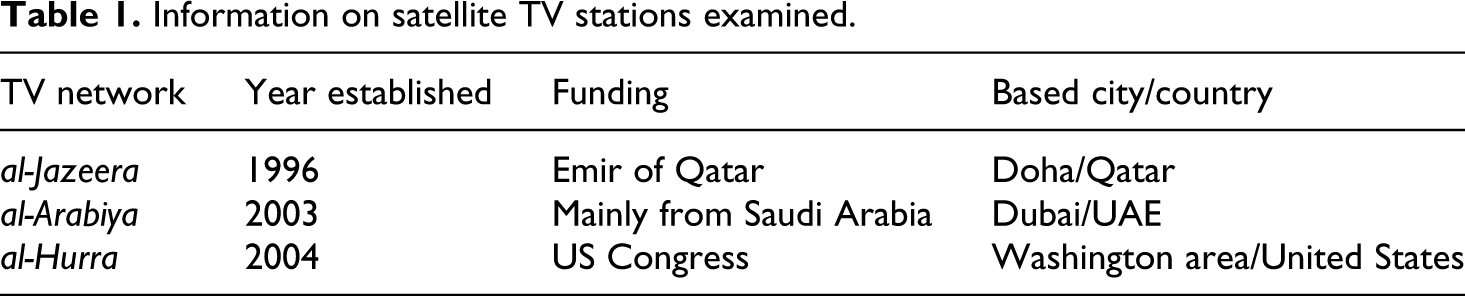
As part of a large-scale mediated public diplomacy effort to improve United States’s image in the Middle East, al-Hurra TV station (meaning ‘The Free One’ in Arabic) was launched in 2004 (see Table 1) to explain the US foreign policy and provide a comprehensive view of US culture and society (see Baylouny, 2005; El-Nawawy, 2006, 2007). Further, some observers noted that in an effort to gain popularity it provided viewers with both news and entertainment content (including cookery shows, travel shows, and sport games).
Information on satellite TV stations examined.
In terms of news, the station’s directors have claimed that its main objective is to provide relatively fresh and balanced versions of news events. As Mouafac Harb (2004: 21), the former news director of al-Hurra explained: ‘We do our work the way it is supposed to be done. We play it straight and we behave like news professionals because that is what we are.’
The Arab-language satellite television channel broadcasts to 22 Middle Eastern countries. Because Arab viewers are savvy media consumers who can pick from hundreds of satellite channels, however, the question arises as to how successful the US-funded station has been in winning the hearts and minds of Arab audiences (Wise, 2005). Since the network was created and funded by the United States, political observers have claimed that Arab viewers perceive it as a propaganda station – with the aim of selling the US government’s policies in the region – and therefore always hold its credibility under suspicion (El-Nawawy, 2006, 2007; Wise, 2005). On issues such as the Palestinian/Israeli conflict, for example, al-Hurra’s claim of objectivity may hold little appeal for Arab viewers, particularly because they could potentially seek alternative news outlets to support their preconceived notions regarding the Middle Eastern conflict (El-Nawawy, 2006). Further, critics have argued that the network has hardly achieved its claimed goal of objective reporting. Baylouny (2005), for example, found that its coverage heavily relied on US officials, with President Bush’s speeches extensively covered and the US war efforts portrayed in a positive light. Al-Hurra has also been criticized for what it cannot cover, such as airing interviews with leaders of terrorist groups or presenting negative views regarding the coalition efforts in Iraq. Supporters of the network, however, noted that al-Hurra has not acted as a puppet of US foreign policy. In their view, the station does indeed report stories that reflect negatively on the US occupation in Iraq, including anti-US protests in the Middle East (see Wise, 2005). Because of broadcasting stories that are both anti-American and anti-Israeli, for example, the network has come under criticism from the US Congress and other government and public officials (Linzer, 2008; Whitlock, 2008).
Overall, al-Hurra has received a mixed reception from its target audience and polling results have not been clear-cut. While a recent study by IPSOS-STAT, for example, found that approximately 26 million viewers watched al-Hurra station in the last week (Whitlock, 2008), Shibley Telhami, an expert on US policy in the Middle East, and particularly on the role of the news media in shaping political identity and public opinion in the region, explained that the network’s impact on public opinion in the Arab world has been negligible. He described its influence as ‘less than zero. . . . For most people in the region . . . it’s not really on the radar screen’ (Linzer, 2008). Similarly, Zogby International found in a 2008 survey that only 2% of Arab viewers listed the network as their primary source of international news.
To gauge the credibility of the TV station, a survey of students in five Arab countries revealed the network’s overall credibility was relatively low (El-Nawawy, 2006, 2007). Another Arabic-language survey posted on al-Jazeera website compared the credibility of the three networks under study (in addition to local Arab stations). Results confirmed the perceived low credibility of al-Hurra by Arab viewers. Respondents judged al-Jazeera as most credible, followed by al-Arabiya. Respondents rated al-Hurra and local Arab stations lowest on all credibility measures examined (see Johnson and Fahmy, 2010).
These results are not surprising however. Wise (2005) explains that in the Arab world people are generally skeptical of news from al-Hurra TV. For many Arabs al-Hurra news appears to be a spin from a government (the United States) they don’t particularly trust to begin with (Wise, 2005).
Heavy users of the channel, however, were more likely to judge it as credible (El-Nawawy, 2006, 2007), which supports earlier credibility studies that suggest people judge the media they rely on as the most credible (e.g. ASNE, 1985; Auter et al., 2004, 2005; Johnson and Fahmy, 2008; Wanta and Hu, 1994; Westley and Severin, 1964). Overall, while the network that has been known to cover more positive and upbeat stories (e.g. Wise [2005] explains when Hamas founder Sheikh Yassin was assassinated al-Jazeera, and al-Arabiya, and other channels carried wall-to-wall live coverage of the event, while al-Hurra continued to broadcast a cookery show). Thus, it is indeed unclear whether al-Hurra has achieved its primary aim of shifting perceptions of Arab audiences in favor of US policy. Interestingly, El-Nawawy (2006, 2007) reported that students’ attitudes toward US foreign policy have actually worsened since they began watching al-Hurra.
Theoretical framework
Entman (2008) attempted to theorize mediated public diplomacy extending the cascading network activation model to the international communication process. He explained the success and failure of US government efforts to promote favorable framing of US foreign policies (such as the launching of al-Hurra network) depends most notably on the cultural and the political congruency between the United States and, in this case, the audiences of Arab nations. Entman (2008: 93–94) wrote that ‘activating and spreading pro-United States counter-frames in foreign nations requires a degree of congruence between the target nation’s dominant political culture and the facts of US policy, or cultural overlap or ambiguity as minimum.’ Thus the authors’ primary goal here is not to use Entman’s model to analyze frames of foreign policy coverage but to understand how Arab audiences’ perceptions of various factors (such as having positive values and attitudes toward the US political culture) could influence their degree of perceived credibility toward US mediated public diplomacy initiatives, such as al-Hurra TV.
A review of the literature suggests that for the most part US presidents often control frames of foreign policy in US media (see Bennett, 1990; Sobel, 2001). This suggests that on issues, in which foreign policy matters the president and his government completely dominate media framing (Bennett, 1990; Entman, 2004; Robinson, 2002). However, in the case here, Arab audiences’ interaction with the media of their own countries could certainly have an impact regarding whether they would be inclined to believe media produced by the US government. The following scenarios for example illustrate the importance of cultural and political congruency suggested by Entman (2008) in establishing more or less promising conditions for successful mediated public diplomacy.
Consider the contrast between Arab reactions to the US-led interventions during the first Gulf War and the most recent war in Iraq in 2003. In the first scenario, the Gulf War was perceived as an unprovoked invasion by Saddam Hussein against the sovereign nation of Kuwait. Thus, it was easier then to gain Arab elite and public support when the first President Bush intervened. In the second scenario, however, the pre-emptive strike launched on Iraq by the United States and its allies evoked negative reactions and rejection of US foreign policy in much of the Arab world. In this case, Arabs and Arab media did not favor the US framing of that war and their frame happened not to coincide with the White House frame. In fact the US administration was out of luck.
Regarding Arabs’ perceptions, Fahmy and Johnson (2007a) reported in a study of 638 online users of al-Jazeera that respondents perceive US media such as CNN have a different audience and therefore US news is not catered to audiences in the Arab world, missing valuable information available in other media sources (such as Arab media). For example the majority of the respondents in their study supported the broadcasting of graphic scenes of the recent Iraq War on Arabic television – scenes deemed too graphic to be made available in US media. One Arab viewer clarified this: ‘Al Jazeera doesn’t show unpleasant pictures or scenes, these are the real pictures of the truth . . . and if any government [USA)] objects to this coverage then it should stop making bad news, which means stop causing those unpleasant scenes and not criticizing the media [Arab media] for broadcasting it’ (Fahmy and Johnson, 2007a: 256).
Ironically, Dallek (1982) explains that when the United States tends to intervene in foreign countries, most of the US public sees the act as altruistic. Further, Jentleson and Britton (1998) explain if the public then is convinced of the prudence and success of this policy, they will support it. Foreign nations give the United States no such benefit of the doubt (e.g. see quote in paragraph above). Entman (2008: 95) illuminates that ‘many other nations’ political cultures are generally more congruent with oppositional framings of U.S. policies,’ and thus, complicating the task of foreign elites who do or had been supporting the United States such as former President Mubarak in Egypt, for example. Thus, Arab media have little incentive to antagonize their audiences by supporting the United States when US foreign policies could potentially conflict with the Arab political, religious cultures and media of their own countries.
As mentioned earlier, new public diplomacy typically uses media to cultivate favorable views toward a specific country. Entman (2008) clarifies that public diplomacy involves targeted efforts using mass communication – such as the US-funded al-Hurra network launched to increase support of US foreign policies among Arab audiences beyond US borders – making clear distinctions between elite and mass publics. However, opposition and resistance by publics and elites to mediated public diplomacy might occur when US policies for example threaten the widely perceived national interests of another Arab country (such as the occupation of Iraq or the Palestinian territories). The elites and publics according to Entman (2008) might well reject then even the most sophisticated mediated public diplomacy initiatives.
Is there still some hope then? According to a 2003 study by Gentzkow and Shapiro, they suggested that Muslims exposed to CNN were more likely to reject the belief that the 9/11 attack was not carried out by Arabs. Ideally, according to Entman (2008), mediated public diplomacy could stimulate favorable portrayals of the United States in foreign Arab/Muslim media, yielding a more favorable public opinion toward the United States. These positive sentiments would then feed back to foreign elites in these countries who would then support the United States publicly – leading to even more positive media coverage and mutual understanding between the United States and the Arab World.
However, the opposite might be more familiar. Arab allies of the United States (Saudi Arabia is a good example) might remain silent or in some cases even actively oppose the US foreign policy in a culture that is deeply rooted in a political environment of skepticism toward the United States among its elites, news professionals and the public. These negative anti-US sentiments would then naturally feed back, creating further opposition and negative media coverage toward the United States.
Indeed, many nations – specifically after 9/11 and during the Iraq War – have developed hostile feelings toward the United States almost on principle, and many are still skeptical. The United States as a super-power has had to deal with anti-US sentiments from foreign publics throughout the world – especially among the more literate and developed countries. For example, in a recent poll, several countries rated the United States’ global influence as predominantly negative. These countries included: Canada, Brazil, Argentina, Mexico, Britain, Spain, France, Russia, Germany, South Korea, China and Iraq, among others (BBC World Service Global Poll, 2006).
Research questions
Given the vast differences among the three Arab media, the current study was designed to examine differences among viewership and impact. The authors examined predictors in terms of gaps in exposure and credibility. Gaps were used rather than absolute constructed measures to allow for more precise evaluations regarding the impact of potential predictors examined:
RQ1: What are the predictors (sociodemographics, religion and cultural beliefs, political orientations, issue importance and perceptions of the United States) regarding gaps in frequency of exposure between al-Hurra and al-Arabiya, al-Hurra and al-Jazeera, and al-Arabiya and al-Jazeera TV channels?
RQ2: What are the predictors (sociodemographics, religion and cultural beliefs, political orientations, issue importance and perceptions of the United States) regarding gaps in perceived credibility between al-Hurra and al-Arabiya, al-Hurra and al-Jazeera, and al-Arabiya and al-Jazeera TV channels?
Method
Data collection
In winter 2008, the lead author, who is fluent in Arabic contacted senior executives of al-Arabiya and al-Hurra networks in the Middle East, requesting their assistance in putting a URL on the Arabic websites of their news organizations. Note that the authors had also planned on including al-Jazeera network in this study but unfortunately the executives backed out of participating in this project the day the survey was conducted.
The questionnaire was posted in the Arabic language. It was first written in English and then translated into Arabic and once more back-translated into English. Back-translation was done to ensure accurate translation and cultural compatibility with the Arab culture. The questionnaire was then pre-tested to ensure collecting valid and reliable data.
A link to the survey hyperlink was posted for four weeks – from 27 March 2008 to 25 April 2008. It was posted prominently on the front-pages of the official al-Arabiya and al-Hurra websites (in Arabic) only. After paying a major university survey center to conduct the survey, a total of 1109 questionnaires were completed by 25 April 2008, with a cooperation rate of 15.3%. This rate was based on the number of visitors who visited the URL of the online questionnaire on the two websites.
The dependent measures: Perceived credibility and overall exposure
Previous literature suggests that how credible one views a medium is strongly related to how often one relies on it (ASNE, 1985; Auter et al., 2004, 2005; Johnson and Fahmy, 2008; Wanta and Hu, 1994; Westley and Severin, 1964).
Perceived credibility
For each channel this variable was measured by asking respondents on five-point scales to rate the ‘overall competence,’ ‘overall balance,’ and ‘overall trustworthiness’ of each channel. The respondent scores were combined into one additive index assessing perceived credibility of al-Hurra (M = 7.9, SD = 3.9, α = .91), al-Jazeera (M = 10.9, SD = 3.9, α = .89), and al-Arabiya (M = 11.1, SD = 3.7, α = .88). Constructed measures for each channel were subtracted from each other to create indicators of credibility gaps among TV channels.
Overall exposure to each Arab TV channel
This variable was measured by combining two survey items. The first survey measure asked respondents how many days a week respondents watched al-Hurra (M = 2.7, SD = 2.6), al-Arabiya (M = 5.9, SD = 2.6), and al-Jazeera (M = 5.4, SD = 2.9). The second survey item asked respondents how often they visited the website of al-Hurra (M = 1.7, SD = 1.4), al-Arabiya (M = 4.5, SD = 1.6), and al-Jazeera (M = 3.4, SD = 1.9) on a six-point scale ranging from ‘never’ to ‘several times a day.’ The measures for each TV channel were standardized and combined into one overall measure of exposure frequency. Constructed measures for each channel were then subtracted from each other to create indicators of exposure gaps between TV channels.
The measures for perceived credibility and exposure are reported in Table 2.
Overall exposure and perceived credibility measures.

The independent measures
The web-based questionnaire specifically explored five independent variables dealing with sociodemographics, 2 religious and cultural beliefs, 3 political orientations, 4 issue importance, 5 and perceptions of the United States 6 (this set of five variables are fully described in the endnotes section). The authors selected these variables based on past literature and previous polls dealing with media in the Arab world (e.g. Nisbet, 2007a, 2007b; Telhami, 2005, 2008).
Regarding issue importance for example, past literature suggests this variable acts as a function of media use and individuals’ predispositions when forming opinions or making judgments (see Iyengar, 1990). Issue importance has therefore been used in several studies surveying Arab populations, such as polls by Zogby International (Telhami, 2005, 2008). In fact two of the items used to measure this variable were borrowed from a survey conducted by Zogby International and the University of Maryland (Telhami, 2005). In this survey respondents from six Arab countries were asked to rate the importance of each of the following: ‘Advancing democracy’ and ‘Resolving the Israel–Palestinian conflict.’ The authors decided to add a third item to this variable: ‘Resolving the Iraqi conflict.’ The choice is justified due to the importance of the Iraq War at the time this study was conducted. 7 Numerous questions related to how Arabs feel about the war in Iraq have also appeared in surveys by Zogby International (e.g. Telhami, 2005, 2008).
Data analysis
Two different sets of analyses were then conducted employing ordinary least squares (OLS) regression models. The first set of analyses examined predictors of gaps in frequency of exposure between al-Hurra and al-Arabiya, al-Hurra and al-Jazeera, and al-Arabiya and al-Jazeera TV channels. The second set of analyses examined predictors of gaps in perceived credibility again between al-Hurra and al-Arabiya, al-Hurra and al-Jazeera, and al-Arabiya and al-Jazeera TV channels.
The five sets of independent variables were entered into the models for both analyses: sociodemographics, religious and cultural beliefs, political orientations, issue importance, and perceptions of the United States. The criterion measures in the first analyses were constructed by assessing exposure to al-Hurra, al-Jazeera, and al-Arabiya and subsequently creating three measures of exposure gaps between TV channels by subtracting respondents’ scores for frequency of exposure to al-Arabiya from their frequency of exposure to al-Hurra, frequency of exposure to al-Jazeera from frequency of exposure to al-Hurra, and frequency of exposure to al-Jazeera from frequency of exposure to al-Arabiya. The second analyses predicted credibility gaps between the three sets of TV channels by constructing measures of perceived credibility for each Arab TV channel, then again subtracting respondents’ scores for perceived credibility of al-Arabiya from perceived credibility of al-Hurra, perceived credibility of al-Jazeera from that of al-Hurra, and the perceived credibility of al-Jazeera from the perceived credibility of al-Arabiya. In addition, the constructed exposure gap measures for each set of TV channels from the first analysis were also included in the second analyses as predictors of perceived credibility gaps between channels.
Results
Demographics and characteristics
Demographically, respondents were from 48 different countries, with 30% of the respondents from Saudi Arabia. More than 8 in 10 reported they were from the Middle East and the rest of the respondents were from Europe and the United States. The mean age of respondents was 30 and males greatly outnumbered females (93.3 to 6.7%). About 70% reported they were Sunni Muslims and almost 9 in 10 (88.1%) explained religion is ‘important’ or ‘very important’ in their daily lives. The majority was employed and about 70% had a yearly income between US$15,001 and US$20,000.
Regarding background, respondents represented a fairly educated background with more than 7 in 10 (73.3%) having bachelor or graduate degrees. The majority (54.3%) reported they were ‘very proficient’ and ‘proficient’ in the English language, but more than 8 in 10 (85.7%) reported they have never visited the United States. In terms of perceptions of US foreign policy, more than 8 in 10 of the respondents (83%) ‘disagree’ or ‘strongly disagree’ with the US policy toward Iraq, and 9 in 10 of respondents (90%) ‘disagree’ or ‘strongly disagree’ with the US policy toward the Israeli/Palestinian conflict. Overall, the majority of the respondents (67.5%) do not support the US war on terrorism. In terms of watching the transnational TV channels under study, about 40% of the respondents watch al-Hurra once a week. With regard to the other two channels, the majority of the respondents watch al-Jazeera (55.8%) and al-Arabiya (63.7%) 5–7 days a week.
Though the survey is a convenience sample and cannot be considered representative of the general Arab population, it does provide data on Arab audiences who select and rely on transnational Arab TV as one of their major sources of information. Furthermore, as Hayes (2005) notes, sample representativeness is less of a concern when examining relationships between variables and communication processes (as is the case in this study) rather than determining specific population parameter estimates. Lastly, Internet surveys have been shown to lead to an increase in self-disclosure and reduction in self-censorship, demand characteristics, and interviewer bias (Buchanan, 2000; Davis, 1999; Smith and Leigh, 1997), which may be important factors when conducting survey data collection within this population.
Predictors of gaps in frequency of exposure
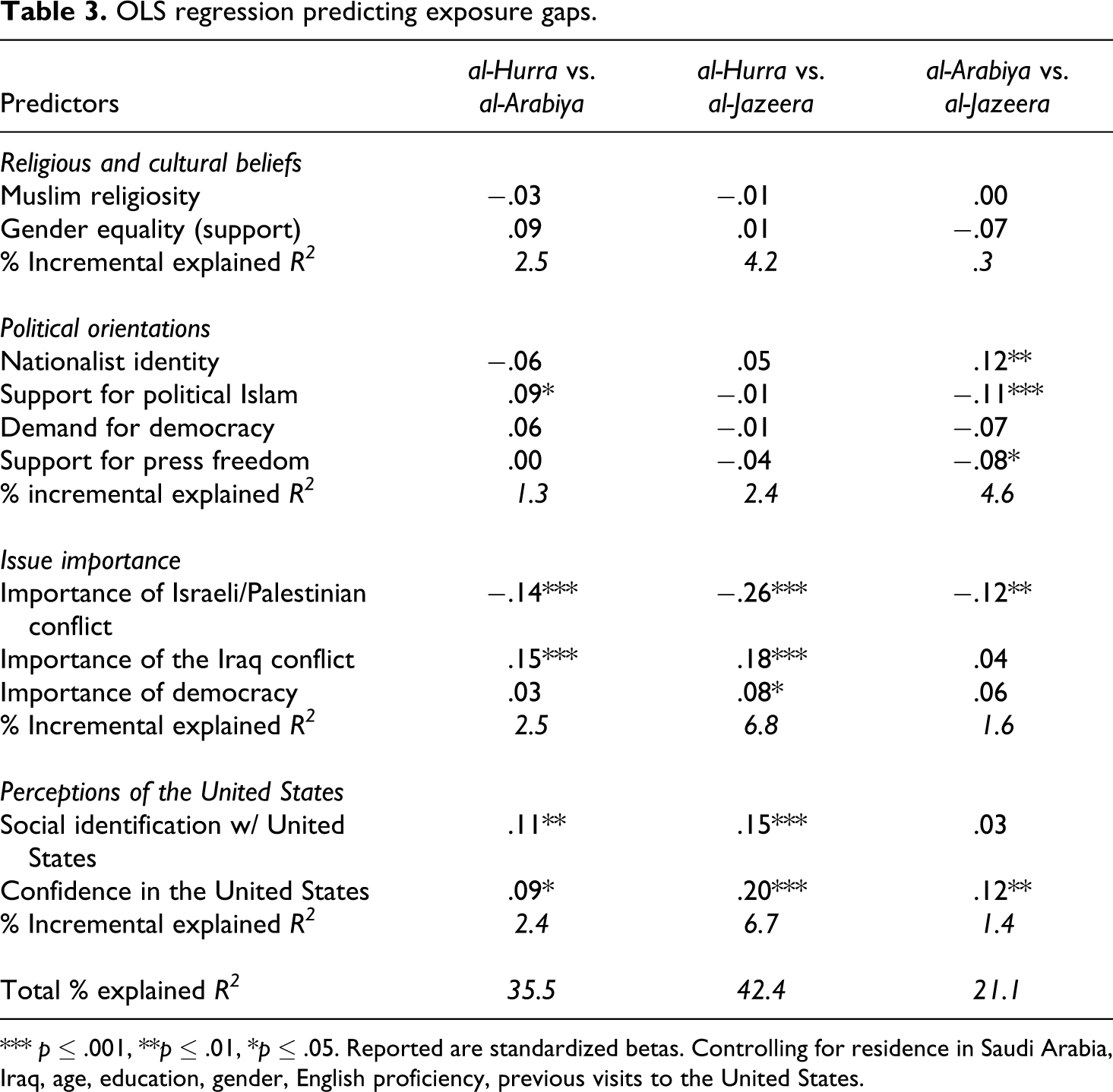
According to the findings of Research Question 1 (Table 3) 8 key factors that predicted exposure to al-Hurra over al-Arabiya were the importance of resolving the Iraq conflict (β = .15, p ≤ .001), identification with the United States (β = .11, p ≤ .01), confidence in the United States (β = .09, p ≤ .01), and support for political Islam (β = .09, p ≤ .05). Conversely, respondents who placed more importance on resolving the Israeli/Palestinian conflict favored al-Arabiya over al-Hurra (β = –.14, p ≤ .001).
OLS regression predicting exposure gaps.
*** p ≤ .001, **p ≤ .01, *p ≤ .05. Reported are standardized betas. Controlling for residence in Saudi Arabia, Iraq, age, education, gender, English proficiency, previous visits to the United States.
A similar pattern of variables predicted favoring al-Hurra over al-Jazeera, with confidence in the United States (β = .20, p ≤ .001), placing more importance on Iraq (β =.18, p ≤ .001) and less importance on Israel/Palestine (β = .26, p ≤ .001), and social identification with the United States (β =.15, p ≤ .001) all associated with greater exposure to al-Hurra compared to al-Jazeera. In addition, Arab TV audiences who placed importance on advancing democracy in their countries (β =.08, p ≤ .05) favored greater exposure to al-Hurra over al-Jazeera.
A somewhat different pattern emerged when examining the exposure gap between al-Arabiya and al-Jazeera. A nationalist political orientation (β =.12, p ≤ .01) and confidence in the United States (β =.12, p ≤ .01) predicted greater exposure to al-Arabiya than al-Jazeera. Conversely, respondents who support the role of Islam in politics (β = –.11, p ≤ .001), value press freedom (β = –.08, p ≤ .05), and place a great deal of importance on the Israeli/Palestinian conflict (β = –.12, p ≤ .01) are more likely to favor watching al-Jazeera over al-Arabiya.
Predictors of gaps in perceived credibility
Table 4 presents the results of the findings of Research Question 2. The second analysis employs OLS regression and reports standardized beta coefficients and incremental explained variance in each model. As a means to explore patterns of mediation two sets of models are presented for each channel comparison, one set without exposure gaps as predictors (models 1, 3, 5) and one set with exposure gaps included as an independent variable in the analysis (models 2, 4, 6).
OLS Regression predicting credibility gaps.

*** p ≤ .001, **p ≤ .01, *p ≤ .05. Reported are standardized betas. Controlling for residence in Saudi Arabia, Iraq, age, education, gender, English proficiency, previous visits to the United States.
Without including exposure in the analysis (model 1), support for gender equality (β = .12, p ≤ .05), support for political Islam (β = .14, p ≤ .001), social identification with the United States (β = .12, p ≤ .01), support for press freedom (β = .10, p ≤ .01), placing more importance on Iraq (β = .11, p ≤ .01) and less importance on the Israel/Palestine conflict (β = –.14, p ≤ .01) were all associated with respondents perceiving al-Hurra as more credible than al-Arabiya. Once the al-Hurra/al-Arabiya exposure gap (β = .59, p ≤ .001) is entered into the analysis (model 2), most of these associations are completely mediated except for support for political Islam (β = .09, p ≤ .05) and support for press freedom (β = .10, p ≤ .01).
Turning to the perceived credibility of al-Hurra compared to al-Jazeera, without including exposure (model 3) respondents who expressed confidence in the United States (β = .24, p ≤ .001) and placed more importance on Iraq (β = .11, p ≤ .001) and advancing democracy (β = .07, p ≤ .05), but less importance on the Israel/Palestine conflict (β = –.21, p ≤ .001), perceived al-Hurra as more credible than al-Jazeera. However, once the al-Hurra/al-Arabiya exposure gap (β = .67, p ≤ .001) is included in the analysis (model 4), only confidence in the United States (β = .11, p ≤ .001) remained as predictor.
The last set of models compares the perceived credibility of al-Arabiya to that of al-Jazeera. In model 5 (without exposure included), respondents who expressed a national political identification (β =.14, p ≤ .001) and confidence in the United States (β = .23, p ≤ .001) were more likely to perceive al-Arabiya as more credible. Conversely, the results of model 5 suggest that respondents who place more importance on Israel/Palestine (β = –.14, p ≤ .001), support the role of Islam in politics (β = –.17, p ≤ .001), and value press freedom (β = –.09, p ≤ .05) are more likely to perceive al-Jazeera as more credible than al-Arabiya. After including the al-Arabiya/al-Jazeera exposure gap (β = .68, p ≤ .001) in the analysis (model 6), the importance of the Israel/Palestine conflict and support for press freedom are completely mediated, while support for political Islam (β = .10, p ≤ .001), nationalist identification (β = .06, p ≤ .05), and confidence in the United States (β = .15, p ≤ .001) are partially mediated.
Discussion
The present study examined variables that could predict media use and perceived credibility of three networks in the Middle East, including one funded by the United States. The survey results suggest that respondents’ stands on issues lead to higher use of media, but exposure mediates any possible effect of issue stance on perceived credibility. In other words, respondents tended to choose their media based on the individuals’ issue stands. If they generally supported US policy, respondents tended to use al-Hurra much more frequently than the other two media. Respondents with anti-US sentiments used al-Hurra less than the other two media. Respondents, however, did not necessarily believe their chosen medium was highly credible once exposure level was accounted for. Exposure level was an intervening variable that lessened any direct effect of issue stance on credibility.
Several other findings are worth noting. First, exposure gaps between the US-funded al-Hurra and the other two Arab media were based almost entirely on issue stance and perceptions of the United States. These variables were especially important in the comparison of al-Hurra and al-Jazeera. Generally, the exposure gaps between al-Hurra and the two other media could be predicted by differences in the perceived importance of the Israel/Palestine conflict, the perceived importance of the Iraq War, by their social identification and their confidence in the United States. Their level of support for political Islam also was a significant predictor of the gap between al-Hurra and al-Arabiya. Thus, if respondents had views toward the United States that were positive and if respondents perceived the Israel/Palestine conflict as more important than the Iraq conflict, these respondents tended to use the US-funded medium more than Arab media.
Respondents’ attitude toward the importance of democracy was also significant in predicting the exposure gap between al-Hurra and al-Jazeera. Notably, the total explained variance rose from 35.5% for the gap between al-Hurra and al-Arabiya (the medium with views that were closer to the United States) to 42.4% for the gap between al-Hurra and al-Jazeera (the medium that was furthest away from US views).
Credibility gaps between the three media produced several different results. Without accounting for exposure, support for gender equality was a significant predictor of the credibility gap between al-Hurra and al-Arabiya. Notably, this was the only variable dealing with religious and cultural beliefs that produced a statistically significant result.
Unlike the exposure analyses, political orientation played a significant role in predicting credibility gaps between al-Hurra and al-Arabiya. Here, nationalist identity, support for political Islam, and support for press freedom were all statistically significant. All except nationalist identity remained significant after accounting for exposure.
The issue importance results for the credibility gaps without accounting for exposure were identical to the tests for exposure gaps (importance of the Israeli/Palestinian conflict and importance of the Iraq War were significant for comparisons of al-Hurra and both other media, and importance of democracy was significant for the comparison of al-Hurra and al-Jazeera). However, all issue importance variables were removed from the models after the introduction of the exposure gap variable. In other words, exposure to the medium was much more powerful of a predictor of credibility than the issue variables. On the surface, this result appears to conflict with the results of Rimmer and Weaver (1987) that found credibility and exposure were unrelated. However, Rimmer and Weaver examined the effects of credibility on exposure, while this analysis tested the effects of exposure on credibility. Perhaps, people don’t base their media use on credibility, but instead base their perceptions of credibility on their media use (see Chaffee and Schleuder, 2006; Johnson et al., 2000).
While the US-funded al-Hurra differed from the two Arab media based mainly on issue stances and exposure gaps, differences between al-Arabiya and al-Jazeera dealt with political orientations, perceptions of the United States, and exposure gaps. Although the overall explained variance of exposure gaps between the two Arab media was the lowest among the comparisons (21.1%), five variables were significant predictors: nationalist identity, support for political Islam, support for press freedom, the importance of the Israeli/Palestinian conflict, and confidence in the United States.
These variables also predicted credibility gaps. However, two variables – support for press freedom and importance of the Israeli/Palestinian conflict – dropped out of the model when exposure gaps were included.
Broadly, then, the findings point to the strong influence of exposure on perceived credibility of the media. Exposure is such a powerful predictor of credibility that few other variables remain viable factors once exposure is accounted for in these analyses.
Because exposure is key to perceptions of media credibility, it stands to reason that factors influencing exposure may hold promise for the effectiveness of al-Hurra. Notably, religious and cultural beliefs were not a significant predictor of media exposure gaps. Rather, issue importance and attitudes toward the United States influenced exposure gaps. Thus, al-Hurra appears to be attracting viewers who already are predisposed to support US foreign policy. This finding thus offers a quantitative contribution to Entman’s theoretical model on ‘mediated US public diplomacy,’ suggesting that the success of US government efforts to promote favorable framing of US foreign policies through mediated communication (e.g. via al-Hurra TV) mainly depends on favorable political attitudes toward the United States by Arab audiences. In other words Arab audiences’ predisposed perceptions and attitudes toward the United States influence the degree of congruency and perceived credibility with US public diplomacy initiatives, including the launching of al-Hurra network in the Arab world.
The results here, however, only suggest the direction of effects – issue stance leading to exposure leading to perceived credibility. The reverse is also possible: perceived credibility of a news medium could lead to higher levels of exposure. The higher levels of exposure could lead to effects on the issue stances of respondents. This possible model could be examined in future research.
Finally, the authors acknowledge that this study unfortunately did not include the results of an online survey posted on the URL of the website of al-Jazeera. Thus given that this network did not participate in this study the possibility exists that the data might be slanted. It is possible that additional results from al-Jazeera might have produced different interpretations of the variables predicting overall exposure and perceived credibility of the three networks examined here.
Indeed, more than in the past additional research about media in the Arab world is needed. The post-9/11 era reasserted the issue of anti-American feelings among many populations in the Arab world. In addition considerable tension between the United States and the Arab world still exists specifically regarding the Israeli/Palestinian conflict, US complaints about Iran’s nuclear program, the recent high profile US occupation of Iraq for almost eight years, and the ongoing war in the neighboring Muslim country of Afghanistan. Further, according to Howard (2010) the Internet has had an active role in enhancing terrorist networks. Currently political leaders in the Arab world face a dilemma by the development of an online public sphere (see Howard, 2010). The new information technologies that have improved the economic situations in these countries have also undermined their non-democratic power structures – many of which were supported by the US government (e.g. former President Mubarak for almost three decades). Thus further research is still warranted to better understand how political attitudes toward the United States influence the way news consumers select and process mediated information in the Arab world.
As a final point, the Arab Spring throughout the Middle East and North Africa (such as the recent revolutions in Tunisia, Egypt, and Libya) appears to have been sparked by Facebook, Twitter, YouTube, and other social media. Therefore the credibility of and exposure to social media and how they affect behaviors of citizens and governments in various parts of the Arab world seem to be a fruitful area of research. It would be interesting for example to see whether Entman’s model – suggesting that the success and failure of mediated efforts to promote favorable attitudes toward US foreign policies depends on the cultural and the political congruency between the United States and Arab audiences – could still be sustained under the new media environment. Further research should investigate the future role of US public diplomacy in using social media in the region and how this role could shape the perceptions of Arabs and their leaders regarding the upcoming democracies in the region and the promotion of positive political attitudes toward the US government.
Footnotes
Funding
The lead author Shahira Fahmy received funding from the School of Journalism at Southern Illinois University at Carbondale to conduct this research.