




Abstract
Since China implemented animation control policies in 2004, foreign animation programmes have almost disappeared from Chinese television. At the same time, the Chinese government has invested enormous amounts of money in developing the animation industry as a creative industry. A questionnaire survey was conducted to explore how the Chinese audience views domestic and foreign animation programmes. The results indicate that pirated Japanese animation is widely viewed via the Internet by adolescents; on the other hand, domestic animation is popular only among children. Preferences for domestic animation correlate positively with age and patriotism but negatively with Internet use, while preferences for Japanese animation correlate negatively with age and patriotism but positively with Internet use. These results show that nationalistic sentiments are associated with preferences for either domestic or foreign animation programmes. However, preferences for Japanese animation are not significantly associated with anti-government attitudes.
Keywords
The Chinese government recently implemented a series of measures to control the broadcasting of foreign animation programme. 1 Consequently, it has approved almost no new foreign animation programmes since 2006, and only a few foreign animation programmes are still broadcast on Chinese television. 2 The implicit objective of these regulations is to reduce the accessibility of Japanese animation (anime), which has attracted many child and adolescent viewers around the world, and captured 60% of the global animation market (Chen, 2004). Since Astro Boy became the first foreign animation series to be introduced to China in 1981, foreign animation productions have flowed into China like a tidal wave. By 2000, television slots for animation were dominated by anime (Mu, 2006). Even after a ban on foreign animation had been introduced, 82.7% of Chinese students favoured Japanese animation; in contrast, only 8.8% favoured animation from Europe or the US, and 8.5% favoured Chinese animation (Chen and Song, 2009).
Anime (Japanese animation) differs from US animation (e.g. animation produced by the Walt Disney Company [Disney]) in certain respects. For example, anime characters have distinctive and realistic personalities, whereas Disney films typically feature anthropomorphic animals without unique personalities (Xiao, 2002: 133). This difference reflects the fact that anime is viewed mainly by adolescents, whereas Disney animation programmes are viewed mostly by children.
In addition, anime is consumed in the context of the so-called otaku culture. Otaku refers to a person with a particular interest in subjects such as anime, cosplay (costume play), manga (Japanese comics), personal computers (PCs), video games and idols. Otaku are media connoisseurs and activist prosumers who seek out esoteric content from faraway lands, and organize their social lives around viewing, interpreting and remixing these works (Ito, 2005). Foreign anime otaku form ‘fansub’ groups that create subtitled versions of anime. These translated, mostly unauthorized versions are then distributed on peer-to-peer (P2P) file-sharing systems on the Internet (Taneska, 2009). Many young people in the US acquire unauthorized anime, largely through fansub groups (Koulikov, 2010).
This article explores how the Chinese audience responds to regulations against foreign animation and anime in particular. To do this, it reviews China’s animation control policies and uses a questionnaire to examine the relationship between animation preferences and Chinese nationalism.
Regulations against foreign animation
Since the introduction of economic reform and openness (gaige kaifang) in the late 1970s, China has undergone economic, political, social and cultural transformation. Mass communication is used less to transmit a class-based ideology and more to manage the state (Wang and Chang, 1996). Nevertheless, the Chinese Communist Party (CCP) has carefully sought to control the inflow of all foreign media, including books, newspapers, terrestrial television and satellite television, in order to cultivate socialist values and weed out bourgeois influences (Chan, 2000). Television is part of the CCP’s propaganda apparatus, which promotes the party line and encourages puritanism, equality, socialism and collectivism (Chan, 2000: 263). Capitalist values such as individualism, materialism, inequality and freedom are either suppressed or criticized (Chan, 2000).
With the rise of Internet penetration, the Chinese government tightened its control over the Internet. It has continuously blocked anti-communism websites, such as those related to the 1989 Tiananmen Square protests and the religious group Falun Gong. It has also systematically kept ordinary citizens from viewing foreign-based websites such as Facebook and YouTube, which allow their users to post comments that are critical of the Chinese regime. In 2009, the government even sought to mandate that all new computers use ‘Green Dam’ filtering software, although the plan was eventually suspended in the face of strong resistance among Chinese Internet users (Wines, 2009).
Further, anime has been increasingly criticized for negative effects on adolescents. Policymakers are concerned that it portrays unhealthy amounts of violence and obscenity,
3
and create policies to support the idea that Chinese animation should communicate traditional values to young people (‘Animation becomes big business – and not just for children’, 2009). In 2004, the State Administration of Radio, Film and Television (SARFT) requested that at least 60% of animation aired during a quarter be domestic. In 2006, it banned all broadcasters from televising foreign animation during prime time (i.e. 5 to 8 p.m.). Moreover, it issued a ruling requiring them to increase the ratio of domestic to foreign animation shown from 6 to 4 to 7 to 3 by 2008. Consequently, domestically produced Chinese animation constituted roughly 70% of all broadcast animation. At the same time, SARFT extended the time during which foreign animation was prohibited to 9 p.m. (Peng, 2009). Also in 2006, the State Council published ‘Some Recommendations on Fostering the Advancement of the Animation Industry in Our Country’. This circular explains the government’s concern regarding the growing influx of foreign animation programmes:
Developing the animation industry is important in terms of satisfying the spiritual and cultural requirements of the Chinese people, promoting the advanced culture of socialism, providing morality and ethics education for children, fostering the advancement of the cultural industry, and nurturing this new growth area in the economy. (State Council, 2006)
Creating an innovative cultural industry
China has introduced several measures to foster the cultural industry. These measures are aimed at fostering a strong and internationally competitive animation industry under the ‘Go Abroad’ strategy. The Blue Book of China’s Culture 2009 states that exporting cultural products is important because China should have an international voice that competes with those of western countries (Li and Wang, 2009). The State Council describes the ‘Go Abroad’ strategy as follows:
Our aim is to drastically increase the quantity of domestically produced animation, to see a marked increase in product quality and increasing strength in technical innovation capabilities with many excellent products coming into the market, to become a strong world power of creation, development, and production in the animation industry, and to develop the international market while gradually occupying the main domestic markets. (State Council, 2006)
Nevertheless, only 15% of the companies producing animation and comics were profitable in 2009 (Fu and Wang, 2009). Many companies are unable to explore the market or lack sufficient capital to support their productions. Accordingly, they are not producing valuable or interesting programmes (Ding, 2009). Despite huge public investment, domestic animation is not popular among the Chinese, with a few exceptions for productions for children.
Animation and nationalism
The rise of interest in soft power, a term coined by Nye (2004), served as a backdrop for the shift in Chinese animation policy. McGray’s (2002) phrase ‘Japan’s Gross National Cool’ highlights Japan’s growing global cultural influence, which extends from pop music to consumer electronics, architecture, fashion, animation and cuisine. The Japanese government became increasingly interested in enhancing the country’s soft power and launched ‘pop-culture diplomacy’ projects such as the International Manga Award and Anime Ambassador. 4 In 2010, it established the Creative Industries Promotion Office to coordinate the promotion of the cultural industries via various arms of government such as the Agency for Cultural Affairs, the Ministry of Economy, Trade and Industry (METI) and the Ministry of Foreign Affairs (MOFA). 5 Chinese policymakers are also interested in strengthening China’s soft power, as the Chinese President Hu Jintao indicated in an address in 2008. 6
It is difficult to justify China’s animation control policies based solely on their economic effects. The Ministry of Culture states that Chinese animation should embody the Chinese cultural spirit as well as communist values. This circular shows that the animation control policy is driven by nationalistic sentiments:
Financial support for the animation industry will help companies to create, develop, and communicate animation products which are practical, true to life, geared toward the masses with abundant Chinese cultural spirit, Chinese excellent traditional culture, and contemporary characteristics. (The Central People’s Government of the Republic of China, 2008)
A prime minister’s announcement also suggests that animation control is driven by nationalistic sentiments:
‘I sometimes take care of my grandson’, said Prime Minister Wen in April 2009 during a visit to Jiangtong Animation in Wuhan. ‘But he always watches “Ultraman” [a Japanese animation programme]. He should watch more Chinese cartoons.’ (Coonan, 2009)
In the past, nationalistic antagonism against imperialistic invasions prompted the Chinese to boycott foreign products in favour of national products (Gerth, 2003). In the early 20th century, for example, many people joined the National Products Movement (Guohuo Yundong) and boycotted Japanese products as part of a struggle against Japanese power. This movement appealed to Chinese consumers not only to buy domestic products but also to nationalize many products, including fashion, food additives, museums and department stores (Gerth, 2003). In contrast to these populist anti-colonial movements, current economic nationalism is more ingeniously led by the Chinese government, as suggested by the official slogan for the country’s plans for technological innovation (‘Indigenous Innovation’). According to McGregar (2010), the second stage of economic reform aims to bring about ‘the great renaissance of the Chinese nation’ through ‘innovation with Chinese characteristics’. To accomplish this, the government has developed a technology policy in parallel with its animation control policy.
South Korea preceded China in the adoption of cultural policy. In 1998, President Kim Dae-jung launched a new cultural policy to foster and export national content such as animation, comics, movies and video games. Around this period, hanliu (the Korean wave) swept the Asian region, and South Korean television programmes were embraced in many Asian countries, including China, Taiwan and Japan. Subsequently, many Chinese researchers became interested in the success of South Korean cultural policies (Keane, 2004), although few have examined their impact on hanliu. The South Korean government regards the cultural industries as a wealth-creating resource, and supports them in order to establish a national cultural identity. To this end, it limits the inflow of foreign popular culture. For example, a screen quota system has been maintained since 1966 (Yim, 2002), and Japanese dramas and comedy shows are banned from terrestrial television. Before 1998, imports of Japanese popular culture were strictly forbidden due to strong anti-Japan feelings evoked by Japanese colonization; at that time, many anime programmes were translated from the Japanese and broadcast on television, disguised as domestic productions. Korean translations of Japanese comics were also passed off as domestic comics (Yamanaka, 2006). This suggests that South Korean cultural policies are motivated by anti-Japanese and nationalistic sentiments.
Previous studies on the impact and uses of foreign popular culture
Earlier studies have revealed that younger people are more likely to prefer foreign animation than older ones. Chen and Song (2009) report that many university students watch anime via the Internet. In addition, Chinese youth often use the Internet to watch foreign television programmes and movies; according to Zhang (2010), 75.9% of Internet users in Shanghai have viewed or downloaded television programmes or movies from the Internet. Many Chinese-language websites, such as Tudou, distribute unauthorized anime productions. 7
The regulation of foreign content leads people to pirate content. In the 1980s, when Japanese television programmes were banned in Taiwan, unauthorized Japanese content (comics, videos and songs) was widely consumed among the Taiwanese people (Ishii et al., 1999). Many Chinese have accessed foreign media via an unofficial medium in order to evade strict government control. In June 1989, when the government suppressed the pro-democracy movement that took place in Beijing’s Tiananmen Square, Chinese students and their sympathizers exchanged information using personal media: direct-dial telephones, facsimile machines, PCs, photocopies, audio and videocassettes, camcorders and the US computer network BITNET (Ganley, 1992). In many authoritarian nations, new electronic media are used to communicate politically sensitive information.
As described above, policymakers are concerned about the cultural and social effects of anime on the values of adolescents. Cultural imperialists have traditionally regarded foreign cultural impact of a strong and unidirectional nature as a ‘cultural invasion’. However, many empirical studies show that foreign cultures do not always have marked effects. For example, Lee (1991) argues that Hong Kong has absorbed and indigenized foreign popular cultures, and maintains that the imperialist critique is inapplicable to Hong Kong. Conversely, Chan (2000) examines the spillover effects of Hong Kong television on residents of Guangzhou in mainland China, and finds that Hong Kong television lures audiences away from Chinese programmes and reduces satisfaction with domestic channels. The study also concludes that Hong Kong television promotes access to Hong Kong popular culture and cultivates more materialistic values among Guangzhou residents.
Hao and Teh’s (2004) analysis of the effects of Japanese popular culture on Singaporean lifestyles yields mixed results. They find that preferences for Japanese popular culture and frequency of consumption thereof do not correlate with favouring Japan itself, but correlate positively and significantly with preferences for Japanese products. Ishii et al. (1999) contend that Taiwanese viewers approach US and Japanese programmes with different psychological expectations; specifically, they appreciate the quality of US programmes, but value the familiarity of Japanese programmes. Educational levels only correlated positively with the amount of US television watched. Park (2005) investigates the effects of Japanese cultural products in South Korea based on a student survey. The results reveal that South Korean college students spend 25.4% of their media usage time consuming Japanese media products, and indicate that consumption of domestic media negatively affects cultural proximity to Japan because the domestic media are dominated by anti-Japan sentiments.
Research into consumer behaviour shows that ethnocentric feelings deeply influence buying behaviour. The tendency of consumers to distinguish between domestic and foreign products and to avoid buying foreign products because of nationalistic views is called consumer ethnocentrism (Shakamehesh, 2006). Studies show that Chinese ethnocentrism and animosity towards Japan significantly influence consumer behaviours related to Japanese products (Ishii, 2009; Klein et al., 1998). This study therefore hypothesizes that nationalistic sentiments affect the consumption of foreign and domestic animation, although this has not been explored in previous research.
Research questions and hypotheses
Few studies have examined the responses of Chinese people to information regulation by the government. This study explores the views of the Chinese on foreign animation under the restriction policy. Special interest is placed on the relationship between preferences for animation of particular origins and nationalistic sentiments and values. To delineate these matters, the first research question attempts to identify those who embrace foreign animation in China despite the difficulties posed by strict regulation:
RQ1: What factors account for the consumption of foreign animation in China?
H1-1: Those who prefer anime are more likely to be adolescents than those who prefer US and Chinese animation.
H1-2: Those who prefer foreign animation are more educated than those who prefer domestic animation.
H1-3: Preferences for Chinese animation correlate positively with nationalistic feelings.
H1-4-1: Preferences for Japanese animation correlate negatively with nationalistic feelings.
H1-4-2: Preferences for Japanese animation correlate positively with pro-Japan attitudes.
H1-5-1: Preferences for Chinese animation correlate positively with collectivism.
H1-5-2: Preferences for Chinese animation correlate negatively with materialism.
H1-6-1: Preferences for Japanese animation correlate negatively with collectivism.
H1-6-2: Preferences for Japanese animation correlate positively with materialism.
RQ2: How do Chinese people respond to regulations against foreign animation?
H2-1: Attitudes favouring information regulation correlate positively with nationalism.
H2-2: Attitudes favouring information regulation correlate positively with collectivism.
H2-3: Attitudes favouring information regulation correlate negatively with materialism.
H2-4: Attitudes favouring information regulation correlate negatively with Internet use.
H2-5: People who prefer Japanese animation are less likely to approve of information regulation by the government.
Demographic factors are expected to correlate with the viewing of foreign animation. As previously discussed, anime (Japanese animation) should be favoured by adolescents (who constitute otaku groups) rather than children. Further, educational levels should correlate positively with preferences for foreign animation because viewing foreign animation requires certain skills, including computer and foreign language skills that are sufficient to use the foreign content, especially in its unauthorized forms. Consequently, the following two hypotheses are posed:
The Chinese government fears that foreign animation will make its viewers less nationalistic by instilling capitalist values. Therefore, use of foreign animation should correlate negatively with nationalistic feelings, although few studies have empirically tested the relation between the two variables. Given government claims that domestic animation should emphasize Chinese national identity, the study expects people who prefer domestic animation to be more nationalistic. In contrast, those who prefer anime should be less nationalistic and harbour less animosity towards Japan because Chinese ethnocentrism has been connected with anti-Japan attitudes. Consequently, the following hypotheses are proposed:
Chinese adolescents are more open to western values than are their older counterparts (Wei, 1997). China is regarded as a collectivist society, that is, a society in which people maintain strong ties to their family, group or country; however, younger people are increasingly acquiring individualistic and materialistic values as a result of economic growth and modernization (Xiao and Kim, 2009). If the concerns of Chinese policymakers are justified, animation preferences should correlate with such values. That is to say, people who prefer Chinese animation are more likely to agree with older values (e.g. those relating to collectivism), whereas people who prefer Japanese animation are more likely to agree with newer values (e.g. those relating to materialism):
The second research question concerns how Chinese people respond to the animation regulations:
To answer this question, five hypotheses are tested. Apart from animation control policies, the Chinese government currently enforces numerous information regulations, including a directive that anti-government Internet websites be blocked. Given that such regulations are aimed at maintaining socialist values that support nationalism and collectivism, such values should correlate positively with attitudes favouring information regulation:
Additionally, given that the government seeks to control the Internet, Internet use should be associated with a negative attitude towards information regulation:
Finally, China’s tightening regulation against foreign animation is implicitly targeted at Japanese animation; therefore, people who prefer Japanese animation should more likely exhibit anti-governmental attitudes. Accordingly, the following is hypothesized:
Method
Survey procedure
Two mall intercept surveys were conducted in August 2009 by a local market research company, with the aim of interviewing a total of 133 or 134 males and 133 or 134 females in each of three age groups (15–19, 20–29 and 30–39). Only adolescents were surveyed although Chinese animation programmes are more popular among children below 15 years of age, because (1) Japanese anime is targeted at adolescents rather than children and (2) a research purpose is to examine how viewers respond to information regulations. Each age group consisted of equal numbers of males and females. The surveys were conducted in Shanghai, because Shanghai is one of the most affluent regions, with residents who have been open to foreign culture. Thus Shanghai is the most useful survey location to understand potential future changes in China, although Shanghai does not represent the whole of China.
The surveys were administered at two locations in Shanghai. The first survey (the main street survey) had a sample size (N) of 400 and was conducted on a bustling shopping street named The People’s Square, whereas the second survey (the fair visitor survey, N = 400) was conducted at the Shanghai New International Expo Centre for the China Digital Entertainment Expo and Conference (ChinaJoy). ChinaJoy presented several animation, games and comics programmes, such as cosplay shows. 8 The second survey targeted frequent viewers of animation, who were expected to constitute a very small proportion of respondents in the first survey. 9 Since fair visitors are expected to include many animation fans, the results of the fair visitor survey will be used only for the comparison between ordinary people and Chinese animation fans.
Each survey had 400 respondents; in total, they accumulated data from 800 respondents. In each survey, 50.0% or 200 of the respondents were male and the other 50.0% or 200 female. The respondents averaged 24.7 years of age (SD = 7.2) and 24.1 years of age (SD = 6.5) for the main street and fair visitors surveys, respectively. Respondents in the fair visitors survey were significantly more educated than their counterparts in the main street survey: 54.3% of the former held a four-year college degree or higher qualification, whereas only 45.7% of the latter had corresponding levels of education (χ 2 = 5.78, d.f. = 1, p < .05). The proportion of respondents living in Shanghai equalled 73.5% in the fair visitor survey and 93.2% in the main street survey.
Measures
Media use
Questions were asked about the frequencies with which respondents watched animation, read comics and played video or PC games, and answers were coded into monthly frequencies. Respondents were also asked to estimate daily time spent using the Internet and watching television.
Collectivism
Guided by Liu’s (2007) process, the survey required respondents to rate four statements on a five-point Likert scale where 1 represented ‘strongly disagree’, 2 ‘disagree’, 3 ‘neutral’, 4 ‘agree’ and 5 ‘strongly agree’. These statements were as follows: ‘good things should be shared by all members’; ‘it is our duty to devote ourselves to our country’; ‘we should contribute to the success of the group’; and ‘family life without dispute is best’. Cronbach’s alpha for these statements was .801.
Materialism
The materialism scale comprised three items constructed in accordance with Richins’ (1994) Materialism Measure. These items consisted of the following statements: ‘It’s really true that money can buy anything’, ‘Money is always most needed’ and ‘Even though money is not panacea, you cannot do anything without money’. Respondents rated these statements on a Likert scale ranging from 1 (‘strongly disagree’) to 5 (‘strongly agree’.) The associated Cronbach’s alpha was .672.
Ethnocentrism and patriotism
Previous psychological research has distinguished patriotism from exclusionism (or ethnocentrism), although it has revealed that the two are weakly correlated. These studies define patriotism as love for the country and attachment to national values, whereas exclusionism is described as uncritical acceptance of national, state and political authorities combined with a belief in the superiority of one’s nation (Lwin et al., 2010; Skitka, 2005). This study defines consumer ethnocentrism using statements originally developed by Shimp and Sharma (1987) and later modified by Klein et al. (1998). To measure the consumer ethnocentrism and rejection of foreign products, two statements were used: ‘I always want Chinese goods’ and ‘Purchasing foreign-made products is un-Chinese’. Cronbach’s alpha was .839. Similarly, patriotism was measured by asking respondents to rate the statement ‘I like this country, China’ on a five-point Likert scale. The results conformed with previous findings in showing a weak but significant correlation between consumer ethnocentrism and patriotism (r = .121, p < .05).
Attitudes about information regulation
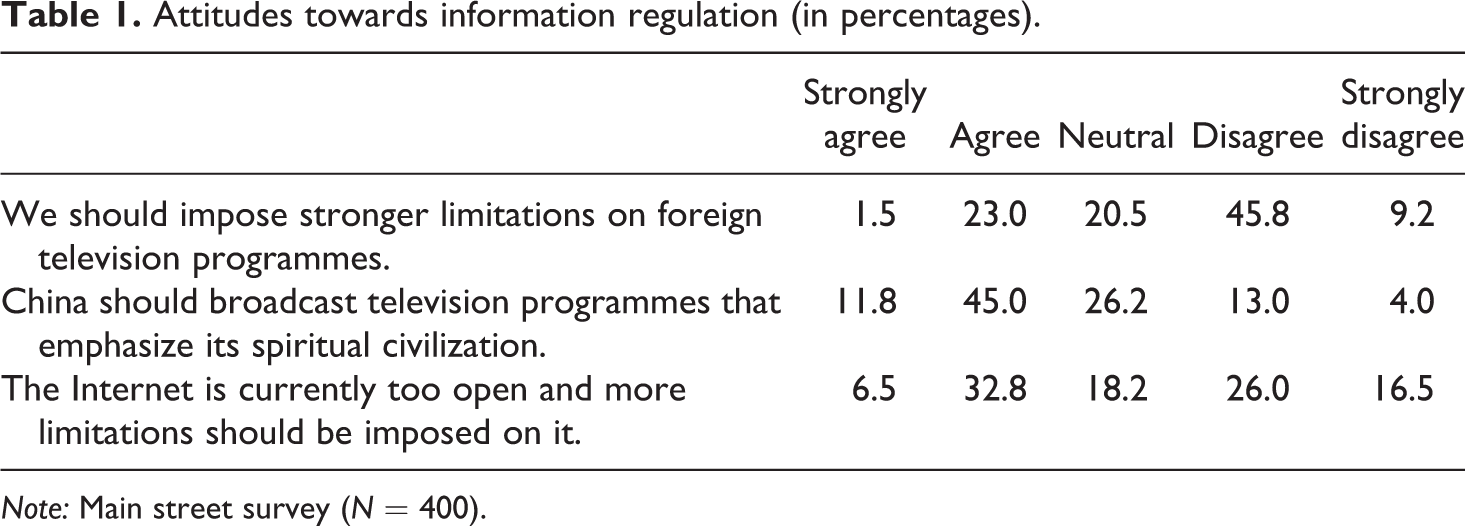
This scale consisted of three statements on information regulation by the Chinese government, which respondents rated on a four-point Likert scale. These statements and results are shown in Table 1. More than half (56.8%) of the respondents in the main street survey agreed with the statement ‘China should broadcast television programmes emphasizing Chinese spiritual civilization’, and a similar proportion (56%) disagreed with the statement ‘We should impose more limitations on foreign television programmes’. Cronbach’s alpha was .676.
Attitudes towards information regulation (in percentages).
Note: Main street survey (N = 400).
Favourite animation programmes
Respondents were asked to list the names of the three animation programmes that they liked best. Results show that 16.1% answered with only one title, 18.3% responded with two titles and 65.6% gave three names.
Preference for animation origin
A Chinese coder who had worked in the Chinese animation industry classified the respondents’ preferred animation programmes according to their countries of production (China, the US, Japan and other countries). Each respondent was then assigned three numbers ranging from 0 to 3 that corresponded to the numbers of their preferred programmes from China, the US and Japan. These numbers represent their preferences for Chinese, US and Japanese animation.
Other preferences related to foreign cultures
Respondents’ preferences for foreign television and China Central Television (CCTV) programmes were measured. CCTV programmes are generally regarded as the most regulated because CCTV is controlled directly by the central government. Attitudes towards Japan were also measured on a five-point Likert scale.
Demographic variables
Respondents’ age, gender, job status and educational levels were recorded
Educational levels were coded into years of education received.
Results
Descriptive results
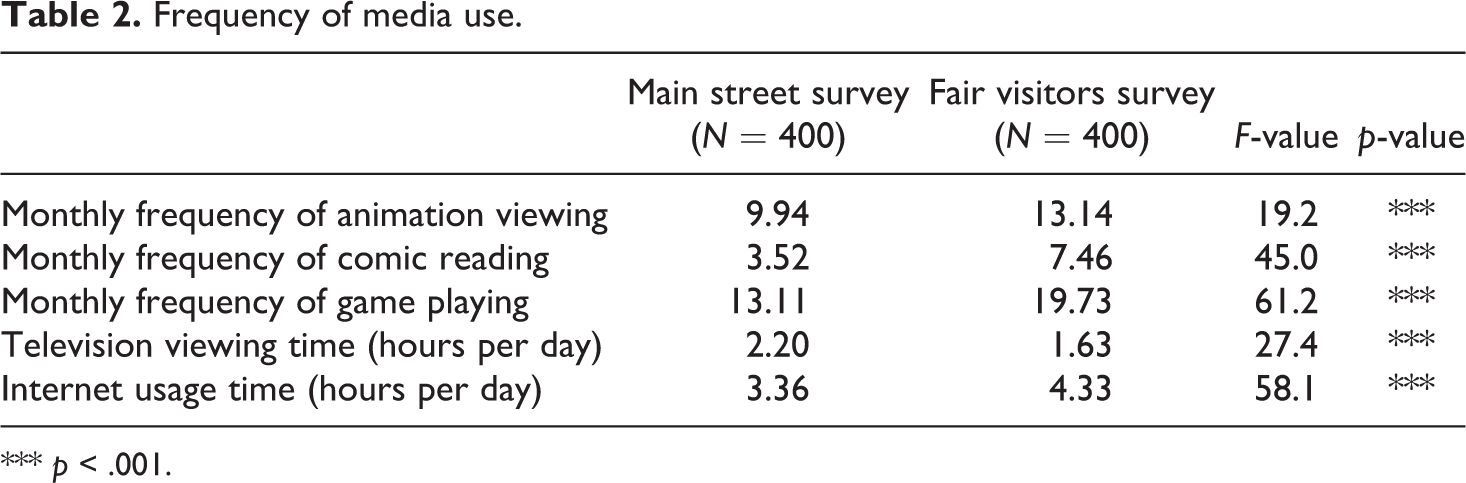
As expected, respondents in the fair visitor survey spend more time viewing animation, reading comics and playing games than respondents in the main street survey do. The former also use the Internet more frequently but watch television less frequently than the latter do (see Table 2). These results indicate that fair visitor respondents are heavy users of the Internet, animation and comics, and may be characterized as anime otaku.
Frequency of media use.
*** p < .001.
Despite the growing number of Chinese animation programmes and tight regulation of the broadcasting of foreign animation, most respondents prefer foreign programmes, especially those of Japanese origin. More specifically, 78.8% of fair visitor respondents and 59.2% of main street respondents named a Japanese animation programme as their favourite. In contrast, only 11.1% of fair visitor respondents and 25.7% of main street respondents specified a favourite animation programme from China, and even fewer (15.1% and 10.1%, respectively) specified one from the US. These results suggest that Japanese animation programmes are widely viewed, especially among heavy viewers of animation.
Favourite animation programmes
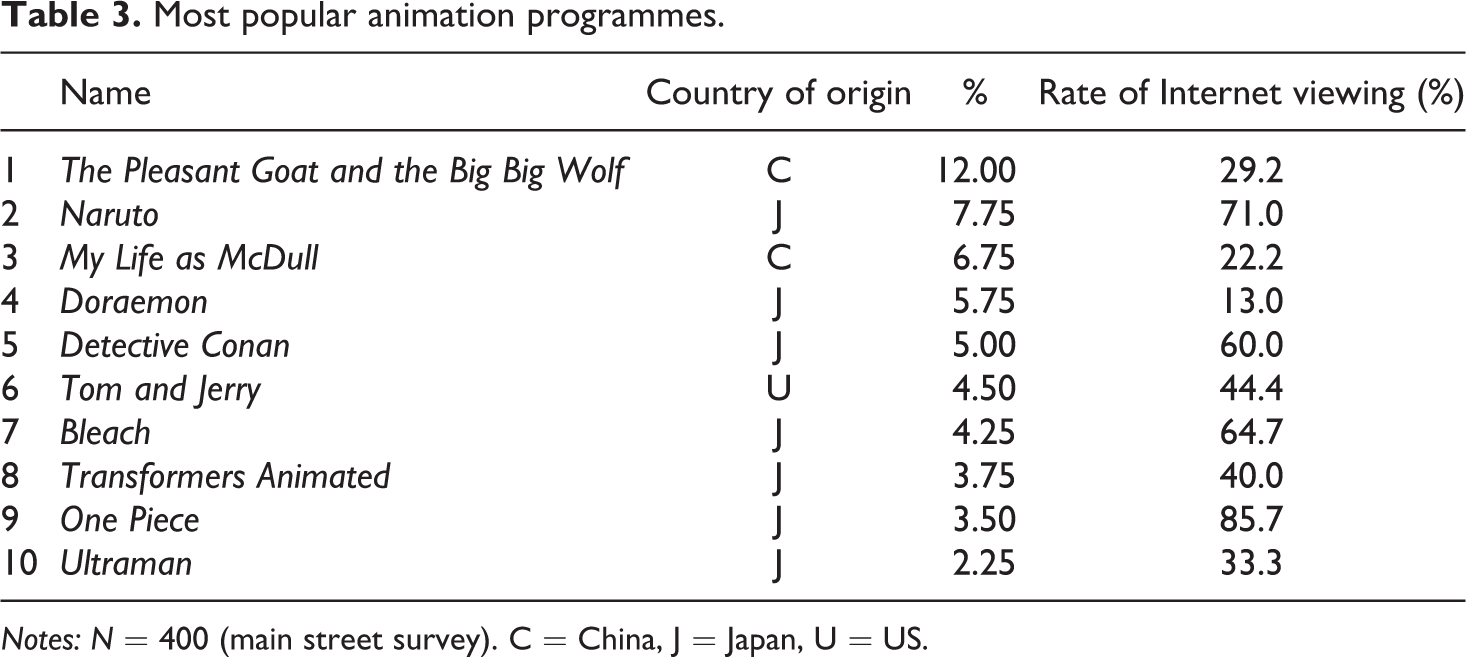
Table 3 presents the 10 favourite animation programmes among main street respondents. Of these programmes, seven are Japanese, two Chinese and one from the US. The two Chinese programmes, The Pleasant Goat and the Big Big Wolf and My Life as McDull, are child-oriented productions in which the main characters are animals. The rightmost column in Table 3 shows the percentage of people who watched the corresponding programmes on the Internet. This rate varies depending on the specific animation programme. Some popular Japanese animation programmes, such as Naruto and One Piece, had never been broadcast in China, 10 although most of the other Japanese programmes on the list were broadcast officially, at least before 2006. The results indicate that 49.4%, 35.0% and 24.5% of Japanese, US and Chinese animation, respectively, is watched through the Internet. 11 According to a personal interview that I conducted in 2009, most popular Japanese animation programmes are available on P2P file-sharing websites within two to three days after their broadcast in Japan.
Most popular animation programmes.
Notes: N = 400 (main street survey). C = China, J = Japan, U = US.
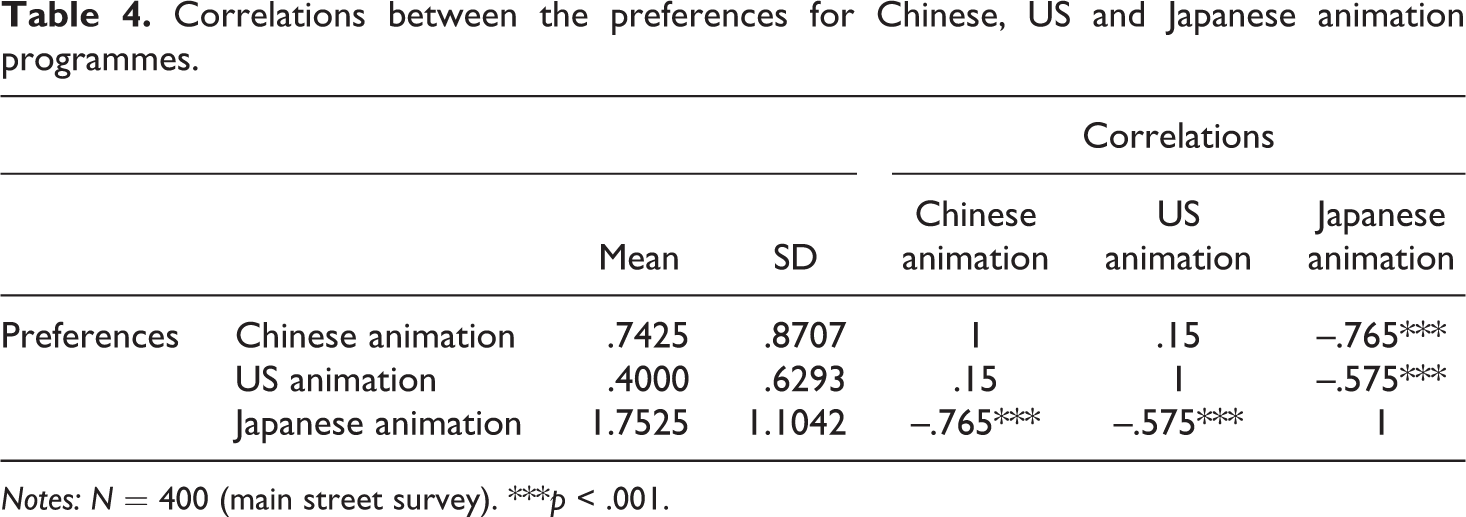
Correlations between the preferences for animation from the three countries (China, the US and Japan) indicate that Japanese animation has a singular niche in the eyes of Chinese viewers. Table 4 shows that the preference for Japanese animation is negatively and significantly correlated with those for Chinese and US animation (r = −.765 and −.575, respectively; p < .001 for both). In contrast, the respective preferences for US and Chinese animation are positively correlated. This is because Japanese animation is viewed mostly by adolescents, while Chinese and US animation is viewed mainly by children, 12 as previously described.
Correlations between the preferences for Chinese, US and Japanese animation programmes.
Notes: N = 400 (main street survey). ***p < .001.
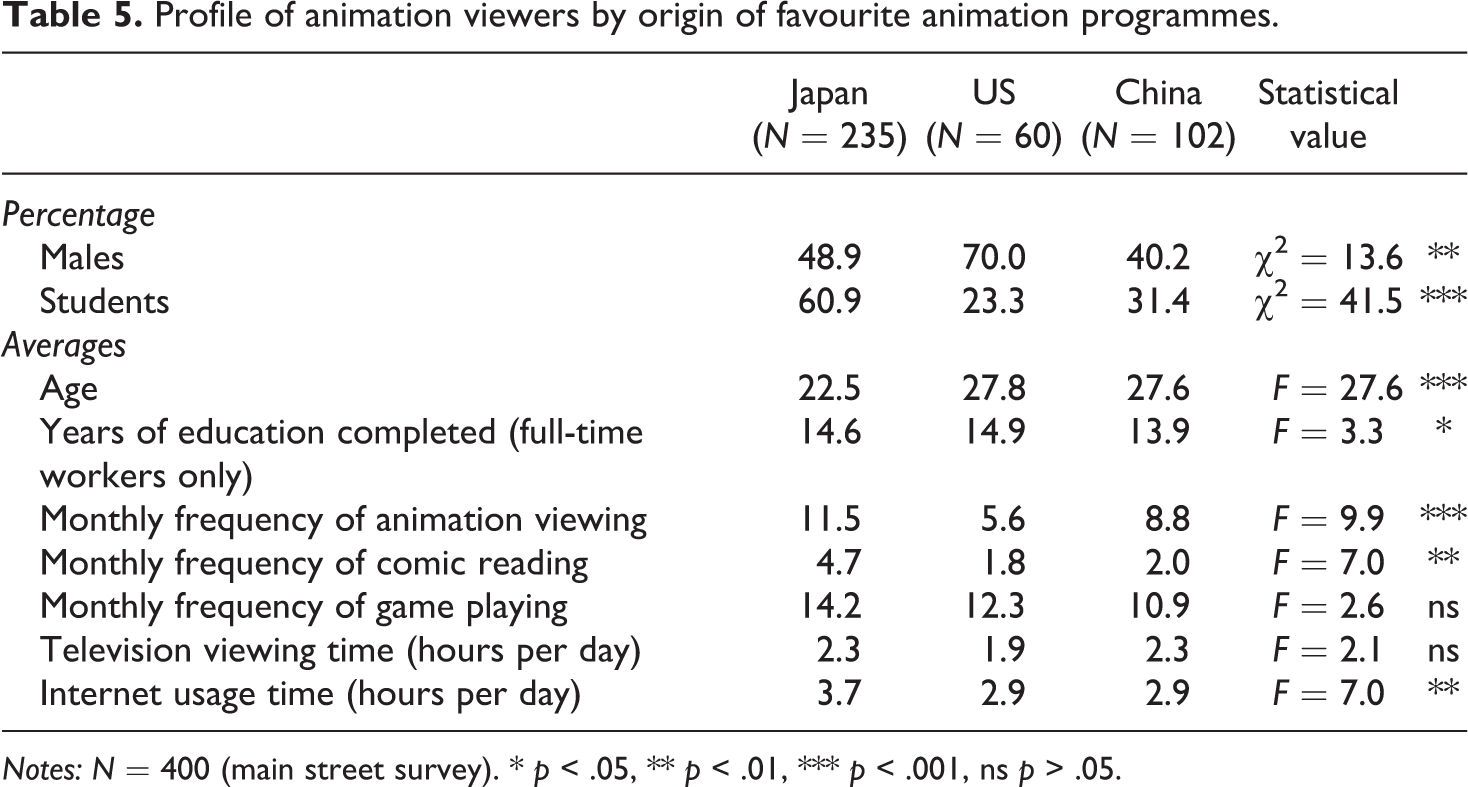
Table 5 profiles the respondents by the origin of their favourite animation programmes. Respondents who prefer Japanese animation are more likely to be students and significantly younger than those who prefer animation from the other countries; consequently, H1-1 is supported. The ages of the respondents (between 15 and 39 years) suggest that some respondents who prefer US and Chinese animation watch these types of animation with their children. A recent report on animation in China also shows that most viewers of Chinese animation are children aged 4–14 years. Of the all animation viewers, children aged 4–14 years comprise more than 40%, while adolescents aged 15–24 years comprise fewer than 10% (Lu et al., 2011).
Profile of animation viewers by origin of favourite animation programmes.
Notes: N = 400 (main street survey). * p < .05, ** p < .01, *** p < .001, ns p > .05.
Table 5 indicates college and high school students constitute a larger proportion of respondents who prefer Japanese animation. Years of education completed by full-time workers in each category were compared and found to differ significantly between those who prefer foreign animation and those who prefer domestic animation. This finding supports H1-2, which states that people who prefer foreign animation are more educated.
Respondents who prefer Japanese animation watch animation significantly more often (11.5 times per week) than respondents who prefer US (5.6 times) or Chinese animation (8.8 times, F = 9.9, d.f. = 2, p < .001). This indicates that, in China, heavy viewers of animation often watch Japanese rather than Chinese or US animation programmes. Similarly, respondents who prefer Japanese animation spend more time on the Internet (3.7 hours per day) than those who prefer US and Chinese animation (1.9 and 2.3 hours per day, respectively). In addition, respondents who prefer Japanese animation are the most frequent readers of comics (4.7 times per week); those who prefer US and Chinese animation read comics only 1.8 and 2.0 times per week, respectively. Conversely, the three groups of respondents do not differ in television viewing times. These media usage patterns suggest that the Internet, comics and animation are jointly consumed, especially among viewers of Japanese animation.
Values and animation preferences
To examine the relationship between values and animation preferences, regression models were estimated using preferences for Chinese, US and Japanese animation as dependent variables. Attitudes towards information regulation, demographic variables (gender, age and years of education completed) and values (collectivism, materialism, consumer ethnocentrism and patriotism) were used as independent variables. Table 6 shows that the preference for Chinese animation is positively and significantly correlated with consumer ethnocentrism and patriotism. Consequently, H1-3 is supported. In contrast to the preference for Chinese animation, the preference for Japanese animation is negatively and significantly correlated with patriotism; however, it does not correlate significantly with consumer ethnocentrism. Consequently, H1-4-1 is partially supported. Further, the results indicate that the preference for Japanese animation does not correlate significantly with collectivism or materialism. Thus, H1-6-1 and H1-6-2 are not supported. Contrary to the hypotheses H1-5-1 and H1-5-2, the preference for Chinese animation correlates negatively with collectivism; therefore, neither hypothesis is supported.
Regression models predicting preferences for Chinese, US and Japanese animation programmes.

Notes: N = 399 (main street survey). M = male, F = female. * p < .05, ** p < .01, *** p < .001.
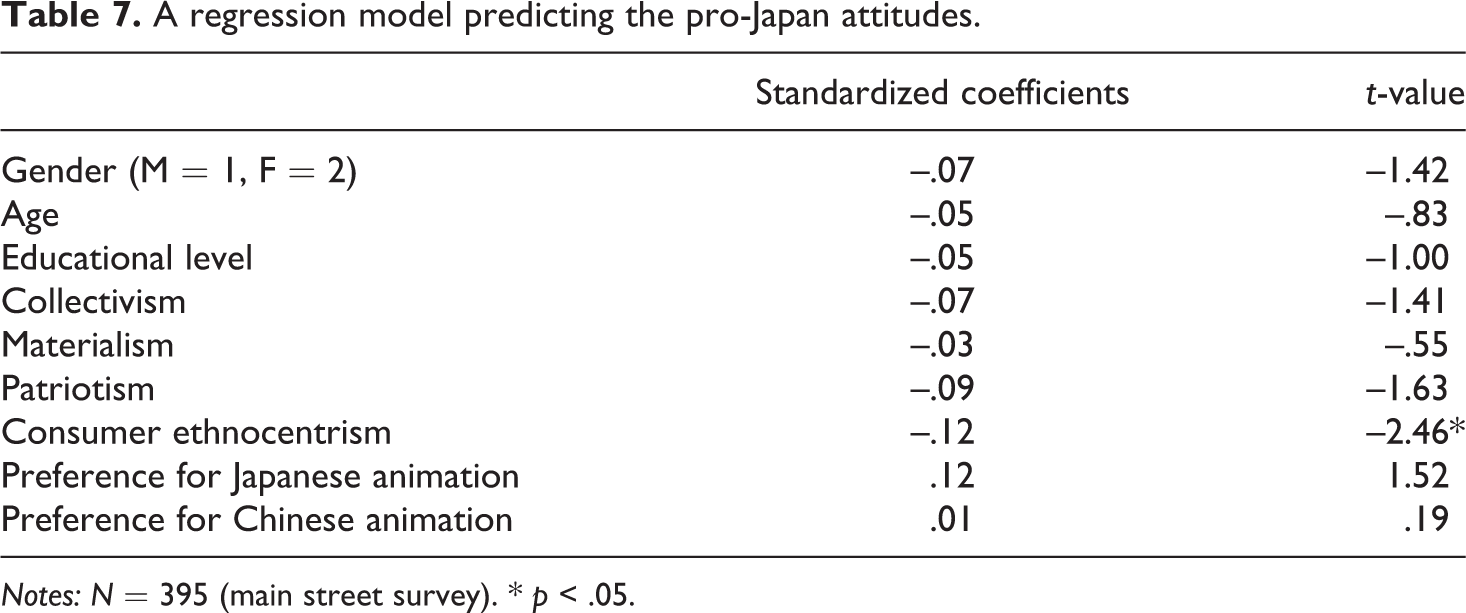
Are Chinese fans of Japanese animation more pro-Japan, given that they live in a country where patriotism is associated with an anti-Japan attitude? Against expectations, Table 7 indicates that the preference for Japanese animation does not correlate significantly with a pro-Japan attitude. Only consumer ethnocentrism is negatively and significantly correlated with a pro-Japan attitude, and preferences for Japanese and Chinese animation do not correlate significantly with a pro-Japan attitude. Thus, H1-4-2 is not supported. Additionally, the preference for CCTV channels correlates positively with the preference for Chinese animation but negatively with the preference for Japanese animation.
A regression model predicting the pro-Japan attitudes.
Notes: N = 395 (main street survey). * p < .05.
Factors accounting for attitudes towards animation regulation
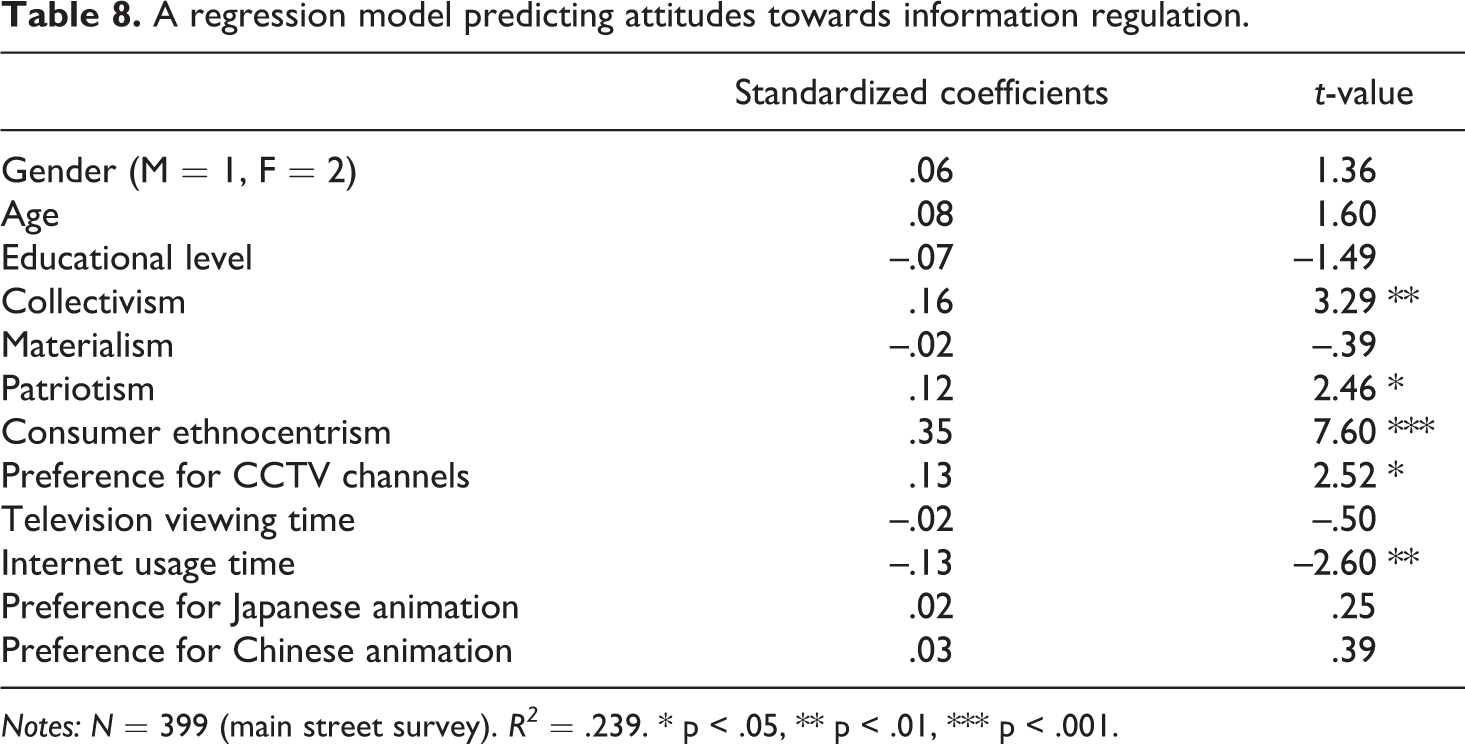
A regression model was employed to identify the factors that account for attitudes favouring governmental regulation of information, which includes a tightening regulation against foreign television programmes and control of the Internet. The model comprises the following independent variables: demographic factors (age, gender and educational levels), values (collectivism, materialism, patriotism and ethnocentric consumerism), media use (animation, comics, games, TV and the Internet) and preferences for CCTV, Chinese and Japanese animation. Table 8 presents the parameter estimates, which reveal the following findings. First, collectivism, consumer ethnocentrism and patriotism correlate positively with attitudes favouring information regulation; consequently, H2-1 and H2-2 are supported. However, materialism does not correlate with attitudes favouring information regulation; hence, H2-3 is not supported. Second, Internet use is negatively and significantly correlated with attitudes favouring information regulation. 13 This supports H2-4, which predicts that Internet use correlates negatively with attitudes favouring information regulation. Third, the preference for CCTV channels correlates positively with attitudes favouring information regulation, which is consistent with the observation that CCTV channels are most strictly controlled in China by the government. Lastly, the preference for Japanese animation does not correlate significantly with attitudes regarding information regulation. This result contradicts H2-5, which predicts that those who prefer Japanese animation are less likely to approve of information regulation.
A regression model predicting attitudes towards information regulation.
Notes: N = 399 (main street survey). R2 = .239. * p < .05, ** p < .01, *** p < .001.
Discussion and conclusions
Certain limitations must be recognized when interpreting the study’s findings. The study’s non-experimental research design implies that the findings should be interpreted with caution, especially in terms of causality. For example, the finding that more frequent Internet use predicts stronger preference for Japanese animation does not necessarily mean that Internet use leads to viewing Japanese animation.
China’s animation control policy is a huge social experiment entailing large amounts of public investment. However, this policy has not yet achieved its intended results. The findings indicate that many viewers of animation are devoted fans of Japanese animation who watch unauthorized animation programmes on the Internet. Japanese animation is uniquely positioned in the eyes of Chinese viewers. As of 2009, few Chinese animation programmes have become popular, aside from those targeted at children. Anecdotal evidence such as the slogan ‘rejuvenation of Chinese animation’ indicates that animation control policies are driven by nationalistic interests. The results also show that the preference for domestic animation is associated with conservative and nationalistic values. People who prefer Chinese animation are older and more ethnocentric and patriotic, whereas people who prefer Japanese animation are younger and less patriotic. All these results demonstrate that the animation preferences of the Chinese are widely affected by nationalistic sentiments.
However, the finding that the preference for Japanese animation is independent of viewers’ values disproves the hypothesis (H1-6-1 and H1-6-2). A possible reason for this is that the variety in Japanese animation programmes reflects different values. It should also be noted that the preference for Japanese animation is unrelated to political leanings such as attitudes for or against Japan, as indicated by the finding that this preference does not correlate significantly with pro-Japan attitudes. Further, approval of the government’s information regulations does not correlate significantly with the preference for either Japanese or Chinese animation. Judging from these results, it is doubtful that the Japanese government’s ‘pop-culture diplomacy’ projects, which feature Japanese animation characters, will neutralize anti-Japan sentiment in China.
One important finding of this study is that attitudes towards the information regulations are negatively and significantly correlated with Internet usage. This suggests that Internet access can promote non-communist values because it is difficult for the government to control Internet use, as exemplified by the failure of the ‘Green Dam’ project. Growing Internet use will make it more difficult for the CCP to maintain media control.
Many countries have recently refined their cultural policies in the name of developing their creative industries (Keane, 2009). In Asia, both China and South Korea have sought to protect and develop their cultural industries by adopting similar policies such as limiting the inflow of foreign popular culture. 14 These countries aim to export their cultural products to the international market. However, these unilateral policies are inherently contradictory because they engender a zero-sum game among countries. For example, many users made critical comments about the growing number of Korean dramas being shown on the Chinese television channel CCTV-8 on a popular Bulletin Board System (BBS) in 2008. 15 This suggests that export-oriented cultural policies cause people in the target country to reject the cultural products by kindling nationalistic sentiments.
Footnotes
Funding
This study was financially supported by the Japan Society for the Promotion of Science (JSPS) KAKENHI Grant (No. 19402034).