




Abstract
Prominent communication theories find a strong association between the news and our perception of the world. In this article, we compare the country names mentioned in the news with those recalled from the memory of individuals from four different nationalities: the United States, Israel, China, and Switzerland. Our findings suggest a more nuanced relationship between the news and memory. Larger and stronger countries are prominent in both news and memory. Countries engaged in conflicts or major events are more prominent in the news but less so in memory, while countries with social and geographical proximities are more prominent in our memory but less so in the news. These findings call for revision of the theory accordingly.
There is no doubt that news from different countries tend to focus on different perspectives and may therefore reflect different cognitive representations of the world. Most pervious cross-national comparisons of news tend to focus on specific frames in the news of specific countries. Among these are the availability of hard and soft news in the United Kingdom and Finland (Curran et al., 2009); the cultural differences reflected in television news in the United States and Sweden (Dimitrova and Strömbäck, 2010); the European Union politics in British, Danish, Dutch, French, and German television news (Peter and de Vreese, 2004); or the relationship between democracy and press pluralism found in the news of seven countries (Woods, 2007).
There are, however, very few studies that attempt to explore the more general question of the different focus of the international news from different countries. Kayser (1953) compared the international focus of 17 newspapers and found a very small overlap. Out of 18 preselected international stories only three appeared in all newspapers. Gerbner and Marvanyi (1977) studied foreign news coverage of nine countries and found a wide variation of regional coverage. While there were much news about the United States and western Europe in all newspapers, news about Asia, Oceania, and Africa remained largely local. More recently, Wu (2004) studied the international focus of newspapers from 44 countries, showing that the United States has remained by far the most mentioned country, followed by the United Kingdom, France, Russia, and China. Yet, his findings, based on aggregated data, outlined the similarity of newspapers’ focus on core countries rather than their regional differences.
More recently, Wilke et al. (2012) studied the television news channels in 17 countries, finding major differences in the international focus of countries, reflecting local and regional relationships as well as specific journalistic considerations. Similarly, when it comes to online news, Segev (2010a) studied 35 news sites in 10 different languages over a period of 6 months, pointing out significant differences in the scope of news sites from different countries. While news from Middle Eastern countries tend to focus on local affairs, news from European and Asian countries show a more global scope. American and French news are more self-centered in their international news coverage.
In the present work, we examine (a) whether international news in different countries significantly differ in their focus, and (b) whether these differences could be reflected in the memory of individuals consuming news media in those countries.
Why some countries are more newsworthy than others?
The prominence of a foreign country in the news is traditionally attributed in the literature to three groups of variables: (a) national traits (e.g. the size and power of the foreign country); (b) relatedness, namely proximity to that foreign country in terms of geography, demography, etc.; and (c) events (e.g. disasters, wars, conflict, local protest) (Wu, 2000; Segev and Blondheim, 2013; Sheafer et al., 2013). While national trait variables can explain the similar focus of news from different countries on the core countries such as the United States and western-European countries, relatedness variables explain their different regional focus. Event-oriented variables can explain both the regional and global focus based on the extent of the event and its relevance to the reporting country.
National traits
Variables of this group often measure the size of a country and its economic and political power. Following Wallerstein’s (1974) World System Theory, Chang (1998) classified states as core, semiperipheral, or peripheral and found that core countries get much greater news attention than semiperipheral and peripheral countries. Particularly, the economic power of a country was found to be a strong indicator of its news prominence (Kim and Barnett, 1996). Military power is another important predictor of news prominence (Kariel and Rosenvall, 1984; Shenhav et al., 2012), followed by population size (Charles et al., 1979; Dupree, 1971; Rosengren, 1977).
Relatedness
Relatedness variables measure the economic, political, social, and cultural ties between a reporting and a reported country. It was found, for example, that bilateral trade is a strong predictor of mutual newsworthiness of two countries (Charles et al., 1979; Kariel and Rosenvall, 1984; Rosengren, 1977; Wu, 2000). Geographic proximity (Dupree, 1971; Galtung and Ruge, 1965) and cultural proximity, which often refers to ethnic similarity (Shoemaker et al., 1991), as well as immigration, travel, and shared languages (Chang et al., 1987; Kariel and Rosenvall, 1984), were also found to be determinants of international news coverage.
Events
Event variables measure the deviance of a country, in other words its involvement in conflicts (Golan and Wanta, 2001), as well as political, economic, and social changes it is experiencing (Chang et al., 1987). The recent uprisings in the Middle East are a good example in this regard, demonstrating that smaller and less powerful countries such as Tunisia and Syria can get very high news attention worldwide, at least for a time, due to their provision of outstanding news events. The tsunami in Japan or earthquake in Haiti both underscore the same point.
The news–memory nexus
While the focus of international news from different countries differs following the reasons mentioned earlier, it is also widely accepted that news has a strong influence on our perception of the world. One prominent theory in this regard is the agenda setting, suggesting that media set a certain agenda of issues which can be later reflected in people’s perceptions of the world (McCombs and Shaw, 1972). Studies of agenda setting are traditionally divided into two levels. While the first level of agenda setting explores the media salience of issues and objects (such as countries, politicians, or brands), the second level looks at the deeper layer of their attributes, characteristics, meanings, and frames (Kiousis, 2004; McCombs and Shaw, 1993).
Agenda-setting theory has been widely studied and has received consistent support (Kiousis, 2004; McCombs and Shaw, 1993; Scheufele and Tewksbury, 2007). For example, Wanta et al. (2004) analyzed data from the Chicago Council of Foreign Relations along with the frequency and valence of news reports about different countries from prominent network newscasts. They found a significant correlation (r = 0.568) between media content and people’s rankings of countries as of ‘vital interest’ to the United States.
In another study, specifically focused on the question of causality, participants were asked to rate the importance of multiple national issues (e.g. defense capabilities and pollution) before and after viewing newscasts that highlighted (in different conditions) these differing issues (Iyengar et al., 1982). Though the questions were embedded within a host of other nonrelated questions and were not answered on the same day as the newscasts were viewed, there was a strong effect of news exposure on participants’ subsequent perceptions of issue importance.
The previous two examples studied national and international issues. Yet, the audience is not always affected equally by all subjects and issues presented in the media. Zucker (1978) further argues that agenda-setting effect is stronger for unobtrusive issues and objects. In other words, media have potentially more power in shaping people’s perceptions and views toward things with which they have no direct contact, and thus their only way to learn about them is through the media. Likewise, Palmgren and Clark (1977) maintain that media have a stronger impact when it comes to international or national issues rather than to local issues. Hence, when looking at the salience and perceptions of countries in people’s mind, agenda-setting theory suggests that media have potentially a strong influence. Yet, there is a lack of studies focusing on the news–memory nexus in regards to foreign countries and comparing this among people and media from around the world. In order to compare the international focus of news and memory in different nationalities, this article sets three hypotheses:
And finally, the literature on news flow mentioned earlier suggests that larger and stronger countries such as the United States are mentioned more often in the news around the world. Since news, and particularly news on unobtrusive issues and objects such as foreign countries has a strong influence on our memory, it is expected that:
Method
News collection and analysis
News items were collected from popular news sites in the four different nationalities: China, the United States, Israel, and Switzerland. Subsequently, we analyzed and compared news items in four different languages: Chinese, English, Hebrew, and German (see Hills and Segev, in press). Apart from data availability, we chose these countries since they are located in four different regions: Asia, America, the Middle East, and Europe. The popularity of news sites was determined using statistics provided by the World Association of Newspapers, the State of the News Media in 2010, Nielsen online, and IVW (Informationsgemeinschaft zur Feststellung der Verbreitung von Werbeträgern e.V.). The final list of news sources included: CNN and the New York Times (for the United States), TagesAnzeiger and NZZ (for Switzerland), the People Daily and Sina (for China), and Ynet and Haaretz (for Israel). Table 1 summarized the estimated national reach and ranking of each news site.
News sites popularity by country.
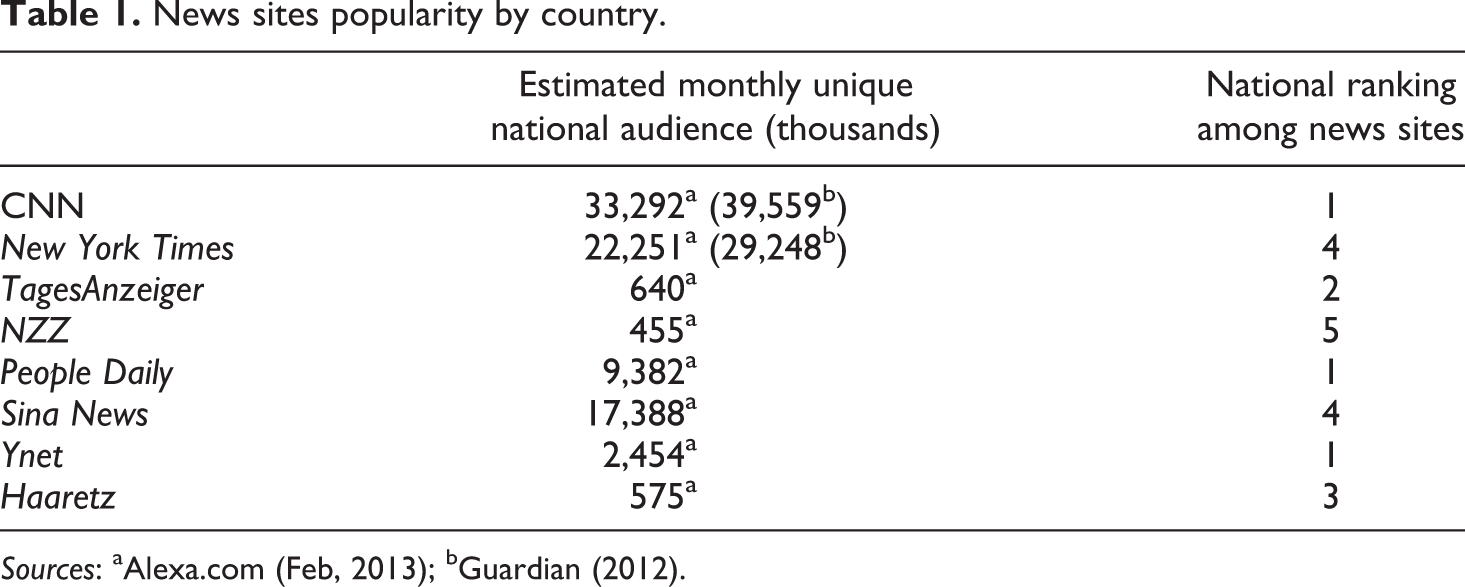
Sources: aAlexa.com (Feb, 2013); bGuardian (2012).
In addition, we analyzed a third news site – Google News vernacular edition of each country. Google News aggregates over 4,500 English-language news sites and hundreds of news sources in Chinese, German, and Hebrew ranked automatically by the popularity of the news source, its traffic, number and length of stories, number of authors and staff employed, number of bureaus cited, and the length of time it has been in business (Segev, 2010b).
A possible caveat is that news sites within each country may vary greatly in terms of their international scope. Thus, we first examined whether news sites from the same nationality are more similar to each other and different from news sites of other nationalities. A Spearman correlation test confirmed this assumption, showing a very high correlation between country rankings of news from the same nationality (r > 0.8, p < .01). The country ranking correlations among news from different nationalities were significantly lower (Fisher z-transformation indicates significant differences between the lowest correlation of news sites from the same nationality and the highest correlation of news sites from different nationalities with p < .01). In other words, the news environment differs significantly by language and thus justifies the cross-country comparison (see also the ‘Results’ section for a more detailed analysis).
In each of these popular news sites, all textual news items from five main topical categories were collected every other day using RSS (Rich Site Summary) feeds, including ‘top news,’ ‘world news,’ ‘business and economy,’ ‘technology,’ and ‘entertainment and culture.’ These categories were chosen because they were common to all news. The news data were sampled over a period of 6 months between October 1, 2010 and March 31, 2011 at 12:00 UTC (Coordinated Universal Time). In total 26,276 news items from 12 news sites (three for each country) were collected. Special software was developed to identify and document for each item its date, the countries mentioned, and its news source. The country names mentioned in each news item were extracted automatically. For this purpose, a database of 196 country names in four different languages was built based on the complete list of country names available from the International Organization for Standardization. Native speakers translated country names into all languages, identifying common and alternative names (e.g. ‘USA’ and ‘United States of America’), as well as excluding ambiguous names. In this way, we recorded the frequency of each country name in several national news sites.
Memory data
We collected online data from 126 participants from four different countries, corresponding to our news data described earlier. These were China, the United States, Israel, and the German-speaking part of Switzerland. Participants were recruited using flyers and word of mouth. One participant selected at random won a prize. All participants were volunteer students from social sciences with similar demographic and media use characteristics. Participants were directed to an online form in which they were asked to fill in demographic information, media usage information, and an estimation of the number of countries they might be able to recall. Finally, they were instructed to type all the country names that they could recall from their memory in their own language. Participants were allowed to visit the online form only once, and in most cases the task lasted between 5 and 15 min.
The task was online from October 27, 2010 to March 31, 2011. We registered the time each country name was typed and monitored the IP addresses (Internet Protocol) of users in order to avoid multiple submissions. Additionally, 90% of the participants filled in their email in order to take part in the raffle. Country names were corrected for spelling by an automated computer program. Names that could not be identified as a known country were removed. In total, all participants recalled together n = 5,524 country names, divided to n = 1,855 names recalled by the 36 Swiss participants, n = 1,079 names recalled by the 29 Chinese participants, n = 1,292 names recalled by the 31 Israeli participants, and n = 1,298 names recalled by the 30 American participants.
The average age of all participants was 23.3 years (Switzerland = 23.22, China = 23.79, Israel = 25, and the United States = 21.2). The reported media use ranged from less than 1 h per day (9%), 1–3 h a day (46%), 3–6 h a day (32%), and greater than 6 h a day (13%). The preferred media was the internet (93.6%), but also encompassed newspapers (66.7%) and television (42.8%). Over all participants, 63.5% reported using media in their own language only. It is important to note that although the sample is homogenous in age, education level, and media consumption, we did not choose participants based on their news consumption preferences. In fact, participants may not directly read the specific news sites in our analysis. On the other hand, they all use the internet extensively, mostly in their own language. Hence, they are indirectly exposed to the media environment in their language. For example, Israeli participants may not read Ynet or Haaretz online, but still recall often-mentioned countries such as Iran. Since our analysis concerns with comparing the general perceptions of the world in the news and memory, we also attempted to look at the more general sample in this regards.
In what follows, our analysis focuses on the aggregated level of the news–memory nexus. We look at the frequencies country names were recalled by all participants from the same nationality (hereafter: memory), and the frequencies country names were mentioned in the news in each of the four countries during the sampling period (see also Kosicki, 1993, for the macro-level approach of agenda-setting research). Still, we provide here a short summary of the interesting findings regarding the differences between participants in recall patterns. While conducting an Analysis of variance (ANOVA) to compare the means of the different variables, it was found that there are significant differences in the number of countries people estimate and actually remember depending on the nationality, gender, and media and news usage. Swiss participants remembered significantly more countries than participants of other nationalities (µ = 58 compared with µ = 37 in China and µ = 46 in the United States and Israel, p < .05). Israelis estimated that they could remember fewer countries than other participants (µ = 26 compared with µ = 41 in China and µ = 46 in the United States and Switzerland, p = .06). Male participants both estimated and actually remembered significantly more countries than female participants (µ = 56 compared with µ = 42, p < .01), and the higher the media and news usage the more countries people recall or estimate to recall (p < .05).
National data
Attempting to explain the prominence of countries in the news and in our memory, we collected national data. We have gathered a series of political, economic, social, and geographic indicators based on the three groups of variables (i.e., national traits, relatedness, and event-oriented variables) suggested by the literature surveyed earlier on international news flow. Our initial list included some 30 variables, but we report here only on 11 variables that were found to best correlate with news and memory:
National traits
CINC (political) – the Composite Index of National Capability developed by Singer et al. (1987) is a comprehensive index for the general power of a country based on its population, urban population, iron and steel production, energy consumption, military personnel, and military expenditure. The latest CINC scores are from 2007 (http://correlatesofwar.org).
GDP (economic) – the Gross Domestic Product is calculated in $US and is based on the World Economic Outlook Database of the International Monetary Fund. We used the 2010 data (http://www.imf.org).
Population (social) – based on the World Population Prospects of the UN Department of Economic and Social Affairs Population Division, we used the 2010 data (http://esa.un.org/unpd/wpp/unpp/panel_population.htm).
Area (geographic) – measures the size of a country in square kilometers based on the Demographic Yearbook of the UN Statistics Division (http://unstats.un.org/unsd/demographic/products/dyb/dyb2008/Table03.pdf).
Relatedness
Trade (economic) – the total value of imports and exports between two countries in $US. The 2010 data are based on the Direction of Trade Statistics Yearbook of the International Monetary Fund (http://www.imf.org/external/data.htm).
Foreign Population (social) – the foreign-born population is based on national censuses conducted between 2000 and 2011 as reported by the UN Statistics Division (http://data.un.org/Data.aspx?d=POP&f=tableCode%3a44).
Inbound Tourism (social) – the tourist arrivals by country were obtained from official sources in each country separately: The US International Trade Administration (http://tinet.ita.doc.gov/outreachpages/download_data_table/2010_Visitation_Report.pdf), the Israeli Central Bureau of Statistics (http://www.cbs.gov.il/publications11/1427_tourism09/pdf/t04.pdf), China National Tourist Office (http://www.cnto.org/chinastats_2010ArrivalsByAgeSex.asp), and the Swiss Federal Statistical Office (http://www.bfs.admin.ch/bfs/portal/de/index/themen/10/03/blank/key/02/01.Document.64549.xls).
Region (geographic) – a binary variable that indicates whether two countries are from the same region based on the UN classification of regions (http://unstats.un.org/unsd/methods/m49/m49regin.htm).
Border (geographic) – a binary variable that indicates whether two countries share the same border based on the CIA World Factbook (https://www.cia.gov/library/publications/the-world-factbook).
Event-oriented
Conflict Intensity (political) – a composite measurement of all international conflicts of a country between 2009 and 2010 based on PRIO (Peace Research Institute Oslo) Armed Conflict Dataset v.4-2011. See also the ‘Conflict Relation’ variable.
Death Disaster (social) – is the total death toll from natural disasters occurred between 2009 and 2010 based on the International Disaster Database (EM-DAT) (http://www.emdat.be).
In order to study which of these variables has the best predictive power, we tested their correlation with the prominence of each country in the news and memory. We additionally used a multiple regression model, but this proved inappropriate due to the many inner correlations. Variables from the national traits and the event-oriented groups were tested for correlation with the observed news/memory prominence of each country. For example, the prominence of countries in American news/memory was tested for correlation with their GDP. Variables from the relatedness group, on the other hand, differed for each country and were tested separately for correlation with the news/memory prominence of each specific country. Thus, for example, the prominence of countries in American news/memory was tested for correlation with the US level of trade with those countries (imports and exports).
Results
Is the international focus of news from different nationality essentially different?
Table 2 shows the differences in the most prominent countries mentioned in the news sites from the United States (US), Israel (IL), China (CN), and Switzerland (SW). It also presents significant differences between the news sites based on z-score tests.
Differences in the most prominent countries in news sites of four nationalities.

Note: Z scores higher than 1.96 indicate significant differences (two-tailed p value of above .05) and are marked in gray. Countries that were significantly more prominent in the news of one or two nationalities are marked in bold.
Table 2 shows that all countries mention themselves much more in their news sites. While the United States and Switzerland mentioned themselves in 24.4 and 25.3% of their news items, respectively, China and Israel mentioned themselves in 46.1 and 49.4% of their news items, respectively. This suggests that the latter are more self-referential in their news than the former.
Additionally, there is an obvious difference in the international focus of the news from each country. Countries that are significantly more prominent in US news are Iraq, Iran, Pakistan, Afghanistan, Libya, Yemen, India, Haiti, Mexico, and Brazil. This list reflects US international conflicts, its interest in the Middle East and the Arab Spring, and its relative regional focus on Central and Latin America. Conflict and event-oriented variables can surely shed light on the specific international focus of US news as will be explored below.
Israeli news, on the other hand, share with the American news only Iran as a prominent actor. Other countries that appear frequently in Israeli news are Palestine, Egypt, Lebanon, Syria, Jordan, and Turkey, reflecting the very local focus on the Middle Eastern region and particularly neighboring countries and entities. Likewise, China shares with the United States only one prominent country – India. Other countries that appear more frequently in Chinese news are Japan, South and North Korea, and Thailand. The significant focus of Chinese news on Asian neighboring countries and the Israeli focus on Middle Eastern countries provide another evidence for their local rather than global orientation.
Finally, when looking at Swiss news, Germany, Italy, Libya, and Haiti are relatively more prominent than in the news of other nationalities. While the former two indicate its higher interest in Europe and the neighboring countries, the latter two, which are also prominent in US news, indicate its more global focus. The prominence of Libya and Haiti can be also related to conflict and event-oriented variables as will be suggested below.
Hence, when looking at the list of most prominent countries in each nationality there is a clear support for H1 that news from different nationalities will display different international focus. But perhaps the strongest evidence for this difference is the number of significant differences among all pairs of nationalities (as shown in the last column of Table 2). An average of 4.68 out of the 6 possible pairs of nationalities show a significant difference of news coverage. Another strong indication is the average z scores of each pair of nationalities (as shown in the last row of Table 2), which ranges from 4.67 to 9.6. These very high values indicate that the focus of news from each pair of nationalities is significantly different. The international focus of American news is the most similar to that of Swiss news (z = 4.67), while the international focus of Israeli news is most different from that of Chinese news (z = 9.6). In fact, all the three pairs with the highest average z scores (CN–IL, z = 9.6; US–IL, z = 8.62; and IL–SW, z = 8.53) include Israel, suggesting that the international focus of Israeli news is the most different from the international focus of news from other countries.
Are news and memory related?
In order to examine whether the international focus of the news from different nationalities corresponds to the memories of people from that country (H2), we examined the collective memory for each nationality by aggregating the number of times each foreign country was recalled over all participants for each nationality. This produced a frequency ranking for each country within each nationality. For example, the most frequently recalled foreign country by Chinese participants was the United States, followed by France. We also computed the frequency of occurrence of each country for each national news source. A Spearman rank correlation was then computed for each set of recall data with each national news sources (Table 3). Consistent with agenda-setting theory, the results demonstrate that in all cases the best indicators of collective memory for any nationality were the news sources common to that nationality. Yet, a Fisher z-transformation indicates that the differences between the correlation coefficients are not significant. In all nationalities memory is highly correlated with news of other nationalities as well. Hence, our findings do not support H2. In other words, news and memory of all nationalities were very similar to each other.
Correlations between nations’ collective frequency of and various news sources.
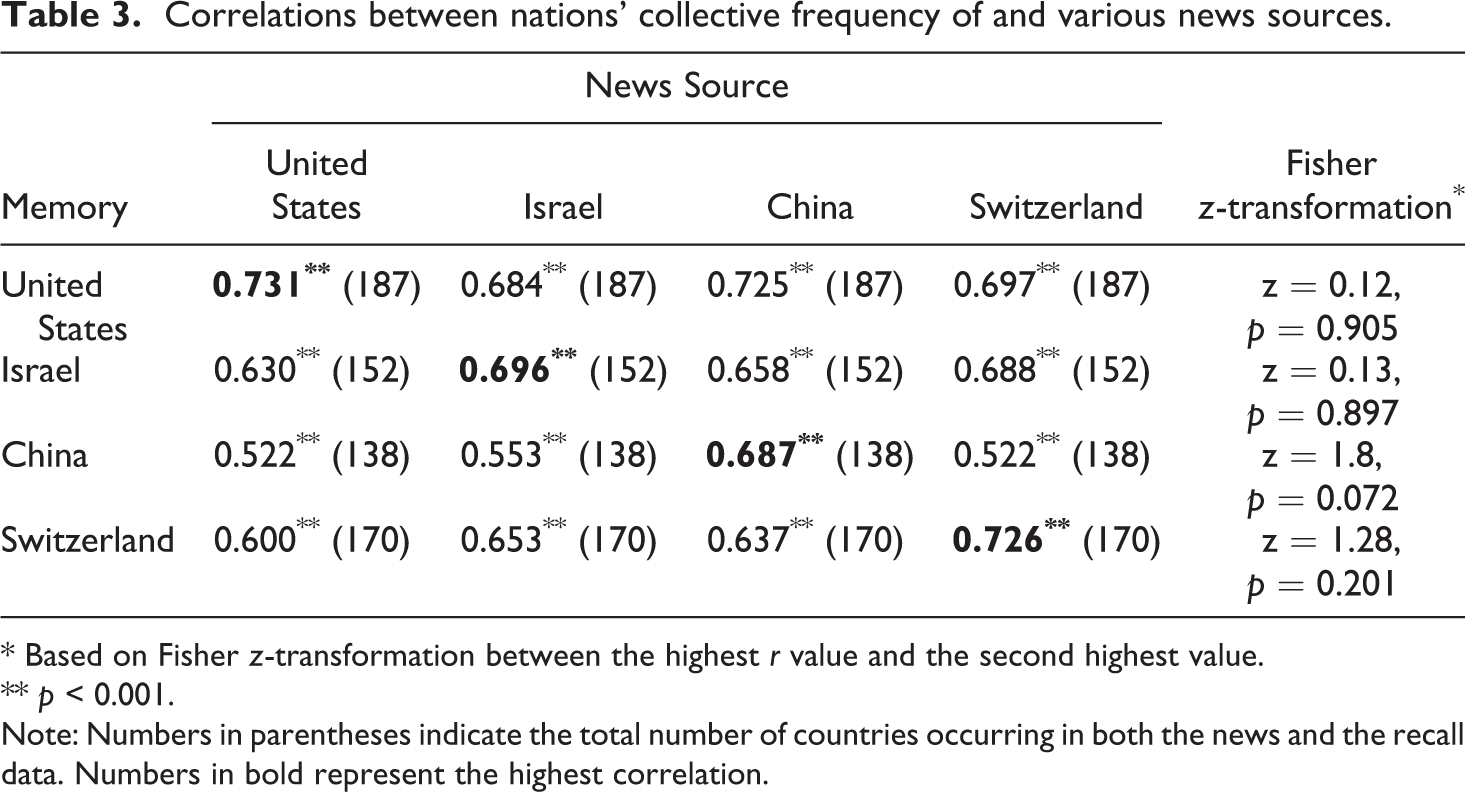
* Based on Fisher z-transformation between the highest r value and the second highest value.
** p < 0.001.
Note: Numbers in parentheses indicate the total number of countries occurring in both the news and the recall data. Numbers in bold represent the highest correlation.
When news and memory come apart?
Although there is a strong correlation between news and media in each nationality, public memory cannot be fully explained by the exposure to news. There might be countries that are recalled more frequently from our collective memory but are not mentioned so often in the news and vice versa. In order to identify those outliers, we run a linear regression model, in which the memory of all participants in each country is the dependent variable and the news from that country is the independent variable (Table 4). In this way we could identify residual countries that are two standard deviations or more away from the regression line, and therefore were over-represented by our memory (above the regression line) or over-represented by the news (below the regression line). We used a logarithmic transformation for the news variable in order to achieve a normal distribution. Table 4 shows that in all nationalities news was a strong predictor of memory, explaining 39.4% of the variance in Switzerland to 57.3% in China.
Residuals of a memory–news regression model.
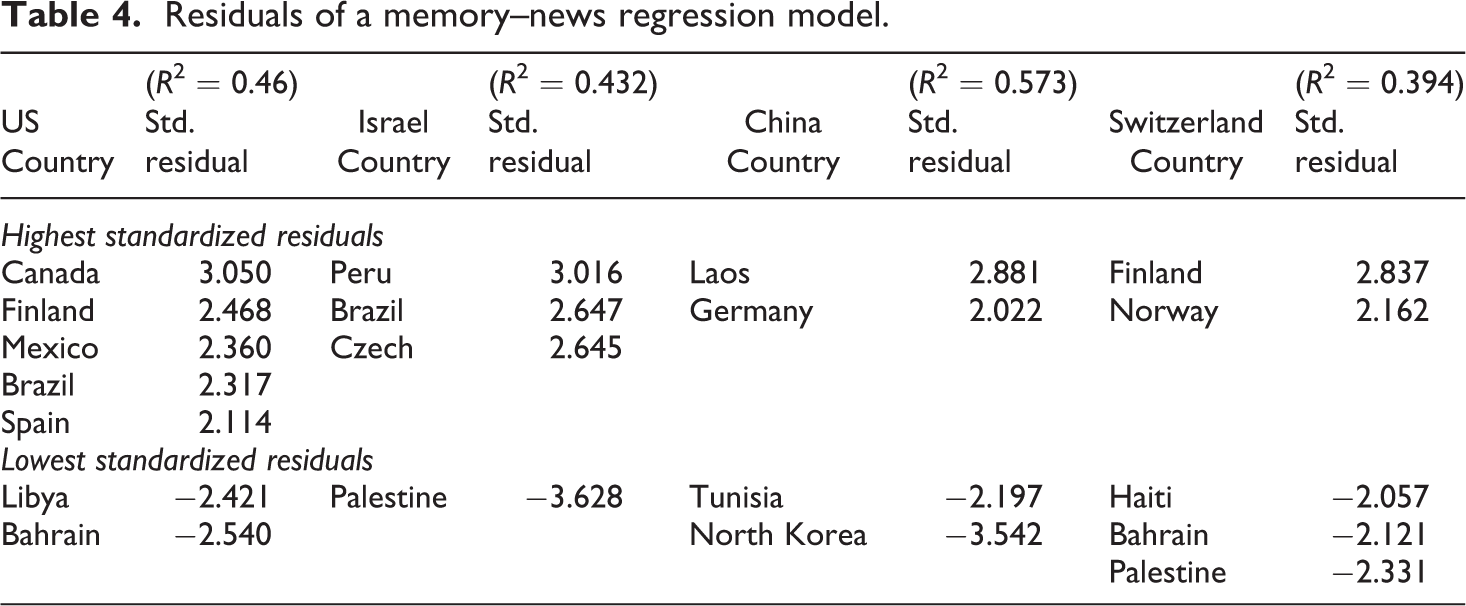
Among the American respondents, countries that had a much higher recall rate than would be expected by news were Canada, Mexico, Brazil, Finland, and Spain. This suggests that apart from news there might be other reasons that people recall those countries more easily. For the former countries, this could be a result of the common border they have with the United States. In other words, geographic proximity may increase the chances that countries are recalled. Libya and Bahrain, on the other hand, appeared frequently in the American news during the sampling period as part of Arab Spring events. These countries, however, were not part of the American public memory.
The Israeli respondents recalled Peru, Brazil, and the Czech Republic much more frequently than could be predicted by the news. Palestine, which appears very frequently on the Israeli news, was not recalled frequently most probably as a result of its ambiguous national status.
In China, Laos and Germany were more frequently recalled in the memory than would be expected if explained by the news. While Laos is again a neighboring country that may generate more recalls than indicated by the news, Germany might have another significant meaning to the Chinese respondents that cannot be explained by its news prominence. On the other hand, the prominence of Tunisia and North Korea in Chinese news was not reflected in the public memory. Similar to the United States, temporal events and political tension made these countries newsworthy rather than memory-worthy in China.
This is true also for Haiti, Bahrain, and Palestine that were relatively more prominent in Swiss news, but were not recalled frequently by the Swiss respondents. Finland and Norway, however, were recalled much more frequently than would be expected if explained by the Swiss news. Here too, the regional proximity as well as tourism could provide a possible answer. Yet, Table 4 gives us only an initial evidence for the limits of the news to fully explain our memory of the world. The following section offers a more systematic analysis of the reasons behind those differences.
Why news and memory come apart?
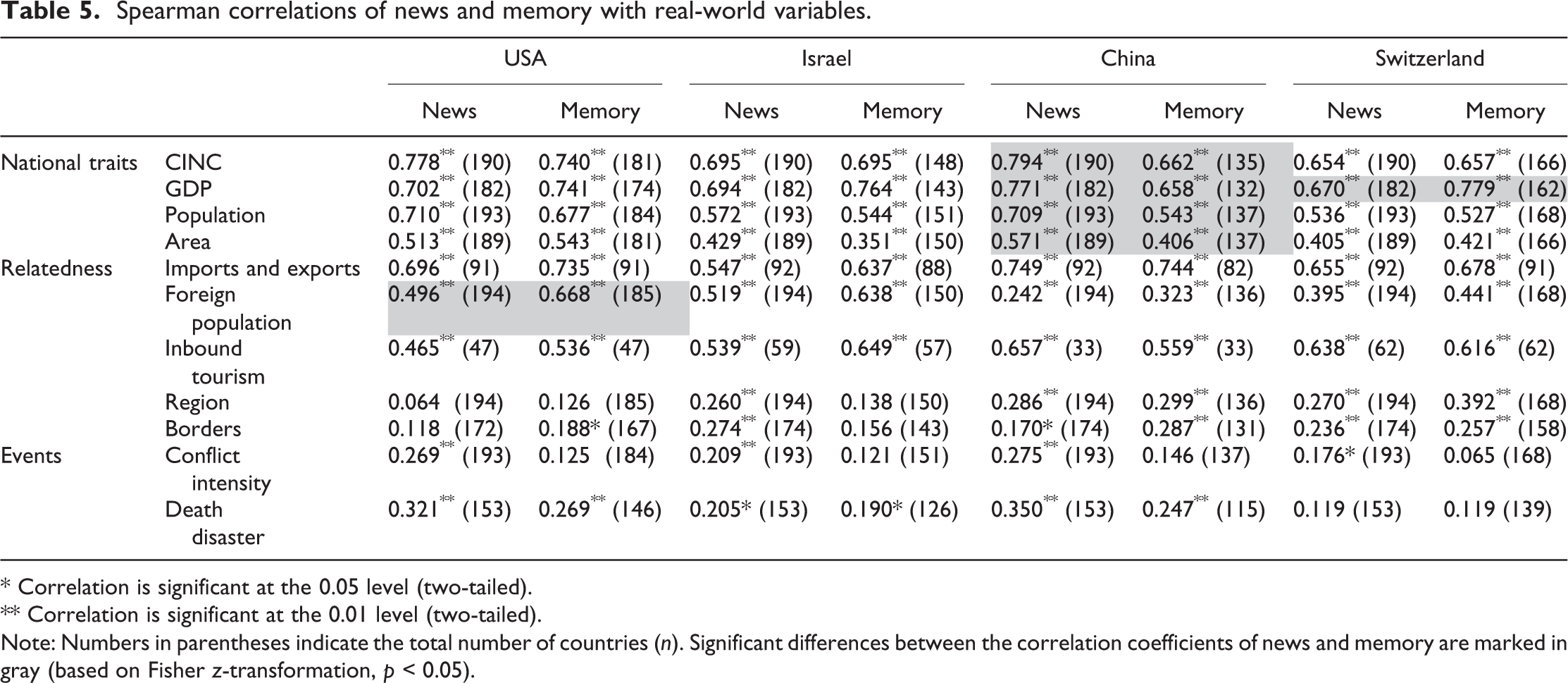
Media in general and news in particular are only one of the many agents mediating information about foreign countries to the public. As shown earlier, countries appearing in the news are proportionally encoded in memory. This is likely to partly depend on the context in which they are mentioned as well as their general relevance to our life. For example, some countries represent economic or military world powers, whereas others represent holiday locations or recent locations of major catastrophes such as earthquakes. In order to understand the reasons behind the differences between news and memory, we look at the correlations of both news and memory with real-world variables (Table 5).
Spearman correlations of news and memory with real-world variables.
* Correlation is significant at the 0.05 level (two-tailed).
** Correlation is significant at the 0.01 level (two-tailed).
Note: Numbers in parentheses indicate the total number of countries (n). Significant differences between the correlation coefficients of news and memory are marked in gray (based on Fisher z-transformation, p < 0.05).
Table 5 indicates that national traits and particularly the political power (represented by the ‘CINC’ variable) and economic power (GDP) of a country are the most significant predictors of its being mentioned in the news and recalled in our memory. Still, the size of a country and its population, which are related to its political and economic power, are also important predictors. Put differently, the stronger and bigger a country is the more chances are that it will be mentioned in the news and recalled in our memory. This provides a clear support for H3 and is true regardless of the location of the news and the nationality of the people.
Together with similarities, there are also several differences between memory and news when it comes to national traits. In China, the news has a stronger correlation with politically and economically powerful and larger countries than the memory (Fisher z-transformation indicates a significant difference between news and memory for all national trait variables with p < .05). In contrast, in Switzerland, the memory has a stronger correlation with economically powerful countries (GDP) than the news.
When looking at variables specifically related to each nationality (relatedness variables), the volume of trade of each nationality (imports and exports) is the most significant predictor of countries’ prominence in both news and memory. Here too, the social factor (represented by foreign population and inbound tourism) plays a significant role. While in the United States and Israel foreign population and inbound tourism are equally important determinants of countries’ prominence in the news and memory, in China and Switzerland, inbound tourism is a much better predictor. Geographic factors (represented by shared region or border) have a very weak or not significant correlation with both news and memory.
Memory has in many cases a slightly stronger correlation with relatedness variables than news. In fact, foreign population is a stronger predictor for memory prominence than for news prominence in all countries. This was found to be particularly significant for the United States – where people more than the news tend to mention countries from which there are more immigrants to the United States (Fisher z-transformation indicates a significant difference between news and memory for the foreign population variable with p < .01). Thus, social proximity is related to memory more than to news prominence.
Finally, when it comes to event-oriented variables, conflict intensity plays a relatively weak yet significant role in the news of all nationalities. However, conflicts do not predict our recall patterns. None of the nationalities show a significant correlation with this variable. The death toll from natural disasters is a slightly better predictor of news- and memory-worthiness of a country. Still, it is generally a stronger (yet not significantly stronger) predictor of news than of memory prominence. In short, news rather than memory is generally better associated with event-oriented variables.
Discussion
In this study, we looked at news and memory of four nationalities from four different continents and cultures: the United States, Switzerland, Israel, and China. In line with early studies of the newspaper (Gerbner and Marvanyi, 1977; Kayser, 1953), and more recent studies of the internet (Segev, 2010a), the international focus of news differs significantly between the nationalities, reflecting their different local, regional, and global interests (H1). However, these differences were not clearly reflected in the national memories (H2). In fact, news was highly correlated with memories regardless of the nationality. In other words, when it comes to the international focus in different nationalities, agenda-setting theory seems to provide only a broad understanding of the link between news and memory. Indeed, in line with the theory, and previous studies on news flow (Chang, 1998; Kim and Barnett, 1996; Lee, 2007; Wu, 2000), we found that both news and memory focus on the larger and economically stronger countries. However, a major contribution of this work is highlighting under what conditions the news and memory do or do not differ significantly when it comes to relationships between countries and events. In what follows, we outline the similarities and differences between news and memory based on the three groups of variables: national traits, relatedness, and event-oriented.
Similarity between news and memory (national trait variables)
News of all nationalities can be very powerful in constantly reminding us who are the big and powerful players that should be followed. Our findings suggest that the general economic and political power of a country (represented by national trait variables) is still the best predictor of its news and memory prominence. This is also the core list of countries that appear in the top of news and memory from all nationalities, such as the United States, the United Kingdom, France, and Germany. This represents the main reason for the strong correlation between news and memory regardless of the nationality. When it comes to international focus, the explanatory power of the agenda-setting theory is therefore a result of the mutual attention of news and memory on the core countries.
More news less memory (event-related variables)
Unlike economically and politically leading countries that are mentioned constantly in the news of all nationalities over a long period of time, our analysis reveals that event-oriented variables, and particularly international conflicts, are the major reason for differences between news and memory. Countries such as Tunisia, Libya, Bahrain, Palestine, and Haiti, which are highly related to ‘events,’ tend to be recalled much less than would be expected if news were the sole explanation for our memory. This is reasonable if we consider our memory to be a limited resource. Not all information can be encoded in memory (Miller, 1956). What is encoded therefore reflects the outcome of a competition between all possible items that could be encoded. This represents a significant limitation of the agenda-setting theory when looking at the international focus of news and memory.
One of the implications of this finding is that not all news has the same impact. In other words, the fact that a country is frequently mentioned does not mean that people will notice, let alone recall it in the long term. Claiming, for example, that more news coverage of largely ignored countries such as the Democratic Republic of the Congo (DRC) might change the audience attitudes (see, for example, Hawkins, 2008) is therefore problematic. This is mainly since most participants in the present study did not recall any of the countries that made headlines due to extreme events. Hence, ad hoc events mentioned in the news temporarily have much less chance to be recalled in our memory. On the other hand, well-established long-term news coverage, such as that devoted to large and wealthy nations, appears to be much more likely to influence recall (for short- and long-term agenda setting, see also Kosicki, 1993).
More memory less news (relatedness variables)
On the other side there are countries that appear more often in our memory but not in the news. This list differs for different nationalities and in most cases is related with regional interests. When looking for potential variables to explain this, we identified that foreign population is more related with memory than with news prominence, particularly in the United States, a country of immigrants. Common borders is another relatedness variable and, indeed, for the United States, China, and Switzerland it was slightly more correlated with memory than with news. The Israeli border is an exception since most Israelis have very limited physical connection with residents of neighboring countries due to political tension and conflicts. Thus, bordering countries with Israel were more likely to be mentioned in the news than be recalled by the Israeli respondents.
Conclusions
As we note earlier, the places where news and memories come apart potentially tell us about the way the news influence memories and the cognitive limits of that relationship. Importantly, our participants’ recollection of countries appears to draw on long-term relationships between countries, which often include GDP, holiday locations, and countries with shared borders. Local conflicts and disasters, on the other hand, reflect recent events that might be best described as short-term events. These kinds of events may reflect differences in long- and short-term memory, with short-term memory often reflecting information that is only temporarily stored and often easily forgotten, while information in long-term memory represents information that has consolidated over time and is therefore less likely to be forgotten (Eichenbaum and Cohen, 2001). Our memories of countries appear to reflect these long-term roles, while being only marginally influenced by more short-term information. Those differences between memory and news when foreign countries are at stake invite us to rethink agenda-setting theory and its limitations.