



Abstract
This paper draws on the contrast between community media and the nature of its communities in Africa that are not participatory but use participatory media. The general contention is that participatory media in Africa preside over non-participatory communities. The paper uses data collected at one Ugandan community media to prove that the limitations between community media and ‘the community’ require over half a century to solve. The immediate solution should be to rethink the idea of community, pay more attention not just to the nature of which media can develop which community as if it (community) was a homogeneous entity but also the idea of which community has the ability to host which media. The paper concludes by suggesting a redefinition of media to include non-media forms that show more potential in enhancing participation for all than community media.
Keywords
Introduction and literature review
One of the essential ingredients of community media is participation, alongside access and self-management (Semujju, 2011). Community participation is based on the idea that local people, as key stakeholders, can have an impact on issues that affect them (Burns and Taylor, 2000). Such participation is beneficial in several ways as it increases the sense of responsibility and consciousness about local issues while at the same time, as Zakus and Lysack (1998) observe, maintains a powerful citizenry due to acquisition of new skills that can help them control different aspects of their lives.
Community media therefore bring back the participatory role by sticking to a common-sense approach obtained from the affected parties. With modern innovations in technology, participation even gets easier, quicker and cheaper. However, this paper argues that a combination of computer, phones, internet and community media can only aid participation if the community in which they operate has the willingness and capacity to participate. Building on that premise, the paper dissects the notion of community starting from the oldest meaning of family to the most recent cyber communities to understand what kind of communities Uganda has. Then, this paper explores the current community media-participation set-up in Uganda using modernization theory and presents findings that disagree with the rhetoric-only operation of community media before a conclusion that calls for alternative community participation avenues is drawn.
Community media
Community media are participatory media (Cammaerts, 2009: 635). Such media are started on the principle of frustration with the dominant media service and they treasure access, participation and self-management, the very ingredients missing in mainstream media (Howley, 2002). Therefore, ‘community media are non-hierarchical organizations where individuals have equal control over the production and where decisions including editorial are made collectively’ (Howley, 2002). Uganda has three community radios: Kagadi-Kibaale Community Radio (KKCR), Radio Apac and Mama FM.
Community
As Goodwin (2003) contends, one of the most influential writers on community was a sociologist, Ferdinand Tonnies, who, in his 1887 book Gemeinschaft und Gesellschaft (Community and Society), said that community is a group based on ‘mutual aid and trust’. Community, Aldous et al. (1972) note, ‘is a mass, undifferentiated and compact, which is only capable of movement together, and is directed by the mass itself, or by one of its parts entrusted with directing it’. However, while commenting on Tonnies’ Community and Society, Mitzman (1971) recognized that as people evolve in thinking, which makes them more creative and complex, ‘economic development undermines tradition, and state centralization destroys local autonomy’. Therefore, Carpentier (2001) notes that the trendy way of discussing the notion of community is far from geographically defined spaces as stated earlier. Now, Carpentier (2001) continues, communities are ‘formed in cyber space-for example usergroups’. Such communities are less prone to geographic limitations like distance. Regardless, Opubor (2000) insists that ‘community still retains a strong physical reference to people in geographic proximity, with frequent, if not continuous contact’. While the change from top-down to participatory communication created the rationale for the establishment of community media, the need to change community to get what could correspond with participatory media was neglected. Community media therefore came with an assumption that merely starting to operate would develop whatever community they were put into, after all, the media were participatory. The social, economic and political set-up of the community participants was not considered.
Theoretical framework and research methodology
According to Sakwa (2011), modernization is closely related to development through emulating western industrialization and that ‘once set in motion, it tends to penetrate all aspects of life, bringing occupational specialization, urbanization, rising educational levels, rising life expectancy, and rapid economic growth’. Matunhu (2011) voices the same optimism that modernity ‘policies intended to raise the standard of living of the poor often consist of disseminating knowledge and information about more efficient techniques of production’. Media and modernization collide on two levels: first as form where modern technology (community media) is transferred to the rural areas so that they can change from traditional to advanced ways. Second is the dissemination of modern ideas about several aspects of development to underdeveloped communities.
With the innovation of digital technology, as the globalists suggest, the concepts of time and distance have been redefined (Banda, 2006). By that argument, the rural communities should be well placed on the global information and communication network, regardless of how far they are from the cities and this should take minutes not years. In reality, the technology is expensive and complex. These problems have however been overlooked to have technology delivered to rural areas for participation.
It is overambitious to think that rural Africa will use community media and internet for participation just because this is the case in other parts of the world. For example, the idea of e-participation promoted by Information Communication Technologies (ICTs) is unattainable in most rural communities in Africa because of poverty. Worst of all, even the most common ICTs in other parts of the world, like the internet, are for the privileged. Out of 34 million Ugandans, 16 million have access to mobile telephony while both fixed and mobile wireless internet subscribers are 1 million (Uganda Bureau of Statistics, 2012). Access and attitudes of the rural person to ICT is still low.
The rural areas are expected to take city examples of ICT and adapt easily. This method is copied from modernization pundits who thought that it was the best way to develop the Third World. Harry Truman, then president of the United States, put it clear in 1949 that ‘We must embark on a bold new programme for making the benefits of our scientific advances and industrial progress available for the improvement and growth of underdeveloped areas—’ (Sakwa, 2011). What modernization failed to realize was the uniqueness of communities in Africa that made its applicability a failure.
However, this is not to suggest that the modernization approach has not succeeded anywhere. Development research suggests that the four Asian Tigers (Hong Kong, Singapore, South Korea and Taiwan) have reached a high level of economic growth by emulating the western values of economic freedom (Tang, 1998; Weede, 2006). Nevertheless, Weede makes an interesting revelation on the assessment of development: ‘In general, we lack data for autocratic, poor, and small countries’. What makes Uganda unique is that it shares all the three elements Weede puts across: autocratic, poor and small country.
The African communities with a low level of economic freedom like Uganda, as a result, found themselves in a compromising position when, regardless of an understanding of their geography and demography, the West pushed for the continued use of technology like radio (radio is a medium with an unquestioned relative advantage. Its teleological scholarship concerns itself with a perfect medium that only needs fixing. No alternative has ever been thought about and yet it is only a medium of convenience but not one for all).
Research methodology
Data for this paper were collected in three areas of Kibaale, a district found in Western Uganda. These areas are Kagadi (the biggest town in Kibaale district), Muhorro (found 7 km away from Kagadi) and Kyenzige (10 km away from Kagadi). The two areas were added on the sample as a desperate attempt to fully understand participation after realizing that Kagadi, which was the major sample area, is dominated by radio signals of only one station: KKCR. The other stations stream in at midnight when KKCR goes off air.
Research methods used in the field
The listeners in Kibaale district (Kagadi town) had higher chances of being selected because very few of them experienced signal loss since they lived near the station.
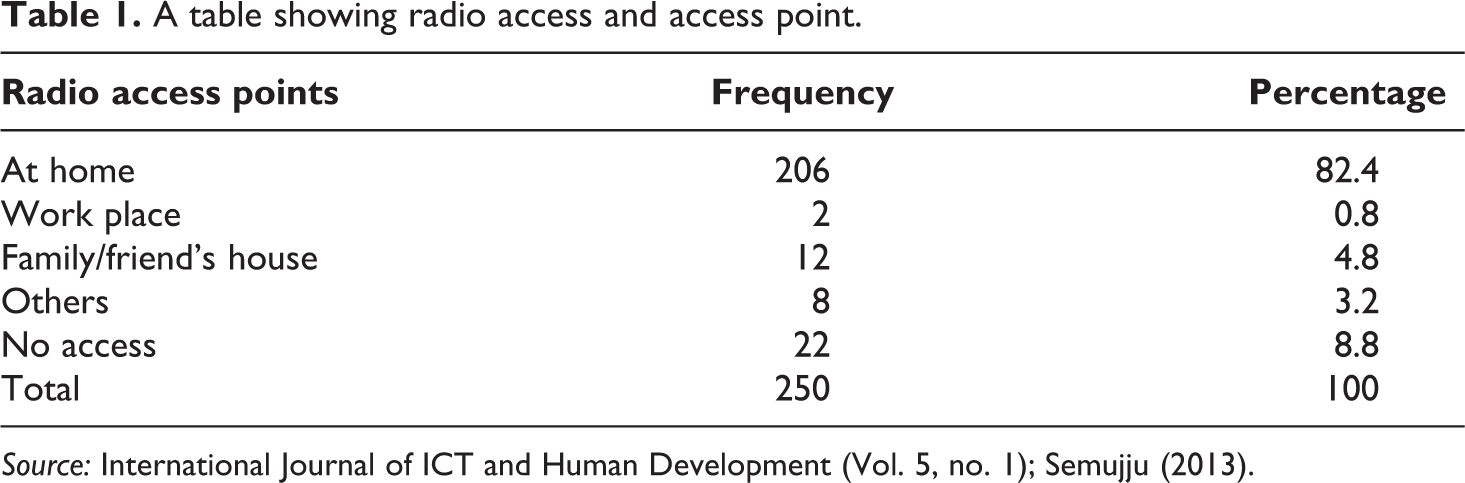
As Table 1 indicates, data from 250 listeners were collected in a door-to-door approach, picking a house randomly, followed by the house after next, alternating between male and female respondents to ensure gender balance. These represented the 1.8 million listeners KKCR commands in five districts of Western Uganda. Additionally, an interview guide was used to collect data through key informant interviews while a focus group outline was used during the focus group discussion. Focus group discussion participants were chosen on the basis of responsibility. They included all the editors and the station manager. The sample of listeners chosen included all age groups (from 18 and above), both sexes and people with different economic and education status. Choosing a house after next (within the Kagadi-Town Council area), regardless of the economic status of that household or education background of inhabitants meant that there was a variety of responses on the income and education variables. For purposes of numeric gender balance, if the first respondent was a man, the next had to be a woman or else the researcher moved to the next house.
A table showing radio access and access point.
Source: International Journal of ICT and Human Development (Vol. 5, no. 1); Semujju (2013).
Population sample and justification
The sample size included one KKCR management group (including the station manager), 10 KKCR journalists (all journalists with no administrative posts), one basic media presenter, two KKCR volunteers (volunteers with the most hours at the station), three policy makers at district and national level: The mayor, the area MP and the secretary of the National Broadcasting Council. These helped to understand the policy and regulation bit of community media and participation. The media workers were fundamental in understanding the technology used and the problems faced. In addition, 250 community members were also interviewed, using a questionnaire, to determine their access and participation in community media.
Findings
Radio access and access points
Most people who participated in the study owned a radio set. These 41.6% owners then created access for those who listened to radio at home but did not own sets themselves. Access in total then shot up to 83.4%. Only 8.8% did not have access to radio. Other places beside home, like bars, friends’ houses and workplace also created more access, although it was limited. However listeners who accessed from these alternatives had no control over the radio sets.
It should be noted that, the radio access figures are changing steadily and so there is a need to initiate studies that will give the most recent picture. Most of the Phone-radio sets are owned by the youths who are a target audience for advertisers.
Participation by choice of station
KKCR’s listeners take up the lion’s share of the general audience. The radio’s 78.8% (197 respondents) dominance is shown in Figure 1.
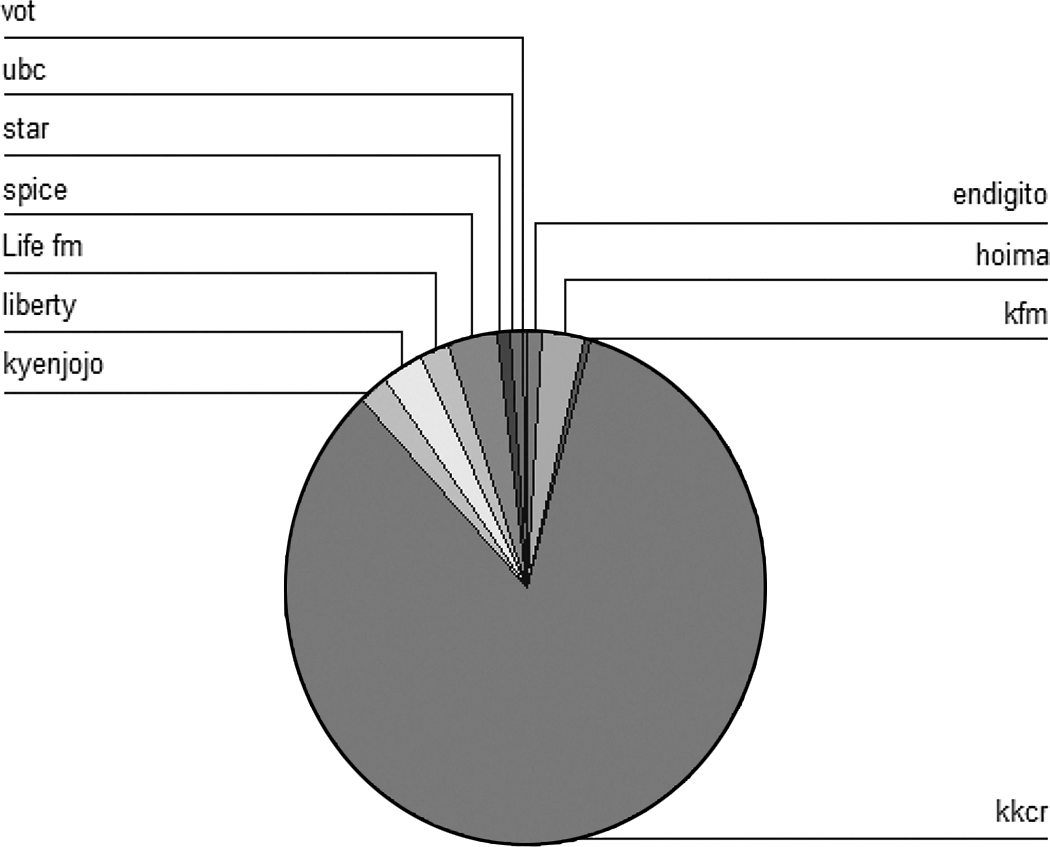
KKCR’s dominance of the community spectrum.
The channel with most listeners would be also determined by how much time someone spends listening to radio. Since it is already established which radio people listened to most and the circumstance under which they listened, another measure of participation was through establishing how much listening was done. Radio and its complements, for example batteries, are important in determining ‘listenership’. The number of people who listened for more hours is likely to be the number of people who would move on to other levels of participation. Such people are ‘propertied’. They can afford batteries.
Number of hours spent on radio a day and working status
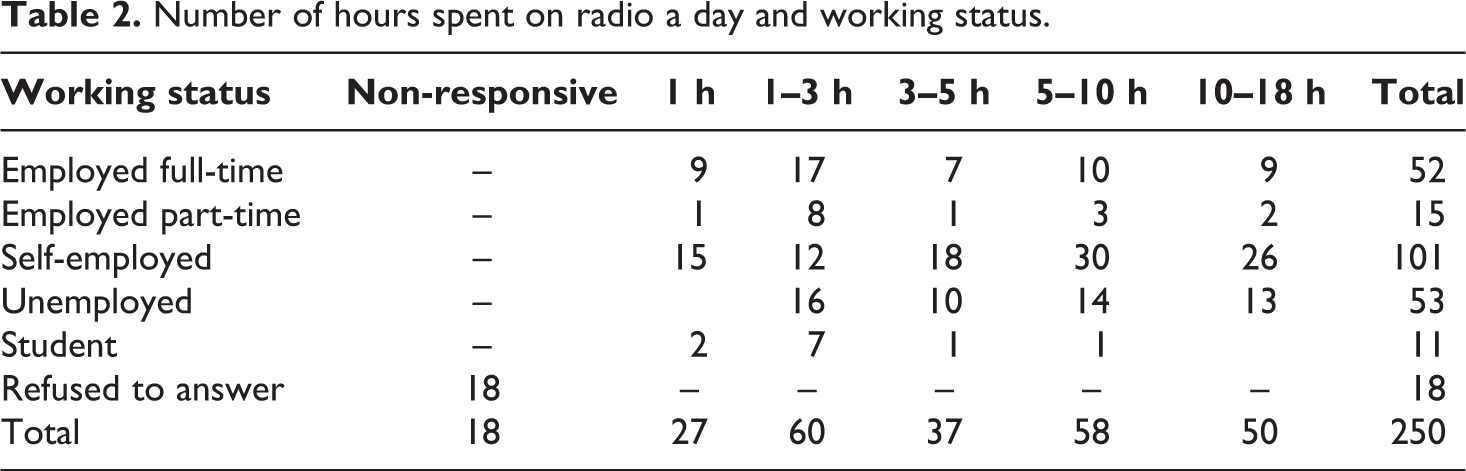
The category of people that listened for the most hours was that of the self-employed. These were 40.4%. They listened to radio for 10–18 h and were the heaviest listeners. There were others whose listening fell between 5 and 10 h, 3 and 5 h, while the least category was for 1 h.
Because the self-employed did blue-collar jobs like carpentry (at small scale), salons and retail shops, they could listen to radio while working. These casual jobs were mostly dominated by women except retail shops that had both women and men. Apart from the unemployed, there were more self-employed listeners than other groups in other categories. Students and part-time workers listened less because of classes (for students) and shuffling between jobs (for part-time workers). Unemployed women, for example, listened to the radio for 3 h. They divided their daily time between house chores like preparing the meals, cleaning the home and listening to radio.
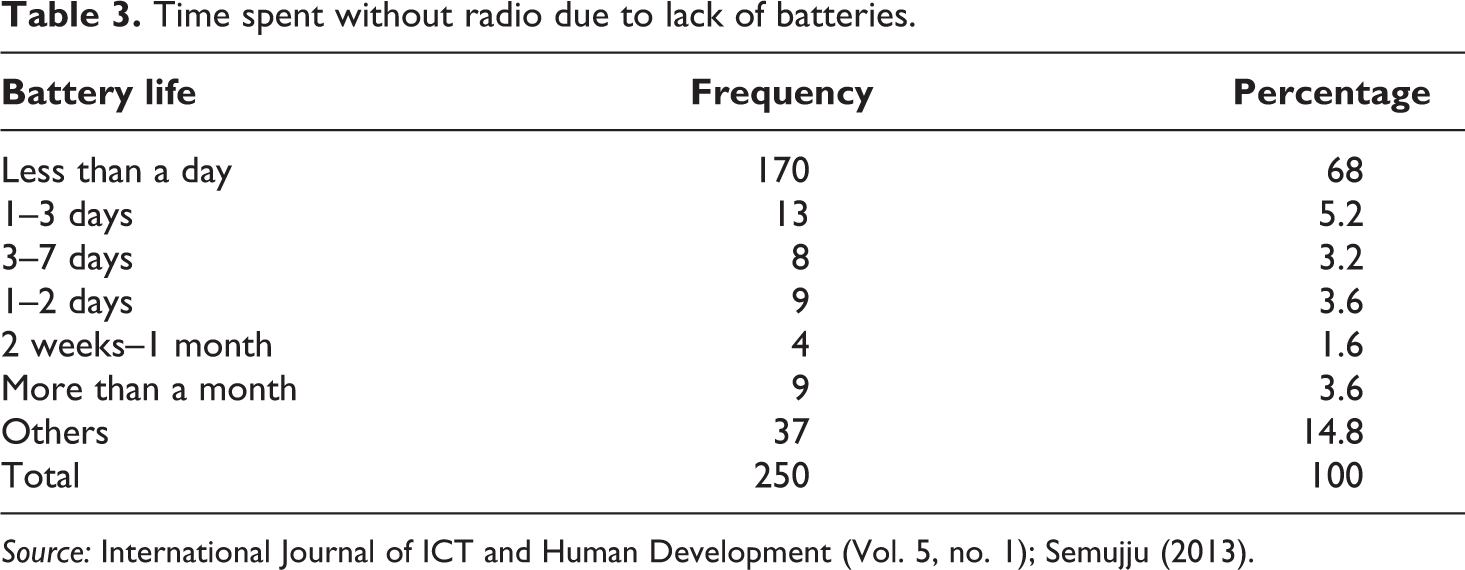
Women in this category said that it was relaxing to listen to their favourite programme when all chores were done. The major problem they faced, which also was mentioned under the student category was that since it was the husbands (or fathers for the students) who bought the batteries, they (women and children) had to listen to radio only during special programmes’ time. The women said that although their husbands had not given them orders to listen to radio once in a while, they themselves listened sparingly in order for the batteries to last longer. Fortunately, the majority of all respondents (68%) were able to replace the batteries within a day of wearing out. The remaining percentage took time before they replaced the batteries. The highest time measured was more than a month, responded to by 3% of the sample size. They also revealed that within that time, they never listened to KKCR.
Using generators was no option for listening to radio except where the person’s major aim for buying a generator was to run a business. Even then, the price of generator fuel made matters worse. By the time of the study, Uganda was suffering from a 14% inflation increase (Kulabako, 2011). Electricity too was unreliable. For example, at the time of the study, power went off for two weeks as KKCR went dead silent (Tables 2 and 3 ).
Number of hours spent on radio a day and working status.
Time spent without radio due to lack of batteries.
Source: International Journal of ICT and Human Development (Vol. 5, no. 1); Semujju (2013).
While the convergence of radio with a mobile phone could minimize some participation problems at the receiver’s end, phones too needed charging, which takes participation back to electricity problems. Charging and other phone-participation hindrances discussed later in this paper made listening vulnerable to external forces and yet if people didn’t listen, there is no way they could give feedback on what they did not know.
Participation by calling-in
During a programme called Greeting Card, the members of the community call-in and communicate with the rest of the listeners. As the name of the programme suggests, content revolves around sending greetings and commenting on topical issues. These topics include culture, health, death announcements, business and several others discussed all across the week.
The above participation slots point to the role of mobile phones in community radio. However, when phones are down, or when the signal is low, there will be little or no participation. This is the case as when electricity is off. Interviews with journalists at the station indicate another disappointment relating to the use of phones for participation which is the failure by some community members to operate their own phones while some who use them might not use all the functions. On top of that, the station manager said that some callers have to be cut off because of the feedback noise that comes through when a person fails to move away from the radio set because he/she wants to talk on phone while listening to his/her voice over the radio at the same time. No amount of sensitization has managed to change this.
Phones therefore make participation to be only for a few people. The station manager also said that out of the 60 phone calls the station might receive daily, some callers may be recorded for having called more than two times. In the end, it may be that only half of that number of people has participated. People still do not know how to manage radio and phone participation. Some of them call and fail to know that they are already on air and so continue conversations with friends after which a delayed hello comes. Meanwhile, all this time, other callers may be waiting on line. In other cases, callers go through and fail to say anything. They shy away without saying hello. The station manager observed that this congests the line and instead of having 50 or 60 callers a day, you may find that only 30 people participate.
Nevertheless, telephones make interaction easy and fast. The alternative for nearby community members would be to walk to the studio and give their views. Unfortunately, the expense of phones and the literacy level plus lack of exposure limits the community from using internet services like social networks and emails.
Generally, it is evident that radio and phones have profound effects on community participation although not on participation for all. What one person says on radio through the phone or what that person says to others about the technology affects the listeners and their participation choices and efforts.
The contribution of ICTs to participation
Access to internet. Like computer, which had 79.2% of the respondents say they did not know it, internet had few users. Data show that 172 respondents (68.8%) did not use internet while 42 respondents (16.8%) had never heard of the internet. Because of convergence between mobile phone and internet, 36 (14.4%) people said they used the internet on their phones. Most of these people used the internet to access news. This was followed by sports, education, music, while social network sites like Facebook and Twitter came at the very bottom among users.
The community participation landscape of KKCR is filled with different types of participation. The phone and the computer have revolutionized radio participation in countries with greater Gross Domestic Product (GDP). According to the International Monetary Fund (IMF) rankings, Uganda is the 20th poorest country in the world (Global Finance, 2012). It is little wonder therefore that as the findings indicate, community participation is greatly hampered by poverty related problems. Until those problems are solved, participation for all is impossible.
Challenges faced by community participation
Some volunteers admitted to not having any computer skills. Other would-be participants did not have access to ICTs and were unable to walk 45 km to the station to share their views.
The distance problem was compounded by insecurity. The female volunteers said that walking through the forest all by themselves, especially when their programmes end at midnight, would be too much a risk. One of them said that sometimes she missed her programme because of that fear.
The other problem is commercialization. For each voice of a volunteer that goes on air, an amount of money must have been paid by the stakeholders the volunteer is trying to promote. This makes KKCR’s community participation far from free. The people who participate by reading their own adverts live also have to pay. At the end of the day, there is a very thin line between commercial and community broadcasting.
Political influence also stifles participation. Some participants have been stopped from speaking on air because of their critical views of the current government. The existence of political tension at the station was denied by the station manager saying that there could never be such tension since ‘all of us here support the ruling government’.
Participation as a normative notion
What makes community media a normative notion is that those media have failed to succeed among poorer communities.
Today’s community media should correspond with an advanced community (society). The growth from community to society, which should warrant a more complex media like community media, was conditioned by Ferdinand Tonnies (1887) on the advancement of capitalism, industrialization and urbanization. Uganda fails across the board on Tonnies’ weighing scale. There are still some areas like the military, water and revenue service where the private sector cannot invest and yet economic freedom has been cited as the major cause of development among the Asian Tigers (Weede, 2006). On urbanization, data from the Uganda Bureau of Statistics (2012) indicate that Uganda’s urban population is growing at 5.6% per year, but 86.7% of the total population (Uganda has 34.1 million people) live in rural areas and survive on agriculture.
Way forward: What community are we serving?
If community media are based on the definition of community, then we should look at community from a poor person’s perspective. The success of community media elsewhere, like in Europe and America cannot be undermined though. The communities found on those continents are more privileged than all communities in Uganda. The failure of Uganda’s community media can be found in the differences between the west and southern communities.
A quick look at an American community media set-up reveals some differences. In the United States, there is what is called the Grassroots Radio Coalition specifically to lobby for grassroots/community media interests. This group comes from the communities served by some community media. Made up of listeners, the group hosts annual conferences promoting awareness against commercialization of radio (Grassroots Radio Coalition, 2011). The members have a mailing list which allows them to get information on a timely basis and this group acts as a link among different community media listeners. The community media activities of the group are funded by listeners and well-wishers. These community media operate in good infrastructures, better health care system, better education system and better legal frameworks. The ‘grassroots’ they serve, therefore are different from the one served by KKCR and so the two cannot use the same communication process for development. Below is a look at the circumstances under which the KKCR person lives.
There are three passenger service vans that transport people 260 km to the capital city. The interval of their departure is 3 a.m., 12 p.m. and 3 p.m. If one misses the 3 p.m. van, he/she has to wait until 3 a.m. the following morning to get another one. From the station to the capital city, the road is only clear towards the last 160 km. The condition of the first 100 km of the road depends on whether it’s a dry season (dusty) or a rainy one (slippery). The area has one hospital, no university and no free-to-air TV channels that the rest of the country enjoys. With lack of those important infrastructures, the community resources are prioritized towards basic survival needs than purchasing participatory communication technology.
Alternative to community media: Basic media
After analysing community media problems earlier, I have proposed basic media as a solution to solve community participation problems.
Basic media are ‘community-accessible media that provide on-time information about people’s basic needs and suggest immediate solutions’ (Semujju, 2013:31). Such media try to cut-off the bottlenecks of development communication like poverty that may block the communication process. These media appeal to solutions that are realistic for a given poor community. They do this by setting no obligation for anyone who wants to receive information. Whether rich, poor, illiterate, distant or handicap, one can have access to information. Since the effort of taking information to the listener has been proved to be dividing people, we can try to take the people where information is using basic media.
Appropriate technology
One of the several examples of basic media is found at Kitara Institute of Commerce in Western Uganda. Radio KICO gives the community information on health, education, commerce and news. The name of the station and the programming create an atmosphere of a real radio broadcast except that Radio KICO uses a horn-speaker on top of the roof and a small built speaker inside the studio that regulates sound quality back for the presenter, a computer, an amplifier and a microphone. The simplicity of basic media gives it an extra edge over more complex media forms. ‘There is an exchange of information between the listeners and the presenters through small pieces of paper that they write and submit for us to read’, said one presenter at Radio KICO. Besides that easy access, the media are cheaper to run in terms of human resource and logistics. Among other advantages of radio KICO is that the institute’s journalism students use the studio for training.
The fact that people, through their own effort, established these fragmented media all throughout the districts of Uganda is evidence that there was a communication gap that needed to be filled, created by the current mainstream and community media set-up. People therefore resorted to smaller simple communication forms that could deliver information effectively without having to pressure them.
However, as I have argued before, if there is to be success in basic media, there is need to subject their processes to the kind of careful study that community media have undergone for the last 20 or more years (Semujju, 2013: 31). There are challenges facing basic media that need serious scrutiny. These media, first of all, are not documented by Uganda Communications Commission. There is no information on how many they are, within what distance they should operate from each other and the attitude of the communities towards them especially on whether or not they are considered as information liberty or noise. These and more constitute some of the problems discussed below.
Problems with basic media
The National Environment Management Authority in Uganda fights pollution including noise and yet this is one area that basic media have no control of. Careful studies should solve that issue by analysing the sound decibels of the horn-speakers needed only to serve a particular community. The other challenge is that for one to have a choice of station, he/she would still have to move to another location. This is one area that has failed community media too in Uganda. For example, KKCR has to go off at midnight for the other radio stations to stream in. This problem can be solved by creating a policy that will regulate basic media.
Conclusion
Understanding community media’s ineffectiveness to the rural person can best be achieved by critically looking at community as done earlier. From the data given earlier, it is evident which community deserves which media and at what stage. Community media as currently known do not fit the profile of most of Uganda’s communities. They are appropriate for western communities. Mobile phones and radio continue to aid participation in Kagadi-Kibaale community. Most people in the community have access to them. However, complexities of mobile phones, load shedding, illiteracy and other problems make community participation a privilege. Therefore, participation for all is impossible. With access and participation for a few and lack of self-management, community media do not differ from commercial media. A paradigm shift in development communication to adopt a more participation-friendly media based on the nature of community is long overdue. This paper proposed basic media to fill that void.
Footnotes
Acknowledgment
Appreciation goes to Associate Professor Monica Chibita, Department of Mass Communication, Uganda Christian University, for her valuable comments on the paper.
Funding
Special thanks go to Carleton University and the International Development Research Centre (IDRC) for funding the project.