




Abstract
This study examines how journalists in Latin America, specifically in Argentina, Brazil, Colombia, Mexico and Peru, view their professional roles in today’s digital media landscape. This study is part of a larger research project of an online survey administered to journalists in Latin America. In particular, this study examines through a comparative analysis how journalists in Latin America perceive their journalistic role and what forms of digital and social media are becoming parts of the journalists’ daily work in this region. Survey findings show that the interpretive and populist mobilizer roles resonated the most among the countries sampled. Furthermore, these journalists are engaging in specific digital and social media tasks for daily newsgathering and reporting routines in their respective newsrooms.
Keywords
Today’s global media climate is undergoing a major transformation about how the media business operates and functions (Stone et al., 2012). There are different regions around the world that are experiencing this transformation differently – one of those regions in particular is Latin America. According to a recent World Association of Newspapers report, the news industry in Latin America is experiencing an increase in news circulation and readership (Riess, 2011). A recent Economist article also highlighted how countries in Latin America like Brazil are experiencing a surge in news readership, and regions like South America are experiencing a 5% increase in newspaper circulation (Bulletins from the Future, 2011).
Specific examples of digital journalism transformation are popping up in Latin America in legacy news operations in places such as Argentina, Brazil, Colombia, Mexico and Peru. Argentina’s media system has been transforming with the emergence of data-driven journalism techniques in recent years. Specific organizations and journalists are now hosting hacking festivals and contests for journalists in the country (Argentina: Launch an Innovation, n.d.). The Argentinean newspaper, La Nacion has begun to acquire a national and international reputation in Argentina for its recent digital journalism and data-driven journalism work with public data (Knight Fellows, 2012). Brazil has also been innovating with its digital journalism and data-driven journalism efforts with conferences, hacking festivals, and data-driven investigations (Journalists and Technologists, 2012) in the same capacity as Argentina. In Colombia, Bogota’s newspaper of record, El Tiempo, has recently embarked on a digital, crowd-sourced initiative to map crime and corruption in the country using specific digital technologies that earned it an international grant (Lovler, 2012a, 2012b).
In Mexico, journalists are creating new journalism entities, or non-legacy organizations via the digital and print platform such as Animal Politico (2010). The momentum of an entrepreneurial effort is underway in Mexico with its first masters program in digital journalism geared toward entrepreneurial journalism (Breiner, 2013). In addition, a new journalism organization in Mexico has formed to serve as a collaboration for cross-national investigations with other news organizations and journalists in Colombia, El Salvador, Guatemala, Brazil, among others (Lara, 2013). Furthermore, legacy media such as El Universal and Grupo Reforma have been experimenting with various digital strategies with their online products in recent years with mobile, digital subscriptions, multimedia content and other efforts.
In Peru, similar entrepreneurial efforts are also underway. One example is Etiqueta Negra, which has grown to have a circulation of 11,000 in only four years (Vigil, 2006) in the country. In addition, the Peruvian media landscape is transforming as news operations become decentralized, prices for news products drop and subscriptions change from the print to digital model (Zeta de Pozo, 2009). Specific news organizations like El Comercio, Peru.21, and La Republica are incorporating various forms of news sharing, social media, and multimedia into their online products (Zeta de Pozo, 2009).
We can identify that legacy and non-legacy media operations in the countries aforementioned and elsewhere in Latin America are now using the digital platform in three ways to explore (1) new forms of multimedia storytelling through mobile and tablet platforms, (2) audience engagement through social media channels, and (3) new ways of doing investigative journalism with sophisticated data-driven techniques (Dorroh, 2013; Paz, 2013).
Today, legacy and non-legacy media organizations around the world including those in Latin America are facing dramatic changes to the news production and distribution process. Many news organizations are dealing with more content that is multimedia in nature resulting in the need for new content management and publishing processes to accommodate new storytelling options such as video, audio, and animation. These changes not only bring about technical change but the need for new skill sets for the journalist to learn ranging from data analysis to multimedia production. In a survey of global media managers, 62% said they would like to invest in developing their organization’s journalists’ skills in the next 12 months as part of their improvement and development strategies (Stone et al., 2012: 13). Many news organizations say they need to improve their operations by arming their staff with the latest digital skills, but the actual resources to do this remain an issue in many newsrooms due to cost, resources, and time (McLellan and Newton, 2012).
Social media has also brought about new challenges and opportunities for the news operation around the world including Latin America. Based on the same global media manager survey, 57% of publishers said they consider social media to be an opportunity for their organization in the next five years (Stone et al., 2012: 7). Nowadays, news organizations on a daily basis are experimenting with platforms such as Facebook, Twitter and Pinterest to see how these channels can be used in the journalistic process. The number of organizations now hiring journalists with social media skills continues to grow at a fast pace (Hermida, 2010; Singer et al., 2011).
As identified, newsrooms around the globe and in Latin America are facing a multitude of challenges and opportunities that impact the business operation, the news production process, the tools and techniques used in the journalistic process, and the kind of skill set required of today’s journalist in order to perform their daily news work that incorporates a digital and social media focus. Based on the major digital transformations underway in specific countries in Latin America as discussed above, this study examines how journalists in Argentina, Brazil, Colombia, Mexico and Peru perceive their journalistic role today as digital and social media are becoming a part of the journalists’ daily work in this region.
Literature review
In order to understand how journalism and journalists are transforming in Argentina, Brazil, Colombia, Mexico and Peru, it is necessary to understand how journalism and the role of the journalist has been examined by media scholars from a sociological theoretical framework.
Sociology of news work
This study is based on sociological approaches of the news creation process that examines how journalistic routines can impact the profession and its current and future development (Boczkowski, 2010; Deuze, 2005, 2007; Singer, 2003, 2005). It is through this lens that we can understand how journalists’ work can be deciphered and explore how this work defines the journalist and the craft. There is a rich history of scholarship devoted to the sociology of news work in the USA and how the journalist’s role has evolved over the past century (Deuze, 2002, 2005, 2007; Johnstone et al., 1976; Singer, 2003, 2004, 2005, 2006; Singer et al., 2011; Weaver, 1998; Weaver and Wilhoit, 1986, 1991, 1996; Weaver et al., 2007) and how this work has influenced other scholars globally to use a similar sociological lens for comparative research (Deuze, 2002; Deuze and Paulussen, 2002; Deuze and Yeshua, 2001; Henningham, 1996; Herscovitz and Cardoso, 1998; Mellado et al., 2012; Wilke, 1998; Zhu et al., 1997).
Through the work of Johnstone et al. (1976), Weaver and Wilhoit (1986, 1991, 1996; Weaver et al., 2007), and most recently Weaver and Wilnat (2012), we can see how the journalist’s role has evolved over the decades by analyzing their routines. Routines can be defined as those practices and tasks that are repeatedly done throughout the day by the journalist (Weaver et al., 2007).
Country details.

July 2011 estimates.
July 2012 estimates according to CIA World Factbook (n.d.).
Note: Estimates from 2011–2012 were used to correspond with the timing in which the survey was administered. The survey was conducted in 2012.
Media ownership and state intervention in media by country.

Note: Information based on recent reports by country from Freedom House (n.d.), CIA World Factbook (n.d.) and relevant chapters from Albarran (2009).
One-way analysis of variance of professional role conceptions.

Note: Scale ranges from 1 = not important to 4 = extremely important. Significances calculated by one-way independent ANOVA, using Kruskal–Wallis test.
p < .001.
p < .01.
p < .05.
Scholars have examined these particular journalistic roles in countries around the world and have identified some commonalities as well as differences with these professional roles in different regions of the world including Europe (Deuze, 2002; Deuze and Paulussen, 2002; Deuze and Yeshua, 2001), Asia (Deuze, 2002; Henningham, 1996; Zhu et al., 1997), the USA (Beam et al., 2009; Cassidy, 2005; Deuze, 2002, 2007; Plaisance and Skewes, 2003; Singer, 2003, 2004, 2006; Singer et al., 2011; Weaver, 1998; Weaver and Wilhoit, 1986, 1991, 1996; Weaver et al., 2007) and Latin America (Arroyave and Barrios, 2012; Herscovitz, 2012; Herscovitz and Cardoso, 1998; Mellado, 2012; Mellado et al., 2012; Wilke, 1998). In regards to Latin America, studies conducted in this area on journalistic roles have been limited to only a few (Mellado, 2012). Most Latin American journalism studies have mainly focused on media institutions, social construction of messages and the audience instead of the producers of the messages (Mellado, 2012).
Latin American studies on journalists’ roles
Of the few studies that have explored the journalists’ role in Latin America, scholars have identified that the professional roles of disseminator, populist mobilizer, interpretive, and the adversarial role do apply in certain countries (e.g., Argentina, Brazil, Chile, and Mexico), but must be appropriately contextualized within the cultural, political, sociological, and economic nuances of the countries examined.
One study (Wilke, 1998) examined the role of Mexican journalists and found that they considered themselves in the adversarial and interpretive role. Furthermore, 77% of Mexican journalists also felt that their freedom of press was endangered, and two-thirds named political institutions and the government as the groups that would threaten this press freedom. These findings must be understood within the framework of how much the press has had to fight for press freedom in Mexico over the years and how much the government and political situation in the country has created a difficult environment for the press to thrive there (Alves, 2005; Lawson, 2002; Wilke, 1998). Within the past decade, Mexico has faced a difficult and tumultuous time of violence from drug wars and organized crime activities that have impacted many news organizations, journalists, and general press freedom in the country (Correa-Cabrera, 2012; Edmonds-Poli, 2013; Molzahn et al., 2012; Monroy-Hernandez et al., 2013).
A study (Herscovitz and Cardoso, 1998) of Brazilian journalists found that they perceived themselves in the interpreter/investigative and adversarial role. About 80% considered it important to investigate the government and 67% said they considered it important to provide analysis to complex problems. Another study (Herscovitz, 2004) of journalists from Sao Paulo, Brazil also showed that of the 402 journalists surveyed, they ranked the disseminator role the most important at 77% followed by the interpreter role at 66% (p.84). In 2012, in another study, Herscovitz identified that of the 506 Brazilian journalists she surveyed, she found that interpreter and investigative role were prominent. Investigating government claims, providing analyses to complex national problems were the main tasks that they still felt were important to their daily work. However, the disseminator role was less important where only 39% of journalists felt this was their main role (Herscovitz, 2012). Herscovitz attributes this change from 1998 to 2012 in role to the effortless task nowadays of posting to the Internet quickly that has made it a nonissue to many. Furthermore, the adversarial role was also identified as less important in 2012. The researcher (Herscovitz, 2012) attributes this change to the numerous lawsuits and censorship orders against the press that may have impacted this difference in role.
Brazil’s history illuminates these findings considering that there has been a long and ‘tense relationship’ between the government and press since the 18th century in the country (Alves, 2005; Herscovitz and Cardoso, 1998). The lack of democracy, institutional corruption, high levels of censorship, and social disparities have marked Brazil’s past and have had a significant impact on the press in the country and the journalists’ perception of their role for decades (Herscovitz, 2012). Furthermore, Brazil has experienced military coups and dictatorships in the past and now remains in a period of democracy that has seen a fast rise of the middle class and has become a fast economic power in Latin America and around the globe that has positively impacted the press and journalism practices in the country (Alves, 2005; Rosas-Moreno, 2013).
Arroyave et al. (n.d.) conducted focus groups with journalists in Argentina, El Salvador, Dominican Republic, and Uruguay and found that the journalists perceived their role as active communicators, wanting societal change and being in a position they felt where they could promote social change. The researchers identified that the professional roles of the disseminator and the adversarial role were the most applicable to the journalists who participated in the focus groups.
Mellado et al. (2012) conducted interviews with 300 journalists from Chile, Brazil, and Mexico and identified that the journalists perceived their role as investigative. Furthermore, the researchers identified that the journalists from Brazil and Chile had more of a focus on the analytical and interpretive functions of the profession than journalists from Mexico.
In recent years, other researchers have explored the impact of the digital platform on the journalist’s role in Latin America.
Herscovitz’s (2012) study of 506 Brazilian journalists identified that they were using the digital platform to assist with basic news tasks (e.g., reading other media, dealing with press releases, researching information, and source generation), but not all tasks (e.g., fact-checking, audience engagement, curating data and conducting analysis). She found that journalists found a growing interest in social media with 64.7% using Facebook, 53.4% blogging, and 47.2% using Twitter. Overall, the journalists found the digital platform was helping in the areas of dissemination, diversity, and feedback, but also creating accuracy, credibility, and precision issues (Herscovitz, 2012).
Boczkowski (2010) examined digital journalists’ work in two Argentinean newsrooms to find that homogeneity runs the newsroom and contributes greatly to a disseminator-like role. Despite the cacophony of information available in today’s digital media landscape and the opportunity to tell many stories in different ways across various digital platforms, he found less news being produced in the newsroom.
Garcia (2008) examined journalists at work in an Argentina newsroom and their ability to negotiate their professional identity and autonomy in the workplace. He identified that the online journalists in the online newsroom felt they were second-class citizens to the print operations and had to fit into what the print operation’s needs were at any given moment.
These studies have shown varied results of how the interpretive, populist mobilizer, adversarial, and disseminator roles are perceived among journalists in Latin America in countries such as Argentina, Brazil, and Mexico. To date, no studies have captured this information on journalists in Colombia and Peru. The research conducted on journalists in this region remains sparse and this study seeks to contribute to the existing scholarship by examining the following question in this study:
RQ1: What journalistic roles (interpretive, adversarial, disseminator and populist mobilizer) do journalists identify with the most in Argentina, Brazil, Colombia, Mexico and Peru? RQ2: What journalistic roles (interpretive, adversarial, disseminator and populist mobilizer) do journalists identify with the least in Argentina, Brazil, Colombia, Mexico and Peru?
Digital media routines
As mentioned earlier, the way journalism is produced and distributed today reflects a new form that incorporates digital and social media components. Defining the journalist today can be complicated and quite nuanced as Deuze (2005) suggests that the professional ideology and identity of journalists globally must be looked at from a multimedia and multicultural lens. It is necessary to take this perspective to see how much it is shaping the profession today and its impact on the public service role, the objectivity, the level of autonomy, the sense of immediacy, and ethics that make up some of the major values of the profession.
Furthermore, the growing use of digital media in the newsroom (e.g., the use of digital video cameras to the mobile device for mobile reporting) makes it necessary for journalists to also be adept at several digital technologies in order to produce and publish the news. There are new dimensions in news work (e.g., from posting blogs to creating multimedia story packages) that now rely on the multiskilled and multiplatform journalist than ever before creating different levels of power and authority in some newsrooms (Robinson, 2011) among those who are digital media-adept over those who are not.
Pierce and Miller (2007) found that in today’s complicated media environment, basic journalistic skills remain important in the news industry in general such as writing, reporting, and critical thinking, but journalists must also recognize that they need to work on building other digital skills. Of the 311 editors surveyed, they placed higher importance on computer-assisted reporting and online reporting skills than in a previous survey conducted. ‘Although writing and spelling may always be important skills for new journalists, the growth of technology and the blending of electronic and print journalism – convergence – is changing the face of journalism’ (Pierce and Miller, 2007: 53).
The influence of technology on the journalist’s work is one factor, but also its impact on professionalism is another factor. The technology is not separated from the journalist’s role: People tend to assume the behavior, forms, structures, and in this case, communication procedures that are associated with the new technology, and this influence often produces common cultures of practice across different social contexts …. The influence of technology cannot be separated from the social context in which technologies are adopted and implemented, of course, and we should not exaggerate the standardizing effects of technologies of mass communication (Hallin and Mancini, 2004: 260).
Thus, this study seeks to find out exactly what kind of technology and furthermore, technological procedures such as routines in digital media (e.g., fact-checking online, downloading data, finding sources online, etc.) impact the journalists’ work daily in their respective newsrooms as well as how these routines may be impacted by their journalistic role:
RQ3: What are the digital media routines that journalists from Argentina, Brazil, Colombia, Mexico, and Peru engage in? RQ4: Does journalistic role (interpretive, adversarial, disseminator and populist mobilizer) impact the kinds of digital media routines that journalists from Argentina, Brazil, Colombia, Mexico, and Peru engage in?
Social media routines
Social media platforms like Twitter now provide another public communication component to journalistic routines in newsrooms around the globe. ‘Twitter presents, to an even greater degree, the possibility for changes to journalistic norms –i.e. for journalists to be more open with opinions, more liberally in sharing their gatekeeping role, and more thorough in being transparent about the news process’ (Lasorsa et al., 2012: 24).
Social media is having an impact on the journalist and their daily routines. Hermida (2010) calls it a form of ‘ambient journalism’ which creates an awareness system that ties into the monitoring of public opinion and the opportunity for dialog with the public on important issues in society as part of the journalistic process. Platforms such as Twitter ‘facilitate the immediate dissemination of digital fragments of news and information from official and unofficial sources over a variety of systems and devices’ (Hermida, 2010: 298).
Lasorsa et al. (2012) found in a content analysis of 22,000 journalists’ tweets from Twitter that the main forms of communication the journalists were using for this platform were in the areas of linking and opining on the microblogging platform. Forty-two percent of the journalists were linking to content in their tweets, 27% minor opining, and 20% included personal information in their tweets (Lasorsa et al., 2012: 29).
Based on these studies, it can be summarized that journalists are using Twitter and other social media platforms for more than dissemination of news, but using these platforms for moderation, analysis and engaging in dialog with various publics.
Social media platforms are a unique form of technology. Deuze (2007) contends that technology has always had an impact on the news industry – from manual typesetting to desktop publishing. ‘However technology is not an independent factor influencing the work of journalists from the ‘outside’ but rather must been seen in terms of its implementation, and therefore how it extends and amplifies previous ways of doing things’ (Deuze, 2007: 53).
Thus, this study seeks to extend on these previous studies to find out exactly what kind of social media platforms are journalists using, how are they being used and if journalistic role impacts their social media use in the newsroom:
RQ5: Does journalistic role (interpretive, adversarial, disseminator and populist mobilizer) impact the kinds of social media use by journalists from Argentina, Brazil, Colombia, Mexico, and Peru? RQ6: What social media channels do journalists from Argentina, Brazil, Colombia, Mexico, and Peru use and in what ways?
Comparative media analysis method
This study used an online survey to examine the perceptions about the journalists’ daily work. This study is part of a larger research project that was conducted in February–March 2012 and administered to 16,678 journalists in Latin America. This study focuses on a portion of this larger study, examining 444 journalists surveyed from Argentina, Brazil, Colombia, Mexico, and Peru. These five countries were selected from the overall larger study based on the Hallin and Mancini (2004) framework for comparative country analysis.
The comparative media analysis method used in this study helps to show not only the similarities, but also the differences between countries. This is a method that has been used in several studies of journalists across the globe (Boczkowski et al., 2011; Deuze, 2002; Hanitzsch, 2011; Hanitzsch and Mellado, 2011; Hanitzsch et al., 2010a, 2010b; Henningham, 1996; Mellado et al., 2012; Weaver, 1998; Zhu et al., 1997).
Comparative analysis is an important method that provides an opportunity to test existing notions and expand our theoretical understandings and empirical research: Adopting cross-national approaches that compare differences and similarities in press structures and journalistic practices seems a promising path to strengthen theoretical frameworks, refine research questions, and enrich empirical conclusions. Just as with any other ‘area studies’, keeping a bifocal view on Latin American journalism is necessary: conducting research to capture local conditions and respond to region-specific questions, while remaining in dialogue with broad debates in journalism studies. (Waisbord, 2009: 395)
Furthermore, comparative analysis allows for the examination of the ‘role of concept formation and clarification and its role in casual inference’ (Hallin and Mancini, 2004, p.2). Hallin and Mancini’s (2004) framework for comparative media studies includes four dimensions: (1) media market development based on the strength or weakness of a country’s mass media, (2) political parallelism which identifies the extent the media system reflects political makeup of the country, (3) development of journalistic professionalism in such a country and the (4) extent of state intervention in the media system in such a country (21).
Hallin and Mancini (2004) have used this approach in a North American and European context, and they also state that it can also be adapted to Latin America. Mellado et al. (2012) used this approach previously in examining the differences in journalists’ perceptions between Argentina, Mexico, and Chile. These four areas are the criteria by which the countries were selected for comparison for this study. The following explains each country and how they align to the four dimensions (Hallin and Mancini, 2004). See Tables 1 and 2 for country specifics and media ownership by country details.
Four dimensions of comparative analysis
The development of the media in Argentina, Brazil, Colombia, Mexico and Peru has evolved in the last century albeit in different forms. Peru’s media system is unique as they have a combination of state-owned, private and indigenous media. The other four countries operate within a climate of government-owned television and radio stations as well as private media that includes newspapers and broadcast. Each country has a media conglomerate and/or several large media companies with ownership over a substantial amount of programming and media content across platforms – such as Grupo Clarin in Argentina, Globo in Brazil, TV Azteca and Televisa in Mexico, for example. In some cases, the government has intervened in the media market ownership game as the Argentina government recently forced Grupo Clarin to surrender a large number of its broadcast holdings to diversify ownership in the country (Argentina-Freedom House, 2013b). In Mexico, a broadcast duopoly plays out between Televisa and TV Azteca, accounting for 90% of the market (Mexico-Freedom House, 2013b; Renteria, 2009). The media market in Mexico has undergone varying market strategies over the past two decades – television has undergone major market concentration, the press has followed a monopolistic model, and other media outlets have remained small and niche (Renteria, 2009).
As for the digital and social media landscape, Brazil leads the group with 75.9 million Internet users. The country has 42 million Facebook users and is the fifth largest group in the world to be on Twitter according to a 2012 report (Brazil-Freedom House, 2013a). Civic activism on social media channels in Brazil is growing as the public is increasingly using the platform for voicing their opinions on electoral campaigns, sanitation concerns, and indigenous rights (Brazil-Freedom House, 2013b). Mexico has a strong connected population with 31 million Internet users. Yet, there are issues of Internet access in the rural areas of the country due to cost and infrastructure (Mexico-Freedom House, 2013a). In addition, criminals in recent years have attacked citizens for reporting crimes online (Mexico-Freedom House, 2013b). However, social media platforms have provided an outlet for mobilization and activism in which citizens have used the platform to warn each other about violence among the cartels and safety issues in their communities (Mexico-Freedom House, 2013a). A 2012 report highlighted there were 38 million Facebook users and 11 million users on Twitter as of 2013 (Mexico-Freedom House, 2013a). Argentina is another country with a strong wired population with 13.6 million Internet users. A report from 2012 highlighted that there were 20 million registered Facebook users and 1.6 million Twitter users (Argentina-Freedom House, 2013a). In 2012, a major antigovernment protest was mobilized through social media called 8 N. (Argentina-Freedom House, 2013a). Colombia and Peru also have growing wired populations with 22.5 million and 9.1 million Internet users respectively. Less is known currently about the number of social media users in both countries at the time of this study.
Politically, the five countries have similar democratic infrastructures within their own federal or constitutional republics. Argentina and Colombia are republics, Brazil and Mexico operate as federal republics, and Peru is a constitutional republic. Argentina, Brazil and Mexico operate within a multiparty system. In Argentina, it has a multiparty political system although the Peronists have been dominant for decades (Argentina-Freedom House, 2013b). The country has experienced its fair share of ups and downs in the past century in which it has had stability but other moments of political upheaval, various coups d’etats, and financial crises that have impacted the media market (Silvestri and Vassolo, 2009). Brazil is also a multiparty system and encourages competition between rival parties (Brazil-Freedom House, 2013a). The Worker’s Party 9PT remains the prominent group in government for 12 years running (Brazil-Freedom House, 2013b). Mexico’s multiparty system consists of the PAN, PPD, and PRI. The dominant party has been the PRI, which has ruled Mexico from 1929 to 2000 and recently regained control in 2013 (Mexico-Freedom House, 2013b). Colombia and Peru do differ from the other countries. Colombia has a liberal-conservative duopoly and progress has been slow to include other voices (e.g., Afro-Colombian, indigenous groups) into government structure (Peru-Freedom House, 2013). The country has had a stable democracy but periods of violence from the guerrillas and paramilitary organizations have interrupted that stability from time to time in the past century (Forero et al., 2009). In Peru, the country operates as an electoral democracy with a right-wing party, center, and left-wing party. In the past decade, the country has faced issues of official corruption, political fragmentation, and polarization (Peru-Freedom House, 2013).
As for state intervention, journalists in each country have had to overcome many challenges in their daily work ranging from censorship to kidnapping, while the attainment for a completely free press system remains a long-term goal in each country (Radsch, 2014). Argentina’s press continues to experience challenges with the government on information rights and press freedom. Recently, its Senate passed a right to information bill but it remains in a holding pattern. The country does have a high Internet penetration rate but an urban-rural gap remains and the government has tried to help this effort with a five-year plan to expand ICT infrastructure throughout the country (Argentina-Freedom House, 2013a). In Brazil, they also continue to experience challenges with the government in the areas of censorship and press freedom. Violence against the press remains a factor. The country instituted a Freedom of Information Act in 2012, though some cities and states have not yet fully implemented it (Brazil-Freedom House, 2013b). It has a strong connected population with 75.9 million Internet users, yet access for all is uneven due to issues of social inequality, infrastructure, and poor education in the country (Brazil-Freedom House, 2013a, 2013b). The country has tried to combat this with several initiatives including a National Broadband Plan that aims to triple broadband access in the country by 2014 (Brazil-Freedom House, 2013a, 2013b). In Colombia, violence against journalists continues to be an issue. Press freedom was instituted in 1991, but journalists continue to face censorship and other attacks on the press. The country does not restrict or censor Internet access, and social media platforms have become a growing force in political discourse in the country (Colombia-Freedom House, 2013). Mexico has experienced the most difficulty in comparison to the other countries in recent years in terms of violent attacks against journalists, press freedom issues, issues with access to information, and media censorship (Correa-Cabrera, 2012; Edmonds-Poli, 2013; Molzahn et al., 2012; Monroy-Hernandez et al., 2013). Organized crime, violence and official corruption remain serious problems in the country (Mexico-Freedom House, 2013b). As for Peru, it remains stifled at local and national levels despite being granted press freedom in 1993. Access to information laws were passed in 2002 and 2003, but journalists still face difficulties, and violent attacks on journalists continue to occur.
As for the overall development of the profession in the region, a recent UNESCO report (Radsch, 2014) highlighted several issues for journalists: (1) journalist autonomy and independence remain compromised in an environment of private media and commercial media ownership where profitmaking takes precedence, (2) salaries remain low, (3) gender discrepancy in income remains, (4) there is a lack of and scarce access to training and education for professional development, and (5) labor shifts from the print to digital market have created several job security issues. Yet, the report also found growth in the number of journalist associations (1) promoting and providing education and training for professional development and (2) advocating press freedom efforts. In addition, there has been growth in the number of media networks and news collaborations across regions among journalists and news organizations (Radsch, 2014).
In conclusion, these five countries share commonalities along the four dimensions of the Hallin and Mancini (2004) framework. Each country shares a similar political infrastructure albeit different party systems. As shown in Tables 1 and 2, each country operates within a media system that is diverse with a combination of government-owned and private media with several major media players controlling the programming and media content presented in the country. In addition, each country has shared the common challenge of seeking full press freedom despite the barriers they have faced with state intervention, corruptive practices, organized crime and stalled access to information legislation. These countries also reflect a broader trend of the growth and challenges to the development of the journalist profession and media in the region. Lastly, these five countries are the most populated, have the highest concentration of Internet users, and the highest literacy rates in the region which is significant when examining the role of journalists in these digitally wired countries and how digital media and social media impact the work and the publics they serve.
Methodology
Survey design
As mentioned earlier, this study is part of a larger research project that was conducted in February–March 2012 that was administered to 16,678 journalists in Latin America with a response rate of 15% (n = 1123). 1 This study focuses on a portion of this sample of 444 journalists from Argentina, Brazil, Colombia, Mexico, and Peru. These countries represented 40% of the 1,123 responses. 2
The journalists who were contacted for this online survey were associated with a newsletter list of Latin American journalists from a Latin Journalism nonprofit training and outreach program organization. 3 All journalists on that list were surveyed to formulate the overall universe for this study.
In general, respondents were asked about their work routines, their perceptions about the field, their training opportunities, and the business operations of their news organization. Questions from the survey were based on questionnaire items used in previous studies (State of the News Media, 2009; Weaver et al., 2007).
Furthermore, professional roles of the adversarial, interpretive, disseminator, and populist mobilizer were included in the questionnaire based on the Weaver and Wilhoit studies (1986, 1991, 1996) that consisted of several statements asking the news media about the importance (using a Likert-type scale of 1 = not important at all to 4 = extremely important) of those items as it relates to their daily news work. See Table 3 for the full list of statements.
Professional role scales
To answer the research questions in this study, four scales were created for each of the roles: adversarial, interpretive, disseminator, and populist mobilizer. These are based on existing studies that have used these scales in national and international contexts (Deuze, 2002, 2005, 2007; Singer, 2003, 2004, 2005, 2006; Singer et al., 2011; Weaver, 1998; Weaver and Wilhoit, 1986, 1991, 1996; Weaver et al., 2007).
The Interpretive variable was comprised of the scores from each of these statements that ask how important it is that the news media: (1) provide analysis and interpretation of complex problems; (2) investigate claims and statements made by the government; (3) provide analysis and interpretation of international developments; and (4) discuss national policy while it is still being developed. Cronbach’s alpha for this variable was .77.
The Disseminator variable was comprised of the scores from each of these statements that ask how important it is that the news media (1) get information to the public quickly; (2) provide entertainment and relaxation; (3) stay away from stories where actual content cannot be verified, and (4) concentrate on news that is of interest to the widest possible audience. Cronbach’s alpha for this variable was .37. 4 This low alpha does impact the reliability of the disseminator variable as a reliable measure for this particular study, but the statements alone still provide key insight into the dissemination tasks the journalist must carry out in their daily work.
The Adversarial variable was comprised of the scores from each of these statements that ask how important it is that the news media: (1) be an adversary of public official by being constantly skeptical of their actions and (2) be an adversary of businesses by being consistently skeptical of their actions. Cronbach’s alpha for this variable was .93.
The Populist Mobilizer variable was comprised of the scores from each of these statements that ask how important it is that the news media (1) develop intellectual and cultural interests of the public; (2) to set the political agenda; (3) give ordinary people a chance to express their views on public affairs; (4) motivate ordinary people to get involved in public discussions of important issues; and (5) point people to possible solutions to society’s problems. Cronbach’s alpha for this variable was .78.
Demographics
Of those who participated in the survey, the average age of the respondents was 40. About 45% were female in comparison to 55% male. Sixty percent worked in a newsroom with 2–10 people on staff, followed by 15% with a staff ranging from 21 to 50 people, 14% with a staff between 11 and 20 people and 11% with more than 50 people on their staff. The majority of the respondents were fairly experienced journalists with 30% having between 5 and 10 years of experience in the newsroom, 29% with 11–20 years of experience, 22% with less than 5 years of experience, and 19% had more than 20 years of experience. About 28% worked for a newspaper, 22% for an online news site, 11% stated other, 7% said they worked for a news magazine and another 7% said a TV station, 6.8% worked for a radio station, 6.5% said they worked on a blog, 4.7% worked for a weekly paper, 3.8% said a wire service, and 2.5% said they worked for a newsletter. Thirty-six percent were reporters, 23% were editors, 12% were directors, 7% were producers, 1.6% were bloggers, and the remaining 20% had positions that were tied to design or production. About 47% had an undergraduate degree, 38% had a master’s degree, 4% had a doctorate degree, and 11% provided no response. As for the representativeness of this sample to the greater Latin American journalist population, there is no central resource to capture this information. Resources do exist at regional and country levels, but at best they are inconsistent as records of capturing the number of journalists in each area is hard to collect and retain. This is an issue that remains for scholars who examine the professionalism and roles of journalists in Latin America (Herscovitz, 2012; Mellado, 2012).
Results
RQ1: What journalistic roles (interpretive, adversarial, disseminator, and populist mobilizer) do journalists identify with the most in Argentina, Brazil, Colombia, Mexico, and Peru? RQ2: What journalistic roles (interpretive, adversarial, disseminator and populist mobilizer) do journalists identify with the least in Argentina, Brazil, Colombia, Mexico, and Peru?
In response to RQ1 and RQ2, journalists in all five countries identified the most with the interpretive and populist mobilizer roles. As shown in Table 3, three of the four statements that make up the interpretive role were found to have a statistical significance via one-way Independent ANOVA, using the Kruskal–Wallis Test. Brazilian journalists identified the most with the interpretive role in comparison to the other countries. Colombian journalists identified the least with the interpretive role in comparison to the other countries.
For the disseminator role, only one statement resonated the most with journalists in all five countries. The statement of getting information to the public quickly was considered most important among but it was not found to be significant. Concentrating on the news that is of interest to the widest audience possible was noted as statistically significant via one-way Independent ANOVA, using the Kruskal–Wallis Test (p < .01) among all countries in comparison to other items on the scale. Among all five countries, the role of providing entertainment and relaxation was considered the least important among the journalists surveyed.
In general, journalists in all five countries identified the least with the adversarial role. Only one of the two items on the adversarial scale was identified as statistically significant and important among the five countries, that being skeptical of the actions of public officials (p < .001).
As shown in Table 4, as for the populist mobilizer role, all five statements on the scale were statistically significant and considered important among the five countries sampled. Mexican journalists resonated the most with the populist mobilizer statements of: setting the political agenda, giving people a chance to express their views on public affairs, and pointing people to possible solutions to today’s problems in comparison to the other countries.
RQ3: What are the digital media routines that journalists from Argentina, Brazil, Colombia, Mexico, and Peru engage in?
In response to RQ3, the journalists surveyed perform a variety of digital media tasks daily. Chi-square tests were conducted between digital media task and country. As shown in Table 5, seven digital media tasks showed statistical significance among the five countries: (1) using the web to get background information on sources, (2) searching for stories online, (3) fact-checking online, (4) searching for news releases online, (5) downloading databases, (6) downloading spreadsheets for data analysis, and (7) reviewing social media channels for news and information.
By specific country, Argentinean, Brazilian, and Mexican journalists identified that they are using the digital media platform daily in three areas: (1) newsgathering, (2) research, and (3) fact-checking with at least 65 percent or higher saying they do so. In contrast, Colombian and Peruvian journalists were not engaging in these digital media tasks as often as 40 percent and fewer say they do so daily.
In contrast, journalists in all five countries stated that they do not use email to interview sources with fewer than 14 percent saying they do so (p < .10). In addition, the journalists in all five countries said that they did not engage in data journalism tasks such as downloading databases or using spreadsheets or statistical programs to analyze data as fewer than 25 percent say they do so daily.
RQ4: Does journalistic role (interpretive, adversarial, disseminator, and populist mobilizer) impact the kinds of digital media routines that journalists from Argentina, Brazil, Colombia, Mexico, and Peru engage in?
In order to answer RQ4, chi-square analyses were conducted against journalistic role, digital media task and country. Mexican journalists who identified with the populist mobilizer role were more likely to engage daily in the tasks of finding sources on the web χ2 (1, n = 48) = 167.529, p < .05, searching for news releases online χ2 (1, n = 36) = 63.028, p < .01, and communicating with readers via email χ2 (1, n = 48) = 76.197, p < .01. Colombian journalists who also identified with the populist mobilizer role were more likely to engage in the daily task of searching for news releases online χ2 (1, n = 39) = 59.943, p < .05.
Argentinean journalists who identified with the interpretive role were more likely to engage in the daily tasks of fact checking online χ2 (1, n = 32) = 67.274, p < .001, staying on top of other news competitors online χ2 (1, n = 16) = 52.875, p < .001, and searching for news releases online χ2 = 45.510, d.f. = 24, p<.01. The only other statistical significance was among Brazilian χ2 (1, n = 27) = 52.121, p < .01, Colombian χ2 (1, n = 30) = 45.054, p < .05, and Mexican χ2 (1, n = 22) = 47.424, p < .001 journalists who identified with the interpretive role and were more likely to engage in the digital media task of staying on top of their news competition by viewing their sites daily.
For Mexican journalists who identified with the disseminator role, they were more likely to engage in the digital media tasks of getting background information for stories from online sources χ2 (1, n = 36) = 48.476, p < .10, fact-checking online χ2 (1, n = 36) = 56.558, p < .10, keeping on top of the competition online χ2 (1, n = 18) = 33.817, p < .01, and searching for news releases online χ2 (1, n = 27) = 61.229, p < .001. Brazilian journalists who identified with the disseminator role were more likely to engage in the daily digital media tasks of searching the web for stories χ2 (1, n = 40) = 59.821, p < .05 and searching for news releases online χ2(1, n = 40) = 53.801, p < 10. Colombian journalists who also identified with the role were more likely to engage in the task of getting background information for stories from online sources χ2 (1, n = 32) = 49.731, p < .05 and fact checking online χ2 (1, n = 32) = 50.484, p < .05. Argentinean journalists who identified with the disseminator role were more likely to engage in the digital media task of keeping tabs on their competition online χ2 = (1, n = 16) = 27.873, p < .05 and searching for news releases online χ2 (1, n = 24) = 33.700, p < .10.
For journalists who identified with the adversarial role, none of the daily digital media tasks resulted in statistical significance among the countries surveyed.
RQ5: Does journalistic role (interpretive, adversarial, disseminator, and populist mobilizer) impact the kinds of social media use by journalists from Argentina, Brazil, Colombia, Mexico, and Peru?
In response to RQ5, chi-square analyses were conducted against journalistic role, social media task, and country. Mexican journalists who identified with the populist mobilizer role were more likely to engage in the daily tasks of reviewing social media for news and information χ2 (1, n = 48) = 66.778, p < .05 and posting information to social media channels χ2 (1, n = 48) = 63.308, p < .10. Peruvian journalists who also identified with the populist mobilizer role were more likely to engage in posting information to social media channels daily χ2 (1, n = 44) = 57.477, p < .10.
Brazilian χ2 (1, n = 40) = 71.595, p < .001, Mexican χ2 (1, n = 36) = 49.472, p < .10, and Peruvian χ2 (1, n = 36) = 60.641, p < .01 journalists who identified with the disseminator role were more likely to engage in the daily task of reviewing social media channels for news and information. Colombian journalists who identified with the disseminator role were more likely to engage in the daily task of posting information to social media χ2 (1, n = 32) = 47.879, p < .05.
For journalists who identified with the interpretive and adversarial role, none of the social media tasks resulted in statistical significance.
RQ6: What social media channels do journalists from Argentina, Brazil, Colombia, Mexico, and Peru use and in what ways?
Among the journalists in all five countries, Facebook was listed as the most popular channel for the journalists daily news work at 68%. Twitter was listed second at 64% among those surveyed. YouTube and LinkedIn were both used by 8% of the respondents respectively. Google+ was used by 6% of the sample followed by blogs at 5%, Orkut at almost 4%, Flickr almost at 3%, and the remaining social media channels at less than 1% among those surveyed.
To go beyond the two social media tasks measured earlier, all journalists in this study were also asked via open-ended question how they use social media. These responses were then recoded into the following main areas: (1) to post information or news (34.5%), (2) communicate with the public (22.9%), (3) seek news and information (20.5%), (4) for research purposes (16.6%), (5) finding sources (11.9%), (6) promoting/generating traffic to website (7%), and (7) the verification of information (2.5%).
Conclusion and discussions
The professional roles of the journalists surveyed in this study show statistically significant differences and similarities between countries in the area of the populist mobilizer and the interpretive role. All five countries showed statistical significance for the populist mobilizer role particularly with Mexican journalists identifying with this role the most. This may best be explained by the tumultuous past of Mexico’s press and state intervention of the media as well as the escalating violence and organized crime that has affected the country. The Mexican journalists are seeking ways to go beyond just being informers of the news but seeking to engage the public in dialog and impact change as moderators and curators to the conversation.
In general, the populist mobilizer role is one that seeks to create and set the media agenda while acknowledging and encouraging public discourse among the masses about important issues that impact the community at large. Considering all five countries showed significance in this area demonstrates how much the journalists surveyed in this study perceive a different role than just a informer or disseminator that can be tied back to the unique media evolution that is now taking place in each of these countries.
The interpretive role also showed statistical significance among all five countries but Brazilian journalists identified the most with this role. This finding can also be further understood by the fact that Brazil’s media system has grown and transformed in terms of private media ownership while state media intervention has remained an issue in the areas of press freedom and rights to information. Again, among those journalists surveyed in this study, their perception of their job is correlated to this interpretive function and how they want to go beyond the role of just being disseminators and fulfill a watchdog role for their community. The adversarial role and disseminator were also significantly different but only one item on each scale was found statistically significant between the countries examined. These differences may highlight the idea that roles are not stagnant but may change as the journalist’s work changes and that these roles may need to be adjusted to new ways of looking at the profession.
This study can provide insight into how journalistic roles of the disseminator, populist mobilizer, interpreter, and adversary may need to expand to incorporate new identities that touch upon influences that can be part of a larger journalism culture that incorporate institutional roles, epistemologies, and ethical ideologies (Hanitzch et al., 2011).
Furthermore, this study also identifies how digital and social media are having an impact on different news organizations around the globe, particularly in Latin America in the countries of Argentina, Brazil, Colombia, Mexico, and Peru among those surveyed.
The digital media routines that the journalists engage in among those surveyed in this study include using the digital platform for several newsgathering and reporting purposes ranging from fact-checking to finding sources online. This reflects similar results that other scholars have highlighted in studies on the state of journalism today (Boczkowski, 2010; Deuze, 2007; Hermida, 2010; Lasorsa et al., 2012; Pierce and Miller, 2007; Robinson, 2011; Singer et al., 2011). The surveyed journalists also identified multiple uses of social media channels ranging from using it to post news to using it to encourage dialog and conversation with the public. The study also showed that Facebook and Twitter were the most popular tools used daily by the journalists surveyed across all five countries.
Digital and social media are contributing to the transformation in the way work is produced, how it is presented to the public as well as how journalists perceive their role in the media landscape today (Boczkowski, 2010; Deuze, 2007; Singer et al., 2011). It is necessary for us to understand exactly how these digital media and social media routines do impact the perceptions of the journalist and where they see it in relation to their professional identity. This study shows that journalists from the countries surveyed are exploring new methods and techniques to do their daily work through digital media and social media – albeit some may be using specific tools and platforms more than others. In particular, the populist mobilizer, disseminator, and interpreter roles were associated the most in the daily digital media and social media tasks among the five countries surveyed.
The routine of using digital media and social media in daily news work can be incorporated into the populist mobilizer and interpreter roles based on how the journalists are using these platforms to publish information as well as using these platforms as a place to provide analysis and interpretation of information for the publics they serve (Hermida, 2010; Singer et al., 2011). The daily routine of specific digital media tasks (e.g., searching online for information/sources, fact-checking, etc.) and social media tasks (e.g., for newsgathering and posting information) also highlighted how specific countries were more likely to be associated with the populist mobilizer role than the adversarial, interpretive or disseminator roles in this context.
The journalists in this study show that they wear multiple hats depending on the circumstances (e.g., disseminator when breaking news occurs and investigative when a data-driven project may be on hand). In today’s multitasking environment, the journalist may also be multi-tasking their role and identity to suit the kind of reporting and newsgathering required. The differences and similarities found by country in this study highlight that specific cultural, social, economic, and political influences by country remain that impact the identity of a journalist in the Latin America countries surveyed in this digital media landscape, reflecting a pattern that other scholars have found (Arroyave and Barrios, 2012; Boczkowski, 2010; Garcia, 2008; Herscovitz, 2012; Mellado, 2012; Mellado et al., 2012). In addition, the digital and social media routines that now play a role in the daily work of the journalists surveyed in this study brings to light that affordances and adaptations are being made in unique ways by country and journalist.
One-way analysis of variance of professional role conceptions.
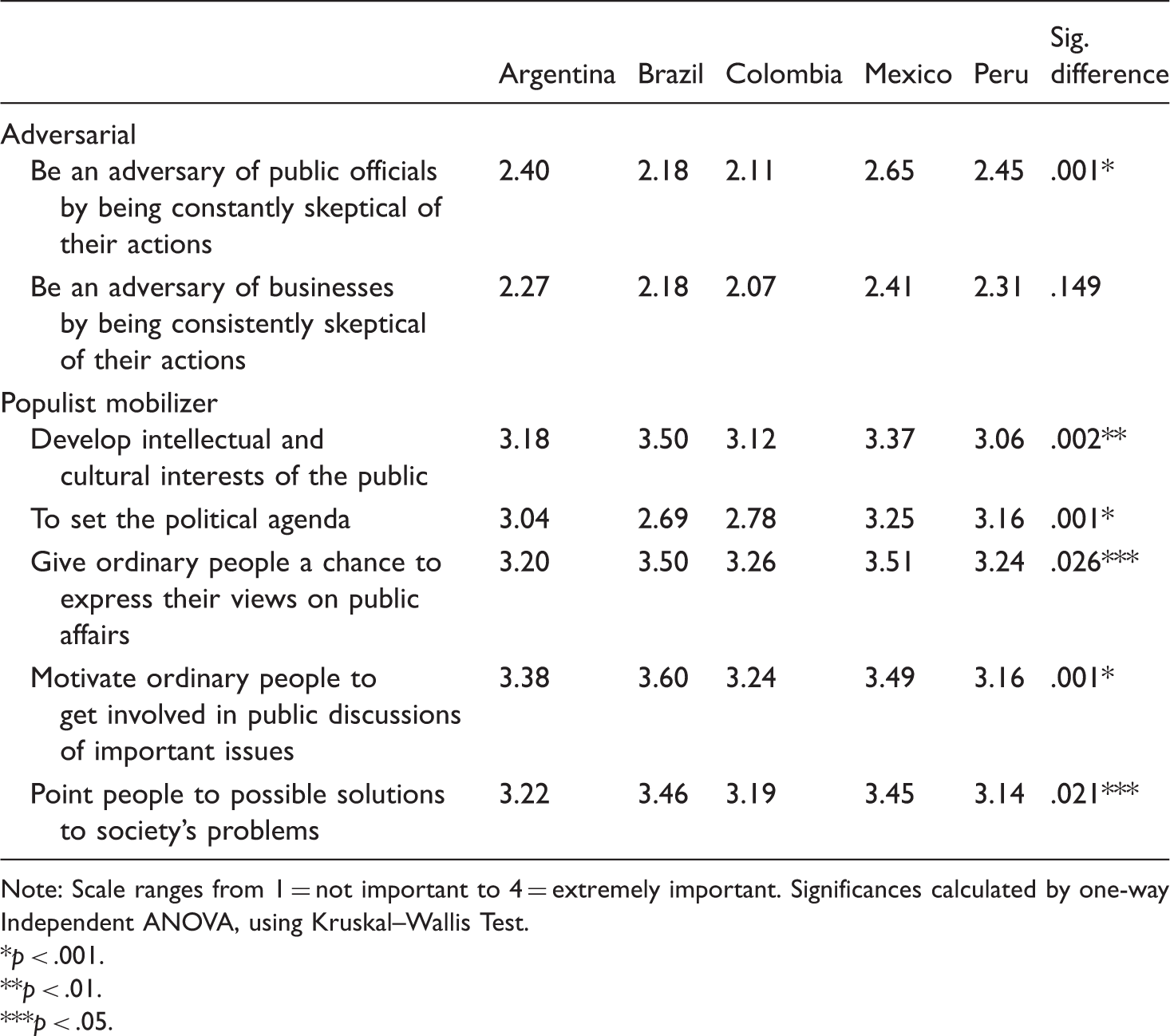
Note: Scale ranges from 1 = not important to 4 = extremely important. Significances calculated by one-way Independent ANOVA, using Kruskal–Wallis Test.
p < .001.
p < .01.
p < .05.
Digital and social media routines conducted daily by journalists by country by percentage.
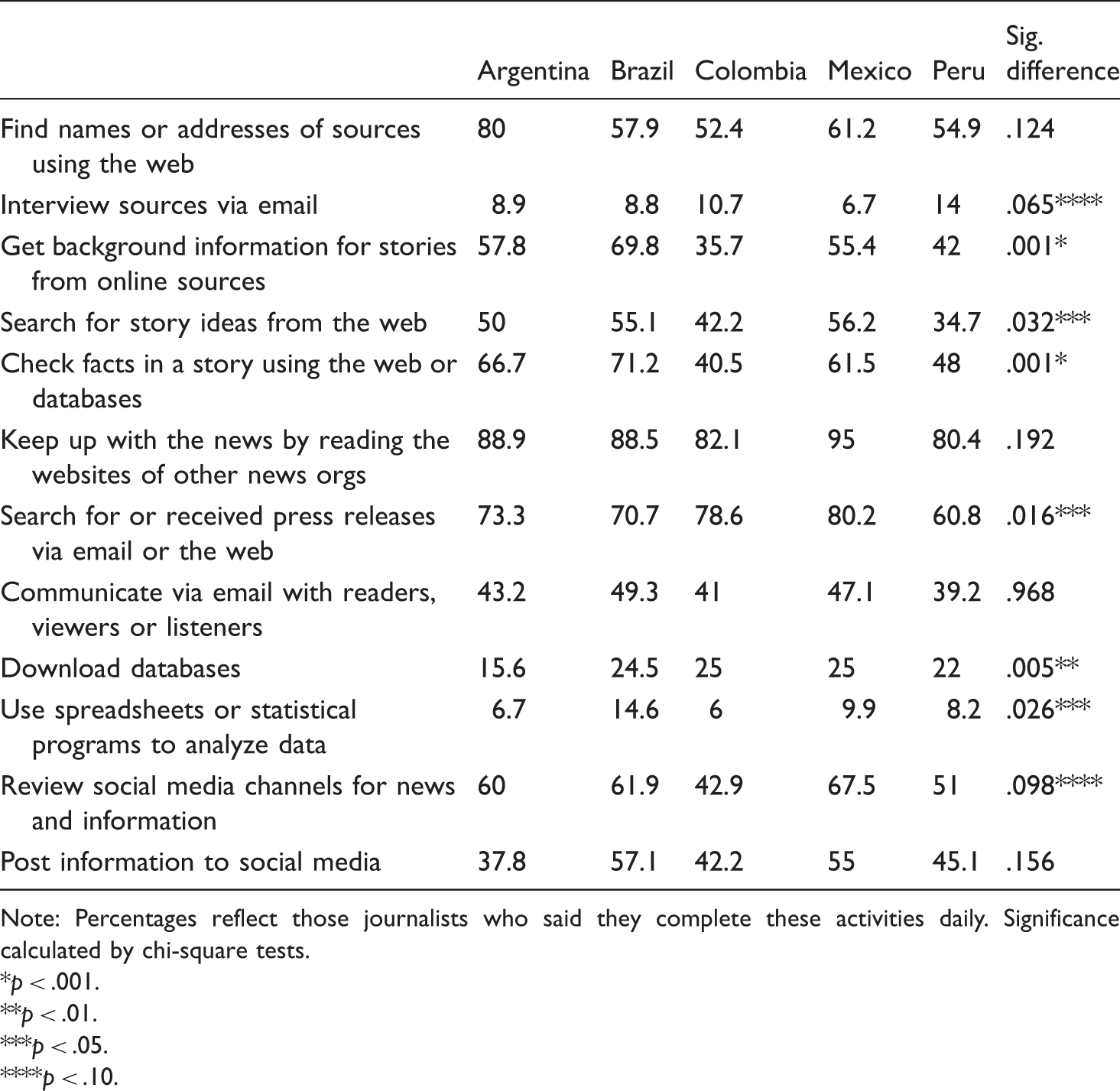
Note: Percentages reflect those journalists who said they complete these activities daily. Significance calculated by chi-square tests.
p < .001.
p < .01.
p < .05.
p < .10.