




Abstract
The internet is often celebrated for the abundant opportunities it appears to offer citizens to become more informed about and inspired to act on issues related to international development and distant suffering. But to what extent do users actually make use of such opportunities? And what social processes are such decisions governed by? This article begins to answer these questions by analysing the results of a two-month study of UK internet users’ online behaviour. The results reveal, not just a general resistance to using the internet to develop a cosmopolitan consciousness, but also the dominant modes of avoidance that participants used to justify their inactivity. I conclude that the potential for digital cosmopolitanism appears to be primarily governed, not by the peculiarities of individual texts or even the properties of the technology, but by the nature and acceptability of pre-existing discursive resources and how they are deployed by users.
Keywords
Introduction
Effective philanthropy is no longer the sole province of big foundations that employ teams of experts. With the technology we have today, and with the innovations that are still to come, anyone with an internet connection, a few dollars to give, and the time to do a little digging can become a more-informed donor. These days, effective philanthropy is for everyone. (Gates, 2013)
High profile examples of the use of social media in humanitarian campaigns, such as One Billion Rising, Kony 2012, the IF campaign and #BringBackOurGirls have certainly drawn attention to the potential role of the internet in facilitating public mobilization and activism in response to distant suffering. Despite this, though, we still know remarkably little about the role of more mundane, everyday uses of the internet in fostering a sense of connectivity with distant suffering or in cultivating cosmopolitan sensibilities. Questions remain as to how the internet is being used as a source of information about international development or overseas humanitarian crises. Or in what ways the internet might facilitate the orientation of openness that cosmopolitanism requires.
The above quotation from Bill Gates helps to illustrate how such questions are responded to by ‘cyber-utopian’ (Morozov, 2011: 1) narratives, which have partly dominated debate in this area. Essentially, such narratives assert that new technologies have particular (universal) affordances which facilitate forms of online communication that lead to understanding, openness, connection, immediacy and action vis-à-vis distant suffering. As Gates (2013) puts it, ‘technology is creating the opportunity to make philanthropy both more efficient and more effective’.
There are, however, two major problems with such cyber-utopian narratives. Firstly, they fail to account for the dimensions of the medium that may work against cosmopolitanism. In other words, they ignore equally plausible, alternative claims about how new technologies might foster communitarian dispositions or a more bounded sense of belonging. Secondly, they fail to understand that the impact of the internet is regulated by the institutional contexts and wider social processes it is embedded within (Lim, 2013; Morozov, 2011; Tatarchevskiy, 2011). These contexts refer partly to political institutions and economic conditions, but also to contexts of consumption, where users’ preferences and choices govern its use. The point is that even if the internet does have particular affordances which allow individuals the possibility to develop a cosmopolitan consciousness (or become ‘more-informed donor[s]’ (Gates, 2013)), we do not yet know the extent to which different individuals make use of such opportunities and what social processes this is governed by.
The first section of this article outlines in more detail the nature and limitations of cyber-utopian narratives and their more pessimistic counterparts. Subsequently, the work of Seu (2010, 2011, 2013) is identified as offering a useful means of moving beyond such polarized, media-centric debates by drawing attention to the ways in which audiences routinely neutralize appeals to act on distant suffering. In order to investigate whether similar modes of avoidance are deployed in relation to distant suffering online, this article examines the results of a two-month study of UK internet users’ online behaviour. The results show that participants’ online behaviours vis-à-vis distant suffering were characterized, not by understanding, immediacy and action, but by the deployment of culturally acceptable justifications which allow users to remain inactive whilst also retaining a positive moral self-image. This suggestion that dominant systems of sense-making available in society are central to determining the mediation of distant suffering online also raises the possibility of an unfortunate irony. It is possible that, despite being inaccurate, when drawn upon by audiences as a means of justifying and rationalizing their online behaviour, cyber-utopian narratives themselves might provide a means of challenging current modes of avoidance and promoting digital cosmopolitanism. In other words, by encouraging us to imagine ourselves as cosmopolitan, cyber-utopian narratives may provide a first step towards becoming cosmopolitan. Unfortunately, though, this article shall ultimately conclude that promoting cyber-utopian narratives in the pursuit of digital cosmopolitanism may do more to support the interests of individuals like Bill Gates, than to genuinely advance our ethical engagement with distant suffering.
Debating digital cosmopolitanism
Existing research which focuses on the role of the internet in fostering a sense of cosmopolitanism amongst users is sharply divided. There are those who highlight the particular affordances of new technologies which seemingly permit or encourage a cosmopolitan consciousness (cyber-utopians), whilst others emphasize how the logic of the internet appears to work against this. This contradiction plays out across a number of issues.
Kennedy (2009: 1) suggests that new technologies offer the opportunity for more complex, nuanced and multidimensional portrayals of distant suffering, which may promote greater understanding – a key dimension of cosmopolitan engagement (Madianou, 2013). The internet, Kennedy continues, ‘can help us better visualise and know a [distant] place: articles can be backed with links, stories can be supplemented with refugee narratives, a full array of photos can be used’. But while new technologies may indeed offer greater opportunities for revealing complexity, they also have characteristics which limit the tendency for this possibility to be realized. Lim (2013: 636), for example, contends that the online environment is more accommodating to simple and/or simplified narratives than complex/complicated ones because of the ‘rapidity and briefness of interaction online and the escalation of velocity and size of information available’. In support of this, Chouliaraki (2013) argues that one of the key consequences of the ‘technologisation of solidarity’ has been a growing tendency for humanitarian communications to simplify their messages; to rely on the ‘aura’ of their brand to hint at why action is required, rather than to offer explicit explanations.
Such dichotomized views also extend to the question of action, a second key dimension of cosmopolitan engagement (Madianou, 2013). In this context, Kennedy (2009: 1) argues that new technologies, [supply] us with new ways of acting at a distance and new ways of influencing future events … Our feelings of moral obligation can stay the same; all that changes is an expansion of the range of opportunities available to us.
Regarding the reproduction of hierarchies of human life, upon which the cultivation of a cosmopolitan consciousness depends, there are clear grounds for suggesting that the internet may have the capacity to at least partially address power asymmetries between users and distant others. In particular, new technologies can allow distant others to speak for themselves and even converse directly and in real time with other users through web chats, forums and other social media. It is in this context that Madianou (2013: 250) describes social media as offering a high degree of ‘disintermediation’, or the ability to communicate with others, ‘without having to depend on powerful intermediaries such as media corporations and other traditional gatekeepers’. This, she suggests, can potentially democratize the space of appearance (Arendt, 1998) by allowing previously marginalized issues or voices to be included or highlighted.
Equally, though, since new technologies provide us with more control over what we consume and who we interact with, users are increasingly able to satisfy their general tendency to prefer more comfortable, self-affirming interactions with those already in our in-groups (Lawrence et al., 2009). In doing so, they necessarily encourage communitarian, rather than cosmopolitan interaction. Moreover, even if users do make use of the possibility to interact directly with distant others, this does not negate all power differentials. Digital divides ensure that such interactions will still likely be mediated, either by local elites who have greater access and control over local technologies, or by NGOs who can regulate the format and even the content of such exchanges. As Madianou (2013) accepts, traditional gatekeepers may be bypassed online, but new intermediaries will almost inevitably emerge.
The purpose of highlighting these dichotomized views, across a number of issues, is not to seek a means of resolving them – but to identify a means of transcending them. It should be clear from this discussion, not just that existing debates in this area are largely polarized, but also that they are based almost entirely on competing claims about the nature of new technologies and what forms of moral agency they have a tendency to prefer. This focus on the nature of the internet is variously referred to as its ‘ecology’ (Lim, 2013), ‘architectures’ (Madianou, 2013), ‘configuration’ (Tatarchevskiy, 2011), ‘communicative structures’ (Chouliaraki, 2013) or ‘logic’ (Morozov, 2011). In each case, the focus is on the implications of the medium rather than on the nature of its use.
In fact, the same overwhelming focus on the process of ‘passing through the medium’ (Tomlinson, 1999: 154) is evident in debates about the mediation of distant suffering in general. The central assumption in Chouliaraki’s (2006: 46) seminal work on the spectatorship of suffering, for example, is, by her own admission, that ‘the moral horizon of the spectator resides in media discourse and, thus, has a thoroughly textual form before it becomes part of the spectator’s consciousness and her or his will to act’. While such a focus is useful for understanding how the process of mediation is shaped by political, economic and institutional contexts, it also inevitably draws attention away from equally important questions about how such processes are integrated within the everyday lifeworlds of audiences. Silverstone’s (2005: 189) characterization of the process of mediation as a ‘fundamentally dialectical notion’ reminds us that it always involves some form of interaction between the audience and the text. Thus, if we want to understand more fully the role of the internet in supporting a more cosmopolitan engagement with distant suffering, then, as Zuckerman (2013: 73) puts it, ‘we have to look less at what’s made possible by the internet and more at what we actually choose to do [with it]’.
Analysing audiences
In this context, Seu’s (2010, 2011, 2013) study of audience reactions to Amnesty International advertisements concerning human rights abuses provides not only a rare exception of reception-focused research, but also a framework for guiding further empirical research in this area. From an analysis of nine focus group discussions about these advertisements, Seu identifies three dominant interpretative repertoires. These refer to systems of sense-making available in society, or the ‘often contradictory and fragmentary complexes of notions, norms and models which guide conduct and allow for its justification and rationalisation’ (Wetherell et al., 1987: 60). The three repertoires that Seu (2010: 452) identifies are a series of seemingly well established, collectively available understandings used by participants to justify their refusal to donate ‘and their general passivity in response to the appeal’. Firstly in what Seu refers to as the medium is the message repertoire, participants’ un-responsiveness is justified by presenting oneself as being resentful of and resistant to manipulative and formulaic marketing campaigns. The second, shoot the messenger, repertoire ‘attacks the sender of the appeal, primarily Amnesty International’. The third, babies and bathwater, questions in various ways the validity of the action recommended in the appeal (Seu, 2010: 443).
Drawing on the work of Cohen (2001), Seu describes these repertoires as particular forms of implicatory denial or modes of avoidance to protect ourselves from responsibility towards the suffering of others. Rather than denying the reality of an event or its conventional interpretation, this form of denial is used to deny the ‘psychological, political or moral implications that conventionally follows’ (Cohen, 2001: 8). In other words, it refers to techniques of evasion, avoidance, deflection and/or rationalization which draw on widely shared, publically acceptable stories to protect ourselves from recognizing our responsibilities towards the suffering of others (Seu, 2010).
Seu’s study generates two particular conclusions which are especially relevant to the study of mediated cosmopolitanism online. Firstly, if implicatory denial is indeed a key feature of audiences’ mediated encounters with distant suffering, then it is likely that, as Seu (2010: 453) puts it, ‘audiences disengage from the humanitarian appeal at a very early stage in the reception’. In which case, the nature of media representations of suffering – such as the extent to which distant suffers are humanized – may be less important than a predisposition to denial and the forms of interpretative repertoires available to audiences to perform such denial. Regarding distant suffering online, this suggests that the overwhelming focus on analysing the ecology or architectures of the internet, discussed above, may not be entirely justified. Instead, the most pressing research question to consider is to what extent similar modes of avoidance are deployed in the context of the mediation of distant suffering online?
Secondly, Seu’s (2010) research also highlights that when responding to mediated encounters with distant suffering, audiences are operating within a broader media context, permeated by wider discourses about the media. The medium is the message repertoire, for example, relies upon a wider discourse about the media as manipulators of truth. Thus, a further key research question considered here is – how are the modes of avoidance that participants draw upon informed by their relations with the media in general?
Talking about distant suffering online
Interested citizens’ main sources of information about international development (Debeljak, 2012).
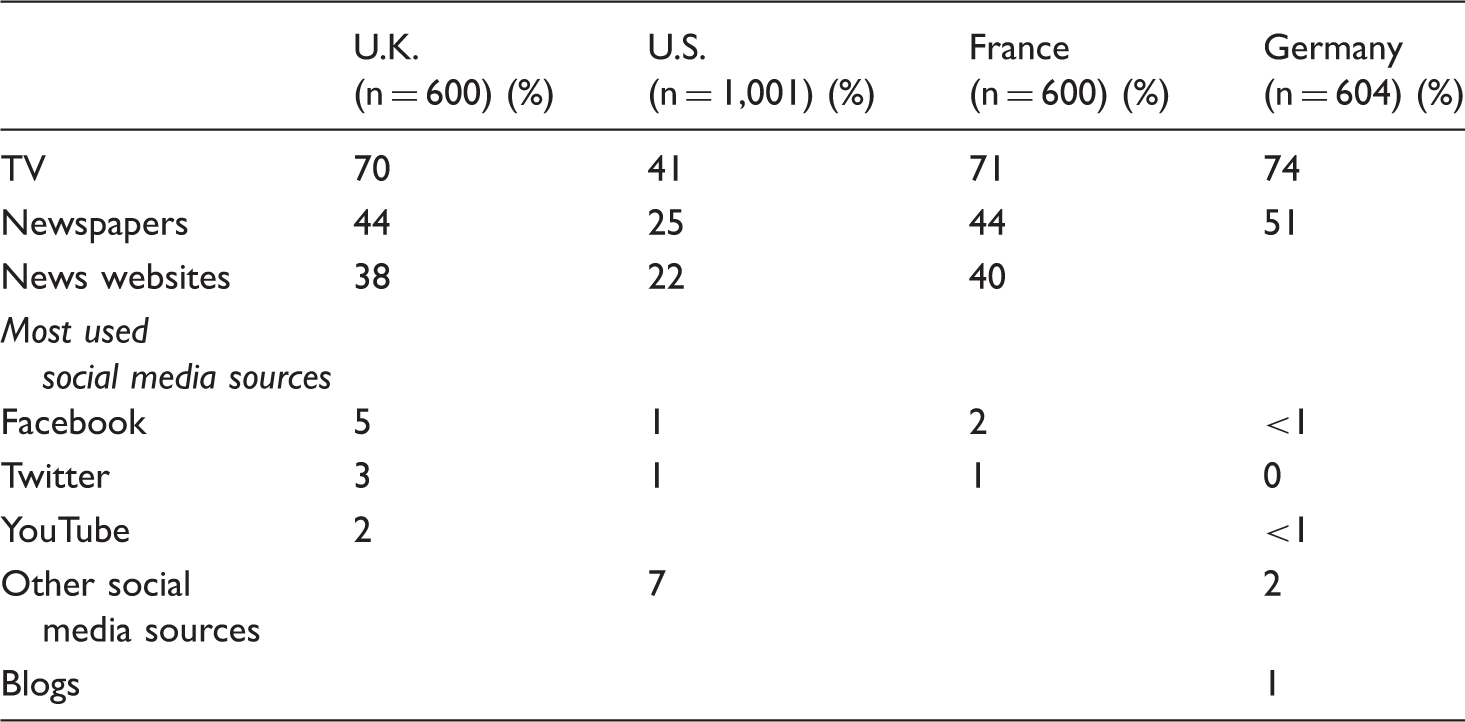
In order to address these issues, a study was designed that required participants to attempt to find out more about issues related to distant suffering online and that would encourage talk about these subjects. References to life in developing countries and international development were used in the study to define the subject matter because they were the terms most readily understood by the majority of participants. They also invoked the discursive context under investigation.
In the first research phase, 52 participants were asked to keep a week-long diary of their online behaviour in general, including which websites they visited and why, when they went online and for how long. This provided useful background information and also acted as a stimulus for the second phase. This next phase involved seven, 90-min focus group discussions about participants’ everyday internet use. These focus groups took place in London, Manchester and Derby in October 2009. In order to begin to explore possible differences between different groups of individuals, participants for this study were recruited primarily on the basis of age, gender and level of interest in international development following the UK Department for International Development (DFID, 2008) segmentation model of public engagement with development (see Figure 1).
Characteristics of focus group participants.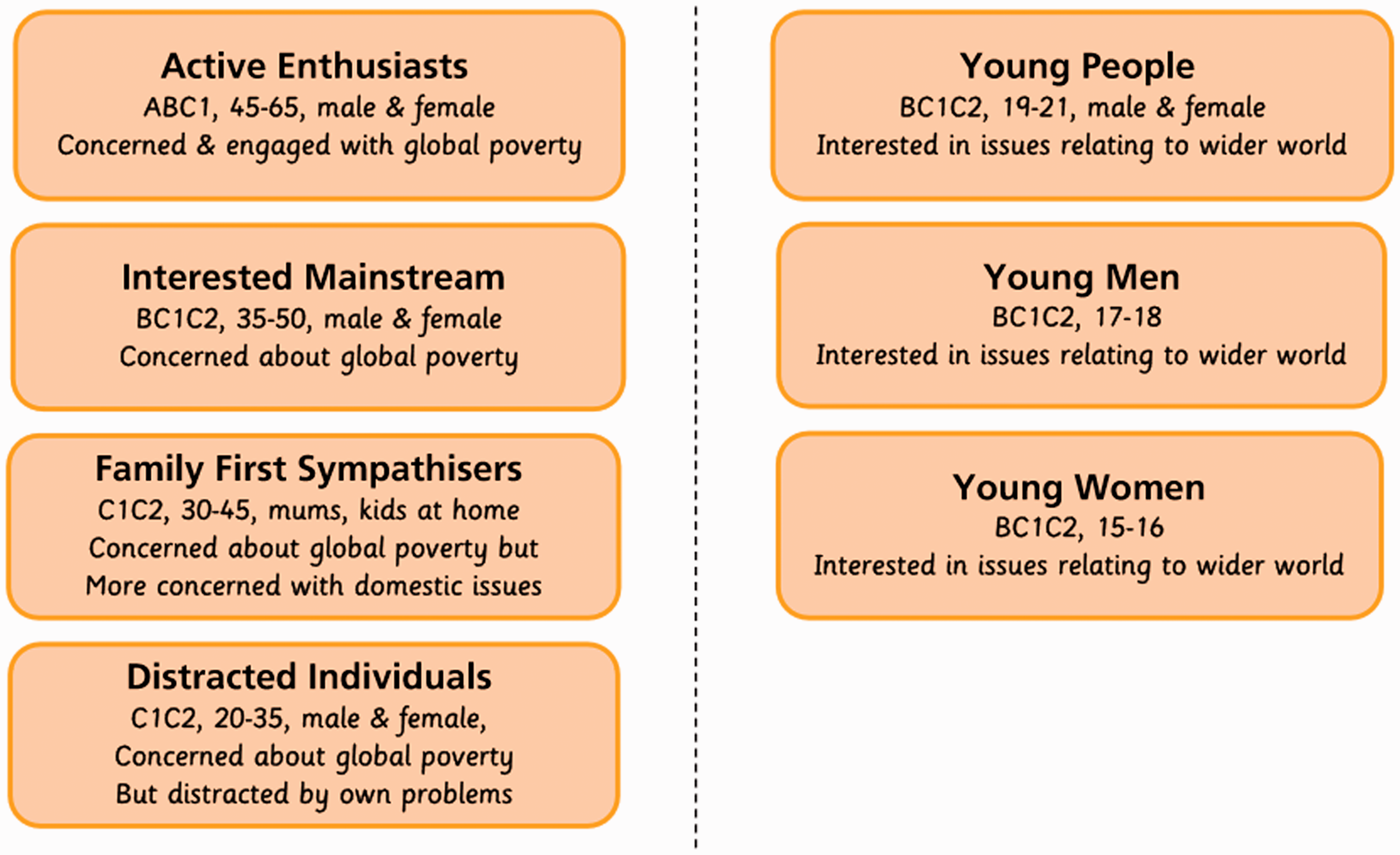
In the third phase of the research, the same 52 participants were asked to go online in their own time and find out more about an issue that interested them about international development or developing countries. A number of questions were also provided by the facilitators as prompts. The questions asked most frequently by the participants concerned aid spending, corruption and sweatshops. Typical questions included, ‘where does the money the government is spending on overseas aid actually go’ and ‘is buying from Primark exploiting or helping the developing world’?
In the final phase, the focus groups were repeated with the same participants, one month later. On this occasion, the discussion focused on participants’ experiences of the research task. It is the nature of participants’ talk in this final phase of the research which forms the basis of the majority of the analysis discussed below. When reading this analysis, though, it is important to bear in mind that requiring participants to complete the online research task meant that they were not discussing ‘natural’ experiences that occurred as part of their everyday lives. Moreover, their conversations were generated in a very peculiar context – a focus group – which would undoubtedly have affected their responses. Nevertheless, this research task did at least make it possible to generate conversations about real-life experiences, and an analysis of the resulting talk does allow us to identify common systems of sense-making available in society relating to distant suffering online.1
The analysis of the talk generated by this research favours a social constructivist over a realist perspective. By treating participants’ conversations as socio-political constructions, rather than transparent self-revelations about their lives, I aim to identify, as Seu (2010, 2011) does, the dominant storylines participants use to ‘define themselves as particular kinds of people’ (Buckingham, 2000: 63) – in this case – in relation to distant suffering online. From this perspective and by following Potter and Wetherell et al.’s (1987) approach to discourse analysis, the analysis studies (1) the content and structure of participants’ conversations, (2) the rhetorical functions they serve and (3) variations in their nature and use. The study also focuses on how participants draw on specific linguistic resources and patterns of reasoning to position themselves in relation to the media.
Results and analysis
There were occasions in the second round of focus groups when participants’ talk did appear to reflect instances in which the particular affordances of the internet had enabled participants to achieve proximate encounters with distant suffering, such as in the following quotation. The task opened my eyes … I looked at the Maldives which is a holiday site for half a million people but the actual conditions for the people are terrible. I found a link to a really interesting YouTube video about how bad it was there without commenting: just a day-in-the-life thing for people on a dollar a day. It was so good I tweeted about it. It could have been a set-up but it was done as an amateur video and it was how it was reported. It was just information from a real person. (Interested mainstream)
The medium
The following focus group extracts illustrate how the difficulties that participants appeared to have completing the research task often appeared to stem from the nature of the medium they were using. It’s hard to find exactly what you want to find ….You’ve got to read through lots and lots and lots of different articles and reports … Things aren’t in an easy to find format. (Young men) It should be better advertised because when you’re searching for stuff it does take a long time and you don’t really trust the stuff so you just don’t bother. Yes, you get bored with it because there’s so much there and it means you’re just not interested any more. (Young people) I wouldn’t know which website to start with … There was a lot of stuff on there and I got lost. (Distracted individuals) There were so many different blogs and none of them actually had what I wanted – wasn’t my answer. I did get the idea that it was probably in there somewhere but I would literally have to spend a couple of days trawling through and who’d have time to do that? (Family-first sympathizers)
Zuckerman (2013: 29) refers to such claims as ‘cyber-sceptical’ narratives because they draw attention to how the properties of the internet seemingly work against the formation of cosmopolitanism – much like the academic arguments, discussed earlier, which stood in opposition to cyber-utopian narratives. For some participants, such ‘cyber-sceptical’ narratives were used to justify a failure to even attempt the task, because they would inevitably fail. As one participant said, ‘I wouldn’t know where to even start on the internet to look for stuff because there’s so much stuff on all the websites’. For most, though, it was used to justify a decision to stop searching for material after only a short period of time. When one participant said, ‘it’s not that I just give up, but I do give up’, the statement ‘just’ signals that she is not giving up without good cause, but that giving up is a logical response to being confronted with the vast quantity of material available. In doing so, the participant justifies her failure to complete the task whilst also preserving a positive moral self-image.
The same logic is implied on the numerous occasions that participants claimed they had become ‘lost’ online. This is a morally effective claim in this circumstance because it largely absolves the participant of responsibility for having failed to perform the task more fully and shifts attention instead to the quantity and organization of material online. The statement cited above that ‘there was a lot of stuff on there and I got lost’ typifies the direct, unambiguous link often made between the quantity of material that participants had to search through and their inability to fulfil the task.
But while claiming to have become ‘lost’ online may have enabled participants to preserve a positive moral stance, it does not allow for the maintenance of an entirely positive self-image. In making this claim, participants must admit to a certain degree of digital illiteracy (whether this is genuinely the case, or not). In the following quotation, for example, the participant admits to an absence of a number of key competencies in order to justify her unresponsiveness. I know this probably is going to defeat the whole object [of the task] but if I did want to find out about Africa and what’s going on, I don’t think I’d know where to start, where to look, what to type, I don’t know. (Distracted individuals) It depends how many layers you want to unpeel as you could go on for hours and hours. And I only want to know so much (Young women). I would literally have to spend a couple of days trawling through and who’d have time to do that? (Family-first sympathizers).
In this case, by ending this statement with the question – ‘who’d have time to do that?’ – the speaker demonstrates that her decision not to spend further time on the task stems, not from her own personal judgement or values, but from a widely accepted societal norm concerning the time pressures and priorities within people’s daily lives. Such gestures towards commonly shared, rather than individual, understandings of how a concern for distant suffering fitted into the other priorities within people’s lives were characteristic of many of the claims made about time. In the following extract, the statement – ‘yes’ – is used on three separate occasions to demonstrate agreement with the sentiment of the previous speaker. Moreover, the referential ambiguity inherent in the references to ‘you’ and ‘we’, as well as the question – ‘isn’t it?’ – all help to provide mutual reassurance amongst the participants that they are all referring to a well-established, collective understanding of what is reasonable. The references to ‘out there’, ‘stuff’ and ‘it’ in this exchange also reinforce the idea of the internet consisting of a vast mass of material.
Well just really how much information is out there, but how difficult it is to find stuff. To find it, yes. Yes, the difficulty. It’s a very time-consuming thing as well, isn’t it? Yes, there’s so much of it … Once you start, and by the time you’ve finished. We’re busy. (Active enthusiasts)
‘Messengers’
The other major obstacle which appeared to prevent participants from fully completing the task was a lack of trust in many of the sources of information that they encountered. The following quotations are typical of the way in which information from governments and well-known charities was rejected by many participants for being inaccurate or biased. The impression I get … from a government website … is that they don’t want to give you information, just tell you how good they are doing. (Interested mainstream) I put, ‘where does my £2 a month to Water Aid actually go’? And I didn’t get an answer … I did go to [the] Water Aid [website] itself but I thought that was going to be a bit one-sided … They’re going to be biased, aren’t they? Of course they are, because it’s their site. (Family-first sympathizers)
I wouldn’t have the attention span. I wouldn’t read a blog as they don’t interest me. They annoy me. They are too random and all over the place. Peoples’ blogs are just their opinions so I’m not interested. (Interested mainstream) There are a lot of people on Twitter talking about poverty. It wasn’t interesting. Just really opinionated people who think their opinion is so important that it has to go on the internet doesn’t interest me. It’s not fact. It’s peoples’ opinions and they are so contradictory that it winds me up reading them. (Distracted individuals)
From a realist perspective, such responses suggest that if the internet is to foster a sense of cosmopolitanism, then rather than dismissing all non-journalistic content for being biased and entirely unreliable, users require a more sophisticated ability to critically evaluate multiple sources of information. From a social constructivist perspective, though, this tendency to reject online sources for being unreliable can be seen as another technique for justifying inaction in relation to distant suffering. By drawing attention to their unreliability, responsibility for a failure to complete the task is constructed as lying with the ‘messengers’, rather than with participants. To claim, for example, that you would not be able to find out where aid money is spent because, ‘obviously, they’re going to put, “oh, it goes here; it goes there”’ (Young women), is to support a view that there was nothing valuable to be gained from pursuing the task further because we are essentially being lied to. In this particular quotation, the validity of the individual’s claim is supported by the term ‘obviously’, which gestures towards a taken-for-granted common knowledge about the unreliability of such information. This is reinforced by the term ‘oh’, which frames the proceeding characterisation of charities’ claims with a sense of mockery and exaggeration. The repetition in the phrase ‘it goes here; it goes there’ adds further emphasis to the questionable nature of charities’ claims.
This form of response corresponds closely with the ‘shoot the messenger’ repertoire that Seu (2010) identifies in her research, whereby audiences frequently responded to Amnesty International appeals by questioning the motivations and integrity of the charity. In so doing, they undermined the trustworthiness of the ‘messenger’, thereby weakening the impact of its charitable appeal and justifying their own inaction. But while participants in both contexts sought to legitimize unresponsiveness by drawing attention to the unreliability of the ‘messenger’, there are important differences between the two. In the case of the Amnesty International appeals, unresponsiveness was normalized by appealing to a consumerist discourse, in which participants’ scepticism was presented as a means of avoiding being taken advantage of by manipulative campaigns. As Seu (2010: 449) puts it, ‘agencies are positioned as liars, manipulative and self-serving through the use of this repertoire. Conversely, audiences are the victims and in need of protection’.
By contrast, in the context of searching for information about international development online, unresponsiveness was normalized by deploying a particular ‘media literacy’ discourse of the kind that Buckingham (2000) identifies. By emphasizing their awareness of the difference between opinion and fact and that organizations’ self-interest can affect the content they produce, participants presented themselves as possessing the ability to understand that media content is constructed and has embedded values and points of view (a core competency of media literacy). As one participant remarked, ‘you should never take it as read. You should never take anything as read, should you? You should always investigate’ (Family-first sympathizers). As a consequence, participants constructed themselves not as victims in need of protection from manipulative campaigns, but as active, media literate users demonstrating the futility of searching for information that was untrustworthy. When the participant quoted above says that ‘peoples’ blogs are just their opinions so I’m not interested’, a direct link is made between demonstrating ones’ ability to distinguish opinion from professional journalism and ones’ willingness to consume new information.
Interestingly, though, this media literate discourse did not extend to discussions about all online content. Participants were far less critical of charitable organizations they did not recognize, such as Antidictatorship.com, poverty.com and the Overseas Development Institute, compared to more well-known organizations like Oxfam, Christian Aid and Save the Children. This may be because participants were simply less familiar with the kinds of discursive resources available to them for discussing the activities of less well-known organizations and their often alternative approaches to international development. The following extract illustrates the way in which such organizations were often described, rather than critiqued, in participants’ conversations. The word ‘interesting’ is used here, this time seemingly to position the participant closer to this organization as a source of influence. Charitynavigator is a company that helps people make decisions about how and where they donate their money safely and helps them track it. A lot of times peoples’ money has gone to corrupt people. I found it interesting that there are people out there who have got a company that helps people find their money after it has disappeared. (Interested mainstream)
Conclusion
The findings of this research suggest that what matters most in terms of the internet’s role in fostering a cosmopolitan consciousness is not necessarily the peculiarities of individual texts or even the properties of the technology. Of central importance is the nature and acceptability of pre-existing discursive resources and how they are deployed by users to justify their media use. When asked to find out about distant suffering online, what dominated participants’ conversations afterwards were not stories of what they had found out – thanks to the unique affordances of the internet – but various justifications for failing to complete the task. This is significant because debates about whether the ‘ecology’ or ‘configuration’ of the internet hinders or promotes cosmopolitanism will continue to miss the point so long as they fail to consider how this configuration is situated within individuals’ everyday lives. Put simply, even if the internet means that ‘anyone … can become a more-informed donor’ (Gates, 2013), it does not affect our willingness to do so. It is striking, for example, that in 21 hours of focus group conversations about distant suffering online, there were almost no references to taking action. Concerns about ‘clicktivism’ (Morozov, 2011: 190) were seemingly irrelevant, because no one was even clicking.
The results have also helped to identify common modes of avoidance in this context, and their associated vocabularies and patterns of reasoning. As others have found, users’ relationships with the ‘messengers’ of information were particularly important (Cohen, 2001; Seu, 2013). But rather than positioning themselves as potential victims, resisting the influence of manipulative and self-serving campaigns (Seu, 2011: 148), participants in this study emphasized their apparent media literacy. This critical stance was used to demonstrate the untrustworthiness of the material they encountered, thereby justifying unresponsiveness. The most commonly used linguistic resources in this context related to trust and bias.
Surprisingly, though, participants’ most important relationship was not with ‘messengers’ (and certainly not with distant others, who were seldom mentioned) but with the medium itself. By emphasizing particular properties of the internet – especially the seemingly vast quantity of disorganized material – participants’ justified their failure to complete the task on the basis that they lacked either sufficient time or ability (digital literacy) to do so. The most commonly deployed metaphor within such cyber-sceptical claims was the idea of getting ‘lost’.
In either case, what should be clear is that it were wider discourses about the media in general – whether as ‘manipulators of truth’ or as ‘a poorly organized mass of information’ – which were central to participants’ responses. For this reason, media content does remain crucial in regulating the moral horizons of audiences because it plays a key role in reproducing and popularizing such wider discourses.
This is significant for the study of mediated cosmopolitanism, not just because it dramatically opens up the range of relevant texts. Since academia is itself an important source of discursive resources about the media, it must therefore also bear some responsibility for the availability and acceptability of the resources which audiences may draw upon. Indeed, there were clear parallels between the cyber-sceptical narratives deployed by participants and the claims within academia which draw attention to how the properties of the internet seemingly work against the formation of cosmopolitanism. Equally, though, many participants’ initial response to the task was to deploy the same kind of cyber-utopian discourses that are advanced in other areas of academia. This was evident in references to how easy it was to ‘just Google’ information, for example (see supplementary material). Although such celebratory discourses were often quickly replaced by the forms of avoidance discussed above, they did constitute some of the only occasions in which participants’ positioned themselves with any degree of openness towards distant suffering as they draw on some of the characteristics of cyber-utopianism, such as a focus on the ability of the internet to offer a high degree of disintermediation.
It is ironic, then, that the results discussed here have both undermined the validity of cyber-utopian narratives and, at the same time, suggested that advancing such narratives may nevertheless provide a means of contributing to digital cosmopolitanism. This is an unfortunate irony for two reasons. Firstly, because while imagining ourselves as cosmopolitans (through cyber-utopian narratives) may provide a first step towards becoming cosmopolitans, it may also support a (mistaken) belief that we are in fact already cosmopolitan, thanks to new technologies. As Zuckerman (2013: 73) puts it we need to ask whether we’re reading the Times of India, or imagining we are simply because we could be … Imagining that we have a broader picture of the world than we actually do subjects us to unhelpful distortions and misperceptions.
For these reasons, the promotion of cyber-utopian narratives is not, unfortunately, a satisfactory answer to the question of how to foster digital cosmopolitanism. Nor do such narratives provide an accurate account of the role of the internet in cultivating a cosmopolitan engagement with distant suffering. Instead, those who really want to promote digital cosmopolitanism will have to engage more fully with the stories that people tell themselves, and each other, to justify their moral stance in relation to distant suffering.
Footnotes
Author's Note
The focus groups were funded by the International Broadcasting Trust (IBT) and conducted by Terry Watkins and Alice Fenyoe (see Fenyoe, 2010).
Declaration of Conflicting Interests
The author(s) declared no potential conflicts of interest with respect to the research, authorship, and/or publication of this article.
Funding
The author(s) received no financial support for the research, authorship, and/or publication of this article.
Supplementary Material
This article contains supplementary material. It can be accessed online.
References
Supplementary Material
Please find the following supplemental material available below.
For Open Access articles published under a Creative Commons License, all supplemental material carries the same license as the article it is associated with.
For non-Open Access articles published, all supplemental material carries a non-exclusive license, and permission requests for re-use of supplemental material or any part of supplemental material shall be sent directly to the copyright owner as specified in the copyright notice associated with the article.
