




Abstract
This article examines the roots and consequences of public service broadcasters’ strategic commitment to digital universalism and the ‘anything, anywhere, anytime’ paradigm of mobile media delivery. Using policy analysis, expert interviews and case studies it traces the adaptation of national public service broadcaster to global information capital, linking broadcasters’ pursuit of multiplatform ubiquity with competition policy, the rise of ubiquitous computing and its commercial realization in global mobile media markets. It then analyses the challenges of implementing a public sector mobile agenda in the Australian context, where the scope of mobile broadband uptake is internationally significant. The analysis explores the dynamics of mobile media planning and investment at the Australian Broadcasting Corporation and the Special Broadcasting Service, identifying new expressions of universalism in online access and accessibility, new costs in research, design, development and delivery, and significant debates emerging around the prioritization, privatization and commercialization of public resources.
Keywords
Introduction
In international media and marketing circles 21st April 2015 was dubbed Mobilegeddon – the day that Google’s algorithm would change, ranking sites with mobile responsive design more highly than those without in smartphone search results. The move was a signal shift for multiplatform media companies in two senses. It established the primacy of mobile devices over desktop computing, and consolidated the industry turn from exposure models of audience measurement towards user analytics, where individual consumption behaviours are monitored, aggregated and patterned.
The need for public service broadcasting (PSB) to go mobile has been widely accepted in European and US public sector policy (Cochran, 2010; Smith, 2012; Steenfadt, 2011). Provision of content and services to an increasing array of phone, games and tablet platforms has largely been read as an extension of the institution’s 20th-century principle of universal service (Brevini, 2013). In multiplatform markets the European Broadcasting Union’s Suarez Candel suggests ‘ubiquity, mobility, time-shifting, on-demand, personalization and social sharing are becoming up-to-date, necessary characteristics of any service’ (2012: 6). Yet this article argues that public service media (PSM) organizations need to analyse the consequences of digital ubiquity for their strategic evolution.
To date PSM mobile research has largely focused on technical policy issues such as spectrum allocation and surprisingly little work has emerged on the conceptual grounds for mobile development, its structural drivers or its social and cultural implications. There is also a growing need for PSM organizations to demonstrate a distinct, sustainable mobile agenda in public value or market assessment terms, quite aside from the digital business case.
In particular, PSM might analyse how its growing enthusiasm for mobile services has been shaped by the less transparent logics of informational capital, during the evolution of ubiquitous computing, online surveillance and the industrial internet. From this perspective mobile media represents a thoroughly commodified idea of instantaneous, personalized access to knowledge that differs fundamentally from Lord Reith’s vision of unified moral uplift and universal service, or later PSM concepts of diverse appeal and the digital commons.
This article analyses PSM’s entanglement with mobile media, taking up Genevieve Bell and Paul Dourish’s (2011) exhortation to critically analyse the social, cultural and political dimensions of ubiquitous computing. It begins with a genealogy of PSB policy commitments to universality, tracing links between these and newer rhetorics of digital ubiquity associated with the rise of pervasive computing and mobile media. The study then draws on policy analysis and expert narrative interviews to investigate the dynamics of mobile media development at the Australian Broadcasting Corporation (ABC) and the Special Broadcasting Service (SBS), probing the contemporary rationales for these trajectories and their implications for PSM objectives.
The universal and the ubiquitous
Mobile technologies – smartphones, tablets, gaming consoles, wearables, their apps and proprietary networks – now represent everyday, ever present interfaces to digital media and communications for much of the Western, industrialized world and increasingly in the global South (Cumiskey and Hjorth, 2013; Goggin and Hjorth, 2014). Although the metrics are contested, industry studies suggest time spent on mobile devices in highly connected countries is outranking web and broadcast media (Comscore, 2014; IAB, 2014). Indeed mobile media and communications infrastructures, devices and apps have been central to ‘the contemporary growth and salience of ubiquitous computing’ (Goggin, 2011: 149) which aims to integrate microprocessors into conventional objects to create networked, informative products.
The reason why PSB policy in Europe and beyond has moved from a focus on broadcast universality to the pursuit of digital ubiquity has a lot to do with that story of mobile emergence and adaptation to globalizing competition. The narrative also has colonial ripples, given the BBC’s longstanding record of influencing PSB strategy in many countries, including Australia.
Back in the welfare capitalism era of early public service broadcasting, the BBC’s universality objective was articulated in four ways, each referencing Director General John Reith’s preference for Enlightenment pedagogy and social reform. PSB would provide the best of human knowledge for all citizens alike regardless of class or status, and it would address them as one. The state would manage scarce spectrum in the public interest, ensuring citizens had universal opportunity to hear PSB regardless of location, as a means to securing national unity. These two social objectives translated remarkably well across industrialized countries, from Meiji-era Japan to the Progressive politics of the United States.
Born and Prosser suggest the BBC also aimed to provide universality in ‘genre and address’, providing comprehensive forms of programming to demonstrate that it courted popularity: ‘both as a value in itself — given the social importance of entertainment and leisure — and, more instrumentally, in order to draw audiences across different and unforeseen kinds of programming’ (Born and Prosser, 2001: 676). Whether this was initially true of all PSM broadcasters is a moot point, but competition has since prompted more populist offerings.
The final universal goal was state funding, making programmes equally affordable to all. Economic universalism has proved challenging in different jurisdictions and the search for sustainable, equitable collective funding has led to different regulatory outcomes (Picard, 2006). However, at least until the 1980s, the aim was accepted due to the potential of terrestrial free-to-air broadcasting to operate as a public good with marked positive externalities (see Berg et al., 2014).
The way that free market economics, liberalized broadcasting policy and subscription television intersected to undermine that foundation is well illustrated in the debates surrounding the 1986 Peacock Committee review of the BBC. Alan Peacock’s case for radically limited public sector intervention, which foreshadowed the contraction of the liberal state, rested on satisfying individual preferences via competitive markets. His proposal that PSB services should be determined by ‘consumer sovereignty’ alone (Peacock, 2004: 36), underpinned subsequent moves to advertising financed PSB and contestable production funding in Britain and elsewhere.
Yet PSB proponents used this moment to rework and consolidate the institution’s claim to universality. The British Broadcasting Research Unit’s (1986) codification of PSB principles listed full geographic availability and content of universal appeal as its key social principles, as well as mandating that at least ‘one main instrument of broadcasting should be directly funded by the corpus of users’. The articulation of availability as universality did conflate service delivery and socio-economic opportunity. However, the notion of appeal extended the PSB remit to serving difference in ‘interests and tastes’ (Brevini, 2013: 43).
That address to neoliberal rhetorics of choice could easily be read as a defensive measure. Yet it sets the conditions under which European regional media policy is able to craft a new rationale for multiplatform PSM during the era of informational capital – one which valourizes the service of social plurality, cultural difference and individual economic participation.
Benedetta Brevini (2013) charts this unfolding in European PSB policy during the last two decades. Here there is a new vocabulary of universality as access and accessibility. Rather than broadcasters supplying generalist channels, at the turn of the century the European Broadcasting Union (EBU) urges them to provide services tailored for specific audiences, and to have a: ‘ … presence on all relevant media and platforms with significant penetration, but also the ability to deliver a “personalized public service” in the “pull”, online and on-demand environment’ (EBU, 2002). In his landmark New Beginnings work Karl Jakubowicz suggests PSB should move towards the ‘ultimate goal of access’ – the ‘Anything, Anytime, Anywhere’ paradigm (2007: 11, 15). Yet the consequence of seeking what he calls ‘universality of access’ has involved all kinds of licensing deals, commercial partnerships and creative collaborations, and many forms of editorial compromise. Not only has online PSM leaked into commercial spaces, as Burns (2008) put it, but its cultural boundaries have become less distinct – as when BBC World licensed comedy and drama that used to appear first on the ABC is sold instead to Rupert Murdoch’s Foxtel (Rourke, 2013).
The access focus is to some extent a reaction to the commercial enclosure of digital television services but is heavily inflected by ideas of open internet standards, web accessibility and participatory media, as can be seen in the BBC’s Building Public Value report (BBC, 2004). Murdock (2005) characterizes this moment as a search for a digital commons; the intention to create shared cultural resources that everyone, regardless of situation can use to communicate, create and debate with. The 2005 BBC Charter Review report is typically utopian in this respect: Digital technology provides the means for us to create a society in which the ability of all to participate in the democratic process is enhanced, in which access to learning, knowledge and skills are greatly increased and in which the competitiveness and productivity of our economy is transformed. (Select Committee on the BBC Charter Review, 2005: 519)
More recently, access arguments have provided a central part of the case for PSMs’ widespread presence on new online platforms where content is shared ‘in all kinds of ways’ (EBU, 2012: 4). In this ubiquity paradigm, access to communicative interaction enables social inclusion and participation in public sphere debate, as well as in the creative life and goal setting of institutions (EBU, 2012). The Council of Europe recommends that PSM should develop ‘channels of communication with audiences and stakeholders that are immediate, unmediated and consistently and universally available’ (Council of Europe, 2012: 10). On the other side of the world, the ABC sees ‘ubiquitous availability’ encompassing ‘a right for citizens to participate’ in content creation (ABC, 2011: 3).
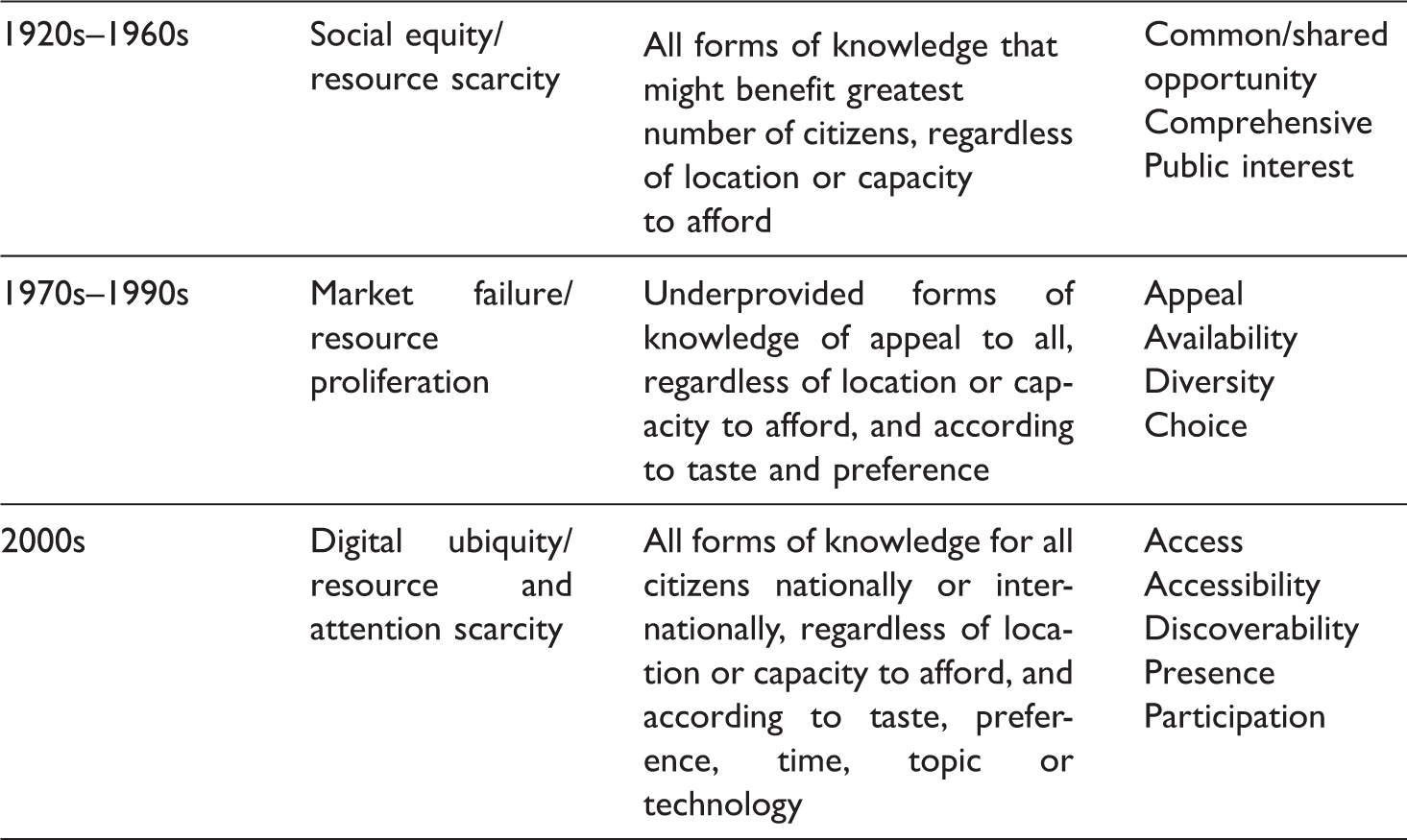
Historic expressions of universalism in PSB/PSM.
Thus at a time when PSM can hardly afford to be present on every new media platform, and is often not welcomed in new media markets, policymakers have tasked the institution with expanding into our Instagram shares and YouTube recommendations.
It is important to see this shift as more than PSMs’ response to the advance of neoliberal government. Instead we can read the institution’s pursuit of digital ubiquity as an adaptation to the conditions of international capitalist restructure and communicative power realignment that Castells (2009) observes, dominated by accelerated, dynamic, transnational flows of internetworked infocomms and mass self-publishing. Like media companies worldwide, PSM is working to a developmental agenda first envisioned by the founders of ubiquitous computing.
Ubicomp and mobile media
Computing scientist Mark Weiser, one of the first to articulate a ubicomp agenda, wanted to ‘better integrate computing’ into the everyday social world with ‘embodiments to be of many sizes and shapes, including tiny inexpensive ones that could bring computing to everyone’ (Weiser, 1993: 2). He envisaged portable devices, allowing interaction across networks and between locations, ‘making everything faster and easier to do’ (Weiser, 1991). Mobile technologies would ‘weave themselves into the fabric of everyday life until they are indistinguishable from it’ (1991: 1) allowing them to be ‘taken for granted’ (Galloway, 2004). Weiser recognized rightly that their enhancement of personal mobility and social organization would open up new markets for customized, real-time information and sensing technologies. Ubicomp rhetoric has fuelled the subsequent global expansion of networked and mobile media, with the anywhere, anytime trope common in ICT marketing by the mid-1990s.
Ubicomp’s influence on public sector policy demands critique, given its advocates’ boosterist tendency to underplay structural constraints or implementation problems. They propose a world of seamless digital interconnectivity, but Bell and Dourish argue this is ‘at best a misleading vision and at worst a downright dangerous one’ (2006: 134). Global mobile media infrastructure is ‘messy, partial and contingent’, a ‘triumph of making-do, accident, unintended consequence and resistance’ (Goggin, 2011:149). In Australia alone, poor mobile coverage and connectivity is of concern for anyone living outside of major metropolitan areas (Australian Government, 2015). Yet the commercial promotion of mobile media development devotes little critical attention to the consequences of uneven network provision or limited spectrum availability (cf IAB, 2014; GSMA, 2015).
Privatization of public spectrum assets and commercialization of content carriage present further equity issues for PSM mobile delivery. In a move away from free-to-air broadcast use of public spectrum, mobile broadband operators now charge users differentially, both to cover the cost of public spectrum purchases and to generate a profit. Additionally, PSM broadcasters must pay for bandwidth to serve content online, and users – who have already paid for the cost of broadcast carriage and production through license fees or taxes – now have to pay their service provider for data use. The EBU indicates the costs of broadband bandwidth alone make it ‘unlikely that PSM’s public service goal of universal coverage (>95%) will ever be reached’ using online delivery (2014: 45).
Industry attention may be diverted from these dubious opportunity outcomes because ubicomp literature tends to fetishize innovation and the immanent future, so that even new mobile investments and strategies appear ‘irrelevant or at the very least already outmoded’ (Bell and Dourish, 2006: 134). However, a policy focus on enabling the next big thing (wearables, sensors) may underestimate the difficulties of implementing current strategies. There are complex issues, for example, in re-designing web or television content for small screen and gestural controls, and in creating apps for diverse handsets and operating systems. Equally, increased personalization of content delivery demands new systems for registering, tracking and responding to individual, localized calls for information.
Weiser (1993) does acknowledge the surveillance and privacy issues that can arise with ubiquitous mobile tracking and sensing technologies. He does not however foresee the widespread commercial use of these technologies in audience analytics, which intensify commodification. Certainly in developing mobile apps, PSM companies enter the realms of user profiling and algorithmic measurement, if only to understand how these can be used in service delivery. The issue then is how far they move towards adopting commercial modes of behavioural targeting.
It is also unclear to what extent the future of PSM is tied to its presence in transnationally controlled, commercially enclosed digital media platforms. The latest BBC review has argued that PSB services need to be prominent and discoverable ‘in all the places audiences expect’ (Ofcom, 2015: 17). This is difficult to ensure where companies such as Google, Baidu or Facebook control the algorithmic logics of search and sharing. Ofcom itself notes the increasing complexity of mediating content distribution and production reduces PSM’s capacity to exert editorial control over its prominence, for example, on social aggregators like YouTube.
Competitively there is a great deal riding on PSM adoption of mobile media, not the least in its claims to social innovation. Mobile media users represent an ideal-type future audience: young and participative, with the potential to be early adopters and to generate new revenue streams (see Ofcom, 2015; Smith, 2012). Mobile media use is quickly reshaping news production (Newman et al., 2015) and also television, through second screen participation (Hutchinson, 2015) but often in ad hoc, unplanned ways that take advantage of social media platforms but without attention to inclusion.
So ubiquity comes with many commercial strings attached and many questions about its relation to older ideas of broadcast universality. Mobile technologies can potentially enable PSB to extend its temporal, spatial and technological presence online, and its participative capacities, but these outcomes are not givens. The move to mobile involves greater dependence on corporate platforms, private control over public resources and communications, and more detailed surveillance of individual citizens. This is why public service broadcasting’s investment in mobile media services and digital ubiquity represents a critical balancing act between internetworked openness and enclosure, public interest and personal convenience.
Beyond that, organizations like the ABC and SBS have to address the national and local contexts of mobile media industries, regulation and culture. While both have an innovation remit that underpins their competitive multiplatform transformation and both are largely dependent on state funding, SBS can take limited broadcast and online advertising, making them useful contrasting case studies in the move to mobile media ubiquity.
The multiplatform ABC and SBS
Australia is unusual in having two PSM organizations, each created to address economic and social problems that emerged during the European settlement of the vast island nation. The ABC, founded in 1929, was modelled on the BBC but not given its broadcast monopoly. Rather it operated in complement to an emerging commercial radio sector, providing market information, news and culture to areas of the continent not financially viable for fledging private broadcasters. Corporatized in 1983, the ABC’s broad charter bound it to deliver comprehensive and specialist services, international and local perspectives – veritably something for everyone, including those living in rural and remote areas (Martin, 2002).
It was also charged with being innovative, as an economic leavening for the country’s small, highly concentrated media markets. From the 1990s it has pioneered online, multichannel and on-demand television services (Cunningham, 2013). Its digital offerings now include four television stations and an on-demand ‘catch-up’ service; four national radio networks and 54 local stations (metro and rural); 11 digital radio channels and four specialist music channels; its web presence, abc.net.au; and a changing array of apps, streaming, on demand, and podcast content including the nine audio streams of Radio Australia, its overseas radio service.
The SBS, created in 1975, has innovation embedded in the last, rather than first clause of its charter, where it is directed to: ‘contribute to extending the range of Australian television and radio services, and reflect the changing nature of Australian society, by presenting many points of view and using innovative forms of expression’ (SBS, 2013). The SBS was the political legacy of 20th-century post-war migration, first from Europe and then Asia. It sprang from a federal Labor policy of multiculturalism and was given the twin objectives of reflecting an increasingly pluralistic nation and assisting new ethnic communities with information to support their social integration. Over nearly 40 years SBS has expanded and transformed to address Australia’s ‘increasingly globalized society … [whose] cultural diversity has become not only more complex but also more pervasive’ (Ang et al., 2008: 2). In 2011, at the last census, 32% of Australians were born overseas and 9.5% of those had arrived since 2003 (Australian Bureau of Statistics, 2013).
Now SBS’s role is more about forging connections between people of differing cultural heritage or developing ‘an ethos of engagement and inclusion across various dimensions of difference and diversity’ (Ang et al., 2008: 2). Its offerings have grown from multilingual radio and television broadcasts to encompass a cosmopolitan television and internet presence. It broadcasts four digital free-to-air television channels, two subscription channels and an on-demand service. Its radio network broadcasts in 74 languages, more than any other station worldwide, and via specialist regional music aggregation apps such as PopAsia and PopDesi.
As well as their innovation agendas, in 2012 the ABC and SBS were each given a charter responsibility to provide digital media services. Multiplatform production and delivery is central to the strategic plans of both into 2016 (ABC, 2013; SBS, 2013). However, budget cuts in 2013, under a new conservative Coalition government, have reduced the ABC’s overall allocation by $254 million or 4.6% over five years and the SBS’s budget by $25.2 million or 1.7% over the same period (ABC News, 2014). This has meant expenditure on mobile innovation is under greater scrutiny for audience impact and commercial potential, particularly at the partially advertising-funded SBS.
Mobile broadband technologies are significant informational tools for Australia’s population, which is dispersed across a landmass nearly as large as the United States. Fixed broadband connections may handle 93% of the data traffic (Australian Government, 2015), but Australians are turning to wireless mobile broadband, partly because of slow fixed broadband rollout, patchy service and capacity. Australia is ranked fifth in world for mobile broadband subscriptions, after South Korea, Japan, Denmark and Sweden, and ahead of the United States (OECD, 2015). In 2013 seven in 10 users had a smart phone and 50% of adults had used a tablet to access the Internet (ACMA, 2014; ACMA/CIE, 2014).
At the same time, while mobile access to the Internet is increasing and driving data usage, affordability remains a concern. Most phone plans have data caps, making them less suited to video streaming, and uncapped plans are relatively expensive. Twenty-nine per cent of Australians have no fixed line telephone and so are dependent on mobile phone services for work and social interaction (ACMA, 2015).
So just as ABC and SBS need to respond to Australians’ strong drive to mobile internet use, senior executives have to make difficult choices about what they can afford to deliver in digital media terms, who for and how these choices might position their organizations into a potentially leaner budgetary future. This analysis aims to interrogate the strategic objectives informing their mobile development, including the principles and policies central to PSM thinking about digital ubiquity.
Studying mobile PSM
The work presented here is part of a larger comparative study of the national and institutional factors shaping mobile PSM, a project which takes in the UK’s BBC, Italy’s RAI and Spain’s RTVE, as well as the two Australian broadcasters. This sample will enable comparisons between PSM in Australia’s competitive but light touch policy environment, and in the more diverse but highly regulated European environments.
The Australian research draws on policy analysis of annual reports and strategic plans, government submissions and public speeches for the last five years, as well as well as publicly available media industry data. A central source is semi-structured interviews of 45–60 min with 18 ABC and SBS executives. These participants were nominated by the organization’s senior policy contacts to represent mobile media developments in key strategic and operational areas. The SBS participants included managers from corporate policy, online and digital services, on-demand television, audio and language content, innovation, audience strategy, sales and legal. The ABC participants were from corporate policy development, online and multiplatform, television, radio and innovation.
Expert interviews were essential to investigating the nature of policy development and strategic planning as well as the conduct of professional practices. The interviews were conducted on site, at the ABC and SBS, between June and November 2014 and were audio recorded for transcription and textual analysis.
In the policy and interview analysis, documents were initially searched for the occurrence of the keywords: mobile, tablet, social media, broadband and apps. They were then examined for the positioning of mobile media references in relation to mentions of online or multiplatform strategy, and references to the discursive markers of universality and ubiquity listed in Table 1.
Ubiquity: Access, accessibility and presence
One of the core interview questions asked which PSM principles were driving the rollout of mobile strategies. All but two interviewees mentioned, as their first response, some aspect of universality – generally couched as servicing the needs of all Australians wherever they were consuming media. This was the only principle the majority gave without further prompting. Most did not frame this aim in terms of social opportunity or geographic reach, but in terms of free access and platform availability: We used to be a free-to-air broadcaster which was confined to TV sets. We now just talk about ourselves as a ‘free’ broadcaster. I guess the overarching principle from a public broadcaster perspective, ‘free’ is critical, but the platform is immaterial. (SBS, respondent 9) Well we’re about providing multicultural, multilingual services for all Australians, so I guess if it’s for all Australians you have to be on all the devices they choose to use – that’s really the driver … (SBS, respondent 16) The ABC has for a long time had a … strategic position that it will be on any major platform that it looks like audiences are going to … and mobile was rapidly becoming the way that the majority of people access the internet more of the time. (ABC, respondent 15) There’s also an element of wanting to make sure that we’re not missing out on certain demographics within society. So if it turns out that young people prefer to view content on their mobile, then we ought to be on those platforms, otherwise … we’re effectively non-existent for that part of society. (SBS, respondent 12) If you’re a Mandarin-speaker, you have one opportunity a day to listen to your radio show, so to have that available as catch-up, as an on demand bit of audio accessible on your mobile and online is crucial, especially for the small languages, some of them only have two programs a week. (SBS, respondent 17)
Notions of technical and cultural accessibility were distinguished from access. Interviewees talked about making content useable and functional in ways that enhanced user’s spatial mobility or understanding of the interface: There’s a difference between availability and accessibility of information and content … All of Dateline’s video content is available via SBS On-Demand which is available on apps, the whole shebang, but if you were to go to the Dateline website on this phone it’s currently not optimised for mobile, so there’s perhaps an accessibility argument for optimising that site. (SBS, respondent 3) We recently redeveloped our language app to be an SBS Radio app because we have so many stations we want people to go and explore … We had to ensure that it was accessible to all in the first instance. Most of it is in English, then go and find your language, because there has to be a default … but it’s simplifying the instructions, the icons, the intuitive design, so people can find their language quickly. (SBS, respondent 17) … whilst Australia is iPhone-centric, within certain communities [it’s] not. So if we try and give away an Apple product in a Korean community there’s far less value or desire than a Samsung product or something like that, so we’re constantly dealing with little pockets of complexities – even in terms of which communities have a greater potential of using mobile. (SBS, respondent 16)
The web-era policy turn to participative, co-creative forms of access, mentioned earlier, was not strongly evidenced in discussions of mobile strategy. Only two interviewees nominated participation as a key principle driving mobile PSM development, with the most compelling examples being social media engagement during natural disasters and political debates. Given participatory rhetorics were a critical marker of PSB 2.0 visions, their absence from these discussions is perhaps indicative of the greater mobile industry focus on personalization, apps and small screen design.
Ubiquity: Design and delivery
Moving to a multiscreen, multi-device mobile environment has required the ABC and SBS to choose between commissioning purpose built apps for major platforms like iOS or Android (the enclosed design approach) and introducing responsive or adaptive web design, programming which ensures web content will effectively reformat on any mobile screen device (the more open approach). Generally while app commissioning has been creatively driven, responsive design has been more strategic. SBS rolled out a responsive design project in September 2013, in order to server web browser-based content without platform or IOS restrictions – and claimed to be the first Australian broadcaster to do so (SBS, 2013). At the time of interviews ABC had updated its high traffic and high value web assets for mobile response, but was still in progress with updating legacy sites and projects.
The majority of interviewees saw responsive design as the primary solution to dealing with audience fragmentation, given it brings diverse mobile segments to a single web product and attempts to standardize user experiences of that content. However, one saw it as an administrative, cost saving response that did not address the need for ongoing research on situated use of mobile technologies: Organizations don’t like mobile strategies being in flux. They want to know, “What do you need … in your budget. What’s going to fix all of our mobile strategy?” Then someone says, “Well, responsive design, that will fix everything, one push of a button” [when] actually we’re needing to understand context better. (ABC, respondent 6) We find with our content that people with smart-phones, the iPhone, prefer apps, and people who have Android prefer visiting the websites directly, probably because the quality of the apps on Android aren’t as good as iPhone because they don’t have the same standards. So we just have to ensure that our content is accessible no matter which way they decide to interact on mobile. (SBS, respondent 17)
Several interviewees raised the need to test industry assumptions about mobile media consumption and to monitor localized trends. The ABC’s iView on-demand television service was built with 3G and 4G support, anticipating that people would watch it while commuting or on the move. However to the contrary, researchers found most access occurred from home and work on fixed broadband: … it turns out it is only 14% of Sydney that uses public transport for one thing, and out of that you have got the subset that might be interested in the ABC, and out of that you have a subset that has an iPhone and that has the app and that is willing to pay whatever the data charges and you are down to something like … less than 1% of our [on-demand] traffic coming over 3G and it’s probably people watching the news. (ABC, respondent 4)
Two of these, content delivery network (CDN) and audio-visual rights costs appear as critical restrictions on the scope of mobile delivery. At present both ABC iView and SBS On Demand services are still experiencing rapid uptake, with iView accesses doubling between June 2012 and May 2014. At the time of the study, CDN expenses were more of a concern for the higher rating ABC, given that the cost of transferring data increases with each additional user. It was possibly the lowest quality provider in the Australian market, delivering video at 650 kb/s. SBS in contrast could ‘wash its face’ of the digital delivery costs, as one respondent put it, offsetting them with advertising sales. Nevertheless, SBS successfully cut its CDN costs during 2014–2015 by reducing its video delivery bit rate (Department of Communications, 2014). ABC and SBS both use geoblocking to contain CDN costs, restricting citizens from accessing video content while working or travelling overseas.
The recent Lewis review into PSM efficiency (Department of Communications, 2014) had several suggestions for addressing rising CDN costs, including instituting a pay per view service after an initial free period of access, and charging for archival access to ABC-owned assets. It also proposed that the broadcasters launch a jointly owned and managed platform, although it coyly noted that the ‘legal aspects of monetising ABC content through advertising would need to be explored further’ (2014: 60). However, national communications economics penalize Australian PSMs in on-demand servicing. According to one respondent the ABC, which uses US-based commercial giant Akamai to serve up iView content, pays an estimated four times the CDN costs of broadcasters in the United States.
Catch-up services also present significant new rights costs. As a result podcast radio is stripped of its musical content and on-demand television services have a range of limited free access arrangements, usually 14 days for ABC content and between seven and 30 days for SBS. From March 2015, ABC Commercial introduced its first foray into pay per view content, with its ‘links to buy’ feature on iView. This recommendation technology surfaces image links to commercial downloads or ABC shop DVD sales of general adult programmes that are no longer available on the free catchup television service – although editorial policies exclude children’s programmes from being offered on the service. This is not so much a new commodification of public service content, but an intensification of it. To use the language of one respondent, the goal is to provide a ‘frictionless opportunity to transact’ at the moment of browsing.
Digital ubiquity then has a delivery cost, quality and access limits that are not always apparent in discussions of mobile development. Equally back of office is debate about how PSM might handle its collection and correlation of data about its mobile users.
Ubiquity: Metrics and analytics
In tightened budgetary conditions, where digital services are vying for developmental funds, and where market assessment regimes are in place, the use of detailed consumption analytics is becoming more important. In Australia, as elsewhere, the standards for measuring audience engagement are in flux. Varying analytics companies and measures are vying for legitimacy, with international players such as Google providing benchmarks, such as traffic sources, devices, input methods and screen size, landing pages and user flow, time on page and bounce rates. As Bennett (2013) has described, the industry picture is then complicated at institutional level by different localized approaches to gathering, analysing and valuing audience engagement figures.
Interviewees from both organization raised concerns about the impossibility of comparing audience metrics from different digital platforms, and about the precision, transparency and meaning of different measures. The apples and oranges problem impacts on the capacity of PSM staff to make business cases for mobile development and on both organizations’ capacity to measure performance effectively.
In the SBS case the new complexities of multiplatform digital advertising had led to a quadrupling of the sales team in 2014 from two to eight people, including a person with programmatic or automated advertising trading experience. For a public sector organization, the move to auction-based advertising presents a range of questions about the efficacy and accountability of buying and placement: It’s so complex … I lose sleep over this at night. The digital ad space has changed so much in the last couple of years it’s phenomenal. But it’s all about data overlays, it’s all about how much you bid on it. We might put in our inventory as blind or not, or branded or not … You can put it in the open exchange as blind, you can put it in the open exchange as visible, you can set up a private deal with just that ad agency or just those three agencies, or you can set up here at a specific price. (SBS, respondent 5) We very much would like to be travelling down that path where we can actually know more about the people who are consuming our content and therefore provide them a better product. Whether they sign on, and we’ll definitely be looking at that, or whether that’s mandatory or not is another question – probably not. But certainly if you want to get certain benefits that can come from that sort of customisation, sign on and we’ll be able to give you more things that you like … You’ve only got to look at the success of Spotify and Netflix to see how [personalisation] makes that such a good and rich experience. (ABC, respondent 7)
Conclusion
Digital ubiquity is not isomorphic with PSBs’ founding principle of universality, a concept rooted in fostering social equity and national cohesion. Rather it extends commitments to content availability and audience appeal, in respect to discoverability, engagement and participation, but assumes rather than guarantees opportunity. In competitive mobile markets PSMs are potentially more oriented to individual preference than social inclusion, and more exposed to transnational commercial strategies and plays. In this respect, PSMs multiplatform expansion is not simply an outcome of neoliberal politics or the competition state, but also of global informational capitalism. Mobile media are at the forefront of media and communications globalization, as well as intensified surveillance of consumption and communicative behaviours.
This study has documented conceptions of mobile ubiquity that clearly correspond with older public sector agendas, in delivering more flexible, relevant, culturally appropriate access to knowledge. The SBS and ABC focus on responsive web design well before Mobilegeddon is an indicator of their commitment to providing a new universality of access and accessibility. How they might implement aggregation and analytics for public sector outcomes deserves further attention, for example, around on-demand television and second screen interaction. Also of interest are the ways in which mobile technologies might further enhance audience participation in programming and public debate, and the issues PSM use of third party services might present for editorial control and analysis of that interaction.
Chief concerns for PSM on mobile are that its resources are further stretched and investments further entangled in the agendas of the transnational tech giants. This potentially diverts attention from local public interest innovation and embroils PSM in the reactive cycle of updates, metrics shifts and policy adjustments that characterize global informational media. SBS, Australia’s smaller and more commercially oriented broadcaster, is more vulnerable to these agendas and to the difficulties of servicing diverse mobile audience segments. Certainly the question is not whether these relationships are necessary, for PSB has always been engaged in commercial collaborations and market innovation, but to what extent they allow for distinctive creative directions and public outcomes, and how the state ensures popular, effective forms of PSM delivery are adequately funded.
Footnotes
Acknowledgements
Many thanks go to staff of the ABC and SBS who volunteered their time to participate in the interviews, and particularly to Teresa Iverach and Michael Brearley, who coordinated consents and permissions for the study. Marko Ala-Fossi and Benedetta Brevini provided inspirational feedback on drafts of this work.
Declaration of Conflicting Interests
The author(s) declared no potential conflicts of interest with respect to the research, authorship, and/or publication of this article.
Funding
The author(s) disclosed receipt of the following financial support for the research, authorship, and/or publication of this article: Fiona Martin gratefully acknowledges the support of the Australian Research Council, which funded the ARC Discovery project Moving Media (DP120101971) from which this paper arises. The School of Literature, Art and Media provided funds for interview transcription.