



Abstract
This content analysis of still images explores how leading media from the US and Middle East (CNN and Al-Jazeera) visually framed Muslim women during the Arab Spring. The findings indicate that when women were in images, they were the primary focal point more than men. Both media framed Muslim women as active participants in the political unrest; however, Al-Jazeera portrayed Muslim women as active significantly more than CNN. The results contrast sharply with previous studies of portrayals of Muslim women in Western media, especially in the post 9/11 era in which women were largely framed as passive victims.
Introduction
Muslim women have attracted considerable attention of Western media since the 1960s, and much of this attention has drawn criticism from media and communication scholars (Nacos, 2005; Roushanzamir, 2004). Following the 11 September 2001 attacks and wars on terrorism in Afghanistan and Iraq, waves of Muslim women’s images were brought into Western media, in particular, the US media (Cloud, 2004; Fahmy, 2004). Throughout, Western media framed Muslim women in stereotypical, often extreme and inconsistent ways: as passive, uneducated victims covered by Hijabs, as beautiful and seductive terrorists, as suicide bombers (Ayotte and Husain, 2005; Cloud, 2004; Fahmy, 2004; Manley, 2009; Nacos, 2005; Rantanen, 2005; Ross-Sheriff, 2006). More recently, since the 2011 beginning of Arab Spring, waves of democratizing movements in the Arab World have brought Muslim women to the focus of Western news media again (Voice of America (VOA), 2011; Woodrow Wilson International Center for Scholars (WWICS), 2012). However, this time some Western media have reported about new, more visible public roles for Muslim women in Arab societies, and the obstacles and violence these women faced in their advocacy for social and political change (Kasinof and Worth, 2011; VOA, 2011; Women and the Arab awakening, 2011). Some portrayals showed women alongside Arab men, revealing the crucial roles women had in Arab uprisings. Foreign Policy magazine went further and introduced four Arab women activists as among the Top 100 Global Thinkers of 2011 (The FP Top 100 Global Thinkers, 2011). Hence, as media coverage of the Arab Spring globally publicized the democratic ideology of Arab people, in some cases it also revealed changing roles that Muslim women have taken in their societies (BBC, 2011; Gelvin, 2012; VOA, 2011; WWICS, 2012).
This study seeks to understand how and to what extent these changing roles of Muslim women were documented in still visual images published by two leading international media—CNN and Al-Jazeera—during early 2013, the latter stage of Arab Spring. The study assumes that news creation is a social construction, shaped by the culture, news organizations and people that produce the content. As a result, news content—in this case, visual images—reflects the values of those who create it, and suggests that differences are likely to exist in how these leading Western and Arab media report the news. The idea that news is a social construction draws from sociological thinking about the nature of knowledge (Berger and Luckman, 1967; Goffman, 1974) and has shaped media scholars’ theorizing about factors that shape news creation (Gans, 1979; Shoemaker and Reese, 1996; Tuchman, 1978) and the development of news sociology.
A purpose of this study was to explore the impact of cultural ideology on visual news frames. Feminism is an ideology that differs significantly in Western and Arab cultures. In the West, feminism is a rational conquest for gender equality in all aspects of social, political, and economic life (Lind and Salo, 2002). In contrast, in the Middle East, Muslim women claim their rights in the context of tradition and religion (Badran, 2002; Hirschmann, 1997; Wadud, 2002). Accordingly, to the extent that feminism and culturally defined ideals about gender differ between the West and Arab World, it can be assumed that these differences will be reflected in the framing of news content (Badran, 2002; Hirschmann, 1997; Muller and O’Callaghan, 2013; Wadud, 2002; Waugh and Wannas, 2003). Further, because news frames have cultural resonance and tend to be enduring (Entman, 2004), the study explores the extent to which visual frames of Muslim women may have changed to reflect the realities of Arab Spring.
Literature review
This study is informed by several areas of literature. The first section looks at research of Muslim women in Western media; this is followed by the role of Muslim women in the Arab Spring and a brief review of Islamic feminism. The literature review then moves to influences on media content, drawing primarily from news sociology, which provides a basis for understanding why media from different cultures create and frame the same news events differently. Finally, visual framing is reviewed, with a focus on how various photography and journalism techniques create visual frames; the section ends with the study’s hypotheses and research question.
Western media portrayals of Muslim women
For the past half century, scholarship on the portrayal of Muslim women in Western media has yielded several consistent themes: Muslim women live in poverty and sadness in conflict-ridden places (Fahmy, 2004; Falah, 2005; Roushanzamir, 2004); they are covered from head to toe as ‘unattractive and uneducated’ slaves, a ‘submissive nonentity’ in male-dominated societies (Shaheen, 2000: 26–28); or, quite differently, they are seductive, sexual objects, using their sexuality to cloak their terrorist intentions toward the West (Nacos, 2005).
An iconic early example is Leila Khaled, a Palestinian who in 1969 was part of a team that hijacked a TWA flight on its way from Athens to Damascus (Nacos, 2005). In the Western media, she was the first Muslim women who gained attention as a female terrorist (Bickerton and Klausner, 2010; Nacos, 2005). Photographed wearing a headscarf and holding an AK-47, Western news described her as a stunning, beautiful hijacker with her ‘dark-eyed pin-up look’ (Nacos, 2005: 439). She was called ‘the glamour girl of the international terrorism,’ or the ‘bombs’—referring to her breasts (p. 439). The Iranian Revolution in 1979 brought another wave of coverage of Muslim women, and Western reports framed Iranian women as ‘sexually available underpins’ for Muslim men (Hirji, 2011: 34), symbols of ‘traditionalism, violence, terrorism, fanaticism,’ as well as the ‘oriental other,’ who are ‘faceless,’ ‘emotional,’ ‘impoverished,’ and ‘oppressed’ (Roushanzamir, 2004: 24). In the 1990s, the Gulf War and the Chechen War brought more Muslim women into the focus of the Western media as passive victims, cooks, the weak supporters of men, domestic captives, and the ‘black widows’ (Hirji, 2011: 97).
After the terrorist attacks of 11 September 2001, the Western media’s negative framing of the Muslim women continued, and some scholars suggest it worsened (Fahmy, 2004; Falah, 2005). This time, Afghan women, covered head-to-toe by Burqas, were brought to the top of international news headlines (Ayotte and Husain, 2005). In these images, Afghan women were often faceless, framed as passive victims, dehumanized, without identities, enslaved, victimized, and insecure others who needed liberation from Taliban (Ayotte and Husain, 2005; Fahmy, 2004). In 2002, the suicide attack of Wafa Idris, a 32-year-old Palestinian woman, once again found Western media portraying a Palestinian woman as a beautiful terrorist (Nacos, 2005). Beginning in 2003, the Iraq War prompted additional attention of Western media to Iraqi women, who were often framed as passive victims or active suicide bombers and terrorists (Falah, 2005; Manley, 2009).
These portrayals can be understood in relation to portrayals of Western women in Western media. Western women, too, are generally portrayed in less powerful and positive positions compared to men (Carlin and Winfrey, 2009; Goffman, 1976; Parry-Giles and Parry-Giles, 1996; Wasburn and Wasburn, 2011). Further, Western women largely receive media coverage in gender-specific boundaries such as femininity, appearance, personality, attractiveness, and wardrobe (Carlin and Winfrey, 2009; Parry-Giles and Parry-Giles, 1996; Wasburn and Wasburn, 2011). However, a stark difference in Western media is the depiction of Muslim women as deviant, enslaved, dehumanized oriental ‘others’ (Ayotte and Husain, 2005; Fahmy, 2004; Roushanzamir, 2004).
Muslim women in the Arab Spring and Islamic feminism
The Arab Spring and its waves of uprisings across the Arab world was also a revolutionary event for Muslim women, as they played foundational roles in regime changes in Tunisia, Egypt, Libya, and Yemen (Anderson, 2011; Gelvin, 2012). Coleman (2012) argues that women’s participation was a key inspirational element for other opposition groups and minorities to stand against the regimes in the Arab world. Shirin Ebadi, an Iranian, Nobel Peace Prize winner and a human rights activist, even claims that the Arab Spring would have not succeeded without the vast and active participations of women (WWICS, 2012). Sahar (2011) calls the Arab Spring ‘the Arab Feminist Spring,’ arguing that women joined the uprisings mainly to gain their own freedom and rights (p. 692). Moreover, Power (2012) names the Arab Spring an action of ‘sexism’ of women in the Arab world (p. 39).
Muslim women played crucial and courageous roles as active participants in the anti-government protests during Arab Spring (Sahar, 2011). Women were the organizers of several demonstrations and led online propaganda efforts to globalize the uprisings (Jadallah, 2011; WWICS, 2012). Generally, women were on the frontlines, carrying slogans and flags, and men strongly encouraged them to chant and speak, because male protestors thought women’s voices were heard better the men’s (BBC, 2011; WWICS, 2012). This expanding social and political activism was met with resistance. Throughout the Arab uprisings, many women were harassed, beaten, chased, sexually assaulted and even raped by ‘state and nonstate actors’ (Marcus, 2011: 2). For example, in Egypt some women suffered virginity tests by male military forces, some were raped, and some were dragged and beaten on the streets during the protests (WWICS, 2012).
Muslim women’s roles and their courage in the Arab uprisings gained international attention, including in Western media. Some examples include: Antelak Tawakkol Karman, a 32-year-old Yemeni female activist who shared the 2011 Nobel Peace Prize (Kasinof and Worth, 2011). Razan Zaitouneh, a Syrian human rights lawyer who has publicized the Assad regime’s brutality since 2005, went into hiding in 2011, was kidnapped by a group of armed men in December 2013. Her whereabouts remains unknown (Human Rights Watch, 2015). Manal Al-Sharif, a Saudi woman, gained worldwide attention when she filmed herself driving a car. The New York Times reported her Facebook campaign, ‘Teach me how to drive so I can protect myself,’ was inspired by broader uprisings across the Arab world demanding new freedoms (Mackey, 2011, para. 3).
A large number of these Muslim women advocate gender-equality and broader human rights in Arab societies through Islamic feminist ideals, which in detail are quite distinct from Western feminism. Scholars note that feminism is a cultural ideology that has grown many branches based on secular, religious, racial, and ethnic values across the world (Badran, 2002; Hirschmann, 1997; Wadud, 2002). Feminists in different parts of the world fight for different kinds of freedom, because what is considered women’s freedom in one culture, might mean ‘unfreedom’ in another culture (Hirschmann, 1997: 464). In other words, women in different parts of the world are privileged some rights and deprived of others (Waugh and Wannas, 2003). Among feminist branches, Islamic feminism ‘is a feminist discourse and practice articulated within an Islamic paradigm,’ which ‘seeks rights and justice for women, and for men’ based on ‘understanding and mandate from the Quran’ (Badran, 2002, para. 1). Islamic feminists argue that religion gives them more power (Eltantawy, 2007; Waugh and Wannas, 2003).
The practice of veiling in public is one example where cultural differences in feminist ideology are apparent. Islamic feminists define the veil as a symbol of ‘resistance,’ ‘agency,’ ‘cultural membership’, and ‘morality’ (Hirschmann, 1997: 464–466). They claim that the veil gives women more control of their bodies and makes them less likely to be viewed as sexual objects (or victims) in male-dominated societies (Eltantawy, 2007; Waugh and Wannas, 2003). However, from a Western feminist perspective, the veil is a symbol of inequality, barbaric Islam, domestic violence, and oppression (Hirschmann, 1997: 464). Islamic feminists disagree with the anti-veiling feminist ideologies—arguing that Western feminism exploits women, making them sexual objects more than providing them sexual freedom (McDonald, 2006; Debating France's new Burqa Ban, 2011; Haddad et al., 2006; Waugh and Wannas, 2003).
News sociology and visual framing
News sociology focuses on analyzing the factors inside and outside media organizations that influence media content, suggesting that news content is social construction rather than an objective reflection of reality (Shoemaker and Reese, 1996). News content reflects the ‘experiences, personalities, and knowledge’ of the people who create it, in which in-group individuals are often portrayed as normal, and out-group individuals are framed as abnormal (p. 4).
In their hierarchy of influences model, Shoemaker and Reese (1996) identify five factors—ideology, external media forces, organizational factors, routines of journalism work, and individual-level characteristics—that create a continuum of macro to micro influences on media content, with the macro level forces exerting the greatest impact. Ideology, the most powerful factor, is a ‘relatively formal and articulated system of meanings, values, and beliefs of a kind that can be abstracted as a ‘world-view’ or a ‘class outlook’’ (p. 222). Ideology integrates societal interests in that some values and beliefs are defined as acceptable, while other values ‘are read out of legitimacy’ (p. 225). Studies show that the US media tend to cover those international events that are in violation with their own cultural-ideological norms (Chang et al., 1987; Shoemaker and Reese, 1996). ‘The more deviant an international event is, the more likely it is’ to be covered in the US media (Chang et al., 1987: 399–400).
News frames are the result of content production processes defined by news sociology.
Entman (1993) notes that news frames are based on common cultural values, which help journalists make sense of social issues and problems. Routines in news work add to the framing process, as journalists exercise their professional values (e.g., news values) to determine what makes news (Shoemaker and Reese, 1996). News frames become the extension of journalism routines, as journalists seek to package information to fit their professional norms and audience expectations (Scheufele, 1999).
News frames can have important media effects. Frames assign attributes to issues and people in the news, making these attributes more salient by highlighting and connecting them ‘so as to promote a particular interpretation, evaluation and/or solution’ (Entman, 2004: 5). Framing can be used in ‘making new beliefs available about an issue, making certain available beliefs accessible,’ or making existing beliefs ‘strong’ in people’s evaluations (Chong and Druckman, 2007: 111). Framing occurs through verbal and nonverbal attributes, including visual images (Coleman and Banning, 2006: 313).
Visual images have strong communicative power (Mandel and Shaw, 1973: 355), as they contain facial expressions and gestures that give emotion to the image and create intimacy between the image subjects and audience (Hoy, 1986; Kobre, 1999). Images, like words, that have cultural resonance are likely most influential, as they are understandable, memorable, and emotionally charged (Entman, 2004: 6).
Like other media content, visual images are influenced by news sociology factors in two phases: news gathering and news production (Barnett, 2003; Rodriguez and Dimitrova, 2011). First, visual frames occur before the image is taken by environmental factors and journalists’ choices of lens distance, placement of the subject in the frame, camera angles, and lighting (Barnett, 2003). The second phase of visual framing happens after the photo is taken by ‘digital manipulation’—using certain software, cropping, color changing, and so forth (p. 108). Research has identified important visual framing devices are focal point, lens distance, depiction, and image dominance (Barnett, 2003; Hoy, 1986; Kobre and Brill, 2008; Mandel and Shaw, 1973; Rodriguez and Dimitrova, 2011). These visual framing techniques, used as measures in this study, are explained briefly below.
Focal point is a way of framing the most important parts of the image (Codak, 2010). ‘The primary and secondary focal points create a hierarchy that guides viewers through the visual narrative,’ (para. 3), illustrating which parts of the image are most important and relevant to telling a visual story.
Lens distance is another way of placing emphasis in a visual image (Hoy, 1986). Long shots capture the whole figure of a subject at a distance that implies isolation, loneliness, strangeness, and otherness (Fahmy, 2004; Hoy, 1986; Rodriguez and Dimitrova, 2011). Medium shots are known as ‘waist up shots,’ in which subjects are photographed from an acceptable social distance (Rodriguez and Dimitrova, 2011: 55). Close shots hone in on the dominant elements in the image, providing the potential for emotional intimacy with the image’s subjects, through their faces and expressions (Kobre, 1999).
Visual depictions are often defined as active and passive (Fahmy, 2004; Goffman, 1976). In active depictions, subjects are in powerful positions such as leading, controlling, helping, ordering, etc. (Fahmy, 2005; Falah, 2005). In passive depictions, subjects look as motionless, sad, shy, quite, and receivers (Bullock and Jafari, 2000; Fahmy, 2005; Falah, 2005; Goffman, 1976; Hardin et al., 2002; Rantanen, 2005; Ross-Sheriff, 2006).
Image dominance results from news production and reflects how visual editors package and place images among all news content. An image is dominant when it appears with the news headlines, title, and summary on the front page of a publication or website (Hardin et al., 2002; Schwalbe et al., 2008). In contrast, all other photos appearing inside the news stories are non-dominant; they are usually smaller than the dominant image (Hardin et al., 2002).
Hypotheses and research question
Based on news sociology assumptions, socio-cultural differences between the West and Middle East create different standards for gathering information and presenting the news. In Western media, Muslim women have often gained attention for gender roles in their societies that deviate with those of the West (Cloud, 2004; Falah, 2005; Shoemaker and Reese, 1996). Conversely, Arab cultures view men to have greater socio-political influence; modesty is highly valued for Muslim women, who are expected to live a domestic life (Darwish, 2011; Jawad, 1998; Moghissi, 1999; Shears, 2006). These cultural differences suggest images of Muslim women are more likely to be more dominant in Western media, and Muslim women are less likely to be the primary focus of Arab news coverage (Al-Malik et al., 2012; BBC, 2011; Coleman, 2012; Engineer, 2004; Fahmy, 2004; Jawad, 1998; Meranssi, 1991; Moghissi, 1999). Thus, these two hypotheses: H1: Muslim women are portrayed in dominant images significantly more on CNN than Al-Jazeera. H2: Muslim women are the primary focal point in CNN news images significantly more than in Al-Jazeera news images. H3: Arab women in the primary focal point are photographed from close range significantly more by CNN than Al-Jazeera. H4: Arab women in the primary focal point are framed as passive significantly more on CNN than Al-Jazeera. RQ1: When Arab women are in the primary focal point, are there significant differences in portrayals of with/without Hijab between CNN and Al-Jazeera?
Methods
Content analysis was used to explore how Western and Middle Eastern media visually frame Muslim women; two news agencies with international audiences were chosen: CNN and Al-Jazeera. These media were chosen because they are leading sources of news from two respective cultures. CNN has been one of the most respected US news media and an international agenda setter for three decades (Ammon, 2001; Angela and Stella, 2010; Wu, 2007). Al-Jazeera is an Arab news medium and growing international presence that attempts to ‘rebalance global media by respecting humanity of the world’ (Al-Jazeera, 2015; Fahmy and Al-Emad, 2011). This study examines Al-Jazeera’s English website, providing an opportunity to make direct comparisons between Arab and Western media portrayals intended for English-speaking audiences.
Sample
The sample of this study was drawn between 1 January 2013 and 31 March 2013—a 3-month consecutive sample. A total of 1460 images about the Arab region were published on CNN and Al-Jazeera, of which 419 (28.7 percent) included Arab women in the primary or secondary focal point. Twenty-two Arabic-speaking countries and territories comprise the Arab region: Algeria, Bahrain, Comoros, Djibouti, Egypt, Iraq, Jordan, Kuwait, Lebanon, Libya, Mauritania, Morocco, Oman, Qatar, Saudi Arabia, Somalia, Sudan, Syria, Tunisia, the United Arab Emirates (AUE) and Yemen, plus Israel and Palestinian territories (Gelvin, 2012). All news images that included Arab women from the above countries on CNN English and Al-Jazeera English websites during the 3-month period were included in the sample.
The study included only still images to limit each unit of analysis to a single image, which can be analyzed more accurately and objectively for framing variables (Coleman and Banning, 2006); conversely, video motion pictures consist of as many as ‘30 frames per second’ (Schwalbe et al., 2008: 453) with many different variables that complicate the process of analysis (Barnett, 2003; Garber, 1990: 136; Grimes and Drechsel, 1996). Also, still images—as standalone content—tell their own stories and influence people’s decisions about whether to read a news story (Zillmann et al., 2001). Still images are the images news consumers encounter when they come to the website, whether they watch the videos or not.
Images that were the opening frame for video stories were included in the sample, as these images are still until activated (clicked on).
Measures
The visual framing variables were focal point, lens distance, visual depiction, the presence of a Hijab (veil) and dominance.
The primary focal point is the most important element of the image, the point that first attracts the viewer’s eyes (Codak, 2010). It is the closest or biggest person or object, or the element in the image to which other people inside the image were attracted. Multiple people were the primary focal point when they were of equal size in the image, of equal distance from camera, and equally focused.
Visual depiction was measured as active, passive and can’t tell. Active depictions included women moving, helping, instructing, ordering, attacking, fighting, and leading others (Fahmy, 2004; Goffman, 1976). Passive portrayals included women who were motionless, in quiet poses, looking away from the camera; receiving aids and help from others, or watching others who are active (Fahmy, 2004; Falah, 2005; Goffman, 1976; Hardin et al., 2002).
Lens distance was coded as long, medium, and close-up (Hoy, 1986). A long shot captured the entire figure of a woman/women with some background (Hoy, 1986; Rodriguez and Dimitrova, 2011). A medium shot captured a woman/women from head to waist (Rodriguez and Dimitrova, 2011). A close-up shot focused on the face (portrait), and included a woman/women from the shoulders up. In a few images close shots focused on parts of a woman’s body (hands, foot or feet) (Hardin et al., 2002; Hoy, 1986).
Hijab was measured based on the presence of a veil and visibility of the faces and heads of Arab women in the primary focal point. It was coded in four categories: 1) face-veil—full faces covered including eyes, or faces covered except for eyes, 2) full faces visible but heads covered, 3) no Hijab, and 4) other (Hirschmann, 1997).
Image dominance was measured based on the placement of the images. Dominant images appeared on the homepage, positioned at the top of stories with news headlines, placed first or at the top of photo essays, or packaged as a still image that could be clicked on to begin a video in the news report (Hardin et al., 2002; Schwalbe et al., 2008). Non-dominant images were published inside the news stories and photo essays, and were smaller than the dominant image.
Inter-coder reliability
The first author coded all the images (n = 419) and was the primary coder of the content. To ensure a level of consistency in coding, a second coder analyzed a random sample of 40 images (20 each from CNN and Al-Jazeera), about 10 percent of the entire sample (Wimmer and Dominick, 2011). Cohen’s kappa was calculated to measure the inter-coder reliability, or the level of agreement between the coders on each variable (Riffe et al., 2005). The kappa coefficients ranged from .928 to 1—focal point (1.0), Hijab (.930), depiction (.939), and lens distance (.928)—reaching a high level of reliability on all variables (Fleiss et al., 2003).
Results
The sample comprised of 419 images that included women. Of these, 237 images (56.6 percent) were from Al-Jazeera and 182 (43.4 percent) from CNN. Women were the primary focal point in 257 of the 419 (61.3 percent) images. Chi square was used to test the hypotheses and answer the research question. H1 included all images in the test; the remaining hypotheses and research question were answered by images in which women were in the primary focal point.
Hypothesis 1 predicted that Arab women are portrayed in dominant images significantly more on CNN than Al-Jazeera. There was no significant difference in image dominance between the two media; the hypothesis was not supported (χ2 = . 214, df = 1, p = .643). Both media portrayed Arab women in dominant images about 70 percent of the time (CNN = 72.5 percent; Al-Jazeera = 70.5 percent). Although the expected difference between media was not found, it is worth noting that when women were included in news images, these images were packaged as dominant about 70 percent of the time for both media.
Hypothesis 2 predicted that Arab women are the primary focal point in CNN news images significantly more than in Al-Jazeera news images. There was a significant difference between the two media by focal point in the predicted direction (χ2 = 13.097, df = 3, p < . 004); this hypothesis was supported.
The primary focal point of images in CNN and Al-Jazeera.

χ2 = 13.097.
df = 3.
p ≤ .004.
Hypothesis 3 predicted that Arab women in the primary focal point are photographed from close range significantly more on CNN than Al-Jazeera. There was no statistically significant difference in the lens distance of women in the images between the two media (χ2 = 4.588, df = 2, p = .101); the hypothesis was not supported. CNN was more likely to frame Arab women in close shots (46 percent) than Al-Jazeera (38 percent), supporting the logic of the hypothesis, although the differences did not reach a level of statistical significance. The results also demonstrate that CNN had fewer medium-distance images (28.7 percent) than Al-Jazeera (41.5 percent). Additionally, CNN had more long shots of Arab women (24.6 percent) compared to Al-Jazeera (20 percent).
Active and passive depictions of Arab women in CNN and Al-Jazeera images.
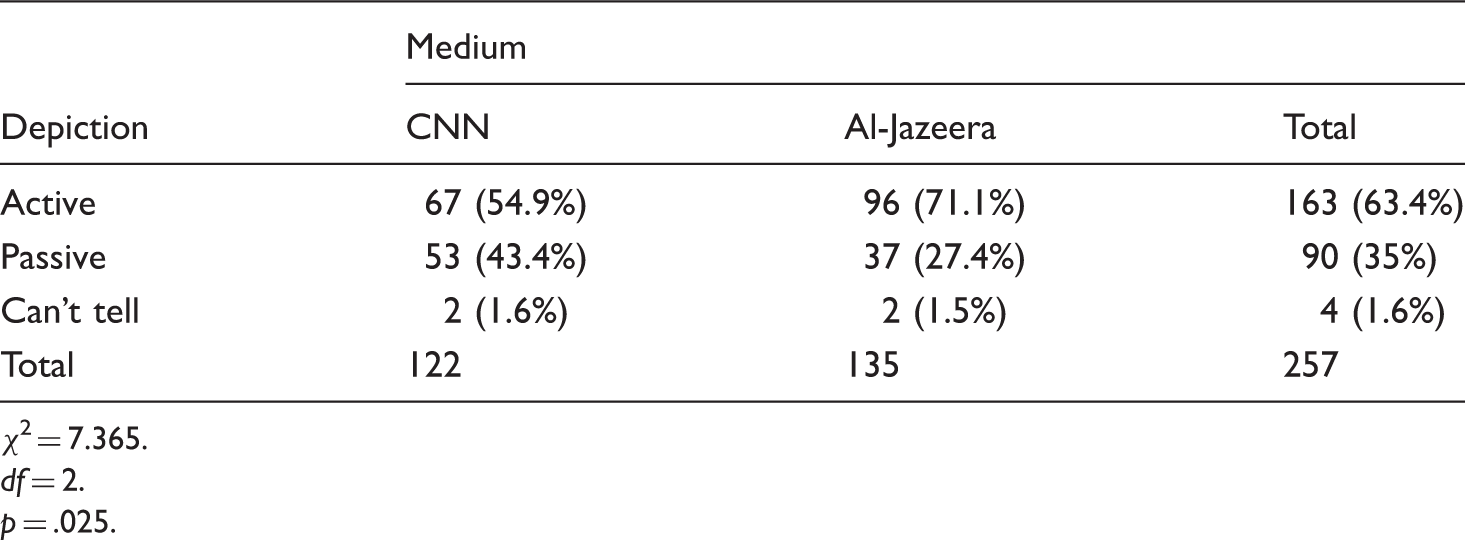
χ2 = 7.365.
df = 2.
p = .025.
The inclusion of Hijab of Arab Women in CNN and Al-Jazeera images.
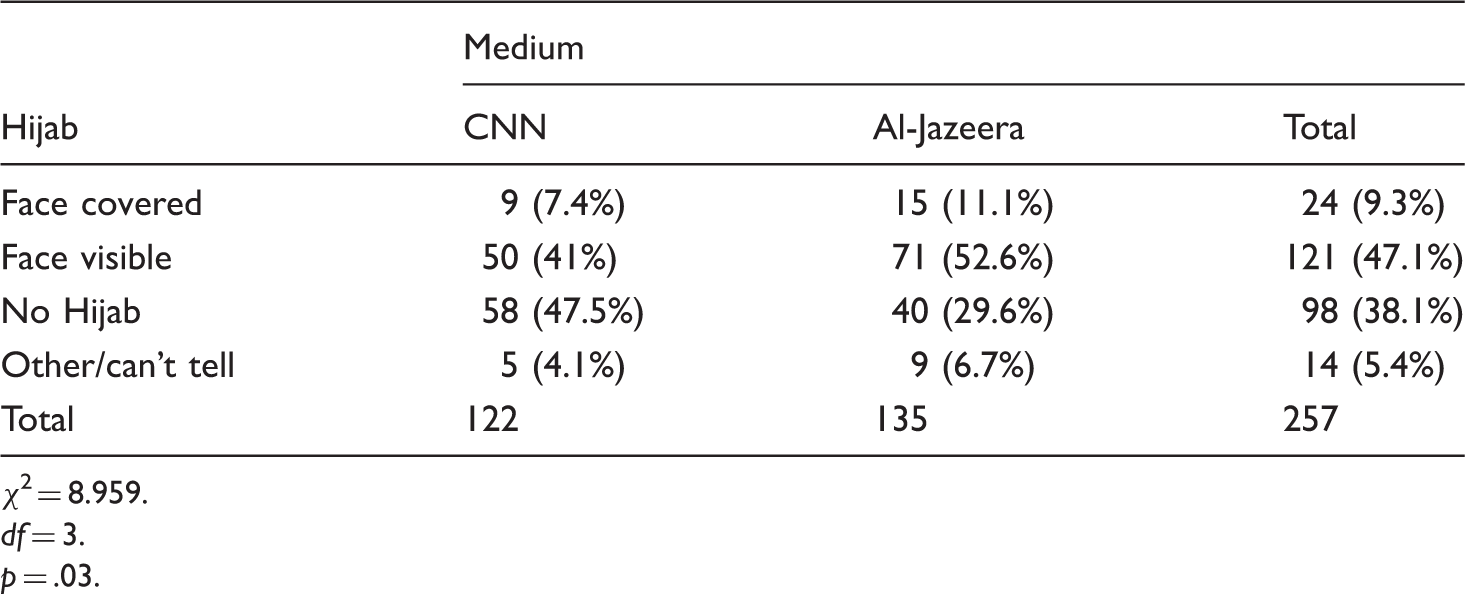
χ2 = 8.959.
df = 3.
p = .03.
Discussion and conclusion
This study analyzed how Muslim women were framed in visual images during the Arab Spring, comparing two leading international media, one from the West and one from the Middle East. Frames in news content result from social processes of news creation (Entman, 2004; Gans, 1979; Goffman, 1974; Shoemaker and Reese, 1996; Tuchman, 1978), and the findings in this study suggest that cultural differences between the West and Middle East regarding gender contribute to differences in how Muslim women are visually portrayed in their respective media. The results generally illustrate that visual news frames reflect the cultural values of those who produce the news, but perhaps more interesting is that the study also begins to reveal how news frames evolve and endure.
Muslim women made news by their increased presence in the social and political uprisings of Arab Spring, and their activism was captured by both media. Visual images of women were packaged prominently in news reports, and when men and women were in images, women appeared in the primary focal point a majority of the time for both media. Regarding Al-Jazeera, this result is somewhat surprising given the male-orientation of Arab cultures (Engineer, 2004; Khawaja, 2011), CNN framed Muslim women in the primary focal point significantly more than Al-Jazeera, and this finding reflects both previous findings that the coverage of the Islamic World in Western media has a strong focus on Muslim women (Cloud, 2004; Fahmy, 2004; Falah, 2005). This finding may also result from US news values. Conflict, crisis, and deviance in other nations receive more coverage in the US media, often because they are perceived as the efforts for normalizing the abnormalities (Chang et al., 1987; Shoemaker et al., 1991; Shoemaker and Reese, 1996). The participation of Arab women in the Arab Spring was not only novel to the world, but also had the potential for social and political changes that broadly fit with Western democratic and gender ideologies.
Additional findings also support that the visual frames of Muslim women shifted in Western media because these women were acting to create social change aligned with Western ideologies. Much of the post-9/11 research found Western media framed Muslim women passively, as symbols of injustice in the Islamic societies, and their activism was either framed negatively, or it was simply ignored (Fahmy, 2004; Malik, 2011; Nacos, 2005). However, this study notes a shift of frames; in a majority of images, Muslim women were framed as active by both CNN and Al-Jazeera. For CNN, the increased active depiction of Muslim women likely resulted from Western journalists’ observations of the dynamic changes in the political participation of women in Arab Spring (Coleman, 2012). But the shift could also reflect that women’s activism and gender equality are more valued in the West. For Al-Jazeera, the active depiction fits with Al-Malik et al.’s (2012) findings that stereotypical portrayals of women in Arab media are changing and research that suggests that in-group news coverage tends to reveal more positive characteristics and agency (Shoemaker and Reese, 1996; van Dijk, 2009).
The images of women wearing the Hijab (or not) indicate another change in Western media coverage since 9/11. Only 7.4 percent of images on CNN had Muslim women with the face veil in the primary focal point, and CNN captured significantly more women with no Hijab and visible faces than Al-Jazeera. These images reflect more human, visible and active portrayals of Muslim women, and differ significantly from previous studies of Western media, especially in post 9/11 news, that found a significant proportion of Muslim women’s images with face veils (Cloud, 2004; Fahmy, 2004; Rantanen, 2005). As authors of these post 9/11 studies noted, images of women with veiled faces fail to establish human contact with the viewers, and make the women look invisible, faceless, and anonymous. However, Al-Jazeera, as an Arab medium, didn’t see the veil as an obstacle against activism. Al-Jazeera’s inclusion of veiled women is likely a reflection of Arab culture, where veiling is a common and expected practice, and unveiled women are labeled as prostitutes, whores, and ‘uncovered meat’ often harassed in public places (Darwish, 2011; Moghissi, 1999; Shears, 2006).
Scholars have noted that once news frames are created they tend to endure and are repeated in news coverage, as cultural ideologies tend to be stable and journalists share professional values and work routines that standardize news production (Entman, 2004; Gans, 1979; Shoemaker and Reese, 1996). In this study, there is considerable evidence of shifting visual frames, but the continued passive frames of Muslim women, particularly in CNN images also indicates the resilience of this frame in Western media. CNN framed Muslim women passively in 43 percent of its images, and significantly more than Al-Jazeera, an Arab medium in cultures where modesty for women is highly valued (Jawad, 1998; Moghissi, 1999). This finding suggests that Al-Jazeera has a more progressive view of Muslim women’s activism, even though this activism fits well with Western and US ideological and cultural norms regarding democratic participation and gender equality.
Arab Spring meant different things in different countries (Gelvin, 2012), and in some places it is still ongoing, in others it hardly ever took place (Jones, 2013). This study was limited to two news outlets, which cannot capture the totality of the news coverage. In addition, this analysis had a small window of sampling (3-month period), which was impacted by some events, such as Syria War, which drew considerable coverage on both CNN and Al-Jazeera websites. For these reasons, results cannot be generalized beyond the media and time frame studied. Also, this study focused exclusively on still visual images, not including the text that accompanied the images or videos. Although it is well-established that images tell their own stories, the text that accompanies images can provide valuable cues on how to process the image, Future research can extend the analysis of portrayals of Muslim women by addressing these limitations, as well as studying content in non-conflict zones.
Despite these limitations, the study contributes to international communication research in several ways. The study demonstrates a shift—and largely positive change—in the visual framing of Muslim women in a leading Western medium, and it adds to the research suggesting that some Arab media are covering Arab women in less stereotypical ways. Further, as a study that compares and contrasts news images of media from two cultures during a critical event (Arab Spring), it provides nuanced evidence of how cultural values are manifest, shift and endure in visual frames and news coverage.
Footnotes
Declaration of Conflicting Interests
The author(s) declared no potential conflicts of interest with respect to the research, authorship, and/or publication of this article.
Funding
The author(s) received no financial support for the research, authorship, and/or publication of this article.