



Abstract
Social capital refers to the resources inherent in social relationships; it is considered the foundation of economic, political, and social development. To explore the media’s impact on social capital, we analyze the impact of media consumption at the individual level and the effects of media system structures at the national level. Multilevel analyses were computed using individual data from the European Social Survey and national data on media structures. The results indicate that Internet use and informational media use increase social capital. Moreover, societies seem to benefit from open, free, and pluralistic media systems as they support the production of social capital. In sum, we argue for a dissociation from a culturally pessimistic, one-sided point of view when discussing media effects. In today’s societies, media imply potential rather than restrictions.
Keywords
Introduction
Social capital refers to the resources inherent in social relationships (Bourdieu, 1980; Burt, 2000; Coleman, 1988; Putnam, 1995a, 2000). At the individual level, social capital can be understood as a resource of individuals; at the societal level, it might be seen as the wealth of an entire society (Lin, 1999; Portes, 2000). Social capital enhances the effectiveness of government action (Putnam, 1993), reduces poverty (Narayan, 1999), and increases economic outcomes (Fukuyama, 1995). This societal relevance underlines the need to explore the factors that may influence social capital in societies.
In his essay ‘Bowling alone’ (1995a), Robert Putnam claimed that 25 to 50 % of the decline in social capital in the United States is due to increasing television viewing (cf. Rojas et al., 2011). Putnam’s analysis has been confirmed only to a certain extent by other researchers. First, the observed effects on social capital are not as large as he claimed (e.g., Lee et al., 2003; Norris, 1996; Scheufele and Shah, 2000; Schmitt-Beck and Wolsing, 2010; Uslaner, 1998). Second, media effect studies provide evidence that the impact of media use depends on the content (e.g., Beaudoin and Thorson, 2004; Brehm and Rahn, 1997; Fleming et al., 2005; Moy et al., 1999; Norris, 1996; Quintelier and Hooghe, 2011; Scheufele and Shah, 2000; Shah et al., 2001).
Reviewing this research, we note that most studies solely focus on the effects of media use and thus on media effects at the individual level (Norris and Inglehart, 2009: 42). 1 However, to fully explain media effects, the properties of media use must be analyzed in the context of media systems, as media systems are ‘central to the living of everyday personal and social life’ (Ball-Rokeach, 1998: 20).
In our study, we apply a ‘context-dependent approach’ (Iyengar et al., 2010: 292) and consider the effects of media exposure being embedded in national media structures. In this way, we are able to examine how media structures may influence social capital and also how the relationship between media use and social capital may vary according to the context (cf. Nisbet et al., 2012; Norris and Inglehart, 2009). Therefore, we ask the following research question:
What are the effects of media use and media system structures on social capital?
Social capital
Bourdieu (1980: 2) defined social capital as the resources inherent in more or less formalized relationships on the individual level. Coleman (1988: 409) understood social capital as socio-structural resource that may have positive consequences for individuals and for society as a whole. Additionally, under the term social capital, he included trustworthiness, information, and norms as characteristics of social relations that may constitute resources for individuals (Coleman, 1988: 101–105). Putnam (1995a, 2000) primarily regarded social capital as an attribute of society (cf. Rojas et al., 2011: 691) and introduced the term ‘stock of social capital’ (Putnam, 1995a: 67). He defined social capital as ‘features of social organization—networks, norms, and trust—that enable participants to act together more effectively to pursue shared objectives’ (Putnam, 2000: 664–665). Following Putnam (2000), networks refer to formal organizations and informal groups of friends or neighbors. According to these concepts, we define social capital as the resources available in networks of formal and informal relationships on which individuals and society as a whole can capitalize (cf. Arnold, 2008).
Dimensions of social capital
All the presented approaches understand the resources inherent in social relations as the core of social capital (cf. Vergeer et al., 2011; Vergeer and Pelzer, 2009). However, these resources have to be distinguished from terms presented in the context of social capital by Coleman (1988) and Putnam (2000). Trust and norms are mechanisms that generate social capital; information might be a consequence of the possession of social capital (Portes, 1998: 5). Moreover, based on Putnam’s (1995a, 2000) and Bourdieu’s (1980) differentiation between formal and informal relations, social capital might be differentiated into two forms (e.g., Arnold, 2008; Rojas et al., 2011; Wellman et al., 2001). Network capital lies within informal relations with friends, neighbors, relatives, and workmates, as they provide ‘companionship, emotional aid, goods and services, information, and a sense of belonging’ (Wellman et al., 2001: 437). Participatory capital appears primarily in associational memberships that afford opportunities for people to bond and articulate their demands (Wellman et al., 2001: 437; see also Vergeer et al., 2011: 434). In this article, we focus on network capital and participatory capital as these two forms constitute the core of social capital (Bourdieu, 1980; Putnam, 1995a, 2000).
Levels of social capital
The concept of social capital operates on two levels (Lin, 1999; Portes, 2000). Following Coleman (1988) and Putnam (2000), the resources in formal and informal social relations are expected to be beneficial to the collective itself and to the individuals within the collective (cf. Lin, 1999). The aim of this article is not to theorize the transition of the concept from an individual resource to the national level (cf. Lin, 1999; Portes, 2000). However, we point to the notion that both levels are ‘essential features of the construct’ (Rojas et al., 2011: 691) and accordingly analyze the impact of factors on both levels on the amount of individuals’ social capital. Referring to Coleman’s (1990) macro-micro-macro model, we state that the distribution of social capital among individuals has consequences for the amount of social capital in societies. In the following section, we will outline the theoretical argument regarding media’s potential influence on both levels of social capital.
Individual level: Media use and social capital
Putnam (1995b: 679) explained his results on the negative impact of media use on social capital by theorizing that time spent watching television results in social isolation and that heavy consumption of television may cultivate inactivity and distrust towards other people. Putnam’s argumentation provides parallels to Robinson’s videomalaise hypothesis (1976) and Gerbner’s cultivation theory (e.g., Gerbner and Gross, 1976). To derive theoretically based hypotheses on media’s impact on social capital, we refer to both research traditions (cf. Arnold and Schneider, 2008).
Robinson’s (1976: 426) videomalaise might elucidate media’s impact on participatory capital, as it describes the link between reliance on television and the resulting ‘political malaise’ (cf. Arnold and Schneider, 2008: 202). The idea of videomalaise is based on the notion that feelings of political cynicism and a lack of political efficacy are caused by the high amount of conflict frames and high negativism presented on television. However, referring to surveys in Europe and the United States as well as experiments in Britain, Norris (2000: 10) noticed that ‘contrary to the videomalaise hypothesis, use of the news media is positively associated with a wide range of indicators of […] mobilization’ (see also Bennett et al., 1999; Liu et al., 2013; McLeod et al., 1999). We find the notion of ‘political mobilization’ (Luengo and Maurer, 2009: 45) or the ‘mobilization theory’ (Newton, 1999: 580) emphasizing the positive impact of news media consumption in the literature (Strömbäck and Shehata, 2010). Holtz-Bacha (1990: 81) transformed the videomalaise hypothesis into an entertainment malaise hypothesis, in which she specifically blamed entertainment programmes for the decline in public participation (cf. De Vreese and Boomgaarden, 2006; Hooghe, 2002; Livingstone and Markham, 2008). In summary, it is not television use per se that leads to a decline in social capital; instead, it is a specific kind of television use that has this effect (Schmitt-Beck and Wolsing, 2010).
If these theoretical and empirical findings are adapted to social capital, it seems plausible that entertainment content might lead to decreased participation in associational memberships (participatory capital), as it instils feelings of political inefficacy. By contrast, the use of informational media enhances political knowledge and thus might lead to more political participation.
Gerbner’s cultivation theory might provide insights into the impact of media exposure on network capital (cf. Arnold and Schneider, 2008: 203). Gerbner et al. showed that violence is an integral part of American television (Gerbner and Gross, 1976: 174) and that television is capable of undermining viewers’ confidence (Morgan et al., 2009: 39). According to a study by Hawkins and Pingree (1981: 295–296), the ‘mean world syndrome’ is primarily due to fictional entertainment programmes, and informational programmes do not have comparable effects. Thus, the consumption of entertainment programmes may lead to social isolation—not due to the time spent watching TV, as stated by Putnam (1995b), but due to the social mistrust that such viewing evokes. However, trust is a precondition for connecting with neighbors and workmates and thus for generating network capital. Consequently, the current state of research leads to two arguments. First, we have to analyze what type of media content is used by the individual: information or entertainment. Second, we have to consider differences between media systems, as the media content might depend on structural conditions and thus may vary according to the context.
To sum up, media’s presentation of reality might influence the public’s perceptions of reality and thus its willingness to connect with the social environment via formal (participatory capital) and informal relations (network capital). As the framing of reality differs between informational and entertainment media, we assume that the effects of mass media might depend on content-related aspects rather than on the medium (Newton, 1999: 577). We thus state the following hypotheses:
H1: Informational media use has positive effects on social capital.
H2: Entertainment media use has negative effects on social capital.
In addition to the differentiation between informational and entertainment media use, the Internet seems to be a special medium with potentially special effects. According to Putnam’s (1995a) claim concerning the effects of television, Nie (2001: 43) evaluated the more dramatic isolating potential of Internet use (cf. Kraut et al., 1998; Nie, 2001; Nie and Erbring, 2000; Valenzuela et al., 2009). By contrast, cyber-optimists judge the impact of the Internet as a social technology to be primarily positive. Providing various technological features with which to communicate with others, the Internet can help ‘to create, extend and maintain’ (Lee and Lee, 2010: 715) the social network (Boase et al., 2006; Gil de Zúñiga et al., 2012; Haythornthwaite, 2001; Mesch and Talmud, 2010; Valenzuela et al., 2009; Wang and Wellman, 2010). Supporting this claim, Bakker and De Vreese (2011: 15) showed that most of the effects of Internet use on political participation ‘are positive in nature’ (see also Romer et al., 2009; Shah et al., 2001). In line with these results, Boulianne’s (2009) meta-analysis of 38 studies found that Internet use is positively associated with citizens’ engagement (cf. Nisbet et al., 2012). These results demonstrate the generic relational impact of the Internet as a communication tool (cf. Sum et al., 2008). By reducing time and effort, the Internet supports membership in open networks organized around common interests (Boulianne, 2009: 205; Ellison et al., 2011: 15; Uslaner, 1998: 225). Moreover, the Internet facilitates relationship maintenance and removes the traditional boundaries of space and time (Ellison et al., 2011: 17).
In summary, as a social technology, the Internet can stabilize and expand social networks. Social capital is an inherent resource in social networks. Internet use thus strengthens the structural environment of social capital; informal relationships (network capital) and formal relationships (participatory capital) become more probable. We therefore assume a positive effect of the Internet on social capital:
H3: Internet use has positive effects on social capital.
National level: Media structures and social capital
The extent to which the stated media effects occur in a specific country depends on various structural factors of the media on a national level (cf. Morgan et al., 2009: 43). The media system dependency approach (MSD; Ball-Rokeach, 1985, 1998; Ball-Rokeach and de Fleur, 1976) theorizes why media message effects on beliefs and behavior depend on media systems. According to MSD, the media system controls information resources (Ball-Rokeach, 1998: 15; cf. Djankov et al., 2001: 2) and has relationships with other social systems that shape the dynamics of an individual’s dependency on disseminated media messages (Ball-Rokeach, 1985: 488). Therefore, to fully understand media effects, we must understand the role of the media system in society (Ball-Rokeach, 1985: 488). We therefore theorize a media system’s functions and the structural conditions (shaped by other social systems) that might influence a media system’s exercise of its functions.
As an information system, the media system ‘is necessary for development, maintenance and change of modern societies’ (Ball-Rokeach, 1998: 15). In addition to their information function, media provide a civic forum in which pluralistic debates about public affairs can take place and in which public participation is encouraged. Moreover, media fulfil a ‘watchdog’ function, protecting democracies from the misuse of power (Norris, 2000: 7). As they strengthen the awareness of norms and values and thus facilitate social integration, media also have socio-cultural functions (Curran et al., 2009: 20; Gerbner and Gross, 1976).
Norris (2004: 116) theorized that media freedom and access to information are necessary to ensure that media systems function effectively and provided empirical support for her hypotheses using a macro analysis of 135 countries. The United Nations Educational, Scientific and Cultural Organization mentioned Norris’ considerations and further noted the need for pluralism. As a platform for democratic discourse, the media should reflect and represent society’s diverse views and interests (Puddephatt, 2007: 12–14; cf. Ball-Rokeach, 1998: 21).
To sum up, democratic media structures build a structural environment in which social capital can be generated. If media freedom, media access, and media plurality exist, media are able to promote government transparency, to provide an open platform for political discussion and to facilitate social integration. Thus, democratic media structures might enhance not only participatory capital but also network capital:
H4: Democratic media structures have positive effects on social capital.
Contemporary media depend on the economic system (Ball-Rokeach, 1985: 490) and are guided by a commercial logic. Curran et al. (2009: 6) state that ‘in most parts of the world, the news media are becoming more market oriented and entertainment centered’. The ‘commercial deluge’ (Hallin and Mancini, 2004: 274) has changed media systems by forcing them to follow the ‘dictates of the market’ (Iyengar et al., 2010: 292) and has changed the function of journalism. As the system depends on maximizing advertizing revenues (Curran et al., 2009: 19), journalists’ main objective is not only to create social consensus and to inform citizens but also to satisfy consumer demands (Hallin and Mancini, 2004: 277; Iyengar et al., 2010: 295). As a consequence, there is an increasing turn towards soft journalism in commercial-oriented media systems (Curran et al., 2009; Iyengar et al., 2010). Moreover, economic globalization, which is interrelated with commercialization, plays an important role (Hallin and Mancini, 2004: 276). The global expansion of the market has diminished the differences between nationally distinct cultural systems. In this way, commercialization and globalization concertedly contribute to homogenization, undercutting the plurality of cultural systems of individual nations (Hallin and Mancini, 2004: 277).
In summary, commercialized and globalized media structures might lead to a decline in social capital. Following primarily commercial principles, the media system is less likely to fulfil its social integration and informational function. However, integration is particularly important with regard to network capital; high information quality is a precondition for political participation. Moreover, commercialization brings individualistic values into focus that might reduce the individuals’ willingness to connect and thus hinder the production of social capital. Thus, commercial media structures might have a negative impact on network and participatory capital:
H5: Commercial media structures have negative effects on social capital.
Media structures may have not only a direct impact but also an indirect impact on social capital by affecting the linkage between media use and social capital on the individual level. It seems highly plausible that the effects of media use on social capital are moderated by the structures of the media system. For example, the positive influence of informational media use and Internet use might be fostered by democratic media structures due to the high quality of the information. In fact, in their study ‘Cosmopolitan Communications’, Norris and Inglehart (2009) proved that interaction effects between context variables and media use influence cultural and political values. Comparably, in their study ‘Internet Use and Democratic Demands’, Nisbet et al. (2012: 260) showed that contextual-level variables moderate the relationship between Internet use and the demand for democratization. Therefore, we assume that there might also be interaction effects between media use and media structures with reference to social capital and posit the following hypothesis:
H6: There are cross-level interactions between media use and media structures that affect social capital.
Method
The aim of this study is to explore the impact of media consumption and media structures on social capital. Consequently, we need representative data depicting network capital, participatory capital, and media use on an individual level as well as data describing the structures of media systems on a national level.
Secondary data
On the individual level, we use data from the European Social Survey (ESS). 2 The ESS is an academically driven social survey, funded by the European Commission’s Framework Programmes, the European Science Foundation, and national funding bodies in each country. For this study, we used data collected in 2008. Concerning the national level, data from various sources collected in the same year were used. In sum, the following analysis is based on 53.046 cases from 27 countries. 3
Operationalization
Social capital
Our operationalization of both forms of social capital—participatory and network capital—is based on survey data provided by the ESS.
Participatory capital was operationalized with an additive index of seven behavioral items (α = .66; M = .71; SD = 1.19). These items were measured dichotomously, examining whether the respondent participated in a series of actions over the past 12 months, which included different forms of civil participation (e.g., working in an organization or association, taking part in an official public demonstration).
The ESS includes two questions concerning the respondents’ network capital: the frequency of social activities and the regularity of meeting socially with friends, relatives, or colleagues. As the answers were registered on different scales, the two variables were z-transformed before building an average index (M = .01; SD = .82). The internal consistency (Cronbach’s α = .52) must be evaluated as ‘poor’ (Darren and Mallery, 2002). As both items represent parts of the informal network that differ slightly from each other, we decided to add both variables to the index instead of applying only one variable.
The distribution of the variables (Figure 1) shows that European societies differ with regard to their average level of social capital. Northern European countries have more social capital at their disposal than Southern European countries. Furthermore, we notice a decrease in social capital from Western to Eastern Europe. Overall, countries in South-eastern Europe exhibit the lowest degree of social capital.
Participatory capital and network capital in Europe.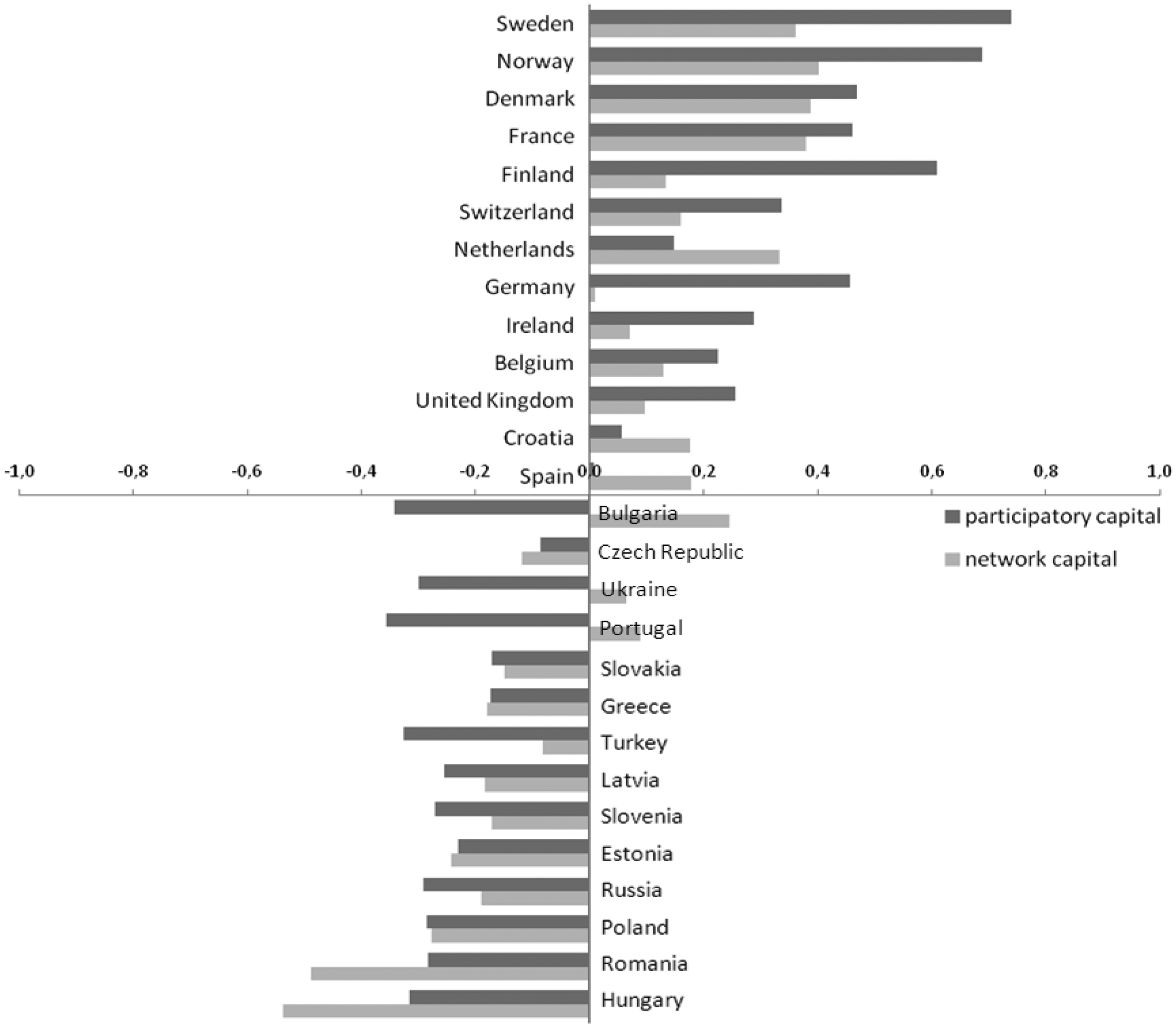
Media use
The ESS measures the use of television, radio, and newspapers on an 8-point scale in half-hour intervals. In this way, general media use and informational media use were measured. Following Norris and Inglehart (2009), we constructed an overall informational media use scale (M = 1.28; SD = .89) and combined the data on television, radio, and newspapers. Moreover, we were able to operationalize entertainment media consumption by calculating the difference between general and informational media use. Similar to the construction of the informational media use scale, we built an overall entertainment media use scale (M = 1.56; SD = 1.04).
Additionally, the ESS includes data on Internet use without differentiating between different types of usage. Generic Internet use (M = 2.8; SD = 2.77) measured on a 7-point scale ranging from 0 = no time at all to 6 = every day was integrated into our analysis. Similarly, in their secondary analysis based on the Afrobarometer and Asian Barometer, Nisbet et al. (2012) used a single 5-point item to measure Internet use.
When comparing media use in Europe, differences in content preferences and Internet use become evident. Citizens of Northern and Western European countries are more information-oriented and use the Internet more frequently. By contrast, citizens of South-eastern and Eastern European countries favor entertainment programmes and rarely use the Internet.
Media structures
To represent European media systems, we used macro data collected from several sources in the same year as the ESS data.
Media freedom is operationalized by the Freedom of the Press Index from Freedom House (2009); it is the most appropriate media freedom index for our purpose because it measures the extent to which countries restrict the flow of information by considering legal, political, and economic factors (Freedom House, 2009: 12; cf. Norris and Inglehart, 2009: 141–142). Norris and Inglehart (2009: 143–144) demonstrated its reliability by showing its strong correlation with the measures of the Worldwide Press Freedom Index for the countries included in the World Values Survey. To simplify the interpretation of its effects, we transformed the original scale of the Freedom of the Press Index, such that high scores represent free media systems.
To operationalize media plurality and media access, we collected data from three sources: ‘Television International Key Facts 2009’ (IP Network and RTL Group, 2009), ‘World Press Trends 2009’ (World Association of Newspapers and Publishers, 2009), and ‘The Yearbook of the Eurpoean Audiovisual Observatory 2008’ (European Audiovisual Observatory, 2008). The media plurality index is based on the number of TV programmes and the number of newspaper titles published daily. To control the size bias of a country, the data were divided by the size of population. Before computing the index, the data were z-transformed. The media access index includes data on the technical infrastructure, such as the number of households with television and broad band equipment. 5 Additionally, the average circulation of dailies weighted by the number of households was integrated into this index.
Advertizing revenue represents the media system’s dependence on the advertizing market and thus indicates its level of commercialization. The ‘World Press Trends’ provides data on advertizing revenues adjusted by the gross domestic product. Commercialization is further indicated by the economic globalization of the media market. As there are no specific data on the economic globalization of media, we used the KOF Index 6 to represent the economic, social, and political globalization of nations. Focusing on economic globalization, we integrated the data on the economic dimension.
Applying the theoretical explanations, the indices were combined into democratic structures (media freedom, media access, media plurality) (M = −.05; SD = .83) and commercial structures (dependence on advertizing revenues, globalization) (M = −.08; SD = .77). 7
The descriptive data analysis (Figure 2) shows that the media systems in Northern and Western Europe are primarily characterized democratically. Furthermore, the media systems of Eastern Europe are more commercialized than those in Western and Northern Europe.
Media systems in Europe.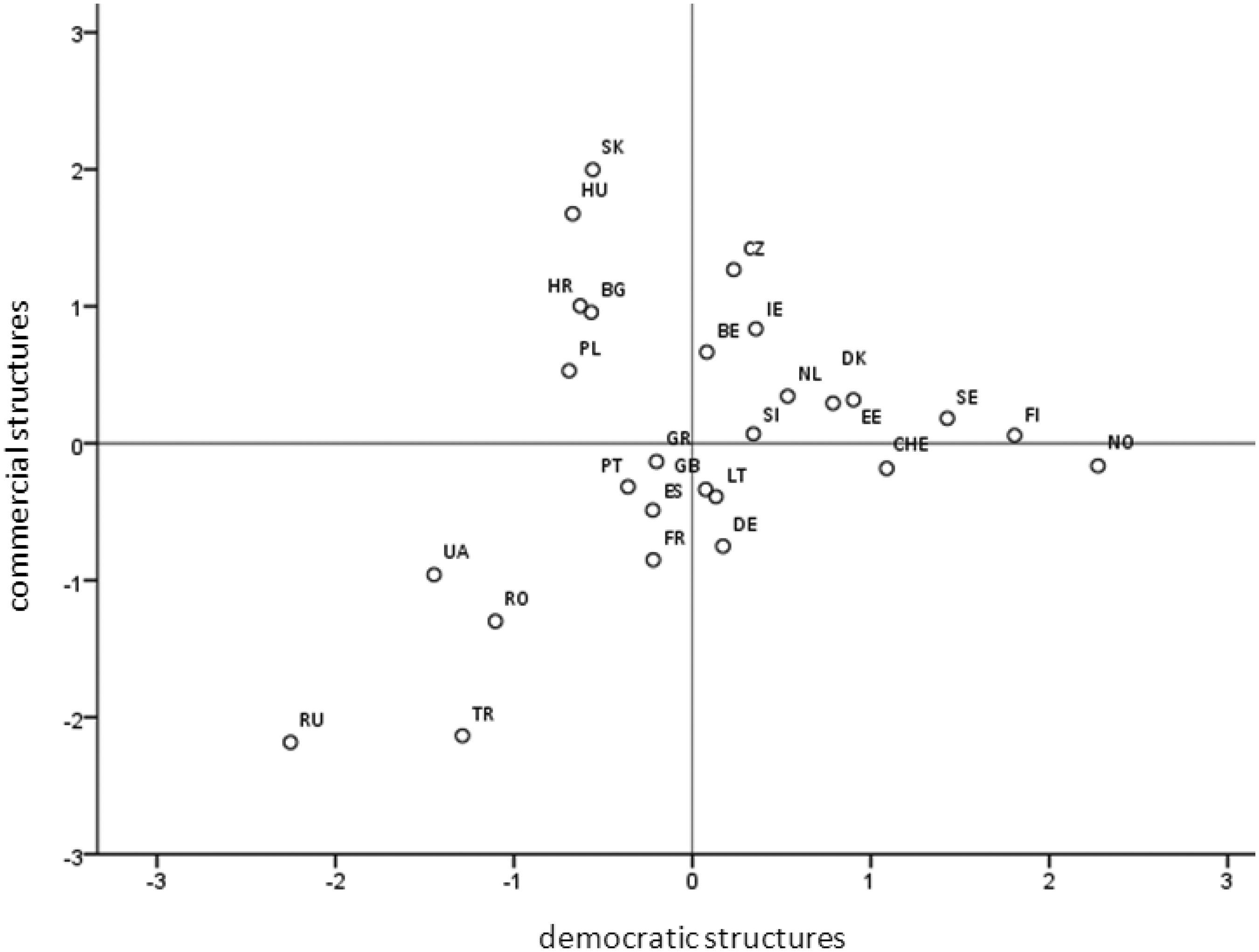
Data analyses
Multilevel analyses were performed to test the hypotheses. In addition to analyzing the impact of media use and media structures on social capital, multilevel analyses allow the estimation of cross-level effects between the factors at the micro and macro level. Analyses were computed using HLM 7.0. 8
Multilevel models for participatory capital and network capital.
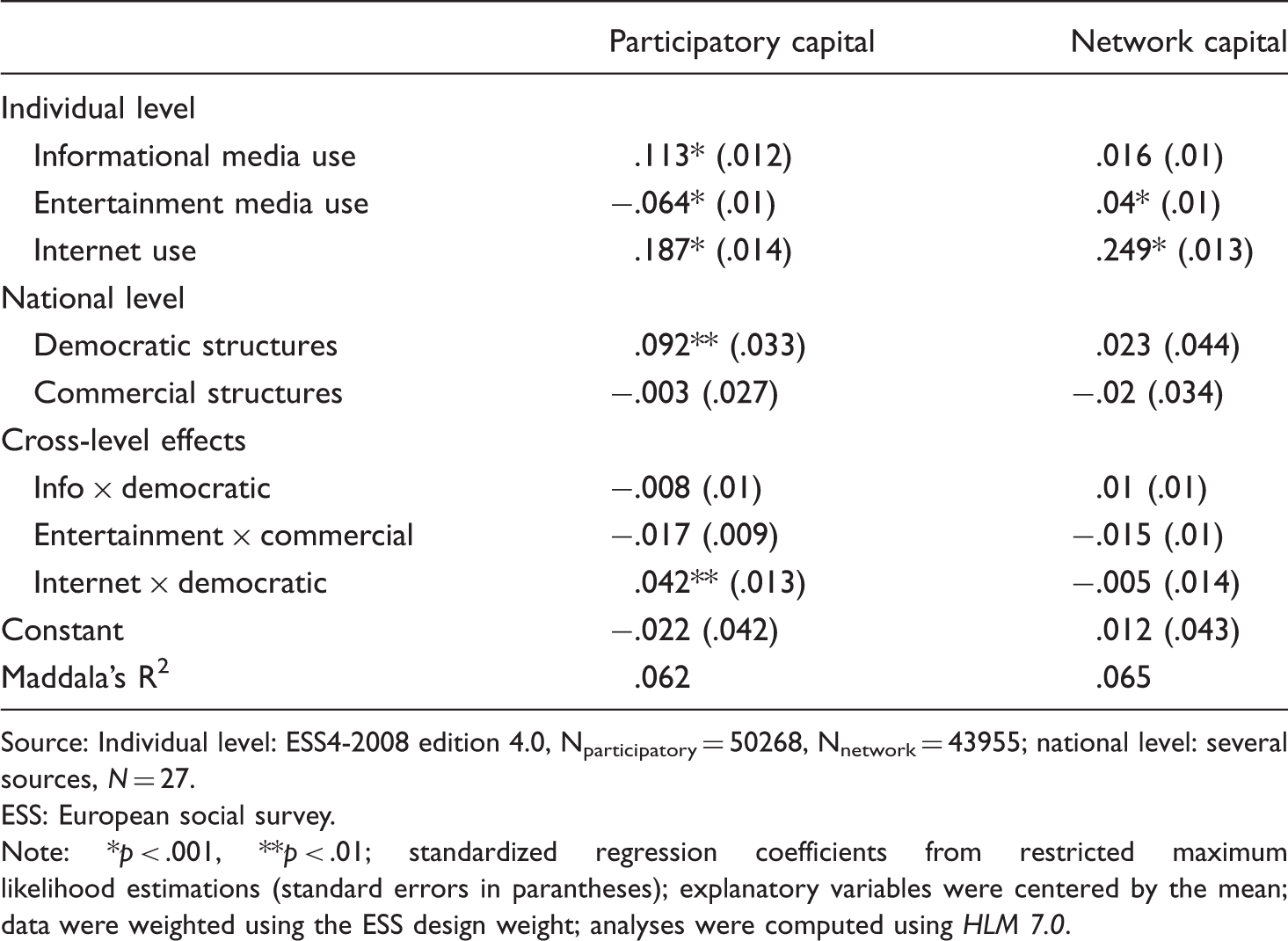
Source: Individual level: ESS4-2008 edition 4.0, Nparticipatory = 50268, Nnetwork = 43955; national level: several sources, N = 27.
ESS: European social survey.
Note: *p < .001, **p < .01; standardized regression coefficients from restricted maximum likelihood estimations (standard errors in parantheses); explanatory variables were centered by the mean; data were weighted using the ESS design weight; analyses were computed using HLM 7.0.
In an attempt to substantiate media effects, the demographic control variables, age (M = 47.7; SD = 18.48), gender (M = .45; SD = .5), and education (M = .66; SD = .47), 9 were included in our analysis ex post facto (Table 2, Appendix).
Results
Media use and media structures explain approximately 6% of the variance in both forms of social capital, i.e., participatory and network capital (Maddala’s Maximum Likelihood-R 2 ). 10 As only media use variables were integrated into the model, this explanation power is exclusively due to the media.
Individual level: The impact of media use on social capital
Whether media use leads to more or less social capital in Europe depends on the content. Enhancing civil engagement, informational media use is credited with increased participatory capital (β = .113, p < .001). As this effect is still significant after including socio-demographic variables (β = .095, p < .001), it cannot be attributed to the higher education level of information-oriented recipients (Table 2, Appendix). There are no significant and steady effects of informational media use on network capital. However, the direction of the effects provides evidence of a positive impact on social capital. Consequently, our results corroborate the first hypothesis (H1) that informational media use has positive effects on social capital.
By contrast, we expected that entertainment media consumption would reduce social capital. This assumption is strengthened regarding participatory capital, as Europeans who favor entertainment content are less engaged in public life (β = −.064, p < .001). Contrary to these effects and to our expectations, the consumption of entertainment media content supports informal social networks and, in turn, network capital (β = .04, p < .001). Thus, entertainment media use weakens participatory capital but facilitates network capital. The second hypothesis (Entertainment media use has negative effects on social capital (H2)) cannot generally be confirmed.
Internet use reveals more solid effects than does mass media use. It moderately affects participatory capital in a positive way (β = .187, p < .001). To a comparable extent, Internet use also supports exchanges between friends, neighbors, relatives, and workmates, which in turn increases network capital (β = .249, p < .001). After including socio-demographic variables in the model, the effect of Internet use on network capital is reduced by approximately 40% (Table 2, Appendix). This finding may be ascribed to the influence of age on the Internet use and social activities. However, the effect remains relatively moderate (β = .153, p < .001). To summarize, Internet use reveals solely positive effects on different dimensions of social capital. The third hypothesis (Internet use has positive effects on social capital (H3)) is strengthened.
National level: The impact of media structures on social capital
The significant role of a free, open, and pluralistic media system is supported by the positive effects of democratic media structures on participatory capital (β = .092, p = .01). Citizens living in a country with democratic media structures tend to be more engaged. Thus, the fourth hypothesis (Democratic media structures have positive effects on social capital (H4)) is strengthened.
The assumed negative effect of commercial media structures on social capital was not confirmed. Therefore, our fifth hypothesis, which states that commercial media structures have negative effects on social capital (H5), must be rejected.
Moreover, there is a small, but significant, cross-level effect (β = .042, p = .004) of democratic media structures and Internet use on participatory capital, indicating that the politically mobilizing effect of Internet use is stronger in countries with democratic media systems than in countries with weak democratic structures. Therefore, the sixth hypothesis, which posits that there is a cross-level interaction between media use and media structures that affects social capital (H6), is partially confirmed.
Discussion
Overall, our results are in line with our comprehension of social capital as a multilevel concept. On the individual level, we found that informational and entertainment media use and Internet use influence social capital. Additionally, democratic media structures and thus macro factors affect social capital; participatory capital is particularly sensitive to national effects. The cross-level effect between democratic media structures and Internet use demonstrates the importance of taking structural conditions into account when analyzing media effects (cf. Nisbet et al., 2012; Norris and Inglehart, 2009). In sum, the effects of media on social capital seem to be solid but rather small—maybe too small to assume a dramatic influence on civil society (cf. Schmitt-Beck and Wolsing, 2010: 465). There are probably additional factors, such as personality, life experience, and socialization, that influence social capital (Valenzuela et al., 2009: 839).
Analyzing the effects on the individual level, we have to note that most of the empirically identified effects were positive. The only substantial negative effect was the proposed effect of entertainment use on participatory capital. Therefore, we conclude that Putnam’s (1995b) isolation explanation might be contested and that the cultivation explanation is supported by our results.
However, the impact of entertainment media use on social capital is not generally destructive, as stated in our hypotheses; it seems to strengthen informal social networks. This result might be explained by the social integration function of entertainment programmes. Portraying social life, entertainment programmes provide orientation for social interactions and thus stabilize informal relations. Furthermore, entertainment might also provide topics of conversation and hence initiate an exchange between friends, neighbors, or colleagues.
Additionally, our results demonstrate the positive role of informational programmes, as theorized in the research tradition of ‘videomalaise’. Informational media have mobilizing potential, as they communicate political knowledge and thereby enhance civil engagement.
Based on our results, the hypothesis on the social isolation of Internet users must be rejected. By contrast, Internet use has been found to be capable of increasing community integration. However, the impact of the Internet relies on a different logic compared with the influence of mass media; it is structure-based rather than content-driven. As an interaction platform, the Internet stabilizes and extends the structural environment of social capital rather than providing certain ‘democracy-promoting’ contents.
Regarding the effects on the national level, we have to acknowledge that commercial structures appear to be altogether irrelevant. The globalization of media markets and their dependence on advertizing markets do not hinder the political and socio-cultural efficiency of European media systems.
In contrast to the commercial structures, democratic media structures have a direct positive impact on participatory capital. Societies may benefit from an open, free, and pluralistic media system that offers a discussion forum and, in turn, promotes civil engagement. Thus, our empirical findings emphasize the central role of media systems and underline the political responsibility to ensure a free, open, and plural media system.
However, the most interesting result might be the cross-level effect between democratic media structures and Internet use. In line with MSD approach (Ball-Rokeach, 1985, 1998; Ball-Rokeach and de Fleur, 1976) and similar to the studies of Norris and Inglehart (2009) and Nisbet et al. (2012), our results indicate that media effects may vary by context. In our study, democratic media structures moderate the impact of Internet use on participatory capital. The politically mobilizing effect of Internet use is stronger in European societies with democratic media systems than in countries with weak democratic structures.
In summary, we argue for differentiation when discussing media effects and for dissociation from a culturally pessimistic, one-sided point of view. For today’s societies, the media implies potential rather than restrictions. Pluralistic, objective, and free information within democratic media structures offer chances for the development of societies. Due to the Internet’s potential for interactive, horizontal linkages, its diffusion may be particularly important for democratization (Norris, 2004: 118).
Limitations and future research
Our article provides an overview of the relationship between media and social capital in Europe. In contrast to traditional approaches examining media effects, we were able to empirically examine how media structures may influence social capital and also how the relationship between media use and social capital may vary according to the context (see also Nisbet et al., 2012: 261). However, there are several methodological approaches required to extend and validate our results.
Our approach corroborates the claim that media have an effect on social capital. However, causality is determined based on theoretical approaches and previous empirical studies. Only panel data can actually prove directions of influence. Unfortunately, panel data on media use and on social phenomena are not available at the international level (Nisbet et al., 2012: 260).
Moreover, the impact of the Internet is measured based on a single item; hence, the results have to be interpreted carefully. The assessment of the effect of Internet use on the individual level should be more nuanced to capture the diversity of social media use. Thus, the analysis of different online activities would allow a better and more differentiated understanding of the Internet’s impact on social capital (Bakker and de Vreese, 2011; Shah et al., 2001). Hence, we do not claim to have adequately measured the impact of Internet use, but we were able to explore the potential of the Internet compared with that of other media.
As we theorize that the impact of Internet use is in contrast to that of mass media use structurally caused rather than content-driven, we did not distinguish between informational and entertainment Internet use in our analysis. However, also the Internet might promote social capital by providing political information; therefore, it could be insightful to differentiate Internet use in this regard in future studies.
Furthermore, there are limitations concerning the operationalization of media structures at the national level. There might be further structural dimensions that could have been considered in our multilevel analysis. For example, emphasizing the understanding of the media system as an information system, one could focus on the role of public service broadcasting and the dominance of its news programmes at the national level. However, regardless of the structural dimensions considered in such an analysis, there is a need for exact indicators concerning media structures and their consequences with regard to media content. The most appropriate way to evaluate content is a content analysis comparing media outlets across different countries (see also Curran et al., 2009; Iyengar et al., 2010; Liu et al., 2013).
The sample of 27 European countries is a sample of rather democratic media systems. As a consequence, our results on the relationship between media and social capital are limited to the European context. For example, there might be different effects of media structures on social capital in countries with more authoritarian governments and collectivist cultures. Further research comparing culturally different nations across continents with different media systems and their impact on social capital might be insightful.
The discussed limitations are primarily due to a lack of international data on media and social capital. Therefore, we conclude by suggesting a differentiated integration of media data in national and international surveys, which would allow for the assessment and analysis of different media systems and media use cultures and their resulting effects on important societal properties, such as social capital.
Footnotes
Declaration of Conflicting Interests
The author(s) declared no potential conflicts of interest with respect to the research, authorship, and/or publication of this article.
Funding
The author(s) received no financial support for the research, authorship, and/or publication of this article.