



Abstract
This study examines predictors of blogging in six Arab countries in a secondary analysis of population surveys of, in total, 7,525 respondents in Saudi Arabia, Qatar, Lebanon, Bahrain, Jordan, and the United Arab Emirates in 2013. The surveys assessed a wide variety of Internet uses, news and information consumption, and also levels of political efficacy, media trust, and attitudes toward free speech, among other cultural and political indicators. Despite the oft-referenced supposition that blogging in the Arab world is associated with political disaffection, results here suggest that in the six countries investigated blogging is mainly connected to online engagement in general—such as sharing photos online, participating in online chats, and reading others’ blogs—rather than to sociopolitical indicators. In none of five of the six countries, for example, does a sense that one’s country was not ‘on the right track’ significantly predict blogging behavior. Also, distrust of mainstream news organizations only played a minimal role.
Introduction
This study explores possible determinants of blogging in the Arab world. In particular, it tests the stereotype that political motives are strongly behind blogging among survey respondents in six Arab countries. Human rights activists, scholars, and others have often speculated about the role the Internet plays in the political mobilization of Arab populations in recent years and, at the same time, how political disaffection may drive online behaviors such as blogging (see, e.g., Ulrich, 2009). The purpose of this study is to explore some of the potential behavioral, attitudinal, and demographic predictors of blogging in six Arab countries, and, specifically, to examine whether characteristics commonly associated with political dissidence (e.g., being unemployed, unhappy with the trajectory of one’s country, being young) are related to both blogging as such and to blogging more frequently. But our study also explores whether other possible predictors—simply doing many other things online, for example—help explain variance in blogging activity.
Discussions of why people in the Arab world blog are long on anecdotes and convenience samples and short on representative data. It has been claimed that blogs allow Arabs to participate in politics in a way they often cannot through other means of communication (Fahmy, 2010; Lynch, 2007), which, while possibly true, has not been studied as a primary motivation for blogging in Arab countries through the administration of large surveys. Based on their analysis of Facebook, Twitter, YouTube, and blog posts during the uprisings in Egypt and Tunisia, Howard et al. (2011) assumed that social media were among the primary drivers of political activity and change, despite the fact that just one in five Egyptians were Internet users as recently as 2013 (Dennis et al., 2013). Online communication tools in Saudi Arabia, blogs among them, wrote Murphy (2013: 18), ‘constructed a whole new dimension to Saudi life by creating a social and political space where Saudis are expressing themselves more freely than ever,’ but her conclusions came from interviews with a relatively small convenience sample of largely English-speaking, educated elites.
York (2012) described the increase of blogging and social media prior to the Arab uprisings of 2011 and suggested that blogging precipitated revolutionary actions in multiple nations. The data explored are anecdotes. Another datum: two Egyptian police officers were exposed by bloggers for torturing a bus driver in 2007. This anecdote was used to speculate that a turning point was afoot for blogging in Egypt (Isherwood, 2008). Zayani (2012), however, argues that despite optimism regarding online tools available for civil participation, those tools remain under-utilized in Arab countries.
Arab blogging motivations and content
The few more systematic studies of motives and content of blogging in the Arab world provide mixed results about the political aims of bloggers. Scholarly work on blogging in the Arab world often ‘focuses on why bloggers should be blogging rather than why they actually do blog,’ wrote Taki (2011: 91, emphasis in original). Khalil (2013) points out that young people in the Arab world had expressed their culture and politics well before either blogs emerged or the Arab uprisings occurred—through such diverse communication means as theater, puppetry, dance, and print. So, it is not as though Arabs had no way of expressing dissident views before digital communication tools became available—implied, if not stated directly, in many discussions of Arab blogging.
So, what do we know about motives for blogging in the Arab world? Taki (2011) found that, when asked why they blog, Syrian and Lebanese bloggers frequently provided abstract answers, such as ‘I want to be read,’ a motivation that may or may not involve political speech. Some other motivations to blog Taki identified were also not necessarily political, such as wanting to develop one’s writing skills or belong to a community, respectively. Riegert (2015) did find that at least the top bloggers in Egypt according to Internet traffic were concerned primarily with politics. Top bloggers in Lebanon and Kuwait, however, focused mostly on social issues and consumption, respectively. Earlier, though, Riegert and Ramsay (2013) had also studied the content of the ten most popular blogs in Lebanon in 2009–2010, and found most of the blogs routinely discussed politics (criticizing the sectarian political system), current events, and human rights issues (see also Tarhini, 2011). A significant minority of the blogs employed political satire. An analysis of Palestinian blogs found that most of them were of a political nature (Martin and El-Toukhy, 2012). In a study of Egyptian online activism, the supposed link between online dissent and regime change was cited explicitly: ‘[A]ctivists had been engaged since 2009 in online discussions and debates on sociopolitical conditions, which eventually developed into a full-force revolution’ (Eltantawy and Wiest, 2011: 1218).
Other studies of Arab blogs evoke concerns due to small, purposive samples; El-Nawawy and Khamis studied five political blogs in Egypt, and claimed that blogs like them ‘contributed to the democratization in Egypt in a manner that paved the way for the Egyptian revolution’ (2014: 962). Another study of political (activist) blogs in Egypt (Ramsay, 2012) claimed bloggers were attempting to maximize their political reach by using more populist language—because they were more likely to be written in Egyptian colloquial, rather than standard, Arabic. Use of colloquial versus modern standard Arabic in Egypt, however, is largely a function of education and class, so reliance on the former may not necessarily represent a concerted effort by bloggers to disseminate their political message more widely.
Blogs in Saudi Arabia, a country with arguably the most active Internet citizenry of any Arab country (Winder, 2014), tended to focus less on politics and more on matters of everyday life (Etling et al., 2010). Al Nashmi et al. (2010) content analyzed Arabic-language discussion forums in Egypt, Saudi Arabia, and Jordan, and found that pluralities in some cases, but not majorities, of posts involved expression of a political nature (9% in Egypt, 31% in Saudi Arabia, and 7% in Jordan). In popular Egyptian blogs, posts of a political nature increased in the first half of 2011 in the weeks before and months after deposed President Hosni Mubarak resigned (Al-Ani et al., 2012). But, according to the same Egyptian study, personal topics of a non-political nature were common in blogs even during the hot phase of the Egyptian ‘spring.’
In sum, then, it is likely the case that online forums in the Arab world provide some space for discussions of politically sensitive topics that are less likely offline (see Dashti, 2009). And blogging may indeed assume a far more political nature in times of war and conflict, making studies like Wall’s (2006) analysis of Kuwaiti blogs during the early years of the second US war in Iraq timely and appropriate. But research to date suggests that much blogging, including blogging in Arab countries, is motivated by factors other than activism and politics.
Predictors of blogging
If looked at from the standpoint of the uses-and-gratifications approach to communication behavior (see, e.g., Katz, 1959), what motivates blogging? Worldwide, we often find as purposes of blogging personal fulfillment, expression, affiliation, and social connectedness (Bronstein, 2012; Hollenbaugh, 2011; Kaye, 2010). Contributing content of one’s own to the Internet seems to strengthen individuals’ sense of self-efficacy and psychological empowerment (Leung, 2009). In a survey of 177 bloggers in China, the venting of feelings and connecting to friends and other acquaintances were mentioned as the main motives of keeping and maintaining a blog (Liao et al., 2011; see also Guadagno et al., 2008). These motives, in turn, are more often found among bloggers with higher education and income as well as being male (Fullwood et al., 2014).
Mishra et al. (2014) found that students’ adoption of blogs was heavily associated with time spent on Facebook with US, suggesting that online behaviors in general may also drive blogging activity. We are reminded here of the ‘more-and-more rule,’ discovered by Lazarsfeld et al. (1944) in their classic election study as early as 1940: People who use one channel of communication for a specific purpose tend to use all other channels as well that serve the same purpose.
Prior research has also identified some of the gratifications of blogging as forming community forums, publishing commentary and opinions, and expressing one’s emotions (Nardi et al., 2004). Some studies have linked the intention to blog with moderate levels of psychological distress. So, blogging may be used as a mechanism to achieve venting (Baker and Moore, 2008; Ekdale et al., 2010), perhaps on concerns regarding politics or public affairs. Watson and Riffe (2011) found that higher levels of ‘community stress’—higher murder and poverty rates and greater physical decay of one’s community—were positively associated with the number of public affairs blogs in US cities. Bloggers in Western countries have sometimes been described as the ‘Fifth Estate,’ offering a scrutiny of companies and public officials that traditional media may fail to provide (see Cooper, 2006). Still, Ekdale et al. (2010) report in their study of political bloggers in the US that serving as a political watchdog and influencing mainstream media were actually among the less frequently cited potential appeals of blogging.
Unfortunately, the evidence mentioned so far about reasons why people blog and typical characteristics of bloggers comes from studies of bloggers only—i.e., that research is not able to tell us what is special about bloggers. Do bloggers tend to be those particularly dissatisfied with the course their society has taken or is taking? There are seemingly just two studies so far that systematically compared, through the administration of representative surveys, those who blog with those who do not. One of them, a representative survey for the adult population of the Netherlands (Bakker, 2013), found that bloggers in 2010 were younger, better educated, more likely to be male, and more interested in public affairs of all sorts than those who did not blog. The other large and representative survey, in Austria, showed that, in 2011, 20% of respondents read at least once a month about political topics on a chat forum, a social network or on blogs. But, again during a typical month, only one percent contributed content focusing on politics to at least one of those platforms (Vonbun and Schoenbach, 2014). Those active vis-a-vis politics on the Internet in Austria, but also its passive consumers, were younger, more interested in politics and participated more often in political activities offline as well—but above all were simply enthusiastic Internet users.
Generally speaking, it looks as if blogging worldwide is justified mainly by the three upper steps of Maslow’s (1943) pyramid of needs—love and belonging, esteem, and self-actualization. That is, a safer world, personal and financial security, better health, and well-being (the second step of the pyramid) as motives to change society do not seem to play a greater role among the purposes for blogging.
When it comes to the Arab world, our knowledge about blogging motives becomes even weaker. It is based either on information from a few selected bloggers only or on more or less systematic analyses of the content offered in blogs (see above). The somewhat thin evidence from other regions of the world does not generally support the supposition that the driving motives of blogging are political dissent and disaffection—in other words, that people blog because they want to express their views that detract from those of ruling class(es). But is this impression from countries outside the Middle East also true for the Arab world? The notion of whether political motives, or actually other antecedents, drive blogging in Arab countries forms our general research question on Arab blogging: Central research question: What are the possible determinants of blogging and of its frequency in Arab countries?
Method
Survey data collection
This is an exploratory study of our research question, based on the somewhat limited and inconclusive evidence presented above and on data available for an extensive secondary analysis. We examine blogging and its predictors using population surveys in six Arab countries: Saudi Arabia, Qatar, Lebanon, Bahrain, Jordan, and the United Arab Emirates. The database for this study’s secondary analysis was Media Use in the Middle East (Dennis et al., 2013), created and commissioned by Northwestern University in Qatar in 2012–2013.
The surveys were supposed to find out as much as possible about the use of media and communication channels of all kinds. Furthermore, the questionnaire contained questions about perceptions of media credibility; attitudes about government, online freedom of speech, privacy, and Internet regulation; political efficacy via the Internet and an impressive number of socio-demographic variables.
The population the surveys represent was adult (18 years and older) citizens in the countries and those expatriates who both lived outside migrant labor compounds and were capable of completing the interview in Arabic, French or English. Labor compounds house primarily Asian guest workers in the Gulf countries surveyed: Qatar, Bahrain, Saudi Arabia, and the UAE. In Qatar, where random-digit dialing was used, workers in the labor compounds were accessible for survey participation but, again, respondents who spoke only, say, Hindi or Tagalog were not included.
The sampling procedure and the fieldwork were conducted by Harris Interactive, Inc. (now part of The Nielsen Company). In Bahrain, Jordan, Saudi Arabia, Lebanon, and the UAE, multi-stage random probability face-to-face sampling was implemented. In Qatar, computer-assisted random-digit dialing was used. Sampling quotas were developed based on age, gender and geographic region of the country. In Qatar, Saudi Arabia, and the UAE, the quota also took into account ethnicity—national, Arab expatriate, Asian expatriate and ‘other’ (including Western expatriates).
Recruiting the respondents within those quotas was conducted randomly. At each randomly selected household, the interviewer would record the names of all individuals 18 or older in the household from oldest to youngest and also indicate their gender and then interview the one person fitting the quota list. In Qatar, quotas were also set for landline (746) versus mobile only (173) respondents. Once a quota was filled (for example, Women 18–19) the interviewer would go to the next household and quota target on the list. Weighting based on census data in four countries—Qatar, Saudi Arabia, and the UAE, i.e., nations with large expatriate populations—was applied to achieve representativeness by ethnic group, region within the country, age and gender.
Face-to-face interviews were conducted between 26 December 2012 and 5 February 2013—with the exception of Qatar where the survey period was from 26 March to 18 April 2013, and interviews were conducted via telephone (1). The survey was offered in Arabic, English or French, depending on the country and respondent preference. At least 1,250 respondents were interviewed in each country.
Respondents were informed that their data were being collected under the auspices of the Harris polling organization, and that the study was commissioned by researchers at Northwestern University. Respondents were also told the research was being conducted for academic purposes, and that they could opt out at any time. Interviews took 30 minutes on average.
The percentages of the potential respondents approached that also completed the full questionnaire were comparatively high: Bahrain (83%), Egypt (92%), Jordan (75%), Lebanon (70%), Qatar (54%), Saudi Arabia (81%), and the UAE (70%). Only in Tunisia was the response rate low: 21%. There may be a relatively stronger social desirability in Arab countries (Nydell, 2006; Sohlberg, 1976), which possibly contributes to the generally high response rates the Northwestern researchers achieved (with the exception of Tunisia).
For the purpose of our secondary analysis, Tunisia had to be dropped because of its unacceptably low response rate. And, unfortunately, Egypt had to be omitted from our analyses as well, as the survey from that country contained too small a number of respondents who blogged at all (only 68 of the more than 1,250 interviewees). So, our analysis examines six countries from the Arab Gulf and the Levant. In those countries, different ethnicities were represented in the samples thus: The percentages of nationals, Arab expatriates, Asian expatriates, and European/American expatriates in each country were, respectively, as follows: Saudi Arabia = 68%, 12%, 12%, 7%; Qatar = 28%, 28%, 28%, 15%; Lebanon = 98%, 2%; Jordan = 84%, 17%; Bahrain = 60%, 8%, 22%, 7%; UAE = 25%, 24%, 35%, 14%. These figures approximate the proportions of these groups within each country, based on census data.
Measurement
Dependent variables
In our secondary analysis we used actively blogging as our first of two dependent variables. It was measured by the question ‘How often do you use the Internet for the following purposes?’ This question was posed to those who had replied ‘yes’ to
‘Do you currently use the Internet? This can be at any location using any device and for any reason, even if you use someone else’s Internet connection.’
One of eleven purposes of Internet use listed was ‘Work on your blog.’ The six possible answers ranged from ‘several times a day’ to ‘never.’ A dichotomous variable was created: Those who did not answer ‘never’ were called ‘bloggers’ (with a score of 1). Everybody else (the ‘non-bloggers’) got a zero.
For our second independent variable, blogging frequency of those who blog at all, we recoded the answers by projecting the frequency of working on one’s blog during a whole year—with the purpose of defining the semantic distances between the categories more adequately. ‘Several times a day’ was estimated as three times a day (i.e., 1,095 times a year). ‘Once a day’ was set at 365, ‘weekly’ at 52, ‘monthly’ at twelve, and ‘less than monthly’ at six.
Independent variables
To explore who blogs in the six Arab countries, we investigated potential correlates gauged by the eight-country study: first of ‘working on one’s blog’ at all—regardless of how often—and then, for those who blogged, of the frequency of that activity. The questionnaire of the surveys used here allowed us to investigate three different groups of possible independent variables, derived from previous evidence, but also from previous speculations (see above).
Potential disenchantment with society and media: As is often assumed for Arab countries (see above), blogging may be driven by feelings of disenfranchisement. For this, we used indicators of being unemployed (the question was ‘Are you currently employed?’), having a low total monthly household income and level of education (see Appendix for the respective recodes of these two variables), but also being young and female (see Joseph, 1996). Education could actually have an arbitrary meaning in our analysis: A low education and a low income could indicate disenfranchisement, and thus encourage blogging. But a high education and a better income may lead to the same behavior—for instance, because of the oft-demonstrated relationship between being well educated and affluent and quickly adopting new communication offers, particularly on the Internet (see above).
As a second possible source for being discouraged by one’s life circumstances we could explore the (political and economic) culture of one’s country (see above). The six countries of our secondary analysis differ in some respects that could be important as reasons to blog. One difference is in authoritarianism. Lebanon, Jordan, and Qatar have considerably more political pluralism and freedom of expression than Saudi Arabia, Bahrain, and the UAE (according to Freedom House, 2014). In addition, there are great economic differences (Chauffour, 2012): Lebanon and Jordan are middle-income states with few natural resources, Saudi Arabia and Bahrain benefit from petrochemical wealth but nonetheless struggle with unemployment (Sullivan, 2012), while citizens in Qatar and the UAE do not have to be employed at all to have their basic needs taken care of.
Four of the countries had experienced no uprisings in recent years: Qatar, Lebanon, Saudi Arabia, and the UAE. Uprisings were substantial in Bahrain, and demanded sectarian equality as well as increased political and social liberty, but were crushed by that country’s military as well as with armed support from Qatar and Saudi Arabia (Dalacoura, 2012). Jordan experienced milder unrest and demonstrations than Bahrain, but its protests were more readily contained by reform attempts by the king. So, if blogging activities are furthered by frustration with one’s political system, it should be more widespread and frequent in Saudi Arabia, the UAE and, in particular, Bahrain, followed by Jordan, Lebanon, and Qatar.
To take these differences into account, all our analyses of potential determinants of blogging were conducted for each of the six countries separately. Also, the following question could be used to get a sense of respondents’ evaluation of their countries (not asked in Qatar, though (2)): ‘All in all, do you think things in your country are generally headed in the right direction, or do you feel that things are off on the wrong track?’
As a third category of indicators for a respondent’s discontent (possibly leading to blogging), attitudes toward mainstream media were available for our secondary analysis: Did bloggers regard them as insufficient? For this purpose, we could use the strength of agreement with the statements ‘News media in your country are credible’ and ‘The media in your country can report the news independently without interference from officials.’ Respondents were asked to use a 5-point scale for their responses (1 = ’totally disagree’ to 5 = ’strongly agree’). The weaker the agreement with these two statements, perhaps, the more respondents may feel an urge to blog and fill gaps they perceive in traditional media coverage of public affairs.
Next to these indicators of negative perceptions of one’s country and the media as potential reasons for blogging, a number of positive, encouraging reasons could be investigated. The first of them was the impression of ‘political efficacy’ afforded on the Internet: This was assessed by three statements, introduced by the question, ‘Do you think by using the Internet…’: ‘people like you can have more say about government policies,’ ‘people like you can have more political influence’ and ‘public officials will care more what people like you think.’ Possible responses ranged from 1 = ’totally disagree’ to 5 = ’strongly agree.’ The three items were tightly connected—added up, they produced a Cronbach’s alpha of .78.
An additional index of opinions possibly encouraging blogging was available: ‘Expressing oneself on the Internet is safe’ was represented by adding up the scores of agreement with three beliefs: ‘On the Internet it is safe to say whatever one thinks about political affairs (in Qatar: public issues),’ ‘In general, I feel comfortable saying what I think about politics (in Qatar: public issues)’ and ‘It is okay for people to express their ideas on the Internet, even if they are unpopular.’ All three items combined produced an acceptable Cronbach’s alpha of .66. A final indicator at hand in the survey questionnaire and possibly encouraging blogging was agreeing with the statement, ‘People should be free to criticize governments on the Internet.’
The third category of potential determinants of blogging that we could investigate, next to (a) frustration and (b) feeling encouraged to express oneself was ‘blogging as just another way to communicate on the Internet’: Some of the studies conducted on blogging so far revealed that bloggers may simply be enthusiastic Internet users (see above). In our secondary analysis, we could look at quite a number of other communicative activities on the Internet as correlates of blogging. They were gauged in the eight-country study using the following three questions: ‘Now I’d like you to think about the different ways people interact and communicate with each other in their everyday lives, like keeping in touch with people. How often do you use the Internet for the following purposes?’; ‘Some people often look up information on the Internet as they go about their daily lives—things like news, sports scores, and movie times—others don’t. How frequently do you use the Internet for the following purposes?’ and ‘Now I’d like you to think about the routine things you do for personal entertainment like playing games or listening to music. How frequently do you use the Internet for the following purposes?’ For all three questions, possible responses ranged from ‘several times a day’ to ‘never.’ We recoded them into a numerical estimate of annual activities (see also above). So again, ‘several times a day’ was set at three times a day (i.e., 1,095 times a year), ‘once a day’ at 365, ‘weekly’ at 52, ‘monthly’ at 12, ‘less than monthly’ at 6 and ‘never’ at zero.
An index representing ‘Internet for interpersonal communication’ resulted from a factor analysis of all the Internet activities presented to the respondents of the eight-country study, following one of the three questions quoted above. The index comprised the four items ‘Check your email,’ ‘Send attachments with your email,’ ‘Do instant messaging’, and ‘Make or receive phone calls over the Internet’ (Cronbach’s alpha = .74).
In addition, we included the following activities singly: ‘Comment on other people’s blogs, message boards, etc.,’ ‘Participate in chat rooms,’ ‘Post photos or pictures on the Internet’ and ‘Read web-logs (blogs).’
Frequencies, ranges, means, and standard deviations (SD) of the independent variables (Internet users only).

To estimate the relevance of our independent variables for blogging at all and its frequency, multiple regressions were used. They calculate the specific weight of each possible determinant of blogging by taking their relationships with each other into account. So, for instance, income and education are often correlated, but multiple regressions can determine how much each of the two variables separately contributes to explain blogging. For our dichotomous dependent variable ‘blogging vs. not blogging,’ binary logistic regressions of possible predictors of blogging were applied and multiple linear regressions for the recoded variable ‘frequency of blogging.’ In the logistic regressions we had to use a list-wise exclusion of cases if there were missing values; for the linear multiple regressions we could use a pairwise exclusion. The tolerance level for multicollinearity in the multiple regressions was set at .20. None of the variables described above had to be excluded because of this threshold.
Results
Internet use, blogging, and its frequency.

Who blogs at all?
Who in the five countries of this analysis is more likely to work on a blog at least once in a while? All our possible determinants, taken together, do not explain much of this activity—from a pseudo R-square of at most 27% in Bahrain to a low of 15% in Qatar.
Correlates of blogging at all (only Internet users)—Unstandardized betas and odds ratios.

Note: Table entries are unstandardized betas from binary logistic regressions.
p ≤ .05.
p ≤ .01.
Bahrain is the only place where ‘the general direction’ of one’s country plays a (weak) role—but a positive one: Those confident in the trajectory of their country are more likely to maintain a blog. Nowhere, however, was distrust in (mainstream) media significantly associated with blogging at all (Table 2).
And only in Bahrain does the belief in one’s ability to influence public affairs on the Internet seem to encourage blogging. But interestingly, bloggers from Bahrain also believe a little less than other Internet users that ‘expressing oneself on the Internet is safe.’ Jordan is the only other country where this conviction plays a role—but positively: There, bloggers are convinced more strongly than other respondents that it is safe to express oneself on the Internet.
However, what seems more consistently connected to blogging at all in the five Arab countries of this analysis are different kinds of other communication activities on the Internet. One of them, participating in chat rooms, is even significant in every country except Lebanon. And, quite plausibly, reading blogs were predictive of blogging in three of the five countries after all (recall that Saudi Arabia was not included in this portion of the analysis—see above).
Frequency of blogging
Correlates of blogging more frequently (bloggers only)—standardized betas.
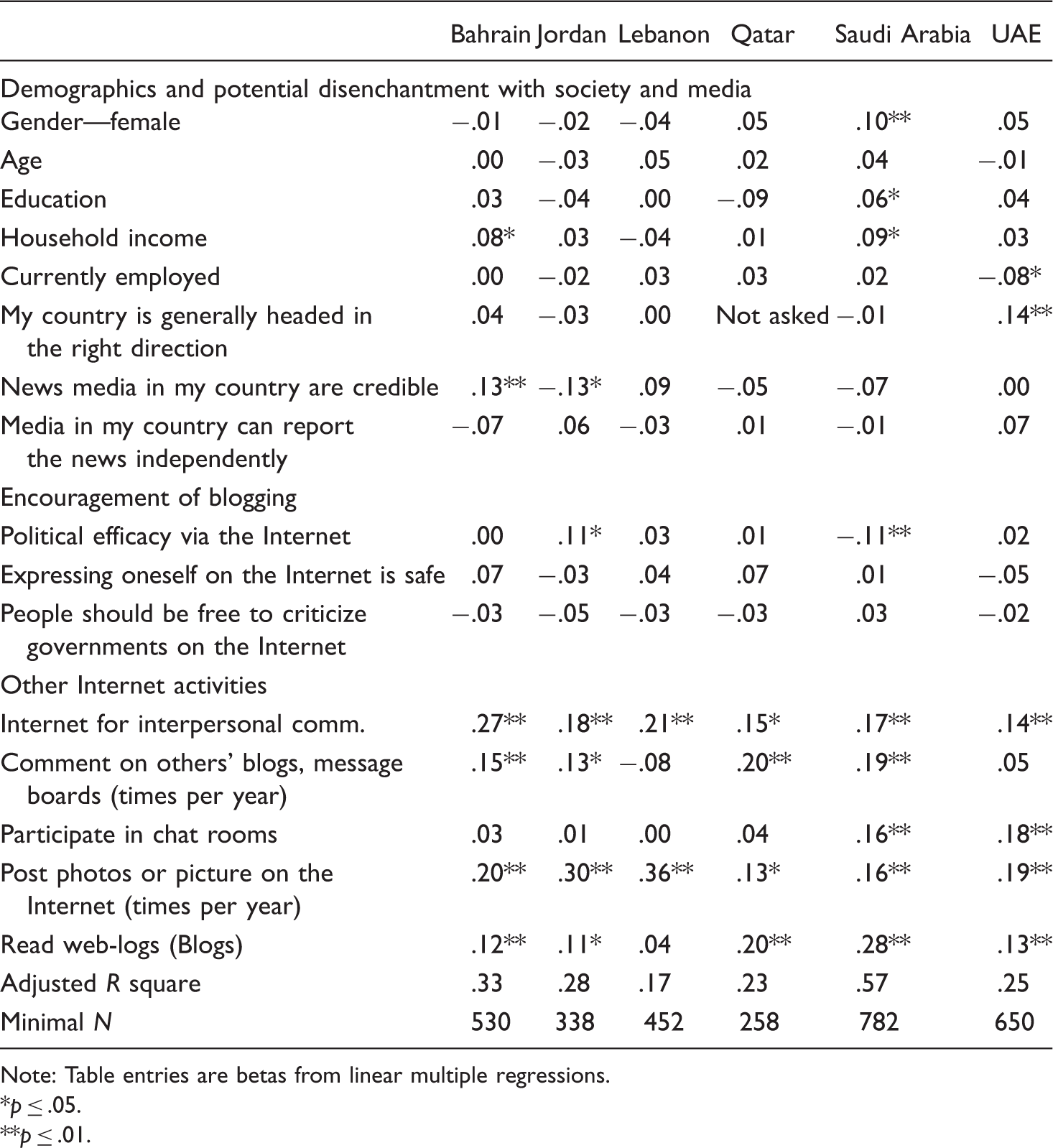
Note: Table entries are betas from linear multiple regressions.
*p ≤ .05.
**p ≤ .01.
But there are some more differences among the countries in our analysis:
Bahrain is the only country where more blogging is associated with greater trust in news media. Higher household income is also a significant predictor. Demographic variables and confidence in Bahrain’s general direction, related to blogging there at all, have lost their significance when it comes to its frequency. In contrast, Jordanian bloggers who do not find their own news media credible blog a little more often. This did not play a role there for blogging at all. In Lebanon, age and education, demographic predictors of blogging in a number of Western countries, were associated with blogging at all, but are no longer relevant for blogging frequency. Saudi Arabia is the second country, next to Bahrain, with a connection between a higher income and more frequent blogging. Women and those with a better education also blog more in Saudi Arabia. Saudi bloggers who think they are less politically efficacious on the Internet than others also blog less frequently. The UAE is the only country where a belief that one’s country is ‘generally heading in the right direction’ is predictive—positively—of blogging frequency.
Discussion and conclusions
Personal characteristics often associated with political activism—for example being poor, young, feeling one’s country is on the wrong track, and that the media are not doing their job—were neither strong nor consistent predictors of blogging in the Arab countries examined in this study. Instead, as seen in other research on correlates of blogging activity, online communication in general was consistently and more robustly associated with blogging, including behaviors such as participating in chat rooms, sharing photos online, and using the internet for interpersonal communication via phone calls and email.
So, our explorative study supports what other research on blogging motivations and predictors suggests: that driving forces are often not political ones. As our literature review showed, even among political bloggers, the main motive for blogging was social interaction with other blog users (see above, e.g., Greuling and Kilian, 2014). This seems to be the most common predictor of blogging in our analyses of Arab countries as well. More specifically in the current study, for maintaining a blog at all, the most common correlate across countries was participation in online chats, while sharing one’s photos and communicating one-on-one with individuals is correlated with blogging frequency.
Beyond these principal findings, however, the results in this study reflect the diversity of the Arab world in general. Arab countries exhibit considerable variance and resist monolithic generalizations (see Gregorian, 2004). At times, even sub-grouping countries in this study together—such as the ‘middle income’ states of Lebanon and Jordan or the energy-producing states of the Arab Gulf—is problematic. So, the notion that blogging should be more strongly related to discontent with the country and its media in Bahrain, the UAE and Saudi Arabia, compared to, say, Jordan and Lebanon, does not find solid backing here. Education, for instance, is a robust, positive predictor of blogging at all in Lebanon but not in Jordan, and income positively predicts maintaining a blog in the UAE but not in Qatar. Qatar is the richest country in the world according to data from the I.M.F. (Tasch, 2015), so perhaps there is less variance in income in Qatar, whereas the UAE, though wealthy, has more income dispersion—its GDP per capita is less than half that of Qatar—that can covary with blogging frequency. Discontent with media seems to be related to blogging only in Jordan. Blogging respondents in all countries in the study but Jordan, then, are utilizing the medium of blogging, but not seemingly because they are displeased with legacy media.
Other examples of diversity: In Bahrain only, a sense that the Internet promotes political efficacy is associated with an increased likelihood of maintaining a blog, but not with blogging frequency. This is also the case in Saudi Arabia. It could be that a belief in the political efficaciousness of blogs encourages Bahraini and Saudi webizens to establish blogs but perhaps does not ultimately yield political results there—in two of the more autocratic countries in the Gulf—and the motivation to blog may taper off.
That could be different in Jordan, where frequent blogging is actually linked to the impression of political efficacy, as is the feeling that expressing oneself is safe on the Internet. Bahraini bloggers, however, while regarding online speech as politically efficacious, believe more than others that it is not safe. But it is not inconceivable that a blogger would at once feel that the Internet can be useful for political speech and that speaking out on the Internet can be risky. This, again, may make sense in the political context. In 2013, when these data were collected, Bahrain was punishing activists more severely than arguably any other country in the current study, going so far as to strip activists’ citizenship (see above, Fahim, 2012).
In sum, blogging in the six Arab countries investigated here does not seem to be fed strongly by political frustration—in other words, as an activity of mainly those who wish to express disenchantment with the current state of society and media. Even in Lebanon, which has one of the more politicized media landscapes—daily newspapers and television networks are owned by some of the country’s many fractious political parties (Rugh, 2004)—frequency of blogging is predicted by general measures of online engagement, such as online personal communication and sharing photographs.
Our results align with a body of other scholarship on blogging motivations in other countries reviewed in this article. Hindman’s (2008) hypothesis that online spaces in the United States, blogs among them, do not truly mobilize the critics of culture and society in ways that are commonly romanticized may, then, apply to the six Arab countries investigated here as well. In two of the countries (Bahrain and the UAE), the optimistic belief that one’s country is generally headed in the right direction actually seems to further blogging.
Of course, the results of our analysis do not mean that there are no residents of Arab countries who blog because it is a channel for them to criticize their governments or to circumvent or correct media they regard as untrustworthy, corrupt and obeisant to authorities. Also, data in this study do not include information on the actual content of respondents’ blogs, an admitted limitation. Respondents in the study may indeed discuss and cover politics on their blogs, despite lacking some of the characteristics scholarly research suggests are associated with political speech. Nonetheless, while political motives for blogging in Arab countries certainly exist, they are not the primary correlates of blogging behavior in the countries we investigated. Instead, among the vast majority of respondents in this study, active blogging simply seems a communication activity among many on the Internet—a supplement of, e.g., reading blogs, emailing, participating in chat rooms, and posting photos online.
It could have been different in Egypt and Tunisia, the two countries we could not include into our secondary analysis. Sure, with the exception of Qatar, all countries in our study experienced some form of political unrest during the peak of the Arab uprisings. But Egypt and Tunisia were the countries in which uprisings led to the fall of incumbent regimes.
Is it plausible, though, that the rather quotidian predictors of blogging we found in this study are the consequence of respondents’ feelings of intimidation? For instance, do those dissatisfied with their country and media simply eschew admitting in a survey interview that they are also bloggers? We do not think so, as (1) our question was about blogging in general, not about blogging on any presumably risky topic; (2) the actual activity of dissident blogging as such is certainly more dangerous than simply admitting to an interviewer that one has a blog; and (3) those apprehensive of being open about their blogging would also not likely criticize their country and its media in the first place—which our respondents did fairly often (see Table A1 in Appendix). For example, a majority of respondents in Saudi Arabia (55%) said people should be free to criticize governments on the Internet, a percentage higher than in any other country of the study, including Lebanon, which is typically viewed as a more politically open country than some other Arab states. In Bahrain, two-thirds of respondents (63%) said people should be able to express themselves on the Internet, even if their ideas are unpopular. There are numerous examples from the study in which respondents express attitudes that may not align with government elites in their country (Dennis et al., 2013).
But, while our analysis tried to shed some light on why people in Arab countries blog at all, it would of course be useful for a next step of research to know more specifically about the actual content of respondents’ blog postings. Arguably the most complete examination of blogging predictors would involve not only large and random samples of national populations like ours, which identify both bloggers and non-bloggers, but also the ability to examine the outputs of respondent bloggers and to link their various attitudes and behaviors to the nature and tenor of the blog content they produce. Also, this study was explorative in nature, but future studies on blogging correlates should test specific hypotheses relating to blogging predictors in Arab countries, while incorporating theories of uses and motivations of media platforms. Still, this study offers the first comprehensive evidence of blogging precipitants in six Arab countries, which sit in a part of the world that invokes considerable discussion of blogs and their correlates but far less systematic analysis on such associations.(1)
Footnotes
Declaration of Conflicting Interests
The author(s) declared no potential conflicts of interest with respect to the research, authorship, and/or publication of this article.
Funding
The author(s) received no financial support for the research, authorship, and/or publication of this article.