




Abstract
This study compares newspaper coverage of Beijing’s air pollution in China and the United States (2008–2013). There are two aims: (a) to systematically compare how such a local environmental crisis has been reported across the two countries, and (b) to explore how the news coverage were produced under the influences of social systems and news flows between the two countries. Based on the hierarchy of influence theory, the content analysis reveals that US media covered the issue earlier, having more topics ‘politicizing’ the pollution, using more negative complaints as overall themes of the news articles, more US sources, and a noticeable number of Chinese NGO sources. By comparison, Chinese media reported pollution with more Chinese sources, more self-legitimizing overall themes in which topics regarding strategies and solutions of the pollution were emphasized; it also covered the issue with mild self-criticism. The results contribute to the literature of comparative media analysis between China and the US as well as the hierarchy of influence model by suggesting a two-way flow of news between the two countries.
Many industrialized countries have experienced severe environmental problems, for example, water and air pollution, acid rain, and deforestation (Chapman and Sharma, 2001). As the second-largest economy in the world, China is no exception. China reformed its economic structure in 1978 (Wu, 2000), but after almost 40 years of remarkable economic achievements, the country faces environmental degradation stemming from extensive economic growth (Economy, 2011).
As a development issue, air pollution is a typical example of environmental problems in China, with most of the pollutants being a byproduct of industrial processes, burning coal, and automobile exhausts. This makes the health costs associated with air pollution in China more severe. Researchers have found that the so-called ‘ambient particulate matter pollution’ was the fourth-leading risk factor of deaths in China in 2010, behind dietary risks, high blood pressure, and smoking (Wong, 2013e). The World Bank and the Chinese Ministry of Environmental Protection concluded that 350,000 to 400,000 people die prematurely in China each year because of outdoor air pollution (Wong, 2013e).
Air pollution affects many mega-cities in China, among which the situation in Beijing attracts more attention from both the public and the media at an international level. The primary reason is that the 2008 Beijing Olympic Games attracted worldwide public attention to the issue (Qing and Richeri, 2012: 230–405). Another explanation is that Beijing is the capital city and the premier political, cultural, and educational center. Third, Beijing is a direct-controlled municipality, which means it is directly under the control of China’s central government. Therefore, policy making depends on the position held by the Chinese central government. Lastly, it is surrounded by Hebei Province, which has many more longstanding polluting enterprises and energy users in comparison to other cities in the south.
This study focuses on media coverage of Beijing’s air pollution, which originated in 2008, the year when the Beijing Olympic Games took place. During the Beijing Olympic Games in 2008, the US media criticized Beijing’s air quality as ‘not healthy enough for a world-class race’ (Scocca, 2008). Since that period, it has become one of the most important reporting angles in American media’s coverage of the Olympic Games (Min and Zhen, 2010). Beijing’s air pollution gradually received increasing attention, especially starting in 2011, with the involvement of the US Embassy and the rise of social media, which first started the political debate over publication of data of particulate matter PM 10 or PM 2.5 1 (which is more detrimental to people’s health). In 2011, Pan Shiyi, a Chinese celebrity and business magnate, noticed the data from the city’s Air Quality Index (AQI) were consistently better than the data from the US Embassy’s monitoring apparatus. Pan pointed out the omission of PM 2.5 in the index by the Beijing Environmental Protection Bureau on ‘Weibo’, China’s most popular Twitter-like social media platform back then (Pan, 2011). Under such circumstances, in 2012, the Chinese Ministry of Environmental Protection released additional air pollution data, starting to include PM 2.5 to the public (Zheng, 2012), and the state media began covering the issue more openly and critically. In 2013, pollution reached new levels. Beginning on January 12, the US Embassy’s Twitter account included information on Beijing’s ‘crazy bad’ 2 AQI at levels above 500 ppm, 3 which represents the top of the scale, according to standards set by the US Environmental Protection Agency (Wong, 2013a). Shortly after this event, Beijing’s air pollution reemerged as a hotly-debated international topic taking place in Chinese and US national media (Wong, 2013a).
This study compares American and Chinese media coverage of Beijing’s air pollution and analyzes how the news contents are produced under the influences of social systems as well as news flows. The analysis relies on the hierarchy of influences model (Shoemaker and Reese, 2014), and contributes to the model a transnational perspective—incorporating the dynamic news flow between the two countries into the analysis of content. The contrasts between the news coverage with regards to topic, source and overall theme could reflect how news flow between the media in the two countries, and how a local-level environmental problem increasingly become international under globalization.
Literature review
This study analyzes news content and the flow of news content between the two countries in order to explain how a Chinese local environmental issue is getting more and more exposure in the US media. This review of literature mainly focuses on identifying the differences in coverage between the media systems of the two countries, and the news flows between the two countries.
News media in China and the USA
Media system can be generally considered as a variety of mass media outlets, such as TV, radio, newspaper, and the Internet in a national context. It’s internally complex, autonomous and is a part of a greater whole system, such as a country or society (Sończyk, 2009). The original concept of ‘media system’ came from the book Four Theories of the Press (Siebert and Schramm, 1956); it was defined and categorized based on the political system under which media operates. Hallin and Mancini (2004) pointed out that Four Theories of the Press was deficient in explaining the present media systems. They proposed that media system could be tested and compared empirically, and proposed four dimensions in their conceptual framework of media system—characteristics of structure of media markets (e.g., readership, newspapers’ circulation rate), political parallelism (e.g., political orientation), professionalization of journalism, and the role of the state. This framework has been applied and extended to the case studies of media systems beyond the western world, such as China (Hallin and Mancini, 2011).
Based on the proposed framework by Hallin and Mancini (2004, 2011), China and the USA have distinct media systems, especially in the respect of the state-media relationship (Zhao, 2012). Specifically, the Chinese news media system has long been known as a party-state political apparatus. The state owns, funds and controls the media’s operations (Chan and Qiu, 2002; Zhao, 2008). Especially, the government has traditionally dominated the newspaper branch of the state media (Yang, 2012; Zhang et al., 2014). In general, China’s communism, nationalism, and developmentalism contribute to its fundamental ideology 4 that is imposed on its media system (Chakrabarty, 2009), which makes the state media generally tend to cast the government in a positive light. This is especially evident in public crisis communication cases, such as food safety crises (Feng et al., 2012). However, China started a profound economic reformation in the late 1970s. For almost 40 years, the liberalization of the economy has allowed more flexibility and freedom within the media system. Therefore, the media system is now influenced both by the state and the economic market system (Meng and Rantanen, 2015). The whole media industry is now commercialized but not thoroughly privatized, and media outlets remain affiliates of the party-state (Ren et al., 2014). For example, it has been found that Chinese media’s controls are restricted to the extent that the contents do not pose a threat to the ruling party. This might help explain why China has been recently found to be increasingly open and transparent in environmental reporting (Kay et al., 2015; Tong, 2014), but only when issues are not extremely politically sensitive.
In the USA, under the ideology of liberalism, media are expected to serve as the government’s watchdog, which means the press are responsible for supplying public information with the aim of preventing abuse of power (Strentz and Keel, 1995; Zeng et al., 2014). But media in the USA are not fully independent; especially in the reporting of foreign affairs, the coverage often reflects capitalist and anticommunist values (Luther and Zhou, 2005; Wu, 2006). Sepulveda (2012) found that western media, including US media, often limited their coverage of developing countries to a few topics that present negative viewpoints about these countries. Specifically, the ‘China frame’ in major US news coverage is usually driven by anti-communism ideology, and is often presented by, for example, a human rights abuser frame (e.g., Guo et al., 2012; Huang and Fahmy, 2013; Wu, 2006).
Cross-national comparison of media coverage
Under the impacts of distinct media systems, news coverage in China and the USA is found to be very different. For example, in the coverage of HIV/AIDS in China, US media tended to apply an anti-Chinese government frame, while the pro-Chinese government frame was more common in Chinese media (Wu, 2006). Such differences have been found in the reporting of other issues as well, such as public health issues (e.g., Tang and Peng, 2015) including the coverage of SARS (Beaudoin, 2007) and the Chinese baby formula scandal (Feng et al., 2012), political issues such as the coverage about the Fourth United Nations Conference on Women and the NGO Forum (Akhavan-Majid and Ramaprasad, 1998), or China-specific social problems such as the coverage of Foxconn suicides (Guo et al., 2012). To date, however, relatively few studies have compared the two countries’ media coverage of environmental issues, especially China’s local environmental issues. Given that environmental reporting in China is becoming increasingly open and transparent in this era (Tong, 2014), media coverage of environmental issues might be different from the coverage of other issues analyzed before.
Comparative studies of environmental coverage in China and the USA
Existing comparative media studies of environmental issues have either focused on the coverage among developed countries or compared media coverage of environmental issues that are of common interests to China and the USA, such as climate change (Jiang and Lei, 2010; Xie, 2015). One exception is Liu and Thomas Goodnight’s (2008) study of complex China–US communicative relationships regarding the environment, which emphasized that there is a need to study multiple-level innovations of communicative actions (local, regional, national, and global levels). Moreover, unlike the issue of air pollution, existing studies that focused on China’s environmental issues were mostly event-driven, region-specific, or concerned with issues that attracted only short-term media attention (e.g., Tilt and Xiao, 2010; Wang, 2005; Xu, 2012). As compared to the studies of China’s environmental coverage, existing research on environmental coverage in the USA focused on more diverse issues, such as climate change, pollution, environmental causation of breast cancer, carbon capture, and storage, etc. (e.g., Ader, 1995; Boykoff and Boykoff, 2007; Brown et al., 2001; Feldpausch-Parker et al., 2015). These include many relatively long-term news agendas rather than the short-term topics such as environmental protest or crisis (e.g., oil spill) as found in the studies of Chinese media. This article contributes to this literature by taking both local and cross-national levels of perspectives to analyze media coverage of a long-term environmental news issue in China.
The news flow between China and the USA
Despite the distinct media systems, studies have suggested that media coverage in China is changing in respect to environmental reporting (Tong, 2014). Tong (2014) stated that China’s environmental reporting has entered a new era; although economic modernization has long been China’s national priority, environmental problems have increasingly been portrayed in China in a manner that opposes rather than supports such national priority for economic development. Furthermore, the news flow between China and the USA may change as well. China has been one of the nations that attract US media’s attention for reasons such as its potential for social change (e.g., level of instability in a nation), close China–US bilateral ties, and trade-political elements (Chang and Lee, 2010). Although US media coverage of international news has been declining in recent years, the reporting of China has grown steadily (Willnat and Metzgar, 2012).
Chinese media’s increasing openness in environmental reporting and US media’s growing attention toward China make the news flow between the two countries possible. In the case of Beijing’s air pollution, the flow of news could be attributed to the Internet as well, which accelerated the democratization of information (Chang, 2010). As aforementioned, Twitter information played a big role as it flowed from foreign news sources, US Embassy’s Twitter account toward Chinese social media and state media resulting in Chinese state media becoming less restricted on the reporting of the pollution (Kay et al., 2015; Wong, 2013a). As a local environmental issue in China, Beijing’s air pollution has gained a lot of media exposure in the USA during 2008 and 2013, which presents an opportunity for a comparative media analysis between China and the USA, and the six-year longer-time period of media attention also presents an opportunity for examining the gradual change of news flows between the two countries across years.
Based on the review of literature, and despite the distinct media systems between China and the USA, there could be news flows between the media in the two countries, especially in the respect to environmental reporting. Traditional comparative media analysis between China and the USA focused primarily on the differences of news content under the influences of distinct media systems, distinct societal and governmental policies toward these issues, and focused extensively on health, social, or political issues (e.g., Akhavan-Majid and Ramaprasad, 1998; Beaudoin, 2007; Feng et al., 2012; Guo et al., 2012; Tang and Peng, 2015). This research is one of the first studies attempting to look at the coverage of Chinese local environmental problem with a perspective of news flow. Although Chinese media and US media were found to cover environmental issues in different ways (e.g., event-driven reporting vs. setting longer-term environmental news agenda), Chinese media’s increasing openness in environmental reporting, US media’s increasing coverage of China, as well as the role social media plays in disseminating news, together suggest that there has presumably been an increasing flow of environmental news between China and the USA. Studying the characteristics of news flow in this regard will contribute to the understanding of China’s ever-changing environmental journalism, and by extension, it will emphasize the importance of taking macro-level supranational perspective in comparative media system research between China and the USA.
Theoretical considerations and research questions
Hierarchy of influence model is a theoretical framework developed by Shoemaker and Reese (2014), which is used for media analysis based on levels of analysis. These levels range from the most micro to the most macro: individual (e.g., media workers), routine (e.g., sourcing), organizational (e.g., type of organization), social institutional (e.g., other media organization, audiences, etc.), and social systems (e.g., ideological forces in the sense that they concern ideas and meaning in the service of social interests and power) levels, with each level viewed as subsuming the prior one(s) (Reese, 2001).
Social system is the structure of relationships among people and the institutions they create. Social system level of influence includes influences on content from the system as a whole, including ideological forces in the sense that they concern meaning in the news in the service of social interests and power (Shoemaker and Reese, 2014); it is the greatest factor having an impact on news content in the hierarchical model (Shoemaker and Reese, 2014). In the present study, influence of social system is defined as the symbolic media content being influenced by the characteristics and the interests of the nations and societies as a whole where the media reside in, such like Chinese media’s tendency to put a positive spin on the government under the communism, or the anti-communism ideology in US media.
Especially in cross-national comparative media research, the larger media structure at the higher social system level of analysis needs to be taken into consideration; merely focusing on journalistic functions at individual and media organizational levels is not sufficient in explaining cross-national news media differences (Reese, 2001; Shoemaker and Reese, 2014). Given that China and the USA have competing media systems, it is highly possible that the differences of media coverage at media routine levels are largely influenced by the larger media and social systems in the two countries. Media routines are those routinized procedures of news selection and production; namely, those ongoing, structured, deeply naturalized rules, norms, procedures that are embedded in media work (Reese, 2001), such as the assessment of newsworthiness, the sourcing practices, or certain ways of covering the topics.
This study contributes to the existing framework by taking into account the news flow between the two countries. It applies this theoretical framework to the analysis of media coverage of an important local environmental problem in China—Beijing’s air pollution, with news flows between countries being considered as an additional influence that is beyond the scope of this present theoretical model. The goal of examining the characteristics of media routines of the two media was to explore whether the influences of ideologies in the social systems within the two media systems, can to some extent be overcome by the two-way news flows between countries. Consequently, this study starts by asking: RQ1: What are the similarities and differences in regards to the quantity of coverage during specific event periods between Chinese media and US media? RQ2: What are the similarities and differences between Chinese media and the US media in their coverage of topics about the Beijing air pollution? RQ2.a. How did the differences of coverage of topics between the two newspapers change across time? RQ3: What are the similarities and differences in the overall themes of the reporting of Beijing’s air pollution between Chinese media and the US media? RQ3.a. How did the differences of overall themes of the reporting in the two newspapers change across specific event periods? RQ4: What are the similarities and differences between Chinese media and the US media in terms of their source use? RQ5: What is the relationship between source use, topic use, and overall theme in each newspaper?
Research method
To address the research questions, this paper presents a content analysis (Riffe et al., 2014) of print newspaper articles on Beijing’s air pollution published in a newspaper in China (China Daily) and a newspaper in the USA (the New York Times) from 2008 to 2013. In total, 167 articles and 67 articles from each newspaper were respectively selected for a six-year period analysis.
Sample description
This study is aimed at exploring the news flow between China and the USA. The USA was selected for this comparison because it has been found to be the major hub for information dissemination around the world and command the news flows in international communication (Chang et al., 2000; Segev and Blondheim, 2013). In addition, it was selected because the China–US interdependence at political, economic, and security arenas have strengthen in recent years (Fingar and Jishe, 2013), and this might facilitate the two-way flow of information between the two countries.
This comparative study utilized one newspaper from China and one newspaper from the USA as the newspaper samples. This accords with previous studies, such as Brossard et al.’s (2004) examination of one French newspaper and one American newspaper in their comparison of American and French media coverage of climate change.
Information about the two newspapers.
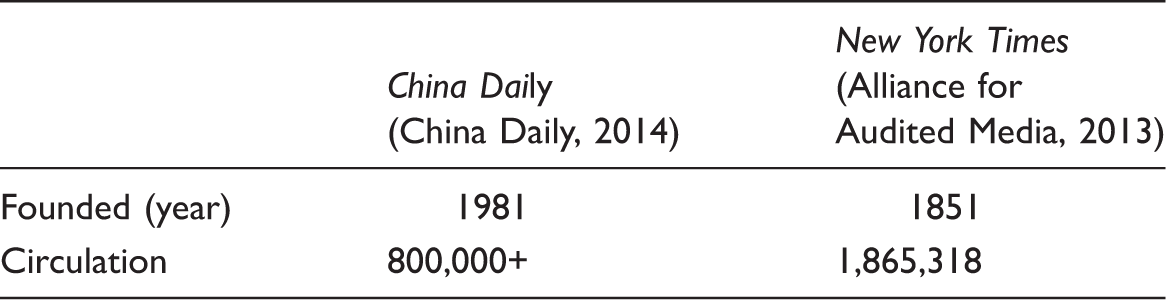
The coverage was divided into three time periods based on the aforementioned timeline of the issue—Olympic period (1 January 2008–17 September 2008), post-Olympic period (18 September 2008–31 December 2012), and 2013 Incident Period (1 January 2013–12 December 2013). Although the time periods are not even by duration, they were created based on the intensity of the news events and the amount of coverage that make the periods comparable. The year 2008 was chosen as a starting point because it was the year when the pollution started to attract media attention from the USA and it was the year of the Beijing Olympic Games. The year 2013 was chosen as the last time period, with 31 December 2013 being the end point, because the recurrence of ‘crazy bad’ air quality in January 2013 fueled the debate about the issue (Wong, 2013a).
Sampling procedure
News stories were defined as non-advertising and noncommentary matters in a news product, namely, hard news pieces excluding information on comment/opinion pages, editorials, routine business data, and other similar materials. A news story about Beijing’s air pollution was defined as a relevant report that was significantly devoted to at least one paragraph to Beijing’s air pollution.
The LexisNexis database was used to collect NYT articles only because it doesn’t include articles from China Daily. Therefore, data retrieval method used the keywords for NYT’s LexisNexis database. The keywords used were ‘Beijing* AND Air* AND (Pollution* OR Quality*)’. The manual screening of articles led to a total of 67 relevant articles from NYT, with 24 in the first Olympic period, 23 relevant articles from post-Olympics period, and 20 relevant stories from the third time period.
The searchable online database of China Daily (http://search.chinadaily.com.cn/) contains articles from the entire six-year period. The keyword ‘Beijing air’ was used for data retrieval. A total of 715 news stories were found in the first Olympic period. After examination, 29 stories were identified for this period. Irrelevant articles concerned issues such as ‘Beijing air travelling’ or ‘air zone defense’ were excluded. Following the same approach, excluding the irrelevant coverage, 60 of 3,127 articles were identified in the second ‘post-Olympics’ time frame (18 September 2008–31 December 2012) and 78 of 673 articles were collected for the third period (2013). In total, a complete list of coverage of ‘Beijing’s air pollution’ consists of 167 news stories. This comprises the population of China Daily for this study. The difference between the total number of news stories and the number of the selected ones is large, because the keywords did not contain quotation marks—the word ‘Beijing’ and ‘air’ did not need to appear together in the text, and news stories that did not significantly devote to at least one paragraph to Beijing’s air pollution were eliminated (e.g., mentioned air pollution in passing, or air pollution in other regions in the world). The method was used to maximize the retrieval while simultaneously excluding the irrelevant ones.
Coding scheme
The three major variables for this content analysis were topic, source, and overall themes. The coding categories for these variables were identified, developed and tested through a deductive pilot study where 32 news stories on Beijing’s air pollution were reviewed.
Topic was defined as what the story discusses about, and the coding unit for it was news story. The coding scheme focused on six topics: strategies/solutions to deal with pollution; pollution causes; social impacts of the pollution; associated health risks; economic aspects (defined as stories that analyze how the pollution occur due to the extensive economic growth or how the pollution-mitigation strategies might affect the economic growth and related industries); links to other political issues in China (e.g., linking the pollution to human right issue, to Chinese government’s ruling role, Chinese government’s potential political reform, or Chinese government’s information openness).
Source variable in this study was defined as a person, publication, or other record or document that gives information in the news story. It was classified into 12 categories and one open-ended category: official sources: 1) Chinese official source (e.g., Chinese government, environmental bureau; 2) US official source (e.g., US embassy, US Environmental Protection Agency); 3) Chinese social elite; 4) US social elite (e.g., scientists, university professors, etc.); 5) Chinese NGO source; 6) US NGO source (the relatively independent nongovernmental organization/non-profit organizational sources in each country such as US Olympic Committee); 7) Chinese public; 8) US public (public sources are ordinary people who are not informed); 9) Chinese business; 10) US business; 11) Individuals representing Chinese business organizations; 12) Individuals representing American business organizations; 13) international organizations (e.g., non-Chinese and non-US organizations which are relatively independent and relatively free from influence of China or USA such as the United Nations, WHO, world independent research institute). International organization sources were coded as open-ended. Any given story could include multiple topics and sources. If present, the treatment of that topic/source was coded as present (1), if not, it was coded as absent (0). The coding unit for the variable source was news story.
In regards to the variable of ‘overall theme,’ the coding unit was the paragraph. Each paragraph was examined to determine the theme, and the total number of paragraphs containing each theme were identified and summed up to determine the most prominent overall theme for each news story. The coding scheme treated the overall themes as mutually exclusive for each news story, with one of the three categories (‘1’ to ‘3’) being coded for each news story. This variable was defined as the overarching idea of the whole body of the article, referring to the main position of the news article toward the actions to solve the pollution problem. Three categories of overall theme were determined via the pilot study of 32 stories: 1 = showing the pollution-mitigating progress: government’s self-legitimization; 2 = negative complaints toward the pollution; and 3 = neutral. The first general category presents pollution as an extreme case and emphasizes the confidence of or praises toward government’s pollution-mitigation efforts, including how the overall air pollution severity has been reduced over the past years. The second refers to those stories in which the problem is described with mostly negative adjectives and is described to be in an extreme condition, being difficult to be solved, or relying on multiple sources consistently criticizing the pollution, the consequences of the pollution or how the pollution results in the loss of trust or faith toward the Chinese government. The third category (neutral) refers to those stories that did not predominantly use the first or the second theme as the overall theme, and stories that were relatively balanced with the use of the first and the second themes.
Intercoder reliability
Intercoder reliability was calculated from the pilot study. In the pilot study, 32 (representing about 13% of the total number of sampled articles) were coded independently by two coders. These articles were from different national newspapers from the USA and China (16 from USA Today in the USA and 16 from Global Times in China) in order to avoid the contamination of the original sample from China Daily and the NYT.
Intercoder reliability was calculated using Krippendorf’s Alpha, which ranged from 0.70 to 1.0, which is within the acceptable level of reliability (Krippendorff, 2012). The reliability scores for topics ranged from 0.76 to 0.93; the reliability for sources ranged from 0.82 to 1.00; and the reliability of overall theme was 0.70.
Results
Frequency of coverage of Beijing’s air pollution
Frequency distribution of articles on Beijing’s air pollution.

Change of topics across years
Frequency of topics

Note: All expected cell frequencies were greater than five. a Proportions of topic over all the topics’ mentions (e.g., 126/395≈32%).
Proportions of mentions over all the articles (e.g., 126/167 ≈ 75.4%).
p < .05. **p < .01. ***p < .001.
RQ2.a. further asked if the difference of coverage of topics between the two newspapers changed across periods. Results show that the difference of coverage of topic of ‘strategies/solutions to deal with pollution’s was contingent upon time periods. Initially in the Olympic period, China Daily covered significantly more topics of ‘strategies/solutions to deal with pollution’ (χ2 = 7. 98, df = 1, p < .01). But such differences attenuated across time. In the following event periods, there were no significant differences in terms of the coverage of these strategy-related topics.
Results show consistent significant differences across time between the two newspapers in terms of the coverage of the topic of ‘links to other political issues in China.’ In regards to the topics of ‘associated health risks’, ‘social impacts’, and the ‘economic aspects’, the two newspapers’ coverage only significantly differed during Olympic period and the 2013 incident periods, which suggests that the two newspapers especially covered these topics in different amount during the special event periods.
The overall theme of news coverage
Overall themes of news coverage.
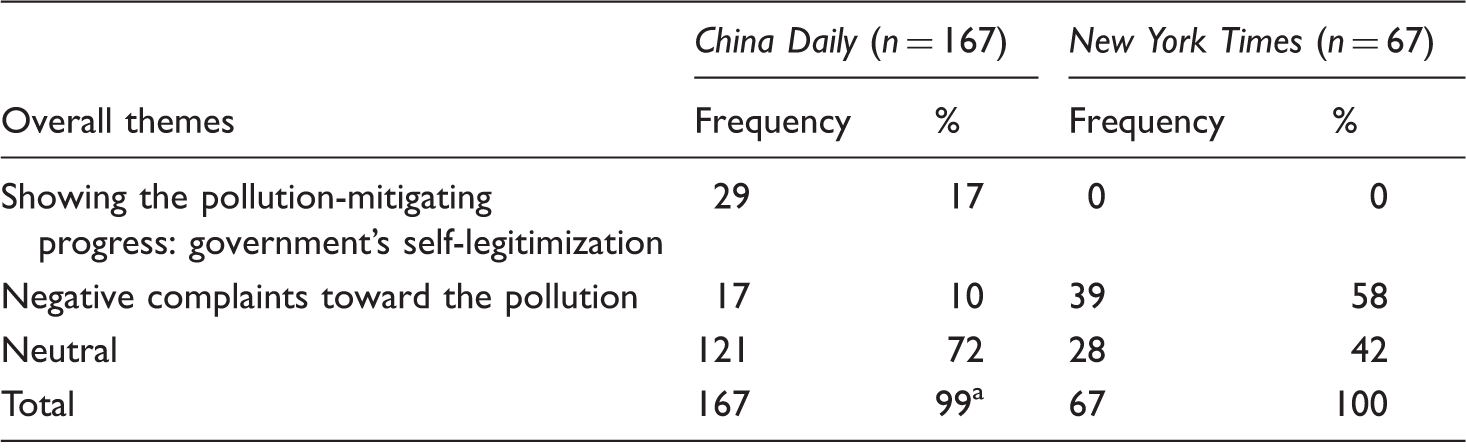
Note: χ2 (2) = 64.79. p < .001. All expected cell frequencies were greater than five.
Some rounding error.
RQ3.a further asked if such differences of uses of overall themes changed across time periods. Results show that the difference of overall themes between the two newspapers was consistent across time periods.
The consistent and significant difference of overall themes of news coverage between the two newspapers can be illustrated with some excerpts below, representing the overall theme of ‘showing the pollution-mitigating progress: government’s self-legitimization’, and the overall theme of ‘negative complaints toward the pollution’. The quality of the air in China’s capital has improved for 14 consecutive years, with the number of major pollutants falling… The municipal government has been taking measures to cut coal consumption in the city for a number of years… (Wu et al., 2013, China Daily). What the leaders neglect to say is that infighting within the government bureaucracy is one of the biggest obstacles to enacting stronger environmental policies. Even as some officials push for tighter restrictions on pollutants, state-owned enterprises—especially China’s oil and power companies—have been putting profits ahead of health in working to outflank new rules, according to government data and interviews with people involved in policy negotiations (Wong, 2013d, the New York Times).
News source usages
Comparison of sources of China Daily and the New York Times on the coverage of Beijing’s air pollution.
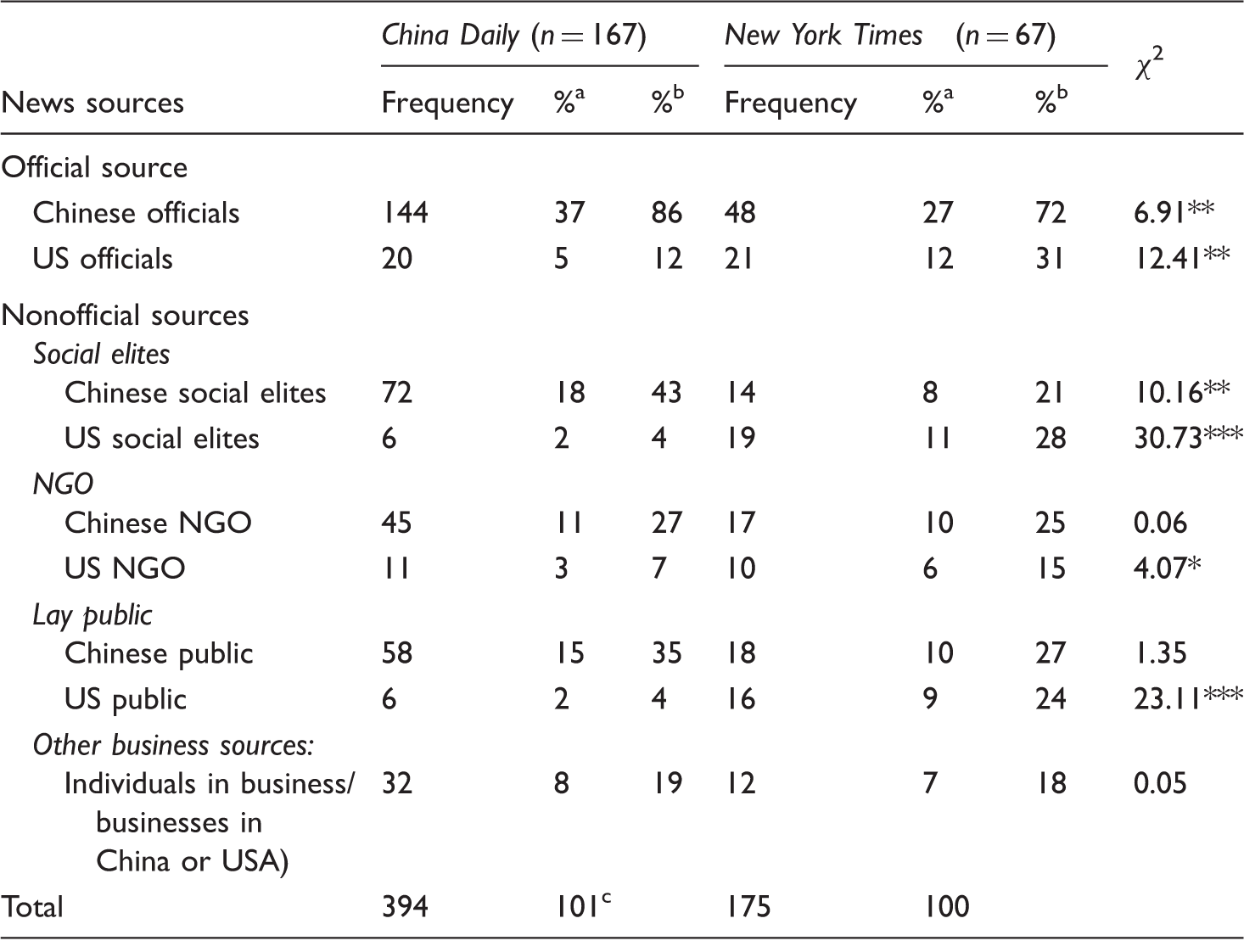
Note: All expected cell frequencies were greater than five. Source variable also considers international sources (non-Chinese and non-US sources), which were coded as open-ended variable and thus not being included in this table.
Proportions of source over all the source presences (e.g., 144/394 ≈ 37%).
Proportions of source over all the articles (e.g., 144/167 ≈ 86.2%).
Some rounding error.
p < .05. **p < .01. ***p < .001.
The chi-square tests identified different uses of six sources between the newspapers. They were ‘Chinese official sources’, ‘Chinese social elite sources’, ‘US official sources’, ‘US social elite sources’, ‘US NGO sources’, and ‘US public sources’. China Daily (37%) relied significantly more on Chinese official sources than NYT stories (27%), and on Chinese social elite sources (18%) than NYT (8%) (χ2 = 6.91, df = 1, p < .01; χ2 = 10.16, df = 1, p < .01). While NYT relied significantly more on US official sources (12%) than China Daily (5%) (χ2 = 12.41, df = 1, p < .01), having significantly more US social elite sources (11%) than China Daily (2%) had (χ2 = 30.73, df = 1, p < .001), and using significantly more US NGO sources (6%) than China Daily (3%) used (χ2 = 4.07, df = 1, p < .05), also using significantly more US public sources (9%) than China Daily (2%) (χ2 = 23.11, df = 1, p < .001). In other words, there were significant associations between these sources usage and the newspapers.
Meanwhile, more interestingly, there were some similarities with regards to source use. Some Chinese sources were used in NYT as frequently as in China Daily, such as Chinese NGO source, and Chinese public source. Also, there was a certain degree of inclusion of US sources in China Daily (e.g., some percentages of US sources in China Daily were similar to those of Chinese sources in the NYT). The study also included categories of business sources in each country, but there were very few sources falling into those categories, so they were then merged into one category (Table 5). The study included the open-ended source variable as well: international organizations. The two newspapers both focused on the use of World Health Organization (WHO) source the most, followed by the source of International Olympic Committee (IOC), with the former used for interpreting AQI-standard of a healthy life, and the latter showing official international attitudes toward Beijing’s air quality during the Olympics. In this respect, there are also some similarities with regards to the use of international organization sources.
Journalistic practices: Interpreting source and topics with different overall themes
RQ5 asked the specific characteristics of journalistic practices in the two newspapers with respect to their similarities and differences in interpreting topic and source.
In regards to the differences of coverage of topics, the most significant difference concerns the topic of ‘links to other political issues in China’. Below are excerpts from NYT and China Daily stories that covered this topic: Xia Yuchen, a 25-year-old resident who returned to Beijing from France three months ago, welcomed the new leadership’s determination, but said she hoped the problems can be tackled as soon as possible…. To tackle air pollution, a transparent supervision system is needed (Cao, 2013, China Daily). … Bill Bishop, the editor of Sinocism, a daily online newsletter about news media coverage of China, wrote on Monday that ‘Chinese media is all over the story in a remarkably transparent contrast to today’s haze in Beijing’…. Even before the congress,
5
the official news media had some latitude to publish critiques of environmental policy and investigate environmental degradation, in contrast to strict limits on what they can say on ‘core interest’ issues like Tibet and Taiwan. Nevertheless, the coverage unfolding now represents a new level of depth in addressing air pollution (Wong, 2013b, the New York Times). Chinese people want freedom of speech… China’s new leadership under Xi Jinping, who took over as general secretary of the party in November, is already feeling the pressure of these calls. Mr. Xi has announced a campaign against corruption, and propaganda officials, in a somewhat surprising move, allowed the state news media to run in-depth reports on the air pollution last week (Wong, 2013c, the New York Times).
Another aspect related to RQ5 concerns the topic of ‘pollution causes’. Although this topic was covered similarly in the two newspapers (p > .05), the topic was interpreted in different ways between the two newspapers. NYT included discussions of industry waste, coal-burning factories, automobile exhaust, and so forth as the potential causes using US elite sources, while China Daily blamed foggy weather and fireworks as causes of the pollution, using Chinese social elite sources more often (Xinhua, 2013), and even used Chinese official sources to address causes by blaming western countries, stating that they were transferring pollution to China (Cui, 2008). This is how they vary in using sources to support the overall theme in their coverage of the same topic—‘pollution causes’. For example: China is today producing most of our electronics and consumer products. Providing electricity for such large-scale production creates massive pollution. In a sense, the way in which the U.S. and Europe ‘solved’ part of their pollution problem is now causing pollution in other parts of the world, such as China…. (Wu et al., 2013, China Daily).
Discussion
Influences of social system on news content
This exploratory study confirms and extends the existing literature on comparative media studies of environmental issues. Reese (2001) argued that higher level of analysis of larger media structure of a country is especially necessary in the cross-national comparative media research. With this in mind, this study attempts to discuss whether or not the differences of news content between the two countries could also be influenced by the news flows between the countries.
The results are consistent with previous studies, showing that social systems, especially the ideological forces in the social systems are inherently influencing the news content in the two countries. The study shows Chinese state media tend to put a positive spin on new content, and the US media tend to report pollution issues in a negative overall theme under anti-communism, which was identified in the previous studies (Luther and Zhou, 2005; Wu, 2006). Furthermore, under such influences, China Daily favored the topic of ‘strategies/solutions to deal with pollution’ the most in their coverage using more Chinese sources emphasizing the confidence in solving the problem, while topics that linked pollution to other Chinese political issues and the critical topic of ‘social impacts of the pollution’ were more prominent in the NYT with more use of US sources. As a local environmental issue in China, Beijing’s air pollution was covered earlier in the NYT (Table 2), suggesting that Chinese state media, as represented by China Daily, was reluctant to cover this negative issue in the initial Olympic period. These differences of coverage confirm prior research on the characteristics of Chinese and US media coverage (e.g., Chinese media’s tendency to put a positive spin on the government, US media’s tendency to criticize against China and communism (Kobland et al., 1992; Luther and Zhou, 2005; Ren et al., 2012; Wu, 2006), and accord with the comparative media analysis studies between China and the USA on health issues, social problem and political issues (e.g., Akhavan-Majid and Ramaprasad, 1998; Guo et al., 2012; Tang and Peng, 2015). However, the exchanges of and flow of news between the two countries in the case of Beijing’s air pollution are also affecting the characteristics of news coverage in the two countries, which are explained below.
Two-way news flow between China and the USA
This study extends the existing literature by taking the perspective of news flows at the transnational level into account. The study shows that the coverage of the pollution in China Daily generally increased after the year of the Olympics following the trend of NYT, which might confirm that information being exported from American news sources (e.g., US Embassy’s Twitter account) was one of the forces that contributed to the increasing openness of Chinese media on this matter. Such statistical results concerning the change of frequency of coverage confirm that there was an increasing flow of information from the USA to China after the Olympic year, and such influence of news flow can overcome the constraints of ideologies in the social system in China. This might also help to explain why environmental reporting in China has been found to be increasingly open and transparent in today’s age (Tong, 2014).
In addition to frequency of coverage, the news flow at the transnational level can have an impact on the coverage of topic and the usage of sources as well. This study finds that the two newspapers had similar coverage of the topic of ‘economic aspects’ and ‘pollution causes’. Among the other four topics that received different amount of coverage, the difference of coverage of strategy-related topics was contingent upon the event periods—the coverage changed to be more and more similar between the two newspapers after the Olympic event period. These indicate that there were some similarities between the amounts of coverage of some certain topics, and the differences of coverage of some other topics (e.g., strategy-related topics) decreased across time. This might imply that the differences of coverage of strategy-related topics on the basis of different ideologies in the social systems were mitigated by the influence of cross-national news flow to some extent. The exchange of source use is also an indicator of news flow between the two countries. Chinese sources in US media sometimes accounted for a similar percent of stories as the percent of US sources in Chinese media. Specifically, China Daily more or less incorporated some US sources: US official sources (5%), US social elite sources (2%), US NGO sources (3%), and US public source (2%). Similarly, US media also incorporated similar amount of Chinese sources into their news stories: Chinese social elite sources (8%), Chinese NGO sources (8%), and Chinese public sources (10%). Especially Chinese state media’s usage of US sources (e.g., information flowing from US Embassy’s Twitter account to China) potentially implies a two-way direction of news flow across the two countries as well as the Chinese state media’s increasing openness.
Under the influence of news flows, this study also extends the existing studies on media coverage of China’s environmental problems by empirically examining the increase of information openness in China’s state media in the respect of environmental reporting. Although China Daily constantly put a positive spin on the government and using an overall theme of self-legitimization, the sources in China Daily were diverse since a number of US sources were included. Also, Chinese sources were used in US media; this is different from the reporting of SARS crisis in China. During the SARS outbreak, Chinese media used to control the information sources and did not openly discuss the problem (Beaudoin, 2007). In the case of air pollution, instead of controlling the pollution information and the availability of information sources, the state media allowed the sources to be exported to the US media. This higher accessibility of Chinese sources indicates the possibly freer flow of news from China to the USA, which also results in US media’s use of Chinese social elite and NGO sources, with frequency of use being similar to the use of US sources in China Daily. This higher availability of Chinese sources, especially Chinese environmental NGO sources indicates that the relevant environmental nonprofit and nongovernmental organizations are getting exposure in both domestic and US media, and are becoming internationalized, which further implies an increase of awareness of environmental conservation in China, according with the finding by Tong (2014) in a study of ten Chinese newspapers. Such awareness deeply motivates and facilitates the openness and easier use of Chinese sources as found in this study and may provide directions for future research. Besides, Beijing’s air pollution as a news agenda was previously found to be highly event-driven, and media coverage toward the issue was found to be revolving around the association among air pollution, Olympic Games and China’s national reputation (Xu, 2012). However, this study depicts that the pollution has changed to be a longer-term news agenda in China and is receiving long-term media attention in the US. Topics and amount of coverage are also becoming more diversified across time in this six-year study than in Xu’s (2012) study of the coverage of the 2008 Olympics period. In the meantime, the results of this study concerning the coverage in NYT slightly differ from previous literature, which stated that US media had the common narrative of anti-communism (Kobland et al., 1992; Luther and Zhou, 2005; Wu, 2006). In this study, NYT included a mild degree of praise toward the Chinese government’s efforts in tackling the pollution. That indicates a milder critical overall theme that was relatively rare in previous US media coverage of China (Kobland et al., 1992: 64). A possible and important explanation for that change is that China increased state media’s coverage of this negative issue and allowed the state media to report critically after the Olympic year.
Limitations
This study is based on a relatively small number of news stories from two newspapers, which prevents the generalizability of the results. Also, the study focuses on the macro-societal level of analysis, but individual journalists as well as the journalistic practices of the media organizations might also influence the media coverage in the two countries. Such levels of analyses were not the focuses of this study, limiting the results’ explanatory power. To better understand the differences of media coverage between countries, a variety of factors that are at multiple levels of analysis would also need to be examined. Future studies should incorporate these other variables to test their predictive power under the influence of social systems and the news flows. These could also help to better apply and examine the theoretical model in the comparative media study contexts.
Finally, as social media played a big role in the case of Beijing’s air pollution (e.g., US Embassy’s Twitter account, Pan Shiyi’s Sina Weibo), future studies could follow this line of research and explore how new media technology might facilitate the changing flow of news and the globalization of media coverage.
Footnotes
Declaration of Conflicting Interests
The author(s) declared no potential conflicts of interest with respect to the research, authorship, and/or publication of this article.
Funding
The author(s) received no financial support for the research, authorship, and/or publication of this article.