



Abstract
This article reports a meta-analysis of 345 published studies to examine the media’s role in construction of a Muslim and Islamic identity. A quantitative analysis highlights the geographical focus, methods, theories, authorship, media types, and time frames of published studies. A qualitative analysis investigated the most prominent researched themes. Our findings suggest that a large majority of studies covered Western countries, while Muslim countries and Muslim media have been neglected. We also identified an evident lack of comparative research, a neglect of visuals, and a dearth of research on online media. We found that most studies investigated the themes of ‘migration’, ‘terrorism’, and ‘war’. Moreover, our meta-study shows that Muslims tend to be negatively framed, while Islam is dominantly portrayed as a violent religion. Implications of these findings are discussed.
Media representation of minorities is a well-researched topic in the academic community (Hall, 1990; Poole, 2002; Van Dijk, 1991). The past few decades have seen a resurgence of interest, as indicated by extensive scholarly work examining the relationships between media representation of minorities and issues concerning ethnicity, race, multiculturalism, and identity politics. However, today, of all the minorities in world affairs, Muslims and Islam are at the crux of much censure and debate. Since the horrific events of 9/11, media and political debates surrounding issues pertaining to Muslims and Islam have narrowed to an Orientalist discourse (Saeed, 2007), while the relationship between Western nations and Muslims has been re-interpreted as a divide between the West and the world of traditional Islam (Ibrahim, 2010). There is a dominant antagonistic view against Muslims and Islam across many societies, with the most strained sociopolitical relationships being witnessed in the USA (Powell, 2011). The ‘clash of civilizations’ proposition saw a return during the Bush administration (Kumar, 2010: 255), while incidents in other parts of the world (e.g., Jyllands-Posten and Charlie Hebdo cartoon controversies) evidence a simplistic public understanding about Islam, resulting in possible anti-Muslim sentiments (Akbarzadeh and Smith, 2005).
Numerous scholars across disciplines have investigated media representation of Muslims and Islam through various lenses of analytical inquiry and across varying geo-political contexts, which include: North America (Ibrahim, 2010; Kumar, 2010; Said, 1978, 1980; Shaheen, 2009), Europe (Ehrkamp, 2010; Poole, 2002), Asia (Ahmed, 2010, 2012; Green, 2013), Latin America (Ahlin and Carler, 2011) and Oceanian countries (Ewart, 2012; Kabir, 2010, 2011; Patil, 2015). Despite the vast scholarship, we are still lacking a systematic analysis of literature providing us with a detailed understanding of overall findings and trends.
This study presents a meta-analysis of 345 academic studies pertaining to media representations of Muslims and Islam from 2000 to 2015. Our interest in this area is manifold: First, in the last two decades, hundreds of studies have investigated the portrayal of Muslims and Islam in the media, to establish that social resentment, coupled with cultural and economic factors, have led to the alienation of Muslims from societies. Our study considers the different methods, perspectives, and findings from all these studies in order to provide a consolidated picture of the present literature. Second, we examine the media’s role in the construction of a Muslim and Islamic identity to propose a common, general framework of media representations of Muslims and Islam across societies. Third, we are interested in knowing if and how these studies consider or represent the perspective of Muslims. The Muslim community has over a billion people, and it stretches across six continents encompassing hundreds of cultures (Courbage and Todd, 2014). Thus, understanding the focus on Muslim people is important for global geo-political concerns.
For our study, we followed a content-based meta-analytical approach (Kamhawi and Weaver, 2003; Li and Tang, 2012; Matthes, 2009) because most of the studies in our sample did not allow for computing effect sizes and other statistical indices. We followed a two-step meta-analytical procedure: In the first step, we used quantitative measures to examine theoretical perspectives being used, countries and continents being investigated, methods and data gathering instruments being employed, media resources being examined, the time frame being considered, as well as authorship details. In the second step, we followed an in-depth qualitative approach to conduct an analytical review and identify the most common themes or topics related to the portrayal of Islam and Muslims in the media. Taken together, our study provides insights which can enable researchers to comprehensively understand the status of the research, fill gaps in the literature and build on existing strands of research.
Media representation of minorities
Mass media play an important role in the creation and distribution of ideologies (Gitlin, 1980; Hall, 1990) and thereby contribute to the overall cultural production of knowledge (Poole, 2002). The stories and images in the media provide resources (symbols) through which we organize a common culture and through the appropriation of which we insert ourselves into this culture (Van Dijk, 1991). Numerous studies have shown mass media to articulate dominant social values, ideologies and developments, and that these characteristics often lead to misrepresentation or stereotypical portrayals of minorities in the media (Hall, 1990, 1992a, 1992b; Saha, 2012; Van Dijk, 1991). Over the years, scholars have investigated media portrayals of minorities through the lenses of race, ethnicity, and religion. Hartmann and Husband (1974) and Hartmann et al. (1974), for instance, investigated the ethnic news coverage in Britain during the 1960s and found that the emerging news framework encouraged the perspective of ‘people of color’ as problems, aberrations, or just oddities. Hall (1992a; 1992b) found similar results, as blacks in the UK were symbolized as less civilized and culturally inferior due to differences in their race and color as compared to the majority. Besides the UK, scholars investigating race relations in the USA in the 1980s also found stereotypical representations of Latinos and other minorities in the American press (Totti, 1987; Wilson and Gutierrez, 1985). Media discourses were frequent in associating minorities with drug involvements and depicting them as problematic to society (Wilson and Gutierrez, 1985). Media portrayals of African-Americans were found to align with majority white preconceptions of blacks being thieves, troublemakers, violent, and drug pushers (Oliver, 1994; Staples, 2011). Scholars in other parts of the world found similar representation of other minorities (Kabir, 2010).
Van Dijk (1991) analyzed two decades of research investigating the relations between media and minority groups across North America and Europe and concluded that the media was representative of a white supremacy which predominantly depicted minorities as ‘a problem or a threat, and mostly in association with crime, violence, conflict, unacceptable cultural differences, or other forms of deviance’ (Van Dijk, 1991: 20). Scholars in the last two decades have continued to obtain similar findings of stereotypical representation of minorities in the media (Poole, 2002; Saha, 2012). Since the resurgence of religion in public life in late 2000s, there has been a shift in the academic interest of media studies from race and ethnicity to religion, and Islam has been at the fore (Knott and Poole, 2013).
Media, Muslims, and the West
The anti-Muslim discourse in the Western media began with the Iranian Revolution in 1979 and the ensuing US hostage crisis, and it grew belligerent during the periodic crises over Libya and the Middle East in the 1980s (Said, 2008). In past decades, wars in Iraq in the 1990s, and the consequent events of 9/11 in 2001, further amplified the tone and volume of the discourse (Ahmed, 2012). Perceptions of Islam as anti-democratic, and a menace to the West, have persisted since the late 1970s (Esposito, 1995; Said, 1981). However, academic interest in the representation of Islam in the media grew after the publication of the Runnymede Trust’s report, Islamophobia: A Challenge for All of Us in 1997 (Knott and Poole, 2013). Poole’s (2002) investigation was one of the seminal studies in this area of research in recent times. Since then a number of scholars across societies have investigated the relationships between media, Muslims, and Islam.
Although over the years the media have paid detailed attention to conflicts involving Muslims and Islam, there are grounds to assume they have failed to comprehend the sociopolitical and economic reasons behind such issues. In the generalizability of assumptions, ‘The West’ and ‘Islam’ can be expected to be defined as opposites, propagating the idea of confrontation (Poole, 2002). Scholars have argued that what is said or written about Muslim thought, nature, religion, or culture in the mainstream Western media is not the same as what is said or discussed about Africans, Jews, other Orientals, or Asians (Said, 1980). Islam is portrayed as populated by ‘an undifferentiated mob of scimitar-waving oil suppliers’ (Said, 1980: 19) or as a religion of irrational violence that subordinates its women (Said, 1980). In recent research, studies have found that the media represents Islam as a monolithic, homogenized, or sexist religion (Korteweg, 2008; Mishra, 2007a). Muslims are often framed as heartless, brutal, uncivilized, religious fanatics (Shaheen, 2009), as militants and terrorists (Ewart, 2012; Ibrahim, 2010; Powell, 2011), or as societal problems (Bowe et al., 2013; Hussain, 2007; Ibrahim, 2010) within well-constructed war and conflict stories (Akbarzadeh and Smith, 2005; Poole, 2002). Islam is presented from the perspective of a ‘white man’s world’ and Muslims are categorized as ‘them’ and presented as a threat to ‘us’ (Osuri and Banerjee, 2004: 167).
Despite this rich body of research, we lack a systematic overview of research findings and trends. Such an overview may provide a comprehensive understanding of how Muslims and Islam are covered in the media, and how this topic is treated by scholars. We investigate the most common themes covered in the literature. Furthermore, we systematically analyze the geographical focus, methods, theories, authorship, media types, and time frames of published studies. The present meta-study therefore adds to the existing body of work by providing an overview of how media scholars have investigated the coverage of Muslims and Islam. These insights can be used as a roadmap for future research.
Method
Meta-analysis is a ‘systematic quantitative technique used to ascertain relationships among variables’, which is a valuable and popular research tool (Emmers-Sommer and Allen, 1999: 486). Scholars suggest that meta-analyses help elucidate misperceptions in literature, examine methodological arguments, and offer a comprehensive assessment of theoretical standpoints (Allen, 2009). However, as Li and Tang (2012: 406) suggest, sometimes meta-analyses can be limited in examining a topic with a varied spectrum of sub-topics, as in the case of media representations of Muslims and Islam. Therefore, an analytical review of the topic is also presented in this study to support the findings of the meta-analyses.
Sample and inclusion criteria for studies
We used the following combination of keywords: ‘media’, ‘media portrayals’, ‘media representation’, ‘media coverage’, ‘media stereotype’ AND ‘Muslim’, ‘Muslims’, ‘Islam’, ‘Islamic’, ‘Islamophobia’, ‘Sharia’, ‘Shia’, ‘Sunni’, ‘Arabs’, ‘Middle East’, and a list of Muslim countries (e.g., Algeria, Malaysia, Nigeria, Pakistan, and Jordan, among others). The following databases were searched: Web of Science (SSCI), EBSCO, JSTOR, SCOPUS, Taylor and Francis, Wiley Online Library, ProQuest, and Google Scholar. We initially identified 522 articles. Book reviews were ignored. The abstract of each article was read to see if it investigated or discussed media portrayals of Muslims or Islam. Here, studies investigating topics involving the Muslim (ethnic) media rather than media representations of Muslims were also ignored. Our final criteria for inclusion in the sample resulted in a total of 345 articles. The choice of the period 2000–2015 was selected to reveal how research on media representation of Muslims has been conducted in the new century. Due to limitations of knowledge of multiple languages, the findings of this study are necessarily bound to the selection of English language journals; this is, however, a common procedure for meta-studies (Matthes, 2009).
Procedure
The present meta-analysis was conducted in two steps. At the first step, we conducted a quantitative data analysis, coding the most important characteristics of the sampled studies, which are discussed in detail below. At the second step, a qualitative analysis was conducted to identify the most common themes investigated in studies of media portrayals of Muslims and Islam.
Quantitative analysis coding
At the quantitative stage, each article was coded for the following categories:
Year of publication
Country
Continent
Journal
Authorship: The authorship category was coded for the first author’s country of affiliated university. Methodological approach: We coded three methodological approaches: quantitative analysis, qualitative analysis, and mixed analysis. An article was coded as quantitative if ‘the results determined involved numerical or counting procedures and statistics were used to report the data’ (Kamhawi and Weaver, 2003: 11); otherwise, an article was coded as qualitative. If both approaches were adopted, it was categorized as mixed. Data-gathering instrument: Each quantitative study was coded for the following subcategories of instruments:
Content analysis, b) survey, c) secondary data, d) experiment, e) mixed (if more than one instrument was used), and f) other.
Each qualitative study was coded for the following subcategories of instruments:
a). Textual analysis, b) review, c) interview, d) focus group, e) mixed, and f) other.
Each study which followed the mixed methodological approach was coded respectively for the both quantitative and qualitative instruments adopted.
Theory: Theories refers to frameworks of empirical evidence, which are scientific ways of thinking about social life that encompass methods of explaining social behavior and ideas of how societies change and develop (Harrington, 2005). Each article was coded for the utilized theory. If multiple theories were mentioned, one unit for the category was equally subdivided among each mentioned theory. Analysis perspective: Each article was coded for the central analysis’ focus on a) only media content, or b) both media and audience. Type of media analyzed: The different types of media coded were a) television content, b) newspapers, c) Internet and online media, d) radio, e) mixed, and f) other. Time frame: Each article was coded on the basis of five time frames: a) less than a month, b) a month to six months, c) six months to two years, d) two to five years, or e) more than five years. Muslim Perspective: We wanted to analyze whether a study considered the Muslim perspective in its analysis. To do so, we checked whether the study included a) media content generated by Muslim news organizations (e.g., Al Jazeera Arabic), b) a Muslim sample (for surveys, interviews, focus groups), or c) both (a) and (b).
Qualitative analysis review
Based on the focus of each study, two coders categorized a study into an overall contextual theme. These clusters of studies varied, from investigations focusing on September 11 attacks, to issues pertaining to mosques, to bombings in London (2005), Bali (2002), and Boston (2013). If a study discussed more than one theme, it was categorized into each theme investigated. However, such cross-theme investigations were few in number. We must acknowledge that some of the studies did not fall into a commonly investigated theme and, hence, are under-represented in our findings.
Coders and reliability
A team of two coders were employed to code the articles for the above mentioned categories (Cohen’s kappa 0.74 to 0.96, N = 76, randomly selected).
Results
Quantitative findings
Articles by year (2000–2015)
The overall mean of articles for the 16-year period stands at a high rate of 21.56 articles per year. Figure 1 shows the increasing interest in this area of research, with the most productive years being 2010 and 2013 (N = 34), closely followed by 2012 (N = 31) and 2014 (N = 31).
Trend in academic research 2000–2015.
Country and continent focus
List of countries by research ranking.

Analyzing by continent, we found that the research was mainly focused on Europe (N = 100.5, 34.93%) and North America (N = 112.53, 32.61%). Australia (Oceanic), despite its smaller size, featured a respectable 12.32.08% (N = 42.5). Only 14.62% of studies focused on Asia (N = 50.5), where there was a major concentration on war-torn countries as we can see in Table 1. Research focused on Africa (N = 14. 4.06%) and South America (N = 1, 0.29%) was minimal.
Journals
Studies were published in journals across several disciplines. The Journal of Arab and Muslim Media Research was at the top (N = 36), followed by the International Communication Gazette (N = 26) and the Journal of Muslim Minority Affairs (N = 24). Other journals included the Journal of Ethnic and Migration Studies (N = 16), Contemporary Islam (N = 13), and the Journal of Media and Religion (N = 13).
Authorship
Authors from a total of 38 countries contributed to our data set. As shown in Figure 2, authors from the USA (N = 132, 38.24%) were the most common, followed by those from the UK (N = 69, 20%). Australian scholars (N = 34, 9.86%) were the third largest group of contributors worldwide, while authors from the Netherlands (N = 16, 4.64%) and Germany (N = 16, 4.64%) were the most productive in Europe.
Authorship by top 10 affiliated countries.
Methodological approach
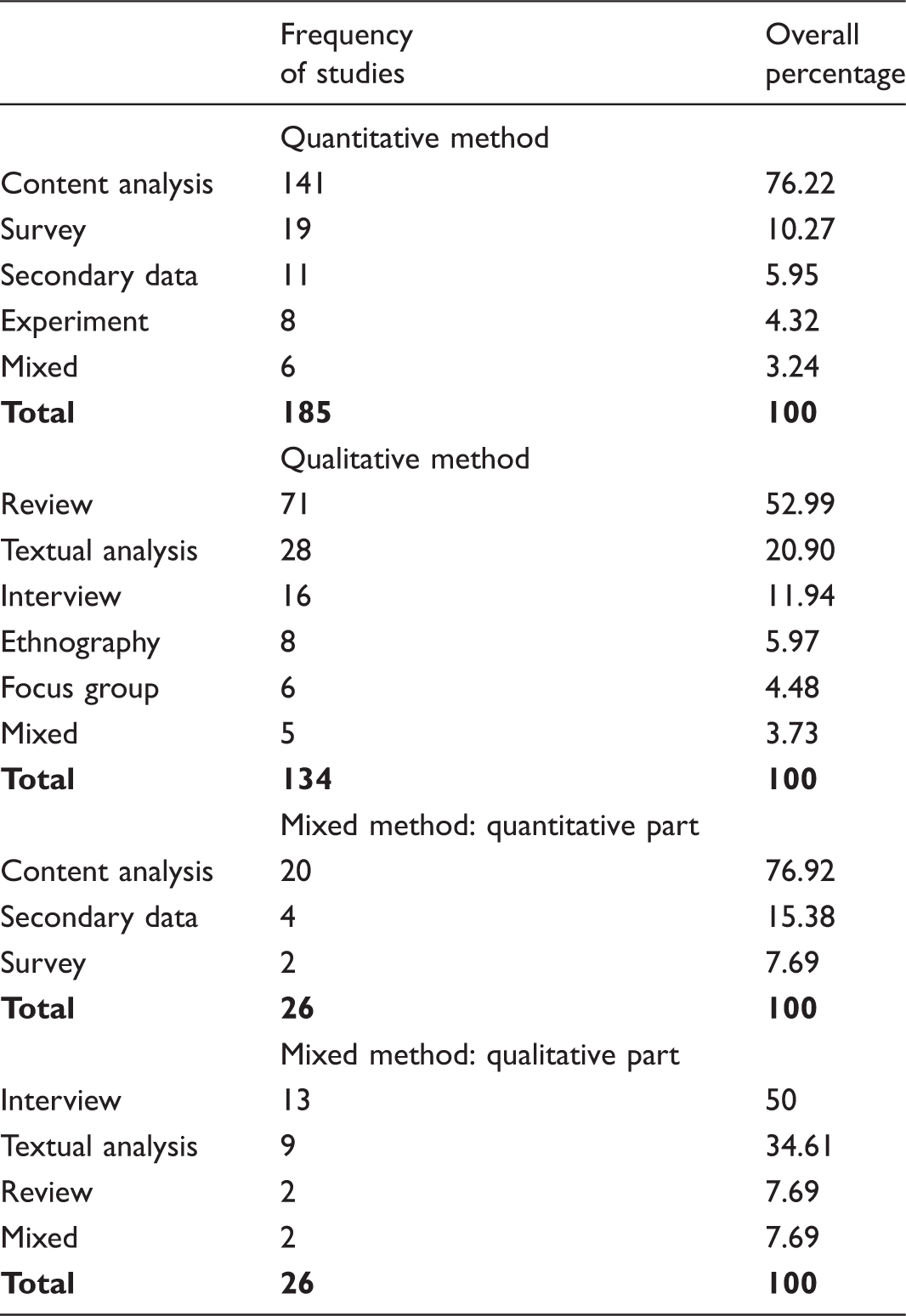
Out of 345 articles under inspection, 53.62% (N = 185) of the studies favored a quantitative method, while 38.84% (N = 134) of the studies followed a qualitative approach. Studies that followed both a quantitative and qualitative approach were few in number (N = 26, 7.54%). Our findings corroborate previous meta-analyses results analyzing communication studies, where most scholars were found to use quantitative methods (Li and Tang, 2012).
Methodology.
Theoretical usage
More than half the studies (N = 213, 61.74%) built their research on a theoretical framework. Overall, a total of 33 theories were used, with more than half of them being used just once. Framing (Entman, 1993) was the most commonly used theoretical approach (N = 128, 60.01%), followed by Edward Said’s Orientalism (N = 49, 23.01%). Agenda-setting (McCombs and Shaw, 1972) was the third most commonly used theory (N = 18, 8.45%) followed by critical discourse analysis (N = 11, 5.16%), social identity theory (N = 7, 3.28%), and integrated threat theory (N = 7, 3.28%).
Analysis perspective
Approximately 90% of the studies (N = 310) focused solely on discussing or analyzing media content. Only a small percentage of studies explored both media and audience perspective (N = 35, 10.14%). Out of the studies exploring the media-audience relationship, only a few focused on the role of media discourses in Islamophobia. With regard to these, greater attention was paid to resulting attitudinal effects on non-Muslim majorities (N = 14) as compared to Muslim minorities (N = 9).
Types of media analyzed
Figure 3 shows that half the studies focused on analyzing newspapers (N = 167, 48.41%). We found the focus on television content to be marginally low (N = 45, 13.04%). A small number of studies focused on the Internet (N = 20, 5.80%), and we found just one study on radio.
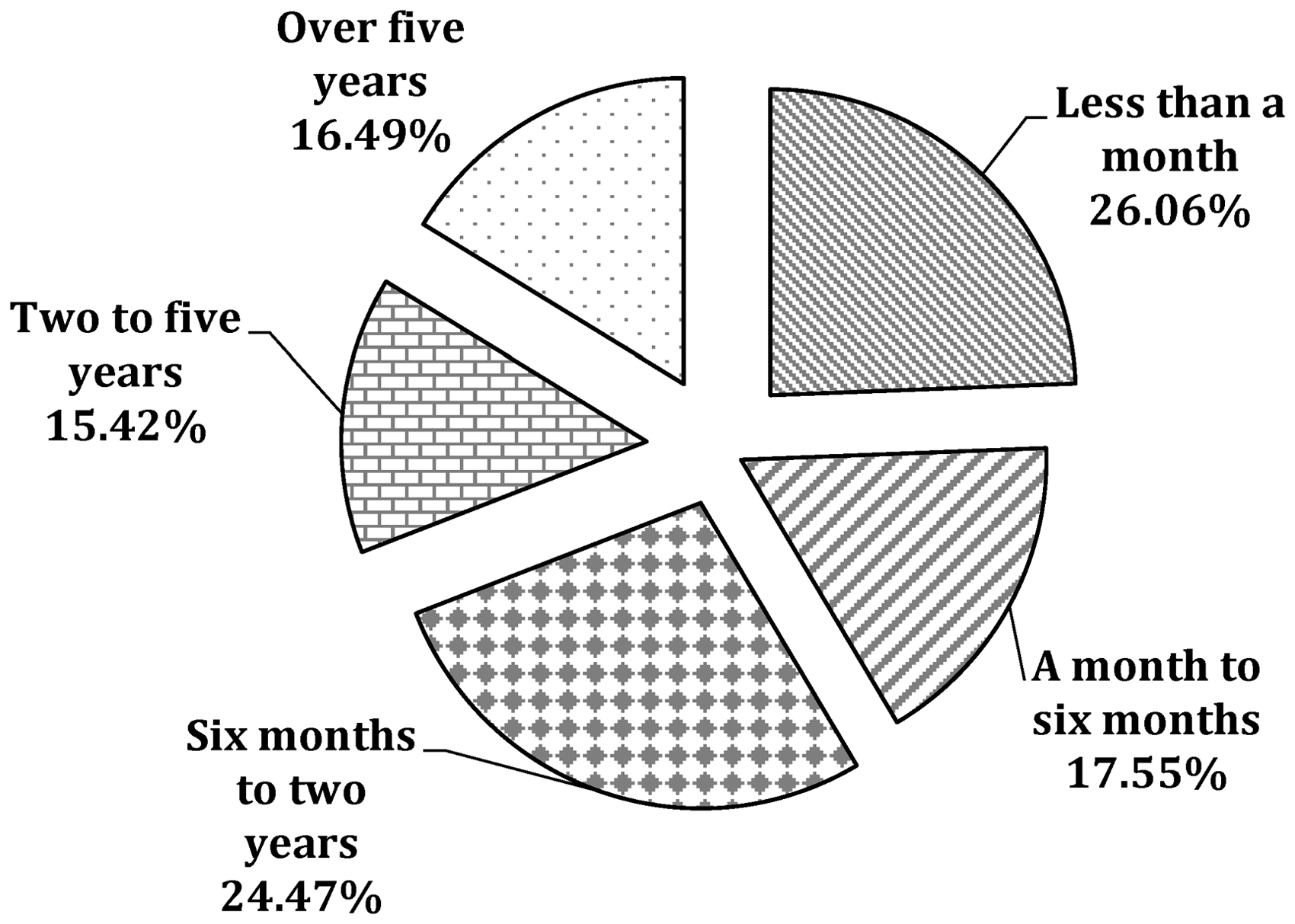
Types of media analyzed. Breakdown of time frames of studies.
Time frame
Figure 4 shows a majority of the studies (N = 188, 54.49%) analyzed media content over a time period. Of those that did, it was found they largely examined media content spanning less than a month (N = 49, 26.06%), followed by studies which examined content between six months and two years (N = 46, 24.47%). It was encouraging to see that 16.49% of the studies (N = 31) examined media content spanning over five years.
Muslim perspective
It was found that only 9.56% (N = 33) of the studies incorporated Muslim audiences or pro-Muslim media institutions (Al Jazeera, Al Hayat, and others) in their analysis. Most of these studies either focused on Arab news networks’ coverage of Middle East wars or compared the coverage of Western and Arab networks.
Qualitative findings
In this section, we review eight of the most commonly occurring themes found in our sample. These are presented in descending order of their overall frequency of occurrence.
Before and after 9/11
In our review, we found that a large proportion of studies investigated the portrayals of Muslims and Islam in various types and sources of media, within and outside of the USA, following the before and/or after 9/11 framework. Findings suggest a change in the patterns of representations of Muslims and Islam in the mainstream media since the attacks of 11 September 2001 (Brown, 2006). Post 9/11, media portrayals of Muslims and Islam worldwide were mostly negative, with Muslims and Islam being framed within the context of religious extremism and a clash of civilizations and cultures (El-Aswad, 2013; Kumar, 2010). Critical scholars argue that the US media paralleled the views of the Bush administration in deploying spectacles of 9/11 terror to promote specific political agendas (Kellner, 2004) and avoided discussing any relations between the attacks and US policies in the Middle East (Abrahamanian, 2003).
Within the USA, there were changes in volume, themes, and stereotypical references to Islam and American Muslims. Among specific media sources, the New York Times (Mishra, 2007b), the Los Angeles Times, and the Washington Post (Trevino et al., 2010) were unfavorable in their representations, with a common theme being Muslims are ‘terrorists’, ‘extremists’, ‘fundamentalists’, ‘radicals’, and ‘fanatics’. These findings corroborate studies of visual frames in major American news networks (Ibrahim, 2010; Kumar, 2010) and verbal frames in CNN message boards (Martin and Phelan, 2002), that reinforce that Islam is represented as a sexist religion spawning terrorism, incapable of rationality.
Studies outside the USA have also identified that the September 11 attacks appear to have influenced a rise in overt and indirect discrimination against Muslims—as was witnessed in the UK (Sheridan, 2006) and Canada (Poynting and Perry, 2007). Overall, media representations of September 11 emphasized Muslims as a threat to universal ‘white’ values of democracy and freedom (Osuri and Banerjee, 2004).
Terrorism
The findings also point media portrayals of Muslims to be strongly associated with terrorism, and this association was generally more pronounced after a major terrorist event (more so, if it was local). Muslims are consequently presented as a direct or indirect threat in societies through such portrayals. Saeed (2007) suggests that these media misrepresentations can be linked to the development of ‘racism’, as oftentimes deep-rooted societal issues such as asylum seeking are conflated with Islamic fundamentalism or terrorism.
Although terrorist event-specific studies were usually published years later than the actual events, we have provided Figure 5 as a brief reference to understand the association between overall research trends we found for 2000–2015 and the major terrorist activities (along with major political activities—bottom half) across the world during the same phase.
Major terrorist attacks and US political activities since 2000 against overall research trend.
Studies investigating terrorist attacks were able to identify them as the catalytic point when the national media and majority society adopted a common negative stance towards Islam. For example, D’Haenens and Bink (2007) found that before the assassination of film-maker Theo van Gogh in 2004, the Dutch press focused on Islam in general, but after the murder, the negative pronouncements about Muslims were more evident and stories focused on the crude relationships between Islam and Dutch society. Similarly, after the 7/7 London terror attacks and the 2007 Glasgow International Airport attack, the media in the UK constructed stereotypes of Muslim terrorists and conflated Islamic beliefs as terrorism (Ewart, 2012; Shaw, 2012).
Jackson (2010) argues for an implementation of thematic, analytical, and critical media literacy in social studies classrooms to critically respond to portrayals of Muslims as terrorists.
Muslim women
Several studies investigated how the media represents Muslim women (Fahmy, 2004; Mishra, 2007a, 2007b; Williamson, 2014). The identities of Muslim women are excluded from the overall construction of women in most nations. There is a dominant belief that Muslim women are victims of their own culture and a threat to the modernization of women’s identities in developed countries (Navarro, 2010). Studies by Haque (2010) and Mishra (2007a) have identified that, post 9/11, the Western media has portrayed Muslim women as oppressed victims in need of liberation from a religion that is gender-oppressive and violent; furthermore, these portrayals have rendered Muslim women as mistrusted outsiders in society.
Numerous scholars over the years have also investigated media portrayals and perception of hijab usage by Muslim women (Donnell, 2003; Fahmy, 2004). The events of 9/11 replaced constructions of the veil as ‘an object of mystique, exoticism and eroticism’ with a ‘xenophobic, more specifically Islamophobic gaze through which the veil, or headscarf, is seen as a highly visible sign of a despised difference’ (Donnell, 2003: 123). Others highlight that the media created a general understanding that veiled Muslim women should not be a part of the non-Muslim progressive public sphere (Byng, 2010).
War
Several studies have focused on media representations of wars within and between Muslim countries, with special emphasis on the wars in Afghanistan (2001–present) and Iraq (2003–2011). Researchers comparing the USA and the foreign media observed that the US media used pro-war and anti-Muslim/Arab frames, while the media outside of the USA were anti-war and more humanistic in their portrayals—examples include the results of a visual framing analysis for the Afghan war in the International Herald Tribune and Al-Hayat (Fahmy, 2010) and a textual comparison of elite newspapers in the USA and Sweden (Dimitrova and Strömbäck, 2005). Similarly, studies investigating the framing of the Iraq war have identified that the Western media reported the war in a dissimilar way to the Arab networks (Salih, 2009), and even more so than the non-Arab countries (Maslog et al., 2006). The news coverage of the Iraq war in Muslim countries was more supportive of Iraq than was the coverage in newspapers from non-Muslim countries, which were pro-war and supported the American/British outlook.
Coverage of other wars, such as the Gaza war (Marzano, 2011) and the 1991 Gulf war (Muscati, 2002), demonstrated that Arabs and Muslims were constructed as an inferior, threatening, and immoral community, in order to help win public support for war, and Islam was presented as a combatting democratic Western societies.
Migrants
Western media’s coverage of migration and the integration of Muslim immigrants has been a hotly debated topic in the last decade (Byng, 2010). The culturalist approach adopted by the media focuses on the culture of the ‘origin’ and excludes the ‘broader political, cultural, economic, and social contexts’ within which the immigrants are situated (Eliassi, 2013: 43). A greater emphasis remains on the negative ethno-political consensus, where Muslim migrants are largely presented as a threat to national cultures (Hussain, 2007). Others have identified the media as raising several cultural questions in the context of Muslim immigrants, such as when the German press discussed honor killings and forced marriages of Muslim migrant women in Germany (Ehrkamp, 2010) or when the French and New Zealand press subjected Muslim immigrants to labeling, harsh stereotyping, discrimination, and suspicion (Kabir, 2010). Most have found these media stances to obstruct societal integration of Muslim immigrants and, as a result, the alleged unassimilability discourse is then raised as a vital argument to avoid immigration from countries with a high Muslim population (Fekete, 2006).
Public opinion and Islamophobia
Few studies investigated the relationship between the media representation of Muslims and Islam and the attitudes of non-Muslims toward Muslim minorities—or the effects of these representations on Muslim audiences.
Ogan et al. (2013) found that while Islamophobia significantly increased in the USA between 2004 and 2008, this trend was not observed in Europe. They add that anti-Muslim prejudice in the USA is increasingly associated with anti-Muslim media discourses. These prejudices against Muslims were specifically driven by security threat perceptions in the media, with the cultural threat remaining a marginal determinant (Ciftci, 2012; Wike and Grim, 2010).
It is generally observed that adolescents, oldest age cohort (Ahmed, 2012; Brockett and Baird, 2008; Christian and Lapinski, 2003) and conservatives (Field, 2007) were more likely to exhibit Islamophobia. In non-Western countries, it was found that foreign media, rather than national media, perpetuates higher negative attitudes against Muslims (Ahmed, 2012). However, personal interaction and close association with Muslims can negate Islamophobia (Ahmed, 2012; Brockett and Baird, 2008). Rane and Abdalla (2008) found that 80% of Queenslanders did not consider Muslims to be a national threat, and more than half the respondents recognized that media representations of Muslims were stereotypical.
From the minority perspective, studies investigating Muslim audiences found that the community felt the media were biased against them, and this resulted in them distancing themselves from societies (Kunst et al., 2012) and feeling more affiliated to an imagined global Muslim community (Güney, 2010; Kabir, 2008).
Mosques
Several studies examined issues concerning mosques and their discussion in the media. Scholars suggest that the construction of Islam in news media content by political actors influences mosque-building debates, as they present local facts to a national readership and infuse fear by extending the popular negative discourse on Islam (Bowe, 2013; Saint-Blancat and Schmidt di Friedberg, 2005). Bowe (2013) found that some political actors framed Muslims as contributing members of society; others portrayed them as an out-group with sinister foreign ideologies threatening American culture. In Australia, too, findings by Dunn (2001) suggest that mosque opponents in Sydney were (mis)informed by these stereotypical negative images of Muslims and Islam.
Event-specific
Several framing studies have been conducted in the context of specific events related to Muslims and Islam. In the case of the publication of cartoons of the prophet Mohammad in Jyllands-Posten, a Danish newspaper, studies identified that instead of acting as a mediator between Western society and the Muslim community, the media acted negatively against Islam and criticized the religion for the lack of freedom of expression (Strömbäck et al., 2008).
In the case of the Darfur crisis, Galander (2012) established that the Western categorization of the crisis was a typical case cross-cultural framing, since frames of the Western media were subsequently copied by Muslim media.
In the case of the death of Bob Woolmer, a British national and the coach of Pakistan’s national cricket team, Malcolm et al. (2010) found that British news’ sports coverage replicated ‘mainstream’ reporting as Muslims were presented as violent, irrational, and backward. Finally, in the negative representation of Muslims in Spooks (a BBC program), Morey (2010) suggested that that was a symbolic position of British Muslims in the country as untrustworthy and of dubious loyalty.
Discussion
Our findings suggest that, with the incidents of 9/11 acting as a catalyst, media discourse evoked Said’s Orientalist approach for constructing meanings and identities of Muslims as the ‘others’ in liberal societies. The events of 9/11 had an effect on the Western world’s perception about Muslims and Islam. Post 9/11, the international media focused intensively on Muslims and Islam and the Middle East in particular. Furthermore, the murder of Theo Van Gogh (2004) and the Jyllands-Posten Muhammad cartoons controversy (2005) raised the question of Muslim integration in non-Muslim-majority societies, while the bombings in Madrid (2004), London (2005), Toronto (2006), Mumbai (2006), and Glasgow (2007) highlighted the threat of Muslim extremism globally. Correspondingly, we found numerous studies to follow 9/11, migration, terrorism, and war themes. This thematic pattern of linking Muslims and Islam with terrorism, violence, and orthodox ideals, highlights the religion as a threat of a resurgent atavism, and calls to mind Said’s criticism of the media (Said, 1978, 1981).
Since the social interactions between majorities and Muslim minorities in most societies are quite restricted, the content produced by the media may influence individual and societal opinions and attitudes (Hall, 1990; Hartmann and Husband, 1974). As evidenced in our findings, anti-Muslim sentiments in the USA are on the rise, but elsewhere the findings remain mixed. A 2015 Pew Research Center survey corroborates our findings with most Americans perceiving Muslims unfavorably, while among European nations, only Italy and Poland were critical of Muslims; anti-Muslim sentiments in France, Germany, and the UK were not severe. There is agreement on the anti-Muslim rhetoric in the media across most countries, but this does not always result in anti-Muslim sentiments among all citizens. Therefore, our findings raise an important question about the media’s influence and the ability of audiences to shape their own opinion. In the wake of the wave of recent terrorist attacks across Europe, the European Islamophobia Report found Islamophobia advancing across the board—‘political environment, media outlets, on streets and in business life’—of most European nations (EIR, 2016: 1). The report suggests that acts of terrorism trigger Islamophobic activities, which was also witnessed in the USA after the 9/11 attacks. Therefore, given the current political and social crises involving Muslims in most nations, researchers investigating relationships between media and Islam should pay greater attention to how this influences perceptions and attitudes in a majority-minority milieu.
While most of the Western mainstream media has constructed negative images of Muslims and Islam, there is a constant effort by some critical scholars to oppose these views. These scholars argue that the media should recognize Muslims as social partners and include them in the organization and production of media content. According to this view, academic discourses run the risk of using pre-constructed media categories when studying Muslims and Islam. It is thus argued that there is a need for scholars to go beyond the frequently used paradigms and research categories. More specifically, there is a clear need to include the range of rapidly shifting social, political, and religious contexts.
In the remainder of this article, we suggest five points that future research in this area should take into account.
Need to focus on new geographical regions
We found scholars from the USA to be most productive on this topic, followed by researchers from the UK and Australia, which might explain some of the geographical biases found in this article. The attention has predominantly been on Europe (largely the UK), North America (largely the USA), and Australia. Attention to Arab countries has mainly focused on the war-torn regions of Iran, Iraq, and Afghanistan, while countries in Latin America and Africa remain largely ignored. This specifically belies the current events and existing volumes of literature discussing the turbulent relationship between Muslim immigrants, the government, and the media in other Asian, European, and African nations.
The skew in geographical focus also results in a large proportion of research concentration on English media sources, predominantly the New York Times, The Guardian, ABC, BBC, and The Sun. Across Europe and Asia, the main media sources are non-English. For a representative overview, it is thus necessary to analyze media sources in other languages outside of English, including but not limited to Dutch, French, German, Hindi, or Mandarin. Clearly, research needs to integrate the Muslim perspective to a larger extent, for instance, by studying Muslim news organizations or Muslim samples.
We understand the focus on the USA and the UK might be a reflection of the general trend in English-language social science academic research, which is largely dominated by these two countries and a few others. The presence of credible and well-funded research universities and organizations in these regions may further facilitate this trend. Another factor which may reaffirm this trend is the limited funding opportunities to conduct academic research when breaking new ground. Proposals which are conventional and follow tried-and-true approaches may be more likely to be funded, rather than new, challenging, or unorthodox proposals dealing, for instance, with under-researched countries (Armstrong, 1997). Overall, there is an urgent need to break the existing geographical bias and investigate under-explored countries where Muslims are facing tense relations with either the local, national, or international media.
Need for cross-national comparative work
The worldwide media representation of Muslims qualifies the debate as highly suitable for conducting comparative investigations, but, except for a few studies, we found a lack of transnational comparative approaches. This is also important for the advancement of framing research, the most commonly used framework found in our sample. Investigations of international, domestic, or issue-specific frames across nations would not only expand the comparative media studies field, but would also provide us with a better understanding of the similarities and differences in the construction of media frames across societies. Our findings suggest that many issues concerning Muslims and Islam are common across countries and continents; for instance, the negative portrayals of Muslims and the domestic issue of integration is debated in European nations including Austria, Belgium, France, and Switzerland, as well as in Asian countries such as Burma and India. A model of cross-country inquiry comparing two or more contrasting societies can help scholars to show the robustness of a relationship between dependent and independent variables, while comparing two similar countries can increase the possibility of eliminating factors responsible for differences between them.
Need for cross-discipline collaboration
We found a good mix of communication, political science, sociology, psychology, and education scholars examining issues related to Muslims and Islam. It would be useful, however, for future scholars to expand the current understanding of the investigated topics with truly cross-discipline collaborations. Scholars from communication, sociology, political science, psychology, and related fields should borrow and work with researchers and critical studies scholars from international relations, religious studies, or Islamic studies to refine their work. A cross-discipline collaboration can help achieve a better understanding of media portrayals of Muslims and Islam because, as Dewulf et al. (2007: 13) have stated, ‘single disciplines are generally ill-equipped to deal with issues that are both technically and socially complex and interdependent’.
We do acknowledge that there may be studies published in non-English-language journals in Europe and Asia. A number of critical studies scholars write in French, German, or other languages. However, due to language and geographical barriers, this research is not easily accessible to the international research community. Therefore, synthesizing worldwide research on a global topic like media representation of Islam becomes limited. A cross-discipline approach can also be a way to scale the research focus beyond geographical boundaries and breach cultural and linguistic impediments.
Need to focus on new media content
Our findings show that scholarship mostly focused on analyzing traditional media, with a large emphasis on textual newspaper content. The focus on television content was most common in the earlier period between 2004 and 2008, probably due to the evolution of the Internet which facilitated easy access to large archives of newspaper content after 2008. Also, the evolution of Web 2.0 technologies platforms such as Facebook, Twitter, Instagram, and other forms of social networking, is forcing communication scholars to reconsider their samples and rethink their traditional effects models. Recent evidence suggests that social media platforms serve as important outlets for the framing of news and information (Hamdy and Gomaa, 2012) and shape public opinion and cultural perceptions (Burch et al., 2015). Therefore, there is an urgent need to incorporate the evolving new media environment (Cacciatore et al., 2016). Ahmed (2012), for instance, found that adolescents who favored online media sources for their news consumption showed greater negative attitudes towards Muslims as compared to those who preferred traditional media. Furthermore, the availability of big data has made it easier for social science scholars to analyze a wider range of sources. Such data also enable sophisticated longitudinal analyses, which could provide insights into developments or variations in the media portrayals of Muslims and Islam.
Need to focus on visuals
We found that most scholars analyzed newspaper content, and that the analysis of visual elements in newspapers or television coverage was under-represented. While Fahmy (Fahmy, 2004, 2010; Fahmy and Al Emad, 2011; Fahmy and Kim, 2008) was a consistent scholar in analyzing visuals, there remains a lack of much-required attention to investigating the representation of Muslims and Islam through visuals. An explanation for the lack of visual analysis could be driven by the fact that coding visuals can be difficult. However, as Graber (1989: 149) stated, ‘purely verbal analyses not only miss the information contained in the pictures and nonverbal sounds, they even fail to interpret the verbal content appropriately because that content is modified by its combination with picture messages’.
In sum, we have identified important research gaps, such as the neglect of visuals and online media, the dearth of research on Muslim media and non-Western countries, as well as an apparent lack of comparative research, and a neglect of the minority perspective. However, it is important to address some of the limitations to this study. We have only examined English language studies which is a common procedure in meta-studies. The analysis of non-English articles was beyond the scope of this work. Having said that, it is important to stress that even if non-English work on the media coverage of Muslims and Islam exists, it is hardly accessible to the international research community. As common in meta-studies, our data set excludes book reviews and conference papers and this may have influenced our results. The themes followed in our qualitative analysis were selective, and there were few studies which could not be included under any of the described themes. Also, the decision to exclude book chapters and monographs might have limited our results. Finally, summarizing the perspectives of critical scholarship surrounding this topic is a complex task given the evolving nature and varied perspectives on the subject itself. We do acknowledge that this study’s attempt to detail critical academic viewpoints does suffer due to brevity requirements. These limitations notwithstanding, we believe our findings can be used by scholars to improve and expand this increasingly important research domain. The depiction of Muslims in the media can be a severe political concern with important implications not only for society, but also for single individuals whose lives are affected by such coverage.
Footnotes
Declaration of Conflicting Interests
The author(s) declared no potential conflicts of interest with respect to the research, authorship, and/or publication of this article.
Funding
The author(s) received no financial support for the research, authorship, and/or publication of this article.