




Abstract
Through a content analysis of 571 videos posted on the self-generated YouTube channels of five international news channels, this study examines whether user-generated content is a significant part of today’s international journalism. The study includes international news channels Al Jazeera English, France 24 English, Russia Today, CNN International, and Al Arabiya. Exploring the implications for gatekeeping theory, the study looked at how these international news channels incorporate user-generated content in their daily news coverage. Results show that the international news channels are generally not using user-generated content—both work produced by citizen journalists and various measures of ‘interactivity’—to its full potential and that user-generated content is not disruptive to the conventional application of gatekeeping theory.
Keywords
The 2009 Iranian election and its related violent protests transformed many in journalism into true believers about the value of social media, and, more specifically, journalistically focused user-generated content (UGC). At a time when the Iranian government was claiming that there were no protests over the elections—and that if there were protests, they were peaceful—‘citizen journalists’ were sending out video and reports that proved a very different reality (Stelter, 2009). When international journalists were banned from Iran, the ability to receive news reports from those on the ground showed news executives the value of UGC (Stelter, 2009). But did that event and others, including the 2006 London subway bombings, the Arab Spring Movement of 2011, and the Syrian civil war (Karam, 2013), prove to be defining moments for international journalism and UGC? Is UGC now an integral part of the international journalism landscape? And what does this say about the role of gatekeeping in today’s reporting of international news?
Built on the foundation of UGC, YouTube is one of the more successful social media outlets for news organizations. YouTube has more than one billion unique users. Every day people watch hundreds of millions of hours of content on YouTube, which reaches more U.S. adults ages 18–34 and 18–49 than any cable network. It has launched local versions in more than 88 countries and in 76 different languages (YouTube, 2016). Through a content analysis of five international news organizations’ YouTube channels, this study examines whether UGC has become a significant part of today’s international journalism and whether those organizations are actively encouraging interactivity among their viewers. It explores the implications for gatekeeping theory and looks at how CNN International (CNNi), Russia Today (RT), France 24 English, Al Jazeera English, and Al Arabiya incorporate UGC in its daily news coverage.
Technological advancements, including those related to social media, have changed journalism in four distinct ways: the nature of news content, how journalists do their jobs, the structure and organization of the newsroom and news industry, and the nature of relationships between news organizations and journalists with their audience (Pavlik, 2000). This study focuses on elements of each of these changes, but most especially the fourth change as identified by Pavlik: the changing nature of relationships between news channels and what used to be identified as ‘the audience.’
Review of the literature
In covering the 2009 Iranian elections where Mahmoud Ahmadinejad was reelected, Western news organizations were largely thwarted in trying to report on citizen protests. As antigovernment passions in the country heated up, the government ejected international reporters, leaving the telling of the true story of what was going on to citizen journalists living in Iran. Media reporter Brian Stelter (2009: para 5), formerly of the New York Times and now with CNN, wrote: In a news vacuum, amateur videos and eyewitness accounts became the de facto source for information. In fact, the symbol of the protests, the image of a young woman named Neda bleeding to death on a Tehran street, was filmed by two people holding camera phones.
Defining UGC in journalism and research
Journalistically focused UGC can be divided into two broad categories: content produced by ‘citizen journalists’ that closely resembles the output of ‘traditional’ journalists and includes raw video, video segments, and full-blown news packages (Al-Ghazzi, 2014; Harrison, 2010; Hellmueller and Li, 2015; Mortensen, 2015); and a second variation, measured through ‘interactivity,’ that includes opportunities for viewers to take part in the journalistic process by indicating their desire to ‘like,’ ‘dislike,’ or comment; share a video; or produce a video reply (Burgess and Green, 2009).
Precisely defining UGC is a concept that has sometimes stymied scholars, as well as the news industry itself. For example, Wardle and Williams (2010) argued that the term ‘UGC’ is far too broad to cover the array of ways in which major legacy news organizations such as the BBC rely on content produced by nontraditional journalists. In content analysis studies focusing on UGC, ‘interactivity’ was often defined and measured by counting and evaluating ‘likes,’ ‘dislikes,’ and comments. In those studies, scholars looked at various themes including motivation of viewers (Hanson and Haridakis, 2008), popularity (Chatzopoulou et al., 2010; Gallardo-Camacho and Jorge-Alonso, 2010; Schultes et al., 2013), and analysis of the tone of comments (Ksiazek et al., 2015). Both approaches—the production of content by citizen journalists and viewer interactivity—are considered UGC and have been explored by news organizations as well as scholars.
There are specific behavioral intentions that online video viewers would like to partake in. Some users only choose to view the videos, while others take an extra step and use the interactive functions offered by the site—share videos with their friends, comment on videos, or post reply-videos. One question that deserves some attention is why YouTube viewers choose to use the interactive functions available in the site. Is it their attitude toward a specific issue (partisanship)? Or is it their experiences with YouTube and the Internet as a whole? Hanson and Haridakis (2008) employed the perspectives of uses and gratifications, which states that the audiences actively seek specific media and engage in specific media behaviors to satisfy individual needs, to analyze the factors that influence watching YouTube news clips and sharing them with family and friends. They concluded that motivations for watching news clips were different from the motives of sharing those news clips with others in that people who had intentions of seeking information were more likely to watch a news clip on YouTube whereas YouTube users who share news clips with friends and family said they did it for purposes of interpersonal expression.
Harrison (2010) suggested that the BBC’s experience with UGC on significant stories such as the 2005 London subway bombings inspired a reexamination of their attitudes toward UGC, as well as their policies and procedures. Likewise, Hayes et al. (2007) argued that the shifting definition of what constitutes a ‘journalist’ caused news organizations to broaden their thinking about the value of UGC and their related policies and procedures. One reporter wrote that UGC was the ‘paramount cultural buzz phrase of 2006’ (Pareles, 2006: para 3). As Mark Deuze (2003) noted, UGC has the potential to change the ‘we write, you read’ attitude of modern journalism.
Still, in studies focusing on domestic U.S. newsrooms, it was determined that UGC is being used in only a limited way. For example, Cleary and Bloom (2011) found that, for the most part, local television stations were using UGC mostly for lighter fare including weather shots and a feature genre that could be described as ‘Your Big Ol’ Fish’ pictures (p. 105). On whole, UGC did not provide meaningful journalism that added substantially to the public discourse. Other scholars identified a similar reluctance to include meaningful UGC in national and international coverage (Domingo et al., 2008; Paulussen and Ugille, 2008; Thurman, 2008). Journalism ethics was another area for UGC-related study (Singer and Ashman, 2009), as was verifying content for accuracy (Depp, 2013), professional cultural mores and expectations (Hermida and Thurman, 2008), and credibility (Johnson and Wiedenback, 2009). It is time to examine whether more recent events have brought a change in the practices of these organizations toward UGC and that is a focus of this study.
How is interactivity promoted by international news organizations?
UGC and the notion of ‘interactivity’ with the audience are inherently linked. The ability to contribute content to a news channel that may then distribute it to a massive audience goes far beyond the opportunity to click on ‘like’ or ‘dislike.’ In the first case, the contributor is essentially working as a journalist. In the second scenario, the contributor is offering an opinion about the content produced by the news channel. However, both options indicate audience engagement.
Scholars have examined the subject of interactivity in the news media from a variety of angles, including how to measure interactivity itself (Kiousis, 2002). Studies have suggested that ‘interactivity’ can be defined in any number of ways, including simply as the notion of ‘interacting with’ (Smuts, 2009: 54). Members of the press have also advocated for interactivity, arguing that it gives the audience the chance to shape a story in meaningful ways and to ‘remove the wall that exists between media and their audience’ (Regan, 2000: 30). Other studies have looked at the technical aspects of how interactivity can and should work (Chiang and Su, 2011).
YouTube and international news organizations
YouTube has opened doors for a new form of convergence and participatory culture between legacy and digital media and between individuals and media organizations. In 2005, when streaming online video became possible, many online video sites began appearing, but only YouTube was able to capture this niche market early on. Founded by former PayPal employees Chad Hurley, Steve Chen, and Jawed Karim, YouTube was launched in June 2005 and quickly became a household name and one of the most popular sites in the world. Its success was clear when Google bought the company in October 2006 for $1.65 billion. The emergence of YouTube allowed individuals and even global media corporations to offer content that competes with traditional broadcast media in the United States for the first time.
Little attention has been given so far to the role of global news organizations, which are utilizing the Web to reach audiences in the United States and compete with big media. For those organizations, including fairly recent startups like Al Jazeera English, Al Arabiya, France 24 English, and RT, as well as more traditional media organizations such as CNNi, YouTube has become the go-to site for online distribution. Today numerous news organizations sponsor their own YouTube channels, and as conventional television viewership is on the decline, Grove (2008) said these news channels must take advantage of the free services of YouTube if they want their content to be viewed by an international audience. He noted, ‘The ones that have been doing this for a while rely on a strategy of building audiences on YouTube and then trying to drive viewers back to their Web sites for a deeper dive into the content’ (p. 26). Certainly, Al Jazeera English is one of the most successful organizations in applying Grove’s strategy, largely due to the reluctance of many U.S. and international cable companies to distribute Al Jazeera (Burman, 2016; Youmans, 2016). While many cable companies blocked Al Jazeera and the more recent, but now defunct Al Jazeera America from distribution in the United States, its online practices have proven to be successful. Further, these sites provide the opportunity for news organizations to decide which of their many stories they wish to prominently feature for redistribution on their YouTube channel, thus providing important insight into the channels’ branding strategies.
Giving up the gatekeeping role?
Shoemaker and Reese (1991) note that ‘modern studies began with David Manning White’s (1950) suggestion that journalists act as gatekeepers of media messages’ and that they ‘select from among the day’s events those what will become news’ (p. 3). Shoemaker and Reese (1991) assert that gatekeeping is not a task for a single individual, but rather ‘the organization as a whole as the actual gatekeeper’ (p. 117). When audiences have the ability to influence media content, they challenge long-standing traditional norms and practices and threaten the professional identity, social status, and role of the journalist as gatekeeper (Berkowitz, 1990; Cleary and Bloom, 2011; Himelboim and McCreery, 2012). Himelboim and McCreery (2012) found that news organizations typically prefer the type of audience engagement that protects the traditional one-way flow of information and preserves the ‘hierarchical relationship’ with the audience (p. 438). And Hermida and Thurman (2008) found that journalists at news organizations that have adopted UGC have largely retained traditional gatekeeping roles.
In the simplest terms, ‘the gatekeeper decides which information will go forward, and which will not…their choices hold the potential to color the mental “pictures” that are subsequently created in people’s understanding of what is happening in the world around them’ (Stone et al., 1999: 173). This was traditionally the purview of the journalist, an employee of a legacy media organization who was charged with using their trained judgment to make decisions about news content. Scholars have argued that audience members are shifting the traditional news paradigm and raising the question of who are the gatekeepers in the new media world (Cleary et al., 2015; Cleary and Bloom, 2011; Hermida, 2010; Himelboim and McCreery, 2012; Lasorsa et al., 2012; Shoemaker and Vos, 2009; Singer, 2005). News organizations have opened up their websites to facilitate interactions with their audience, allowing them to submit photos and videos, comment on stories, and email or post content to their social media circles. But it appears that despite this new potential for a two-way flow of content and information, news organizations apply features which allow the audience to interact with content but not necessarily influence it (Himelboim and McCreery, 2012; Pew Center for the People and the Press, 2011).
Shoemaker and Vos (2009) updated gatekeeping theory to describe a model where the audience, as creators and distributers of media content, becomes an active part of a secondary gatekeeping process. They suggest that the role of the audience in gatekeeping picks up where the mass media part of the process stops and they are now able to respond and redistribute content instantaneously over the Internet using social media platforms such as Twitter, YouTube, and Reddit (Shoemaker and Vos, 2009). Additionally, as a new gatekeeper in the process, the audience also has the ability to frame the news item through personal messages used to engage the recipients. The audience member selects the information distributed from the media that is significant to his or her interests and social circle, and redistributes that information further along the media spectrum (Shoemaker and Vos, 2009). The process is no longer a one-way symmetric flow of information from one voice to a passive audience, but now a two-way distribution of information to an audience with agency to continue a circular distribution cycle with content tailored to their interests (Pavlik, 2000; Shoemaker and Vos, 2009). Critics argue that too many news organizations are adhering to traditional one-way communication through the social sphere, forgoing an opportunity to engage in open dialog and two-way communication as the technology allows (Bloom et al., 2016; Himelboim and McCreery, 2012; Lasorsa et al., 2012).
Building on previous studies related to use of UGC and interactivity by news organizations, the following research questions were generated: RQ1: Do international news organizations employ UGC in their video content? RQ2: Where is the UGC featured by international news organizations geographically focused and is it ‘hard news’ reporting or feature oriented? RQ3: What format does the UGC that is featured by international news organizations take, i.e., is it largely used as ‘voice over’ video, citizen journalist produced ‘i-reports,’ or agency-produced packages that include UGC? RQ4: What do indicators of interactivity show about the audience’s reactions to the efforts of international news organizations?
Method
There are five international news organizations’ YouTube channels included in this content analysis. There is no single, independent ranking source for international broadcast news agencies. Depending on the criteria—number of viewers, global reach, credibility—knowledgeable critics could suggest very different lists. This study used a purposive sample taking into consideration whether the news organization had a self-generated YouTube channel, the geographic focus of the agency, and an interest in tapping into an English-speaking audience. (There are numerous ways the content of news organizations can appear on YouTube, but this study limited its focus to only include organizations that selected their own content to feature on a YouTube channel that they maintained control over.)
The five news channels that were selected include a wide, but not comprehensive, geographic spread. Two of the channels originate from the Middle East, an important focus of much of the world’s armed conflict at the time of the study. Those two channels—Al Jazeera and Al Arabiya—operate from very different business and news philosophies and potentially provided a clear comparison in approaches to the use of UGC. One channel, France 24, is based in Europe and originates its content from a country with a very diverse population and a strong multilanguage interest in worldwide events, much like the BBC. RT is the news channel most clearly operating under a state-funded model, potentially providing yet another philosophy of the appropriate role for ‘traditional’ and ‘citizen’ journalists. Finally, the fifth organization, CNNi, provided the sample’s most classic example of a long-standing legacy news operation and could be helpful in offering a benchmark for how these legacy news groups might be making use of UGC.
The news channels in this study include Al Jazeera English, based in Doha, Qatar, and largely funded by the Emir of Qatar since its founding in 1996; CNNi, the global network of the Cable News Network (CNN), based in Atlanta, Georgia, and owned at that time by Time Warner; France 24 English, a 24-hour news channel which covers international current events and ‘conveys French values throughout the world’ (http://www.france24.com/en/about-france-24). France 24 is a wholly owned subsidiary of the public-funded holding company France Médias Monde and operates three separate channels, distributing signals in French, English, and Arabic. Also included in the study was RT, the Moscow-based Russian network that describes itself as providing the ‘international audience with the Russian viewpoint’ (http://rt.com/about-us/, para 3); and Al Arabiya, based in Dubai, United Emirates, and primarily funded by the Saudi royal family. (These last two organizations are widely thought to be most reflective of the prevailing governmental positions in their respective countries.) The five news organizations were chosen to provide a diverse group that covers a substantial portion of the world and represents a variety of philosophies and business models. Additionally, the five agencies have, in the past, shown varying degrees of commitment to using social media and UGC in their news coverage (Bloom et al., 2016), perhaps somewhat due to the dependence on a small cadre of legacy media outlets that were providing content under restrictive contracts (Baisnèe and Marchetti, 2010).
All videos on the respective news agency’s YouTube channels were captured during the week of 16–22 September 2013. Additionally, all video posted by these agencies to their respective YouTube channels during that seven-day period was coded and analyzed. This week was randomly chosen, but, as it turned out, it offered a good range of domestic and international news stories. For example, it marked a critical time in the negotiations related to Syria’s chemical weapons stockpile. At this point in mid-September 2013, the United States and Russia were attempting to broker a settlement to the crisis, with heavy involvement from France, England, and Saudi Arabia. This was a story of international importance and was receiving coverage by all major news agencies during this period, therefore offering a basis of comparison across countries, news organizations, and platforms. During the course of the week, other breaking news occurred including the fatal shooting of 12 workers at the Washington Navy Yard early in the week; the terrorist attack on the Westgate Shopping Mall in Nairobi, Kenya at the end of the week; and an ongoing debate in Congress about whether to shut down the U.S. government in an effort to block funding to the Affordable Health Care Act. As a result, the week offered a good opportunity to compare how a variety of international news agencies covered significant stories on different platforms.
The unit of analysis was individual video stories (n = 571) posted on the five YouTube channels. The RT data set included 49 videos, France 24 English included 66 videos, CNNi included 200 videos, Al Jazeera English included 159 videos, and Al Arabiya presented 97 videos.
The concept of UGC was defined in this study as both the use of viewers as ‘citizen journalists’ who were providing original video content to the five media organizations and viewers who were participating in opportunities for ‘interactivity’ including responding with ‘likes,’ ‘dislikes,’ etc. to reports provided by the news channel. Each site was coded for variables indicating interactivity including number of views, number of ‘likes’ and ‘dislikes,’ and comments. They were also coded for variables indicating ‘location’ which divided the world into eight regions and tracked what area the story focused on. ‘News values’ were coded based on conventional definitions including impact, timeliness, prominence, proximity, bizarreness, conflict, currency, and human interest (see Appendix 1). The use of UGC was tracked, including the type of UGC (video/audio only, photos, commentary, and channel-produced packages), and whether audience-produced content was actively solicited. Four coders, including three of the authors and one graduate student, were trained to perform the coding. The coders underwent lengthy training prior to conducting the coding in order to reconcile understanding of key terms.
Intercoder reliability analysis was used to test the consistency and relevance of the coding process. Ten percent of the sample was double coded. A fifth coder, who also participated in the pretraining, was used to conduct the intercoder reliability test.
Using Krippendorff’s alpha (2004), the overall intercoder coefficient was .96, certifying a high level of agreement between the two coders and confirming the validity of the coding process.
Results
The first research question asked whether international news agencies were using UGC in their video content. This analysis included 571 total videos. Of those, 19% (n = 110) included some type of UGC. The breakdown by news organization showed that CNNi included the least amount of UGC in just 11% (n = 22) of their videos that week. France 24 had the most UGC at 29% (n = 19) of their total videos. Al Jazeera (n = 40) and RT (n = 12) included UGC in 25% of their videos, and Al Arabiya in 18% (n = 17). It is important to note that these UGC examples were often single shots included in a much longer piece and not necessarily an extended part of the individual story. In other words, the UCG was primarily used as ‘B-roll’ and supplemental video, rather than adding additional voices to the story.
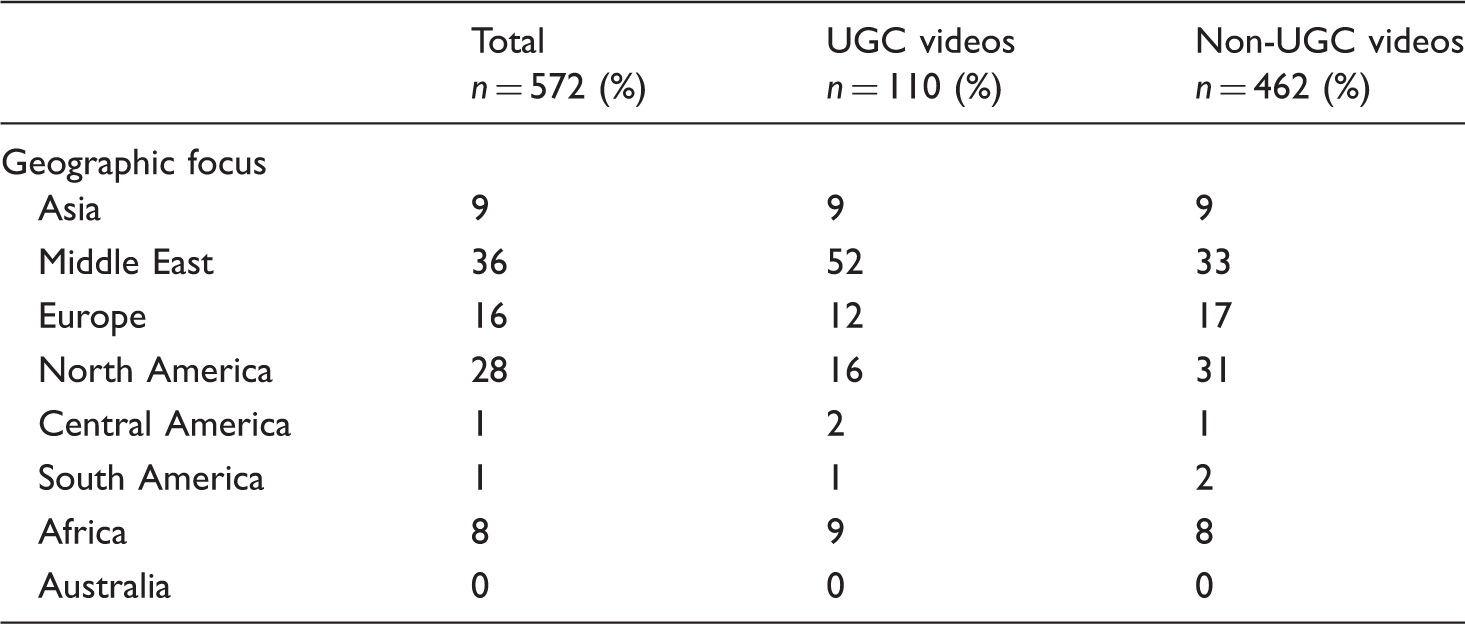
The second research question asked where the UGC that was utilized focused geographically, and if it took a ‘hard’ or ‘soft’ news approach. The overwhelming majority of the content that included UGC was coded as hard news (87%, n = 95). Breaking that down by news organization 83% (n = 33) of Al Jazeera’s stories, 88% (n = 15) of Al Arabiya, 82% (n = 18) of CNNi, 95% (n = 18) of France 24 English, and 92% (n = 11) of RT were hard news.
Geographic focus of videos with and without UGC.
UGC: user-generated content.
χ2 = 19.5, df = 7, p = .007.
The third research question asked what form the UGC took, ranging from ‘voice over’ video to news agency-produced packages. A substantial 67% (n = 74) of stories that incorporated UGC used audio or video contributed by nonjournalists. In 31% (n = 34) of the cases, still photos were used. Perhaps most revealing is that only 9% (n = 10) included a viewer-produced commentary, and only 1% (n = 1) used a completely viewer-produced iReport in a package format. Meanwhile, 69% (n = 76) included UGC material incorporated into a report produced by the staffs of the five channels.
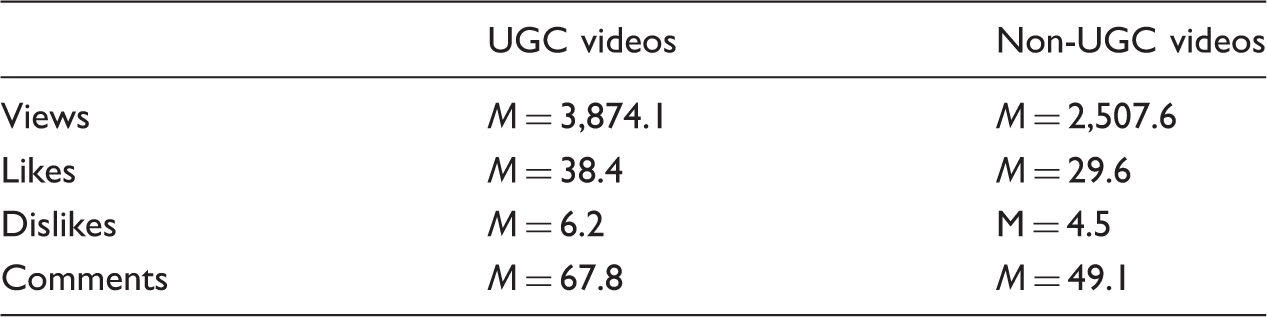
Differences in the mean number of views, likes, dislikes, and comments between videos with and without UGC.
UGC: user-generated content.
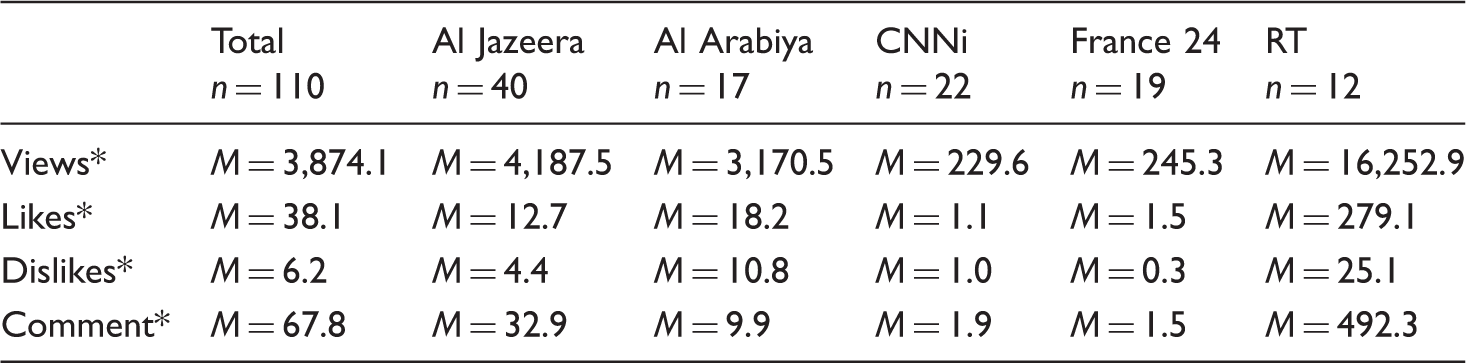
Differences in the mean number of views, likes, dislikes, and comments between UGC videos from the five news channels.
CNNi: CNN International; RT: Russia Today; UGC: user-generated content.
Differences among channels significant, p < .01.
Discussion
This study revealed that less than 20% of the YouTube content of these international news organizations included UGC. Previous studies found that UGC in local U.S. news websites was primarily ‘fluff’ content (Cleary and Bloom, 2011), but that did not seem to be the case for international operations. Of the UGC that was present, much was hard news in nature and primarily focused on the Middle East. Most of the UGC that was used was audio, video, or still photos provided by citizen journalists. There were very few fully viewer-produced reports or viewer-provided commentaries, lending further support for Harrison’s (2010) notion that legacy newsrooms are much more comfortable using UGC as part of a station-produced report, and indicating a reluctance to give too much prominence to nonstaff reporters.
It would seem intuitive that UGC would be an increasingly important part of the international journalism landscape, but that did not prove to be the case among these five different international news organizations. For the most part, UGC built on the tools of legacy media—packages, video, photos—was rare in this sample, with the exception of one story: the conflict in Syria. In that case, each organization occasionally used UGC to supply cell phone video of the war, but otherwise, the studied news organizations relied almost exclusively on their own reporters (or contracted freelancers) to report stories.
Further, the news organizations did not encourage their viewers to provide UGC, at least not in the video presented on these five YouTube channels, although it is possible that the organizations issued such calls to action in content that was not represented in these segments. Some of the news organizations—Al Jazeera English, France 24 English, and CNNi—occasionally displayed viewer tweets, which could be seen as implying encouragement of a kind of UGC. Also, no guidelines related to content or production standards were ever presented by any of the organizations in regard to submitting UGC.
It may not be surprising that so much of the UGC that was found in this study is tied to news events about conflict, especially given the implications of the situation in Syria and the attack on the mall in Kenya. It is difficult to cover a geographically spread out series of events with a small crew of journalists which is the situation faced by nearly all international news organizations, including these five channels. In the case of the Syrian chemical weapons attacks, and the attack on the Kenyan mall, events occur where the traditional press may simply not be present or able to gain access at the moment of the event.
Hand in hand with the lack of solicitation of UGC in general was the lack of admonitions to potential citizen reporters to be careful in gathering content. In domestic news coverage where UGC is solicited—such as with natural disasters—it is common to hear the anchor caution viewers to be careful in shooting video if danger might be imminent. Since much of the UGC used in the international coverage was taken from dangerous situations such as wars, it would seem that there might be similar verbal cautions issued, but the researchers saw no such activity from any of the reports.
Because these five channels work under various business models, and with varying levels of funding from the governments of the countries they originate in, it is important to consider whether there is some impact on their editorial choices as a result of those ties. The phenomenon of the ‘CNN Effect,’ a theory that some scholars have suggested takes place when major news organizations focus on international issues (Gilboa, 2005; Kogen and Price, 2011; Robinson, 2002; Strobel, 1996), might be affected by the inclusion of more content originating with those working outside their corporate structure. This introduction of ‘citizen journalists’ producing UGC could have additional implications for traditional gatekeeping theory.
This study followed a broad definition of UGC, including examples of ‘citizen journalist’ roles for viewers, as well as measuring interactivity through the ‘comments,’ ‘likes,’ and ‘dislikes’ features routinely offered on YouTube. However, there were no examples found among the five news channels where they encouraged viewers to even do that. In short, no efforts were made to bring ‘users’ more actively into the process.
So, why are international news organizations not relying more on UGC? The findings in this study mirror what studies of domestic news organizations have found: meaningful UGC has yet to become an integral part of journalism. In the U.S., studies of domestic news organizations (Cleary and Bloom, 2011; Thurman, 2008) have shown that solicitations for UGC tend to either focus on the frivolous—i.e., pleas to send in ‘Your big ole fish photos’—or limited images of breaking news stories such as weather disasters (Cleary and Bloom, 2011). It does not appear that international news organizations are doing any more to live up to the potential for the audience becoming a more active part of the journalistic process. For example, a story featured on France 24 English about life in Soweto a generation after the official end of apartheid in South Africa relied entirely on a traditional journalist to tell the story, rather than giving the featured citizens the opportunity to shoot and tell the story in their own words. There were ample examples of this kind of potentially missed opportunity.
Additionally, some journalists at traditional news organizations (Harrison, 2010) have expressed suspicion about the efficacy of UGC, and that could be at play here as well. The gatekeepers at these news channels may be of a split mind on how much they want to encourage content that they have little opportunity to vet. Likewise, with most channels that did use some UGC, the acknowledgments of UGC were subtle, if not completely nonexistent. There were a number of stories where it appeared that some of the content might actually be UGC that had not been clearly identified. Whether it was because of the production values or the content, it appeared that some of the stories featured material that had not been contributed by professional journalists.
It could be that the ‘evergreen’ nature of the content that appears on the YouTube channels—the fact that it may be accessed by viewers, days, months, or even years after it was posted—may have contributed to the relatively lower level of solicitation of UGC and interactivity. Specifically, if the programmers believe that the viewing of the YouTube channel content could be well past when the featured event has resolved, they may decide to not put much effort into asking those viewers to contribute content because it would be ‘old news’ by the time the potential UGC was submitted. On the other hand, if UGC was being routinely included in a news organization’s efforts, it seems that it would be reflected in the stories the channels chose to prominently feature.
It is perhaps somewhat surprising that YouTube—a platform that is, by nature, a participatory forum—does not more actively solicit viewer interactivity. There were consistent ‘likes,’ ‘dislikes,’ and ‘comments’ opportunities attached to every video, but no additional written or verbal encouragement for viewers to contribute video, photos, on camera comments, etc. Since these are the YouTube channels for these legacy media outlets, it would seem intuitive that the news agencies would want to showcase their own work. However, not aggressively soliciting viewer contributions seems to be circumventing the two-way flow opportunities for audience involvement. Perhaps the editors assumed that YouTube viewers already know they can contribute content to news organizations, but it was not emphasized on their YouTube channels. It seems to be a missed opportunity.
The presence of UGC did not appear to have an effect on interaction, but it seems that interaction depends on how each news organization brands itself on YouTube, and how controversial their selected content is. RT had the most interaction probably because it is anti-American and that is a common theme throughout their videos. Al Jazeera English and Al Arabiya were second and third in terms of interaction. Because they are news organizations from the Middle East with sometimes limited distribution on venues in the United States, they utilized YouTube to reach an international audience and to brand themselves globally. Also, all three organizations (RT, Al Jazeera English, and Al Arabiya) are fairly new, so YouTube was important to them as an alternative path for reaching a global audience.
CNNi and France 24 had the least amount of interaction. Both organizations are older, more established in a ‘traditional’ journalistic model, and somewhat less controversial than the other three. They have already established themselves as international news leaders so YouTube is a somewhat less important platform for disseminating their content and not necessarily as important to branding their organization.
In the 571 YouTube videos that were analyzed, there were very few examples of viewer-contributed UGC beyond expressions of ‘interactivity.’ France 24 English did offer a compilation piece drawn from web and social media sources and titled ‘Web News’ that incorporated UGC and social media content related to various stories. Reports included full screen graphics featuring tweets, still photos, and Google Map content. While they did not solicit additional similar content, this segment was a prominent use of UGC and offered the reporter a chance to talk about stories that were ‘trending’ in areas around the world. Also, a debate format program on France 24 English did occasionally solicit viewers to send tweets expressing their opinions and posing questions to on-set guests. Overall, these examples were scarce and were not coded as part of this study.
Even in the best of financial times for journalism, when there were many more international news bureaus throughout the world, news organizations could not be everywhere at every critical minute. However, part of the promise of UGC is that if the pool of potential journalists includes everyone with a cell phone, the ability to provide eyewitness journalism from around the world is dramatically increased. Modern technology potentially allows someone who would have once been just a witness to a news event to become a ‘citizen journalist’ when news happens. In a time of dramatic decreases in staffing and shrinking of economic resources, the appeal of UGC for international news organizations might appear obvious: they could seemingly utilize the benefits offered by technological advances to allow citizens to more fully participate in the news gathering process. It would appear that increasing the ‘boots on the ground’ through citizen journalists would provide the ability to gather more news more cheaply and be a ‘win-win’ for international news organizations. It could also help defray the formidable economic challenges faced by international news channels in gathering the news (Baisnèe and Marchetti, 2010) and increase the variety of viewpoints represented on these international news channels. However, more than a decade after the Massey and Levy study (1999) in which they noted that newspapers by and large did not take advantage of the opportunities for the audience to contribute meaningfully to the content, it would appear that that little has changed in this aspect of journalism.
While an increase in UGC by news agencies could potentially shift the traditional gatekeeping dynamic between legacy media and ‘the audience,’ it still appears that this is not happening on an international stage in any meaningful way. True, a few high profile cases of important UGC have occasionally shifted the dialog, such as the video of ‘Neda’ dying in the streets of Iran. By and large however, it has been used in only limited ways or not at all. It will be important to monitor whether this changes over time.
Limitations of the study and suggestions for further research
In retrospect, it would have been useful to have a ‘multiple locations’ option on the ‘location’ variable since some stories had relevance for a number of countries and regions. Given that this is a study focusing on international news channels and their coverage, this is not surprising. For example, France 24 offered a number of pieces that grouped topics together thematically rather than just geographically. This might have given a more accurate view of the scope of coverage by these international news channels.
It would be interesting to directly compare the YouTube channel content with concurrent Twitter output by the same news organizations to see if the choices and areas of emphasis are similar. Further, it would be useful to compare the actual UGC content between news channels to see if there is overlap.
Footnotes
Funding
The author(s) received no financial support for the research, authorship, and/or publication of this article.