




Abstract
The notion of globalization has yielded a rich literature, both scholarly and popular, that reveals the highly contested nature of the meaning of the term. This article focuses on Wikipedia as one of the most popular reference sites worldwide, and compares, through computer-assisted text analysis and qualitative reading, entries for the word ‘globalization’ in six major Western languages: English, German, French, Spanish, Portuguese, and Italian. Given Wikipedia’s model of open editing and open contribution, it would be logical to expect that definitions of globalization across different languages reflect variations related to diverse cultural contexts and collective writing. Results show, however, more similarities than differences across languages, demonstrated by an overall pattern of economic framing of the term, and an overreliance on English language sources. Our findings support some scholars’ arguments about the inherent ambiguity of the idea of globalization, and highlight broader questions of linguistic, technological, and cultural hegemony.
Introduction
This article inquires into degrees of cross-cultural harmonization and common discursive framing of concepts related to the notion of globalization in Wikipedia (WP). As one of the 10 most visited websites in the world, with more than 30 million articles in over 287 languages, WP represents an increasingly popular reference tool across the globe.
Our article intends to make a contribution to the vast literature on globalization, as well as to the emerging literature on WP, by comparing WP entries in multiple languages for the term ‘globalization.’ This constitutes the first phase of a multilayered project that will also explore a group of notions related to globalization, including glocalization, cosmopolitanism, universalism, localism, particularism, multiculturalism, hegemony, colonialism, hybridity, identity, interdependence, and sovereignty. While glocalization and some of its associated terms have not been recognized as the most disputed WP entries, controversy over the definition and scope of those notions has sustained a considerable scholarly production to date (Al-Rodhan and Stoudmann, 2006; Van Der Bly, 2005). To what extent is it possible to identify, however, similar struggles over the meaning of globalization within the open and plural context of WP?
Through a two-pronged approach combining qualitative and computer-assisted text analyses, this study identifies and compares association patterns among the most recurrent words in the WP entries for the notion of globalization in six different Western languages (English, German, French, Spanish, Portuguese, and Italian), the most significant on WP by volume and influence also historically linked to the idea of globalization itself, in particular because of the role played by Western Europe in that process, through areas of influence (not only geographical, but also technological and cultural). By doing so, we seek to unveil differences and commonalities in the way that some of the largest linguistic communities articulate the idea of globalization within the collaborative but also potentially contested domain of WP. Results from this pilot study shed light on some of the cultural and historical factors intervening in the social construction of meaning over the elusive, yet omnipresent concept of globalization.
Theoretical framework: Defining globalization and hegemony
Attempts at defining globalization have resulted in an extensive, multidisciplinary, and frequently conflictive literature (Al-Rodhan and Stoudmann, 2006; Kilminster, 1997; Van Der Bly, 2005; Walck and Bilimoria, 1995). Although many authors seem to coincide in recognizing the complex and multidimensional nature of the idea of globalization, they generally ‘solve’ the challenge of generating a comprehensive definition by delimiting instead the scope of the field in which they propose their own articulation of the term. The net result, however, is the current situation of epistemological fragmentation that characterizes globalization theory, in which definitions of the phenomenon range between very discipline-based formulations with little capacity for extrapolation to other fields (see, e.g., OECD, 2005), or very broad constructions containing mutually contradicting or vague categories that frequently impossible to operationalize (Ritzer, 2004).
Examples of the first end of the spectrum can be found in economic definitions that seem to have fared better than propositions by other disciplines in ‘colonizing’ the field of globalization theory, with seminal categories and terms that have permeated lay persons’ and nonspecialized discourses on the subject (Hall, 2000; Kohr, 1995). On the other end of the spectrum, represented by broader definitions of globalization, examples abound in the disciplines of sociology, anthropology, history, politics, and communication, including the early formulation by Albrow (1990: 9): ‘globalization refers to all those processes by which the peoples of the world are incorporated into a single world society, global society,’ and a more recent one proposed by Al-Rodhan and Stoudmann (2006: 5) after an extensive review of the literature on the subject: ‘globalization is a process that encompasses the causes, course, and consequences of transnational and transcultural integration of human and non-human activities.’
In an examination of different definitions of globalization, sociologist Martha Van Der Bly (2005) identified three major dialectics underlying most conceptualizations of globalizations: (1) ‘globalization as a condition’ versus ‘globalization as a process,’ (2) ‘globalization as a reality’ versus ‘globalization as futurology,’ and (3) ‘one-dimensional globalization’ versus ‘multidimensional globalization.’ In the first dichotomy, the major perspectives confronted are those of authors who assume globalization as an empirically measurable situation ‘rooted in the here and now of modern life’ (Van Der Bly, 2005: 880), and those of authors who understand globalization as an unfolding phenomenon whose precedents can be located in different points of human history. The second dichotomy distinguishes between observers who focus on the contemporary and measurable manifestations of globalization, as opposed to those who are more concerned with forecasting its direction (i.e., trends) and the outcomes of such direction. Lastly, the third dichotomy differentiates literature that reduces globalization to the strict confines of one discipline or one specific set of transborder activities from literature in which globalization is associated to a wide array of manifestations, activities, and fields, usually without well-defined common identifiers.
After exploring the advantages and shortcomings of definitions of globalization located at each side of these dichotomies, Van Der Bly (2005) argues that we must recognize the quintessentially ambiguous character of the term. She then proposes that we pursue clarity on the matter, no so much by seeking a conceptual uniformity that may lead to determinisms and neglect of human agency, as by embracing any of the dialectical dynamics described above when articulating our own understanding of globalization. The author highlights these dialectical dynamics ‘…in a Platonic rather than a Hegelian sense: as a method to acquire knowledge by interrogatory dialogue, rather than as a process whereby contradictions are overcome through synthesis’ (Van Der Bly, 2005: 876). Given WP’s structure as a plural, collective, and open space for the construction of popular knowledge, we deem Van Der Bly’s proposed strategy to better understand globalization a valuable one. We find particularly useful her recognition of competing discourses in the process of framing the subject, as such recognition allows us to locate different formulations of globalization in WP across different Western languages at different sides of the dialectics described above.
Finally, some basic considerations of technological, intellectual, and linguistic hegemony inform the interpretation of results emerging from our analysis, as our data reveal important disparities in the length and unique terms employed in articles about globalization and related notions in the English, German, French, Spanish, Portuguese, and Italian versions of WP.
Hegemony is a relevant concept for analyzing social communications (Gramsci, 1995; Philipson, 1992; Wexler and Whitson, 1982) as it is connected to symbolic power and the prevalence of certain modes of interpreting the world that are, nonetheless, in a constant process of discursive negotiation. The general consent that historically emerges from the position, prestige, and function of a dominant group maintains the status quo and also reproduces disruptions that are ‘naturalized’ in an attempt to avoid the system’s breakdown.
Anglo-Saxon cultural hegemony, in particular American, is closely related to English linguistic supremacy in dialectic interaction with knowledge, both scientific and popular, and also with technology as a correlated field (Ensslin, 2011). English is the dominant language in Wikipedia (2017) with more than five million of articles and the dominant language in the web with more than 800 millions of users (Internet World Stats, 2016). English supremacy not only concerns contents in this language but also applies to contents in other languages through vocabulary, sources of knowledge, information resources, and discursive logics, among other aspects. Wiley (2000: 113) suggests that this kind of power may lead to broader forms of intellectual conformity. Linguistic hegemony is achieved when dominant groups create a consensus by convincing others to accept their language norms and usage as standard or paradigmatic. Hegemony is ensured when they can convince those who fail to meet those standards to view their failure as being the result of the inadequacy of their own language.
While exhausting the complexities of cultural, linguistic, and technological hegemony is beyond the scope of this report, it is important to recognize their interpretive value in understanding the results emerging from our analysis. ‘From a discourse analytical and sociopolitical point of view it is tempting to study the relations between discourse structures and power structures more or less directly. This will often be effective and adequate’ (Van Dijk, 1993: 250). The connection between language and culture is quite complex and it has gained the attention from intellectuals—in the sense of Gramsci (1995)—across times. The very process of globalization is rooted in the historical course of actions that led to the emerging of the nation-states in Western Europe, the expansion of capitalism, and the construction of a cultural hegemony through areas of influence around the world, eventually all integrated by the power of markets. In the battle for leading this process, English emerged as a dominant language based on the economical, territorial, military, and technological power of the United Kingdom first and later of the Unites States. The notion of globalization itself is constantly influenced by discursive and cultural mediations involved in the dynamics of power and international relations. As Gramsci (1995: 450) stated: The whole of language is a continuous process of metaphor, and the history of semantics is an aspect of the history of culture; language is at the same time a living thing and a museum of fossils of life and civilizations.
Theoretical framework: Framing and frame analysis
The identification of major themes in a text through dual methodological approach—quantitative and qualitative—is one of the ways in which assumptions about framing can be inferred. As a number of authors in the fields of political science, communication, and rhetoric have tried to engage in systematic explorations of discursive constructions, frame theory and frame analysis have gained increased attention in recent decades (David et al., 2011; Vliegenthart and Van Zoonen, 2011). Framing is defined as the practice of [selecting] some aspects of a perceived reality and mak[ing] them more salient in a communicating text, in such a way as to promote a particular problem definition, causal interpretation, moral evaluation, and/or treatment recommendation. (Entman, 1993: 52)
Contextual framework: Defining WP as a discursive space
WP focuses on concepts and knowledge built around them. Conceiving WP as a space for discursive constructions is connected to the permanent unfinished status of the platform, in continuous change with the help of several users, assembling information in a growing scale. (O’Sullivan, 2016: 93–105). Mediawiki, the software beneath WP, run by the Wikipedia foundation, allows constant online interactions, including arbitrations and watchdog functions. As the software is quite self-explanatory, open participation from anonymous users is frequent, but WP supports a hierarchical contribution system encouraging a well-organized discursive community. Active registered users get the right to elect and being elected as administrators, who act as gatekeepers of discourse. The structure behind WP is complex and full of positions with sometimes overlapping responsibilities. Authors are in charge of writing, often within specialized area and can have their own personal page; visualizers make illustrations and graphics; cleaning staff help with the editing process, the organization, and the quality of contents; troll hunters block any attempt of attack on that matter; arbitrators solve disputes over problematic themes; helpers are in charge of aiding new participants on the platform; reviewers or classifiers are respected and ranked authors who approve contributions and banned hoaxes (Kumar et al., 2016); administrators are leading authors entitled with special rights as to protect entries and forbid their edition in extreme situations; bureaucrats can revoke rights given to administrators and even change a WP user name, which means they are very powerful actors in WP hierarchy. At the top we found the stewards, in charge of national WP versions. Outside the platform structure we found developers for software, which is open source, and a back office that takes care of communication and public relations (Staub and Hodel, 2016: 350–351).
Initial reservations about the reliability of WP’s content have partially subsided, in light of growing evidence of the effectiveness of its open and expedient process of editing—a process that pits the power of crowdsourcing and collaborative construction of knowledge against traditional ideas of expertise and authoritativeness (Benkler, 2011; Chesney, 2006; Messner and South, 2011; Shirky, 2010, 2008). This validation has occurred in spite of some observer’s recent questioning of WP’s internal vetting of editors and contributors (see, e.g., König, 2013; Mattus, 2014). Still, WP’s vindication of the ‘wisdom of crowds,’ which is supported by processes of plural revisions and open review, is far from guaranteeing epistemological consensus, and from being free of power dynamics or cultural biases (Brake, 2014; Ensslin, 2011). For example, a number of recent studies have addressed content controversies in WP (commonly known as ‘edit wars’), by mapping the location of conflicts within larger linguistic communities, and by identifying specific topics that are subject to the most intense debates within each language’s edition of the online encyclopedia (Fullerton and Ettema, 2014; Yasseri et al., 2012).
Methods: Framing globalization in WP
To explore framing of globalization in WP across the languages selected for this study, English, German, French, Spanish, Portuguese, and Italian we decided to complement an interpretive reading of the articles about globalization in that site with a computer-assisted text analysis. These languages were selected as they are the most important ones in terms of volume on WP historically related to the concept of globalization, culturally and historically speaking. English is on the top of the list with more than five million articles on the platform, followed by German (more than two million), French (more than 1.8 million), Italian (around 1.37 million), Spanish (around 1.34 million), and Portuguese (over 0.97 million) (Wikipedia, 2017).
The software CatPac®, by the Galileo company, facilitates the identification of the most frequent meaning-bearing terms (i.e., no prepositions, conjunctions, pronouns, etc.) in an text without the need to predefine search and coding parameters, thus minimizing researchers’ interventions in an initial phase of data collection (Gil-Egui et al., 2010; Stewart et al., 2006). The software also reveals association patterns among the most frequent terms in a text, which generally indicates the presence of themes or frames (Woelfel, 1993; Woelfel and Murero, 2005). The software does the latter by generating both dendograms of hierarchical clusters (i.e., major and minor groups of terms) and, with the help of an additional application called ThoughtView®, multidimensional scaling (MDS) maps showing distance between clusters of words. The closer two or more clusters appear to one another in the maps, the more likely they represent related themes or frames in the text (Woelfel, 1993; Woelfel and Murero, 2005)
The list of frequent words, dendograms, and MDS maps created by our computer-assisted analysis is not, however, sufficient to offer an overall sense of the ‘forest’ comprised by the individual ‘trees’ of each analyzed WP entry. Therefore, we combined these data with a qualitative reading of the WP articles on globalization in English, German, French, Spanish, Portuguese, and Italian. The authors have basic competencies in all the languages except German, for which the help of a fluent speaker in that particular language was sought.
The results cover the following items: extension of entries or articles, bibliographical sources of articles, predominant frames, identification of frequent words, clusters from MDS map and qualitative reading, positions toward globalization, and overall perspective of discourse.
In the case of this project, we sought to determine how the concept of globalization is framed by decentralized and uncoordinated teams of contributors in different linguistic domains, by identifying the themes and terms being highlighted in the WP entry for that particular word in six Western languages. The articles were all downloaded on the same date (5 April 2016). The latter is an important consideration in the case of dynamic web content such as that of WP, where entries are open to constant editing and change by multiple and anonymous contributors.
As a first step to unveil the dynamics of discursive construction of Globalization on Wikipedia as a collective knowledge space, this work is not intended to be diachronic, although we acknowledge the importance of remarking the historical and continuous process involving discursive practices in particular within our case study.
Results: Globalization as a hegemonic discourse
For this first stage of our project, focused initially on the term ‘globalization,’ our computer-assisted analysis revealed more similarities than differences across the articles that WP dedicates to the concept in the six Western languages selected for this study.
Recurrence of most frequent words and its corresponding translations, identified in each language’s Wikipedia article for the term Globalization.

Beyond the initial mapping of term coincidence in Table 1, the individual computer-assisted analysis of each article on globalization in each of the six languages evidenced a common presence of economic terms that appeared grouped as distinctive clusters of words when mapping the association patterns of the most frequent terms in each case. This suggests that, regardless of the general orientation of the discussion about globalization in each language in WP, the presence of an economic frame (whether central or not to the overall sense of the article) is common across every language.
Despite these immediate similarities, a number of additional frames and interpretations emerged when combining the results of the computer-assisted analysis for each article with a qualitative reading of them, as summarized in the following paragraphs.
English (globalization)
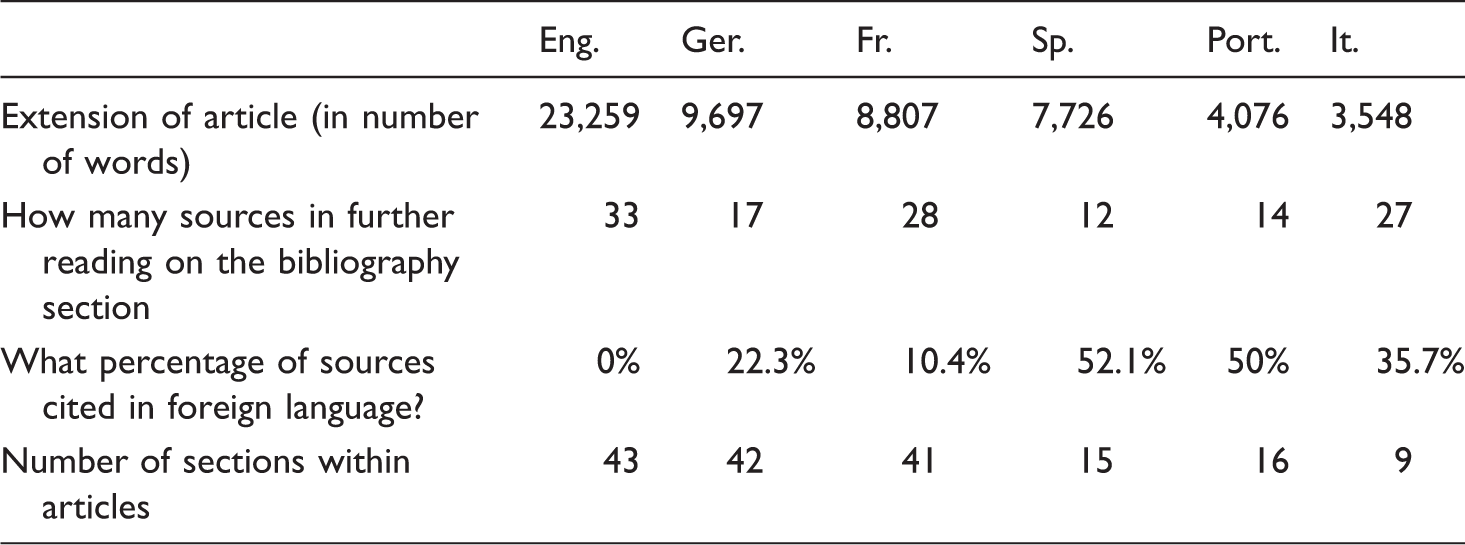
With an extension of 23,259 words as of 5 April 2016, this article is substantially longer than the articles for the same term in other languages (we found the one in German to be in a distant second place, with 9,967 words). Additionally, this is the article with the largest list of bibliographical sources (a total of 33, against 28 of the article with the second largest bibliographical list, in French), none of them in any other language. Despite its extension (which might suggest complexity or multiplicity of perspectives), both the analysis with CatPac and a qualitative reading of this article showed a prevalence of economic frames.
While identification of the 19 most frequent words in the text only reveals five terms (economy, development, trade, capital, and growth) that constitute unequivocal economic references, the MDS map of the association patterns for the most frequent terms shows three discrete clusters. The first one contains the words ‘capital,’ ‘countries,’ ‘trade,’ ‘people,’ ‘states,’ ‘economic,’ ‘international,’ global,’ ‘world,’ ‘united,’ and ‘nations,’ which suggests a theme focused on transborder commerce. The second cluster of terms includes the words ‘anti,’ ‘tax,’ ‘free,’ ‘developing,’ ‘human,’ and ‘development,’ thus signaling a possible theme in connection with broader challenges to globalization. This interpretation is corroborated by a qualitative reading of the article, which at some point discusses negative and controversial aspects of globalization, such as tax havens, international organized crime, and human trafficking, all nevertheless addressed from an economic point of view. The third cluster is a loose collection of three words that suggest an alternative theme to the other two: ‘social,’ ‘movement,’ and ‘growth.’ Our qualitative reading of the article allowed us to identify some sections discussing criticism of globalization and initiatives to oppose it. However, the overall sense of the article confirms the prevalence of an economic perspective throughout the text. Moreover, globalization is explicated as an almost unavoidable process with precedents in colonial conquests and trading, but still unfolding today, in ways that affect every aspect of human experience.
German (globalisierung)
The second longest WP article on globalization among all the languages explored for this study (with 9,697 words) presents the most unique approach to the subject, as revealed by both through the computer-assisted analysis of the text and a qualitative reading of it. By references the entry is in fourth position, with 17 sources quoted. A noteworthy fact about the German article is its reliance on mostly German language sources for citations in the text, unlike the case of the entries in Spanish, Portuguese, and Italian. Unlike entries in other languages, economic terms do not dominate the list of the 19 most frequent words in this particular article. Rather, a number of these recurrent words seem highly descriptive and semantically neutral: ‘year,’ ‘indicators,’ ‘facts,’ ‘number,’ ‘concept,’ ‘world,’ and ‘time.’ Accordingly, the MDS map of association patterns for frequent terms in the article shows a very distinctive cluster integrated by the words ‘education,’ ‘fact,’ and ‘number,’ which emerges from the constant references to external sources in all the sections of the article. The other three clusters of terms (which, judging by their proximity to one another, are not as a discrete as the first one) show a mix of the neutral terms listed before with words connected to sociopolitics, economics, and global development, respectively. Despite having a section dedicated to explore connections between globalization and colonialism, this article frames globalization mostly as a contemporary condition with multiple yet generally measurable dimensions. In explaining some of the different dimensions of the phenomenon, this WP entry presents evidence that substantiate both ‘pro’ and ‘con’ arguments regarding transnational flows of goods, people, technology, culture, and power, in dynamics that implicate individual, organizational, social, national, and multilateral actors.
French (mondialisation)
The article contains 8,807 words, third place in extension among the entire cases of analysis. This is the only language in which a direct translation of the term globalization redirects readers to another term (mondialisation). This contestation over the ‘correct’ noun is explained at an early point in the article, as mondialisation preceded the coining and popularization of term globalization, and emerged as an approach to modeling world integration and interdependence. The list of bibliographical sources comprises 28 references, being the second largest among the six languages analyzed.
The theoretical discussion as to the origins and scope of the notion of globalization is reflected by the computer-assisted analysis of the article, which shows a combination of economic and noneconomic terms in the list of the text’s 19 most frequent words.
The MDS map of association patterns for those frequent words shows three clusters of terms: one extremely tight group of words that refer to market forces as generators of differential levels of development; a second, more loose cluster comprising terms about the roles of culture and states in phenomena of inclusion/exclusion of different population within globalization processes; and a third, tight cluster discussing globalization as a dual force of homogenization and diversification.
In fact, a qualitative reading of the article corroborates a tone of contrast throughout the text, in which two visions of globalization are presented (either as a unifying trend of economic convergence or multidirectional flows of people, goods, and practices, with multiple and unpredictable consequences). In this dual approach to globalization, the French article in WP proposes several criticisms to hegemonic pressures embedded in free trade formulas championed by the U.S., as well as to the ‘linguistic imperialism’ embedded in the technological dominance of the U.S., especially through the Internet. Much of this criticism is possible because of a dominance of French authors in the list of references cited in the article. Still, in a similar fashion to the English article on globalization, the French one sees this phenomenon as an unfolding process, although fraught with more contradictions than those present in the Anglo version.
Spanish (globalización)
The Spanish article for globalization in WP (7,726 words) is somewhat comparable in extension to the French entry (8,807 words), as of 5 April 2016. And in a similar fashion to the French article, the Spanish entry begins with a discussion as to whether the term ‘mundialización’ is more appropriate or not than ‘globalización,’ even though the latter has been accepted for years by the Royal Academy of the Spanish Language, and the former will only be included in the Academy’s dictionary in the 2015 edition. The Spanish entry is the least generous with bibliographical references, with only 12 of them, with most of the references cited being in English. Another commonality with the French article is the dialectical tone that dominates the Spanish entry, mostly with respect to the interplay of economic and political forces in globalization processes. Thus, the advance of ‘liberal democracy’ and ‘democratic capitalism’ are seen as the main cause of globalization, that is, an increasing blurring of boundaries between market forces, liberal ideologies, and representative government systems worldwide. Not surprisingly, the results of the computer-assisted analysis of this article show a mix of economic and political terms in the list of the text’s 19 most frequent words. This same mix is also evident in three of the four clusters of terms unveiled by the mapping of word associations, except for one loose group of terms that is exclusively economic in nature: ‘commerce,’ ‘free,’ and ‘market.’ Whereas these clusters reveal an interpretation of globalization from a framework of political economy within the WP article in Spanish, a qualitative reading of the text also shows an understanding of the same notion as an ongoing phenomenon characterized by tensions, disparities, and contradictions.
Portuguese (globalizaçao)
For a relatively short entry (4,076 words, against the 23,259 of the English one), the Portuguese article in WP for globalization presents the most names of individual authors as distinctive sections discussing theories on the subject. Interestingly, the text shows no correlation between the diverse number of theories by different authors it discusses and the lack of diversity of the sources it uses for in-text citations, in which 50% of the references (of a total of 14) pertain to a few, yet repeatedly used English language sources.
While the description of these theories is intended to provide a sense of the multiple aspects of globalization and the different perspectives though which the concept has been explored, a generally deterministic tone seems to prevail in the article—one that frames globalization as an inevitable consequence of the spread of communication technologies and more efficient means of transportation. Consequently, and according to the article, new hubs of international exchanges are emerging beyond the traditional core nations of the Western hemisphere, e.g., that integrated by growing Asian economies, and the one constituted by the so-called BRIC nations (Brazil, Russia, India, and China).
Tellingly, the words ‘access,’ ‘communication,’ and ‘Internet’ appear among the most frequent terms detected for this text by our computer-assisted analysis, although the same terms are absent from the results of articles in other languages. The MDS map for this entry shows three major clusters of terms: (1) one combining the names of well-known scholars (Stiglitz and Conversi) with terms that suggest discussion of globalization in historical perspective (‘global,’ ‘process,’ and ‘war’); (2) a large group of words comprising two subclusters of mostly socioeconomic terms (e.g., ‘development,’ growth,’ ‘people,’ ‘world,’ ‘market,’ ‘access,’ ‘Internet’ and, remarkably, ‘China’); and (3) a very tight cluster of terms that suggests framing of globalization as a spatially and temporally located phenomenon of flows (‘communication,’ ‘economic,’ ‘nations,’ ‘countries,’ and ‘century’). In sum, globalization is highlighted in the article as a complex process that is still evolving (regardless of conflicting theories about its origins), but that is also inevitable.
Italian (globalizzazione)
The shortest of all the WP entries on globalization analyzed for this project (only 3,548 words), this article shares with others a claim about the complexity and multidimensionality of the concept (i.e., by briefly touching on benefits and downsides), yet it attaches simple and ‘neutral’ causes to it, namely the expansion of transportation means that have facilitated transnational flows, and the changes brought about by modern information and communication technologies. It is important to note that, despite of its brevity, this article has the third largest bibliographical list (27 sources against the 33 listed in the English article and 28 in the French one), which may help explain the emerging list of frequency words with ‘neutral’ terms. By the same token, the Italian entry in WP for globalization has the second biggest percentage of sources cited in a foreign language (English): 35.7%, only surpassed by the entry in Spanish (52.1% of works cited in English).
Aligned with this qualitative reading of the article, the list of the 19 most frequent words in the article combines a few economic terms with mostly generic ones, such as ‘phenomenon,’ ‘process,’ ‘aspect,’ or ‘effect.’
In a similar fashion to the Portuguese entry, this article also discusses some of the theories advanced by a recognized scholar, and so the list of most frequent words includes ‘Pallavicini,’ given the repeated times that work by Giancarlo Pallavicini is invoked in the text. The resulting MDS map of association patterns among terms shows one cluster that is clearly referential, comprising the words ‘bibliography,’ ‘Pallavicini,’ ‘Rome,’ ‘international,’ ‘global,’ and ‘freedom’ (the latter in allusion to frequently cited works in the article that include the term ‘libertá’).
The other two clusters, which are located close to each other (thus suggesting that they tend to relate within the original text), present a mix of the neutral, argumentative terms mentioned above, along with economic terms and a few sociopolitical ones.
General differences identified in each language’s Wikipedia article for the term Globalization.
Conclusions
The overall patterns emerging from these results indicate that, in regards to framing globalization, and based solely on articles dealing with this individual term, it is possible to identify a trend of ‘consensus within diversity,’ by virtue of which articles in WP about the same term in six different languages show, in general, more commonalities than differences. Nevertheless, we were also able to notice some nuanced distinctions across the six languages sampled for this study, which seem linked to ‘production’ questions, that is, extension of each entry, number and variety of sections within articles, extension of bibliographical list, and plurality (linguistic and epistemological) of the sources cited in the texts.
WP’s lack of an effective system of vetting for the authoritativeness of its contributors, despite its formal hierarchy intended as a filter, has proven to be both its curse and its main advantage. On the one hand, the site’s openness to anyone’s editing has led to both frequent cases of strategic communication (where parties interested in controlling the image of, or debate around a certain subject attempt to introduce and maintain highly biased content) and bitter edit wars over contentious matters. On the other hand, WP’s nondiscriminatory model of content building has come to epitomize the most revolutionary aspect of the World Wide Web: the use of what Clay Shirky (2010) has defined as lay people’s ‘cognitive surplus,’ in the construction of a highly collaborative and relatively accessible source of information. A growing number of observers are noting that today’s digital, open, and collaborative technologies are transforming how expertise is measured, how teaching/leaning takes place, and how knowledge is acquired (Benkler, 2011; Messner and South, 2011; Shirky, 2008, 2010).
WP is certainly at the forefront of those paradigmatic transformations. As an object of study in the field of communication, it can help us to understand the way online practices are subjected to broader cultural, historical, and discursive mediations. Furthermore, the prevalence of a discursive hegemony on the construction of knowledge under an Anglo-Saxon perspective, also in the case of WP, addresses one of the pervasive problem of global culture today as stated by Roland Robertson (1992: 103): ‘the politics of the mutual effort of sameness and difference to cannibalize one another and thus to proclaim their successful hijacking of the twin Enlightenment ideas of the triumphantly universal and the resiliently particular.’ These tensions we found in our analysis confirm the dialectical nature of discourse on Globalization at Wikipedia as space but also the significance of the idea of hegemony to understand this process.
In this context of massive collaborations without strong centralized coordination, however, certain concepts seem to still reflect old epistemological and ideological hegemonies. In the particular case of the notion of globalization, the results from the first round of analyses in our multilayered project about the way this term is framed across major Western languages reveal not only a general prevalence of economic themes and vocabulary to describe a rather complex phenomenon, but also an overall deterministic construction of the notion as a process (i.e., as a multidimensional event that it is still unfolding)—one that is presented as an inevitable reality driven mostly by historical and material forces beyond any real human control. Although we focused on Western cultural contexts these results are consistent with the findings of other authors from an Eastern perspective on globalization being discursively constructed as immutable (Flowerdew, 2002).
Our findings corroborate that one of the three dialectics identified by Martha Van Der Bly (2005) around definitions of globalizations is more frequent than the others when it comes to WP articles about this term across major Western languages, namely the one that poses conceptualizations of globalization as a process against conceptualizations of globalization as a condition. Most of the WP articles that we analyzed (except for the one in German) frame globalization as a process, as they present this situation as a continuum of long-term historical trends, rather than a distinctively modern and measurable phenomenon. Yet in framing globalization as an inexorable phase of history that is currently developing, with a few spaces in the world and a few number of domains of human activity left to still be penetrated by its advance, this way of constructing globalization tacitly limits the role of human agency in shaping people’s future. Granted, most of the WP articles considered in this study dedicate some paragraphs to explore the downsides of globalization and present critical approaches to it. But as both our qualitative reading of those texts and results from our computer-assisted text analysis confirm, these critical instances do not amount to a real counterweight of more deterministic approaches that prevail in the articles, and so they usually represent a mere referential note about the risks of ‘a reality that is here to stay.’
After recognizing the different dialectics that prevent scholars outside the field of economics to reach a consensual definition of globalization, Van Der Bly (2005: 876) suggests embracing ambiguity as the essence of that notion: In fact, the very conclusion of the debate on the definition of globalization could be a fundamental recognition of the impossibility of overcoming contrary concepts, and indeed a possible rejection of the necessity for doing so in favour of an approach of question and response, of dialogue based on mutual equality….
Recognizing the complexity of power struggles and human phenomena implicated by the idea of globalization, we deem it necessary to further expand this line of research beyond the ‘snapshot’ image revealed by this first stage of our project. Thus, future inquiries on the subject will include multipronged and longitudinal analyses of other terms in WP that have been traditionally linked to discussions over globalizations by experts in the social sciences and the humanities. Additional explorations should also provide empirical support to existing theories on the social construction of knowledge and on the sociology of scientific knowledge by studying additional open platforms for content dissemination beyond WP, such as digital and decentralized academic repositories, Google books, YouTube, the Open Access Directory, and Google Scholar, to mention just a few examples.
Footnotes
Declaration of conflicting interests
The author(s) declared no potential conflicts of interest with respect to the research, authorship, and/or publication of this article.
Funding
The author(s) received no financial support for the research, authorship, and/or publication of this article.