



Abstract
This article examines the metaphoric frames in the coverage of the Euro crisis in newspapers across five EU countries. Our quantitative frame analysis identified five dominant frames: war, construction, disease, natural disaster, and game. In all five countries, the Euro crisis as war turned out to be the most prominent news frame. Such framing uses martial, aggressive language to describe the European public sphere. This finding is not without importance, as newspapers play a key role in shaping the general public’s perception of the Euro crisis and by extension the European Union’s institutional elite and its (in)ability to cope with crisis.
Introduction
While the Euro zone is again showing clear signs of economic recovery with a lot of innovation-led jobs being created, the European Union—whose fundamental principle is the free movement of goods, services and people—continues to have little reason to celebrate. Even though the crisis is now considered to be over, debt-stricken Greece still faces inflexible, predatory EU ‘partners’ that are mostly unable/unwilling to agree on ways to make its debt load manageable—and entirely deaf to the plight of its population. The European Union is accustomed to crisis: in addition to its ever-present North-South and East-West divides, Donald Trump’s worrying stance is yet another crisis to cope with, on a par with the war and terror in the Middle East and Africa, the refugee issue, and the uncertain future of Brexit.
Both the sovereign debt problems that have plagued European countries since 2009 and a widespread lack of trust in European leadership have had a huge impact on the global economy as a whole (De Grauwe, 2010). Any confidence investors may have had in European leadership and the health of the global economy has plummeted. Beyond investors, the crisis had brought deep suffering to entire populations, starting with the hardest-hit countries, such as Greece and Spain. However, EU Member States in the North were also faced with its direct effects. Support for the Euro significantly decreased from the start of the Euro crisis: while in 2009, 70% of Eurozone citizens assumed the Euro was a good thing for Europe (European Commission, 2009), this figure had dwindled to 55% (European Commission, 2012) in 2012. Furthermore, in Member States that had not yet adopted the Euro, more than half of the respondents (53%) believed the introduction of the Euro in their country would have had negative consequences (European Commission, 2015).
There has been ample debate about the existence and nature of a European public sphere (e.g. Dahlgren, 2010; de Vreese, 2007; Habermas, 2001; Nieminen, 2008). The ideals and opportunities of such a transnational public sphere create a discourse which promotes social, cultural and political integration in Europe with an eye to advancing the EU’s democratic legitimacy (Trenz, 2010). But language boundaries, cultural and national political and policy differences still prevent the establishment of a unified media system (e.g. Drewski, 2015). Nevertheless, most research on news coverage confirmed an increased salience of European issues in national media (e.g. Koopmans and Statham, 2010), and a certain level of convergence across Member States (e.g. Van Cauwenberge et al., 2009). Against this backdrop, the Euro crisis as a common problem in the minds of all Europeans signalled a crucial moment in the market-driven project of European integration, which had run into a cul-de-sac, fuelling a deepening sense of illegitimacy (Ojala, 2013). This contributed to the emergence of a European public sphere whose main characteristic has been a pessimistic view of a stagnant, underperforming continent since the start of the Euro crisis, 10 years ago. Moreover, in addition to a backlash in normative values fuelled by the ongoing refugee crisis (which has given us the Brexit vote, among other things), the rise of phenomena such as Euroscepticism, populism and xenophobia challenges notions of the emergence of a wider public sphere promoting social, cultural and political integration. In other words, the news coverage of the Euro crisis is both Europeanized and shaped by national orientations (Heft, 2017).
The perception that people have of events depends on the information available and the way it is accessed (Scheufele and Tewksbury, 2007). Not only do the mass media select the issues they report on, they also choose the reporting angle. Journalistic language partly shapes the way people form opinions on European political and economic issues. Typically, in crisis situations, people look for information about causes and consequences with more determination than usual (Coombs and Holladay, 2004). For a majority of citizens, the media are an essential source of information on complex economic issues (Boomgaarden et al., 2011) such as the Euro crisis. Hence, the media serve essential functions in terms of guiding citizens’ attention to issues and directing policy responses (e.g. Castells, 2009).
In this study, we compare the news framing of the Euro crisis in five EU Member States (Belgium, Finland, Germany, the Netherlands, and Spain) whose stances towards Europe and economic situations are very different. The study is based on data from an international, comparative research project that explored how the European press had portrayed the financial and political crisis, as well as the implications of that coverage regarding public understanding of the new developments, their causes, responsibilities for addressing the crisis, and European integration and identity. The project was directed by the Reuters Institute for the Study of Journalism at Oxford University (Picard, 2015).
This article looks at the ways the European press addressed the Euro crisis at the end of 2011, the period when the crisis broke out in all its severity (Joris et al., 2013). It was a time of intense European scrutiny, action and discussion that informed subsequent policy. Furthermore, the results are (still) highly relevant as the Euro crisis shows similarities with other recent crises within Europe such as the refugee issue and the Brexit vote. What these crises have in common is the fact that all EU countries were affected, which made for widespread news coverage in every Member State. The various stances and economic situations of the countries under study might have a similar effect on the news coverage of other crises.
Theory and earlier research
This study analyses the coverage of the Euro crisis based on framing and metaphors. The concept of framing is derived from an assumption that the way a topic is portrayed in the news may affect both its public perception and the importance attached to it (Scheufele and Tewksbury, 2007). The Cascading Activation Theory (Entman, 2003, 2004) states that politicians and other ‘elite’ figures have an influence on the media, and vice-versa. Next, the media decide on the use of news frames in their coverage. Brüggemann (2014) conceptualized journalistic framing practices on a continuum ranging from merely passing on interpretations of a situation (those of politicians, etc.) to actively reflecting the journalist’s personal interpretation (possibly using quotes aligned with the journalist’s own beliefs). This shaping of news items has an impact on the way people form their views and opinions on an issue (Lecheler and de Vreese, 2011). Before measuring the effects of framing, it is important to determine which characteristics of the coverage may induce such effects. We therefore need to study the coverage of the Euro crisis through content analysis, and to determine which perspectives or news frames inform the media reporting.
Although framing has no generally accepted conceptualization (Weaver, 2007), it usually refers to two interrelated processes: frame building and frame setting (de Vreese, 2005). Both processes determine the frame effect (Scheufele, 1999). Frame building is the process through which news frames are constructed, while frame setting refers to the impact of media frames on individual attitudes. Such impact is felt through audience frames. With regard to the media frame, framing refers to the very structure of the message, arrived at through a selection process: each message emphasises or excludes specific elements (Gamson and Modigliani, 1989). In other words, a journalist cannot not frame, a phenomenon Scheufele (1999) calls ‘the macro-construct of the framing process’. Concerning the audience frame, framing refers to the assumption that coverage slant may influence the way the public thinks about the topic (Lecheler and de Vreese, 2011). Consequently, framing defines how receivers use a message in forming an opinion. This process arises at the micro level (Scheufele, 1999). For the purposes of this study, we used Entman’s generally accepted definition (1993: 52): to frame is to ‘select some aspects of a perceived reality and make them more salient in a communicating context, in such a way as to promote a particular problem definition, causal interpretation, moral evaluation, and/or treatment recommendation’.
Metaphors are common figures of speech in the construction of journalistic frames (see Millar and Beck, 2004). Metaphors borrow meanings from another domain to create images in people’s minds, and are frequently used to explain abstract and complicated matters such as climate change, healthcare (e.g. Hellsten and Nerlich, 2010; Schön, 1993) or the economy (e.g. Williams, 2013). Metaphors simplify abstract or complex concepts for readers who may lack the expertise to wade through a morass of highly technical information. Furthermore, a metaphor’s implications slant the view of an issue in a specific direction. Focusing on certain aspects and disregarding others, metaphors solidify specific ways of talking and thinking about issues, and therefore structure both our perceptions of reality and our daily actions (Lakoff, 2008; Lakoff and Johnson, 1980; Lakoff and Turner, 1989). Analysing metaphors lets us uncover some of the political implications behind the news coverage. In other words, a metaphor’s rhetoric power may impact the behaviours and economic decisions of individuals, politicians or institutions (e.g. Williams, 2013).
Previous research (e.g. De Landtsheer, 2009; Hellsten, 2003; Joris et al., 2013) has shown that the use of metaphorical language varies according to the duration of a crisis. In emerging crisis situations both the amount and intensity of metaphors increase, and they decline in calmer periods. Numerous studies have pointed out that the language of economics is highly metaphorical (e.g. Charteris-Black and Ennis, 2001; McCloskey, 1995; Richardt, 2005; Skorczynska and Deignan, 2006; Wang et al., 2013). Common conceptual metaphors in economic language depict the economy as a machine, a work in progress or a patient. A nation’s economy and currency are visualised as liquid (swimming in money, need of liquidity) or as moving in space either up (more, positive) or down (less, negative). Viewed as an activity, a nation’s economy can be framed as journey, sport or war (Richardt, 2005).
Medical metaphors are popular in economic language and were used in classic economic theory as early as the 1600s in parallel with the emergence of modern medicine (Miettinen, 2010). In journalistic parlance, an economy is often presented as a living organism or a human being suffering from various ailments, one of which may be an economic crisis (Charteris-Black and Ennis, 2001; Horner, 2011; Wang et al., 2013), possibly thought of as a virus or global contagion (Peckham, 2013). Common metaphors used in depicting an economic crisis also include war and natural phenomena such as weather changes or natural disasters (Charteris-Black and Ennis, 2001).
Studies of the metaphors pressed into service to describe the current economic crisis have come to similar conclusions. Bounegru and Forceville (2011) studied the coverage of the Euro crisis in editorial cartoons and identified catastrophe/(natural) disaster, illness/death and begging as the most frequent metaphors. Horner (2011) studied public discourse on the 2008 US banking crisis and found such metaphors, whose main characteristic is that they eliminate the human element, portraying the response to the crisis as an emergency measure in the face of an act of God. Looking at the depiction of the 2008 credit crunch in English and Danish economic newspapers, Esager (2011) found many metaphors: movement, liquid (e.g. in a container), living being, medical treatment, war or sports, machine, building, journey, object, and a natural phenomenon. Our study shows similarities with many of the earlier research described above, and adds up to the academic discussion on metaphors of economic crisis.
Our study
Our leading research question is: Which are the dominant frames in the coverage of the Euro crisis in European newspapers?
The project identified five mutually exclusive frames, each with a metaphor at its core: war, disease, natural disaster, construction, and game and sports (Joris et al., 2015). The war frame was the most frequently used, followed by disease, natural disaster, and construction. The least common frame was game and sports. At first, in our preliminary project, deductive analysis yielded rather low occurrences for all frames. So, in a second phase we recoded the entire set of articles from a smaller group of countries to identify the dominant frames for the period in which the crisis was most frequently debated in the press (see also sample description). Therefore, we might expect this study to uncover higher percentages of frame occurrences. We hypothesize: H1: The war frame is the most common frame in the coverage of the Euro crisis, followed by disease, natural disaster and construction. The game and sports frame is the least frequently used frame.
Due to the low number of metaphors found for certain countries—to be ascribed to varying level of sensitivity to such metaphors among the cross-country research teams—the preliminary project’s finding should be taken with caution (Joris et al., 2015). As part of this study, training of the coders was optimized (see intercoder reliability results). Its methodological limitations notwithstanding, the preliminary project did point us in the direction of the dominant frames as defined in this study. H2: Newspapers in stronger economies such as Finland and Germany make extensive use of the construction and natural disaster frames. H3: Newspapers in weaker to moderately strong economies predominantly use the war and disease frames. H4: There will be fewer frames in financial business newspapers in comparison with the other two newspaper types.
Method
Our study’s reliability and validity in terms of frame identification were safeguarded by using simple frame elements, which can be more reliably coded than holistic, abstract frames (Matthes and Kohring, 2008). Each frame element in the news articles belongs to one dominant metaphoric frame and one only. Some articles may feature elements from different frames. This does not conflict with the mutual exclusivity criterion, since it is obvious that at article level, more frames may occur together.
The frames are mainly language-dependent mechanisms related to the use of metaphors. In addition, other clearly perceptible elements in the texts or specific linguistic structures are taken into account (i.e. framing devices, see Gamson and Modigliani, 1989). Furthermore, we also analyse reasoning devices through which the presence of a single frame element can activate a complete chain of reasoning (definition of a problem, causal interpretation, moral evaluation, and treatment recommendations) (see Entman, 1993; Van Gorp, 2010). These reasoning devices reflect the way in which the frame highlights a topic (Reese, 2010; Van Gorp, 2010), which may trigger the underlying set of cultural values and expectations (Lecheler and de Vreese, 2011). In other words, framing does not need to explicitly mention such factors to bring them into play in the reader’s mind.
Sample
Our study focuses on newspapers since in Europe the print media remain the backbone of news production and public debate (Lund and Willig, 2010), bringing information to light and influencing the agendas of other media as well as policy makers. Initial coding of the frames was conducted as part of a larger project on print media coverage of the Euro crisis in 10 European countries. 1 The second phase of the study was narrowed down to five countries: Belgium, Finland, Germany, The Netherlands, and Spain. We selected the countries with the highest frequency in use of metaphoric frames: Spain, Belgium, the Netherlands and Finland. Germany was added because of its important role in European economy and in the Euro crisis. This is a representative sample of the varying degrees to which the crisis has hit EU countries. Spain represents those countries directly affected by the crisis; Belgium and the Netherlands those that have been suffering to a lesser extent, while Germany and Finland are seen as economic strongholds. Germany is the Eurozone’s strongest economy and its de facto leader, while Finland, like other Northern countries, carried out a number of adjustments in their current accounts and public finances before the launch of the Euro and in its first years (Honkapohja, 2014). Furthermore, Finland is the only country in our sample with a public debt lower than 60% of GDP.
The focus of the study was on the major developments of the Euro crisis between 2010 and 2012, which included the responses of European and international bodies as well as the moments when specific intervention occurred. In the first study, 11 pivotal periods were singled out as particularly noteworthy—national events as well as European Summits and IMF decisions. Every article mentioning the Euro crisis in the week preceding and the week following each such event in these eleven periods was coded for a total of 10,492 articles.
Number of articles per newspaper.

Determining the frequency of dominant frames in each newspaper’s coverage required some content analysis. We focused on two major events that occurred at the end of 2011—the apex of the crisis (Joris et al., 2013). All news stories about the Euro crisis that were published in 20 newspapers seven days before and seven days after each event were included in the sample. These two events and their inclusive dates were: - The EU summit of 26 and 27 October—strengthening the stability fund, extending new aid and requiring banks to raise new capital (i.e. 20 October – 3 November 2011); - Berlusconi’s resignation, Monti’s appointment, and French austerity measures (i.e. 5–19 November 2011).
The Mediargus and Lexis Nexis online newspaper databases were used to gather the articles to be studied, scanning for the keywords Euro and crisis (N = 1,319). The coders indicated whether or not a frame element was present in a given article. In other words, for each article, the coder had to indicate the presence or absence of each of the five dominant frames with a simple yes/no answer. This study does not take into account the frequency of a given frame per article. Thus, one single metaphor referring to disease may trigger the entire disease frame with all its reasoning devices, for instance. If several frame elements occur in a news item, this obviously heightens the salience of the underlying frame. However, this phenomenon is beyond the scope of this study.
Coding as part of the deductive analysis was carried out on a completely independent basis. For each article, the following variables were taken into account: name of newspaper, date of publication, article length, and frame absence/presence (0 = absent; 1 = present). Training resulted in high scores of intercoder reliability (Krippendorff’s Alpha) carried out on a sample of 10% of the articles under study (Hayes and Krippendorff, 2007). Overall, the results were good: war frame (α = .84), construction frame (α = .77), disease frame (α = .89), natural disaster frame (α = .87), and game and sports frame (α = .72). Although the average intercoder reliability was high (α = .83), certain sample elements scored lower on reliability. This variance in reliability scores might be due to the fact that some categories appeared less frequently (e.g. the presence of the game and sports frame). Broadly speaking, it does not affect the quality of the research.
Characteristics of the articles
German newspapers (36.1%, n = 476) published more articles about the crisis than their foreign counterparts. In Spain (20.2%, n = 267), Belgium (15.5%, n = 204), Finland, and the Netherlands (both 14.1%, n = 186), print media attention was lower.
In our sample, financial or business newspapers devoted the most space to the Euro crisis, with 76.2 articles on average, closely followed by quality newspapers (n = 75.8). In popular newspapers, the average number of articles (n = 26) was considerably lower.
The length of articles was mostly short (43.9%), followed by medium-sized news stories (less than 500 words) (42.4%). Long articles (more than 1000 words) were less frequent in our sample (13.7%). Article length differed significantly between the types of newspapers, χ22(4) = 26.529; p < .001. Average length (‘Short’ = less than 500 words; ‘Medium-sized’ = between 500 and 1000 words; ‘Long’ = more than 1000 words) was the highest in quality newspapers (Mean = 1.76), followed by the financial or business newspapers (Mean = 1.62). Popular newspapers published the shortest news stories about the Euro crisis (Mean = 1.46). Article size also varied significantly from one country to the next, χ2(8) = 224.789; p < .001. On average, Spanish newspapers (Mean = 1.96) had the longest articles about the Euro crisis, followed by Belgium and the Netherlands (both Mean = 1.82), and then Germany (Mean = 1.67). The shortest news stories were found in Finland (Mean = 1.13).
Results: The metaphoric frames of the Euro crisis
In order to determine the relative occurrence of each frame with a view to comparing the relevant newspapers/countries, a quantitative analysis was required. All five frames were present in the articles. The war frame (42.7%) was the most common in the sample as a whole, followed by the construction frame (32.2%). The disease frame came in third (28.4%), with the natural disaster frame (24.2%) and game or sports frames (17.5%) bringing up the rear. The following pages give a more detailed view of the frames.
War
In the battle for the future of the Euro the front line is located in Italy (Helsingin Sanomat, Finland, 7 November 2011). The German Government considers that the last line of defence of the Euro is in France, not in Berlin. With the enemy at the gates, the internal debate in Germany has begun to focus on the search for a stable and lasting solution to this crisis (El Pais, Spain, 21 October 2011).
The war frame sets the Euro crisis stage as clash between the various players, with frequent mentions of battle, fights, weapons, and so on. Journalists often highlight the conflicting views of the various European leaders on potential solutions to the crisis. Furthermore, the diverging interests of financial markets, rating agencies and the political world are very often discussed. A clash of interests may increase rivalry and violence between the actors. Possible solutions in this frame are counterattacks to defend a position, on the one hand, or peace and compromise on the other hand. Within the war frame, the Euro crisis is chiefly shown from the self-interest angle, based on the behaviours of European leaders and the financial markets.
Construction
Greece is still in need of renovation aid (Kaleva, Finland, 15 November 2011). The end of the Euro will only come about if a number of countries choose to leave the European monetary union. We risk a domino effect that could result in the end of the currency (De Telegraaf, the Netherlands, 26 October 2011).
The second dominant frame in the coverage of the Euro crisis is the construction frame. This refers to depicting a country's economy or the European Union as a building, but also as a train, a ship, an airplane, an engine or a machine, which may be, for instance, imploding, broken or worn out. The construction frame refers to the Euro or the European project as an example of hubris, excessive optimism or overreaching ambition. Articles using this frame suggest that the design of the Euro was too ambitious and that its foundations were not strong enough. Consequently, the system and even the societies it underpins might collapse, causing much damage. So to survive, the infrastructure needs to be reconsidered, repaired, or renovated. Overall, the use of the construction frame suggests that the Eurozone/EU construct was shaky from the start. As a result, the blame lies squarely with former and current European leaders.
Disease
Fear of contagion: It is so similar to one of these flu outbreaks, which currently hardly anyone escapes. First the banks were sick and then they infected the States (Suddeutsche Zeitung, Germany, 25 October 2011). It is remarkable that so many should insist on Greece leaving the Eurozone as a solution to the whole crisis. Ubi pus, ibi evacua: let us cut away the dead flesh and the patient will be miraculously cured. A Member State cannot be removed surgically from the Monetary Union (De Standaard, Belgium, 2 November 2011).
The disease frame is predicated on the notion that the Euro crisis stems from an illness that ails a country or financial institution. A crisis is then an emergency situation caused by a serious disturbance in a system or mechanism, so that a remedy is required. This remedy will shape the future: either the disease will be cured, or complete chaos and even death will ensue. To cure the illness (e.g. a virus, an infection, stress, etc.) and to prevent it from spreading to other persons or countries, some sort of medicine, surgery or therapy is needed.
In the mind of the reader, the disease frame creates the image of a problem which may be cured using appropriate drugs. If the disease is given effective treatment—a financial injection, the removal of unsalvageable parts (i.e. a Member State or a bank), etc.—full recovery may take place and further contagion may be avoided. But a disease can also unexpectedly attack a healthy person, for instance through an ‘invisible’ germ. In other words, the disease frame may lead an otherwise healthy reader to fear that he or she might suddenly come down with a chronic disease.
Natural disaster
When Greece failed to repay its debt it let loose the storm which had long been brewing in the stock and financial markets (Kauppalehti, Finland, 21 October 2011). Belgium is scrambling to stay out of the whirlpool of the debt crisis (Het Laatste Nieuws, Belgium, 15 November 2011).
The fourth dominant frame in Euro crisis coverage is the natural disaster frame, which portrays European countries or institutions as having been hit by some sort of unavoidable or unpredictable catastrophe. Here we read about weather-related phenomena (e.g. storm, heavy weather or hurricanes), but also turbulent seas or rivers (e.g. debt tsunami). Some articles also mention an avalanche or a quagmire.
In other word, the Eurozone and the financial markets are viewed as being faced with a disaster both unexpected and unpredictable, brought about by forces out of the control of human beings. Consequently, there could be much economic damage and many victims. A possible solution in the aftermath of the disaster is a rescue plan, which is also supposed to include prevention mechanisms for the future. The natural disaster frame presents the Euro crisis as a problem arising totally unexpectedly and, moreover, a blameless one, since disasters will happen. If we show courage and determination to tackle the crisis, we shall overcome.
Game and sports
What we see here is just a game of poker between French President Sarkozy and German Chancellor Merkel (de Telegraaf, the Netherlands, 19 November 2011). The Euro is a kind of game of 17 against 17 in which Germany always wins (El País, Spain, 27 October 2011).
A fifth frame often encountered in Euro crisis coverage is the game and sports frame. In contrast with the war frame, the game frame refers to a fairly friendly contest between players, who choose to take part in a game such as arm wrestling, soccer or chess. All players do their utmost to win, but unlike in war, when they lose, the outcome is not fatal. In other words, the game frame paints a less deadly picture than the war frame. Generally speaking, the game frame shows the crisis in a light that is both more mundane and less tragic as compared to the other four—which serves to downplay the seriousness of the crisis.
Cross-national frame comparison
One in five articles (17.4%)—chiefly short news items—turned out not to feature any of the five dominant frames. As a matter of fact, previous studies (d’Haenens, 2005, etc.) have shown that short news items feature fewer frames, for obvious reasons, a finding borne out in this study as well, F(2,1316) = 30.364; p < .001. In a very small number of articles (0.3%), the five frames were found to occur together.
No difference was found between the five countries in the average number of frames per article, F(4,1314) = .771; p = .544. On the other hand, frame prevalence varied significantly (see Figure 1). Firstly, there were significant differences in the use of the two most common frames—the war frame, F(4,1314) = 21.975; p < .001, and the construction frame, F(4,1314) = 24.612; p < .001. In Belgium, the Netherlands, and Spain, the dominant frame is war, while in Finland and Germany, the construction frame prevails. Secondly, the disease frame is much less common in Belgium than in Finland and Spain, F(4,1314) = 3.859; p < .05. Thirdly, the use of the game and sports frame is very different from one country to the next, F(4,1314) = 2.414; p < .05. This frame is the most common in the Netherlands, and the least common in Belgium. In contrast with the cross-national framing differences, use of the natural disaster frame is rather consistent, F(4,1314) = .922; p = .450. Consequently, our hypotheses that journalists in the stronger economies such as Finland and Germany would favour the construction and natural disaster frames (H2), while in the other countries, they would chiefly resort to the war and disease frames (H3) are only partly confirmed. As expected, there is a significant difference in the use of the two most common frames (construction frame in the stronger countries versus war frame in the others). However, the variations in the frequency of the other frames were unexpected.
Presence of dominant frames by country (in %).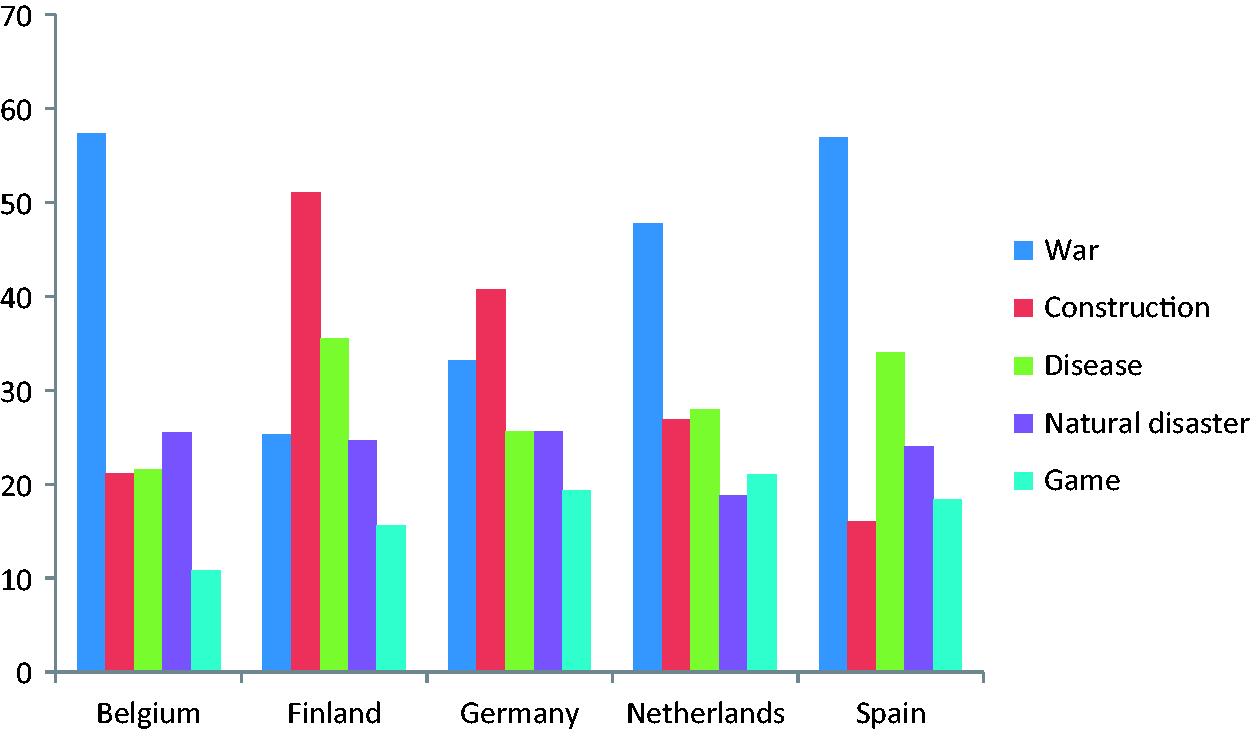
There is one significant difference between newspaper types in the number of frames per article, F(2,1316) = 6.072; p < .05. The largest number of frames was identified in quality newspapers (Mean = 1.51), followed by financial business newspapers (Mean = 1.39), and then popular newspapers (Mean = 1.18). As previously mentioned, articles in popular newspapers are shorter than in quality and financial newspapers. Nevertheless, if we check for article length, there still is a significant difference in the number of frames per newspaper type, F(2,1315) = 3.518; p < .05. So, our hypothesis that there would be fewer frames in financial newspapers was not confirmed. Quality newspapers used slightly more frames than financial newspapers. Popular newspapers came in last in use of frames, partly due to the brevity of their articles.
Furthermore, the most common frame in each newspaper was the war frame (see Figure 2). However, this was much more common in quality newspapers (46.0%) than in popular (33.7%) and financial newspapers (37.8%), F(2,1316) = 5.551; p < .05. The second most common frame was the construction frame, which occurred almost as frequently in each type of newspaper (30.8% in popular newspapers, 32.3% in quality newspapers, and 32.5% in financial newspapers), F(2,1316) = .059; p = .942. Moreover, the relative occurrence of the other three frames was different across newspaper types. The disease frame was the third most common frame in the quality (30.8%) and financial newspapers (26.8%), and so was encountered much more often there than in the popular newspapers (15.4%), which made little use of it F(2,1316) = 5.810; p < .05. The third most common frame in popular newspapers was natural disaster (19.2%), coming in fourth in both quality (25.7%) and financial newspapers (22.3%). The least common frame in quality and financial newspapers was the game and sports one (respectively 16.5% and 19.2%), while it was used in 19.2% of the popular newspapers articles. In other word, the game frame was just as common as the natural disaster one in popular newspapers.
Presence of dominant frames by newspaper type (in %).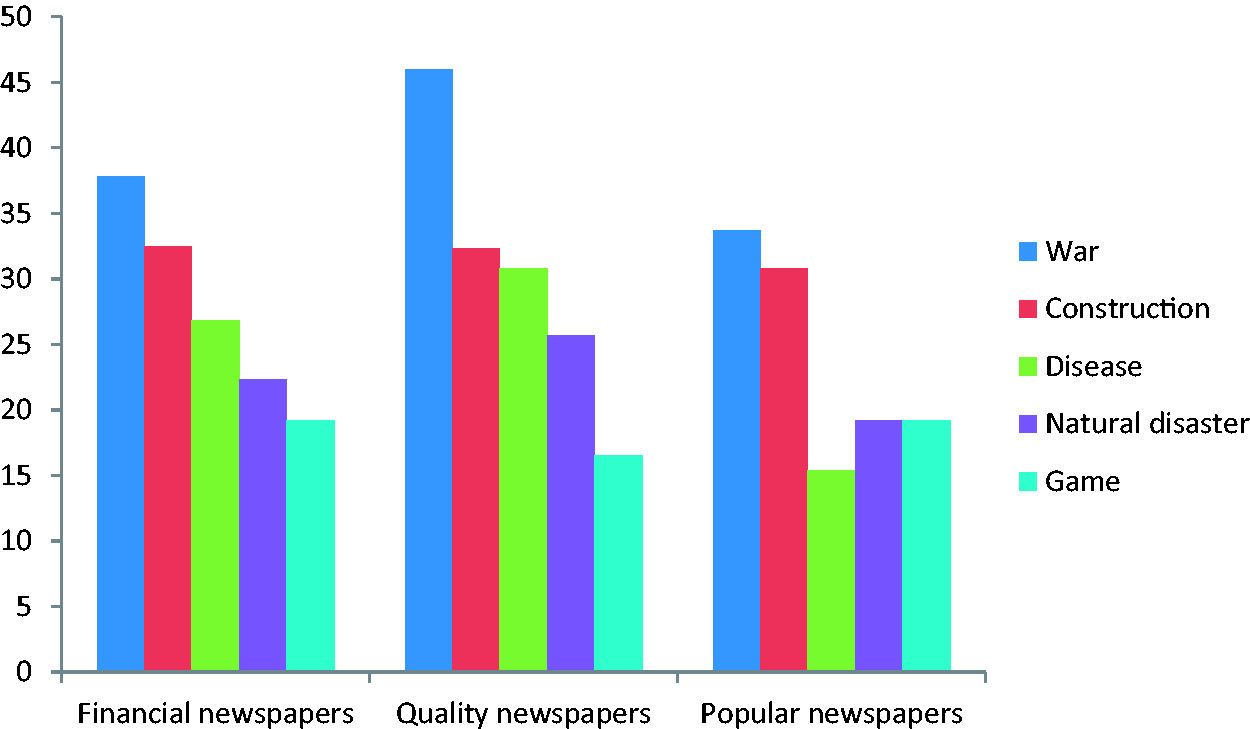
Conclusion
Cross-national differences in framing the crisis
The newspapers under study differ significantly in their use of the main two Euro crisis frames. While the war frame is the most common in Belgium, the Netherlands and Spain, the construction frame holds pride of place in Finland and Germany. Such insistence by the press in picturing the European debt crisis as a war fuels the display of aggressive language in the European public sphere. The war frame reveals the deeply rooted fears and clashes of interests between Member States, and most of all, it highlights the deep chasm between the economic ‘elites’ and ordinary citizens (see also Charteris-Black and Ennis, 2001). The war frame implies that EU policy makers and the financial markets are the ones to blame for causing this crisis, or failing to solve it. The helpless victims of this unconscionable ‘Euro war’ are the indebted countries’ general populations. Even though converging around a common set of metaphoric frames, the framing of the five Member States showed distinguishing features that can be traced back to each country’s stance towards Europe and the economy.
Just like the war frame, the construction and game frames involve some kind of human intervention or responsibility. In the case of the war frame, we are being told who the originators and the victims of the crisis are. With the construction frame, somebody is responsible for building the house or for being too optimistic. The human intervention in the game frame may be found in the involvement in a game or contest. However, the disease and natural disaster metaphors do away with this human element. Such metaphors dilute the question of responsibility by representing the crisis as a natural event. What’s more, the consequences of the disaster are likely to affect everyone in the immediate environment (see Horner, 2011: 40). As pointed out by Peckham (2013), in the context of the 2008 US financial crisis, the definition of ‘contagion’ has been used vaguely and economists have expressed reservations about the usage of the term. Yet ‘communicable disease’ is still an important theoretical framework for interpreting the transmission of financial crises. The comparison of a financial crisis with a contagious outbreak lies at the heart of the notion of ‘risk society’ (Beck, 1992; Giddens, 1999; Peckham, 2013). The decisions of European politicians lay thus hidden behind metaphors that hint that risks were allowed to grow unchecked.
Differences across types of newspaper
A significant difference has been found across the types of newspaper as to the number of frames per article. The largest numbers of frames were found in quality newspapers, followed by financial newspapers. Popular newspapers were the least inclined to use frames, mostly due to their shorter article formats. Furthermore, the most common frame in each newspaper type was the war frame, followed by the construction frame. The relative occurrence of the other three frames varied according to newspaper type. The disease frame was the third most common frame in quality and financial newspapers, and the least common in popular newspapers. The third most common frame in popular newspapers was natural disaster, coming in fourth in quality and financial newspapers. The game and sports frame occurred the least in the financial and quality press, while coming in third in popular newspapers.
Longer period, more countries
This study compared the news coverage of a specific period in five European countries (October–November 2011). Further research should look at a greater number of countries over a longer period for generalization purposes. More attention could also be devoted to media coverage of the European Union on other continents (i.e. an outsiders’ perspective rather than from within), especially in terms of the Euro crisis, to find out what the prominent negative and positive building blocks are in the overall framing of Europe and what alternative or counter-frames may neutralise positive or negative arguments and thus influence public opinion.
Experimental study of framing effects
Framing may refer to factors that remain unspoken but which are triggered by a given frame. Clearly, the dominance of these frames illustrates the ways in which the Euro crisis has been represented in part of the European public sphere—which is anything but innocent as the frames implicitly shape the reader’s perception. Therefore, an experimental design activating one of the dominant frames is a valid approach to finding out the degree to which these frames influence the perception of the crisis, the Euro and/or the European Union. Based on a survey, such follow-up study will make it possible to draw general conclusions, and also to analyse the link between media frames and audience frames as well as their mutual impact.
Footnotes
Declaration of Conflicting Interests
The author(s) declared no potential conflicts of interest with respect to the research, authorship, and/or publication of this article.
Funding
The author(s) received no financial support for the research, authorship, and/or publication of this article.