



Abstract
The positive relationship between cross-cutting exposure and tolerance has long been a topic in the political communication field. By reinvestigating this issue, this study further explores whether hasty discussion moderates the relationship from a cross-cultural perspective by comparing South Korea with the United States. The authors posit that hasty discussion—a term that was coined to explain South Korean’s fast lifestyle as reflected in discussion processes—is a South Korean characteristic that can have deleterious effects on deliberative democracy. Nine hundred and sixty survey participants (480 South Koreans and 480 Americans) showed meaningful results: (1) Hasty discussion comprises two factors (ignoring discussion processes and pursuing discussion efficiency). (2) Americans are exposed to more cross-cutting opinions than South Koreans, but the positive relationship between cross-cutting exposure and tolerance is more significant in the South Korean sample. (3) In the South Korean sample, ignoring discussion processes negatively affected tolerance. (4) An interaction effect of ignoring discussion processes and cross-cutting exposure on tolerance was found among South Koreans. That is, ignoring the discussion process lowered tolerance.
Introduction
Since tolerance is an essential component of deliberative democracy, the effect of cross-cutting exposure on tolerance has been studied by many political communication scholars. The basic assertion in this relationship is that exposure to dissenting views can increase tolerance by providing opportunities for understanding others’ rationales (Djupe and Calfano, 2012; Mutz, 2002, 2006; Mutz and Mondak, 2006). Despite numerous discussions, prior studies have not examined the relationship between cross-cutting exposure and tolerance from a cross-cultural perspective. Given that different discussion characteristics are shown between non-Western (e.g., South Korea) and Western countries (e.g., the United States) (Nisbett, 2010; Peng and Nisbett, 1999), learning how different cultures affect the relationships between cross-cutting exposure and tolerance has an obvious significance. By conducting a cross-national comparison, this study expects to broaden the understanding of deliberative discussions.
This study, in particular, considers the potential role that hasty discussion plays in affecting cross-cutting exposure and tolerance. The term hasty discussion explains South Korean's communication patterns influenced by the country’s quick and fast lifestyle aspects such as premature decision-making (Kang, 2010). South Korea’s distinguishing ppalli–ppalli (hurry–hurry in English) culture has stemmed from the rapid industrialization pursued by the former president Park Chung-Hee in the 1960s to 1980s (Yu, 2014). The ppalli–ppalli mindset has brought out both positive (e.g., the country’s industrial development) and negative effects (e.g., neglecting safety issues) in society and has distinct influence on South Koreans’ communication patterns including illogical arguments and lack of coherence. Discussion without ample elaboration is the representative characteristic of South Korean’s discourse (Choi and Lee, 2012a). In this sense, the potentially detrimental effects of hasty discussion on deliberative democracy are predictable; by inhibiting persons from understanding the rationales for dissimilar views, hasty discussion is likely to diminish the positive effect of cross-cutting exposure on tolerance.
Theorizing about South Koreans’ communication patterns, which are distinguishable from those of US, is an intriguing step in the field of communication. This work can extend previous scholarship that demonstrated that cross-cutting exposure promotes tolerance. In this study, we will specifically (a) consider the moderating role of hasty discussion in the relationship and (b) test the relationships in both South Korea and the US to provide cross-cultural validation. By systematically examining these issues, this study expects to develop a framework for deliberative democracy.
Literature review
Cross-cutting exposure, tolerance, and deliberative democracy
Before we discuss the relationship between exposure to contrasting views and tolerance, we need to clearly define the concept of deliberation. Deliberation derives from deliberative democracy regarded as ‘a system in which decisions are made not by coercion or bargaining among interests but through a discursive process in which citizens collectively consider and debate alternatives’ (Waldman, 2001: 151). As a sub-concept of deliberative democracy, deliberation is regarded as exchanging reasoned opinions by participating in political discussions (Choi and Kim, 2005). According to Habermas (1984), who made an early attempt to define deliberation, people should ideally solve problematic situations by considering arguments from all sides in the public sphere without bias. In order to reach a rationally motivated consensus, the reasoned public with equal voices and positions should freely participate in deliberative discussion (Bohman, 1996; Rawls, 1971/1999). In this sense, equal and reciprocal opinion exchanges are essential preconditions for deliberative discussions (Gutmann and Thompson, 1996). In short, deliberation refers to carefully examining problems and reaching a reasonable conclusion after considering diverse and complementary opinions (Gastil, 2008). Deliberation creates informed citizens because it provides ample opportunities for people to develop better solutions about conflicting issues (Mathews, 1999).
The above discussion shows that diversity and pluralism are crucial factors for deliberation that entails a reciprocal exchange of opposing ideas. Deliberation involves two-way communication processes in which participants’ different political views are voiced and heard (Park et al., 2002). According to Calhoun (1988: 220), ‘Democratic public discourse does not depend on preexisting harmony or similarity among citizens…but rather on the ability to create meaningful discourses across lines of difference.’ Heterogeneous networks, which expose participants to disagreement, contribute to forming a deliberative democratic society (McKuen, 1990). This view suggests the process of exchanging opposing points of view should be highlighted in diversity-focused deliberation. When people neglect the opinions of the opposition and only talk with like-minded discussants, they take more extreme positions (Mutz, 2001), which ultimately endanger deliberation. This results in more fragmented and polarized societies (Mutz, 2002; Stroud, 2010). Because the influence of exposure to disagreement has compelled much attention in communication studies, the concept has been diversely termed—for example, ‘cross-cutting exposure’ (Mutz, 2002), ‘network heterogeneity’ (Scheufele et al., 2003), and ‘diverse discussion networks’ (Ikeda and Richey, 2009). This study will use the term ‘cross-cutting exposure’ to refer to exposure to opponents’ perspectives.
A number of scholars have examined the consequences of cross-cutting exposure, with some arguing for negative consequences. Mutz (2002) suggested that cross-cutting can also lead to discouraging political participation; she explains that exposure to dissonant views creates greater attitudinal ambivalence, which induces political inaction. This negative outcome is related to the psychological discomfort produced by political vacillation and uncertainty (Berelson et al., 1954; Lazarsfeld et al., 1944). Festinger’s (1962) cognitive dissonance theory can explain this reasoning, which postulates that people prefer attitude-consistent information to attitude-dissonant inputs. Therefore, when people feel cross-pressure from exposure to dissonant opinions, they can feel psychological discomfort and withdraw from political participation. Cross-cutting has been also found to lead to bitter arguments and hostile and uneasy silences (Scorza, 1998).
However, the positive effect of cross-cutting exposure still dominates the communication field. First, this exposure results in greater awareness of both opposing views and one’s own arguments (Manin, 1987; Mutz, 2002). By engaging in discussions with people with opposing points of view, people develop rationales for their own perspectives and at the same time learn about the opponents’ perspectives. When exposed to political views that are different from their own, people tend to think about what might have led others to hold those opinions, and furthermore, exposure to different viewpoints encourages tolerance (Mutz, 2002; Price et al., 2002; Stouffer, 1995). Through cross-cutting exposure, people’s ability to see issues from others’ perspectives can improve which ultimately reduces prejudice and increases tolerance for others.
Tolerance, which functions as ‘an essential endorphin of a democratic body politic’ (Gibson, 2006: 21), is a crucial concept for achieving deliberative democracy. Without tolerance for different thoughts, democracy is difficult to achieve (Mill, 1859). Because deliberation includes ‘incorporating differences coexisting with it, and allowing it a share of social space’ (Bohman, 2003: 758), high tolerance and less-biased views toward others who hold dissonant opinions are strongly related to the process. In a similar vein, a public sphere (Habermas, 1984)—an ideal discussion place—serves as a prerequisite for tolerance. People freely share their opinions with each other in the public sphere and, through these processes, develop tolerance for others’ discordant opinions (Sullivan et al., 1993). Focusing on the importance of tolerance, much research has been devoted to exploring the concept. Scholars have focused on the key determinants of tolerance such as exposure to different opinions (Mutz, 2002; Robinson, 2010; Tadmor et al., 2009) and intergroup contact (Bloom and Bagno-Moldavsky, 2015). These factors commonly focus on network diversity in terms of opinions, race, or religion (e.g., Djupe and Calfano, 2012).
Past research has explained the meaning of tolerance not from a unified viewpoint but from various perspectives such as political (Mutz, 2002; Nir, 2002; Price et al., 2002; Sullivan et al., 1993), social (Bloom and Bagno-Moldavsky, 2015; Pattie and Johnston, 2008), or moral (Ikeda and Richey, 2009) tolerance in addition to others. Among the diverse types of tolerance, this study of people’s discussion patterns will focus on deliberative tolerance. The concept is closely associated with having respect for others (particularly those who have dissenting opinions) during discussions and perceiving them as equal members of the community (Bohman, 2003). Not excluding out-group members who have different views supports democratic principles including egalitarianism and non-domination (Kelly and McPherson, 2001). In this sense, pluralism and diversity are considered necessary for the deliberative tolerance that then forms ideal public communities.
Cross-cultural analysis of the effect of cross-cutting exposure on tolerance
A substantial body of research has determined that cross-cutting exposure increases tolerance by leading individuals to understand the rationales of their opponents (Mutz, 2002, 2006; Price et al., 2002; Stouffer, 1995), which leads to forming a deliberative democracy. Mutz (2002) demonstrated two mechanisms that function when people are exposed to opposition views: awareness of rationales (cognition) and intimacy with dissonant opinions (affection). In other words, cross-cutting talk can increase political tolerance through cognitive and affective processes. After being exposed to different ideas, individuals can think about reasonable rationales that support their own opinions and clarify their arguments. Moreover, interacting with people who hold different opinions offers the opportunity to reduce discrimination against out-groups (Brewer, 1999) and overcome group boundaries, thus increasing tolerance (Djupe and Calfano, 2012). Following these arguments, we posit that exposure to cross-cutting opinions will increase deliberative tolerance, and we will empirically test the following hypothesis: H1. Exposure to cross-cutting opinions will positively affect deliberative tolerance. RQ1. Does the relationship between cross-cutting exposure and deliberative tolerance differ between South Koreans and Americans?
Hasty discussion
Quick and fast is how South Koreans live today, and the population’s tendency to work at a fast pace has been a major factor in the country’s rapid economic growth. The phrase ppalli–ppalli (hurry–hurry) is so commonly used (Yi, 2016) that it is one of first words that foreigners learn when they live in Korea. This ppalli–ppalli phenomenon is seen everywhere in Korea. Paints on the ‘close’ buttons of elevators in Korea are all peeled off because people impatiently press close buttons once they are on the elevators, pre-elementary schoolers learn multiplication tables before entering elementary school because Koreans want to learn everything fast, many automobile accidents occurs in Korea due to this ppalli–ppalli syndrome (Kang, 2010). A communication scholar Shyam Sundar who stayed in Korea for one year writes, ‘I have never seen Koreans waiting for anything when they are on the go. Restaurants have a call button at each table so that patrons can summon the wait staff at a moment’s notice. Shopping malls are everywhere, including underground walkways, so that customers can buy clothes and shoes while they are on the go…. Even services can be purchased in a hurry. Seoul shopping districts usually have a line of fortune-tellers in makeshift booths at any time of day or night. Massage services, round the clock, abound as well (Sundar, 2013)’. The South Koreans’ distinctive lifestyle is also reflected in their communication patterns. In recent Korean studies, scholars have termed the nation’s communication patterns as hasty (fast) discussion (e.g., Choi and Lee, 2012a; Kang, 2010).
The term hasty discussion refers to talking with only small groups of people and wrapping up discussions impetuously rather than having ample and rich discussions with diverse people (Choi and Lee, 2012a). The hasty discussion inherent in South Koreans’ communication patterns is related to the nation’s cultures. Scholars suggest five distinctive patterns of Korean communications that contribute to this hasty discussion (Choi and Lee, 2012a; Lee, 2002). The first is the implicit communication style. Hofstede (1980) classified Korea as a country with strong collectivist culture, where contextual communication is prevalent (Hall, 1976). In this contextual communication culture, clear messages are not important and information tends to be conveyed by contextual cues. In addition, high contextual culture has the characteristic of using implicit messages, giving high value to harmony, making it difficult for others to say no, and appealing to emotions rather than logic (Hall, 1976; Merkin, 2009). In such a high contextual collectivist society, having no discussions rather than discussing with others can have a stronger communication effect in some ways. A study compared political advertising between South Korea and the US concluded that the Korean candidates were less communicative and expressive compared to the American candidates, which empirically supported the cultural characteristics of Korea: high-context communication (Tak et al., 2007).
The second characteristic of South Korean communication pattern is emotional communication. It was argued that Korean debate is irrational, illogical, and influenced by emotions (Lee, 2002). Hasty discussion can be encouraged in an emotional discussion environment in which discussions are conducted without following rational discussion procedures. When people are engaged in emotional discussions, they tend not to listen to the opinions of oppositions and not to give importance to the discussion procedures such as rebuttal or persuasion. Particularly, Koreans frequently use emoticons when discussing or sending text messages on the Internet bulletin board. These emoticons function in accordance with the hasty discussion because they contain many messages in implicit ways.
The third South Korea’s strong cultural characteristic is nepotism and Confucianism, which lead people to discuss topics hastily (Lee, 2002). South Koreans live in a nepotism-dominant society and tend to have close connections with their friends and families, and this widespread favoritism causes problems; excluding out-group members is one such problem (Park, 2004). Similarly, in terms of communication patterns, the country’s own cultural characteristics lead people to assume that their in-group members can understand what they are saying without elaboration and to see no need to deeply discuss issues. Nepotism ultimately brings out negative effects in a society in that it contributes to forming close in-group associations while excluding out-group members; strong nepotism and cronyism make it difficult for foreigners and other outsiders to be accepted as in-group members, resulting in closed communication systems.
Another cultural feature of South Korea is Confucianism, which emphasizes harmony, egalitarianism, family, and clan (Moore and Ishak, 1989) but which can also contribute to South Koreans’ engagement in hasty discussion. Benevolence interwoven with bonding social interaction is the cardinal factor that constitutes Confucianism (Chen and Chung, 1994). The intimate connections and reciprocal relationships with others that explain the concept of benevolence are placed as high priorities for materializing Confucian ideologies. As a result of these values, communication styles in South Korea are non-confrontational, which leads Koreans to engage in high-context communication; for example, they do not explicitly point out others’ logical flaws. To help others save face—known as chemyon in Korean (Kim and Yang, 2011)—South Koreans prefer obscuring their positions as a communication strategy and thus creating ambiguous messages (Lint and Choi, 1996). This, in turn, produces more abstract messages than those in other countries such as the US, where a low-context culture dominates (Merkin, 2009).
The fourth characteristic of Korean communication is static communication. Koreans have a lot of thought processes between thinking and expression, and they value listening rather than speaking (Lee, 2002). Also fluent speech is not appreciated as a good communication ability in the Korean society. Kim (2005) pointed out that the ideas of Confucianism, Buddhism, and Taoism, which governed the traditional life and culture of Koreans, also influenced communication. Confucianism valued silence, and discrete and responsible speeches, much more than brilliant rhetoric or rational discussion that is being highly evaluated in the West. This static communication is consistent with the hasty discussion that emphasizes short and quick discussion because it values short and implicit discussions. Static communication values efficient discussions where a small number of elites gather together to discuss about social issues quickly and make quick decisions rather than engaging various sectors of people and debating over a long period of time.
The last characteristic of Korean communication is metaphorical communication. Korean messages tend to be collective, overly concentrated, ambiguous, and implicit (Lee, 2002). In addition, Koreans prefer indirect and metaphorical expressions rather than direct and provocative communications (Kim, 2005). This metaphorical communication is also related to the discussion speed. In the metaphorical communication style, there is a habit of not discussing specific matters in detail, and there is a tendency to speak integrally without discussing details. In metaphorical communications, the discussion content is likely to be abstract and the process of discussing the arguments, such as providing propositions and arguments, rebuttals, and providing bases for those arguments, can be ignored.
Based on the above discussions, this study suggests the characteristics of hasty discussion are as follows: neglecting the rational procedure of exchanging opinions, jumping to conclusions without thinking about issues thoroughly, discussing matters in short periods of time, assuming that there is no need to consider all people’s opinions, and believing that a leader’s unilateral decision is not problematic (Choi and Lee, 2012a). In short, people who pursue hasty discussion do not focus on different people’s opinions or rational discussion processes. Rather, hasty discussion perceives leaders’ arbitrary decisions as efficient solutions that can bring prosperity to societies.
Koreans have traditionally valued static, emotional, and metaphorical communications, and preferred non-confrontational debates rather than rational discussions. With their distinctive cultural features such as nepotism or Confucianism (Park, 2004), South Koreans discuss topics with others in an illogical way (Lee, 2002; Merkin, 2009). The main problem with hasty discussion is that it can strengthen in-group favoritism while neglecting the opinions of out-group members. For example, family egoism, a concept that refers to favoring family members or friends with whom one has close relationships (Park, 1997, 2004) causes South Koreans to discuss matters hastily; they are quick to determine that their in-group members can understand what they are trying to say without elaboration. Along this line of logic, a closed society could form because of the South Korean tendency to consolidate social bonds with close others while excluding out-group members; in other words, hasty discussion could polarize Korean society. People who discuss matters in hasty ways do not listen to opposing opinions. They also do not condone differences, which is a requirement for deliberative tolerance (Bohman, 2003); said another way, hasty discussion will reduce deliberative tolerance.
In an essay that reflects on the relationship between speed and democracy, Chesneaux (2000) called such hasty political decision-making as ‘instant democracy’. According to Chesneaux, ‘time and respect for time scaling, time maturation, are essential ingredients of democratic life. Democracy, by its very nature, requires time, it cannot be compressed into a kind of ‘instant’ political mechanism (in the sense of ‘instant’ coffee)’ (p. 409). Political debates are time-consuming, since they should involve a large variety of institutional and non-institutional forces, and those political forces always need time to collect their ideas, to consider the pros and cons, to launch the debates within their own institutions. Chesneaux’s argument suggests a seminal point: although democracy depends on reflection and maturation and takes time to be achieved, we are living in an environment where speed is valued and favored. Therefore, hasty discussion would have negative influences on the democratic procedures. H2. Hasty discussion will negatively affect deliberative tolerance.
Such cultural characteristics are also presented in the current online media environment. Chau et al. (2002) compared online communication behaviors of consumers between Hong Kong and the US and found that Hong Kong participants tended to use the Internet more for social interaction. In a similar line, Kim et al.’s (2011) research concluded that Korean college students use social media to gain supports from existing relationships while American students use those to seek entertainment. Such differences of communication patterns depending on cultural characteristics contribute to the body of literature on examining social media usage from a cross-cultural approach.
These past studies, which provide the possibility that communication characteristics might be differently presented based on South Korea (collectivism-orientated, high-context communication) and US’ (individualism-orientated, low-context communication) distinct characteristics, offer the need to further seek out online communication patterns from a cross-cultural perspective. Therefore, given that collectivism is pervasive in South Korea (Hofstede, 1980), the communication patterns shown in the country tend to lack coherence and to be focused on indirect communication that produces implicit messages (Merkin, 2009); but it is uncertain whether the relationship between hasty discussion and deliberative tolerance differs in South Korea versus the US. Because no past studies have offered clear differences regarding this issue, we pose the following research question: RQ2. Does the relationship between hasty discussion and deliberative tolerance differ between South Koreans and Americans? H3. Hasty discussion will moderate the relationship between exposure to cross-cutting opinions and deliberative tolerance such that tolerance will be lower for those who participate more in hasty discussions than for those who do not. RQ3. Does the moderating role of hasty discussion in the relationship between exposure to cross-cutting opinions and deliberative tolerance differ between South Korea and the US?
Research model
Method
Figure 1 illustrates the theoretical model proposed in the study. This study used a cross-cultural online survey to compare the moderating role of hasty discussion in the effects of cross-cutting exposure on deliberative tolerance between South Korea and the US. Although political discussions are widely held in online and offline, this study focused on online political discussions, especially those discussions held in online bulletin board.
Participants and procedure
The surveys for both countries were simultaneously administered to 480 participants each in June 2012. The Korean version of the survey was administered to the South Koreans, and a translated English version was administered to the US participants. The surveys were administered by an online survey research center that had bases in both South Korea and the US. The participants were recruited based on quota sampling that were applied in each country: 16–19 years (60 participants: 30 male and 30 female), 20–29 years (120 participants: 60 male and 60 female), 30–39 years (120 participants: 60 male and 60 female), 40–49 years (120 participants: 60 male and 60 female), over 50 years (60 participants: 30 male and 30 female). Subjects received approximately US$2 in exchange for their participation, which entailed roughly 20 minutes to complete the whole survey. A total of 1,549 South Koreans accessed the survey and 530 completed it, while 3,429 Americans accessed the survey and 524 of them completed it. Therefore, the cooperation rate for each country turned out to be: 34.2% (South Koreans) and 15.3% (Americans). We focused on the respondents’ general perceptions of each survey question, as described below.
Theoretical model. DV: Dependent variable; IV: Independent variable; Mo: Moderating variable.
Measurement
Cross-cutting exposure. The survey asked the respondents four questions regarding their exposure to cross-cutting views: (1) I am also interested in posting comments that oppose my opinion; (2) I often select and read posts and comments that oppose my opinion; (3) I fully understand posts that oppose my opinion; and (4) I leave comments on posts that oppose my opinion (Cronbach’s α = .772, M = 4.70, SD = .82 for South Korea; Cronbach’s α = .765, M = 5.16, SD = .98 for the US).
Hasty discussion. Hasty discussion was measured using five items on a seven-point scale from 1 = strongly disagree to 7 = strongly agree; we used the same measurement scales as Choi and Lee (2012a). We classified the items into two factors using exploratory varimax factor analysis to identify any common variance among factors (Park et al., 2002). The factor analysis yielded the same results as those of Choi and Lee (2012a).
Factor analysis for hasty discussion (South Korea).
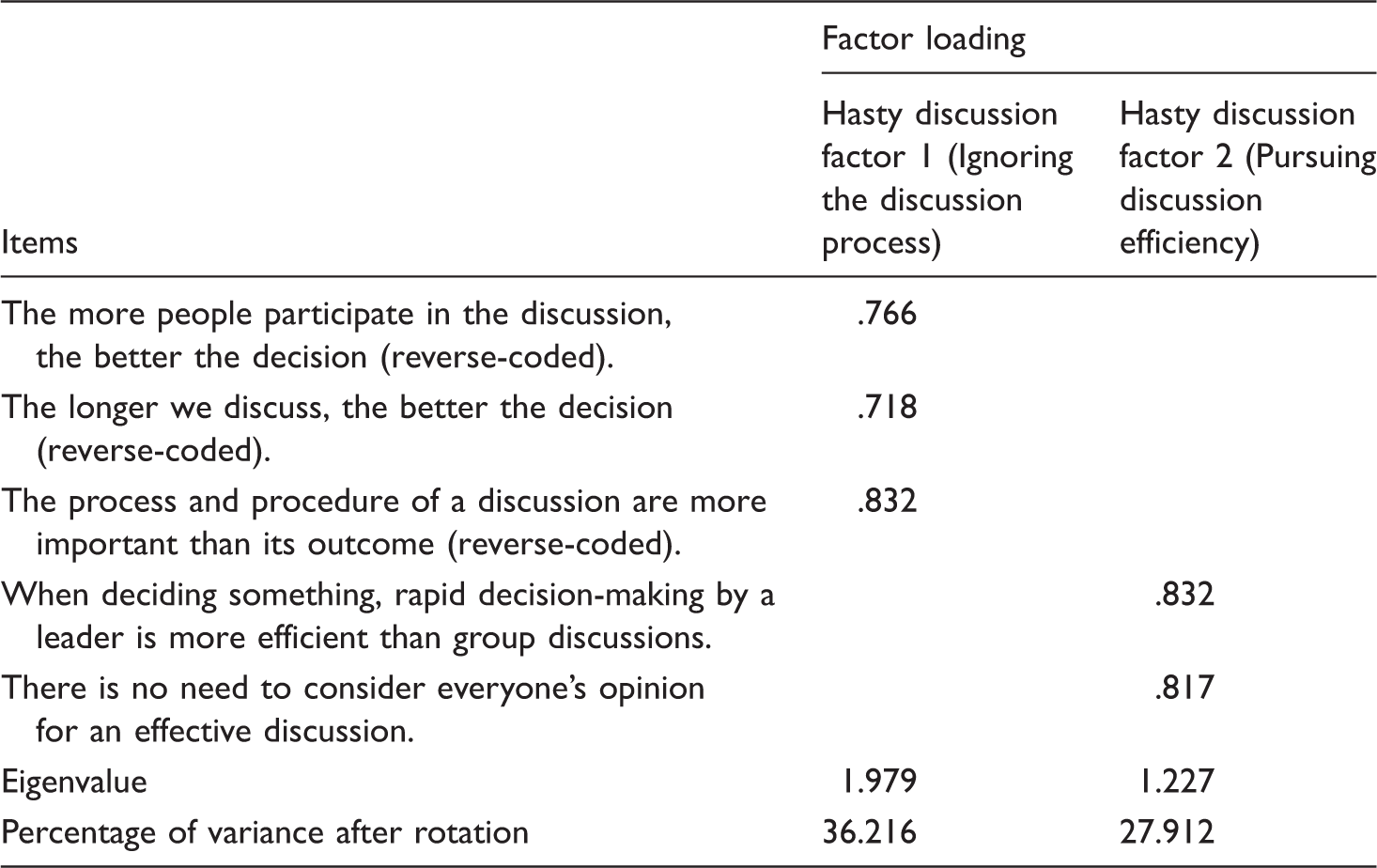
Note: Rotated factor analysis (varimax), Kaiser-Meyer Olkin (KMO) value = .641, Bartlett-test (χ2) = 323.184, df = 10, p < .001, Total percent of explained variance = 64.128%.
Factor analysis for hasty discussion (United States).
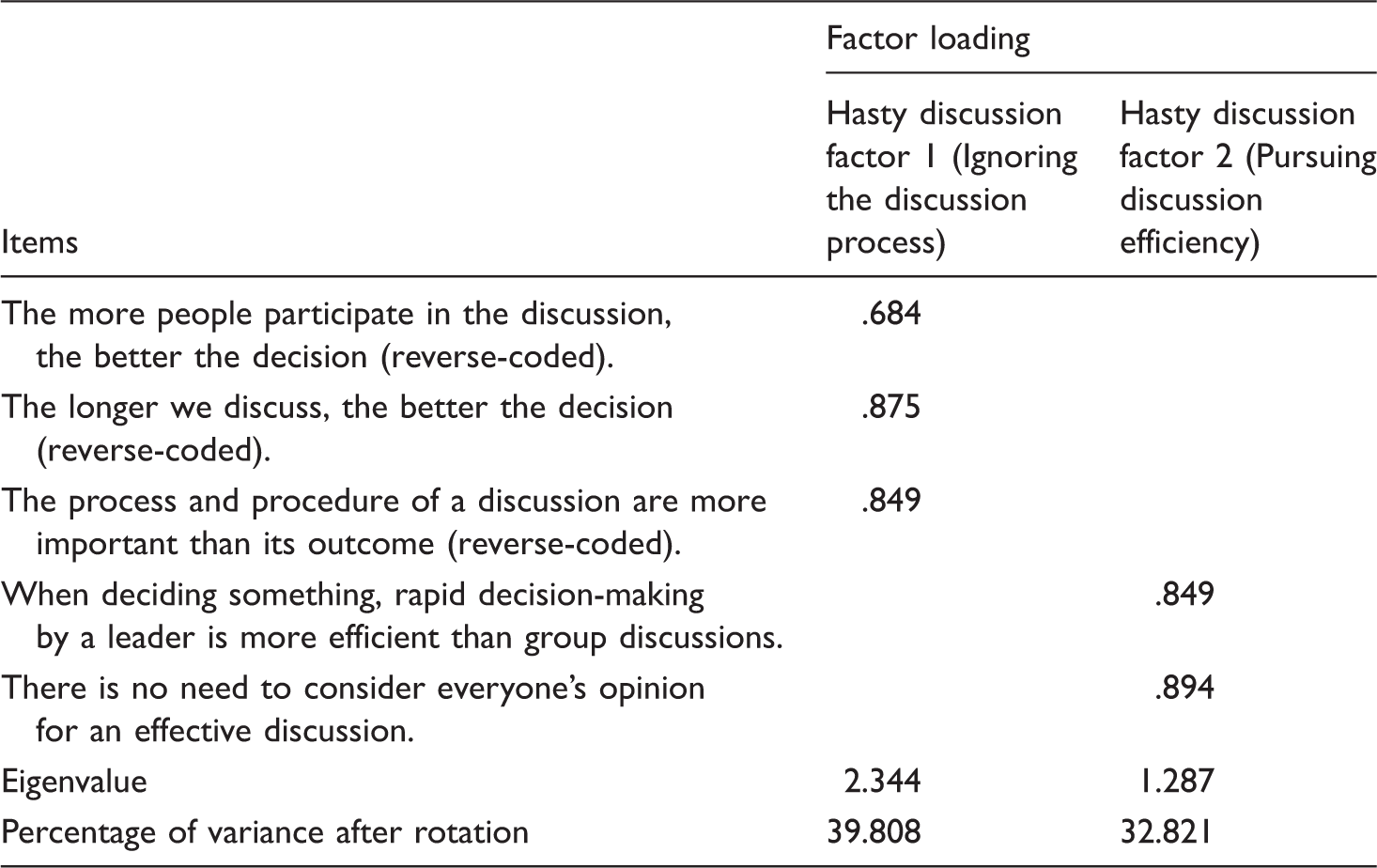
Note: Rotated factor analysis (varimax), Kaiser-Meyer Olkin (KMO) value = .658, Bartlett-test (χ2) = 623.329, df = 10, p < .001, Total percent of explained variance = 72.629%.
Deliberative tolerance. Based on Bohaman’s (2003) research, deliberative tolerance was measured using seven items: (1) those who take opposite stands from my viewpoint also have the right to participate in the discussion, (2) posts that take opposite stands from my position are worthwhile to read, (3) I am willing to adopt some of the arguments found in posts that take opposite stands from my opposition, (4) participants who take opposite stands from my position deserve respect, (5) after participating in a discussion, I feel that I better understand the opposite position, (6) after participating in a discussion, I feel that those who take the opposite side may have their own good reasons, (7) after participating in a discussion, I think that I once was just like those who take the opposite stand. These items were measured on a seven-point scale from 1 = strongly disagree to 7 = strongly agree (South Korea: Cronbach’s α = .868, M = 4.84, SD = .84; US: Cronbach’s α = .842, M = 5.08, SD = .97).
Controls. As control variables, demographics (gender, age, education) and political knowledge were included, based on past research that argued the significant positive relationship between political knowledge and tolerance (e.g., Galston, 2001; Nie et al., 1996).
Findings
Descriptive statistics
Both the South Korean and US samples contained 480 respondents, 240 (50.0%) males and females (50.0%) in both groups. The average age of the South Korean respondents was 34.36 (SD = 11.60), and that for the US was 34.95 (SD = 11.96). Regarding education level, 21.9% of the South Koreans had a high school education or less, 2.7% had attended college, 14.6% were active college students, 51.5% held bachelor’s degrees, and 9.4% had a graduate education. In the US sample, 31.5% of participants had a high school education or less, 12.3% had attended college, 14.8% were active college students, 33.5% held bachelor’s degrees, and 7.9% had a graduate education. Political knowledge was assessed with one item, ‘I do have a lot of knowledge about politics,’ rated on a seven-point scale from 1 = strongly disagree to 7 = strongly agree (M = 4.05, SD = 1.18 for South Korea; M = 4.71, SD = 1.58 for the US).
Partial correlation matrix for study variables (South Korea).
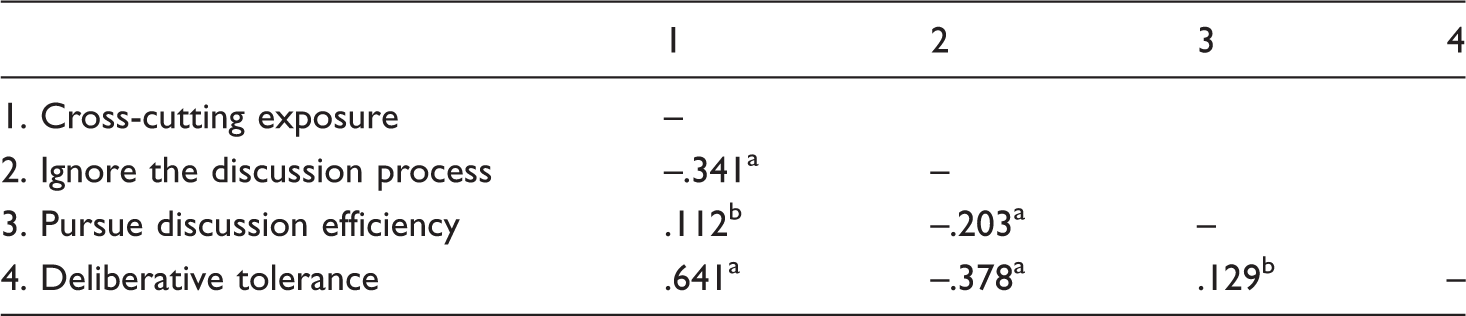
Note: Gender, age, education, and political knowledge were controlled.
p < .001.
p < .05.
Partial correlation matrix for study variables (United States).
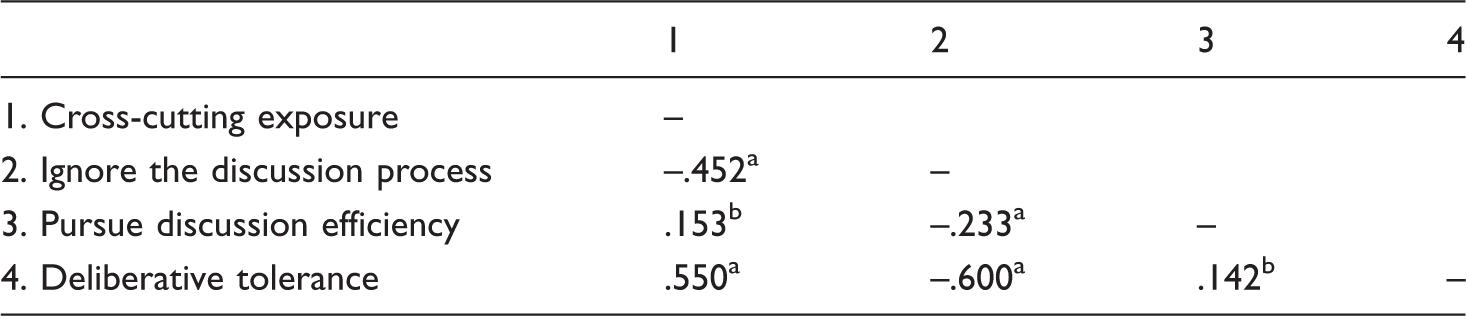
Note: Gender, age, education, and political knowledge were controlled.
p < .001.
p < .01.
In the US sample, cross-cutting exposure was also negatively related to ignoring the process of discussion (r = −.452, p < .001) but showed positive relationships with pursing discussion efficiency (r = .153, p < .01) and deliberative tolerance (r = .550, p < .001), the same as the South Korean sample. Ignoring the discussion process was negatively related to pursuing discussion efficiency (r = −.233, p < .001) and to deliberative tolerance (r = −.600, p < .001). Finally, the positive relationship between pursuing discussion efficiency and deliberative tolerance was statistically significant (r = .142, p < .01).
Independent t test results for hasty discussion by country.

Note: M = mean, SD = standard deviation. All variables ranged from 1 (strongly disagree) to 7 (strongly agree).
p < .001.
p < .05.
Hypothesis testing
Regression results for the moderating effect of hasty discussion on the relationship between cross-cutting exposure and deliberative tolerance (South Korea).

p < .01.
p < .05.
p < .10.
p < .001.
Regression results for the moderating effect of hasty discussion on the relationship between cross-cutting exposure and deliberative tolerance (United States).

p < .05.
p < .001.
p < .01.
Supporting H1, cross-cutting exposure was positively related to deliberative tolerance in both the South Korean and US samples. According to the results in Model 2, in both two countries, the main effects of cross-cutting exposure on tolerance were significant (South Korea: β = .658, t = 18.164, p < .001; US: β = .567, t = 14.340, p < . 001). Regarding the RQ1, which compared the results of the South Korea and the US, the two countries showed the same results.
H2, which posited that hasty discussion would negatively affect deliberative tolerance, was partially supported based on the results in Model 3. One hasty discussion factor (ignoring the discussion process) was negatively related to tolerance in both the South Korean and US samples (South Korea: β = −.177, t = −4.719, p < .001; US: β = −.450, t = −11.52, p < .001); on the contrary, the main effect of pursuing discussion efficiency was not significant in either sample. Regarding RQ2, which compared the differences between the two countries, the results of the two countries were the same.
Lastly, Model 4 tested whether hasty discussion moderated the influence of cross-cutting exposure on tolerance (H3 and RQ3). After we created interaction terms with both hasty discussion factors for cross-cutting exposure, we entered them into Model 4 with acceptable tolerances of multicollinearity (variance inflation factor less than 10; see Marquardt, 1970). The results from Model 4 indicate that the influence of cross-cutting exposure on tolerance was contingent on ignoring the discussion process among South Koreans (β = .264, t = 1.727, p < .10); Figure 2 depicts the interaction pattern. Meanwhile, no interaction effects were in the US sample, and these results explain RQ2.
The interaction effect of ignoring the discussion process and cross-cutting exposure on deliberative tolerance (South Korea).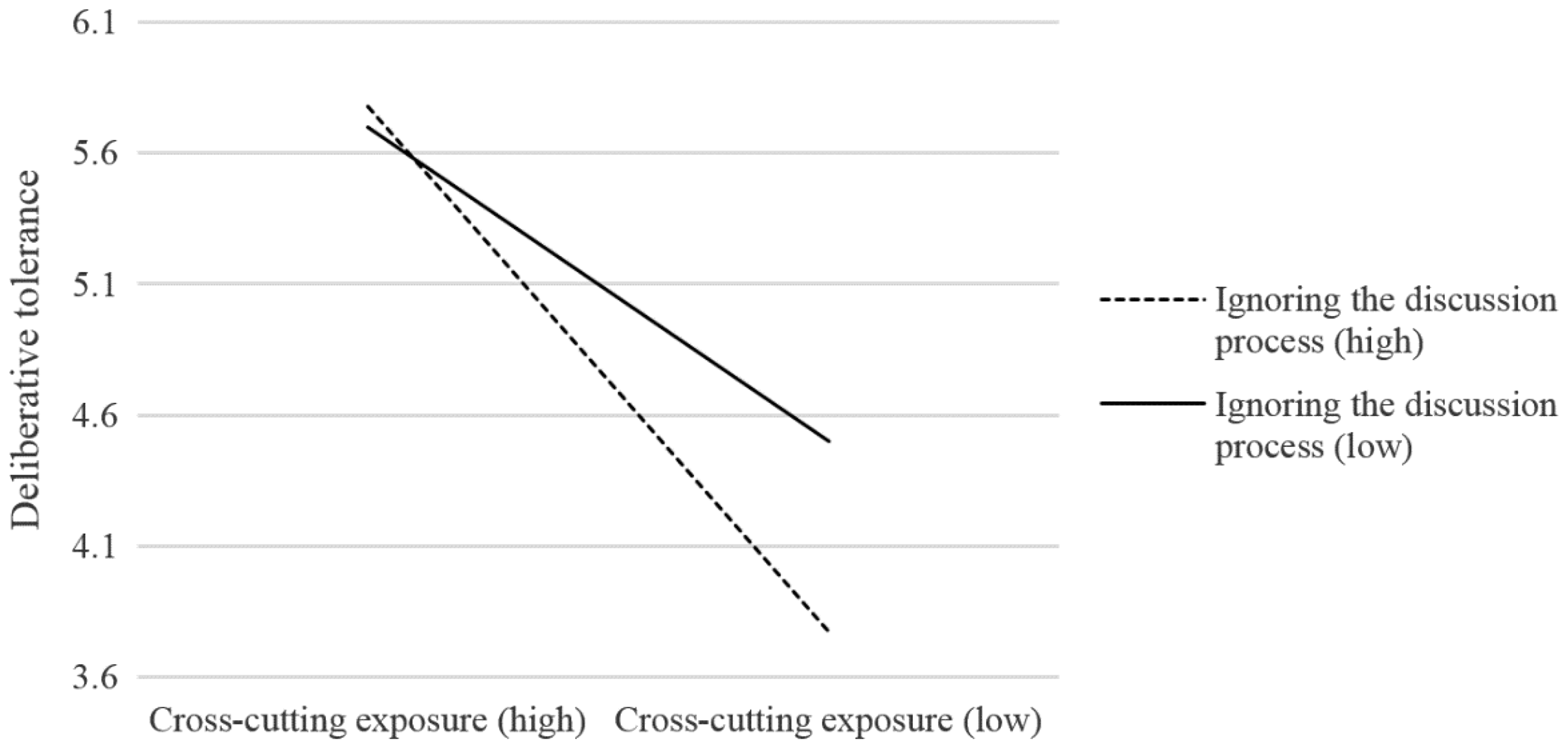
Figure 2 graphically presents the results of the interactions between ignoring the discussion process and cross-cutting exposure on deliberative tolerance (1 standard deviation below/above the mean for ignoring the discussion process). According to Figure 2, there was little difference in tolerance between groups in terms of ignoring the discussion process when the cross-cutting exposure was high, but among people who were less exposed to cross-cutting opinions, the moderating effect of ignoring the process of discussion was high. Compared with low degrees of ignoring the process of discussion, high degrees precipitously decreased deliberative tolerance by low levels of cross-cutting exposure. In other words, for those who were not exposed to oppositional point of views, ignoring the discussion process showed differences for tolerance depending on the extent of the ignoring. Those who ignored the discussion process showed less tolerance than did those who did not with low cross-cutting exposure. Detailed explanations of the above results are provided in the following discussion section.
Discussion
Summary and implications
The goals of this study were to examine how cross-cutting exposure affected tolerance and whether hasty discussion would moderate the relationship between cross-cutting exposure and deliberative tolerance by comparing South Korea with the US. Based on the discussion that hasty discussion is more likely to take place in South Korea than in the US because of the country’s cultural characteristics, this study raised questions that focus learning the differences in deliberative discussions between the two countries. Specific results provide some significant implications.
Before we explain the main results of the study, it is worth noting that the concept of hasty discussion can be explained by two factors: ignoring the discussion process and pursuing discussion efficiency. Although we adapted our hasty discussion measurement items from past research (Choi and Lee, 2012a), we named them differently to supplement past research’s limitations. Furthermore, the new finding from this study is that the two hasty discussion factors had impact not only in South Korea but also in the US; this finding suggests that ignoring the discussion process and pursing discussion efficiency explain the concept of hasty discussion in both countries; this in turn indicates that hasty discussion is not determined by a certain nation’s characteristics. Rather, the result indicates that it is a multidimensional concept. Building on this study, future research could explore additional factors that comprise hasty discussion.
In the preliminary analysis, we found that South Koreans showed hastier discussion than Americans. Interestingly, the difference for ignoring the discussion process, a negative aspect of hasty discussion, was relatively large between the two countries; South Koreans were more likely to neglect discussion processes than Americans. This result is strongly associated with the cultural characteristics of South Korea, as discussed in the literature review. In line with previous research (Choi and Lee, 2012a; Kang, 2010; Merkin, 2009), South Koreans’ tendency to address issues quickly and their indirect communication style contribute to hasty discussion, particularly in a negative way. Although this study did not examine cultural factors in the analysis, it is possible to infer from the past research that the distinct cultures that dominate South Korea (i.e., Confucianism, nepotism, collectivism) have contributed to the formation of hasty discussions. In the context of cultural characteristics, South Koreans have a willingness to avoid conflicts and save face, known as Chemyon (Kim and Yang, 2011). Therefore, during a decision-making process, South Korean people may think that inviting the participation of many or prolonged discussion time would only bring confrontations, thus discounting the process of discussion.
The results of our main analyses certainly did not support all of our expectations. The finding of a positive relationship between cross-cutting exposure and deliberative tolerance in both South Korea and the US is consistent with the arguments by previous researchers (Djupe and Calfano, 2012; Mutz, 2002). Our analysis adds evidence of the positive role of cross-cutting exposure on tolerance, particularly deliberative tolerance, and highlights the cross-cultural approach in examining these relationships. One interesting finding was that the relationship between cross-cutting exposure and deliberative tolerance did not show much difference between South Korea and the US; both countries showed a positive effect of cross-cutting exposure on deliberative tolerance. Supporting the dominant past findings (Mutz, 2002; Price et al., 2002), these results suggest that the effects of exposure to dissonant views on deliberative tolerance exhibit commonalities in South Korea and the US.
Ignoring the discussion process, a major feature of hasty discussion, was negatively related to deliberative tolerance in both South Korea and the US, showing the same level of significance. The interesting finding is that the other hasty discussion factor, pursuing discussion efficiency, showed no significant relationship with deliberative tolerance. Ignoring the process of discussion can potentially hinder understanding other people who hold different viewpoints, making people less accepting of opposing opinions. However, the result that pursuing discussion efficiency showed no significant effects on deliberative tolerance in either country suggests that this pursuit of efficiency might not negatively influence the understanding of opposing opinions. This gives significance to future research that ignoring the procedure of discussion and pursuing discussion efficiency should be distinguished when addressing hasty discussion.
Pertaining to the focus of this study, a closer look into the moderating effect of hasty discussion on the relationship between cross-cutting exposure and deliberative tolerance raises some important ideas. We found that the South Korean sample showed the interaction that when the cross-cutting exposure was low, those who more ignored the discussion process showed less discussion tolerance than did those who only marginally ignored the process. When the cross-cutting exposure was high, there was no difference between the degree to which respondents ignored the discussion process; both groups showed high discussion tolerance. As expected, ignoring the discussion process had a detrimental effect on building a public sphere, but the moderation effect was only notable for South Korean society. These results suggest that hasty discussion serves as a significant influence on the relationship between cross-cutting exposure and deliberative tolerance among South Koreans but not Americans.
Overall, this study indicates that cultural mechanisms cannot be ignored in forming deliberative democracies. The role that cultural characteristics play in weakening the long-supported arguments that have claimed a positive relationship between cross-cutting exposure and deliberative tolerance evinces the need to shift from accepting the relationship without considering cultural impacts. Our results contribute to the research community in a number of ways. First, conceptualizing hasty discussion was a new effort in the field. Scholars have highlighted factors of leaping to conclusions such as overlooking evidence, not acknowledging exceptions to arguments, and believing in the fallacy of relevance (e.g., Walton, 1999, 2004; Walton and Gordon, 2009) and others, particularly, have focused on the different characteristics between Western and non-Western countries regarding the problems shown during decision-making processes (Merkin, 2009). However, linking South Korean’s cultural characteristics with the way of their discussion styles has been relatively unexplored, which provides another significance in this study.
In addition to the focus on hasty discussion in the context of cultural backgrounds, this study identified the mechanisms in the relationship between cross-cutting exposure and tolerance. This can expand past research such as Mutz (2002) that demonstrated cognitive and affective aspects in testing the effects on tolerance of exposure to dissonant views. From the current research’s findings, it can be inferred that the relationship between exposure to dissonant views and tolerance is contingent on distinguishing different countries’ communication patterns. The cross-cultural analysis is another contribution of this study; although much research has examined how tolerance can differ by cross-cutting exposure, this research primarily considered the cultural mechanisms in this relationship. We believe this study established a foothold in cross-cultural communication studies by giving future scholars new ideas of approaching the traditional argument on the relationship between cross-cutting exposure and tolerance from the cross-cultural perspective. Having Hall’s (1976) characterization of different communication patterns between the high- and low-context cultures as guidelines for conceptualizing hasty discussion in the present study, we argue that research in the future can find the distinctive communication styles of other countries and compare among those. Such efforts can offer a new insight into understanding the well-known arguments in a different way. Having that said, the present study is valuable in that it timely addresses the role of cultural mechanisms in forming deliberative democracies.
Limitations and remaining issues
Some limitations need to be mentioned when interpreting this study’s results. First, we only surveyed online discussants to examine the relationships between cross-cutting exposure, tolerance, and hasty discussion in the context of online communication. However, differences exist between online and offline discussion; specifically, online discussion is detached from emotion because it is primarily contingent on text-based messages (Min, 2007). Future research should compare online discussion with offline by acknowledging this drawback. Second, this study did not consider how hasty discussion, cross-cutting exposure, and tolerance would affect people’s actual behaviors such as political engagement. To thoroughly investigate how hasty discussion functions in the whole discussion process, future studies need to explore the effects of hasty discussion more broadly.
Third, the five hasty discussion questions that we used in this study were adapted from previous research (e.g., Choi and Lee, 2012a), future research should add other facets that can supplement the concept. In addition, this study did not explore the causes of hasty discussion, and therefore, there is room to further explore people’s different motivations for hasty discussion. Lastly, some of the sources that support the present research are written in Korean; but the starting point of this research is drawn upon the idea that the discussions of different communication patterns depending on cultural characteristics are needed to be expanded further.
We acknowledge that the cases of US and South Korea, which was the focus of the present study, are hard to represent the Western and Eastern countries, such that the US might show different online communication patterns from those of other European countries. In relation to this limitation, the findings of this study cannot generalize the different communication patterns between the Western and Eastern countries. Based on the findings from this study, future research can test the other differences of communication patterns among different countries and ultimately develop a theoretical model.
Footnotes
Declaration of Conflicting Interests
The author(s) declared no potential conflicts of interest with respect to the research, authorship, and/or publication of this article.
Funding
The author(s) received no financial support for the research, authorship, and/or publication of this article.