



Abstract
The article develops digital constitutionalism as a common term connecting a constellation of initiatives that seek to articulate a set of political rights, governance norms, and limitations on the exercise of power on the Internet. We start by reporting on insights from an analysis of the substantive content of over 30 such documents, and make reference to the political and technological changes to which they may relate. We offer an overview of the core actors in the area of digital constitutionalism and a brief exploration of the processes by which their initiatives aim to entrench rights into law and practice. We discuss the changing sites of political and legal intervention, including a more recent focus on domestic and regional initiatives. Finally, we consider what a future research agenda could entail.
Keywords
Introduction
Efforts to draft an ‘Internet Bill of Rights’ can be traced at least as far back as the mid-1990s. Though as the form, function and scope of these initiatives has evolved, the concept has had remarkable staying power, and now—two full decades later—principles which were once radically aspirational have begun to crystallize into law. In this article, we propose a unified term to describe these efforts under the umbrella of ‘digital constitutionalism’ and conduct an analysis of 32 initiatives spanning from 1999 to 2016. The article proceeds in four parts: first, we introduce the concept of ‘digital constitutionalism’ as a framework for analysis and distinguish it from other uses of the term. We also lay out the criteria for inclusion of a document within the data set. Second, we present our observations regarding substantive rights, governance principles, and themes which emerge from the initiatives studied. Specifically, we analyze the relative occurrence of rights and principles in our data set and relate these to changes of technology and political political developments. Third, we explore the perceived targets, the key actors, and the primary deliberative processes which have informed the character of documents in the tradition of digital constitutionalism. We then explore a trend towards national and regional initiatives and suggest avenues for future research. Our conclusions are obviously limited by our research intentions and the criteria for inclusion that we set to best define the conversation of digital constitutionalism. Still we hope to contribute useful conceptual additions and empirical findings.
Digital constitutionalism
In this article, we propose ‘digital constitutionalism’ as a common term to connect a constellation of initiatives that have sought to articulate a set of political rights, governance norms, and limitations on the exercise of power on the Internet.
Previous scholarly definitions of ‘digital constitutionalism’ or ‘digital/electronic constitutions’ provide useful insights but remain either more focused on actual constitutions for the Internet or are less specifically informed by the transnational debate we explore in this article (see e.g. Amoretti, 2009; Suzor, 2010; Teubner, 2004). The documents of digital constitutionalism that we include in our data set can be traced back at least 25 years, produced by actors that include international political bodies, national governments, technology firms, civil society groups and some of the most influential leaders in Internet governance internationally. Despite their enduring nature and potentially vast political implications, there has been very limited systematic scholarship on the issue. In order to begin to fill this gap, we have reviewed a set of 32 diverse efforts, each of which seeks to articulate or advance a set of rights, principles, and governance norms for the Internet. The purpose of this article is to conduct a mapping of the landscape and to arrive at a collection of documents from which we can gain preliminary insights about the potential constitutionalization of cyberspace.
The collection spans two and a half decades, from the oldest document in 1999 to the most recent in 2016. Rather than produce an exhaustive directory, we map the field based on a set of five criteria for inclusion, which we derive from our understanding of the, more or less intentional, process of constitutionalization of the Internet. A number of initiatives fell through these methodological cracks, including influential documents such as John Perry Barlow's Declaration of Independence of Cyberspace (Barlow, 1996) or the Madrid Privacy Declaration (Public Voice, 2009). These documents continue to represent and influence the global Internet community's thinking about digital rights and principles, though they may require a different place for thorough analysis.
First, it is important to establish that there is some utility to the framework of digital constitutionalism rather than mere ‘digital rights charters’. Constitutions define the fundamental rules and processes of a political community. Classically, the term refers to those mechanisms which control, limit, and restrain state power—though constitutions also serve an empowering function, establishing institutions that enable coordination and collective action (Waldron, 2010). In the documents explored in this article, these substantive values, problems and principles of constitutionalism are undeniably present. Of course, the other core dimension of constitutional rules is a foundational and primary position within a hierarchy of legal norms (see e.g. Hart, 1998; Waluchow, 2014). It is therefore important to state at the outset that our use of the term ‘constitutional’ is not intended to describe how these documents are situated within a set of legal authorities, nor is it meant to suggest that the documents studied are in fact ‘constitutions’ in the classical legal sense. Rather, the term has been adopted here as a powerful shorthand to capture the common thread which binds a set of otherwise divergent initiatives; that each one seeks to engage with political rights, governance norms, and limitations on the exercise of power on the Internet in some fundamental way. In today's political economy of the Internet, states and private corporations alike can either limit or contribute to the realization of perceived digital rights. Efforts toward digital constitutionalism may aim to limit the power of both public authorities and private corporations through the recognition of rights.
The initiatives grouped together in this study as digital constitutionalism might turn out to be, to follow Gunther Teubner, examples of ‘societal constitutionalism.’ Building on Niklas Luhmann, Christoph Graber argues that ‘social institutionalisation of constitutional rights is to be distinguished from their legal institutionalisation’ (2017: 3). Teubner's concept of societal constitutionalism describes a process of constitutional rule-making that arises from social groups like civil society or transnational business corporations (2012). This process can be subdivided into three phases: an initial phase of coming to an agreement about a set of norms by a specific group; a second phase in which these norms become law; and a third phase in which reflection about this builds up to achieving constitutional character (Teubner, 2012). We consider the documents studied to be intellectual building blocks for the constitutional material of the digital sphere, though most yet lack any preeminent status within a hierarchy of legal rules (i.e. they come short of Teubner's second or third phase). As we show in this article, over time the character of the documents changes from purely normative statements by a particular set of actors to (attempts of) legal codification. Such juridification (even if not enshrined in the constitution) represents the second stage of societal constitutionalism (Graber, 2017; Teubner, 2012). Still, most of the documents in our data set represent societal constitutionalism, i.e. an embodiment of normative stances of civil society and other groups, lacking formal codification. Even in this nascent stage, however, these initiatives have powerful political and symbolic value to governments, the global community, and those engaged in Internet governance. Moreover, we observe that Brazil's Marco Civil—along with others that seek to follow in its footsteps—may signal that the values advanced in these documents will tend toward legal entrenchment at the level of the nation state. While it remains to be seen whether this trend towards formalization is in fact beneficial for the normative discourse, it speaks to a fundamental tension between the desire to govern the Internet and the imperative to impose limitations on the power of those who seek to do so (cf. De Minico, 2015).
Naturally, different definitions of digital constitutionalism give rise to varying data sets and, perhaps, another emphasis in the analysis. It is thus paramount to be most transparent concerning our criteria for inclusion. Five criteria help us to define the types of efforts, which belong to the shared conversation of digital constitutionalism. The first (and most important) criterion is that their substantive content addresses broad and fundamental political questions that have an inherently constitutional character; they explore rights (whether collective or individual), articulate limits on state power, and advance a range of governance norms. These efforts may involve the extension of established civil rights to the digital sphere, the translation of existing legal principles to the digital environment in novel ways (e.g. the right to be forgotten), or the articulation of ‘new’ rights and freedoms which appear native to the digital environment (e.g. net neutrality or the right to access the network itself). Governance norms and debates surrounding the limits of state and corporate power—including issues of participation, rule of law, democracy, stakeholder representation or political accountability—also help to form the substantive basis of digital constitutionalism. While more process-oriented issues of governance are sometimes more subtly expressed when compared to explicit affirmations of individual rights and freedoms, they are doubtlessly present and critical to the literature.
Second, the initiatives we include in the data set speak to a particular and defined political community, whether explicitly or implicitly. In most cases, the identity of this community can be derived from the nature of the actor or type of document. While the Internet is not neatly bound by national borders, we have found that even in cases where the scope of intended applicability is not explicit, a contextual reading makes it clear that the document's authors simply perceive the principles to be universal and global in scope.
Third, the principles advanced by these efforts aspire toward a formalized political recognition and legitimacy within that political community. This element should be interpreted with some flexibility, as it is not our intention to argue that only formalized legislative proposals constitute digital constitutionalism. Rather, the initiatives must at least seek to advance the principles they espouse into the realm of political legitimacy in some concerted way. They need not be drafts to be codified in verbatim, but there must be the sense—whether an international declaration or a global activist manifesto—that its authors seek both a formalized recognition of its contents and some mode of remedy or enforcement. In this article, we have limited the site of formal recognition to the state and the global governance community, though in some cases, the desired site may in fact be corporate policy. Such efforts such as the Bill of Rights for Users of the Social Web and the Social Network Users' Bill of Rights (Gagnier and Margossian, 2011) are discussed briefly in this article but have not been included in our collection of thirty-two initiatives.
Fourth, efforts toward digital constitutionalism exhibit a degree of comprehensiveness. Exercises in digital constitutionalism are often aspirational rather than descriptive, and tend to articulate broad moral, philosophical and legal principles rather than a narrow policy agenda. Statements focused on a singular issue (e.g. net neutrality, freedom of expression) have therefore been excluded—both from our definition and from our data set—in favour of those which attempt to address digital rights and principles in some comprehensive manner. Examples of advocacy efforts or policies that we excluded for this reason include the Madrid Privacy Declaration (Public Voice, 2009), Norway's Guidelines for Internet Neutrality (Norwegian Communications Authority, 2013) and the Electronic Frontier Foundation's Bill of Privacy Rights for Social Networks (2010). At the same time, we have been careful to ensure that this criteria does not inadvertently exclude efforts that remain meaningfully comprehensive while strategically prioritizing the visibility of certain rights over others (for reasons of urgency or political salience, for example). By requiring that the effort strive for some manner of comprehensiveness, we have also been able to better compare what has been intentionally included and excluded from various initiatives, appreciate small differences, and evaluate trends over time with greater accuracy.
Lastly, in determining the boundaries of inclusion for the purposes of this article, we have also sought to evaluate the nature of each document's source for practical reasons. Thus, the initiatives we have selected were included on the basis that they represent the views of an organization, coalition, state or other organized group of some kind. This distinction was made to narrow the scope of the study and to avoid lending undue space to the views of singular individuals when weighed alongside larger collective efforts. While we anticipate that future work will refine these boundaries further, the five criteria set out above provide a helpful framework to evaluate whether an initiative can be meaningfully described as an exercise in digital constitutionalism. We decided not to include in our data set the constitutive documents of Internet governance organizations like the articles of incorporation and bylaws of the Internet Corporation for Assigned Names and Numbers (ICANN). We recognize the demands of Weber and Gunnarson (2013) that standards of constitutional law should be applied to the accountability regimes of ICANN and the comparison of the ICANN's governing documents to a constitution. However, in this study, we focus on documents that aim at transforming Internet governance per se—even if limited by some documents' spatial focus, rather than a document defining the rules governing one particular organization, however great the importance of the organization for the governance of the Internet.
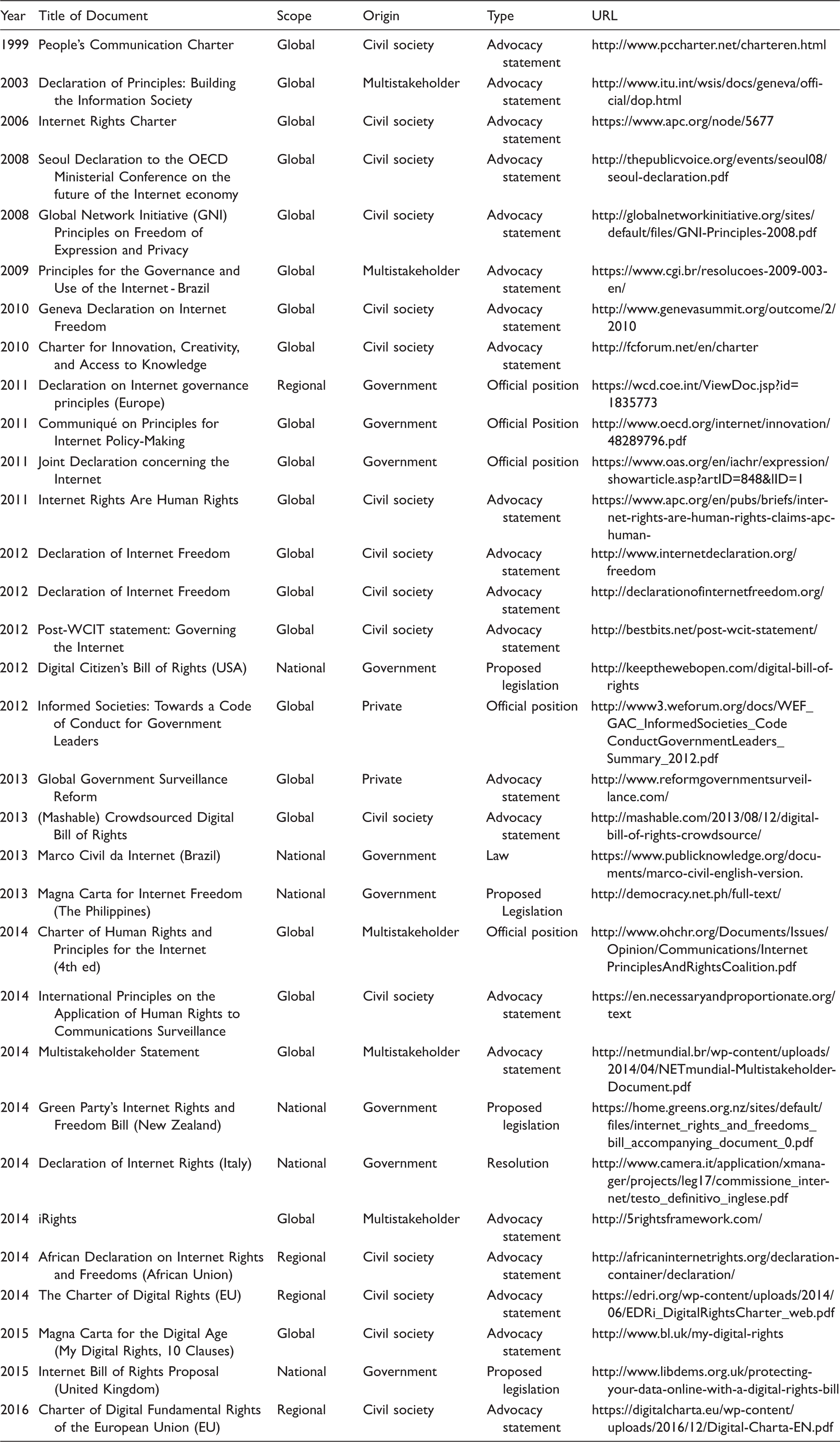
List of documents included in the data set.
Substantive content
Trends in content over time
Our data set provides the groundwork to conduct a quantitative analysis of the frequency with which different rights and principles are cited and to analyze those trends over time. At the outset, it is essential to state that the frequency with which a right or principle appears will not fully capture its importance in all cases; for example, the right to be forgotten—a hotly contested topic in the Internet governance community—appears only four times in the full set of initiatives. Nevertheless, as a general rule, the values, which occur most frequently, are more likely to represent the rights and principles, which is perceived to be most fundamental, and may help to uncover areas of emerging consensus. In this section, we present findings which highlight those rights, which are most frequently articulated, those which appear to be areas of emerging interest and development, and those that have failed to gain momentum over time.
Of the 30 documents analyzed, three distinct rights stand out most prominently by far. We observe that (1) freedom of expression and (2) privacy rights are addressed the most frequently (29 and 28 times respectively) closely followed by the right of access to the Internet (26 occurrences). These issues are rooted in some of the earliest initiatives studied, and continue to persist even in the most recent documents. Transparency and openness, both of Internet governance processes and of networks, were also cited as core principles in over two-thirds (24) of the documents. Given its intimate connection to freedom of expression, it is not surprising that more than two-thirds (23) of the initiatives also explicitly seek to recognize freedom of information as a distinct right. Conversely, certain rights which would appear fundamental in a broader human rights context (such as freedom of religious belief, which appears only twice) receive little attention in the digital constitutionalism conversation.
We have also explored trends over time in order to better understand the possibility of historical change. In some cases, time-based trends are inconclusive. We notice, for example, that the right to freedom of religious belief was cited only twice over the 16-year timeframe of this study: once in 2003 and once again in 2014. Similarly, a right to Internet access in the workplace appears sporadically: once in 2002, a second time in 2008, and finally in 2014. However, in other cases, we see a much clearer development over time. For example, 2009 was the first year that intermediary liability was mentioned as an issue or principle in any of the documents, but it has appeared frequently and consistently since. Similarly, device-related rights arise several times in the data set, but were only first explicitly mentioned in 2010. We also observe certain relationships between themes: the right to control and self-determination over one's personal data first appeared in 2010 and has consistently increased in prominence in the years that followed. The right to be forgotten, in some ways a logical extension of that self-determination principle, emerged for the first time in 2014, seemingly in parallel. We also observe that certain rights and principles appear to coincide with the nature of the documents in question; for example, the right to due process is most likely to appear in documents that aspire to become or instigate domestic and regional legislation and policy.
Impact of political developments
There is a relationship between the political contexts from which an initiative arises and the shape, scope, and form it ultimately takes, including its substantive content. Because efforts toward digital constitutionalism seek to change or influence the policy landscape in some fundamental way, we expect that certain substantive rights and principles will be more clearly articulated at critical historical junctures. We predicted that we would see such a trend following one case in particular: the disclosures in 2013 by Edward Snowden. Interestingly, while we observe little discernable trend in the number of initiatives which seek to advance generalized privacy rights following the 2013 Snowden disclosures, our data indicate substantial increases in a number of ‘peripheral’ privacy rights and principles. In particular, we see marked overall increases in the occurrence of the right to data control and self determination, the right to anonymity, the right to use encryption, and the right to explicit protection from government surveillance. Our hypothesis, borne out at least in a preliminary way by this data, is that while the perceived importance of privacy rights (already high in 2013) was not substantially affected, they are now being articulated in much more specific, sophisticated and nuanced ways than they have been in the past.
This historical moment also provides an excellent case study to examine the underlying motivations which drive efforts of digital constitutionalism. Overwhelmingly, the initiatives published following the leaks speak either explicitly or implicitly to the issue of mass surveillance, pointing to the idea that there is perhaps the greatest interest in digital rights and freedoms when they are perceived to be at risk. Of the 15 documents published from 2013 onward in our study, 13 of them address the topic of mass online surveillance directly; for example, the coalition behind Global Government Surveillance Reform demands that ‘enforcement and intelligence efforts are rule-bound, narrowly tailored, transparent, and subject to oversight’. Similarly, the Charter of Human Rights and Principles for the Internet insists that ‘everyone has the freedom to communicate without arbitrary surveillance or interception (including behavioural tracking, profiling, and cyber-stalking), or the threat of surveillance or interception’. The International Principles on the Application of Human Rights to Communications Surveillance is even more explicit, arguing that human rights law must adapt to modern surveillance technology, and that ‘[n]othing could demonstrate the urgency of this situation more than the recent revelations confirming the mass surveillance of innocent individuals around the world’.
This tendency to reflect pressing political issues is not unique to the Snowden revelations; other critical debates in the history of Internet governance also emerge at predictable moments. For example, the principle of network neutrality is first asserted in 2006, just as major institutions in the United States including the Federal Communications Commission, the Supreme Court and the Senate begin to tackle the issue (Public Knowledge, 2015). Similarly, the World Economic Forum explicitly names ‘Wikileaks and other forced transparency initiatives,’ as an influential factor underlying issues of transparency and openness in the digital age following a major series of critical diplomatic cable leaks (Informed Societies: Towards a Code of Conduct for Government Leaders). Issues at the core of Internet governance—whether debates surrounding digital copyright reform, trends in cybersecurity, and the relationship between technology firms and the state—all invariably find their way into these documents over time, forming milestones along the path of digital constitutionalism.
Actors in digital constitutionalism
By examining the actors behind the documents, we better understand the origins and function of documents of digital constitutionalism. About two-thirds of the 32 documents can be characterized as advocacy statements, seeking to influence official policy and legislation, five represent current or proposed legislation and another five are best described as non-binding official positions or policy statements from state, regional, or international governmental bodies (see Table 1). We examined the actors that are behind the documents in more detail. While a large proportion of the sponsoring parties are civil society organizations, coalitions of state actors or public international institutions, a smaller number of the documents have been drafted by private sector organizations and industry consortia. Certain actors stand out as exceptionally engaged in efforts toward digital constitutionalism, such as the Electronic Frontier Foundation (EFF) and the Association for Progressive Communications (APC). They have each acted as major sponsors for two of the documents examined for this study, and have been signatories and stakeholders for other initiatives, which is perhaps unsurprising given the nature of their mandates.
A broad and transnational set of actors engages in the conversation around digital constitutionalism. We see documents like the Charter for Innovation, Creativity and Access to Knowledge emerge from a 70-member transnational forum of civil society actors, and, more recently, the development of the NETMundial Multistakeholder Statement. The Internet Governance Forum has also classically acted as a venue for convergence and consensus-building around Internet rights and principles, in particular through the leadership of its Dynamic Coalition on Internet Rights and Principles, formed following the Hyderabad IGF in 2008. This coalition has been responsible for drafting the 2014 Charter of Human Rights and Principles for the Internet and includes over 320 members worldwide. In addition, the Internet governance ecosystem is enriched by working groups and conferences of the Council of Europe, the OECD, the OAS, and the United Nations are present alongside specific fora for issues of Internet policy (outcomes, inter alia: Seoul Declaration to the OECD Ministerial Conference on the future of the Internet economy; Declaration by the Committee of Ministers on Internet governance principles; Joint Declaration Concerning the Internet). Similarly, the African Internet Governance Forum convened dozens of actors on the continent, incubating relationships that ultimately resulted in the African Declaration on Internet Rights and Freedoms. Among private economic actors, we see participation from the World Economic Forum in the form of their Informed Societies: Towards a Code of Conduct for Government Leaders report and their increasing engagement in the Internet governance arena through NETmundial. We also observe willingness from private actors in the ICT sector to engage in coalition building on specific issues—the best example of which is likely the Reform Government Surveillance coalition behind Global Government Surveillance Reform.
Sites of intervention: The changing role of the state
Fundamentally, we observe that initiatives in the vein of digital constitutionalism target the most relevant perceived sites of power, regardless of whether those sites correspond neatly to preordained political boundaries. As issues of power on the Internet have become more complex, global and diffuse, the target of initiatives toward digital constitutionalism has shifted in parallel. By the late 1990s and early 2000s, we observe a proliferation of documents with an explicitly focus on global governance rather than inter-state relations, including the People's Communications Charter in 1999, the first draft of the Internet Rights Charter in 2001–2002, and the Declaration of Principles in 2003. These documents evoke the language of international treaties, conventions, and formal declarations, speaking to the broad policy implications at the intersection of digital technology and human rights. Periodic efforts targeting the global community have continued to develop over time, emerging from small technical working groups and global conference audiences alike. Sir Tim Berners-Lee, the inventor of the World Wide Web, has also publicly called for a ‘global constitution’ for the Internet as part of a global initiative called the Web We Want [emphasis is the authors’].
More than two-thirds of the initiatives reviewed in this study are global or international in scope (22 of 32) and they continue to be by far the most prominent and widely available efforts toward digital constitutionalism. Given the nature of the private sector leadership and the lack of state regulation in the early days of the Internet, Internet governance had time to develop a transnational and multi-stakeholder character. Benefits of a global approach are evident for both multinational corporations and civil society advocates in various countries. Thus, the desire to reject a fragmented approach in favor of a set of generalized and universal principles makes a certain practical common sense. Similarly, the perception that these rights and principles are fundamental to Internet governance tends to run in parallel to the sense that they should transcend national borders. However, two trends suggest that the perceived sites of power—and, correspondingly, the respective targets of efforts toward digital constitutionalism—are neither as universal nor as global in scope as they may have been in the early 2000s. First, we see a relatively recent emergence of initiatives which specifically target the private sector. Second, we observe a new trend toward efforts to articulate digital rights and principles at the level of domestic and regional politics.
By the late 2000s, we observe the emergence of several ‘Bills of Rights’ documents tailored specifically toward these new private actors. These documents identify corporations as the central locus of power and users—rather than citizens or another constituent community—as primary rights-holders. We see this in examples such as the Bill of Rights for Users of the Social Web (McCrea, 2007), and in the 2010 Social Network Users’ Bill of Rights, a document triggered by major privacy policy changes at Facebook and Google that year (Gagnier and Margossian, 2011). By 2012, even major international bodies had begun to direct considerable effort toward understanding the complex relationship between human rights and the privately mediated digital sphere (Council of Europe, 2012). The Electronic Frontier Foundation (EFF) has also been a leader in this arena, with a pair of aspirational ‘Bill of Rights’ documents demanding greater privacy for social network users in 2010, and for mobile application users in 2012 (Electronic Frontier Foundation, 2010, 2012). These documents are concerned with the exercise and limits on private power in virtual communities and private social networks, in the spirit of what Nicolas Suzor has also called ‘digital constitutionalism’—though the definition he sets out is markedly narrower than the one adopted in this article (2010; see also Fitzgerald, 1999). We observe that initiatives directed toward private sector actors are more likely to be issue-specific rather than meaningfully comprehensive, seeking to address and remedy particular grievances. Moreover, the rights articulated by such documents tend to be thematically in line with what Todd Davies has described as ‘user data freedoms,’ those rights which are managed by the (typically private) software platform or environment, e.g. privacy or creative control (2014).
In addition to these private targets, in recent years, we have observed a new and somewhat remarkable phenomenon. Of the 32 documents in our data set, four initiatives have a distinctly regional scope (specifically, the African Declaration on Internet Rights and Freedoms, the Council of Europe's Declaration of Internet Governance Principles, The Charter of Digital Rights and the Charter of Digital Fundamental Rights of the European Union), and six speak to specific national constituencies (Marco Civil da Internet; Magna Carta for Philippine Internet Freedom; Declaration of Internet Rights; Green Party's Internet Rights and Freedom Bill; A Digital Citizen's Bill of Rights; Internet Bill of Rights Proposal). From Brazil to the Philippines, national political actors have begun to codify these formerly visionary, aspirational principles into binding legislation and state-level declarations. This trend represents the full departure from the libertarian demands of activists of the early days of the Internet and particularly of the ‘Declaration of Independence of Cyberspace’ (Barlow, 1996). Proposals to enshrine digital rights and freedoms in law and state policy have spanned the ideological spectrum: from Pirate Party members in the European Parliament and Greens in New Zealand to UK Liberal Democrats and US Republican Congressmen (Anderson, 2009; Green Party's Internet Rights and Freedom Bill; Internet Bill of Rights Proposal; A Digital Citizen's Bill of Rights). In Italy, where a ‘constitution for the Internet’ had been proposed at least as early as 2006, the development and adoption of the Declaration of Internet Rights (Dichiarazione dei diritti in Internet) as a resolution by the Italian parliament have been an ambitious and far-reaching state endeavor (Rodotà, 2006). This trend suggests that states are increasingly perceived as a site of power and influence over Internet governance, and that more intervention at the level of domestic policy is to be expected. Along with an increased codification of Internet rights at the state level, the ability to make a distinction between ‘legally binding standards’ and ‘aspirational principles’ will invariably have an impact on the digital constitutionalism landscape (Jørgensen, 2013).
In Europe, recent regional attempts to entrench digital rights include the Charter of Digital Fundamental Rights of the European Union. That initiative aims to establish itself alongside already existing regional guarantors of civil rights, like the Council of Europe's European Convention of Human Rights and the Charter of Fundamental Rights of the European Union. The document is characterized by a strong emphasis on the rule of law and goes beyond aspirational principles toward a legalistic approach. Another European initiative, the Charter of Digital Rights, seeks to embed digital rights into EU legal frameworks. Drawn up by a group of civil society organizations led by European Digital Rights (EDRi) and including Article 19, EFF, and Digitale Gesellschaft, the document sought pledges from EU candidates ahead of the 2014 election to adhere to 10 principles set out in the Charter (on the website wepromise.eu).
Conclusions and research agenda
In this article, we have examined an ongoing conversation regarding the scope of rights and freedoms on the Internet, proposing the concept of digital constitutionalism as a shared framework. We understand such documents to seek to comprehensively articulate a set of political rights, governance norms, and limitations on the exercise of power on the Internet. The initiatives are authored in an inter-subjective process and aim to entrench rights into a global, regional or national order, including but not limited to international treaties and national legislation. Our conclusions are obviously limited by our research intentions and the criteria for inclusion that we use to define the conversation of digital constitutionalism.
We noticed that the relative quantitative occurrence of certain rights could provide us with tentative insights concerning the mindset of the documents’ authors and their situation. Changes in the body of rights and principles are likely driven by the political and technological realities of the day, as we demonstrated. In general, instead of dealing with the nuts and bolts of drafting legislation, digital constitutionalism as a societal constitutionalism allows to think about the ‘ideal’ Internet (see e.g. Graber, 2017; Teubner, 2012). The discourse thus provides an opportunity for action-oriented political philosophizing, having to collectively weight often-conflicting rights and principles. Even if non-binding, these documents can be influential, as they become a rallying point for civil society, media and politicians, and judges can take them as a point of orientation where no legislation exists.
We offered an overview of the core actors and deliberative processes driving efforts toward digital constitutionalism and noted the tendency toward open, participatory, and multistakeholder fora throughout the data set. These deliberative processes, the values embedded within them, and how those values connect to policy outcomes are all issues which merit further study. In particular, while we see a trend toward openness and inclusion, there are nevertheless challenges around issues of meaningful representation and democracy in a multistakeholder context (see e.g. Chenou, 2011; Doria, 2014). In order to better understand the outcomes, i.e. the text body of the documents, it will be necessary to study the genesis of such initiatives critically and from a close distance. In other words, a careful examination of which voices are excluded, marginalized, or perhaps artificially amplified through these processes is required (Gasser et al., 2015). An examination of the motivations and strategies of various actors as well as the degree to which the constitutionalization of the Internet is intended, requires in-depth and focused qualitative research.
We sought to identify historical trends in digital constitutionalism, observing that efforts seek to intervene in a way, which generally conforms to perceived sites of power and authority. We have seen a trajectory from informal, non-binding and aspirational initiatives toward more concrete, sophisticated proposals, some of which have ultimately taken the form of binding legislation or state declarations, illustrating Teubner's three phases of societal constitutionalism (2012). An exploration of how these initiatives fit into existing hierarchies of legal norms and principles over time will also support a more developed understanding of where digital rights are best situated in the human rights landscape.
Footnotes
Acknowledgements
We would like to thank our two anonymous reviewers and the guest editors for their helpful comments. We are thankful for valuable feedback from Wolfgang Schulz, Rosemary Leith, Christoph Graber, and the participants of a workshop on digital constitutionalism at the Association of Internet Researchers Conference 2016 in Berlin. In addition, we would like to recognize previous efforts to collect digital bill of rights by Rebekah Heacock Jones, Claire McNear and Mayukh Sen at the Berkman Klein Center for Internet & Society.