



Abstract
A developing literature on the securitisation of immigration documents the prominence of security-based framing, but its prevalence has not been systematically established in Central and Eastern Europe through an analysis of the relative importance of various immigration-related frames. Using content analysis, this study tests the securitisation of the immigration thesis in the coverage of the refugee crisis between 2013 and 2016 in Czech and Slovak media (N = 7,910), in particular focusing on frame variation over time, and on differences between quality and tabloid media. The results reveal that the security-threat frame is the dominant frame, while economic framing is significantly less frequent in regard to the topic. While both quality media and tabloids employ the security-threat frame often, it is significantly more prominent in tabloids. In sum, these results confirm the existence of a pre-eminent securitised interpretation of immigration in the region during the crisis.
Over the past decades, immigration has become one of the main challenges for the governments of the European Union (EU) member states and one of the most salient and controversial political issues in Europe. Although migration towards the EU has already been an issue at least since the early 2000s, immigration has become an even more pressing issue as the number of immigrants arriving at the borders of the EU has been notably increasing since 2013. This has been further exaggerated when in both 2015 and 2016, more than 1.2 million asylum applications have been lodged across the EU. In the contemporary era, migration policy-related issues are increasingly central, generate much public discussion and should be systematically scrutinised from various angles. Such systematic scrutiny can take different forms, and one way to carry out such a scrutiny is to focus on the reflection within the public sphere.
Of course, not all policy fields are equally likely to get media attention. It is politically contested policy fields that are particularly prone to media and public attention. In the EU, immigration policy has been such a politically contested field at least since 2013. The significant increase of people arriving in Europe came to be represented as a ‘refugee crisis’ characterised by uncertainty about its political, societal and economic connotations. Immigration policy started to be extremely politically contested with diverging positions of different EU member states as to the right solutions of the crisis and therefore it became an ‘intractable policy controversy’ (Dekker and Scholten, 2017). Issues related to the crisis gradually acquired a high media visibility, and its complexity granted ample space for the media to shape the understanding of who the incoming people are and what their arrival means.
Media can be particularly significant in this respect as beyond everyday experiences, citizens mainly learn about immigration in a more indirect way through the media. In times of uncertainty and crisis, they constitute the most important arena for public debate on politically pertinent issues (Bennett et al., 2004). Scholars also often point to the relevance of the media in shaping the political discourse surrounding immigration (Boomgaarden and Vliegenthart, 2009). An investigation into the ways media frame immigration can allow us to develop a clearer understanding of the language they use and can therefore provide us with important information about the nature of this debate.
A variety of studies has analysed media coverage of immigrants in European countries (D’Haenens and Lange, 2001; Gabrielatos and Baker, 2008; Helbling, 2014). Much of this literature suggests that immigrants are increasingly portrayed in terms of a security narrative, namely either as a physical and/or economic threat or as a threat to national identity (Innes, 2010). In particular, research investigating the change of media coverage of immigration over the long term in Western Europe documents a shift away from the traditional economic narrative prevalent following the ‘Gastarbeiter’ era to a security-based narrative that links immigration to, inter alia, crime, public order and terrorism (Benson, 2014; Sciortino and Colombo, 2004). The economic framing of immigrants has therefore been superseded by a common frame centred on security (Buonfino, 2004).
Most of this literature is, however, limited to a single European country, a short time span, or focuses on different time periods without a common methodological focus. In particular, scholars almost exclusively focus on Western European countries and leave Central and Eastern European countries (CEECs) aside. This is particularly surprising as the CEECs happened to be the most outspoken critics of the EU refugee relocation mechanism and they are generally sceptical of their ability to host refugees. As a result, it is difficult to assess whether the common European-wide security-based framing of immigration also prevails in these counties. We evaluate these arguments concerning the media framing of immigration by investigating whether there is a stronger tendency to frame it in security terms than in economic terms in CEECs. Comparing the media coverage in Czechia and Slovakia concerning the same issues during the same period of time, this contribution provides a unique cross-national investigation of media coverage of immigration in CEECs.
Through the use of content analysis, we analyse the framing of immigrants employed in the coverage of the crisis between 2013 and 2016 in Czechia and Slovakia (N = 7,910). The article explores three specific research questions: Are immigrants framed in the media predominantly in security terms, or is economic framing of the issue comparatively common? Was there a temporal variation in the framing as the crisis progressed? Is the conventional distinction between quality/broadsheet media and commercial/tabloid media 1 reflected in their framing? This study is innovative as it (a) is among the first to systematically tackle the media framing of the crisis over a long period of time and a large sample of media, (b) focuses on the largely omitted CEECs and (c) applies a methodology comparable to that of a study conducted on a sample of Western European countries (cf. Caviedes, 2015).
Media narratives concerning immigrants
A vast body of work examined how media frame immigration in Western Europe. This research established several key narratives that construct immigrants as innocent victims in need of help and, at the same time, as intruders who pose security, economic, and cultural threats to the respective host country (Innes, 2010; Quinsaat, 2014; Van Gorp, 2005). Scholars therefore identified four immigration-specific ‘master-frames’: a human-interest frame, a cultural-threat frame, a security-threat frame and an economic frame.
Studies which examined media portrayals of immigration over a long period of time, found that during the 1970s and 1980s it were represented primarily in terms of the economic and human-interest frame (Benson, 2014; Sciortino and Colombo, 2004). Since the 1990s it was represented increasingly in terms of the security-threat frame, which has become the pre-eminent frame by the 2000s (Benson, 2014). Today, the security-threat frame is the most frequent way of portraying immigrants and prevails over other frames (Buonfino, 2004). While the trend of dominant security-threat framing has been documented for a number of countries across Western Europe and North America (e.g., Greussing and Boomgaarden, 2017; Innes, 2010), most of the studies focused on a single country, or a small number of countries, and on different time periods, and their methodologies varied. As a consequence, it is difficult to assess the general prominence that media in different countries give to competing migration-related frames.
Even more importantly, scholars practically exclusively focused on Western European countries and left CEECs aside, probably because they were not destination countries for immigrants. The role of the CEECs has changed during the crisis as they became important transit countries and potential destination countries for refugees a result of the relocation mechanism adopted in September 2015. Identifying whether there is a common European portrayal of immigration along the dominant security-threat line requires an examination of this trend in these countries as well. Also, accurately picturing long-term trends in immigration framing requires investigating media coverage over a longer period of time, which few studies documenting the prevalence of security-threat framing have done (cf. Helbling, 2014).
To examine whether there is a prevalent security-threat framing of the crisis in CEECs, we investigate Czechia and Slovakia over a long period time (2013–2016) overlapping with the crisis. The empirical analysis reveals whether the security-threat frame was the dominant portrayal of immigrants in the unprecedented crisis context. Also, to make a comparison to Western Europe easier, we follow, in principal, the methodological approach adopted by Caviedes (2015) who applied it to France, Italy and the UK.
Czechia and Slovakia and the refugee crisis
To contextualise the analysis, we briefly outline the crisis from the perspective of Czechia and Slovakia as well as their previous immigration experience. In modern history, the societies of the two countries have practically no first-hand experience with migration except for the limited number of refugees that came from the Western Balkans in the late 1990s (Drbohlav, 1994). Also, their societies are racially and, in the case of the Czechia, also ethnically homogenous. Immigrants, particularly those from the Middle East and Africa, are therefore easily ‘othered’ on the basis of racial arguments (Ford, 2011; Leudar et al., 2008). Next, due to not having a colonial past, they have no sense of ‘historical obligation’ concerning accepting immigrants from former colonies. At least in Czechia, the development of migration policy has been driven by and centralised within the Ministry of Interior, and characterised by a control approach and a dominant perception of a security threat posed to the Czech state (Kušniráková and Čižinský, 2011).
In both countries, the numbers of asylum seekers remained relatively low during the 2000s and they have been decreasing from 2004 until the outbreak of the crisis with record lows of 707 asylum applications in 2013 in Czechia and 491 applications in 2011 in Slovakia (Ministry of the Interior of the Czech Republic, 2016, Ministry of the Interior of the Slovak Republic, 2017). After the outbreak of the crisis, the number of applications slightly increased in Czechia (with 1,525 applications in 2015) and further decreased in Slovakia (with 330 applications in 2015). Compared to some other EU member states, these are negligible numbers and the direct impact of the crisis has been minimal in the two countries. Also, only 148 asylums were granted in Czechia and 167 in Slovakia in 2016. This again points to the highly restrictive immigration policy of both countries compared to Western European countries and, by extension, to the anti-immigration atmosphere within their societies. In fact, Eurobarometer opinion polls consistently document that both countries belong among the EU member states whose populations are least comfortable with immigrants (European Commission, 2016–2017, 2018).
As these figures suggest, the two countries were not destination countries of asylum seekers during the crisis. Moreover, in contrast to their neighbours (Hungary, Austria) they did not become main transit countries for immigrants on their way to their destination countries throughout the crisis even as dozens of immigrants transited through their territories. In spite of these trends, the crisis raised significant tensions, and the political elite as well as the general population strongly opposed any EU-level mandatory burden-sharing mechanism. This opposition was so strong that it resulted in a legal action brought by Slovakia and Hungary against the mechanism.
Until the outbreak of the crisis immigration was rarely discussed in the media. Only as it progressed did the media intensify the discussion of immigration, and some preliminary analyses document a 10-fold increase of coverage of immigration (Tkaczyk et al., 2015). The amount of items reporting on the crisis followed the changing numbers of asylum applications across EU countries (Tkaczyk, 2017). Finally, existing studies of online news coverage of the crisis in Czechia between June and October 2015 document a prevalence of administrative and security threat framing at the expense of other narratives. The main sources of news were government officials, while migrants were marginalised in the coverage (Tkaczyk, 2017).
Research design
We build on the framing theory, which defines frames as schemes of interpretation whose central dimensions are the selection, organisation and emphasis of certain aspects of reality to the exclusion of others. In other words, framing is the process of selecting ‘some aspects of a perceived reality and mak[ing] them more salient in a communicating text, in such a way as to promote a particular problem definition, causal interpretation, moral evaluation, and/or treatment recommendation’ (Entman, 1993: 52). By omitting some features of reality, highlighting a subset of potentially relevant considerations, framing leads us to ‘develop a particular conceptualization of an issue or reorient [our] thinking about an issue’ (Chong and Druckman, 2007: 104). Frames have four main functions: they (a) define problems by determining what a casual agent is doing; (b) diagnose causes by identifying the forces creating the problem; (c) make moral judgements by evaluating causal agents and (d) propose solutions by offering and justifying treatments (Entman, 1993: 52).
From a sociological perspective, frames are not only important cognitive devices for organising, interpreting and evaluating information. By embedding events and issues they also serve as instruments structuring the social reality (D'Angelo and Kuypers, 2016: 5–6). Framing traditionally refers to a three-staged process: the construction of information by elites, the application of frames by the media and the impact of frames on opinion. In this contribution, we focus on the second stage and consider frames as manifest characteristics of media discourse. Importantly, frames are never pregiven or included in the event that is turned into a news item by a journalist (Van Gorp, 2005). In covering an event, the media unavoidably make sense of it by framing, and how this is done is not incorporated in the event itself. In covering immigration the media inevitably represent the issue from a certain frame and employ a particular interpretational lens, thus providing a specific understanding of what it stands for (Van Gorp, 2005).
While most of the initial research within the framing theory focused on generic frames, our approach follows the recent turn to investigating the relevance of issue-specific migration ‘master frames’ in media coverage. There are generally two methods to identify frames in news items. The deductive approach derives frames from the literature and codes them in a standard content analysis. The inductive approach identifies frames from the corpus itself; the frames are derived from dimensions such as syntax, script, theme and rhetoric (Quinsaat, 2014). Despite the obvious limitations of the deductive approach – that we can miss newly emerging frames – we build on this approach as we aim to measure the extent to which two selected immigration ‘master frames’ occur in media coverage.
One of the problems of studies on the relative visibility of migration-related frames is that migration is commonly securitised along three axes: as a hard security threat (terrorism and crime), as an economic threat (welfare and the job market) and as a threat to national identity (Innes, 2010). However, these axes all still depict migration as a (security) threat, and they are thus very much interlinked. The problem of a number of studies on the relative frequency of, say, the economic frame and the security-threat frame is that the security-threat frame often encompasses aspects of the economic frame. For content analysis, this is a fundamental problem as coding categories have to be mutually exclusive in order to ensure reliable inferences. The analytical distinction between these two frames is thus misleading if this problem is not corrected in the research design. We try to overcome this in our study by limiting the security-threat frame to hard/physical security and thus making it distinct from the economic frame.
Summary of analysed TV channels and newspapers according to the type of outlet.
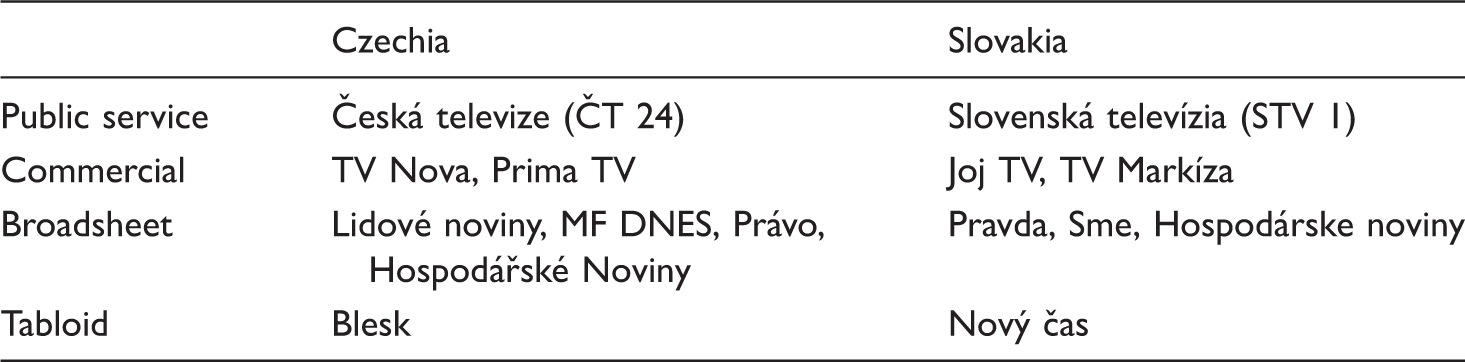
Number of news items in the data set per country and media outlet.

We include both tabloids and quality press in the study since previous research demonstrated that their framing practices are distinct. On average, tabloids harbour more negative and security-based views on immigration than quality media (Gabrielatos and Baker, 2008; Van Gorp, 2005). We thus aim to look into whether the publics were presented with different immigration discourses through different media by examining the extent to which quality and tabloid media differ in employing the two frames. The examined period ranges from 1 October 2013 to 31 December 2016. This period was selected for several reasons. First, it allows for an examination of media coverage of immigration over a long term and thus it allows us to overcome the problem of most studies which cover only a short time span. Second, on 3 October 2013 a boat carrying immigrants to Italy sank off the Lampedusa island, and in the public discourse it has marked the outset of the crisis. Second, 2016 saw a significant drop of incoming immigrants compared to the previous three years. The whole period thus covers the crisis from escalation, through climax, and to de-escalation.
All the news items were downloaded from the NEWTON Media database, which archives media transcripts for both countries. The stories were located through an automated keyword search for the words ‘migrant(s)’, ‘migration’, ‘immigrant(s)’, ‘immigration’, ‘asylum’, ‘refugee(s)’ and ‘asylum seeker(s)’ in the header or the main body of the text. In a bid to analyse only coverage that predominantly deals with immigration, articles were only included in the data set if at least one of the search terms occurred at least twice in them. Quantitative content analysis was used to determine the framing of immigrants. The six coders, all of whom were graduate students, were fluent in the languages of the texts and read all the stories in their entirety. During the process of reading, stories not dealing with the crisis were sorted out. The coding instructions were strictly formulated in order to restrict the coding to the manifest content as much as possible and limit the space for independent interpretation. After introducing the coders to the coding instructions, we reviewed the initial coding together with the coders upon the completion of the analysis of the first 20 items to ensure uniformity.
Frames as general organising devices are often confused with general topics and specific policy positions (Reese, 2016). The key issue thus relates to how frames can be detected in media reporting as independently of the researcher's perspective and as reliably as possible. In this article, frame identification is based on Entman's (1993: 52) function frames. In this perspective, frames can be identified by the presence of specific reasoning and/or framing devices. Framing devices include, inter alia, metaphors, anecdotes, catchphrases, keywords, visual images, historical examples, labels, lexical choices, selection of sources, graphics and stereotypes (D'Haenens and Lange, 2001). Reasoning devices are connected to the four earlier discussed functions of framing. They include causal attributions, consequences and appeals to principles that do not need to be explicitly included in a mediated message (Quinsaat, 2014).
Frames with their representative reasoning and framing devices.
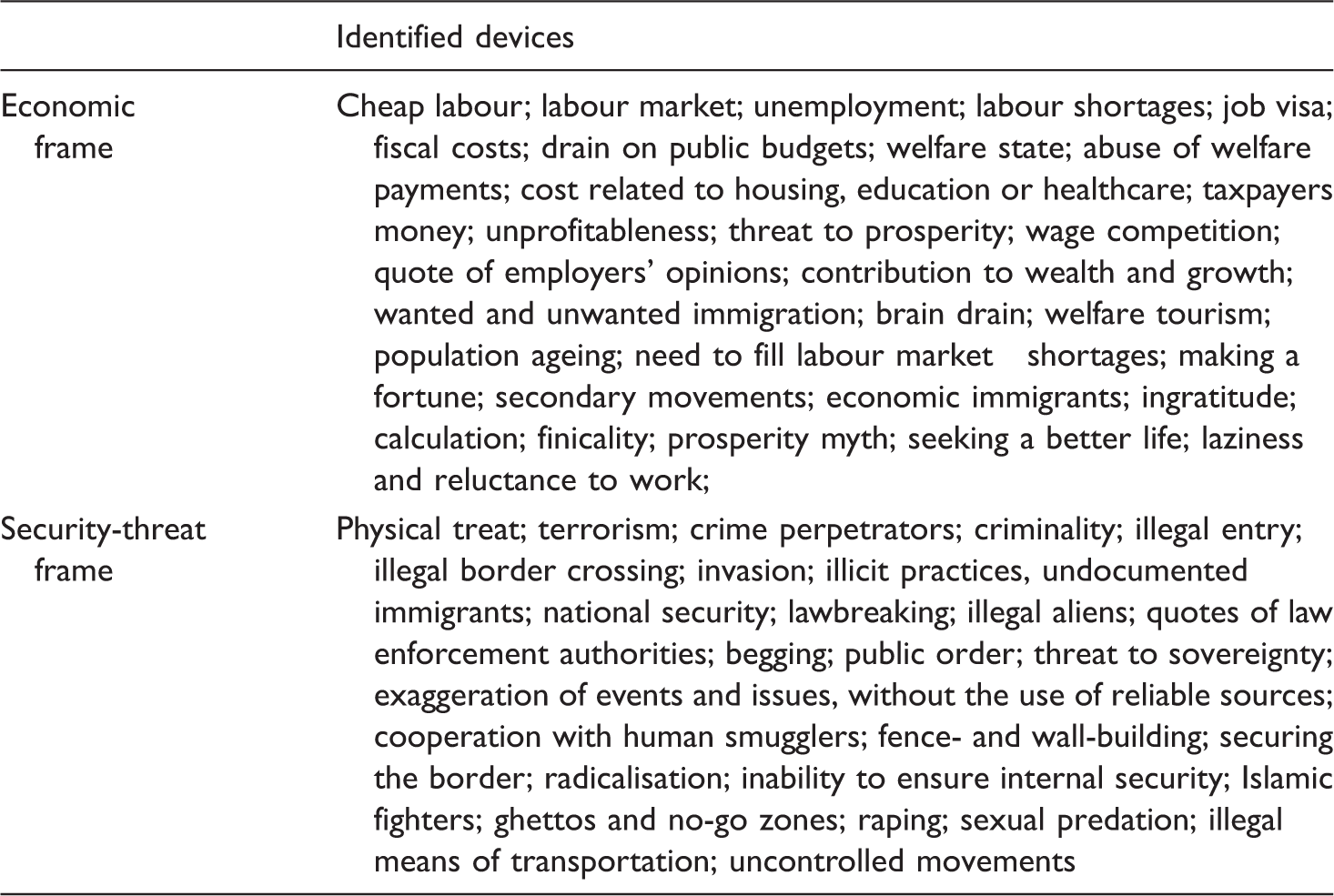
Based on the coding instructions, we looked at all stories and measured the extent to which the two frames appear in them. The prevalence of each frame was examined using individual items rather than individual framing/reasoning devices as the unit of analysis since a story can include more than one frame (Entman, 1993). By using individual articles as the unit of analysis, we obtained frequency counts of the two frames within the whole data set. In the following section, the frequencies are compared in terms of their percentage of the total number of immigration-related stories featuring a particular frame rather than in absolute numbers since the numbers of stories differ across individual media outlets. The data set was analysed not only synchronically to see the differences between quality and tabloid media, but also diachronically in order to reveal the frame variation over time. The reasons for these methodological choices lie in the aim to keep this study as comparable as possible to the previous research on immigration framing in the British, French and Italian press (Caviedes, 2015), and thus to remedy the issues of a lack of a common focus in terms of methodology, and a lack of comparability of results across countries.
Finally, while our aim was primarily to select under-researched CEECs as the examined cases to allow for a comparison with framing patterns in Western European countries, the selection of the two countries was also driven by other strategic reasons related to the two countries themselves. Although Czechia and Slovakia are often treated as most-similar cases, there are a number of differences between the two countries in relation to migration and the EU that justify selecting these two countries as two different cases that could be compared (Gerring, 2007). First, although large parts of the two societies embody a low level of comfort with immigrants, opinion polls show that Czechs are still substantially more hostile towards immigrants than Slovaks (European Commission, 2018). At the same time, the part of Czech society that considered migration as the most important problem during the crisis was significantly larger than the corresponding part of Slovak society. Also, Czechs have shown that they have the lowest support for and highest opposition towards the common European policy on migration, while Slovaks ranked much closer to the EU-28 average in this respect (European Commission, 2016–2017). Second, each year Slovaks consistently exhibit a stronger satisfaction with their country's EU membership than Czechs (see Standard Eurobarometer 62–88).
Third, besides the differences in public opinion towards the EU the two countries and their elites have adopted different paths and strategies within the EU, such as membership in the Eurozone, but also in relation to other EU issues (Kovář and Kovář, 2014). Fourth, available studies show that Czechia has an even more restrictive immigration policy than Slovakia, which may affect the Czech media portrayal of immigrants (Scipioni and Urso, 2017). Finally, although it is not a strategic reason behind the case selection, we were also limited by our own and the coder's language proficiency allowing us to select only a limited number of CEECs. In any case, we believe that the above-mentioned differences may have an impact on the media portrayal of immigrants since previous research shows that the media coverage of the crisis is related to the decision making in the EU, its handling of the crisis and the solutions adopted to remedy it (Greussing and Boomgaarden, 2017; Tkaczyk, 2017). We maintain that in the Czech society, which is more hostile towards the EU and immigrants, the media may be tempted to employ security threat frames more often in order to align with the discomfort of the citizens with immigrants and justify the widespread rejection of EU solutions within the society and among political elites. For these reasons, we believe that the comparison of the Czech and Slovak framing patterns is relevant for the goals of the article, in addition to the aim to compare the framing in the CEECs to Western European countries.
Results
Per cent of articles with security or economic frame, both or neither (by country and type of media).
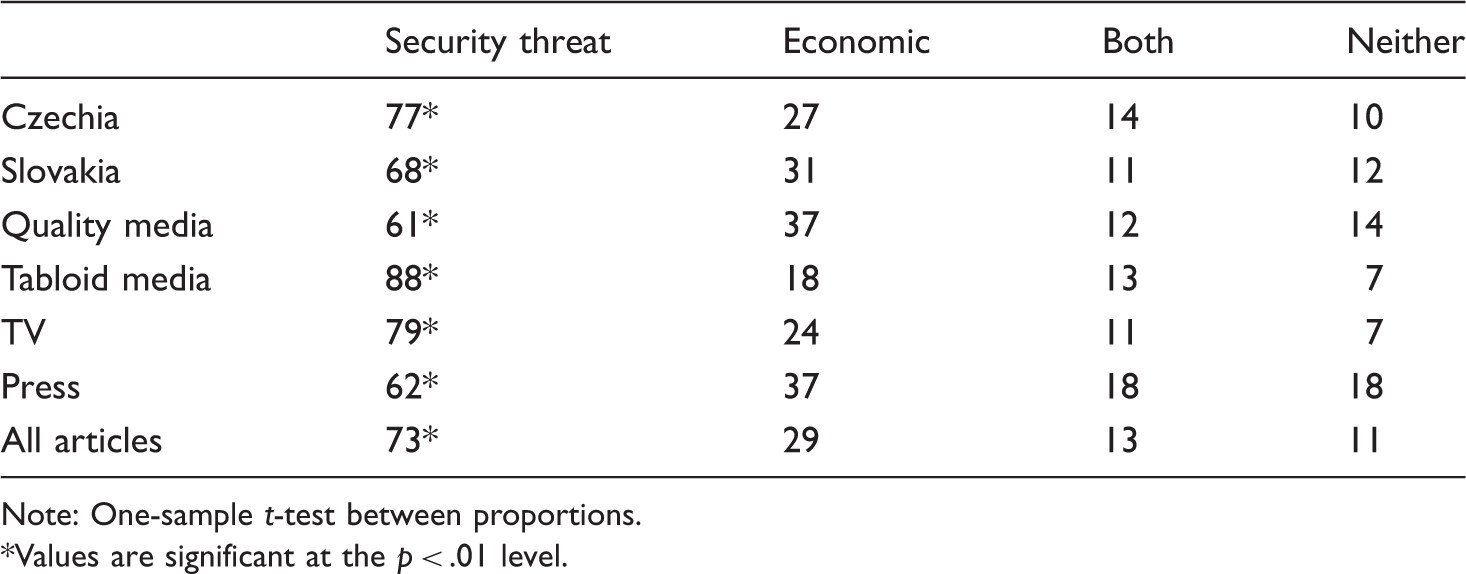
Note: One-sample t-test between proportions.
Values are significant at the p < .01 level.
Aggregating all the news stories (noting that Czechia has 4,301 stories compared to 3,609 for Slovakia), one sees security-threat framing evoked in 73% of the items, in contrast to economic framing, which appears in 29% of the stories. Thirteen percent of the news stories combined both frames, while only 11% of the items evoked neither. Conversely, in 89% of the items, one of the two frames is implicated, illustrating that together they constitute an overwhelming majority of the focus on immigration within the two countries' media compared to other common issues such as humanitarian, cultural or administrative. Table 4 shows that the testing of differences between the proportions of security-threat framing vs. economic framing yields significant differences for Czechia and Slovakia as well as for the aggregate level, indicating that the media in both countries frame immigration more in terms of security threat than in terms of economic consequences. Having established that security-threat framing has garnered significantly higher attention than economic framing, the following paragraphs provide a more detailed, albeit non-exhaustive, exploration of the two frames based on qualitative thematic analysis before moving towards assessing the differences between quality and tabloid media and the sequential framing patterns.
Economic and security-threat framing detailed
While the previous section was based on a quantitative content analysis that looked at which type of framing was more frequent, the following section uses an inductive thematic analysis to find particular themes that feature prominently within each frame. Thematic analysis seeks to unearth the themes salient in a text that emerge as important to the description of a phenomenon (i.e. the frame). A theme refers to a specific pattern found in the data/text (Joffe and Yardley, 2004). The process involves the identification of themes through ‘careful reading and re-reading of the data’ (Rice and Ezzy, 1999: 258). It is a form of pattern recognition within the data with the aim to summarise key features of a body of data/text. Following the convention in thematic analysis, themes were operationalised based on keywords which were structured according to a thematic network and then based on a degree of abstraction to a higher unit (Clarke and Braun, 2014). By employing thematic analysis, we attempted to uncover underlying patterns/themes in the framing/reasoning devices used within each frame to show which ones feature most prominently as these devices are directly related to the four earlier mentioned framing functions.
The stories evoking the security-threat frame often touch upon a physical threat to the native Czech/Slovak population. The physical threat to the native populace is primarily related to terrorism and, to a lesser extent, to organised crime, and other forms of crime, and the formation of no-go zones, which together lead to a decrease of physical security of domestic inhabitants. Beyond highlighting specific crimes such as drug-related crimes, human trafficking or terrorism, the media coverage commonly simply relays the invectives of politicians from right-wing parties, such as Freedom and Direct Democracy in Czechia and the People's Party – Our Slovakia in Slovakia, who invoke crime as an activity that is common for immigrants and link terrorism with immigration in vague terms.
The physical threat to the host societies is primarily portrayed as a consequence of relaxed border controls and the failed protection of the Schengen's external borders and the resulting opportunity of immigrants to uncontrollably transit through the EU. In the view of the media, the border guards of the frontline member states are to be blamed for the problem as they fail to keep tabs on immigrants after they enter the EU. Many news items make a direct linkage between open borders, national security and the security threat for the host societies. The presented possible solutions included mainly measures such as the reintroduction of internal border controls, reinforcement of Schengen's external borders, the creation of a European Border and Coast Guard, detention of immigrants and building of fences to stop migrant movements.
Comparing the findings from the two countries suggests a specific pattern. While the qualitative design does not allow for statistical testing between the underlying patterns in the employed devices, a tentative analysis indicates that frames related to border protection and controls, terrorism and other defensive measures such as detention of migrants were invoked more often in Czechia than in Slovakia (see also Tkaczyk, 2017). In contrast, the Slovak media more often employed framing devices related to public order, organised crime and criminality in general, illegal border crossing and illegal means of transportation. Moreover, the issue of fence-building was more prominent in Slovakia.
The news stories using the economic frame used framing and reasoning devices mostly related to the abuse of the welfare state and fiscal costs. The dominant narrative here is related to welfare tourism, which has two main facets. First, according to the narrative, immigrants do not genuinely leave their countries because of persecution but come to EU countries in order to abuse their welfare benefits. Second, it portrays immigrants as ungrateful since they are unwilling to remain in their first countries of transit/entry, and cagey because their desired destination countries are those with a generous welfare state. The economic frame also touches upon the fiscal costs connected to the reception of and support for refugees and immigrants and how the state and municipalities are impacted by the rising expense of providing public services. This discussion also identifies a specific type of fiscal costs that are typically, albeit not exclusively, borne by the local government, including the costs of housing, policing, education and health care, in addition to welfare benefits. The worry here is that this will negatively impact the national economy and prosperity, and the native populace will not be provided for.
To a much lesser extent, surprisingly, the economic frame in both countries only occasionally touches upon the threat for the domestic population at the labour market. This is probably a result of the fact that long-term settlement of immigrants in Czechia and Slovakia not assumed. When labour market issues were invoked, their implications were usually framed negatively. The prevailing narrative concerned the negative impact of immigrants upon the labour market, as their settling in the given country would result in job losses for natives and wage depression. Even less present, however, is the narrative related to the ageing of the domestic population and the potential of immigrants to fill labour shortages. Immigrants are viewed as threatening prosperity, increasing unemployment and constituting competition, rather than as being complementary to the native populace and offering an economic contribution.
A tentative analysis comparing thematic patterns in framing devices across the two countries again indicates a discernible pattern. Although country-specific thematic patterns were less clear compared to the security-threat frame, we observed an inclination of the Slovak media to more frequently employ framing devices related to employment, the labour market and wage competition than the Czech media. By contrast, the Czech media thematically frame the economic impact in terms of costs connected to the reception, housing and administration of migrants. Finally, the media in both countries employed welfare state themes in connection to immigration with roughly the same frequency.
Framing of immigrants in quality media and tabloids
Percentual framing scores by media type.
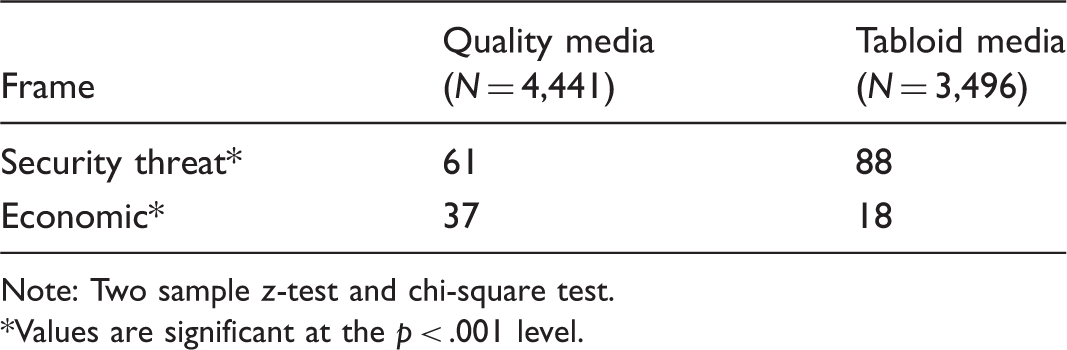
Note: Two sample z-test and chi-square test.
Values are significant at the p < .001 level.
Percentual framing scores by media type and country.
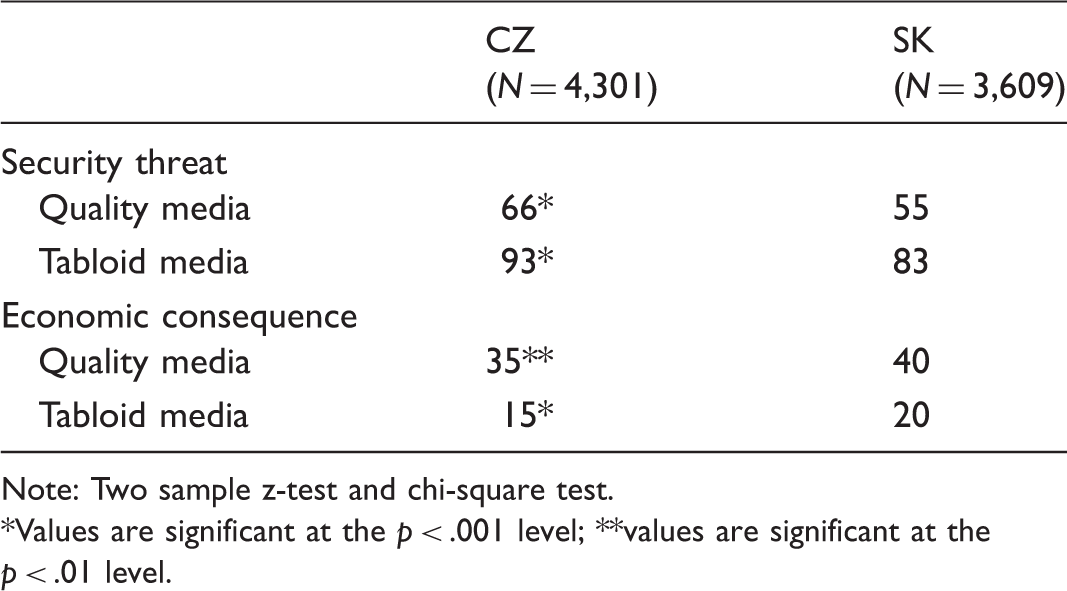
Note: Two sample z-test and chi-square test.
Values are significant at the p < .001 level; **values are significant at the p < .01 level.
Finally, we have also looked into framing differences between television and the press. Table 4 offers an overview of the frequency of the two frames. TV news as well as press articles evoked security-threat framing significantly more often than economic framing. The coverage, however, was more balanced in the case of press articles, with 62% of the articles using security framing compared to 79% of the items in the TV news, while economic frames were used 37% of the time in the press and 24% of the time in the TV news. We also examined the difference between the TV news and press articles regarding the extent to which they evoke the economic frame compared to the security-threat frame. Statistical testing (the z-test and the chi-square test, which are not reported here) yielded a significant difference (p < .001) between quality media and tabloids for both frames, indicating that the TV news use the security-threat frame more often than the press, while the press employs the economic frame significantly more frequently than television.
Media framing research points to the issue of consonance and dissonance of framing patters (Walgrave and Van Aelst, 2006). The prevalence of media frames ranges from domination of one frame (frame consonance) to the coexistence of several frames with roughly equal attention (frame dissonance). To the extent that we can make conclusions from the analysis of the occurrence of only two frames, it can be argued that the media framing of immigration in Czechia and Slovakia embodies frame consonance, as there the security-threat frame is dominant throughout a broad selection of media types and outlets over a long period of time.
Sequential framing patterns
In order to examine the sequential framing patterns over time, we have aggregated the data to a monthly level. Following Greussing and Boomgaarden (2017), the prevalence of each frame is measured in relation to the issue's prevalence, which is defined as the total number of stories on immigrants that occurred in quality or tabloid media in the given month. Figure 1 shows this baseline number of news stories. Immigration was visible only to a quite limited extent from October 2013 through the beginning of 2015. The likely explanation for this stems from the fact that the crisis did not have a direct impact on the two countries, as it was mostly confined to the borderline member states and the neighbouring Western European countries.
Number of articles on immigration and asylum issues per month by media type.
This changed in April 2015, when the issue caught the attention of the media, politicians and the wider public, particularly due to the critical situation in the Mediterranean and the increasing number of incoming immigrants from Greece to Western Europe, who often travelled through the Balkans and CEECs. The highest intensity of media attention to the issue was registered in September 2015 and thereafter the salience of immigration coverage started to decline again. During the climax stage in September 2015, the salience of immigration coverage increased more than sevenfold compared to its salience in 2014. During the entire period, the salience of immigration coverage has basically shifted according to the key events such as the sinking of boats, the holding of European Council crisis summits, the introduction of the refugee relocation mechanism by the European Commission and its subsequent implementation, or the executions of terrorist attacks in Europe.
Figures 2 and 3 display the monthly shares of the two frames for each media type. The sequential framing patterns are highly similar for the tabloid and quality media, yet with higher levels of visibility of the security-threat frame in the tabloids than in the quality media, and higher levels of visibility of the economic frame in the quality media than in the tabloids. In the quality media, moreover, in 38 of the 39 analysed months the security-threat frame prevailed. Only in February 2014 was the visibility of the security-threat frame exactly the same as the visibility of the economic frame. Moreover, in October and November 2014, the visibility of the security-threat frame was only 1.1 times higher than that of the economic frame. During the other months, the security-threat frame prevailed to a larger extent, with the highest disparity between the two frames being recorded in November 2015, March 2016, and December 2016, when the security-threat frame was approximately 2.3 times more visible than the economic frame in the quality media.
Prevalence of security-threat frame in the coverage of quality and tabloid media over time. Prevalence of economic frame in the coverage of quality and tabloid media over time.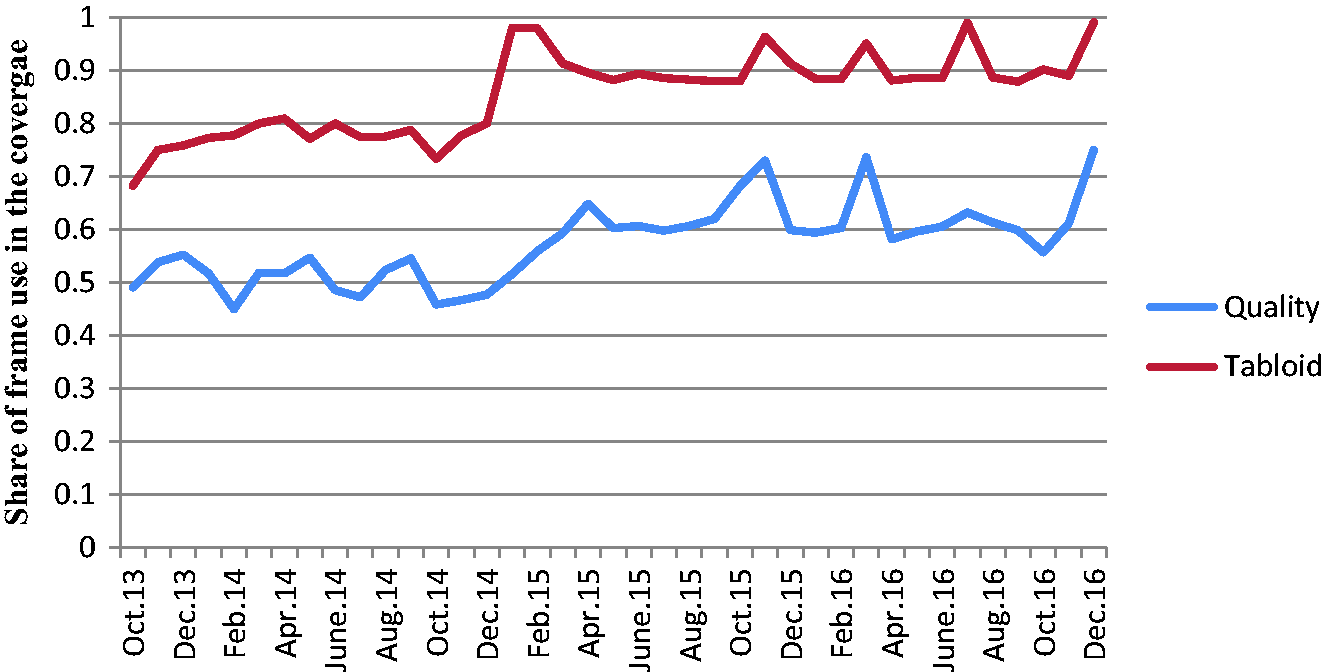
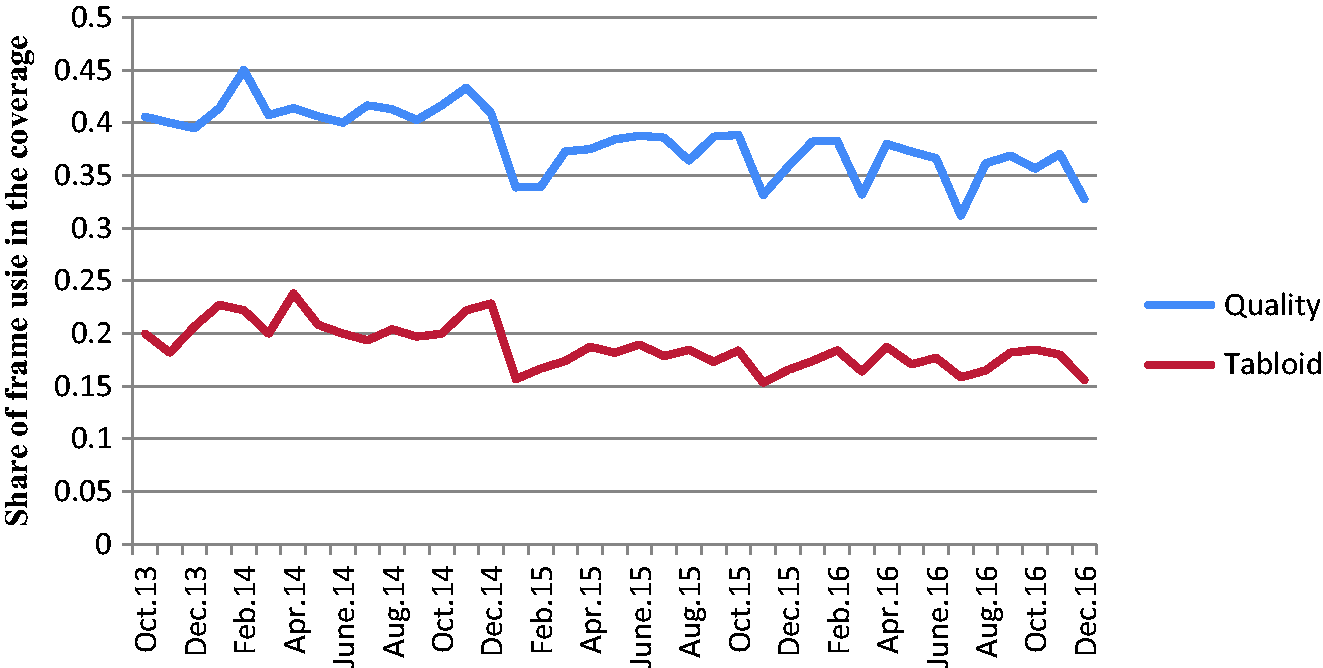
In the tabloids, in contrast, the prevalence of the security-threat frame was not challenged by the visibility of the economic frame. The lowest ratio between the two frames was recorded in October 2013, January 2014 and April 2013, when the security-threat frame was 3.4 times as visible as the economic frame. In contrast, in January 2015, November 2016, July 2016 and December 2016 the visibility of the security-threat framing was approximately 6.3 times higher than the visibility of the economic frame. It is difficult to contextualise and/or explain this descriptive overview of the temporal variation of the relative frequency of the use of either frame without additional quantitative or even qualitative analysis. However, a cursory look at the data suggests that shifts in the relative visibility of the two frames follow key events in the crisis. Interestingly, the prevalence of the security-threat frame in the quality media as well as the tabloids was highest during the month when the terrorist attacks hit Europe.
Therefore, a point-biserial correlation was run to determine the relationship between the relative visibility of the two frames and occurrences of terrorist attacks. 3 There was a positive correlation between the security-threat frame and terrorist attack occurrences for both the quality media (rpb = .627, n = 39) and the tabloids (rpb = .411, n = 39), which was significant at the 0.01 level. By contrast, there was a significant negative correlation between the economic frame and terrorist attack occurrences for both types of media (rpb = −.444, rpb = −.445, n = 39, p < .01). While this claim needs deeper examination, the media framing of immigrants likely links immigration and terrorism.
Discussion and conclusion
This study set out to shed light on the occurrence of the two immigration ‘master-frames’ in the media discourse on immigration in Czech and Slovak media over the extended course of the crisis. Based on a methodology comparable to ours, a recent study of media coverage of immigration in the UK, France and Italy between 2008 and 2012 qualified the previously documented shift of the framing of immigration from economic to security frames (Sciortino and Colombo, 2004). In contrast to this perceived shift, it concluded that economic narratives are at least as prominent in the press as security-based framing (Caviedes, 2015). To test whether the same trend occurred in CEECs during the crisis, this article investigated Czech and Slovak media. The results suggest that the balanced visibility of the security-threat and economic frame documented in the three Western European countries is far from present in Czechia and Slovakia. Rather, this article shows the inclination of the two countries’ media to frame immigration particularly in security-threat terms. We can thus answer our first research question straightforwardly: immigrants were framed predominantly in security terms during the crisis.
These results indicate that a mechanical transfer of findings from existing research on Western Europe to the CEECs is problematic and scholars should further engage in extending this type of research into the region. Future research can investigate how immigrants were framed before/after the crisis. Moreover, during the crisis West European countries were the main target countries for immigrants, while CEECs were transit and non-target countries. It could be argued, for example, that the target character of West European countries makes the chances of job loss there a more important issue and thus the economic frame becomes more significant there. On the other hand, in West European countries there were terrorist attacks that are often connected to migration in the media, which would lead us to assume that security framing would gain significance there. This relationship between country type and frame prevalence should be investigated in future.
The media offered a highly one-sided picture of immigrants, who were depicted primarily as a physical threat, potential terrorists or perpetrators of various forms of crime, including illegal border crossing and lacking necessary documentation. As a result, the most commonly proposed solutions to the crisis included the reintroduction of internal border controls, reinforcement of Schengen's external borders, and detention of immigrants. In any case, we support the inclination to identify a single mode in the depiction of immigrants although there are still other frames that often interweave with one another. 4 This article also contradicts the conclusions from Western European countries and rejects the tendency to identify a balanced overlap of multiple modes in the framing of immigrants (Caviedes, 2015). However, we have to be cautious not to misinterpret these results as we know that dominant frames vary over time (Benson, 2014: 4), so this article's four-year period of focus coinciding with the crisis may not be entirely representative of ‘general’ trends. Moreover, even though the study of the UK, France and Italy uses a comparable methodology, we have to be cautious when comparing the results as it focused on the pre-crisis period while our focus was on the crisis given that during crises new interpretations of immigration may promoted (Horsti, 2008).
Given our results concerning the prevalence of the security-threat frame, one may ask how the frequency of different frames matters. Does the fact that the security frame prevails in it make a country more hostile to immigration than a country where the economic frame is dominant? While we do not offer empirical data to answer these questions, the research shows that media coverage provides a critical backdrop for the formation of public opinion, citizens' interpretation of issues, individual issue positions and political preferences, support for particular policies, and, ultimately, decision making since it utilises a particular interpretational lens in regard to evolving events, and hence serves as cognitive cue for the public's comprehension of these events (Kühne and Schemer, 2015). Media framing is particularly important for the public understanding of complex and politically challenging issues such as the crisis. We therefore maintain that media coverage of the crisis is relevant since it circumscribes the salient viewpoints for the audiences.
We show that security framing is the most dominant interpretational lens of the media discourse on immigration during the crisis. Against this backdrop, countries where the security frame prevails can be to a certain extent seen as more hostile to immigration as the security-threat frame depicts immigration as an intrinsically negative phenomenon (Innes, 2010; Quinsaat, 2014), while economic framing encompasses both a negative and a positive understanding of immigration. Our study shows that in the countries under investigation, there appear to be persistent stereotyped interpretations of immigrants. Based on the research on media framing effects, one can assume that framing effects on the public occur as these effects were shown to be particularly at play when the framing is consonant, i.e. when there is one dominant frame (Walgrave and Van Aelst, 2006), as is the case in our study.
The outlet-specific analyses indicate that the distinct framing practices of quality and tabloid media, which are commonly documented (Van Gorp, 2005), appear to be reflected in the data. While the quality media, much like the tabloids, framed immigration more often in terms of security threats than in terms of economics, the tabloid media – in line with our expectations – significantly more often invoked the security-threat frame than the quality media. But compared to the tabloids, the quality media, by contrast, more strongly emphasised the economic frame. It is also important to note that the prevalence of the frames under study is considerably higher in the tabloid media, as documented by the proportion of items that did not include either of the two frames. It suggests that in the quality media immigration was more often represented in terms that are not met be the two frames. Overall, in response to our third research question, we provide evidence to support the conventional distinction between the framing patterns of quality and tabloid media, in which tabloids are more inclined to employ security threat framing.
The difference between tabloid and quality media matters as these types of media have quite different readerships/viewerships in both countries. Different segments of the given society are therefore exposed to varying levels of salience of the respective viewpoints on immigration, which can lead to different framing effects for these groups. Finally, we found distinct framing patterns over the course of the crisis. First, in the quality media the occurrence of the two frames was roughly balanced at the outbreak of the crisis. However, as the crisis evolved, the framing practices moved towards the dominance of the security-threat frame. In the tabloids, the security-threat frame prevailed ever since the outbreak of the crisis, and its prevalence also increased over time. Second, the framing patterns seem to respond to key events of the crisis: the more security-based events are (such as a terrorist attack), the more the media seem to invoke the security-threat frame. In response to our second research question, we show that there is an important temporal variation in the media framing of immigrants. The variation is particularly driven by key events and in the case of the security-threat frame it is positively correlated with occurrences of terrorist attacks in the EU.
Media securitisation of immigration and its potential effects on citizens can subsequently broaden the space for securitisation of migration policy making, transferring it from the realm of ‘normal’ politics to the realm of ‘extraordinary’ politics. This can in turn increase the likelihood of security-oriented solutions such as deportations, tightening of immigration controls and changes in the asylum procedures and the rights of refugees (Nordberg, 2004). Security-based framing may also have negative effects on the attitudes towards immigrants in the society (Quinsaat, 2014). All things considered, the prevalence of security-threat framing in Czechia and Slovakia may not be to the benefit of promoting positive attitudes and behaviour towards immigrants, and their integration into the domestic societies. On the contrary, it underlines the fact that a large number of citizens of both countries feel that newly arriving immigrants are a problem for their country, and the two countries’ citizens belong among the least likely of all EU citizens to say their country should help refugees (European Commission, 2016–2017; The Public Opinion Research Centre, 2017).
This study has limitations. First of all, our analytical design remains largely descriptive. It does not take into account the political, historical, or socio-cultural context of the data and neither does it aim to explain the frame variation. Also, even if we extend the focus of the scholarly research on framing of immigration to the CEECs, our study only allows for claims regarding Czechia and Slovakia. Future research can extend this type of analysis to other CEECs in a bid to deepen our knowledge of framing practices in the region. Moreover, in the content analysis applied in the study we did not intend to examine positive and negative tones in frame usage. Future research could apply more sophisticated methods, for instance, by combining content analysis with sentiment analysis in order to reveal the overall tone, or using different methods to gain a deeper understanding of the distinct framing practices of different media types, and of the relation of framing of immigration and methods of news production. Finally, to test the thesis that immigration is increasingly more securitised by the media, this study only compared the visibility of two immigration ‘master-frames’. Future studies can also examine the occurrence of additional frames such as the humanitarian/cultural frames.
Despite these limitations, with its focus on two countries of the largely neglected region with the same methodology for both, and its analysis of the two countries' newspapers and TV news, our study offers a distinctively broad comparative view going beyond the insights obtained from a simple comparison of single-country studies focused on Western European that differ in terms of methodology and the time period examined. Moreover, our study provides unique insights into the way Czech and Slovak media interpreted the crisis over a long time period. While so far rare, studies of media framing of the crisis conducted on Western European countries arrived at similar conclusions and hence point to consistent and overarching European media discourses of immigration (Greussing and Boomgaarden, 2017). On the other hand, a cursory comparison suggests that in CEE, immigrants are even more frequently framed in security terms than in the West. Although our research design does not allow for explaining this trend, we may assume that the lower experience of these countries with immigration, the connection between public Euroscepticism and the EU's handling of the crisis, and their lower standards of living may be among the motivations leading to their securitisation of immigration.
Footnotes
Acknowledgements
We would like to thank the two anonymous reviewers for their valuable comments.
Declaration of Conflicting Interests
The author(s) declared no potential conflicts of interest with respect to the research, authorship, and/or publication of this article.
Funding
The author(s) received no financial support for the research, authorship, and/or publication of this article.