



Abstract
Since 2015, refugee numbers in Europe have risen to an all-time high. Despite the desperate conditions of most refugees, many European countries have been reluctant to accept them. We investigate how refugees are received in five European countries (Belgium, France, the Netherlands, Sweden, and Turkey) and the perceptions of the general population on these refugees. Our data were collected through face-to-face interviews (N = 2,649) in Turkey and an online survey (N = 6,000) in Western Europe. Our findings indicate that positive socio-economic conditions are related to more positive attitudes at the country level, whereas a high number of refugees are related to more negative attitudes. On the individual level, we find that attitudes are shaped by economic class, religiosity, religious piety, and settlement conditionality.
Introduction
Europe has always been a continent of migration, but the numbers of refugees who entered Europe reached an all-time high in 2015 (1.3 million applications), more than twice the previous year’s figure (Eurostat, 2018a), and 2016 (more than 1.2 million asylum seekers entered the EU). In 2017, the number of applications (705,705) started to decline (Eurostat, 2018a). Discussions about what to do with the refugees who leave their countries for safe homes have taken a prominent place in news, political discussions, and in policy formation around the world in recent years. According to the United Nations High Commissioner for Refugees (UNHCR), a refugee is ‘any person forced to flee his or her country because of persecution, war or violence.’ The organization estimated that in 2016, more than half of all the 65.6 million refugees worldwide came from just three countries—Syria, Afghanistan, and South Sudan (UNHCR, 2018). Despite the desperate conditions of most refugees, many countries in Europe have been reluctant to accept them
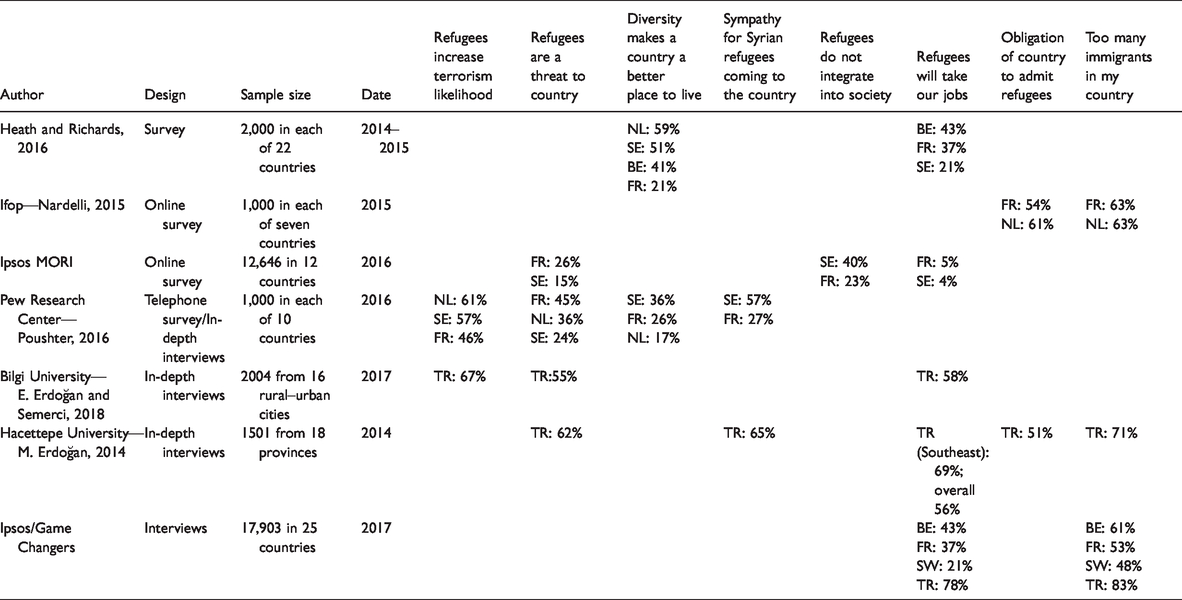
This research will explore the ways in which refugees—the majority of whom were fleeing the Syrian civil war—are received in five countries (Sweden, the Netherlands, Belgium, France, and Turkey) by the general population, and what perceptions are held by the people surrounding the resettlement of Syrians in those five countries. We compare the attitudes held by the public as well as the determinants, both individual-level indicators and country-level social and economic factors, that may be driving these attitudes in the several countries. Following the contact hypothesis, we focus on interpersonal communication between respondents and refugees they encounter in their daily lives rather than on media representations of refugees. Until researchers began to measure contact in alternative ways through computer-mediated-communication and para-socially via television programs, the amount and nature of face-to-face communication have been the primary and we argue the most direct method of testing the contact hypothesis. Although evidence of opposition to accepting large numbers of refugees in all these countries has been reported through polling results (see Appendix 1), it is important to know what factors, including experience with direct contact, determine whether people are willing to share their countries with additional refugees.
Background for the current refugee situation
In 2015, it became clear that Europe was unwilling or unable to maintain an open-door policy regarding the Syrian exodus. At the height of the influx of refugees who traveled through Turkey to the European mainland, the EU entered into an agreement with Turkey that sought to limit or prevent the flow. The agreement stated that for every refugee returned from Greece to Turkey, the EU would resettle another Syrian, following the United Nations vulnerability criteria. The EU also agreed to reimburse Turkey for refugee expenses. Under the agreement, Turkey was required to prevent additional refugees from making the water or land crossing into Europe (Karakoulaki, 2018). New arrivals have indeed dropped since the agreement, falling from more than 850,000 in 2015 to fewer than 175,000 in 2016 and a mere 30,000 in 2017 (Karakoulaki, 2018).
News media play an important role in influencing public response to refugees. Because a large share of the population has limited face-to-face contact with refugees, news media are the main sources through which the public receives information about them. News media representation of these groups is therefore vital, as previous literature indicates that media coverage is strongly related to attitudes toward minority groups (Bleich et al., 2015; De Coninck, 2019; Jacobs et al., 2016; Joyce and Harwood, 2014). Although portrayals of minorities are generally negative, with news media often linking them to criminal activities (Van Gorp, 2005), the type of news media consumed also plays a role. Public and commercial news media have differential effects on attitudes. De Coninck et al. (2018) found that public news media consumption is positively related to attitudes regarding refugees, whereas commercial news media consumption is negatively related to such attitudes. Results from the several studies (see Appendix 1) reveal an increase in negative attitudes directed toward the refugees in several countries. Although those attitudes were relatively favorable at the start of the refugees’ arrival, they grew more negative with increased numbers, demands for increased resources to assist the arrivals, and increases in perceived threats to the way of life in the destination countries.
Sympathetic attitudes in Turkey, a country that shares its adherence to Islam with the majority of the entering refugees, were more prevalent in the beginning. But language and cultural differences, and an economic downturn kept them from uniformly embracing the visitors. Additionally, local populations became less welcoming as their numbers grew ever large. Now they see reasons for wanting them to return to their home countries (unequal benefits for refugees and low-income Turkish families, sharing of scarce resources, and competition for jobs).
Welcoming gestures were made in at least one EU country at the start of the refugee influx. After Germany made the decision to accept large numbers of refugees, thousands of ordinary citizens volunteered to supply clothing, language instruction, babysitting services, and translation help, including nearly 1,000 residents signing up to provide rooms in their homes to needy families (Harding et al., 2015). Incidents of rejection of the German Open-Door Policy were also present, as 336 violent attacks on refugee shelters in the country were reported in the first 8 months of 2015 (Harding et al., 2015). Referred to as the ‘refugee crisis,’ meaning a crisis in Europe’s asylum politics and the solidarity or lack thereof among the European states (Gatrell, 2017), the reference to refugees applies to the Syrians and others from African and Middle Eastern countries who have traveled north into Europe, meeting barriers to entry along the way. Even Germany, the only EU country to adopt an ‘open border’ policy in 2015, dropped that policy a year later following the entry of 890,000 refugees (Trines, 2017). Although certain policy makers and scholars view the presence of refugees as a solution to problems related to an aging population, other problems of workforce integration, German language acquisition, the provision of access to education, and the accessibility of financial aid to those in need all have to be addressed to make that happen (Trines, 2017).
Recent literature on public opinion regarding refugees
The migration issue has become particularly contentious in national and international debates. Polls show time and again that immigration is one of the most important issues occupying people’s minds. The case of Belgium where the UN Global Compact for Safe, Orderly and Regular Migration, which lays out an efficient and humane approach to dealing with increasing global migration in an effort to share the burden of migration, has unintentionally led to the temporary reshuffling of the federal government. It provides one illustration that growing migration from outside the EU has prompted a shift in national migration policy.
Turkey has been home to more refugees than any other country in the world, but more recently a backlash has developed against the millions of Syrians and those from other countries who compete with the local population for jobs, housing, education, and other resources in towns and cities across the country. In May 2016, Turkish President Tayyip Erdoğan wrote an opinion in The Guardian, stating: Turkey’s response to the humanitarian crisis in Syria is another success story. Having adopted an open-door policy towards Syrian refugees in 2011, we now host nearly 3 million Syrian nationals from diverse ethnic, religious and sectarian backgrounds. From 2011-2016, Turkey allocated $10bn to provide Syrian refugees with free healthcare, education and housing. (Erdoğan, 2016, para. 6)
Researchers from Istanbul’s Bilgi University surveyed more than 2,000 Turks regarding their concerns about the refugees in November and December of 2017 and found that three major fears underlie their wish to curb the flow of Syrians into the country: economic fears that scarce resources will dry up, symbolic fears that the cultural values of the country will be compromised by the influence of Arab culture, and fears of physical attack from refugees who are violent (Erdoğan and Semerci, 2018). The authors found that 71.4% of the respondents believe that Syrians take jobs from Turks, 67.4% say that the refugees are the cause of increasing crime rates, and 66.4% worry that moral values and traditions are in danger because of the large numbers of refugees coming into the country. Relatively few respondents had positive views of the refugees.
Also, in 2017 the Center for American Progress sponsored a national survey of 2,453 Turks (in 28 provinces using a stratified sample conducted by the Turkish Metropoll Agency) about their self-perceptions as Turkish nationals (Halpin et al., 2018). Several questions regarding the respondents’ relationship to the Syrian refugees living among them were included. In the study, 78% of respondents agreed or strongly agreed that Turkey was spending too much time and money on the refugees and should instead focus more on its own citizens. Less than half of respondents (49%) agreed or strongly agreed that immigrants and refugees had a lot to contribute to Turkish society and deserved the country’s support. That response contrasted with their answer to the question about whether they had a favorable or unfavorable opinion about Syrian refugees, with 79% saying their attitude was somewhat or very unfavorable. The authors of the study state that: […] the polling showed that the poorest respondents were the most hostile towards refugees. In this vein, as reported anecdotally elsewhere, Kurdish attitudes towards the Syrians were among the harshest, perhaps reflecting competition for low-wage jobs often occupied by Kurds in many big cities and border areas. (Hoffman et al., 2018: 13)
Citizen attitudes: A socio-demographic perspective
Public opinion is split on the value of immigrants to the well-being of a country, while politicians struggle in their attempts to address the migrant or refugee needs. A comprehensive review of recent literature on public attitudes regarding refugees and migrants by Dempster and Hargrave (2017: 11) found that ‘hostility towards refugees and migrants is less prevalent among younger, politically liberal and more educated people.’
A Pew study conducted in 2017 surveyed Western Europeans from 15 countries on what being Christian meant to them in relation to both attitudes and behavior (Pew Research Center, 2018). Those who self-identified as Christian, whether they regularly practiced their religion or not, were more likely to have negative opinions of immigrants, and also of Muslims and Jews, than respondents who were not affiliated with a religion. Specifically, ‘the study shows a strong association between Christian identity and views on religious minorities and immigration, and a weaker association between religious commitment and those views’ (Ogan et al., 2014; Pew Research Center, 2018: 31).
A major mitigating factor in the acceptance of refugees relates to the amount of personal contact through face-to-face communication the majority population may have had with immigrants more generally or with refugees who arrived during the period in question. The idea that intergroup contact leads to greater understanding and acceptance was initiated by Allport in 1954 when he proposed that direct contact between groups of equal status with common goals will reduce prejudice toward each other. Many years later, Pettigrew and Tropp (2006) conducted a meta-analysis of more than 500 studies that had followed over the previous half century, finding that the conditions for reducing prejudice put forth by Allport were not always necessary. In later work, Pettigrew and Tropp (2008) and Pettigrew et al. (2011) found that increased direct contact with minority groups (by the majority group) led to increased amounts of empathy and reduced anxiety related to the outgroup. Several studies have applied this concept to Islamophobic attitudes. In the Netherlands, Savekoul et al. (2010) found that interpersonal contact with colleagues from ethnic minority groups leads to a reduction in negative attitudes toward Muslims. In the four largest cities in the Netherlands, where large groups of Muslim minorities have settled, the population became accustomed to their presence and this led to the perception of reduced threat. Swedish research that tested the contact hypothesis with refugees found that when the proportion of the foreign born increased, attitudes toward refugees became more positive (Velásquez, 2016).
European integration context
The Migrant Integration Policy Index (MIPEX) is a tool created to measure 167 policy indicators related to migrant integration in all European Union countries as well as several others, including Turkey. ‘The project informs and engages key policy actors about how to use indicators to improve integration governance and policy effectiveness,’ according to the Migration Policy Group that was created as the first European Citizens initiative on migration that seeks to ‘engage the public and transform EU migration policy’ (MIPEX, 2015). The 2015 MIPEX covers eight policy areas, which make up a migrant’s trajectory toward full citizenship. These policies cover labor market mobility, family reunion, education, health, political participation, permanent residence, access to nationality, and anti-discrimination. Comparing six integration indices, Jedwab and Soroka (2014) argue that MIPEX offers the most comprehensive set of economic and social indicators, although it captures the ‘best practices’ in regard to policies and not actual integration outcomes. Scores range from 0% (indicating critically unfavorable policies) to 100% (indicating the best possible integration policies) (MIPEX, 2015). The 2015 MIPEX-scores for our five target countries rank Sweden highest and Turkey lowest among the 38 countries under study (see Table 1). Belgium ranks seventh among the 38 countries with 67%. The Netherlands is ranked 11th with a score of 60%, having lost eight points between the 2010 and 2014 period, reflecting more restrictive integration policies on equal rights and opportunities for immigrants. Integration policies among the 38 countries score, on average, 52%, indicating that integration policies still generate considerable obstacles for immigrants to fully participate in economic, social, and democratic life. Notwithstanding the similarities between the three countries occupying a middle position, Sweden stands out in all policy areas while Turkey consistently ranks lowest with respect to all social, economic, and political indicators, thus illustrating very different access levels to various resources as migrants enter these ‘host’ societies and markets.
2015 Migrant Integration Policy Index (MIPEX) scores (in %).
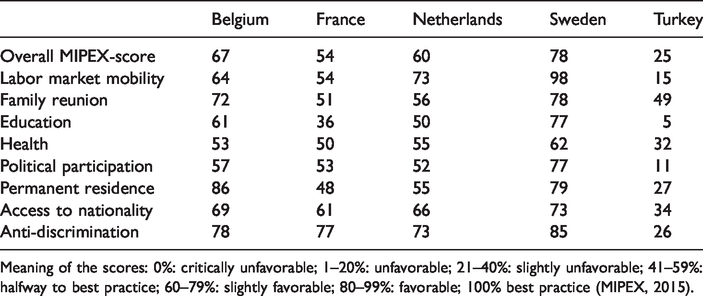
Meaning of the scores: 0%: critically unfavorable; 1–20%: unfavorable; 21–40%: slightly unfavorable; 41–59%: halfway to best practice; 60–79%: slightly favorable; 80–99%: favorable; 100% best practice (MIPEX, 2015).
A country’s economic situation and minority group numbers have also been found to be of vital importance when investigating attitudes toward minority groups. This idea is anchored in group conflict theory, which suggests that negatives attitudes are the result of the idea that one’s own group is threatened by other groups in the competition for scarce goods. These goods may refer to material matters (e.g., housing, jobs), but power and status also apply (Blumer, 1958; Gorodzeisky and Semyonov, 2015; Meuleman et al., 2009; Sides and Citrin, 2007). The economic situation is a first mechanism through which conflict theory works, as less favorable economic conditions increase the scarcity of goods which causes competition for these goods to increase. This occurs much less frequently when the economic situation is favorable, allowing for more positive attitudes to develop. A second mechanism is the size of the minority group present. When this group size is larger, it means there are more individuals competing for the same scarce goods, which again increases competition (Blalock, 1967). In support of this theory, Meuleman et al. (2009) found that a country’s economic conditions and minority group size do affect attitude change. In this study, citizens of countries with minimal immigrant flows were found to be more open toward immigrants. Furthermore, citizens of countries with low unemployment rates were found to hold significantly more positive attitudes than those of countries with higher unemployment rates. Coenders and Scheepers (1998, 2008) have also suggested that changes in attitudes are driven by immigration flows and unemployment levels.
Research questions and hypotheses
As the above literature summary reveals, numerous surveys on perceptions of refugees have been conducted in the countries of focus for this study. What has not been examined is a comparison of attitudes among Turks and Western Europeans on this issue. Each of the countries in this study has taken a somewhat different approach to the reception of refugees. Because of Turkey’s closeness in culture and religion to the refugees from Syria, it might be expected that the country would provide a warmer welcome than any of the Western European countries in the study. However, Turkey is already an overburdened country with a poor economy, especially of late. Based on the findings of previous studies we pose the following research questions and hypotheses: RQ1: How do the countries under study compare to one another when it comes to country-level socio-economic conditions and policy as a breeding ground for perceptions of and attitudes toward refugees? RQ2: How do individual socio-economic and socio-cultural characteristics relate to attitudes toward refugees? H1: Respondents with a high socio-economic status will hold more positive attitudes toward refugees than respondents with a low socio-economic status. H2: Respondents who live in urban regions will hold more negative attitudes toward refugees than respondents who live in intermediate or rural regions. H3: Respondents with a similar religious identity to the refugees will hold more positive attitudes toward refugees than those with different religious identities to the refugees. H4: Respondents with high levels of religiosity will hold more negative attitudes toward refugees than respondents with low levels of religiosity. H5: Respondents who report higher levels of direct intergroup contact will hold more positive attitudes toward refugees. RQ3: Are the determinants of attitudes toward refugees different between the Western European countries and Turkey? RQ4: How do people’s considerations of refugees’ perceived deservingness relate to their attitudes toward refugees? H6: A higher conditionality put on work skills and language acquisition is positively related to people’s economic fears. H7: A higher conditionality put on religion and way-of-life adaptation is positively related to people’s quality-of-life fears.
Data and methodology
Our study uses a combination of data from a four-country study in Belgium, France, the Netherlands, and Sweden, and Turkish data donated to us by KONDA Research and Consultancy, a survey research organization in Turkey. The Turkish data collection took place in February 2016 using face-to-face interviewing. The sample was selected through stratification of the data on population and educational attainment level of neighborhoods and villages based on the Address Based Population Registration System, and the results of the 2011 General Elections in neighborhoods and villages (KONDA Research and Consultancy, 2016). The Western European data were collected through an online survey by iVOX, a Belgian polling agency, in September and October of 2017. Respondents were drawn from a panel of 150,000 individuals and were contacted through e-mail with the request to cooperate in a study. No specific subject was specified beforehand, as we wanted to avoid priming. An incentive was included as potential participants were informed of the possibility to win a prize (e.g., gift certificates) after completion of the questionnaire. The sample in these four countries is representative for age and gender (De Coninck et al., 2018). The research population for all five countries consists of adults aged 18 or older, with an age limit of 65 in the Western European countries. This resulted in a sample of 8,649 respondents (6,000 in Western Europe, 2,649 in Turkey). We constructed country variables on GDP per capita, unemployment rates, and total and relative number of refugees based on data from Eurostat (2018b, 2018c), the UNCHR (2017), and MIPEX (2015).
Sample description
Respondents were asked to provide information on gender, age, economic class, educational attainment, religious denomination, religious piety, household composition, place of residence, and frequency of intergroup contact. Our sample has a mean age of 43.8 years old and a balanced gender ratio (49.1% male versus 50.9% female). We note that the largest share of our sample holds a tertiary degree (43%), although the share of respondents with a secondary degree is also sizeable (41.9%). Those with no degree or a primary degree make up 15.1%, the majority of which can be found among Turkish respondents. Results on household income are often problematic to present as many respondents are unwilling to provide information on this subject, resulting in a high number of missing values. In order to include an indicator of economic class in our analysis, we combined a question which asked respondents how difficult or easy it is to make ends meet, with answer categories ranging from 1 (Very difficult) to 6 (Very easy), with an indicator on economic classes based on household income, car ownership, and household size. The results indicate that in Belgium (87.1%) and the Netherlands (89.7%), the overwhelming majority of our sample is in the lower middle class or upper middle class. For France, we note that the distribution leans toward the lower classes, whereas the opposite is true for Sweden. In Turkey, it is notable that the middle class is by far the smallest of all five countries, with a larger concentration in the lowest and highest economic classes instead. We observe that a majority of our sample lives in a household with its nuclear family (71.1%). Both one-person-households (15.8%) and extended family-households (13.1%) are not as common. Three categories dominate our sample when considering religious affiliation: Christians (31.2%), Muslims (in Turkey) (29.2%), and those with no religious affiliation (32.5%). In terms of piety or religious activity, we find that this is at very low levels in European countries, whereas in Turkey we note a large share of religious and pious respondents. Based on the NUTS-typology, developed by the European Commission, we were able to construct a variable on urban–rural living conditions using postal codes and regions of residence. This shows that our sample is evenly divided between urban (34.6%), intermediate (33.4%), and rural (32%) regions.
We have also included a measure on intergroup contact, which asks how often respondents have interpersonal contact with people with a migration background or refugees in their daily lives, with answer categories ranging from 1 (Never) to 7 (Every day). The results indicate that citizens in Turkey (5.16) and Sweden (5.38) report the highest levels of intergroup contact, while the French report the lowest levels (4.43). Finally, we have also included the indicators on settlement deservingness conditionality. This is a multi-dimensional concept which gauges the degree to which people feel refugees must fulfill certain criteria before they are allowed to settle in the host country. The indicators that are included provide respondent assessment of the importance for refugees to speak the country’s official language(s), come from a Christian (in Europe) or Muslim (in Turkey) background, have work skills that the country needs, and be committed to the way of life in the country. These were measured on a five-point scale where 1 (Not very important at all) to 5 (Very important). Generally, people rate either language acquisition or way-of-life adaptation as the most important indicators for settlement. Religion seems to be the least important. When we consider country differences, we find that Swedes are the least conditional, while the French and Turks are most conditional.
We also asked about media use. In the EU-country questionnaire, multiple questions related to media consumption and trust in media were presented, while in the Turkish questionnaire, the respondents were only asked to provide the name of the television channel they most preferred. This difference between the two surveys prevented us from including media use questions in comparative hypothesis testing. Additionally, at the time of the Turkish survey and in the months since, nearly all Turkish media, both public and private, have come under the direct control of the government, leaving little variation in media content. Hence, testing relationships between channel choice and content that related to refugees in Turkey is at least difficult but even more so, it would have produced unreliable results. In the survey covering France, Belgium, Sweden, and the Netherlands, media use questions divided the focus between public and commercial media. Our results indicated that public media consumption was positively related to refugee attitudes across these four countries, whereas commercial media consumption was negatively related to attitudes (De Coninck et al., 2019).
Attitudes toward refugees were measured by asking respondents about (1) the extent to which they perceive refugees to be a threat to the economy and a threat to employment opportunities in the country (proxies for economic threat), and (2) the degree to which they believe refugees will impact the quality-of-life in their country (a proxy for cultural threat). The indicators of economic threat were measured slightly differently in both surveys and were merged to correspond to a six-point scale where 1 = Small amount of fear and 5 = Large amount of fear. The wording of the items in the European survey was: ‘Would you say it is generally bad or good for the country’s economy that refugees come to live here from other countries?’ and ‘Would you say that refugees who come to live here generally take jobs away from workers in your country, or generally help to create new jobs?’. For Turkey, the items were ‘Asylum-seekers are a threat to the economy in Turkey’ and ‘Employment opportunities decreased because of the Syrian asylum-seekers.’ Items from the European survey were recoded to conform to the six-point scale from the Turkish study. To construct the quality-of-life indicator, we aggregated a question from the European survey (‘Refugees make the country a worse or better place to live’) with one from the Turkish survey (‘How do you think the outcome of the conflict in Syria will affect Turkey?’), with the high end of the scale indicating a large amount of fear or anxiety about a negative outcome for the way of life of the country. We computed the mean score of these items, which results in variables on the economic and quality-of-life dimension of attitudes toward refugees. In Table 2, we aggregated these attitudes at the country level.
Descriptive results of individual-level variables (in %, unless otherwise specified).

In addition to these individual-level variables, we have also included relevant country variables in our dataset (see Table 3): GDP per capita in 2017 (Eurostat, 2018b), the unemployment ratio for the fourth quarter of 2016 (Eurostat, 2018c), the total number of refugees by late 2016 (UNCHR, 2017), the number of refugees per 1,000 inhabitants late 2016 (UNCHR, 2017; own calculations), and the 2014 MIPEX-score (MIPEX, 2015).
Descriptive results of country-level variables.
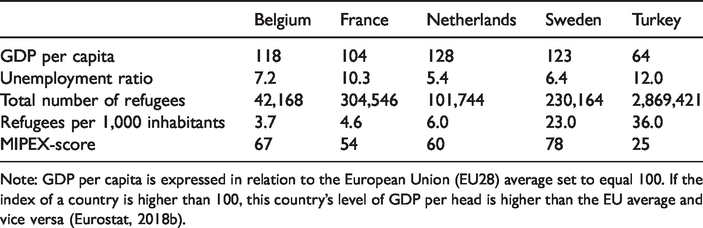
Note: GDP per capita is expressed in relation to the European Union (EU28) average set to equal 100. If the index of a country is higher than 100, this country’s level of GDP per head is higher than the EU average and vice versa (Eurostat, 2018b).
The results indicate that attitudes toward refugees are most positive in Sweden, and most negative in Turkey. Belgium takes a moderate position, while the Netherlands are moderately positive, and France is moderately negative. These trends are similar for both the economic and quality-of-life dimension of attitudes. All countries have a higher than (EU28-) average GDP per capita, with the exception of Turkey. In terms of unemployment, France and Turkey are notable for their high ratios, while the Netherlands has the lowest rate. With 2,869,421 (registered) refugees in 2016, Turkey has accepted far more refugees than the other four countries combined. We see a similar pattern present itself in terms of relative presence of refugees. Here, Turkey, but also Sweden, jump out as having a much higher refugee/1,000 inhabitants-ratio than Belgium, France, or the Netherlands. In terms of MIPEX-scores, we note that Sweden developed the most favorable migration-integration policies out of the five countries in our dataset (and the 38 countries included in the index) (MIPEX, 2015), while Turkey is found to hold the least favorable policies.
Model description and measures
In order to answer the research questions, we conducted multiple linear regressions in SPSS: two with the economic dimension of attitudes as the dependent variable, and two more with the quality-of-life dimension as the dependent variable. For the purpose of these regressions, we decided to aggregate respondents in a European and Turkish category in order to highlight differences between these two regions. We chose not to run a multilevel model, as the number of countries in our study is too low to obtain reliable estimates (see Hox et al., 2017). The socio-demographic variables included can be found in Table 2. Piety is included as a continuous variable. Religious denomination is recoded so that two categories remain: non-Muslims and Muslims. In our regression analyses, we will focus on these socio-demographic indicators, supplemented with indicators on individual intergroup contact and people’s settlement deservingness considerations.
Results
The results in Table 4 indicate that age is positively related to economic threat in Turkey, and positively related to quality-of-life threat in Western Europe, indicating that older individuals in these countries hold more negative attitudes than youths. Gender is significantly related to attitudes among Turkish citizens for the quality-of-life threat only, with women having higher feelings of threat than men. Educational attainment seems to only play a role in Europe: those with a secondary or tertiary degree are found to experience significantly less threat than the lower educated. However, economic class is relevant in both Western Europe and Turkey: those individuals in higher socio-economic classes experience less threat, both economic and quality-of-life, than those from the lowest socio-economic class. This is a confirmation of our first hypothesis. When we consider the role of the spatial characteristics, we find that there is only a very limited impact on attitudes. Citizens of intermediate regions in Turkey do seem to hold more quality-of-life threat than those from urban regions. However, there is insufficient evidence to confirm the second hypothesis.
Multiple linear regressions with the economic and quality-of-life dimension of attitudes toward refugees as outcome variables and standardized betas of independent variables
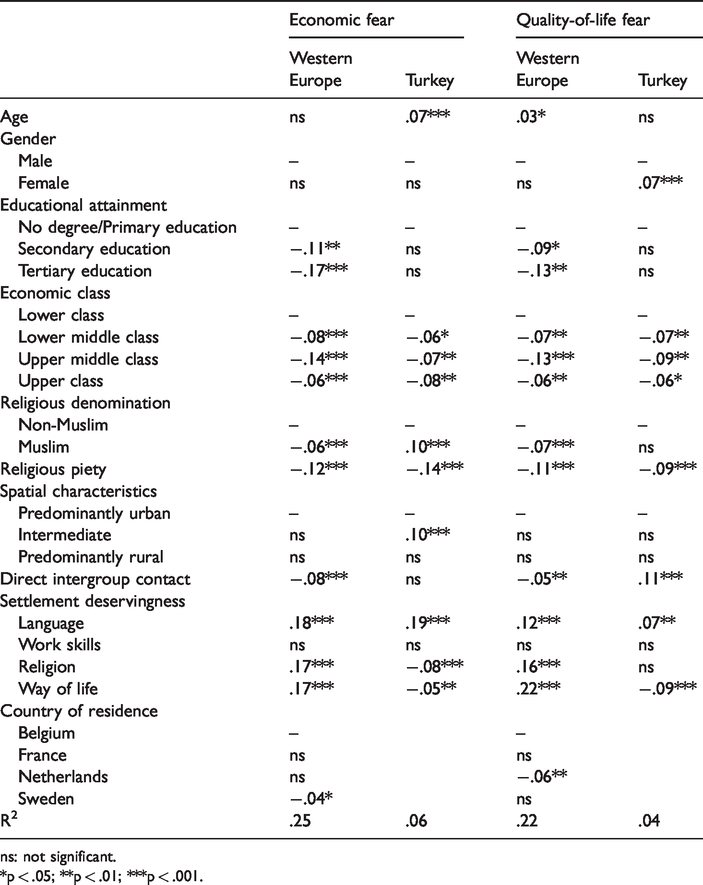
ns: not significant.
*p < .05; **p < .01; ***p < .001.
In terms of religious denomination, we find that Muslims in Western European countries experience less threat than non-Muslims. These findings provide mixed results for our third hypothesis, as a similar religious identity with refugees (being Muslim) relates positively to attitudes in Western European countries, but not in Turkey. When we look at piety, we find that a higher degree of religious practice is negatively related to feelings of threat among Western European and Turkish citizens, which is the opposite of our fourth hypothesis based on the findings of previous research. Instead, in accordance with the tenets of Christianity and Islam to help those less fortunate, it could be expected that more religiously observant respondents would have more positive attitudes. Furthermore, direct intergroup contact is negatively related to both types of threat in Western Europe, while it is positively related to quality-of-life threat in Turkey. Our fifth hypothesis therefore leads to mixed results.
Next, we consider the results on the settlement deservingness considerations. First, we find that people’s conditionality put on work skills is not significantly related to any threat dimensions. However, language conditionality is positively related to both threat dimensions in both regions: the more important people think it is that refugees learn the official language of the country before they deserve to settle, the more feelings of threat people will experience. While we cannot confirm sixth hypothesis, it is true that a higher conditionality put on language acquisition is positively related to economic fears. As for the conditionality put on religion and way-of-life adaptation, we find that these are positively related to feelings of threat in Western Europe. In Turkey, the relationship is reversed. This also means we cannot confirm seventh hypothesis.
To summarize, we find that the five countries under study differ in terms of socio-economic conditions. Sweden and the Netherlands are found to have very favorable conditions in 2016, whereas these are far more unfavorable in France and Turkey in particular. When these findings are coupled with indicators on refugee arrival, we observe that Turkey receives the largest absolute number of refugees by far and also comes first in relative number of refugees (with Sweden second) (RQ1). This shows that, although socio-economic conditions and refugee arrivals undoubtedly contribute to attitudes, they cannot fully explain them. It is important to consider individual-level indicators also. In that regard, we considered the educational attainment and economic class of our respondents. We found that highly educated respondents hold lower feelings of threat than lowly educated respondents.
When considering the socio-cultural dimension in attitude formation, we find some surprising results: sharing a religion does not produce a stronger attachment to refugees in Turkey, although it does in Western Europe. The same trend can be found when it comes to engaging in interpersonal communication with newcomers: this is not a predictor for less threat in Turkey, as direct intergroup contact increases feelings of threat among Turkish citizens but decreases it among Western Europeans (RQ2/RQ3). Finally, we also find that perceptions of deservingness are very important to our respondents. Three out of four aspects (language acquisition, adapting to the way of life of the country, and a belief in the dominant religion of the country) are significantly related to attitudes in Western Europe and Turkey. However, the direction of the effect differs between regions, as Western Europeans seem to experience more threat as conditionality increases, while the picture is mixed in Turkey (RQ4).
Discussion
The countries of our study are diverse in several ways—levels of economic development, population size, levels of unemployment, and religious affiliations—but they all have one thing in common as recipients of refugees from Syria and other countries of the Middle East. Each of these countries has had to cope with a relatively large number of refugees entering their countries, tapping their resources, and forcing discussions and policy changes to accommodate the groups of people that do not speak their language and do not share most of their cultural practices. Each country’s residents have their own set of attitudes regarding the newcomers, yet they are all concerned that the refugees meet certain integration standards to become residents of their countries. We see that the current situation has raised the cultural threat level, especially when the newcomers have no direct contact with the local population.
Swedes stand out as the most accepting of the refugees, but their country’s high socio-economic position, high educational attainment, and sound integration policies as compared to the other countries may help ease their anxiety regarding refugee arrivals. At the other extreme stands Turkey with the lowest socio-economic levels, educational attainment, and weakest integration policies, all of which may lead to a feeling that the residents are in no position to deal with the many people coming across their borders to share their limited resources. Our findings also provide support for the conflict theory: citizens in countries with a favorable economic situation are more positive toward refugees than those in countries with less favorable economies, and those with high refugee numbers also stand out as holding more negative attitudes. The exception here is Sweden, which has the second-highest number of refugees per capita but still maintains positive refugee attitudes, indicating that the sheer number of refugees does not fully explain citizens’ attitudes.
Our results are consistent with other studies that find that direct contact with refugees leads to a higher acceptance level, at least in Western Europe. And in a reversal of other studies’ findings, those who practice their faith with high frequency also tend to feel a commitment to those who need the country’s help. However, overall, the relatively limited amount of variance explained by the combination of factors we were able to measure (especially in Turkey) leads to more questions on the reasons for accepting or rejecting refugees. The status quo is most likely a more comfortable position for most people, and when large numbers of refugees come across a country’s borders, the local residents are just not prepared to deal with the additional problems they bring to their communities and their individual lives.
For instance, the perceived threat may also be partially based on the notion that no matter how long they may live in the host country, the refugees can never be part of the cultural makeup of the country. The 2018 Pew Research study previously referred to found that many Europeans believe that residents in their country ‘can never be one of us’ unless they were born in that country, with the highest percentage coming from Belgians (48%) and the lowest percentage from Swedes (22%). Even higher percentages reported that it was necessary to have a family background in the country to belong there (a high of 53% in France and a low of 21% in Sweden). Furthermore, high percentages of European citizens (a high of 75% in Belgium and a low of 61% in France) agreed with the statement: ‘Our people are not perfect, but our culture is superior to others’ (Pew Research Center, 2018, para. 32). Similar questions were asked in a Turkish study examining the polarization in that society (Halpin et al., 2018). In that survey, using stratified sampling and weighting, 2,453 Turkish people, 86% of respondents said it was somewhat or very important to be born in the country and 75% said it was important to believe that Turkey was better than other nations.
Although we did not ask our respondents these questions, we believe that negative attitudes toward refugees may be explained by the feeling that the new arrivals can never truly belong. In sum, there are no simple solutions because the refugee situation is a complex matter, perceptions of it are fraught with emotions, and it cannot be met with coldly ‘rational’ decisions, while involving both national and international rules. The actors in this complex interplay are not only the people on the move, governments, and NGOs, but also often ruthless refugee smugglers. So, solutions will need to be creative and multifaceted. Although some progress has been made since the crisis in the autumn of 2015, the fault lines within Europe have so far prevented any revision of the Dublin Regulation, which was never meant to cope with massive migration anyway. The decision of member states to spread migratory pressure through new reception centers over more countries than Greece and Italy only while reinforcing Frontex (the EU border security forces) is a positive outcome. Disturbing, however, is the voluntary character of the arrangement, which shows once again that the EU does not have the political will to give fair and equal treatment to each and every refugee while breaking the business model of the people smugglers.
Footnotes
Acknowledgements
The authors would like to thank KONDA Research and Consultancy for their donation of the Turkish data, and all respondents who participated in the study.
Declaration of Conflicting Interests
The author(s) declared no potential conflicts of interest with respect to the research, authorship, and/or publication of this article.
Funding
The author(s) disclosed receipt of the following financial support for the research, authorship, and/or publication of this article: This research was supported by funding from the Belgian Science Policy Office (BELSPO), as part of the framework program BRAIN-be (Belgian Research Action Through Interdisciplinary Networks), through the contract number BR/165/A4/IM2MEDIATE, and the KU Leuven Research Council.
Research results: Opposing sentiments to accepting large numbers of refugees in Western European countries and Turkey
| Author | Design | Sample size | Date | Refugees increase terrorism likelihood | Refugees are a threat to country | Diversity makes a country a better place to live | Sympathy for Syrian refugees coming to the country | Refugees do not integrate into society | Refugees will take our jobs | Obligation of country to admit refugees | Too many immigrants in my country |
|---|---|---|---|---|---|---|---|---|---|---|---|
| Heath and Richards, 2016 | Survey | 2,000 in each of 22 countries | 2014–2015 | NL: 59%SE: 51%BE: 41%FR: 21% | BE: 43%FR: 37%SE: 21% | ||||||
| Ifop—Nardelli, 2015 | Online survey | 1,000 in each of seven countries | 2015 | FR: 54%NL: 61% | FR: 63%NL: 63% | ||||||
| Ipsos MORI | Online survey | 12,646 in 12 countries | 2016 | FR: 26%SE: 15% | SE: 40%FR: 23% | FR: 5%SE: 4% | |||||
| Pew Research Center—Poushter, 2016 | Telephone survey/In-depth interviews | 1,000 in each of 10 countries | 2016 | NL: 61%SE: 57%FR: 46% | FR: 45%NL: 36%SE: 24% | SE: 36%FR: 26%NL: 17% | SE: 57%FR: 27% | ||||
| Bilgi University—E. Erdoğan and Semerci, 2018 | In-depth interviews | 2004 from 16 rural–urban cities | 2017 | TR: 67% | TR:55% | TR: 58% | |||||
| Hacettepe University—M. Erdoğan, 2014 | In-depth interviews | 1501 from 18 provinces | 2014 | TR: 62% | TR: 65% | TR (Southeast): 69%; overall 56% | TR: 51% | TR: 71% | |||
| Ipsos/Game Changers | Interviews | 17,903 in 25 countries | 2017 | BE: 43%FR: 37%SW: 21%TR: 78% | BE: 61%FR: 53%SW: 48%TR: 83% |