



Abstract
This article examines YouTube videos that feature right-wing discourses from Brazil’s periphery based on perspectives extracted from Paulo Freire’s ideas of action for liberation. The findings from a survey conducted from one year before the 2018 elections until one year later combined with a multimodal discourse analysis have pointed to the formation of a new grammar of contestation that discusses socioeconomic, racial, and gender issues in a discourse identified with the right. The Freirean notion of action helps to enlighten aspects that indicate the rise in critical action and pluralism from the periphery, despite the politics of the right that a few media producers have entertained.
The study of the periphery in contemporary Brazil has revealed many new communicative possibilities in this vast layer of the population. As a sociological concept, the periphery is henceforth understood as an amalgam of citizens that have historically lived at the margins of the largest Brazilian cities. It contains numerous minorities that live adjacent to mainstream society (Sinder & Souza, 2007; Wood & Carvalho, 1988). Either because of their poverty, race, or class-belonging, they have suffered the most in the hands of state agents, as some see their historical representation as a kind of second-tier citizenship (Fischer, 2008; Mitchell & Wood, 1999). It englobes the favelas, the countryside, and other victims of the country’s pervasive inequality (Fleury & Ost, 2013; Valadares, 2008).
In contemporary society, the periphery’s language and aesthetics have flourished on the Internet (Bezerra, 2017; Levy, 2018). It incorporates new sexual identities and languages (Natividade & de Oliveira, 2018), as it also represents women as in charge of their political struggle (Marques & Freitas, 2018; Miskolci & Pelúcio, 2017). In a time of higher support for right-wing and conservative candidates, this research investigates discourses of affiliation from this diverse periphery to right-wing or conservative values, political parties, and candidates, as seen through their online video production. The idea is to draw upon Paulo Freire’s notion of action towards liberation to examine these political views that lean towards the right. The article starts with a brief review of how the right-wing support transpired from periphery in recent times.
From the “mass of manoeuvre” to “the poor of the right”
The complexities between media, the periphery, and bottom-up expression grow as the political scenario changes in Brazil (Levy, 2018; Rocha, 2018). From a history of passive interactions with statesmen (Wolfe, 1994), the periphery has moved on to assume that their representatives can circulate in mainstream society and get their message across, as the election of the late councillor Marielle Franco had shown. Slowly, the old saying that named what seemed a manipulable populace as the massa de manobra subsides (Demo, 1992; Ferreira, 2005). The 2018 elections saw a higher proportion of politicians from favelas and other under-represented groups joining the electoral run-up (Barbieri et al., 2019). In terms of media production and consumption, the 2018 election was the contest that happened through the screens of mobile phones, primarily influenced by WhatsApp (Machado et al., 2018).
This article focuses on research on the mediatised aspects of this burgeoning peripheral participation in politics. It samples from a series of online videos narrated or staged in peripheral neighbourhoods. In these mostly amateur productions, periphery residents have purportedly supported right-wing or conservative candidates and their policies, before and after the 2018 election. For example, the video entitled “Parody, I am favela, Bolsonaro 2018” was published a few days from the first round of the votes and went viral. It played the popular music rhythm brega in the background and staged a robbery in a poor community. It boasted more than two million and four hundred thousand views on YouTube. The main character carried one gun in each of his hands. He sings in front of a wall of an unfinished house saying: “This year I am going to vote for Bolsonaro.” These and other similar short videos belong to a wave of similar manifestations for the right. Notoriously, the meme pobre de direita, or the poor of the right is another example. These types of media content turned out to be not only extremely popular and persuasive but also challenging to interpret critically.
The discourse featured in these productions serves multiple aspects in this investigation, although not all of them are possible to discuss at length. However, the reasons why the periphery has indeed supported the right and, somehow, made the candidate Jair Bolsonaro electable, can come into sight as in other productions (Bähre and Gomes, 2018; Oliveto, 2018). In the face of escalating populism, anthropological research has situated right-wing views in this sector of the population within the context of family disruptions and despair in lower-income households (Junge, 2019). Nonetheless, how could this political boost be categorised according to a media perspective? Secondly, since the state-sponsored rhetoric of “chasing to kill” criminals has affected the periphery disproportionally (Balán, 2002;), to what extent has this brutal media representation crept into the periphery’s modes of self-definition and political discourse? Both questions demand an answer which is not entirely given here. First, it is necessary to identify the dynamics of this engagement with the right in the ways one has got to express politically. At the same time, the interest in this group should not excuse discourses that flirt with authoritarian and dehumanising views of society.
Notably, Paulo Freire’s notion of action towards liberation (Freire, 2017) can inform the understanding of much of these developments. His theory’s interest in dialogical participatory processes can anticipate various movements of empowerment and autonomy, or his pedagogies, which are explained in many works currently published in English. This article focuses on the most paradigmatic of his books, The Pedagogy of the Oppressed. First, because covering all of his pedagogies in one piece would sound anecdotal. Secondly, the Pedagogy of the Oppressed narrates the crucial stage in the struggle against oppression. The book wrestles with the archetype of passivity during authoritarian times in Brazil. Third, the thesis that the oppressed can overcome through learning and knowledge, but also from expression, illustrates Paulo Freire’s powerful thoughts about the difficult paths towards political emancipation.
Freire argues for its achievement through available ways of personal or collective expression. Read altogether, these themes are urgent to correctly gauge the weight of right-wing extremism on the 21st-century periphery. Overall it can also refer to the Internet as this broad avenue of participation. Not only because of Freire’s boldness at uninhibitedly seeing unexpected places as strongholds of active learning, but also due to the book’s vision towards new forms of consolidating progressive ideals among the oppressed. From a myriad of inputs about emancipation, I am particularly attracted to problematise Freire’s action as this bifold force toward creativity and reaction, contrasting it with the visible backing of the right in recent times.
Revisiting Freire’s action for liberation
In The Pedagogy of the Oppressed, Paulo Freire’s (Freire, 2017) urges for a better recognition of “action” as a decisive point at the struggle against the oppressor. Freire qualifies the kinds of gestures which the oppressed need and for what purpose. He wrote it during a time of dictatorial oppression in Brazil, in which action bursts out as a transformative movement that could “change the situation and restore humanity” towards liberation. While political action on the side of the oppressed must “be pedagogical in the authentic sense of the word”, it should result in their own “conscientisation.” Action is, therefore, connected to enabling the oppressed to achieve their liberation by a “totality of reflection and action.”
Of course, producing and posting videos on YouTube cannot be assumed as such a democratic gesture of action on its entirety. It should come with the vote and awareness of civic life. However, by breaking the silence, this video interface straight from the periphery can be understood as an allegory of Freire’s meaning of action in itself. For Freire, reflection is still necessary where “subjectivity and objectivity thus join in a dialectical unity producing knowledge in solidarity with action, and vice versa” (Freire, 2017: 12). Matter-of-factly, communicative action-reflection happened in the past through a web of third parties, including NGOs, Catholic bishops, and community leaders. They were both crucial partners and guarantors of the periphery in their negotiation with government and society (e.g. Festa and Silva, 1986). Nowadays, uncertainty lies where these agents can at best feature as co-sponsors for online producers (Davis, 2018). The enormous output of media productions available on the Internet has free rein.
Freire has indeed placed the action for the liberation of the oppressed in very subjective terms. However, it is possible to stabilise keywords such as “interactive” and “rebellious” into the ends of online iterations. In some passages, Freire is prescient regarding a few traps from pursuing action. For instance, the risk of feeling the “irresistible attraction towards the oppressor and his way of life” (Freire, 2017: 36). Before one can delve in, Freire’s notion of action comes close to predict the mimetic movement towards right-wing politics seen in the 2018 elections in Brazil. This new kind of discourse is one of the traps that stem from this self-mediatisation of politics. The attraction to a candidate’s violent tactics that affects the community negatively is one of these unmistakable movements towards the right. It should be problematised against decades of Freirean influence in the periphery. That scenario connects to Freire also due to the revival of militarism in Brazil, characteristic of the context from which The Pedagogy of the Oppressed emerged. In any case, it is still necessary to depart from Freire’s broader vision to properly map the many discursive tactics that exist in today’s politics. Some of which remain unclear, as I shall discuss.
Understanding acceptance or refusal of right-wing politics
Freire’s notion of action also imparts the knowledge necessary to ignite a legitimate form of liberation. “It is essential for the oppressed to realize that when they accept the struggle for humanisation they also accept, from that moment, their total responsibility for the struggle. They must realise that they are fighting not merely for freedom from hunger, freedom to create and to construct, to wonder and to venture” (Freire, 2017: 42). Taking on this passage, the action from the periphery should follow key beliefs in humanisation and freedom aforementioned. During the 2018 elections, many proposals have sought the opposite to a humanising society. Candidates spoke of legalising guns, sending opponents overseas as asylum seekers, and overall, against a state of solidarity, moving towards hardship and less tolerance (Figo, 2018). Anti-women’s rights, anti-GLBT rights, and the pro-violence lobby hit the news headlines after the election of Jair Bolsonaro (Mazui et al., 2019).
In this research’s analytical purposes, these two extremes, the agreement with these discriminatory policies or the favouring of imperatives against historically marginalised communities constitute the acceptance of right-wing politics. It is germane to our theme to see these instances of acceptance/refusal of this revivalist politics as connected to Freire’s preoccupation with acceptance of education versus the distrust from institutions; to refuse this discourse of the right (or expectations thereof) means to voice opposition to their candidates and tactics publicly. While it was not the intention to quantify these stances of acceptance or refusal, this research aimed at grading these alignments or disagreements according to what actors say on video. The method captured acceptance or refusal based on a strategy focused on evaluating the action and agency of producers, as I discuss next.
Looking at multimodal forms of discourse on YouTube
This study has entailed the use of a scoping survey (Marsh and Pountney, 2009) and a multimodal analysis based on the discourse (Machin, 2016) of the videos analysed. The initial quest was to locate the videos that could genuinely represent the support for right-wing candidates from the periphery amid a vast amount of propaganda and random content. The scoping survey could offer the certainty that the content was staged in the periphery, used language borrowed from a diverse range of these communities. The idea was to gather videos that could reflect the periphery’s diversity, although this work does not assume to represent all of the country’s regions and communities. Accordingly, whenever this intent was possible, I targeted videos which dwellers of peripheral neighbourhoods have produced and appeared. This material was typically from favelas, as well as put out by members of black and pardo communities, women’s, GLBT and queer, northeasters and northerners; the sample responds to the communicative initiatives from individuals that were apparently affiliated to these groups, or were considered if these individuals (henceforth, actors, producers) were appearing on them.
The procedure to determine the sample of videos has consisted of a search on YouTube main page using keywords such as Bolsonaro, favelas, periferia (periphery), direita (right-wing), pobreza (poverty), candidato(s) (candidate/s), eleições (elections), comunidades (communities), browsed for together or separately, in plural or singular forms. This survey covered one year before the October 2018 election until one year later, which suffices to offer a proper breadth of the changing political mood. Secondly, a combination between the purposive and snowball sampling strategies led to following suggestions to other YouTubers (henceforth, producers), which also helped to discover new content (Ahmed, 2010). Third, an automatic scrape of the list of videos from YouTube, alongside their URLs and metadata, was also needed. The preference for YouTube is justified for its position as the third most-accessed network in Brazil (Rodrigues, 2019). Furthermore, a set of prominent right-wing commentators, such as Olavo de Carvalho, have broadcast on the platform, evidencing the platform’s outreach.
The procedure resulted in a total of 163 videos from which the random number of 25 productions were selected to ensure the maximum diversity among producers, the accuracy to the topic proposed, and the videos cultural or geographic proximity to the peripheral communities described herein. These steps are indebted to purposive sampling strategies. It avoided including videos that could stand for propaganda pieces (those representing political parties or candidates purely). I also skipped videos that depended only on algorithmic suggestions, as the combination of both manual and automatic recommendations should be the most appropriate track, as in other studies (e.g. Snelson, 2015). These videos were watched in full to allow for sufficient detail capture, the analysis of producers’ repertoire, and text transcription.
Multimodal research methods on YouTube videos have looked into how a range of topics can come out during conversations, individual statements, and performative gestures. For instance, it served the discussion on how feminist communities have seen the issue of domestic violence (Núñez Puente et al., 2015). Lindgren (2011) has explored videos that mentioned school shootings. This research has sought a similar approach but has concentrated on mapping what Machin (2016) has categorised as “agency and action.” He has drawn on Halliday (1985) to summarise the main aspects seen in this method. It contemplates how actors communicate and how actions or transactions (i.e. actions with results) develop. The method starts with gathering elements such as “actor”, “goal”, “process”, and “circumstance.” From Halliday’s (1985) six processes, the following categories were the most relevant for this study’s goal: behavioural, mental, relational, and existential. They could explain critical aspects of the actors’ appearance on a piece. See coding example below.
Example of coding.
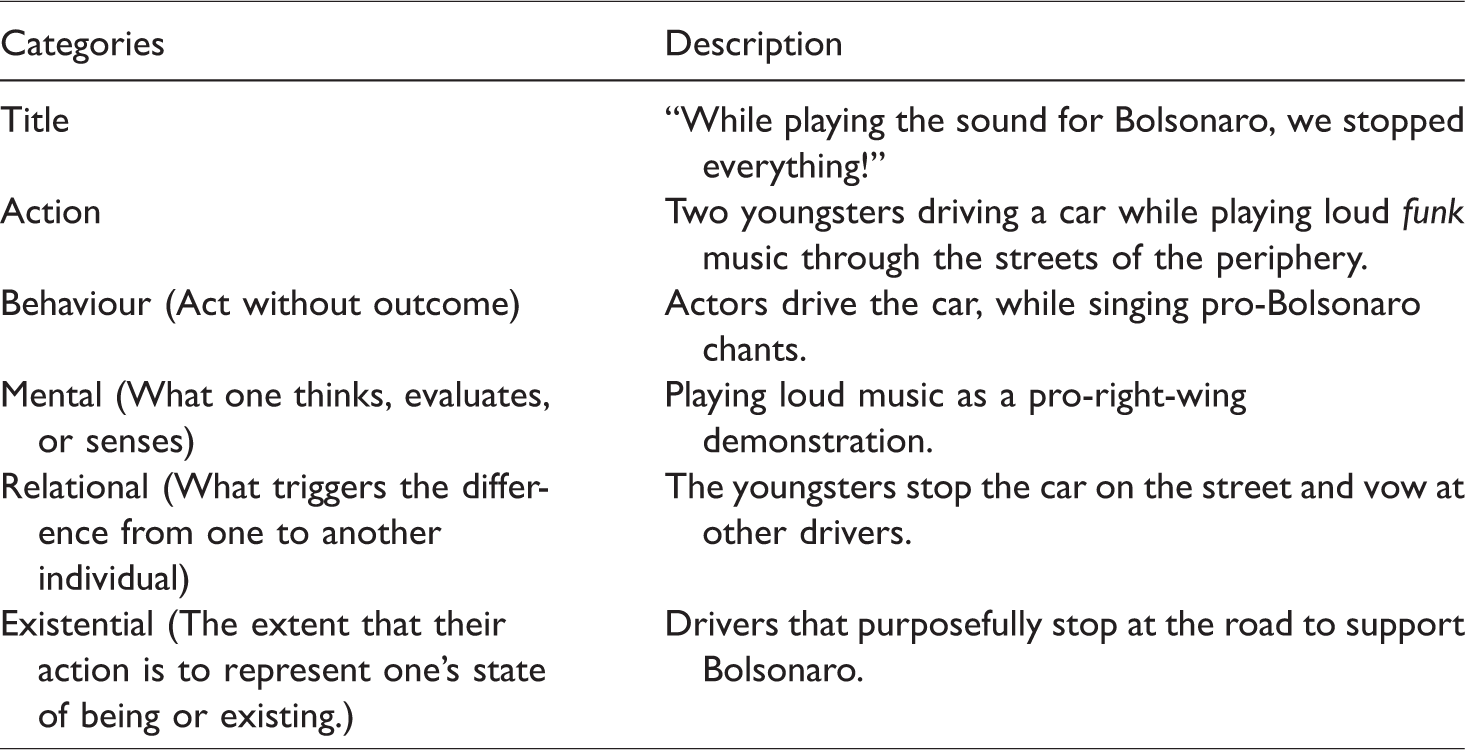
All these aspects of “agency and action” are classificatory tools that helped to ground the later interpretation of the text according to the Freirean notions of action. Namely, this analysis settled with seeing “action and reflection” and “restore the humanity”. Based on that, the coding, see Table 1, categorised the videos in Acceptance or Refusal in relation to the right-wing politics mentioned above. The analysis was repeated by a second academic colleague, who received training on the protocol. The rest of the sample retrieved through the survey has served to give further context for all videos (including the anti-right-wing ones). Excerpts of the text found on the videos, their titles or users’ descriptions of themselves were translated into English to give a better comprehension of the evidence by non-Portuguese speakers. While these nuggets of information are not meant to be entirely conclusive, they helped to organise the results, making producers’ discourse clear for the later application of Freire’s theory. To ensure validity, the agreement between both analyses obtained Cohen’s index of 0,65 (Kraemer, 2014), which is acceptable for exploratory research that carries out a subjective form of analysis.
Results and discussion
The survey results have collected in total 163 videos, which averaged the seven-minute length. 97 of the 163 videos have not characterised any support for the right-wing, but the opposite. These videos have featured debates, responses, and counterattacks from other media producers who were committed to the left, made by leftist journalists, foundations, or proffered a discourse of resistance the penetration of the right-wing in the periphery. A considerable number of videos were productions with mainstream media makers, including newspapers, such as El País, which visited favelas and other peripheral communities to hear their dwellers. These mainstream media productions featuring dwellers in the periphery were not part of the analysis, but identifying their production is as useful to observe the periphery’s presence on mass media as it is to distinguish their original blueprint. Focusing on results strictly published from peripheral producers, there have been also examples of inbred prominence on YouTube. For instance, rapper Eduardo Taddeo, who films many of his interactions in assemblies, some of which in favelas; or Ferrez, the pseudonym of Reginaldo Ferreira da Silva, from Capão Redondo, São Paulo. He is another writer and owner of well-watched video channel.
This brief summary of anti-right-wing activity on YouTube offers a context in which videos with a progressive message have reached some popularity. However, as far as videos showing alignment with right-wing discourse have not made the majority of the videos, this analysis should respond to their critical presence in the political moment of Brazil. There were a range of productions that averaged the five minutes duration, but their prominence was attested to by the million views they have received. Their stories have interspersed with that of the anti-right-wing side to the extent that producers who were supportive of the right tended to openly respond to their contrarians. For example, by appropriating their (leftist) titles, converting it to their way of telling the story. Below, I analyse these examples and other videos identified as reproducing right-wing discourse according to the categories of agency and power aforementioned. Then, I situate their discourse according to Paulo Freire’s idea of action.
Action, goal, process, and circumstance
The first step in this research was to situate the elements that Halliday (1985) described as foundational to analyse agency and power. Most videos in scope show an action, more than a transaction. That is, the fact that producers have conceived the videos as sole endeavours, rather than the filming of a collective activity or conversation. Most producers have created video montages, drawn up music lyrics, and more often, produced sole testimonials in front of the camera. By contrast, their antagonists, i.e. those producers who have not supported the right, have generally invested in broadcasting debates, interviews, dialogues, and meetings in which there is a transactional intent of exchanging values, impressions, and solidarity.
The pro-right producers were also adepts of individualist ways of contesting political positions. This dialogical interaction with the viewer leads to a process that it is less visual and more discursive. They make use of impactful imagery, either by the use of montages (i.e. employing images of Communist countries, famines, famous leftist politicians such as ex-President Lula) or by the use of animation (e.g. video games). The goal is centred on the persuasion of the viewer. They have expounded on their good conduct as citizens (untouched by support to the right) or the redemption of the viewer. The pro-right videos start from three main circumstances. They mainly feature: 1) vote statements for right-wing candidates (mostly, Bolsonaro and affiliated politicians), 2) a personal experience of voting for the other side of the political spectrum, or 3) an expression of conservative values, whether or not referencing the options for the 2018 elections. I must discuss how these aims have matched with the criteria defined in this multimodal method.
Behavioural
In terms of behaviour, producers’ discourse comes down to the attention and seriousness when voicing political positions. They have criticised past left-wing governments or the country’s historical powerholders, whoever has expected the periphery to stay still or to support a candidate under certain circumstances. The excessive intervention or perceived power of the state come into view on a video on which a black, middle-aged man gives an account of his life, while he sits in what seems to be his bedroom. He states: “Do you know what I do think of these left-wing bunch who says: “Eh, the poor of the right [exists because] they praise Bolsonaro (…) Yes, we are poor, proud, thanks God, we work and struggle for our survival, we fight for the things we want. (…) We are poor, but we are fighters, and we have that. [We give] our work, our blood, and our sweat and we don’t depend on social benefits”. 14 November 2018 “Bolsonaro is heading to favelas because shooting is going on. (…) He parachutes in with style. He has his weapons and goes war. This is a live stream. Bolsonaro kills the criminals (…)”. 23 October 2018 “We do not have silence in the periphery. Silence is essential. It does not bother you; it doesn’t interrupt your thoughts. (…) My problem is I am poor. I live in the periphery. They [the dwellers] have that culture of living close to each other. (…) I am not generalising this on all the poor. It is that kind of poor person who does bother you, that petty person, who is not tolerant. (…).” 04 June 2018 “We cannot measure the value of a man by the clothes he wears or the assets he owns. But [you can do it] for his character and ideas. (…) Therefore, if you are thinking of [preconceived] ideas about poor men, quotas for black men, quotas for gay people (…)you are putting yourself at a lower status, [therefore] you will be this [kind of] person.” 14 December 2018
Mental
To consider the mental aspects of the videos means to observe how producers are thinking, sensing and evaluating their support to the right through a range of distinct paths. For example, producers have welcomed the surge of conservative beliefs in the country whenever they could confront the failures of the left. At the same time, they explored the individual benefits from following conservative values. On a video playlist entitled “The poor of the right talking politics,” the presenter, who is driving a car, reflects on politics by creating his theories of what is dysfunctional about Brazilian democracy. For example, he laments the recent defeat of a Bolsonaro’s decree that wanted to liberate the use of personal guns: “The Brazilian senate’s cancelling of Bolsonaro arms’ decree has just damaged Brazilian democracy. (…) We have a president that earned millions of votes, representing the cause of the right. He is fulfilling his promises as far as the Legislature is not respecting it (…). Do those who voted for throwing out the arms’ decree have more votes than Bolsonaro does? I have counted the votes of those who are against the guns and those of Bolsonaro’s, and the former have [won] fewer than him. What kind of democracy is this? (…) 01 October 2019” “Do you want to know what kind of discourse that draws more people to the left? It is about saying that all the poor people have to be left-wing supporters; that the left likes the poor and takes care of the poor (…) Woe to the poor man who says he leans toward the left-wing! If the poor man admits that he himself leans to the right [wing], he is insulted and demoralised by the so-called ‘defenders of the poor’” 25 June 2018
Relational
The most obvious attempt from producers to normalise their shift to the right is to discuss the case of celebrities that have reportedly voted right-wing or whose work seems as such. A well-known YouTuber who self-defines as a black university lecturer of History has posted a testimonial about the famous Brazilian rapper Mano Brown, in which he questions the singer’s image as a leftist icon. He says: “His statements have made me uncomfortable because I was raised listening to [Brown’s band] Racionais. [They helped me in] my view on blackness, of being black in a country like this, where there is so much prejudice (…) [Brown] says that he is back to his roots. ‘I am older, I am listening to funk again.’ He knows that the things of the past are good. He is right-wing musically speaking as well. What is this if not conservatism? What is this but being of the right” 03 November 2018
In all of these examples, either parodic or not, producers have put out theories and jokes. They have refused to agree on limitations to one’s identities, as they also refuted those who wanted to limit their right to diversify personal features just because they could vote for the right. By doing so, they have rejected the attributes associated with a backward, old-fashioned image of the right. Below, I list the existential aspects found on the videos.
Existential
Video producers have argued continuously about the extent to which their political leaning fits their existence in Brazilian society or what one expects from them. Paradoxically, there is a recurrent discourse that reinforces one’s race, ethnicity, religion or low-income status as something that gives them a moral stand to vote for the right. A black YouTuber, who is a cleaner, has filmed himself outside a middle-class tower. He discusses his blackness and a few episodes of racism which he had experienced, but to eventually defend conservative values of “hard work and non-victimisation”, as he says: “The left-wingers, they are used to speak about the poor of the right. I went out to clean a man’s house (…) I arrived at his place. His building sprawled over the full block. I went to the main entrance and someone told me I could not enter. I went to the other entrance and they also said I had to enter through the service door. (…) We are slaves. We are poor and we are violented by this country (…) And yet, we cannot fall for this illusion of the left [that says]: Oh! I cannot work anymore because everything goes to the rich (…).” 28 July 2019 “This is a very serious agenda. (…) I do not want another Hitler. Before the vote, you should ask [to the candidate]: Are you going to do anything it takes to stop this primitive barbarism from returning? There is just one human response (…) Even if that means to vote for someone less prepared. This is the most important question”. 05 September 2018 “Girls, understand that a woman’s value, or as the feminists like to say it, empowerment, is not to behave like a dog. (…) The dancer makes a lot of money from this, but this is not about becoming [a] respectful [woman]. Boys, if you do not like feminism, if you find that feminists are hysterical women, if you cannot deal with it anymore, [I tell you that in] many times you are responsible for incentivising this sort of behaviour (…) If you do not want the women from your family do this, do not stimulate this kind of behaviour (…) 15 February 2019
Paulo Freire’s action and the right-wing politics of videomaking: Grammars of contestation and pluralism
There are certainly fundamental differences between Freire’s perspective of action and the context which has given these actors a platform to communicate the set of ideas, preconceptions, and prejudices. Not least the technological environment and affordances that enable them to create these videos, no longer made by so-called illiterates or “oppressed” in the same Freirean perception. However, the above categories have probed the ways in which producers defy what Freire has called “the culture of silence.” According to him, “Human existence cannot be silent, nor it can be nourished by false words, only by true words, with which men transform the world” (Freire, 2017: 61).
It is not the case of analysing pro-right statements as true or false, as I centre this examination on Freire’s action-reflection as opposed to action alone, which, according to him, would lead only to “activism.” In these videos’ texts, there is an inherent call to move from what was known as the “mass of manoeuvre”; producers argued for reconsidering the power and communicative skills of “the poor of the right.” Freirean action-reflection would certainly not suit a reality that melts in such binary terms. Instead of “true words”, one finds a series of misjudgements, conspiracy theories, and hypothetical scenarios of violence and human degradation. These elements of their discourse are not reflective of truth at all, but of an inconclusive gesture toward action and reflection.
Conversely, notwithstanding the performativity and mockery of many productions, one can perceive in producers’ agency what Freire himself has conceptualised as the critical dimensions of action. The interdependence between “world” and “action” in dialectic thought. Insofar as many productions have brought up fear, panic, and even, violence, there is evidence of critical actions to the extent of their intent and preoccupation with their lives, jobs, and society. Because producers’ narratives have evoked issues that are true for the majority of the peripheral population, their discourses can also amount to “critical intervention in reality through praxis.” Following Freire’s lead, it is not necessary to agree or disagree with their positions but to acknowledge the degree to which their action has been “dichotomised” from reflection. Here, “the oppressed” must be their “own example in the struggle for liberation.” Whatever criticism that one can direct at these producers, one should not deny this due assessment. Even if they are not living up to what they preach or believe, they are responding to the unchanged reality of decades: poverty, violence, and fundamental rights unfulfilled.
In other words, while it is true that the pro-right discourse can emerge from de-humanising, violence “initiated” by the oppressor – a possibility that Freire eyes up very well – producers' repertoire invites observing the way they practice politics (recording videos, debating the news). This action can reveal the awakening of a critical consciousness, but in which they still “owe” things to the oppressor. It is the case of taking into account the rebuttal of stereotypes, their preference for economic systems not entirely understood, or their tackling of the “well-shepherded” stereotype that reaches the poor. Therefore, action gives rise to their ability to perform on videos, defending their positions, and contesting reality, in sum, a path towards pluralism. And yet, action is contradicted by their inability to reflect on the potential consequence of a right-wing rule, especially over the weakest and oppressed. The only way to reconcile both levels of understanding is to see this text as part of a broader grammar of contestation, not fully understood at this point, but visible enough as the periphery gets control of the media narrative from the margins.
This article concludes with a brief attempt at theorising the content of these videos as part of a broader grammar of contestation and pluralism that intertwines with Freire’s “critical action.” The use of the term grammar responds to the textual nature of these video iterations, which can adopt many other formats. Their text is what remains true, as the same producers unite in mobilising in response to political challenges posed to the periphery in recent years. These grammars of contestation can fall back into the “risks” that Freire has also warned of due to their vows at right-wing populism. Likewise, all producers should be acknowledged as a whole, and the majority of them has not given up fighting for human rights and solidarity. In reality, most videos on YouTube have followed the best of the peripheral media tradition: accepting humanising values and rejecting calls for punishment and repression. Overall, the future of left-wing discourse in the periphery rests on making a better case not only for building bastions of human rights and pure models of citizenship, but to accompany other possible forms of political contention that appear on platforms such as YouTube. On this matter, Paulo Freire’s realistic conception of critical action as a dynamic force remains crucial to engaging with this new public, and its controversial political repertoire.
Footnotes
Declaration of Conflicting Interests
The author(s) declared no potential conflicts of interest with respect to the research, authorship, and/or publication of this article.
Funding
The author(s) received no financial support for the research, authorship, and/or publication of this article.