




Abstract
Press freedom is said to be a necessary pillar of democracy. As many sub-Saharan African nations move towards creating or strengthening democracies, examining their levels of press freedom may be an important element. This study utilizes public opinion data from 10 nations in the sub-Saharan African region and international press freedom rankings from Reporters Without Borders to better understand both how important (or not) citizens view press freedom to be in their country and how those beliefs compare to global metrices between 2011 and 2018. Results show clear differences in citizen beliefs about press freedom across countries, but no clear relationship between citizen beliefs and global rankings. A connection between individual perceptions and global rankings may take more time to manifest, and/or a nation’s cultural values and political landscape likely have the strongest impact on citizen beliefs.
Many African nations, notably in the sub-Saharan region, have undertaken significant social, economic and political development in the decades that have followed their independence, and this array of development has included an increased focus on democratic principles and policies (Wanyama, 2000). Press freedom is said to be a necessary pillar of democracy (Becker et al., 2007). Research has shown that in order for a nation to transition to a democracy, and for young democracies to thrive, a majority of citizens in that nation need to be committed to that form of government (Bratton et al., 2005; Mattes and Bratton, 2007). Thus, must citizens be committed to the necessary pillars of democracy, including a free press, in order for democracies to be realized? If so, does the level of press freedom that a country has depend on public demand for it?
This study examines the relationship between global press freedom rankings and public opinion data regarding press freedom in 10 sub-Saharan African nations with varying political, economic, social and environmental landscapes: Côte d´Ivoire, Ghana, Malawi, Mali, Namibia, Nigeria, Senegal, Tanzania, Uganda and Zimbabwe. To date, there is scant research on citizen attitudes about press freedom in sub-Saharan African nations. This study seeks to fill that lacuna by comparing citizen attitudes about media freedom to international rankings in sub-Saharan African nations, to better understand both how important (or not) citizens view press freedom to be in their country and how those beliefs compare to global metrices.
Literature review
The African continent is home to 54 countries with vastly different political, social, environmental, cultural and media landscapes. In order to understand how press freedom compares in the 10 nations being studied, a brief overview of the political and media landscapes in each of them will be discussed. But first, literature relating to press freedom definitions and metrics will be reviewed.
Press freedom
Many nations across the world, including in Africa, have experienced rapid socio-economic development in recent decades, and with such development has come increasing demands for democratic governance (Wanyama, 2000). Many sub-Saharan countries have moved toward democracy since 1990 by conducting competitive multiparty elections (Harbeson and Rothchild, 2009). In addition to multiparty elections, a democracy requires: That an individual can freely express himself/herself without fear of arbitrary arrest, torture and detention for his/her political convictions. The opposite was the case during military and one-party rule in Africa…During this period, the voice of the media was muffled and most African countries had one main media network, which was state-run radio and television. (Mukhongo, 2010: 342)
Nyamnjoh (2013) rightly cautioned, A focus on press freedom provokes a few questions. What exactly is freedom (press or otherwise)? How does one identify or authenticate it? If life is a game of interests and society an uneven playing field, how do researchers of the social world, as academic players from different backgrounds and positions, represent press freedom in ways that do justice to the complexities and nuances of the games in which they partake? (1)
While theoretical frameworks specifically formulated to examine press freedom remain limited, it has been suggested that understandings about the importance of a free press stem from modernization theories which emphasize the power of mass media in development (Lerner, 1958; Rogers, 1983; Rostow, 1960; Schramm, 1964).
Others have argued that, The broad agreement that news media should be protected from government censorship rests on theories about the nature of human beings and their inherent rights. The underlying assumption is that all normal human beings are rational and have inalienable rights of self-determination, including choosing and monitoring their governments. (Graber, 2017: 238)
However, Becker and colleagues (2007) evaluated four well known organizations that measure the concept — the International Research and Exchanges Board (IREX), Reporters sans Frontières/Reporters Without Borders (RSF), Committee to Protect Journalists (CPJ), and Freedom House — and found that these entities seemed to measure press freedom in similar ways (Becker et at., 2007). Such independent evaluations of press freedom are necessary in-part because nations (like those in this study) that guarantee press freedom in their legal documents do not necessarily provide such freedoms in reality (Becker et al., 2007).
Of course, the level of press freedom that a country has is dependent on countless factors that are unique to that nation. Thus, the next section will briefly describe the political and media landscapes in each of the 10 nations under study.
Political and media landscapes
The 10 nations examined in this study come from three varying regions: West Africa, East Africa and Southern Africa.
Côte d´Ivoire. Côte d´Ivoire is part of “Françafrique,” a large region of 12 French-speaking African countries (former colonies of France) where France still retains considerable economic influence and has intervened militarily dozens of times since they received independence in the 1960s. After years of political turmoil, including a civil war and unsuccessful attempts at military coup d’états, Côte d´Ivoire held a long-awaited presidential election in 2010 (Momodu, 2018). Incumbent and leader of the Front Populaire Ivoirien, Laurent Gbagbo, rejected the alleged victory of his political opponent Alassane Ouattara. Much of the international community, including the United States, the European Union, the African Union, and the Economic Community of West African States, supported Ouattara and urged Gbagbo to transfer power (Momodu, 2018). In the months that followed the election, members from both political sides attacked opponents and more than 3,000 citizens died (Lemke, 2020). In April 2011, French and Ouattara forces arrested Gbagbo and he was later transferred to the Hague to be tried by the International Criminal Court (Banegas, 2011).
The influence of politics on Côte d´Ivoire’s media is hard to understate. Lemke (2020) said, “Côte d’Ivoire’s print newspapers are almost all party-owned publications that subscribe to a particular editorial line” (478). Since the 1990s, the nation’s political newspapers have largely followed two ideologies and published content accordingly: La presse bleue papers are left-leaning socialist newspapers that support an array of anti-French, anti-Western political parties, compared to la presse verte, which typically support the more right-leaning party, Rassemblement des Republicaines, the party of Ouattara, the current president (Campbell, 1998; Théroux-Bénoni, 2009). However, private newspapers have a storied history in the country. As the country navigated a multiparty system and what Sendín (2013) called a “press blossom” (p. 190), “Between 1990 and 1996, some 178 newspapers appeared on the nation’s market…[but] only thirty were still operating by the end of 2011” (90-191), largely due to tight relationships between media and political elites and shifting power blocs. While private media do exist in the country today, “The government operates the outlets with the widest reach: two radio stations, two TV stations and the leading daily newspaper” (BBC, 2017a, para. 1) and “the media sector is still kept under close government scrutiny” (BBC, 2017a: para. 5).
Ghana. In 1957 Ghana became the first African country to achieve independence from a European colonial power, it then transitioned to a multiparty democracy in 1992 and has since been lauded as one of the continent’s most politically stable nations (Baah, 2018; BBC, 2018; Cheeseman et al., 2017). Ghana’s media landscape is considered to be among the freest on the African continent with deliberate actions taken to protect and promote media freedoms, such as the 2001 repealing of the criminal libel law (which had been used to intimidate journalists and allow legal proceedings – and the accompanying pressure on journalists – to drag on for long periods of time) (Botwe, 2018). Though, that is not to say that the media environment in Ghana is perfect. Journalists still face challenges regarding to the right to information, arrests related to their professional work and courts imposing large fines that silence media houses (Nyarko, 2015).
Like many countries in the region, radio is very popular in Ghana. As of 2018, more than half of survey respondents in Ghana reported listening to radio news every day and another 29 percent said they did so a few times per week (Isbell and Appiah-Nyamekye, 2018) and local-language radio stations maintain a strong presence in all 10 regions of the country (Gadzekpo et al., 2020).
Mali. Mali received independence from France in 1960, but has since struggled with rebellions, a coup d’état and more than two decades of military dictatorship. While democracy-building steps have been taken, Mali has – and still does – faced challenges related to al-Qaeda-linked militants carrying out attacks in the country, which, coupled with internal political strife, has led some to label the political environment in the country as fragile (Lavallée and Völkel, 2015; Walker, 2013). Mali ranks 184 out of 189 on the United Nations’ 2019 human development index (UN, 2019a), indicating low life expectancies, education levels, per capita income indicators and other measures that point to widespread extreme poverty in the country. Freedom House has said that the media environment in Bamako, the capital city, and other parts of the southern region of the country remain relatively free, but armed militant groups in the north create dangers for media workers and has resulted in increased censorship (Freedom House, 2019). Radio remains the most popular medium, with television and newspapers seeing low audience and circulation levels (BBC, 2019a).
Nigeria. Africa’s biggest oil exporter, Nigeria, is home to about half of West Africa’s population and has held national elections six consecutive times since the nation’s return to democracy in 1999 (World Bank, 2019a). While the country has seen stability in many parts of its political landscape, it has, of course, still faced challenges, including government corruption and an ongoing battle with insurgent groups Boko Haram and Islamic State of West Africa Province (Olukayode and Clowes, 2020: 2018). Despite the prominence of these militant groups, the nation’s media environment is diverse (Daramola, 2017) and “one of the liveliest in Africa” (BBC, 2019b: para. 1). Since the liberalization of broadcast media in 1992, media sector growth has resulted in an array of media platforms including hundreds of radio stations, TV that reaches tens of millions of people and more than 100 newspapers (BBC, 2019b; Nwulu et al., 2010). The Nigerian newspaper landscape is prominent in the country and said to be, Dominated by two publishing hubs in the north and south. The Guardian newspaper, which is regarded as Nigeria’s flagship/elitist newspaper, and The Punch, which is deemed to be the most widely read newspaper in the country, are published in the southern hub while the Daily Trust and Leadership newspapers are published in the northern hub. In addition, these two publications are widely circulated in the northern part of the country and are regarded as ‘the voice of the north.’ (Ette and Joe, 2019: 70)
Tanzania. Tanzania’s 1965 constitution initially called for a one-party system, but that changed in 1992 when the country launched its multi-party system (Wallengren, 1997), which impacted the media system as “countries under pressure to liberalize their political systems … responded by liberalizing the media” (Balikowa, 1995: 603). In fact, in the 1990s, scholars pointed out that the country faced challenges because press freedoms were ahead of political freedoms (Onyango-Obbo, 1996). While radio remains a popular media, TV viewership is rapidly growing, as is online news consumption (BBC, 2019c). Today, however, media freedoms are said to be declining under President Magufuli, who has been in office since 2015, with media outlets being shut down, steep fines being imposed, and journalists being harassed and detained for criticizing the president (Pekkonen, 2018; Public Media Alliance, 2019).
Uganda. The 1960s and 1970s brought political instability to Uganda (Ingham, 1994). After contested elections in 1986, Yoweri Kaguta Museveni declared himself president of Uganda and was elected to the presidency in 1996, 2001, and 2006 (Oloka-Onyango, 2004) and remains president today. Uganda’s broadcast sector experienced liberalization in the 1990s but still faces challenges regarding concentrated ownership, unevenly distributed government regulation and content dissemination (Chibita, 2009; Odongo, 2014). Ugandan journalists report declining levels of press freedom the longer that Museveni remains in office (Sobel Cohen and McIntyre, 2020).
Malawi. In 2014 Malawi celebrated 50 years of independence from British rule and 20 years of multi-party democracy. During the time, as well as since 2014, Malawi has faced economic and infrastructure development challenges and an array of government corruption, but overall has remained relatively politically stable (Gaber and Lora-Kayambazinthu, 2014; World Bank, 2019c). Similar to Mali, Malawi remains one of the poorest countries in the world, ranking 172 out of 189 in the United Nations’ 2019 Human Development index (UN, 2019b). Despite challenges, though, press freedom is said to have improved in recent years and abuse against journalists has declined (BBC, 2019d). Radio remains the most popular medium (Mhagama, 2015b), and “in communities where there are community radio stations, the stations are helping create spaces for ordinary people to participate in public life by setting up radio listening clubs” (Mhagama, 2015a: 105). State run media from Malawi Broadcast Corporation also remains prevalent, though it has been criticized for serving the interests of the political elite (Manda 2011; Manyozo 2004; Meinhardt and Patel 2003; Patel 2000).
Namibia. Namibia gained independence from the South African colonial regime in 1990 after the first United Nations supervised democratic elections took place in November 1989, and the country remains a multi-party democracy with more than 13 political parties (Shihomeka and Arora, 2018). Namibia has five daily newspapers and six weeklies, five commercial TV stations and public broadcasting across an array of platforms (Government of Namibia, n.d.). Like other countries in this study, almost 70% of Namibians have regular access to radio broadcasts, making it a very popular medium (NSA, 2014). Mobile phone and social media use is growing rapidly in the country, and research has shown that this is improving the ability of citizens, particularly youth, to engage in political discussions (Shihomeka and Arora, 2018). Though, despite the positive improvements, research found that journalists and politicians in Namibia lack a clear understanding of what media freedom and responsibility look like in the country (Wasserman, 2010).
Zimbabwe. In March 2008, Zimbabwe held local government, parliamentary, senate and presidential elections simultaneously and “In the run-up to the elections, there was one television station (ZTV), five national radio stations and no private radio station, giving government monopoly over radio and television” (Manganga, 2012: 248). The years that have followed have seen political violence, inflation and extreme poverty rising, and, the ousting of longtime leader Robert Mugabe (Moyo and Specia, 2019; World Bank, 2019d). The main newspapers in the country are all state-owned and tend to serve as mouthpieces for the government, while laws restricting the press have been called “draconian” (BBC, 2017c: para. 4). Radio is the main source of information for most Zimbabweans (BBC, 2017c), but, interestingly, “Unlike most nations in southern Africa, Zimbabwe has not seen the expansion in community radio stations that has been characteristic of the region from the 1990s” (Mhiripiri, 2011: 107).
Given the differences in the political and media landscapes of each of these countries, they represent nations at different levels of socio-economic development and democratization. Given that press freedom is a necessary component of a democracy (Becker et al., 2007), it is worth examining the public’s perception about the role of media in their countries. In order to examine whether the level of press freedom that a country has depends on public demand for it, this study poses the following three exploratory research questions that interrogate the relationship between global press freedom rankings and individual public opinion data regarding press freedom in Côte d´Ivoire, Ghana, Malawi, Mali, Namibia, Nigeria, Senegal, Tanzania, Uganda and Zimbabwe: RQ1: To what extent do citizens in each country believe that the media should be free to report on any topic without government interference? RQ2: How have citizen beliefs about press freedom in each country changed between 2011 and 2018? RQ3: How do citizen beliefs about press freedom compare to international press freedom rankings of each country?
Method
In order to answer the above research questions, this study combines public opinion data from multinational surveys conducted by Afrobarometer with global press freedom data from Reporters Without Borders to better understand the relationship between how free a nation is believed to be, and how much its citizens say they support media freedom. An analysis of secondary data was conducted by employing survey data from the 2011-2013, 2014-2015 and 2016-2018 Afrobarometer surveys. This dataset was selected because it is the most recent and most empirically valid cross-national dataset examining public opinion regarding media freedom issues in the continent. The survey was conducted via face-to-face interviews based on national probability sampling in each country (see www.afrobarometer.org for detailed methodological information). Afrobarometer survey data has been used in academic research for years (see, for example, Bornman, 2016; Cho, 2010; Nisbet, 2008; Nisbet et al., 2012). Utilizing the three surveys (one conducted from 2011-2013 called “wave 1,” one conducted from 2014-2015 called “wave 2,” and one conducted from 2016-2018 called “wave 3”) across the 10 nations, 53,192 survey respondents were included in this study. Specifically, this study utilized a measure gaging citizen’s attitudes about media freedom in their country.
Survey results were then compared against Reporters Without Borders data ranking the level of press freedom in each of the 10 countries during each year (2011-2018). Reporters Without Borders is a non-governmental organization based in Paris with a mission to promote free journalism and defend media workers (Reporters Without Borders, 2020). Since 2002, Reporters Without Borders has published its World Press Freedom Index, which ranks the level of press freedom in approximately 180 countries around the world. Reporters Without Borders uses mixed methods to compile their results: 87-question online questionnaires with experts and quantitative data on violence against journalists (see https://rsf.org/en/detailed-methodology for detailed methodological information and a copy of the questionnaire). Data were retrieved from the organization’s online archives. Reporters Without Borders press freedom data has previously been used in academic research (see, for example, Islam and Osmani, 2017; Lašas and Matthews, 2019; Tran et al., 2011).
Sub-Saharan Africa is the focal region of this study as it remains overwhelmingly understudied in mainstream mass communication scholarship. It also has growing/changing democracies, and rising levels of internet penetration and media consumption, making it worthy of analysis and of understandings that regions around the world can learn from.
Findings
The first research question asked about the extent to which citizens in each country believe that the media should be free to report on any topic without government interference. The nature of the research question dictated that this study examine between-country differences. Table 1 data show results from all 10 countries overall (when results from the three waves of the survey were combined) to a question asking respondents about their perceptions about the rights of the press. Specifically, individuals were asked which of two statements was closest to their view, if either: 1) The media should have the right to publish any views and ideas without government control; or 2) The government should have the right to prevent the media from publishing things that it considers harmful to society. Respondents were asked to select from six options: agree very strongly with 1, agree with 1, agree with 2, agree very strongly with 2, agree with neither, don’t know (and the option of “refuse to answer” was added in the third wave). Table 1 shows the percentage of respondents from each country that responded that they agree or strongly agree with prompt 1 or 2. Agreement with prompt 1 indicates a belief more in line with international (and some would say, Western) notions of media freedom and agreement with prompt 2 indicates a belief more in line with the need (or desire) for government restrictions on the press.
Agreement with each prompt across all survey waves, by country.

Note: Individuals were asked which of two statements was closest to their view, if either: 1) The media should have the right to publish any views and ideas without government control; or 2) Statement 2: The government should have the right to prevent the media from publishing things that it considers harmful to society.
With 57.9% of respondents strongly agreeing with the media freedom prompt and another 12.5% agreeing, individuals in Malawi conveyed the largest percentage of agreement (70.4%) with the statement that media should have the right to publish any views and ideas without government control. Following closely behind is Uganda, where 66.3% of survey participants expressed some agreement (48.3% agreed very strongly and 18.0% agreed) with the press freedom prompt. On the other hand, only 36.8% of respondents in Mali expressed any agreement with the first prompt; in fact, more than 39% of survey participants reported agreeing very strongly with the idea that the government should have the right to prevent the media from publishing things that it considers harmful to society. The other nations were all at varying levels in the middle, with respondents from Namibia and Ghana being almost evenly split in their beliefs.
To answer the second research question, a deeper dive into the data was needed to understand how respondent beliefs changed over time. Specifically, in order to understand how citizen beliefs changed throughout the three phases of the survey, a form of an opinion-differential was used, ranging from 1 to 4. Analysis of variance (ANOVA) tests were run on the data and results are reported in Table 2. Means closer to one indicate that a country agrees with statement 1 (media rights), means closer to four indicate that a country agrees more with statement 2 (government rights).
Comparing means across survey waves (10 ANOVAs).
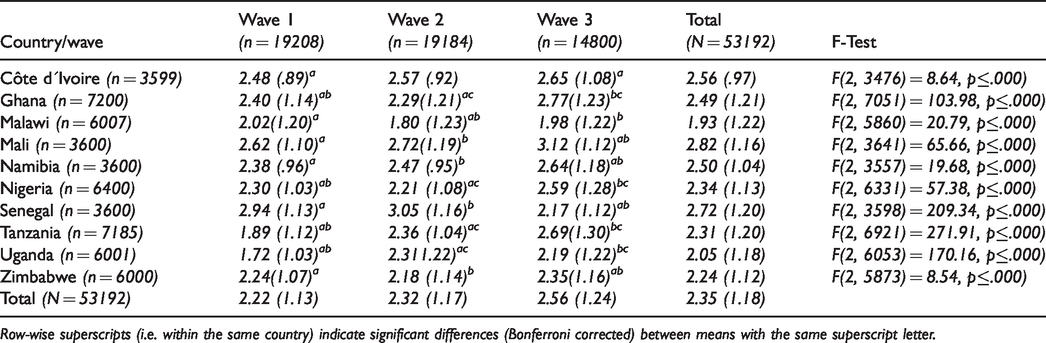
Row-wise superscripts (i.e. within the same country) indicate significant differences (Bonferroni corrected) between means with the same superscript letter.
Overall, we see the most agreement with statement 1 from Malawi, followed by Uganda and Zimbabwe – indicating more agreement with the statement that the media should have the right to publish any views and ideas without government control. On the other hand, agreement with statement 2 (the government should have the right to prevent the media from publishing things that it considers harmful to society) got stronger over time in Tanzania, Mali and Cote d'Ivoire, pointing to growing public acceptance (or support) of government limits on the press. In the earliest wave of the survey, respondents in Uganda and Tanzania expressed the most agreement with the press freedom prompt, but that declined in both of those countries in the following years. Ghana, Malawi, Nigeria, and Zimbabwe all reported the most press freedom agreement during the second survey wave.
Lastly, the third research question asked how citizen beliefs about press freedom compare to international press freedom rankings of that country. In order to answer this question, data from Tables 1 and 2 were compared against data from Reporters Without Borders’ press freedom index for each year under study. Table 3 shows the press freedom index score for each country, by year (a score of 0 represents a perfectly free press).
Comparing Reporters Without Borders press freedom index rankings across countries and years.

Note: Reporters Without Borders released one ranking for the years of 2011 and 2012.
*Rankings are out of 179 countries.
**Rankings are out of 180 countries (Belize was added to the rankings in 2014).
Despite small fluctuations, a number of countries’ rankings on the press freedom index stayed relatively stable throughout the study time period, including Nigeria, Namibia and to some extent Uganda (though Uganda had a period of improvement around 2015 before declining to earlier levels). As Table 3 data reveal, Cote d'Ivoire, Senegal and Ghana’s ratings on the index have improved throughout the study time period, pointing to increasing press freedom in each of those countries. Ironically, the findings for research question two highlighted the trend among respondents in Cote d'Ivoire to more strongly support government restrictions on the press, which is seemingly at odds with the improving rankings on the press freedom index. Between waves 2 and 3 of the survey, Senegalese respondents did report more agreement with the press freedom prompt, which aligns more understandably with increasing rankings on the Reporters Without Borders’ index. Ghana survey respondents seemed to indicate more agreement with the press freedom prompt in the second wave of the survey, but those sentiments were less strong in the third survey wave. Taken together, this does not appear to indicate a consistent relationship between citizen beliefs about press freedom and international rankings.
Data in Table 3 also show that Tanzania, Mali, and to a lesser extent Zimbabwe, have backslid, meaning that, according to the index, the press freedom environment is getting worse.
Table 2 data show that citizens in Tanzania and Mali did report less agreement with the press freedom prompt across the three waves of the survey, which aligns with the declining press freedom scores in those countries. In Zimbabwe, agreement with the press freedom prompt declined from wave one to wave three, but there was a slight increase in wave two.
Discussion and conclusion
Overall, data revealed notable discrepancies in citizen beliefs about press freedom across the 10 countries included in this study, which makes sense given the differing landscapes and cultures in each of the countries. Citizens in Malawi and Uganda reported the highest percentages of agreement with the press freedom prompt and citizens in Mali reported the lowest agreement with the press freedom prompt (and the strongest agreement with the government restrictions prompt, which strengthened throughout the three waves of the study). Results highlight some patterns in the relationship between citizen beliefs about press freedom and international rankings, but those relationships were not consistent across all countries or time periods. Perhaps there is not a relationship between citizen beliefs about press freedom and global rankings, or perhaps the relationship takes longer to manifest – citizens obtaining a belief in the importance of a free press likely requires other socio-economic development aims to be achieved, such as literacy, education and infrastructure improvements, after which these citizens would need to have a strong voice and space to lobby their governments, and then the government would need the political will to enact and enforce structural changes to support journalists. This is not a fast process, so it is possible that a substantial longitudinal study is needed to look at patterns beyond the eight-year snapshot that this study provides.
Since press freedom is an essential part of a functioning democracy (Becker et al., 2007), it makes sense that the countries with the most press freedom, according to the Reporters Without Borders’ rankings, would also be the countries with stable democracies, such as Ghana and Namibia. In fact, Reporters Without Borders rankings have been shown to significantly correlate with countries’ United Nations Human Development Index scores (Martin et al., 2016). Of the countries in this study, Mali received the lowest 2019 human development index score (UN, 2019b) and also reported the least agreement and declining agreement with the press freedom prompt.
However, the overall conflicting results seen in this study introduce questions about whether citizens would value press freedom more if they already have a great deal of it or if they do not yet have much of it. Previous research has suggested that, “In the long-run, press freedom does not cause human development and vice versa” (Islam and Osmani, 2017: 142). In other words, maybe the connection between press freedom and development is not as strong as some would like to believe.
Freire’s (1968) notion of a “fear of freedom” could be at play in some nations where desire for press freedom is remaining stagnant or declining. In such an instance, “The oppressed, having internalized the image of the oppressor and adopted his guidelines, are fearful of freedom. Freedom would require them to eject this image and replace it with autonomy and responsibility” (Freire, 1968: 46–47). Or, it is possible that press freedom is not what is needed or important in all places at all times. McQuail’s (1983, 2010) theory of media development argues that press freedom should take a backseat during times of social, economic and political development. In countries like Mali, that have been referred to as “fragile” due to extreme poverty and political turmoil (Lavallée and Völkel, 2015; UN, 2019a; Walker, 2013), maybe there are more essential socio-economic development aims that need to be met before press freedom can be seen as important. Of course, critics – and years of research (Alam and Ali Shah, 2013; Jacobsson and Jacobsson, 2004; Nixon, 1960, 1965) – would argue that a free press will enable a society to experience socio-economic growth.
Additionally, Sapiezynska and Lagos (2016) suggest that Reporters Without Borders press freedom rankings are more fitting for measuring media freedoms in nondemocratic nations due to the focus on government restrictions on the press and violence against journalists and they don’t pick up on the nuances of media freedom in democratic nations. So this may explain some of the findings in this project.
While this study reveals important findings, it is not without limitations. First, and maybe most significant, is that this study cannot provide causal evidence that citizen beliefs about media freedom contribute to or limit the amount of press freedom that a nation has. Of course, a plethora of factors fuse together to create a nation’s media landscape. Future research could utilize qualitative interviews with citizens in each of these countries to more fully understand their perceptions about press freedom, or a large-scale cross-national survey could focus exclusively on topics related to media freedom to add context to this study’s findings. Future research that compares the results of this study to the perceptions of journalists in these countries would also be beneficial in more fully understanding the relationship between international press freedom rankings and perceptions from individuals in the respective countries. Additionally, the sample included data from 10 nations. It did not include every country in sub-Saharan Africa, nor did it include any nations from other regions or continents. Thus, the generalizability of the results is limited. At the same time, the sample includes nations with varying political, economic, social and environmental landscapes in attempt to create a heterogeneous group that can provide better understandings than would existing single-country research. Future research should investigate linkages between citizen perceptions of press freedom and international rankings in nations not included in this study.
Additionally, as mentioned in the literature review section of this paper, critics have pointed to issues with international press freedom rankings such as those from Reporters Without Borders (Becker et al., 2007; Schneider, 2014). Future research should expand this line of inquiry to include an array of measures of press freedom from organizations within and outside of the African continent.
Also, some limitations could be introduced by this study utilizing secondary data sources. Specifically, the wording of the survey measure, which asked respondents to rate their agreement with one of two prompts is a form of semantic differential between two allegedly polarized opinions. Given that the two opinions are not mutually exclusive, this would be an arena for future research to continue exploring and confirming by utilizing other research methods.
This study aimed to understand whether there is a relationship between the beliefs of citizens and the level of press freedom as evaluated by an international body. However, this study cannot pinpoint directionality, meaning that this study cannot say that citizen beliefs about the importance of press freedom lead to a freer press, or vice versa, that improving global rankings could result in more citizens then reporting a belief in its importance.
Ultimately, this study highlighted similarities and differences across 10 African nations with regard to citizen beliefs about press freedom and international press freedom rankings. While a clear relationship between citizen perceptions and global rankings was not seen, individuals in some nations clearly value press freedom more than others. While the movement toward more democratic political and media systems may arise at an institutional level in nations across sub-Saharan Africa, long-held cultural values are likely to persist, especially as ruling elites maintain the greatest influence on the values that dictate media systems in the region (Tran et. al., 2011). Thus, a nation’s cultural values and political landscape likely have the strongest impact on citizen beliefs.
Footnotes
Declaration of conflicting interests
The author(s) declared no potential conflicts of interest with respect to the research, authorship, and/or publication of this article.
Funding
The author(s) received no financial support for the research, authorship, and/or publication of this article.
