



Abstract
This study examines how media representations of Palestinian-Israeli politicians, can help community members realize their capabilities. The study’s database is comprised of 1,207 interviews conducted with Palestinian-Israeli politicians on news and current affairs programs on the three national television channels and the two national radio stations in Israel, for 24 months (2016-2017). We identified and analyzed the differences in the modes of representation between national and local Palestinian-Israeli politicians and between Palestinian-Israeli parliament members in the Joint List and Palestinian-Israeli parliament members in Zionist parties, all through the capabilities prism. In this study, we demonstrated how different types of Palestinian-Israeli politicians may potentially affect the realization of different political functions and capabilities. Analyzing political representations in the media through the theoretical framework of the ‘capabilities approach’ contributes to a more comprehensive insight into the roles the media can play promoting people’s wellbeing and human rights, relative to traditional media theories.
Introduction
Though many studies have found Palestinian-Israelis to be greatly underrepresented in the Israeli broadcast media (Bar-lev, 2007; First, 2016; First and Inbar-Lankeri, 2013; Laor et al., 2004, 2006), only a few have focused on minority politicians in general, and Palestinian-Israeli politicians in particular (Rovner-Lev, 2015). Moreover, these studies tended to focus on public perceptions deriving from media portrayals, however mediated representations can play a more compelling role in realizing people’s needs and affecting their quality of life and wellbeing.
The “capabilities approach” asserts the successful pursuit of individuals’ goals as the appropriate measurement of a just society (Sen, 1993). The approach measures people’s realization of self-defined needs rather than their ownership over goods and properties perceived as desirable by “objective” measures (Sen, 1993). It posits that people’s ability to realize their own goals is necessary for their flourishing and the pursuit of quality of life and freedom (Sen, 1993). Moreover, this approach relies not only on people’s subjective wants but also on their potential wants, thus measuring what diverse social mechanisms enable individuals to realize their potential (Kaushik and Lopez-Calva, 2011).
In his own writings, Sen did not implicitly tie traditional media and capabilities, yet recent advances in the capabilities literature have attempted at establishing that link. Indeed, applying the capabilities approach to the mass media raises two questions: How can individuals make use of the media in order to realize their capabilities? (Hesmondhalgh, 2018) and what capabilities do the mass media enable individuals to realize? (Jacobson, 2016). While most media theories focus on the subjective desires of consumers (Hesmondhalgh, 2018) the capabilities approach focuses on the enablement of wants (Hesmondhalgh, 2017). Therefore, the capabilities approach provides an additional angle to understanding existing theories routinely applied in communication studies such as cultivation, social learning, symbolic annihilation and framing. It helps us to better understand how the media are affecting people's capabilities and subsequently how they contribute to the promotion of social justice and the advancement of basic human rights.
This study, which serves as a case study for the application of the capabilities approach on Palestinian-Israeli politician's media representations, who are a national and ethnic minority, is relevant to other ethnic, racial and national minorities around the world for both conceptual and comparative purposes.
Capabilities and the media
The capabilities approach differs from most traditional media theories. It focuses on individual needs rather than on changes measured in the aggregate. Indeed, the mass media are seen as acting as a “citizen’s agency” vital for the realization of individual’s capabilities (Jacobson, 2016). This agency can be measured through viewers’ consumption patterns and interpretations of media content as they relate to the realization of their capabilities.
It should be noted that there is no limit to the number of possible capabilities. However, while Sen (2005) abstained from listing fundamental capabilities, fearing it could limit people’s choices by forcing their compliance, Nussbaum (2011) mapped out capabilities she deemed fundamental such as experiencing emotions and having good health. For the sake of this study, we used six media capabilities, which we used in previous studies (Shomron and Schejter, 2020a, 2020b). These capabilities were applied to the political functions the media allow:
“Voicing,” which is defined as “giving an account of one's life and its conditions” (Couldry, 2010: 7), emphasizes that speaking is not sufficient, and that one must also be heard (Couldry, 2010). This capability is realized when minority politicians recount issues that are important to their minority members (Dancygier et al., 2015). This capability can be seen as reflecting Sen’s democratic value of “enhancing the hearing that people get in expressing and supporting their claims” (Sen, 1999: 10), allowing people to “learn from one another” (Sen, 1999: 10). “To be informed,” is the ability to consume affordable and reliable newsworthy information (Bardoel and d'Haenens, 2008; Hesmondhalgh, 2018; Scannell, 1990; Shomron and Schejter, 2019a). Indeed, it is affected by the provision of information by politicians communicating with the public (Gershon, 2013; Vos and Van Aelst, 2018) including their legislation records and positions (Jacobs and Hooghe, 2016). Sen emphasized the importance of “uncensored distribution of news and fair comment” (Sen, 1999: 10) to democratic discourse, highlighting the importance of the “electorate enjoying the freedom to obtain news” (Sen, 1999: 10). “Identity and belonging,” are rooted in the individual’s self-perception as well as in the way s/he is perceived by others (Gerbner and Gross, 1976; Mahtani, 2001; Tuchman, 1979). It thus refers to the accommodation of diversity and caters individuals’ values and cultural identity (Bardoel and d'Haenens, 2008; Schejter, 2009), playing a key role in the individual’s social integration (Gerbner and Gross, 1976). This capability also represents the political function of minority inclusion. The media coverage of minority politicians enhances minority members’ feelings of social inclusiveness (Dancygier et al., 2015). This capability can be seen as emanating from Sen’s concepts of social-cultural freedoms such as “achieving self-respect,” “being socially integrated” (Sen, 1993: 31), and being able “to retain ancestral customs and lifestyles” (Sen, 2005: 155). “Identification and imitation” focuses on the part role-models play as individuals identify with and learn from them (Hesmondhalgh, 2018). This capability can be realized when minority members are instigated to become politicians themselves following media coverage of minority politicians (Jacobs and Hooghe, 2016). It relates to Sen’s concept of the “opportunity aspect of freedom” (Sen, 2005: 153), which focuses on people’s ability to successfully do what they aspire. “To be secure” is the upholding of individual safety (Nussbaum 2011), and the ensuring of their rights (Jacobson, 2016). This capability can be realized when politicians defend the minority (Jacobs and Hooghe, 2016), address social biases and work to ease social conflicts (Jacobs and Hooghe, 2016), actions which may result in social stability and security (Dancygier et al., 2015). This capability relates to Sen’s key freedom of the capability to “live the way one would like” (Sen, 1993: 44), as external threats to a person’s safety could lead to the deprivation of opportunities (Sen, 2005). “Civil participation” denotes taking part in democratic discourse (Hesmondhalgh, 2017; Jacobson, 2016), emphasizing free speech (Nussbaum, 2011) and pluralism (Bardoel and d'Haenens, 2008). This capability is defined by Sen as inherent to democracy and its realization calls for free access to public discussions on issues vital to society (Sen, 1999). This capability may be enhanced by minority politicians’ electoral success (Gershon, 2013; Jacobs and Hooghe, 2016), yet hindered by exclusive media exposure of politicians discussing particular issues. Thus, the media coverage may contribute to the promotion of social issues that are important to the minority group (Dancygier et al., 2015), yet impede individuals’ motivation to partake in public discourse. Politicians can influence other politicians through the media (Vos and Van Aelst, 2018) and the media exposure of minority politicians contributes to the legitimacy of the democratic system and its institutions in the eyes of minority members (Jacobs and Hooghe, 2016).
Minority representations in the media
Mass media are a fundamental social institution, and thus vital for realizing capabilities. The portrayal of minorities in the media and their media representations play an important role in the process of realizing capabilities, and the successful realization demonstrates the minority’s flourishing and contributes to its members’ quality of life (Kaushik and Lopez-Calva, 2011; Shomron and Schejter, 2020a).
Nevertheless, for decades minorities have been underrepresented and misrepresented in the mass media (Chouliaraki and Zaborowski, 2017; First, 2016; First and Inbar-Lankeri, 2013; Kama, 2015; Klein and Shiffman, 2009; Laor et al., 2004, 2006; Mastro and Behm-Morawitz, 2005). The minority’s mediated under-representation contributes to their social insignificance also described as “symbolic annihilation” (Tuchman, 1979) and is measured by appearing in the media in a frequency that is lesser than their share of the population (Mastro and Behm-Morawitz, 2005). Misrepresentation occurs in the context in which the minority is portrayed, when it focuses on stereotypical characteristics, roles and behaviors (Meyers, 2004; Voorhees et al., 2007). Both under-representation and misrepresentation influence minority depictions (Tukachinsky et al., 2015) and can impact the minority’s social standing (McKinley et al., 2014).
News and current affairs programs play a vital role conjuring minorities depiction (Van Dijk, 2000). These depictions usually consist of negative stereotypes (First, 2016; Moy et al., 2016; Van Dijk, 2000) and can derive from both media professionals’ social convictions and from organizational procedures (Anastasiou, 2016; Moy et al., 2016), as well as from power relations (Dixon and Linz, 2000; Kama, 2015) and economic circumstances (Dixon and Linz, 2000; Pritchard and Hughes, 1997). Accordingly, media organizations tend to frame minorities in the context of violence and crime (Bjornstrom et al., 2010; First, 2016), specifically as perpetrators rather than victims (Lin and Phillips, 2014; Petersen, 2016), contributing to the notion that minorities endanger the majority group (Bjornstrom et al., 2010; Lin and Phillips, 2014). For example, Muslims were predominantly depicted as violent in the British media (Ahmed and Matthes, 2017), and Latinos and Blacks were regularly depicted as criminal perpetrators in the United States’ media (Dixon and Linz, 2000). These tendencies point to the important role the media can have regarding capabilities, and more specifically point to the role minority politicians can have in the media regarding the realizations of capabilities by their minority group members.
The Israeli media system
The Israeli mass media system is influenced by the European model. It consists of commercial and public media networks (Schejter, 2009). The Israeli public broadcasting system, which existed until 2017, mirrored the BBC model (Tsfati and Peri, 2006) and included one television channel and eight radio networks. These broadcasters operated under the Israel Broadcasting Authority (IBA) between 1965–2017, until it was replaced by the Israeli Broadcasting Corporation (IBC). In addition, IBA in the past and IBC in the present regulate the non-military content on Galei Tzahal (army radio), which is a nationally broadcast station catering to the general public (Soffer, 2015). Israeli commercial broadcasting operates under the Second Authority for Radio and Television and consisted until 2017 of two television channels - 2 and 10. There are no nationally broadcast commercial radio stations.
The Palestinian-Israeli minority
Palestinian-Israelis comprise of 20.9% of the Israeli population, numbering 1.8 million people, and are commonly identified by the Central Bureau of Statistics (2017) as “Arabs”. The majority of Palestinian-Israelis reside in segregated neighborhoods and towns (Schnell et al., 2015; Schnell and Haj-Yahya, 2014) mostly in the Negev in the South, the Galilee in the north, Jerusalem, and the two “Triangles” (Cohen et al., 2015), which border with the occupied West Bank (Meler, 2016). Though Palestinian-Israelis are a heterogenous group comprising of Muslims (85%), Druze (8%) and Christians (7.5%) (Central Bureau of Statistics, 2015), and even though not all Palestinian-Israelis identify as such, they exhibit a unique socio-demographic profile inherently distinct from the profile of the Jewish-Israeli majority (Cohen et al., 2015). Palestinian-Israelis experience high levels of discrimination in all aspects of life including public budgets, political power, (Cohen-Almagor, 2015) and key positions in state institutions and society (Schejter, 2008, 2013; Yiftachel, 2012), leading to high levels of inequalities between them and the Jewish-Israeli majority (Cohen-Almagor, 2015).
“Palestinian-Israelis” are defined in this study as ethnically Arab citizens of Israel who reside within its internationally recognized borders (“the Green Line”), and which are subject to Israeli Law. The term “Palestinian-Israelis” is politically loaded. It infers a political and social statement that is not uniformly accepted, according to which this minority is first and foremost a national minority, identifying with the Palestinian nation, yet it is Israeli, as the members of this minority are Israeli citizens. Other approaches that have been used in the literature include Sammy Smooha’s (1990) pluralistic approach, in which he highlights the group's Israeli citizenship first (which they share with all Israeli citizens) and their ethnicity second, thus defining them “Israeli Arabs” without recognizing nationalistic self-identification. On the other hand, Azmi Bishara (1997) who adopted a post-colonialist approach, and Majid Al-Haj (2002) who adopted a critical approach, focus on the nationalistic self-identification which emphasizes the existing confrontation between Palestinian nationalism and Israeli nationalism, thus defining this population as “Palestinians in Israel.” Furthermore, the reader should be aware that different identifications also exist within this group, as some members do not define themselves “Israeli” and others do not see themselves “Israelis.” Indeed, the active processes of Palestinization and Israelization have been occurring not only at the group level, but also within each individual (Smooha, 2017).
Eighteen of the 120 members of the 20th (2015-2019) Knesset (MK), Israel’s national parliament, were Palestinian-Israelis. Of these 18, 12 represented the 13-member Joint List, which was an alignment of three political parties: The Communist Hadash; the nationalist-secular Balad; and Ra’am-Ta’al, which in itself is a coalition of an Islamic and a secular party. It was considered the formal political party of the Palestinian-Israeli population and was formed as a result of the raising of the minimum threshold for being elected to the Knesset to four MKs and the fear that each individual party may not reach that threshold. In addition, during the time of the study six individual Palestinian-Israeli MKs served in an array of political parties across the political spectrum, which we generally refer to as Zionist parties. On the local level, there are 73 municipalities, whose residents are predominantly or even exclusively Palestinian-Israelis and in which 80% of the Palestinian-Israeli population resides (Ghanem and Mustafa, 2013; Nagid, 2013). The municipal councils in these towns and villages consist of 750 elected members, all of whom are Palestinian-Israelis, and during the studied period only 10 of them were women (Salaime, 2018), rising to 19 in the 2018 elections (Elon, 2018).
Palestinian-Israelis and the media
Despite the rise of social media and digital news, radio and television continue to play an important role in Israeli society today. In their latest report, Mann and Lev-On (2017) noted that 47% of Israelis regularly consumed radio news, and 36% regularly consumed television news. Similarly, more than a third of Palestinian-Israelis reported frequently tuning in to Hebrew-speaking broadcast stations (New Wave Research, 2016). Indeed, Palestinian-Israelis habitually consume mainstream Israeli media in addition to the consumption of media outlets in Arabic originating from Israel as well as from different Arab countries (Jamal, 2009). Additionally, though some have pointed to the declining listening and viewership of broadcast media around the world, a significant portion of this behavior by audiences can be explained by changing consumption patterns, which include the consumption of broadcast media through online and digital devices (Nielsen and Sambrook, 2016; Pew Research Center, 2017). Furthermore, while some scholars have viewed social media as a bypass to traditional outlets and gatekeepers as they allow access to external sources of information (Westerman et al., 2014), others have viewed them as enhancers of traditional media content and influence as they allow the reverberation of content to larger audiences (Skoric and Poor, 2013). Indeed, a complex relationship exists between these two types of media suggesting a multidimensional interaction in which content flows in both directions (Fook and Simmonds, 2013; Weaver and Willnat, 2016) leading to the conclusion that that the rise of social media has not diminished the importance of traditional media in Israeli society today. In a parallel study we conducted (Shomron and Schejter, 2019b) we demonstrate how the interviews of Palestinian-Israelis described in this study are promoted on the social networking applications Twitter and Facebook simultaneously to their broadcasting on the traditional networks, interestingly in a significantly higher ratio than their ratio in the mass media feed itself.
Indeed, despite television and radio's central role in society, extensive research has pointed to high levels of under-representation and misrepresentation of Palestinian-Israelis in the electronic media (Bar-lev, 2007; First, 2016; First and Inbar-Lankeri, 2013; Laor et al., 2004, 2006; Shomron and Schejter, 2019b, 2020b). For example, Palestinian-Israelis comprised of 1-4% of characters on news programs on commercial television (First and Inbar-Lankeri, 2013) as well as on public television (Bar-lev, 2007). Moreover, they are regularly portrayed in the negative context of violence and crime (Bar-lev, 2007; First, 2016; First and Inbar-Lankeri, 2013; Laor et al., 2006; Shomron and Schejter, 2019b, 2020b), and tend to appear in less of a professional or educated capacity relative to the Jewish-Israeli majority (Bar-lev, 2007; First and Inbar-Lankeri, 2013; Laor et al., 2006; Shomron and Schejter, 2019b, 2020b). This underrepresentation and misrepresentation have been found to negatively affect Palestinian-Israelis’ ability to realize their capabilities through the mass media (Shomron and Schejter, 2020a, 2020b).
Politicians in the media
The appearances of politicians in the media contribute to the public’s accessibility to their opinions and are advantageous in exposing large and diverse audiences to their political viewpoints (Vos and Van Aelst, 2018). Furthermore, politicians appear in the media to influence policies and to promote their public standing (Vos and Van Aelst, 2018). Politicians from minority groups are perceived as representing their minority group, both by the majority group and by their minority group, and the biases in the portrayal of their minority group are often attributed to them as well (Jacobs and Hooghe, 2016; Rovner-Lev, 2015). Furthermore, these politicians can serve as the embodiment of their minority group, voicing its members’ concerns, sharing their beliefs, and expressing their needs (Jamal, 2011). However, only a handful of studies have focused on the media representation of minority politicians in general, and of Palestinian-Israeli politicians in particular (Rovner-Lev, 2015). In her study, Rovner-Lev (2015) found that Palestinian-Israeli parliament members (MKs) were usually depicted in the Israeli media in a negative context, and that the media reports in which they were mentioned focused mostly on inner-minority issues.
This study aims to understand the differences in the modes of representation between national politicians and local Palestinian-Israeli politicians and between the Joint List’s MKs and the Zionist parties' Palestinian-Israeli MKs in the broadcast news media, through the theoretical framework of the capabilities approach. Our goal is to assess which capabilities are enabled or hindered by their representation and misrepresentation, thus understanding how representation and misrepresentation might affect the minority’s flourishing, quality of life and wellbeing.
Research questions
Thus, we ask how the capabilities of Palestinian-Israeli citizens are enhanced or hindered by the appearances of Palestinian-Israeli politicians interviewed on national news and current affair programs on television and radio. In order to answer this question, we measured the frequency of appearance of Palestinian-Israeli politicians. We also measured how the frequency of appearance of Palestinian-Israeli politicians differs between public media and commercial media and between television and radio. In addition, we compared the context in which national politicians appear relative to local politicians, and Palestinian-Israeli MKs from the Joint List relative to Palestinian-Israeli MKs from Zionist parties.
Frequency
We first set out to uncover the frequency of appearance of Palestinian-Israeli politicians on Israeli broadcast media; how does the frequency of appearance differ between national and local politicians; and how does it differ between the Joint Lists’ MKs and the Zionist parties’ Palestinian-Israeli MKs. We hypothesized that Palestinian-Israeli politicians will make up a substantial percentage of Palestinian-Israeli interviewees (Ter Wal et al., 2005). As Israeli media are national in nature, we hypothesized that Palestinian-Israeli politicians will appear significantly more discussing national issues rather than local issues. We expected the members of the Joint List party to appear proportionally the same as Palestinian-Israeli MKs in Zionist parties. The frequency of appearance is vital in realizing capabilities. The more politicians appear in the media, the more their constituents are able to realize capabilities through their appearance.
Media context
Public and commercial media differ in their ethos, and in the way they see themselves serving minorities, while radio and television differ in the richness of their messages and as a result in the ability to entertain the presence of interviewees whose answers require translation. We checked therefore how does the frequency of appearance of Palestinian-Israeli politicians differ between public media and commercial media and between television and radio. Due to the remit of public media and the richness of televisual messages we assumed that Palestinian-Israeli politicians will appear significantly more on public media relative to commercial media and on television relative to radio. Thus, we assumed that public media and television will be more suited to contribute to the realization of capabilities among the Palestinian-Israeli audience relative to commercial media and radio.
Issues regarding national and local politicians
In addition, we assumed that national politicians will serve capabilities in a different manner than local politicians due to the fact that they will be more likely to discuss national topics, general-Israeli issues, and voice criticism of the government relative to Palestinian-Israeli politicians on the local level. At the same time, we expected that Palestinian-Israeli politicians on the local level will be more likely to discuss local topics and inner-minority issues; to defend the Palestinian-Israeli population, and to voice criticism of state institutions relative to Palestinian-Israeli politicians on the national level. The differences expected in media context as a result of political types represents a different and unique way media appearances of politicians of different political levels contribute to the realization of the minority’s capabilities.
Issues regarding Palestinian-Israeli MKs
We assumed that Joint List members will be more likely to discuss inner-minority issues relative to Palestinian-Israelis in Zionist parties; that Palestinian-Israelis in Zionist parties will be more likely to discuss general-Israeli issues relative to Joint List members; that Joint List members will be more likely to appear in a negative context relative to Palestinian-Israelis in Zionist parties; that Joint List members will be more likely to defend the Palestinian-Israeli population relative to Palestinian-Israelis in Zionist parties; that Joint List members will be more likely to voice criticism of state institutions relative to Palestinian-Israelis in Zionist parties; and that Joint List members will be more likely to voice criticism of the government relative to Palestinian-Israelis in Zionist parties. The differences expected in media context as a result of political party affiliation represent a different and unique way media appearances of politicians of different political parties contribute to the realization of the minority’s capabilities, in particular members of a designated minority population, in relation to members of parties in which the minority members are in the minority as well.
Methodology
Sample
During the study, 96,652 interviewees appeared on national Israeli broadcasted media, of them 4,225 (4.37%) were identified as Palestinian-Israelis and of them 1,207 were identified as politicians. These 1,207 interviews with Palestinian Israeli politicians took place on the five major Israeli television and radio broadcast networks (Channel 1, Channel 2, Channel 10, Reshet Bet, and Galei Tzahal). During the study, the “Israeli Broadcasting Corporation” replaced the “Israel Broadcasting Authority.” Channel 1 was renamed Kan 11, and the current affairs Reshet Bet was renamed Kan Reshet Bet. This sample of networks and news programs constitutes practically all the major public and commercial over-the-air broadcasters in Israel, on both television and radio. All 23 identified current affairs programs and news programs broadcast during 2016 and 2017 were analyzed. The lengthy duration of the study was justified by the fact that Israeli media are highly responsive to events, leading to a fear that if the study would focus randomly on a short period, one occurrence could dominate the findings for that brief period and skew the data. Furthermore, it should be noted that no elections on either the national or local level, took place during the two-year study. The study took place 9 months after a national election, and two years after a local election, and ended 10 months before new elections took place. Thus, it can be assumed that the findings were not influenced by election activities. Data collection was conducted by the IFAT group, a media information company. The raw data was verified, coded and statistically analyzed by the first author.
Coding reliability
Cohen’s Kappa coefficient was used to determine each variable’s inter-coder reliability (Wang, 2011). Inter-coder reliability tests are imperative even when the research is conducted by one coder, as in this study (Macnamara, 2005). A sub-sample of interviews was coded by a second experienced coder, that was unaware of the research hypothesis (Clawson and Trice, 2000). An earlier training test was conducted in which the coding variables were discussed and practiced (Macnamara, 2005). This training test consisted of 15 interviews and 240 variable interactions.
The sub-sample reliability tests comprised of 3.3% of the data, which accounted for 139 interviews and 2,224 variable interactions. This percentage and number of variable interactions is characteristic of large-scale studies (Mastro and Behm-Morawitz, 2005). Sample size was determined using Lacy and Riffe’s (1996) statistical formula. Based upon population size, and setting probability level at 95%, and assumed agreement level at 85%, suitable for content-meaning variables, sample size was determined at 139 interviews that were chosen randomly.
Coding book: Units of analysis
Three units of analysis were involved in this study. First, during 2016 and 2017, all regular news programs and current affairs programs were coded. 19 such programs were identified in 2016; however, four of them ceased to be broadcast in 2017 and were replaced by four other current affairs programs. Of the 23 programs in total, 17 were broadcast daily and 6 were broadcast on a weekly basis. Second, only interviewees that were identified as Palestinian-Israelis on these programs were coded. The definition of a Palestinian-Israeli was based upon the Central Bureau of Statistics definition; Israeli citizens who were identified as ethnically Arab, and included Muslims, Christians, Druze and Bedouin (Central Bureau of Statistics, 2015, 2017). Interviewees were defined as call-ins, people present in the studio, and formal interviews. These definitions exclude non-Israeli Palestinians (such as those residing in the Palestinian Territories), and Palestinian-Israelis employed by the media network. Third, the interview’s context was examined.
Variables
All Palestinian-Israeli interviewees that were identified as politicians were coded. These interviews were coded into two sub-variables: Parliamentary party affiliation (Joint List and Zionist parties) K = 1, and political type (national politics, local politics), K = 1.
Interviewees were also coded according to Gender (man, woman, unknown) K = 1, Media Technology (radio, television) K = 1, Media Institution (public, commercial) K = 1, and Broadcasting Time (year and month) K = 1. Topics discussed (violence and crime, security and the Palestinian-Israeli conflict, health, society, education, sports, politics, consumerism, accidents, employment, media, culture, unknown) K = .954. Population addressed (Palestinian-Israeli national minority, general population, both, unknown) was used to determine the population discussed in the interview, K = .982. Context (positive, neutral, negative) was used to determine the interview’s topic context, K = .912. Circumstances of Order (order, disorder) was used to determine the interview’s topic context, K = .923. Assignation of Blame (Yes, no) was used to determine if a Palestinian-Israeli minority was blamed for the happenings reported in the show, K = .928. Defending the Palestinian-Israeli Minority (yes, no) K = .899. Land ownership (yes, no) K = 1. Palestinian-Israeli Deceased (yes, no) K = .898. Whether they expressed criticism of the ruling political coalition and government (yes, no) K = .854 or of the political opposition (yes, no) K = 1, or of state institutions (yes, no) K = .976.
Results
The 1,207 interviews analyzed constituted 28.6% of all interviews with Palestinian-Israelis interviewees. Of these, 81.5% (N = 984) were on the national level and 18.5% (N = 223) on the local level. Of the 984 national politicians, 70.4% (850) were sitting MKs. They consisted of 20.1% of all Palestinian-Israeli interviewees. The majority of MKs were from the Joint List (N = 590, 69.41%), and the minority from Zionist parties (N = 260, 30.58%). Thus, closely representing their actual distribution in the Israeli parliament (12 MKs (66.6%) vs. 6 MKs (33.3%)).
Men were significantly more present as politicians relative to women (90.5% vs. 9.4%, X2(df=19)=359.767, p < .000). This was true on the national level (X2(df=2)=98.240, p < .000) (88.6% vs. 11.4%) as well as on the local level (99.1% vs. 0.9%). These percentages closely represent the actual percentage of in-office Palestinian-Israeli women politicians (Salaime, 2018). Furthermore, Men were also significantly more present than women (X2(df=2) = 61.111, p < .000) as Joint List MKs (81% vs. 19%). It should be noted that there were two women MKs on the Joint List and no Palestinian-Israeli women MKs served in Zionist parties. Overall, women constituted 11.1% of the Palestinian-Israeli MK community, and women MKs consisted of 13.17% of the total Palestinian-Israeli MK interviewees.
National politicians were significantly (X2(df=2)=50.869, p < .000) more likely than local politicians to appear on television (21% vs. 4.8%), as well as on radio (30.4% vs. 6.8%). Joint List interviewees were slightly more likely than Zionist parties’ interviewees to appear on television (69.3% vs. 68.1%), though slightly less likely to appear on radio (30.7% vs. 31.9%). Still, this difference was statistically significant (X2(df=2)=24.104, p < .000).
Furthermore, national politicians were significantly (X2(df=2)=53.641, p < .000) more likely than local politicians to appear on public broadcasting (26.3% vs. 6.8%), as well as over commercial broadcasting (19.8% vs. 3.5%). Zionist parties’ Palestinian-Israeli MKs interviewed were significantly (X2(df=2)=17.758, p < .000) more likely than Joint List MKs interviewed to appear on public broadcasting (58.1% vs. 64.6%), though less likely to appear on commercial broadcasting (41.9% vs. 35.4%).
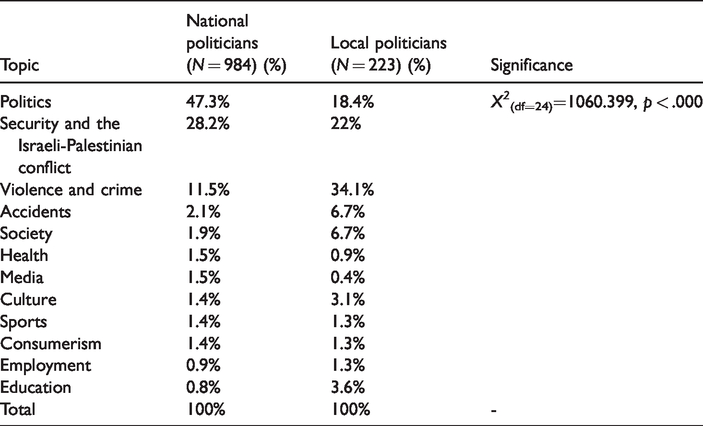
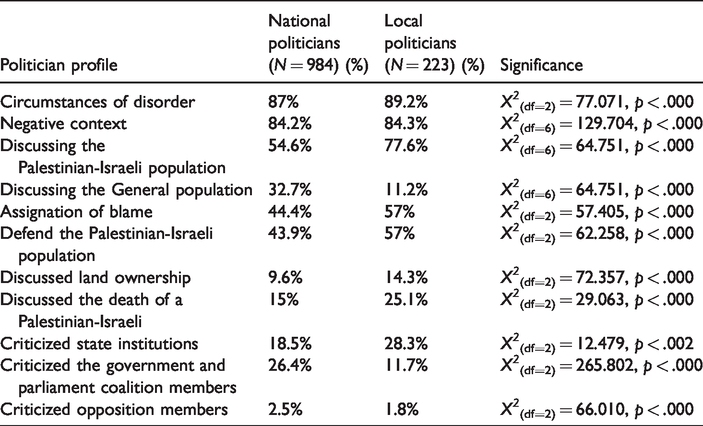
Additionally, we analyzed the media profile of Palestinian-Israeli politicians by national and local levels. However, it should be noted that we did not test each sub-variable for statistical significance as the population was too small. From Table 1 we learn that while local politicians were more likely to discuss the topics of violence and crime, accidents, society, and culture and education; national politicians were more likely to discuss politics and security and the Israeli-Palestinian conflict. From Table 2 we learn that both politician types appeared significantly mostly in a negative context, and in the circumstances of disorder. Local politicians focused significantly more on inner-minority issues such as Palestinian-Israeli deaths and land ownership, discussing the minority population, defending the minority, and criticizing state institutions. Accordingly, national politicians were significantly more likely to discuss the general population and criticize the government, and coalition and opposition parliament members.
Topics of Palestinian-Israeli politicians by national and local levels.
The media profile of Palestinian-Israeli politicians by national and local levels.
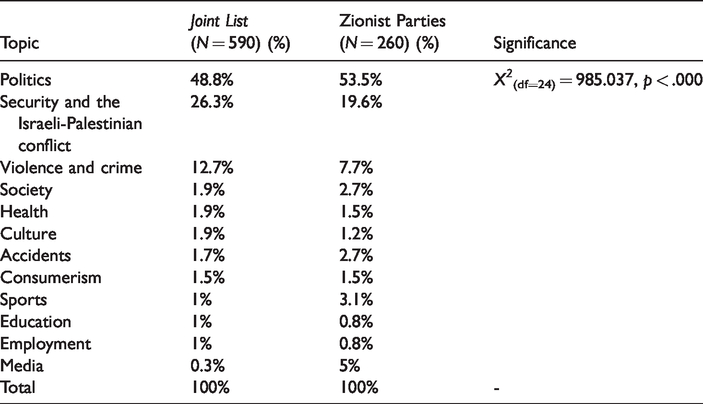
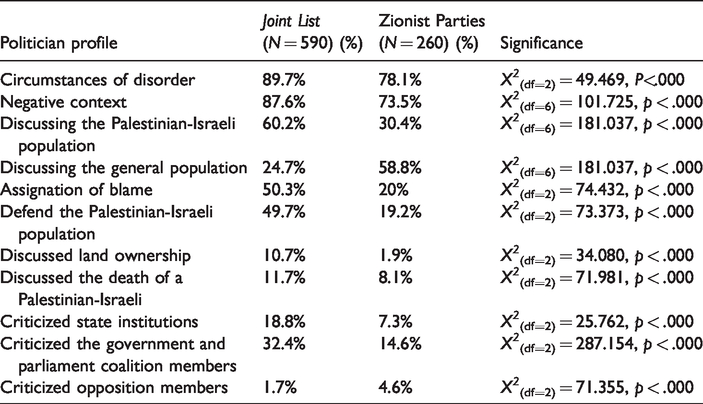
We also analyzed the media profile of Palestinian-Israeli politicians by political party. From Table 3 we learn that while the Joint List members were more likely to discuss security and the Israeli-Palestinian conflict, and violence and crime, the Zionist parties’ members were more likely to discuss politics, media, sports, and society. From Table 4 we learn that Joint List members appeared significantly more in a negative context, and in the circumstances of disorder relative to the Palestinian members of the Zionist parties. Furthermore, Joint List members were significantly more likely to discuss the Palestinian population, blame assigned to and defense of the Palestinian minority, to discuss land ownership and Palestinian-Israeli deaths, and to criticize state institutions and the government and parliament coalition members. Accordingly, Zionist parties’ members were significantly more likely to discuss the general population and criticize opposition parliament members.
Topics of Palestinian-Israeli politicians by political party.
The media profile of Palestinian-Israeli politicians by political party.
Discussion
Few communication studies have focused on minority politicians in general, and Palestinian-Israeli politicians in particular (Rovner-Lev, 2015). Furthermore, though the scientific literature has extensively discussed the ramifications of bias contextualization of representation in the mass media, it has not discussed these ramifications on Palestinian-Israeli politicians’ representations, and how these representations might affect the minority’s ability to realize their functionings and enable their capabilities. The capabilities approach is used in this study as an interpretive tool, offering speculative effects to the empirical findings. These interpretations were informed by previous work of the authors which included in-depth interviews with Palestinian-Israeli individuals (Shomron and Schejter, 2020a, 2020b). Yet, the reader should be aware that the following interpretations concerning Palestinian-Israeli politicians’ representations are speculative and could affect the capabilities of these particular individuals differently. Indeed, enabling or hindering capabilities can influence the opportunities available for the fulfillment of political functions that are possible in the media.
Minority politicians in the media
When minority politicians appear in the media it could allow them to voice issues important to their constituents’ lives and circumstances (“Voicing”) as well as to share vital political information through the media (“To be informed”). The opportunities to realize these two capabilities in the media can result in an enhancement of each individual’s own political understanding (Jacobs and Hooghe, 2016). However, it should be noted that should the representation of Palestinian-Israeli politicians among all the Palestinian-Israeli interviewees be considered as disproportionately high, it may lower the ability of non-politicians to voice their own unique life circumstances, and to share their own vital information; however, we did not measure for such an effect.
Additionally, the appearance of minority politicians in the media, may contribute to the creation of political role-models, many of whom serve in the national parliament as well as in local government (“Identification and imitation”). The realization of this capability could invigorate minority individuals to become politicians themselves (Jacobs and Hooghe, 2016). However, the high representation of Palestinian-Israeli politicians among all the Palestinian-Israeli interviewees may lead to less exposure in the media of minority individuals who may serve as role-models of other professions.
The representation of Palestinian-Israeli politicians in the media together with their tendency to discuss issues relating to Palestinian-Israelis’ safety, and their habitual defending of their minority group in the media, contributes to the minority’s security (“To be secure”). Realizing this capability amplifies Palestinian-Israelis’ opportunities to defend their minority group and ease social conflicts (Jacobs and Hooghe, 2016), resulting in social stability and security (Dancygier et al., 2015). However, the negative context and the circumstances of disorder in which Palestinian-Israeli politicians tend to appear, and the high percentage of them discussing violence and crime and Palestinian-Israeli deaths could routinize these activities, and negatively portrays Palestinian-Israelis, thus, leading to social conflicts (Jacobs and Hooghe, 2016) social instability and overall less security (Dancygier et al., 2015).
The high representation of Palestinian-Israeli politicians in the media, could reflect their participation in democratic discourse (“Civil participation”). While this high coverage legitimizes the democratic system in the eyes of the minority members (Jacobs and Hooghe, 2016), it also allows for the promotion of social issues that are important to minority members (Dancygier et al., 2015). Participation could be impeded by Palestinian-Israeli politicians’ tendency to focus mainly on inner-minority issues, thus, limiting the issues discussed, hindering the promotion of issues deemed important by minority members. Indeed, a cyclical movement is detected here: while media exposure enhances electoral success of minority politicians (Gershon, 2013; Jacobs and Hooghe, 2016), we found that electoral success contributes to high media exposure, thus, it is imperative to understand how this exposure influences minority members’ ability to realize their capabilities.
National politicians vs. local politicians
Voicing was utilized for different ends among the two types of politicians interviewed. Local politicians voiced local minority issues such as Palestinian-Israeli deaths, land ownership, and violence and crime, while national politicians voiced national issues such as the Israeli-Palestinian conflict. Similarly, constituents were to be informed of different types of information; while national politicians focused on political information, local politicians focused on violence and crime and social issues. Moreover, local politicians were more likely to defend the minority population and criticize state institutions, relative to national politicians, thus possibly more prominent in securing the minority’s safety (“To be secure”). Likewise, both politician types promoted different social issues (“Civil participation”): while national politicians focused mainly on parliamentary issues such as legislation and political opponents, local politicians focused mainly on local Palestinian-Israeli issues such as land ownership and violence and crime. These differences between the two types of politicians could represent the two processes occurring in the Palestinian-Israeli society, with national politicians representing more of a Palestinization approach, and local politicians representing more of an Israelization approach (Smooha, 2017).
It should be noted that most minority politicians interviewed served on the national level, thus possibly allowing for more of a realization of capabilities national level politicians were associated with, and less of a realization of capabilities local politicians were associated with. Furthermore, the differences found in the realization of capabilities between both political types, suggest the necessity of media appearances of both politician types.
Lastly, as most Palestinian-Israeli politicians in the media were men, women had plausibly less of a chance to realize capabilities through identification and imitation; to have the voicing of their own unique circumstances realized; to be informed with issues they deem vital; to be secure by having the issues they are concerned about expressed in the media; and to be encouraged to partake in social debates (“Civil participation”). This under-representation could lead to the proposition that women do not exist or are insignificant in the political arena (“Identity and belonging”). Indeed, the low coverage of women politicians in the media negates women’s ability to be elected (Gershon, 2013), preserving their low media coverage as found in this study, thus, hindering their ability to realize their capabilities.
The case of MKs: Joint List members vs. Zionist party members
The two types of MKs utilized the voicing capability differently. While Joint List members focused on voicing inner-minority issues involving the Palestinian-Israeli population, members of Zionist parties voiced general issues regarding the general population. Similarly, members of this national minority were plausibly to be informed of different types of information; while Joint List members informed their constituents with information regarding Palestinian-Israeli issues, members of Zionist parties informed them of general issues. Moreover, Joint List members focused significantly more than members of Zionist parties on issues relating to the security of the Palestinian-Israeli minority group. These included discussing topics such as violence and crime and Palestinian-Israeli deaths, as well as defending the Palestinian-Israelis, and criticizing state institutions (“To be secure”). Likewise, both types of MKs realized the capability of “civil participation” differently. While Joint List members discussed mainly inner-minority topics such as violence and crime, Zionist party members tended to discuss general topics such as media, society and sports. Concurringly, the different context in which each MK type appears in the media, could contribute to the creation of two distinct political role-models, minority members are exposed to. While Joint List members can be perceived as minority politicians representing their minority group, members of Zionist parties can be perceived as general politicians serving in parliament (“Identification and imitation”). These two distinct portrayals could influence minority members’ self-identity. The focus of Joint List members on inner-minority and negative issues could strengthen the minority members’ perception of alienation from the majority group, as well as highlight negative stereotypes such as crime and violence, that could lead to further segregation and discrimination. Contrarily, the focus of members of Zionist parties on general topics and the general population could strengthen the social integration of Palestinian-Israelis into the Jewish-Israeli majority (“Identity and belonging”). These differences between the two types of MKs could represent the processes occurring in the Palestinian-Israeli society, with Palestinian-Israeli members of Zionist parties adopting more of an Israelization approach, and Joint List members adopting more of a Palestinization approach (Smooha, 2017).
Concluding remarks
Mass media are a fundamental social institution, and thus vital for the realization of capabilities (Hesmondhalgh, 2017, 2018). The successful realization of capabilities in the media results in more opportunities for the fulfillment of political functions that are possible in the media, such as enhancing minority members’ ability to be informed (Gershon, 2013; Vos and Van Aelst, 2018), social inclusiveness of minorities (Dancygier et al., 2015), and minority individuals being instigated to become politicians (Jacobs and Hooghe, 2016). In this study, we demonstrated whether and how capabilities were realized through the participation of Palestinian-Israeli politicians in the media. Furthermore, we demonstrated how different types of Palestinian-Israeli politicians potentially may affect the realization of different political functions and capabilities. As different types of politicians contribute differently to the realization of different capabilities in the media, it is advantageous to further diversify political interviewees, especially enlarging the media share of local politicians as well as women politicians. Women for example, should appear more than their share in the political occupation, to compensate for their greater disadvantage. This corresponds with the social-justice principle of improving the positioning of least advantaged in society (Rawls, 1971). Additionally, it should be noted that realizing capabilities in the media is a perplexing endeavor; while suitable representations of minority politicians in the media should consist of positive contexts, diversity of topics, and discussing general as well as minority issues, many of the minority topics tend to be negatively connotated, though essential to their safety and basic human rights. We suggest further research examine what are the expectations of Palestinian-Israelis regarding capabilities and Palestinian-Israeli politicians' media representations, as well as whether politicians who are not Palestinian-Israeli affect the populations' capabilities through media activity. Analyzing political representations in the media through the theoretical framework of the ‘capabilities approach’ contributes to a more comprehensive insight into the roles the media can play promoting people’s wellbeing and human rights, relative to traditional media theories. Thus, this case study can be applied to other racial, national and ethnic minorities around the world.
Footnotes
Declaration of Conflicting Interests
The author(s) declared no potential conflicts of interest with respect to the research, authorship, and/or publication of this article.
Funding
The author(s) received no financial support for the research, authorship, and/or publication of this article.
