




Abstract
COVID-19 ushered in almost unprecedented socioeconomic and political challenges. A typical social reaction during such emergencies is rumormongering, which has intensified since the advent of social media. This study explored factors affecting users’ willingness to spread pandemic-related rumors in Wuhan, China and Israel. We tested a multi-variant model of factors affecting the forwarding of COVID-19 rumors. In an online survey conducted in April–May 2020, users of each country's leading social media platform (WeChat and WhatsApp, respectively) reported on patterns of exposure to and spread of COVID-19 rumors, as well as on their motives for doing so. Despite major differences between the two societies, interesting similarities were found: in both cases, individual drives, shaped by personal needs and degree of negative feelings, were the leading factors behind rumormongering. Exposure to additional sources of information regarding the rumors was also a significant predictor, but only in the Chinese case.
Introduction
Starting in the last quarter of 2019, the Corona virus, also known as COVID-19, ushered in an almost unprecedented global pandemic with severe socioeconomic and political implications and challenges. As in many other large-scale emergencies, both mainstream and social media have played crucial roles (Boyle et al., 2004). One of the typical phenomena during emergencies and crises is rumormongering. Since social media have penetrated our lives, they have become the central platforms for spreading and sharing rumors (Simon et al., 2016), including about the COVID-19 pandemic (Jang and Baek, 2019; D'Urso, 2020; Seah and Weimann, 2020).
Existing research on factors that influence the spread of rumors mostly examines general rumors (Li, 2018; Ning and Wang, 2018). Few have studied specific types of rumors, such as food safety (Seah and Weimann, 2020; Zhou, 2018), nuclear energy, vaccines, and climate change (Chua, Aricat and Goh, 2017). Other studies have examined the spread of rumors at special events like during Korean saber rattling in 2013 (Kwon, Bang, Egnoto and Raghav Rao, 2016), or a study on malicious rumors that emerge during breaking news, which are characterized by the dissemination of a large number of malicious information over a short period (Hosni and Li, 2020). A recent study on COVID-19 rumors in China attempted to reveal the processing of rumors by the recipients (Zou, and Tang, 2021).
Most attention has been devoted to the rumors’ social factors and characteristics. In contrast, scant attention has been devoted to personal factors determining rumor dissemination.
The current study seeks to fill this gap. By analyzing patterns of spreading COVID-19-related rumors using WeChat in Wuhan, “Patient-Zero of Cities” (the Chinese city in which the first outbreak took place), and WhatsApp in Israel, we examined the role of social media in two societies during the pandemic. According to China's 2019 WeChat Data Report, the social platform boasts 1.15 billion monthly active accounts. In December 2019, the Cyberspace Administration of China issued ‘Provisions on the Governance of Network Information Content Ecology,’ which came into effect on March 2020. The provisions directly regulate online platforms and user behaviors related to online information content, particularly WeChat rumors.
As of 2020, WhatsApp is the most popular text messaging application worldwide, with over two billion users (Statista, 2020). WhatsApp is also the leading text messaging application and social network in Israel, with 6.69 million users by 2020 (Ariel and Elishar-Malka, 2019; Weimann-Saks et al., 2019). A study conducted among Israeli WhatsApp users revealed the impressive scope of its use: 67% of respondents reported that they used WhatsApp to send personal messages daily (Malka et al., 2015). In another study, young Israeli users indicated in their interviews that they experienced changes in their patterns of initiating and maintaining social, familial, and professional relationships since the introduction of WhatsApp's into their lives (Elishar-Malka et al., 2019).
This article reports on two different case studies with some striking similarities: Wuhan, China, and Israel. Each has been severely affected by COVID-19, although during the data collection period (April–May 2020), the pandemic was at its peak in Wuhan, while there was a decrease in Israel's morbidity rates. In addition, each is characterized by a leading text messaging application, which also serves as a social network (WeChat and WhatsApp, respectively). In both, social media have been used to spread rumors during the first months after the outbreak.
Rumors
Rumors are commonly defined as pieces of unverified information of uncertain origin, usually spread by word of mouth. The earliest scholarly study of rumors was the pioneering work of Stern (1902). Examining the phenomenon of rumors in which a ‘chain of subjects’ transmitted a particular story from ‘mouth to ear’ without being allowed to repeat or explain it, he discovered that by the time that the story reached the chain's end it had been compressed and altered. Knapp (1944) analyzed over one thousand rumors during World War II and identified three basic characteristics:
They are transmitted by word of mouth. They provide information about a person, an event, or a situation; and They express and gratify a community's emotional needs.
Subsequently, Allport and Postman (1947) examined message diffusion between individuals and found that about 70% of details in a message were lost after the first five or six mouth-to-mouth transmissions. They referred to rumors as changing in three respects: leveling, sharpening, and assimilation. Leveling is the loss of detail caused by transmission processes; sharpening refers to selecting which details to transmit, and assimilation refers to a distortion in the transmission of information due to subconscious motivations.
Subsequent scholars developed models to explain rumor spreading borrowed from epidemic models (Daley and Kendall, 1964; Sudbury, 1985). Following network theories, many more recent models were inspired by empirical discoveries on network topology (e.g. Nekovee et al., 2007). Social network models for spreading rumors, such as small-world networks, dominate rumor modeling (Weimann, 1983; Zanette, 2002). The social network approach highlights the effect of complex network structure on rumor spreading.
The spread of false information over digital platforms takes many forms: from complete fictions or embellished stories independent of facts, to stories that invoke conspiracy theories without presenting any evidence; from disinformation meant to damage a particular party's interests, to entirely inaccurate statements presented as facts. In addition, it ranges from biased or one-sided news to Clickbait, which intentionally uses misleading headlines on the Internet. False information has been described and theorized using a variety of terms and concepts. Thus, the most prominent concepts to describe the spread of false information are fake news, misinformation, and disinformation. We use the term rumor in this study, as it is the most general of these concepts. As already mentioned, rumors refer to information whose truthfulness is ambiguous or unconfirmed at the time of transmission (Buckner, 1965). Utilizing the concept of rumors differentiate it from intent biased, as scholars (e.g. McGonagle, 2017) consider fake news to be deliberate fabricate information that is intentionally circulated to misinform and deceive individuals.
Rumors and social Media
With communication technologies that have democratized certain aspects of the production and reproduction of information, the rate at which rumors and misinformation can spread has increased, leading many to describe our times as the ‘post-truth’ era (Lewandowski, 2017; Harsin, 2018). With the development of the internet and online platforms, rumor spreading has become easier and quicker (Centola, 2010). The rapid development of online technology in recent years, especially in mobile phones, has made social networks effective and universally available. Information spreading has become faster than ever, much faster than any traditional fact-checking process, posing unprecedented challenges in information reliability assurance.
This phenomenon has attracted considerable research attention. One body of work deals with identifying rumors in online messages. Another focuses on the factors in online social networks that influence judgments of rumors’ credibility. The third concerns the effectiveness of counter-rumors in curtailing the dissemination of rumors.
During crises such as natural disasters, terrorist attacks, and epidemics, people increasingly rely on social media to obtain information and guidance. Emergency responders, the media, and members of the public all use social media to disseminate, search for and curate crisis-related information, and make sense of uncertain events as they unfold (Sutton et al., 2014; Vieweg et al., 2010). In such cases, rumors serve as ‘improvised news’ created by collective anxiety, uncertainty, stress, and the need for orientation (Shibutani, 1966). The downside is that under such circumstances, false rumors can spread rapidly across social media platforms. Some can have serious detrimental outcomes for public safety.
The spread of epidemic-related rumors
Epidemic-related rumors are particularly time-sensitive (Nsoesie and Oladeji, 2020; Roberts et al., 2017). The literature on these rumors mainly comprises studies of rumors during the 2002–2004 SARS, the 2013 Avian Influenza A(H7N9), the 2013–16 West-African Ebola, and the 2015 Middle East Respiratory Syndrome (MERS) outbreaks. These studies can be classified into three major categories: (1) How do epidemic-related rumors begin and why do they spread? (2) What are the channels of rumor dissemination and the characteristics of epidemic-related rumors? (3) How do epidemic rumors differ from rumors in other crises?
With regard to the first question, initial research has focused on the incompetence of authorities, personal capabilities, and personal demands. Zhou (2003) explored why rumors were rife in the midst of the SARS outbreak, and concluded that people's scientific and cultural literacy affected their trust in rumors and hence the circulation of rumors. In addition, significant losses inflicted on society by an epidemic and the ambiguity or lack of official information hasten the spread of rumors. Personal cognitive needs also contribute to the rapid spread of rumors. Fu and Liu (2013) studied the spread of rumors about the Avian Influenza A(H7N9) virus in 2013. They found that the speedy dissemination of rumors resulted from a belated or lack of official information release concerning epidemic prevention and control, information redundancy in the big data era, and a rapid shift in matters of public concern. Finally, Jang and Baek (2019) delved into Korean netizens’ online social behaviors amidst the 2015 MERS outbreak. They concluded that when the public no longer trusted official information, they turned to online news media, social connections, and social media for MERS-related information.
Studies of the second category address question, what are the channels of rumor dissemination and the characteristics of epidemic-related rumors? Li (2003) argued that online rumors during the SARS outbreak got mostly through informal channels such as word of mouth, social media, and online forums and circulated quickly. A significant hindrance to rumor proliferation was the stringent control of speech by the Chinese government. Finally, Yi (2017) pointed out that epidemic-related rumors were based on facts and, to some extent, rational.
Thirdly, studies compared rumors during epidemics and other crises. Chen (2011) argued that the public's trust in public health rumors could directly lead to group behaviors. Chinese citizens’ panic-driven buying of salt during the 2011 nuclear leakage crisis in Japan, for example, was triggered by rumors that iodized salt could ward off radiation. In a similar vein, the panic-driven buying of an herbal remedy called Ban Lan Gen amidst the SARS outbreak was fueled by rumors that it could guard against the bird flu. Finally, Hu (2011) pointed out that although new media platforms were important channels through which rumors were propagated, they now also served as platforms for public reflections based on netizens’ reactions.
In conclusion, basic research on epidemic-related rumors has examined causes, characteristics, and types of rumors, as well as their dissemination channels and consequences. Some researchers have begun probing new media's influence on rumor circulation. Researchers have studied message-forwarding on various platforms, including Twitter (Kim, 2018; Suh et al., 2010); Facebook (Kim and Yang, 2017); WhatsApp (Malka et al., 2015; Simon et al., 2016); Sina Weibo, the Chinese equivalent of Twitter (Sun and Li, 2012); and WeChat (Chen et al., 2018). In all, information recipients wield the greatest influence on message-forwarding, in terms of the interest they express in information, entertainment needs, and emotional needs (Bae, 2017; Lee and Ma, 2012); and in social interaction needs and the reciprocity principle (Chen et al., 2018). Message forwarding also features information dissemination, making it crucial to pinpointing factors that affect the spread of rumors. Let us review some of the proposed predictors of message forwarding and the hypotheses drawn from them for the present study.
Factors affecting the spread of rumors
Negative emotions. In terms of content, rumor publishers are good at disseminating rumors by employing high emotional arousal elements, such as creating suspense and using figures of speech (Liu, 2016; Na et al., 2018). When rumors convey negative emotions such as anxiety and fear (Chua and Banerjee, 2018; Lai and Tang, 2016), recipients are particularly susceptible. Na et al. (2018) found that ‘When there is congruence between an individual's current emotion and the emotion induced by a rumor, he or she is more likely accept the rumor as true, perhaps because the rumor explains the current emotion (i.e. misattribution) and/or because the rumor is easier to process (i.e. processing fluency)’ (p. 797).
Furthermore, when rumors are presented in a combined audiovisual format (Guo, 2014; Li, 2018; Zhou, 2018), they are more likely to arouse emotions and win recipients’ trust circulated. In the present study, the variable ‘degree of negative emotions’ refers to the intensity of experiencing disturbing emotions such as fear, anxiety, and anger caused by exposure to the rumor.
Accordingly, our first hypothesis is as follows: H1: The degree of negative emotions aroused by a rumor is positively correlated with social network users’ willingness to forward COVID-19 rumors.
Rumors’ credibility. In terms of content and sources, rumors’ credibility is key to their dissemination (Kim, 2018; Chua and Banerjee, 2017). More specifically, Liu (2016) analyzed meta-texts of WeChat and WhatsApp rumors, and concluded that the use of rhetoric, suspense, and psychological arousal can help build the response-inviting structure of rumors in these social media, thereby boosting their credibility and increasing users’ willingness to disseminate them (Zhou, 2018). Kim (2018) has observed that high ‘virality metrics’ (which indicate the number of retweets, likes, and replies) encourage more people to forward a particular rumor via social media, as this has been perceived as a measure of the rumor's trustworthiness.
When opinion leaders start rumors, recipients are inclined to trust them because of these leaders’ authority and professionalism (Guo, 2014; Zhang and Shu, 2016), and then forward them without much doubt and reflection. On top of that, considering that WeChat and WhatsApp friends share close relationships, recipients are also prone to forward rumors from close relatives and friends (Garrett, 2011; Zhou, 2018). Garrett (2011) pointed out that rumors spread by relatives and friends’ emails are easily accepted, trusted, and shared by internet users. Guo (2014) claimed that the opinion leaders’ advocacy of rumors could speed up their propagation. People are more willing to forward rumors on WeChat or WhatsApp out of approval for authoritative sources (Zhang and Shu, 2016). Therefore, the more users believe rumor sources are professional, and the closer they are to them, the more willing they will be to forward rumors. Hence, our second hypothesis is as follows: H2. Rumors’ credibility is positively correlated with social media users’ willingness to forward COVID-19 rumors.
Exposure to additional sources of information. When official information is lacking (Huo and Huang, 2011), the public will forward rumors to pressure the government into taking measures. By contrast, if official and social media sites deny rumors swiftly and convincingly, rumors can be quashed quickly (Chua and Banerjee, 2018). Tang and Li (2013) noted that people with weak cognitive skills have a stronger tendency to circulate online rumors. Other studies focused on the role of users’ ability to acquire information from diverse channels in silencing rumors (Chua and Banerjee, 2017; Mason et al., 2011). Furthermore, Steppat, Castro, and Esser (2021) found that users from countries with more inclusive political information environments are the least likely to engage in selective exposure in their daily news use. They also found that selective exposure is slightly more frequent among regular social media users than other media. Selective exposure research has a long tradition (Lazarsfeld et al., 1944). The phenomenon is typically understood as the ideological choice of agreeable and the avoidance of disagreeable news content (Mutz and Young, 2011; Messing and Westwood, 2014). In its broader meaning, selective exposure includes the active avoidance or consumption of specific types of news content (Knobloch-Westerwick, 2015).
The role played by counter-rumor news released by the authorities is also underlined in recent studies. Tao (2012) asserted that Weibo users forwarded rumors because the government had not established a sound regulation system for squashing rumors. Chua and Banerjee (2018) contended that medical professionals would be much less likely to trust and disseminate health rumors if they had access to counter-rumor messages publicized by the government. Therefore, social media users’ access to official counter-rumor messages and their exposure to additional sources of information influence their willingness to forward rumors. The third hypothesis is, therefore: H3. The exposure to additional sources of information is negatively correlated with social media users’ willingness to forward COVID-19 rumors.
Personal needs. Previous studies demonstrate that in a social context rife with conflicts and crises (Tao, 2012), users are galvanized into sharing rumors for the sake of establishing and maintaining contact with society (Zhou, 2018); collecting information (Chen et al., 2018; Sun and Li, 2012); seeking others’ approval (Guo and Xue, 2015; Lee and Ma, 2012); securing self-approval (Chen et al., 2018).
Lee and Ma (2012) constructed a model of factors that influence individual forwarding intentions in social media. Their model explored the influences of information seeking, socializing, entertainment, status-seeking, and prior social media sharing experience on news sharing intention, and revealed that respondents driven by gratifications of information seeking, socializing, and status-seeking were more active in sharing information on social media platforms. Tong (2014) found that cognitive, emotional, and self-fulfillment needs, altruism, and social capital maintenance augmented Weibo users’ willingness to forward messages. Kim and Yang (2017) found that emotional needs and personal motives influenced Facebook users’ message forwarding. Finally, Chen et al. (2018) found that WeChat users’ information, identity, social interaction needs, daily habits, and altruism were related to forwarding social crisis information.
The uncertainties and risks associated with the pandemic have thrown the public into panic and anxiety and aroused their needs and expectations, such as information, self-approval, and social interaction needs (Chen et al., 2018; Lee and Ma, 2012; Park et al., 2009). If members of the public do not think that official information can address their needs, they look to other channels for information, and have a stronger tendency to share messages (Jang and Baek, 2019), and forward rumors (Chen et al., 2018; Lee and Ma, 2012; Park et al., 2009). Some research shows that yearning to discover and establish one's own identity predisposes people to share information about crises they encounter (Chen et al., 2018; Guo and Xue, 2015; Lee and Ma, 2012). Lee and Ma (2012) also observe that demand for social interaction motivates people to share information online more actively.
Chua and Banerjee (2017) argue that social interaction needs affect Internet users’ decision to share online health rumors specifically through subjective norms,. Against the COVID-19 pandemic background, WeChat and WhatsApp friends are likely to converse with each other on the pandemic, disease prevention and control, urban policies, and other relevant issues. When users engage with an online community, they will actively share and comment on pandemic-related information. Therefore, the more personal needs users have, the more likely they are to share rumors. Hence our fourth hypothesis: H4. Personal needs are positively correlated with social media users’ willingness to forward COVID-19 rumors.
The complete model
Figure 1 presents a model of factors that influence the forwarding of COVID-19 rumors by WeChat and WhatsApp. It comprises the following factor clusters: negative emotions, rumors’ credibility, the exposure to additional sources of information, and personal needs. As reviewed and hypothesized above, all are assumed to affect the forwarding of online rumors.
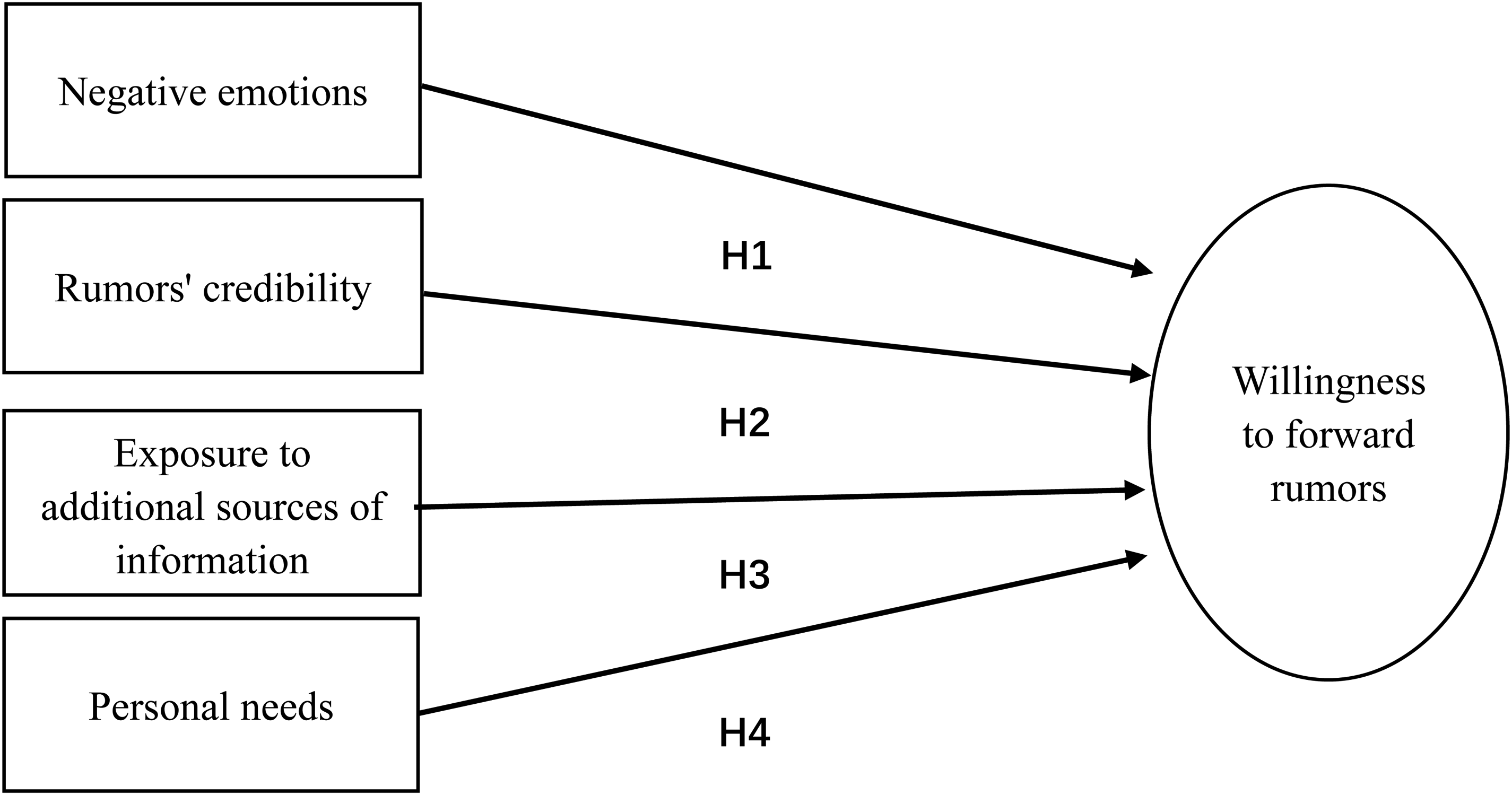
Factors influencing the forwarding COVID-19 rumors by weChat / whatsApp users.
Method
Using a structured questionnaire (see appendix 1), this study was conducted in April–May 2020 simultaneously in two countries: Wuhan, China, where at the time of data collection the pandemic was at its peak, and Israel, where there was decrease in morbidity rates.
Participants
In Wuhan, the participants were contacted mostly via online channels and partly through hand-sharing of the questionnaires. Five- hundred forms were distributed, both online and offline. Of the 482 forms returned, 302 were via WeChat and 180 offline. When testing the questionnaire, we first selected 15 WeChat users and, based on their feedback, modified some of the questions that were ambiguous or difficult to understand. Then we selected 482 users who had received COVID-19 rumors on WeChat as our pretest sample. Among those providing feedback, 67 stated they had received no rumors on WeChat, and were therefore eliminated from the study, leaving us with a sample of 415 participants (effective response rate of 86.1%).
The respondents’ gender was relatively balanced (60% female). Most were young: over 17% were under 20, and over 92% were under 29 years old. About 80% had a bachelor's degree, and over 12% had a master's or doctoral degree.
In Israel, the respondents were sampled from the online Midgam Project Web Panel, a company that specializes in services for internet research, and employs a panel of over 30,000 respondents, representing every geographic and demographic sector in Israel. The company uses stratified sampling based on data published by the Central Bureau of Statistics, and determines quotas by age and gender. A total of 503 valid questionnaires (85%) were collected; 92 were removed due to participants’ reports that they had never been exposed to COVID-19 rumors. Respondents’ gender was balanced (51% female). Half of the respondents (50%) were under 39 and 81% were under 60 years old. About 42.5% had a bachelor's degree, and over 14% had a master's or doctoral degree.
Dependent Variable: willingness to forward rumors
To assess users’ willingness to forward COVID-19 rumors, four types of rumors were examined, and the participants had to refer to at least one: (1) Source of the virus (animal / engineered virus); (2) Lack of food and hygiene products (eggs, toilet paper, alcohol); (3) Restrictions related to closure (closure dates, conditions, population for which the guidelines are relevant); and (4) The deployment of 5G technology and the link between it and the spread of the virus.
We used a 3-item scale (α(Wuhan) = .93; α(Israel) = .94) ranging from 1 (‘strongly agree’) to 5 (‘strongly disagree’). This variable was based a scale used by Lee and Ma (2012), Tong (2014), and Zhou (2018) (e.g. ‘I am willing to forward the information instead of just reading it’; ‘I will continue to forward such information’).
Independent variables
Personal needs were assessed using a 10-item scale (α(Wuhan) = .93; α(Israel) = .89) ranging from 1 (‘strongly agree’) to 5 (‘strongly disagree’). It included three subscales. (1) Information seeking. This 3-items subscale was based on Park et al. (2009) and Chen et al. (2018) (e.g. ‘I look forward to others’ replies when I forward the information’). (2) Self-identity development. This 3-items subscale was based on Chen et al. (2018) and Zhou (2018) (e.g. ‘I hope others know more about me when I share the information’). (3) Social interaction. This 4-item subscale was based on Lee and Ma (2012) and Chen et al. (2018) (e.g. ‘This information enables me to communicate effectively with others’).
Negative emotions aroused by the rumor were assessed using a 3-item scale (α (Wuhan) = .89; α(Israel) = .86) ranging from 1 (‘strongly agree’) to 5 (‘strongly disagree’). These measured insecurity (based on Zhou, 2018), anxiety and fear (based on Berger and Milkman, 2012) (e.g. ‘The information makes me feel insecure in the current pandemic’).
Exposure to additional sources of information. We used a 5-item scale (α (Wuhan) = .81; α(Israel) = .69) ranging from 1 (‘strongly agree’) to 5 (‘strongly disagree’), which included two subscales. (1) Access to counter-rumor information released by the authorities. This subscale was based on Zhou (2018) (e.g. ‘I read news published by the authorities that deny a rumor soon after having received this rumor’). (2) Access to information from various channels. This subscale was based on Bråten and Strømsø (2006) and Chua and Banerjee (2017) (e.g. ‘I will draw on my knowledge to judge whether the information is true or not’).
Rumors’ credibility was assessed using a 6-item scale (α (Wuhan) = .70; α(Israel) = .72), ranging from 1 (‘strongly agree’) to 5 (‘strongly disagree’), which included two subscales (based on Zhou, 2018): (1) Credibility of rumors’ content (e.g. ‘The information is provided in a combined audiovisual format’); and (2) Credibility of rumors’ sources (e.g. ‘It is primarily my relatives and friends who share such information with me’).
Results
Descriptive statistics
The descriptive statistics on the 415 Chinese respondents’ use of WeChat and exposure to rumors show that almost all (97.6%) of the participants have used WeChat over the past year. Most (80%) check WeChat more than six times a day. About half were exposed to rumors less than five times over the past year.
The descriptive statistics on the 503 Israeli respondents’ use of WhatsApp and exposure to rumors show that almost all (97.8%) of the participants have used WhatsApp over the past year. Most (90%) check WhatsApp more than six times a day. Almost half (49%) were exposed to rumors less than five times over the past year. Over 30% received rumors over ten times.
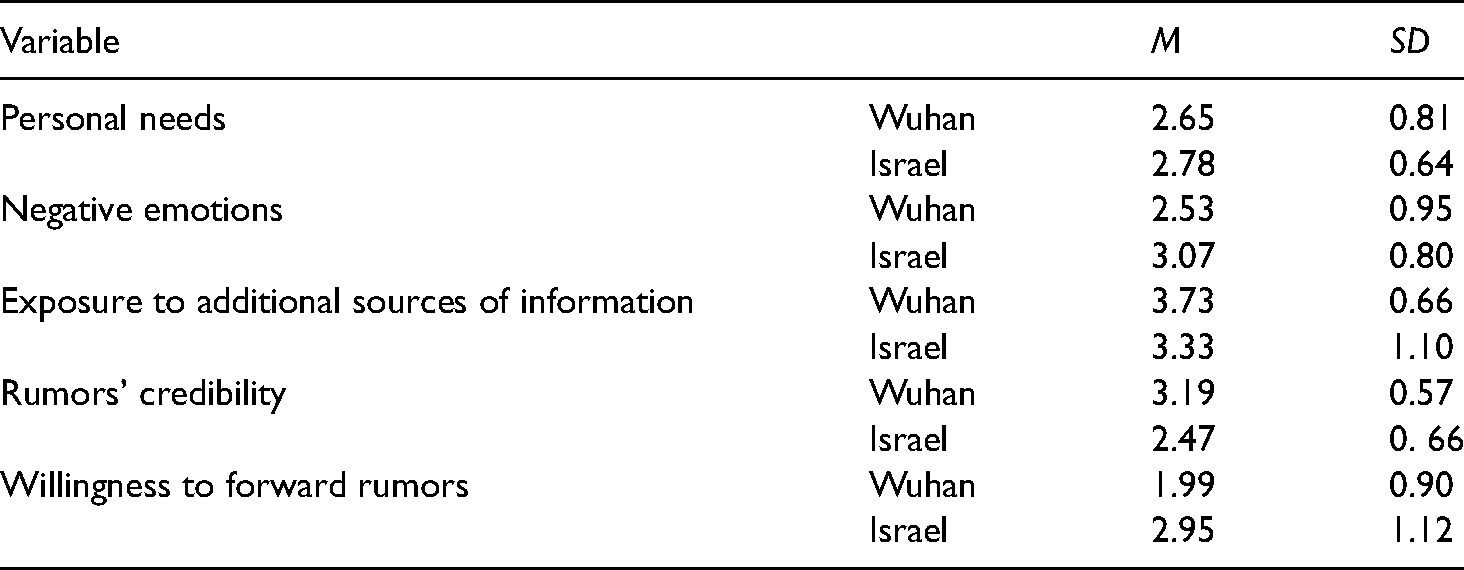
The descriptive statistics for the independent and dependent variables are shown in Table 1.
Descriptive statistics for wuhan, China (N = 415) and Israel (N = 503).
Controlled variables
Analysis of variance (ANOVA) was conducted to determine whether there were any statistically significant effects of controlled variables on users’ willingness to forward rumors. The results revealed that in Wuhan, China, no significant effect was found for gender (F(1413) = 0.037, p > .05), higher education (F(5409) = 2.042, p > .05), and country (F(2412) = 0.067, p > .05). In contrast, age had a significant effect on users’ willingness to forward rumors (F (5409) = 6.872, p < .001): the older the user, the higher the willingness to forward rumors. In Israel
Hypothesis testing
Multiple linear regression analysis was conducted to examine this study's hypotheses, and explore the correlation between the independent and dependent variables. We examined the four independent variables to ensure the absence of strong collinearity (VIF is ≤ 10). In both China and Israel, the regression model was found significant. Moreover, in both countries, the R2 value and the adjusted R2 value were close to 0.5, indicating good fit to the data. Finally, the p-value of the Durbin-Watson test was > 2, which means that no first-order residual autocorrelation was detected in the model (see Table 2).
Descriptors of the regression model in wuhan, China, and Israel.

*p < .001.
In China, three out of the four independent variables — personal needs, negative emotions, and exposure to additional sources of information — were significantly correlated with the willingness to forward rumors. It can be inferred from Table 3 that personal needs exerted the strongest influence on WeChat users’ willingness to forward rumors among all the independent variables correlated with the dependent variable. When other variables remain constant, every one-unit increase in personal needs leads to a rise of 0.621 units in willingness to forward rumors. When other variables remain constant, every one-unit increase in negative emotions gives rise to a 0.119-unit increase in willingness to forward rumors. The exposure to additional sources of information is negatively correlated with the willingness to forward rumors (p < 0.01). When other variables remain constant, every one-unit increase in the exposure to additional sources of information brings about a decrease of 0.140 units in willingness to forward rumors. Finally, rumors’ credibility was not significantly correlated with the willingness to forward rumors.
Regression analysis of factors that influence social Media users’ willingness to forward COVID-19 rumors.
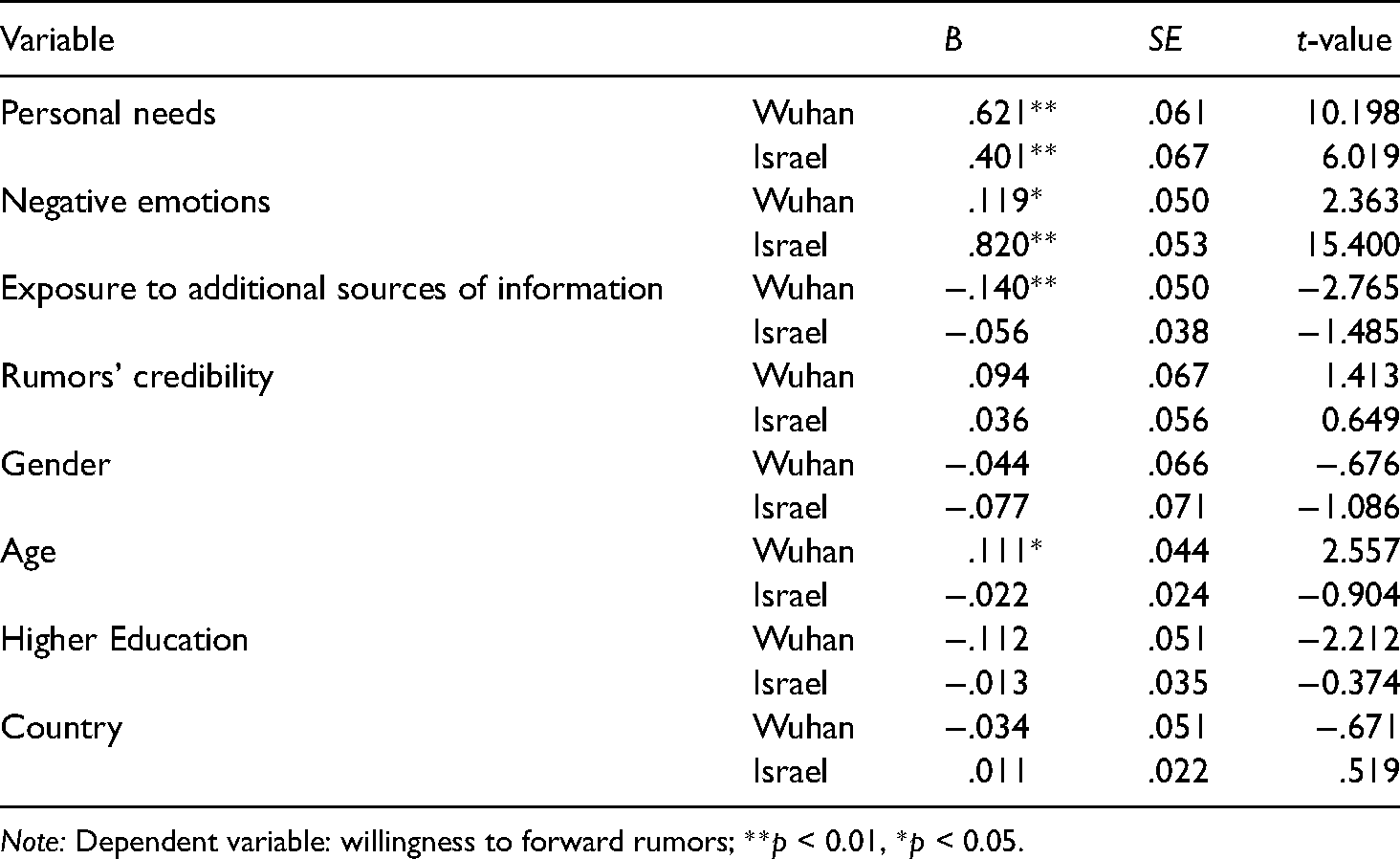
Note: Dependent variable: willingness to forward rumors; **p < 0.01, *p < 0.05.
In Israel, only personal needs and negative emotions were significant. It can be inferred from Table 3 that the negative emotions exert the strongest influence on WhatsApp users’ willingness to forward rumors among all the independent variables correlated with the dependent variable. When other variables remain constant, every one-unit increase in negative emotions leads to a rise of 0.820 units in willingness to forward rumors. When other variables remain constant, every one-unit increase in personal needs increases willingness to forward rumors by 0.401 units. The exposure to additional sources of information and rumors’ credibility were not significantly correlated with willingness to forward rumors.
To conclude, Hypotheses 1, 3, and 4 were supported among Chinese users, and H2 rejected. Regarding Israel, Hypotheses 1 and 4 were supported, and 2 and 3 rejected.
Discussion
The current study has focused on online rumors spreading during the first outbreak of the COVID-19 pandemic in Wuhan - China, and Israel. Although these two case studies are different in many aspects, two meaningful similarities had made this shared study justified: the fact that these countries have been facing the pandemic on a major scale, and the fact that in both places a certain social network is extremely popular, playing a significant role during the pandemic.
This study's results indicate that the distributions (means and standard deviations) of both countries’ main variables are quite similar. A more profound observation reveals that the willingness to forward rumors in Israel was higher than in Wuhan, China, as was the degree of negative emotions. In contrast, rumors’ credibility was higher in Wuhan than in Israel, and so was the exposure to additional sources of information. It can also be seen that WeChat and WhatsApp users are faithful (80–90% of them check the application more than six times a day). Approximately half of them received more than five rumors about COVID-19. In Wuhan, we found that as the age group was higher, willingness to forward rumors was higher. In Israel, we did not find this correlation.
The main result was that in Wuhan, personal needs, negative emotions, and the exposure to additional sources of information significantly predicted willingness to forward rumors, whereas rumors’ credibility did not. In Israel, only the first two predictors, personal needs and negative emotions, were found significant. The best predictor in Wuhan was personal needs, and the best predictor in Israel was negative emotions.
The present findings demonstrate the significant roles leading social media play in users’ lives during a severe national and global crisis. Despite major differences between Chine and Israel (different political systems, the attitude to freedom of speech, the structure of society etc.), several interesting similarities were found: in both cases, individual drives, shaped by personal needs and negative feelings, were the leading motives for spreading rumors. Indeed, the most significant motive in Wuhan was personal needs. At the same time, in Israel, negative feelings were the leading predictor of rumormongering, but both motives were significant in the two case studies. Regarding the exposure to additional sources of information — a leading motive in Wuhan, but not in Israel — this finding may be understood considering the major differences between the two political systems.
Since personal needs engender the use of WhatsApp and WeChat and the ensuing exposure to rumors, they also have a significant bearing on how users choose to deal with rumors. The stronger personal needs are, the greater these social networks’ willingness to forward rumors. When it comes to negative emotions, it is believed that WhatsApp and WeChat users were subjected to substantial pressure in real life and cyberspace, arising out of financial insecurity and pandemic-related information explosion amidst the pandemic.
At the early stage of the pandemic, an enormous amount of negative information was reported by various media, leading to negative feelings. The forwarding of rumors to give vent to emotions or kill time and relieve stress by holding discussions with relatives and friends is essentially decision-making motivated by the experience of negative emotions such as fear, rage, and anxiety conveyed by rumors. Therefore, the more WhatsApp and WeChat users experience negative emotions, the more willing they are to share them. This finding adds to our understanding of the phenomenon as it goes beyond Na et al.,'s study (2018), in which the strong links between emotions and rumors are explored, to show that under such circumstances we will not only open up to rumors but be willing to forward them on to other people. When analyzing the exposure to additional sources of information, which significantly predicted willingness to forward rumors only in Wuhan, China, the results reflect the differences between the two societies. The differences in the political climate, the media structure, the control over online platforms certainly affect some of the revealed differences in patterns of rumors’ flow.
As far as the Chinese case study is concerned, exposure to additional sources of information depends on the maturity of WeChat users’ epistemic beliefs, and on how well the authorities perform in squashing rumors. Mature WeChat users tend to compare rumors received online with information derived from other channels and their knowledge to determine whether rumors are reliable. As a result, they are more likely to choose not to forward rumors and instead suppress rumors’ circulation. If published on a timely basis, counter-rumor information released by the authorities becomes widespread and authentic and can impede the spread of rumors. If WeChat users have mature epistemic beliefs and official counter-rumor messages reach them on time, they will voluntarily end rumormongering. Therefore, the more capable WeChat users are in exposure to additional sources of information, the less willing they will be to forward rumors.
Study's findings may be also analyzed as a resonance to the timeless Aristotle's distinction (Riedenauer, 2016) between Ethos (our second hypothesis regarding rumors’ credibility), Pathos (our first and fourth hypothesis regarding users’ sentiments), and Logos (the third hypothesis which concerns the level of exposure to additional sources of information). In the Chinese case-study pathos and logos have been crucial, while in Israel only pathos played a significant role as a predictor of rumors’ forwarding. In both cases ethos has not been found a relevant predictor. Further research should be dedicated to deepen our understanding of the social, cultural, and political meanings and explanations to these finding, as well as to their practical implications.
Alongside the contribution of this study to understanding the roles of major social media in times of a severe crisis, it has several limitations that call for further research. First, although the study was conducted in the same time period in both countries, the pandemic was at a different outbreak stage (as noted in the method section), and therefore findings should be interpreted accordingly. Second, because of a large difference between both countries (the different regime based on a different political tradition, on different political and social challenges as well as on a different social structure), the research method was different, the sampling was different and therefore no statistical comparison was made between the countries but only between the different trends. this study did not conduct a statistical comparison between the two societies but instead treated them as separate case studies. Hence, no comparison was made in terms of participant sampling and the distribution of their background variables or between the findings from the two sites. Such a comparison was not in order due to the different morbidity rates and pandemic stages at the time of study, among other reasons. It should be part of future studies. It should be also noted that as the two societies are profoundly different, better understanding of the roles social media play in such times will require a much larger dataset, including several societies and/or countries, as well as several major social media. Moreover, it is important to note that people today use multiple devices and media sources and the current study refers to only one platform. Therefore, it is appropriate that further research will examine the model using other media sources and devices.
Footnotes
Declaration of Conflicting Interests
The author(s) declared no potential conflicts of interest with respect to the research, authorship, and/or publication of this article.
Funding
The author(s) received no financial support for the research, authorship and/or publication of this article.
