



Abstract
Although negativity bias is well-documented in media and communication studies, negative news may not always be more influential than positive news. This study adds to the literature by looking at how the positive-negative asymmetry varies with the characteristics of the objects. It examines the media effect on the public perception of three large emerging countries (China, India and South Africa) and their firms. The results indicate that both negative news and positive news influenced respondents’ evaluation of country image and firm attractiveness; the negativity bias was associated with political country image, and the positivity bias was associated with eco-technological country image, affective country image and firm attractiveness; the effect size of media salience on affective country image was higher than on eco-technological and political country image. Comparing the three countries, the study also found that national economic and political development level and international relations were relevant to understanding media salience and public perception of foreign countries.
Keywords
Introduction
The rise of new economic powers and their multinational firms has attracted much attention from politicians and researchers (e.g. Buckley, 2018; James, 2019). A group of new global players, such as Huawei, Prosus and Tata, all from large emerging countries, have stamped their mark on the world trade stage. The countries involved and their firms now frequently appear as headlines in various media from around the world. Their stories have become increasingly more relevant and newsworthy to the media consumer (e.g. Qi et al., 2019). Given their latecomer status, most people have no firsthand experience with them; thus, media is the most important information source. In addition, global digitalization speeds up the process of media production, increasing the flows of information throughout the world. As such, the media may play an increasingly important role in shaping public opinion of these countries. However, we know very little about this role.
It has been well-recognized in agenda setting studies that the media influences individuals’ perception and behavior (McCombs, 2002, 2005; Wanta et al., 2004). Studies from various disciplines have declared the media to be an important source of information that does influence people’s perception about foreign countries, such as the country image (CI) (Fan, 2010; Fung et al., 2018; Han and Wang, 2012; Lee and Hong, 2012; Stock, 2009).
CI is a broad concept that can be subdivided into several aspects (Buhmann and Ingenhoff, 2015b; Roth and Diamantopoulos, 2009). The definition and dimensions of CI and its consequences have been extensively researched by business scholars (Balabanis et al., 2002; Chen et al., 2017; Gartner, 1993; Nadeau et al., 2008; Roth and Diamantopoulos, 2009). However, the media and communication literature shows very limited research on how to conceptualize and operationalize CI (Buhmann, 2016; Buhmann and Ingenhoff, 2015b). It has been often treated as a one-dimensional concept in the empirical studies investigating the relationship between media and CI (Ingenhoff et al., 2018; Kiousis and Wu, 2008; Wanta et al., 2004; Zhang and Meadows III, 2012). This deficiency has severely limited our understanding of the media effect and left us knowing little about how, and to what extent, the media influences foreign countries’ image and foreign firms’ attractiveness.
“Bad is stronger than good” has been recognized in psychological science across a range of occurrences (for reviews, see Baumeister et al., 2001; Ito et al., 1998; Rozin and Royzman, 2001; Skowronski and Carlston, 1989). This phenomenon, coined as negativity bias (Rozin and Royzman, 2001), has been studied in many research fields, such as business (Capelle-Blancard and Petit, 2019; Williams and Buttle, 2014), finance (Endrikat, 2016; Ferreira and Gama, 2007), politics (Lengauer et al., 2012; Soroka and McAdams, 2015) and economics (McCluskey et al., 2015).
Media and communication studies also have acknowledged negativity bias, that is, negative news is given more attention than positive news (Pratto and John, 1991; Soroka and McAdams, 2015; Wu and Coleman, 2009). A couple of empirical studies specific to foreign countries (Wanta et al., 2004; Zhang and Meadows III, 2012) have found that the more negative news a nation received, the more likely it was that the public would think negatively about that country. In contrast, the existence of positive news on a country had no influence on public perceptions. This finding supports the negativity bias.
However, this negativity bias is not always observed, which raises critical questions (e.g. Golan and Wanta, 2001). Some studies have maintained that positive information influences people’s perception too and, in some circumstances, positive news was found to be stronger than negative news (e.g. Korn et al., 2016; Rubin and McHugh, 1987). Psychological science theories suggest that negativity bias depends on some specific conditions, such as information availability, people’s beliefs and expectancies (Brannon and Gawronski, 2018; Skowronski and Carlston, 1989). This implies that to understand the effect that media can have on people’s perception about a country and its firms, we need to look at the conditions under which that negativity bias works. However, the conditions have not been researched well.
Considering these gaps in the literature, this study investigates the asymmetric effect of positive and negative news in the case of three new economic powers, China, India and South Africa.
Based on psychological theories, we argue that both negative and positive news influence individuals’ perception of objects, when these are related to ability and attractiveness, the influence of positive news is stronger than negative news. When the objects relate to morality, negative news is more influential. Our empirical analysis used the partial least squares structural equation modeling (PLS-SEM) on the online survey data collected from 481 Dutch residents. The estimation results provide evidence to support our hypotheses. The findings advance our understanding of the media effect and negativity bias in an international context.
Literature review and hypothesis
Agenda setting theory suggests that the media exert significant influence on individuals’ perceptions of objects (McCombs and Reynolds, 2009). It explains how the salience, or the prominence of objects transfer from the media to the public agenda. Objects can be public issues, political candidates, organizations, government plans, even nations (Carroll and McCombs, 2003; Guo and Vargo, 2015; Kim et al., 2012; Vu et al., 2019; Zhang and Meadows III, 2012). The three emerging countries and their firms are the focal objects in this study. We investigate how media news influences these countries’ image and their firms’ attractiveness.
CI and firm attractiveness
CI as an operationalized concept has been studied in many areas, such as international business and marketing (Balabanis et al., 2002; Roth and Diamantopoulos, 2009; Wang et al., 2012), tourism (Chen et al., 2017; Nadeau et al., 2008) and communication (Buhmann and Ingenhoff, 2015b; Zhang and Meadows III, 2012). It is often considered a multi-dimensional concept. Business studies often have taken a two-component view that includes cognitive and affective components (Martínez and Alvarez, 2010; Roth and Diamantopoulos, 2009; Wang et al., 2012). Recent studies found that cognitive component can be divided further into two dimensions, the eco-technological and political dimensions (Lopez and Balabanis, 2020; Zhang et al., 2019). Buhmann and Ingenhoff (2015a) suggested that cognitive component comprises three sub-dimensions, functional, normative, and aesthetic.
This study follows Zhang et al. (2019) to classify CI into three dimensions: eco-technological-, political- and affective CI. The eco-technological CI reflects people’s perception of a country’s economic and technological development. The political CI reflects the perception of a country’s political system (i.e. human right, corruption, democracy). The affective CI describes people’s affective responses to a country (i.e. to like or dislike, be positive or negative).
Firm attractiveness reflects a firm's ability to attract qualified individuals (Newburry et al., 2006). We follow Newburry et al.'s (2006) definition that firm attractiveness is the degree to which an individual would seek a firm as an employer and would recommend the firm to others. The new economic powers’ firm attractiveness is particularly relevant because of their impressive rise (Alon et al., 2018) and their inability to attract and retain talent especially in advanced countries (Tung, 2016). Therefore, it is interesting to investigate how and to what extent the media impact the firms’ attractiveness.
Based on above-mentioned definitions, we assert that the eco-technological and affective dimensions of a CI and firm attractiveness are related to ability, while the political CI is more related to morality. The eco-technological CI indicates a country’s ability to develop and innovate. The affective CI reflects a country’s ability to gain positive affective evaluations. Firm attractiveness indicates firms’ ability to hire qualified individuals. The political CI is related to moral aspects, such as corruption and human right.
Media salience
Media salience is a key concept in agenda-setting research. It is considered a multidimensional construct (Kiousis, 2004; McCombs, 2005). Kiousis (2004) defined media salience operationally as a two-dimensional construct: visibility and valence.
Visibility, as an external characteristic, indicates an object’s relation to other objects in terms of attention or prominence (Djerf-Pierre and Shehata, 2017). It reflects the first level agenda setting that can be operationalized by news frequency or the amount of coverage of an issue (McCombs, 2005; Wanta et al., 2004; Wu and Coleman, 2009). High visibility implies high public attention (Jia and Zhang, 2015). Valence, as the internal characteristic, reflects the second level agenda setting that is usually determined by the positive or negative framing of the news story (Wanta et al., 2004; Zhang and Meadows III, 2012). Valence matters to people’s perception because positive information about an object leads to a positive assessment of the object, and negative information leads to a negative assessment (e.g. Carroll and McCombs, 2003; Dean, 2004).
In line with the two-dimension view of media salience, studies use frequency of news coverage to indicate visibility and use the content of the stories (positive or negative) to evaluate valence (Kiousis, 2005; Wanta et al., 2004; Zhang and Meadows III, 2012). Evaluation of valence could be subjective. A story may be viewed as positive by some people but negative by others depending on their expectations and experience. Accordingly, this study focuses on perceived salience, and uses the frequency of the received positive/negative news to develop our hypothesis. A high frequency of the received positive (negative) news frequency means that one often receives positive (negative) news about the objects and vice versa.
Applying agenda setting theory to our research context, we assume that people’s assessments of a country and its firms are influenced by media visibility and salience of the country. Regarding country image, several studies found that the more negative news a nation received, the more likely it was that the public thought negatively about that country (Kiousis, 2005; Wanta et al., 2004; Zhang and Meadows III, 2012). Looking at American opinions of China, Wang and Shoemaker (2011) found that positive news coverage was positively associated with Americans’ favorable perceptions of China. A similar study that investigated product country image also found that positive news indicating benefits led to positive attitudes to the product country image and negative news indicating risk led to negative attitudes to the product country image (Han and Wang, 2012). Based on the theoretical prediction and empirical findings, we expect that the positive (negative) news about a country received by individuals has a positive (negative) impact on their perceived image of the country. The higher the frequency of the received positive (negative) news, the better (worse) the country image.
Media news about a country may also influence people’s perception of the firms from this country. Previous studies have found that, when people do not have much information about a firm, they tend to make assessment based on other informational cues. These may be extrinsic informational cues that relate to a broader category, such as the country of origin (Verlegh and Steenkamp, 1999). This related information, as received, can be taken as a signal of the quality of an employer (Williamson et al., 2010). Therefore, the news about a country produces information cues by which individuals evaluate the attractiveness of the country’s firms. Given that positive information results in increased attraction and negative information results in reduced attraction (Rubin and McHugh, 1987), we expect that the positive (negative) news about a country has a positive (negative) influence on the attractiveness of the firms from this country.
A country might be regarded as a broader category of firm and means that a CI may also be perceived as an information cue that influences firm attractiveness. A recent study found that CI indeed does have a significant impact on firms’ attractiveness (Zhang et al., 2020). Therefore, we expected that, besides the direct effect, media salience may have an indirect effect on firm attractiveness through CI.
Using the two-dimension view of media salience, we can identify two variables: positive news frequency and negative news frequency. We have focused on the received information, instead of the general amount of coverage. Therefore, we propose the following two hypotheses:
H1. The frequency of received positive news is positively associated with a) eco-technological CI, b) political CI, c) affective CI and d) firm attractiveness. H2. The frequency of received negative news is negatively associated with a) eco-technological CI, b) political CI, c) affective CI and d) firm attractiveness.
Negativity bias
Negativity bias, the phenomenon where negative information tends to influence evaluations more strongly than positive information, has been well recognized in psychological science (Baumeister et al., 2001; Ito et al., 1998; Skowronski and Carlston, 1989). Brannon and Gawronski (2018) classified the theories that explain the negativity bias into two categories. The first set of theories maintains that negativity bias can be explained by inherent differences between positive and negative information. Some research reported that negative information was more informative than positive information because it was less common and more extreme than positive information (Alves et al., 2017; Rim and Song, 2016; Skowronski and Carlston, 1989). Other research reported that the range of positive information was more similar than negative information (Alves et al., 2017). As Brannon and Gawronski (2018) said “distinct pieces of positive information tend to be more similar to one another than distinct pieces of negative information”. Thus, negative information is less redundant, needs more time to process (Unkelbach et al., 2008) and may be more easily recognized and remembered (Skowronski and Carlston, 1987). Because of these differences, psychophysiological response to negative information may be stronger than positive information (Soroka and McAdams, 2015), which can explain some of the negativity bias.
The second set of theories suggests that negativity bias depends on some specific conditions, such as information availability, people’s beliefs and expectancies (Brannon and Gawronski, 2018; Skowronski and Carlston, 1989). For example, expectancy-contrast theories have suggested that information received greater attention because of its inconsistency with reference information (Brannon et al., 2017; Skowronski and Carlston, 1989). Negative information receives more attention and weight because people have positive expectations. Similarly, frequency-weight theories (Skowronski and Carlston, 1989) have indicated that infrequent information may be more informative and, therefore, receive a greater weight than frequent information. The negative and extreme information receive more weight in impression formation than positive information because they were more novel and less present (Fiske, 1980).
These two sets of theories have a basic assumption that negative information is less common and less expected and, therefore, more informative than positive information (Skowronski and Carlston, 1989). However, given that the media environment is dominated culturally by negative stories, individuals are aware that news tends to be negative (Lengauer et al., 2012; Soroka and McAdams, 2015). “No news is good news” is a well known phrase reflecting this asymmetry. Agenda-setting studies have found that negative news grabs more attention than positive news and, therefore, journalists are more likely to select negative than positive news items (Downie Jr and Kaiser, 2002). In this environment, it hard to say that negative information is more novel and generate greater expectancy violations than positive information (Brannon and Gawronski, 2018).
News items with a negative tone are prevalent regarding new economic powers like China (e.g. censorship, copyright, corruption, pollution, China threatens) (Fang and Chimenson, 2017), India (poverty, social inequality, violence against minorities and underprivileged castes, horrific sexual assaults against women, police brutality, poor governance, political corruption) (Mazumdar, 2020) and South Africa (corruption, crime stories, unemployment, inflation) (The Southafrican, 2019) (BUSINESSTECH, 2020). In addition, the current anti-globalization movement and trade protectionism may enhance the negative sentiment to emerging countries (Witt, 2019). In this case, the assumption of negativity bias is not met, negative news is not less common and less expected than positive news. Hence, negative news is not necessarily likely to have more influence than negative news. Under some circumstances, there would be a positivity bias, i.e., positive news is more influential than negative news (Skowronski and Carlston, 1989).
Next, we analyze the factors that determine the asymmetric effect of positive and negative news by employing the category diagnosticity approach (Skowronski and Carlston, 1987). We focus on the characteristics of objects.
Objects and asymmetric effect of positive and negative news
To understand the asymmetric effect of positive and negative news, we need to look at the attributes of objects. Using the category diagnosticity approach, psychologists assess the diagnosticity of information to predict whether it is negativity bias or positivity bias. When positive (negative) information is more diagnostic, positive (negative) bias can be predicted (Skowronski and Carlston, 1989). Studies have argued that positive information has been generally more diagnostic than negative information when ability judgment is involved. For example, “success should be perceived as a more diagnostic indicant of ability than should failure” (Skowronski and Carlston, 1989: 138).
In contrast, negative information is generally more diagnostic than positive information when moral judgment is involved. For example, “a good person must act good most of the time to retain that categorization, whereas a bad person need act bad only some of the time” (Skowronski and Carlston, 1989: 137). In line with this prediction, some empirical studies found that negativity biases were observed in morality-related judgments and positivity biases were observed in ability related judgments such as competence, success and fascination (e.g. Lupfer et al., 2000; Skowronski and Carlston, 1987). Therefore, ability and morality are two important factors that influence the asymmetric effect of positive and negative news.
In our research context, eco-technological CI, affective CI and firm attractiveness reflect a country’s ability (i.e. economic development and fascination), while political CI is related to the morality of a country (i.e. corruption). If we apply the category diagnosticity approach in our research, then we can predict that the effect of positive news is stronger than negative news (positivity bias) when the eco-technological CI, affective CI and firm attractiveness are evaluated. Similarly, the effect of negative news is stronger than positive news (negativity bias) when political CI is evaluated. Political psychology studies also argue that negative information regarding politics is more likely to generate negative effects, such as anxiety, that interrupt normal processing. This interruption leads to more attention to the negative information and more time to process it (Marcus et al., 2000; Wu and Coleman, 2009). Thus, we concluded that negative information was more influential than positive information regarding politically related issues like political CI.
Based on these arguments, we propose the following hypotheses.
H3. Positive news has a stronger effect on eco-technological CI, affective CI and firm attractiveness than negative news.
H4. Negative news has a stronger effect on political CI than positive news.
Method
Research context and data collection
We chose the three large emerging countries, China, India, and South Africa to pose as the objects and Dutch residents as the media consumers for two main reasons. First, these three countries are newsworthy for the news consumers in the Netherlands for their large populations and influence (Golan and Wanta, 2003). China and India represent the most populous countries and emerging world powers (James, 2019; Kochhar and Ulman, 2020). South Africa is interesting because it was a former Dutch colony and is a popular vacation destination (Rogerson, 2017). Therefore, the three countries frequently appear in news. Taking De Telegraaf, the widely-read newspaper in the Netherlands as an example, during the eight months before we started the survey, we found 962 articles that mentioned China, 139 mentioned India, and 125 mentioned South Africa. Second, these three countries are economically, culturally and institutionally different from each other (Grix et al., 2019; James, 2019), which ensures variances for us when investigating the CIs. In terms of economic development, China has grown faster and reached a higher income level than India and South Africa. According to the statistics from the World Bank, China’s average annual GDP growth rate was 9.36% during 1990–2019, while India was 6.27% and South Africa was 2.22% 1 in the same period. In terms of culture, they belong to different cultural clusters. China is in the Confucian Asia cluster, India is in the Southern Asia cluster, and South Africa is in the Anglo cluster (White) and Africa and Middle East cluster (Black) (House et al., 2004). Institutions are also different among the three countries. According to the World Bank’s Worldwide Governance Indicators (WGI), the most commonly used institutional quality measures, WGI index of the three countries in 2019 are 41.2 (China), 47.9 (India) and 58.0 (South Africa) 2 .
We collected data through an online survey with Dutch residents in the period from October to December 2019. Qualtrics software was used to administer the survey. Dutch was the survey language.
To access respondents, we first selected 35 recruiters of varied gender, age, education level, location, experience and profession. These recruiters distributed the questionnaire through their networks. In total, 494 respondents completed the questionnaire. To ensure the validity of responses, first, we examined the time taken to complete the questionnaire. Three respondents who completed questionnaires in less than 140 s were excluded. Then we inspected the response of a reversed question to check if respondents had read the questions carefully. Ten respondents who had failed to answer the questions in a consistent way were also excluded from the analysis. In the end, we had 481 valid and complete responses. As each respondent provided his/her answers regarding each of the three countries, we have 1443 observations in our estimation models.
The respondents’ average age was 35.5 years; 19.5% were aged 18–24 years, 50.5% were aged 25–44, 30.0% were aged 45–74. 44.7% (N = 212) were female and 55.9% (N = 269) were male. 17.7% (N = 85) had completed basic education in high school, 39.1% (N = 188) had completed vocational education in applied colleges and 40.5% (N = 195) had completed academic education in universities.
To reduce potential common method variance (CMV) problem, we adopt the research approach recommended by Chang, Van Witteloostuijn, and Eden (2010), Podsakoff, MacKenzie, Lee, and Podsakoff (2003), and Podsakoff and Organ (1986), as follows. We developed a conceptual model with a combination of fact-based independent variables (Positive news, and Negative news) and perception-based variables (Eco-technological CI, Affective CI, Political CI, Firm attractiveness). We assured the anonymity and confidentiality of the respondents in the study in questionnaire administration. In addition, we employ Harman's single-factor test to check for the presence of CMV in these multi-item variables. The analysis resulted in six factors with eigenvalues greater than 1, with the largest factor accounting for only 18.2% of the total variance. This indicated that no single factor was responsible for most of the variance.
Measures and measurement model
This study measured media salience with two variables. The first was Positive news, which denoted the frequency of received positive news. It was measured by the number of positive news items about a country received by individuals in one year. The second was Negative news, which denoted the frequency of received negative news. It was measured by the number of negative news items about the country received by individuals in one year. In the questionnaire, the item was rated by a 5-point Likert scale, ranging from 1 (0 times) to 5 (more than 12 times).
CI was measured by three variables, according to the three-dimension view. The items were adopted from (Zhang et al., 2019). Eco-technological CI was measured with four items: “Country X is a rich country”, “Country X is economically well developed”, “Country X has advanced technology” and “Country X has good living standards. Political CI is measured with three items: “People in country X have a great deal of freedom”, “Political system in country X is very democratic”, and “Country X is a country with a low level of corruption”. Affective CI was measured with four items: “Country X is peace-loving”, “Country X friendly towards the Netherlands”, “Country X is cooperative with the Netherlands”, and “Country X is attractive country”.
Firm attractiveness was measured with five items adapted from (Highhouse et al., 2003) with minor adjustments. “A company from country X would be a good place to work”, “I would be interested in learning more about companies from country X”, “I feel attracted to work for a company from country X”, “A job at a company from country X is very appealing to me”, “I would not be interested to work for a company from country X, except as a last resort”. The last was a reversed item. We reversed the coding of it.
The items that measure CI and attractiveness were rated by a 5-point Likert scale, ranging from 1 (strongly disagree) to 5 (strongly agree).
We conducted an exploratory factor analysis (EFA) to check discriminant validity as the first step of data preparation. The results presented in Table 1 demonstrate that the items were loaded on the factors as expected. However, two items, Eco-technological CI4, Political CI1 have a high cross-loading (the difference is lower than 0.3), one item, Affective CI4, has a factor loading lower than 0.5. We deleted these three items according to Hair et al. (2006).
Exploratory factor analysis.
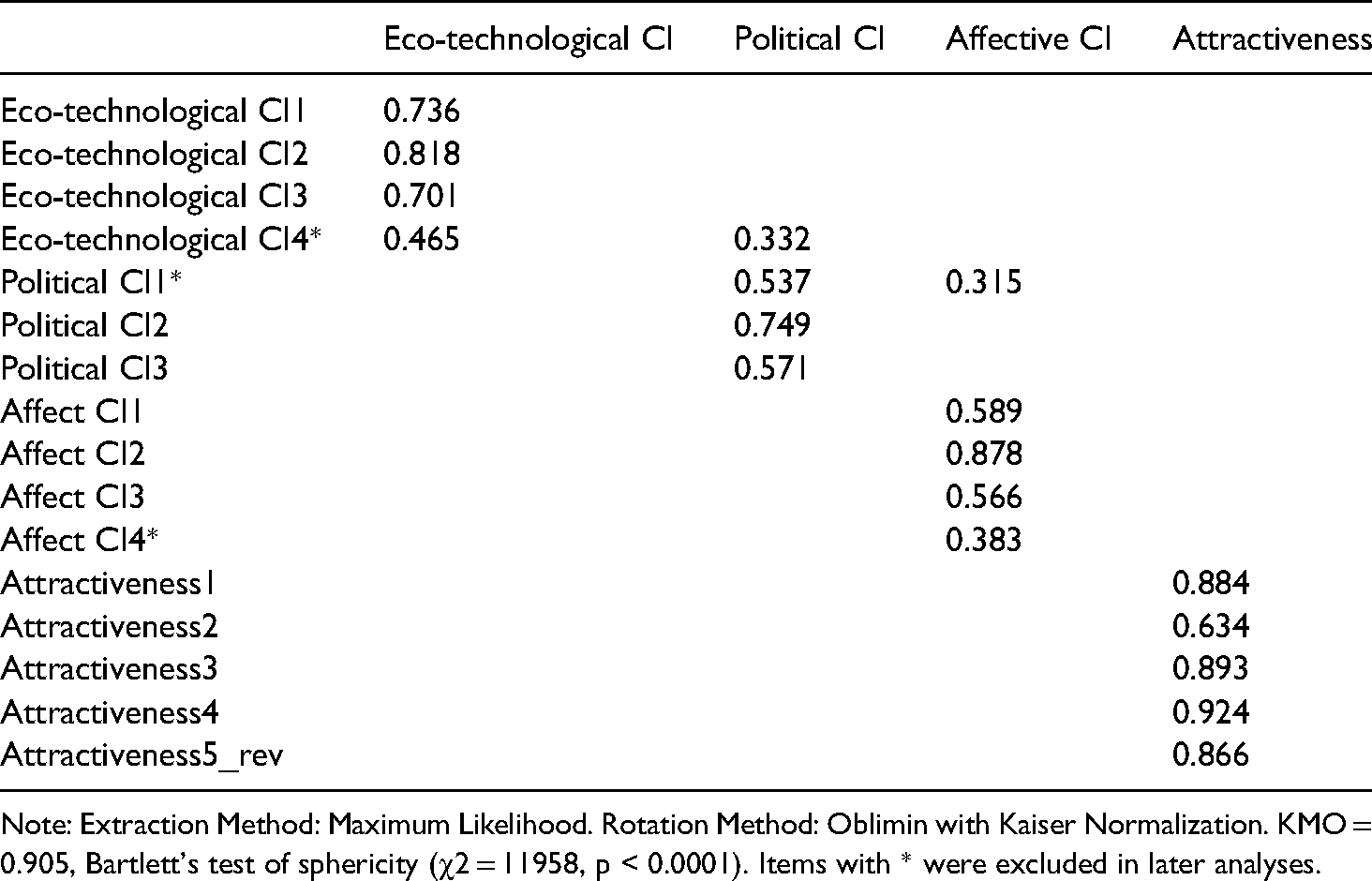
Note: Extraction Method: Maximum Likelihood. Rotation Method: Oblimin with Kaiser Normalization. KMO = 0.905, Bartlett's test of sphericity (χ2 = 11958, p < 0.0001). Items with * were excluded in later analyses.
We assessed the measurement models as the second step of data preparation. Since we had four latent variables, we needed to choose a correct measurement model for each of them, whether it was a reflective or formative model (Diamantopoulos and Papadopoulos, 2010; Jarvis et al., 2003). Based on the decision rules suggested by Jarvis et al. (2003), and relevant studies (Benitez et al., 2020; Buhmann, 2016; Buhmann and Ingenhoff, 2015a; Zhang et al., 2019), we determined Affective CI and Attractiveness to be reflective models, and Eco-technological CI, Political CI to be formative models. Next, we estimate the measurement models by using a new software package, ADANCO (Henseler, 2017).
First, we assessed the reliability and validity of two reflective constructs. Two types of reliability (composite reliability and indicator reliability) and two types of validity (convergent validity and discriminant validity) were assessed. The statistics presented in Table 2 show that Cronbach’s alphas, Dijkstra-Henseler's rho (ρA) and Jöreskog's rho (ρc) are all higher than the 0.70 threshold (Henseler et al., 2016), indicating sufficient composite reliability for the two reflective constructs. The indicator loadings of all items were higher than 0.6, indicating sufficient indicator reliability (Hair et al., 2006). The statistics presented in Table 3 indicate that the average variance extracted (AVE) of each reflective construct is above 0.50. This indicates a sufficient degree of convergent validity. The AVE of each reflective construct is greater than the highest squared correlation between a reflective construct and any other construct, indicating a sufficient degree of discriminant validity (Hair et al., 2011).
A reliability assessment of two reflective measurement models.

A validity assessment of two reflective constructs.

Note: The second and third columns present squared correlations.
Then we assessed the multicollinearity and the contribution of the items for the two formative measurement constructs, Political CI, Eco-technological CI. The variance inflation factor (VIF) for the degree of multicollinearity was computed. The results in Table 4 indicate that the variance inflation factor (VIF) for all items was below the cut-off value of 5 (Hair et al., 2011), indicating that multicollinearity was not a problem. All loadings and weights for the contribution were significant at the 0.01 level, which confirmed the absolute importance and relative importance of all items.
An evaluation of two formative measurement models.

Note: *** p < 0.001.
Finally, based on the measurement models above we calculated the means of the key variables of three countries to produce the results presented in Table 5.
Mean scores of the key constructs of three countries.

Control variables
To provide more accurate estimates of relationships among media salience, CI and firm attractiveness, we added several control variables in the PLS path model estimation. Studies have found that individual perceptions of countries and firms depend on individual experiences and demographics (Held and Bader, 2018; Yildirim et al., 2015; Zhang et al., 2019). Therefore, we included the following variables to control these effects. Gender, a dummy with a value of 1, if a respondent was male, otherwise 0; Age was measured by a respondent’s age, in years, at the time of the survey. Education was determined by the highest level of school that a respondent had completed. The following ordinal category scale (1–4) was used: up to high school (1), vocational education (2), academic education (3) and above master education (4). Country experience, a dummy with a value of 1, if a respondent had visited the country, otherwise 0. Firm experience was measured with a formative construct with two items, visiting experience (with a value of 1 if a respondent had visited one or more firms from country X, otherwise 0) and working experience (with a value of 1, if a respondent had worked in one or more firms from country X, otherwise 0). In addition, we added two country dummies, China and India, to control for country-specific effects.
Estimation strategy
To test our hypotheses, we apply PLS-SEM (Hair et al., 2011). This method is appropriate for the analysis as it provides more consistent results than traditional regression analysis in testing a series of dependence relationships simultaneously (Cheng, 2001; Ramli et al., 2018). In dealing with latent variables involved in these models, PLS-SEM allows the inclusion of measurement error, unlike regression that does not (Ramli et al., 2018). In particular, PLS-SEM can handle both formative and reflective measurement models that are included in our estimation model (Hair et al., 2017). Moreover, the PLS-SEM has such advantages that the normal distribution and large sample size are not required (Dijkstra and Henseler, 2015; Hair et al., 2014). The estimation was performed using ADANCO. We used a bootstrapping procedure involving 5000 random samples to examine the model’s goodness of fit, the path coefficients and their respective significance (Henseler, 2017). The overall model fit test showed that three criteria – SRMR (0.065), dULS (1.688), and dG (0.321) – were all below the corresponding value of the 95% percentile Hi95 (0.080, 2.624, 0.440), indicating the model was true (Henseler et al., 2016).
Result
The results of path estimation are presented in Table 6 and Figure 1. To compare the effect size, Cohen's f2 are also provided. Positive news was positive and significantly related to Eco-technological CI (β = 0.236, p = 0.000), Political C (β = 0.162, p = 0.000), Affective CI (β = 0.299, p = 0.000) and Attractiveness (β = 0.111, p = 0.000), which strongly support H1abcd. We also noticed that the effect size of Positive news on Affective CI (Cohen's f2 = 0.101) was the highest among the four constructs. Negative news was negative and significantly related to Eco-technological CI (β = -0.087, p = 0.002), Political C (β = -0.208, p = 0.000), Affective CI (β = -0.234, p = 0.000), which strongly support H2abc. Attractiveness was negative as expected, but not significant (β = -0.035, p = 0.156) which fails to support H2d. As was the case with Positive news, the effect size of Negative news on Affective CI (Cohen's f2 = 0.057) was the highest among the four constructs.

Results of PLS structural equation modeling. Note: *p < 0.05; **p < 0.01; ***p < 0.001.
Path estimation of PLS-SEM.

Note: N = *p < 0.05; **p < 0.01; ***p < 0.001.
Comparing the effect size of Positive news and Negative news, we observed that Positive news had a stronger effect than Negative news on Eco-technological CI (Cohen's f2: 0.075 vs. 0.009), Affective CI (Cohen's f2: 0.101 vs. 0.057) and Attractiveness (Cohen's f2: 0.016 vs. 0.002), which supports H3. Negative news had a stronger effect than Positive news on Political CI (Cohen's f2: 0.041 vs. 0.027), which supports H4.
The three dimensions of CI (Eco-technological CI, Political CI and Affective CI) were positively and significantly related to Attractiveness. This is in line with the international business studies indicating that there is a relationship between firm and country characteristics (e.g. Sharma, 2011; Zhang et al., 2019, 2020). The indirect effects presented in the low part of Table 6 indicate that Positive News and Negative news both were significantly related to Attractiveness through the three dimensions of CI. The results indicate that Positive news influenced Attractiveness, directly and indirectly, Negative news influenced Attractiveness indirectly only.
For the control variables, we observed that Dummy variable China was positive and significantly related to Eco-technological CI, but it was negatively and significantly related to Political CI, Affective CI and Attractiveness. This result implies that, compared to South Africa, China received a better assessment on Eco-technological CI and a worse assessment on Political CI, Affective CI and Attractiveness, while India received a worse assessment on Political CI and Attractiveness. This result is reasonable, given the development level reached by China and India and the special old colonial relationship between the Netherlands and South Africa. These country differences are discussed in detail in the discussion section below.
Experience was another important factor that influenced CI and firm attractiveness. Country experience was positive and significantly related to Eco-technological CI, Affective CI and Attractiveness, and Firm experience was positive and significantly related to Eco-technological CI, Political CI, Affective CI and Attractiveness.
For other demographics we found that Age was negative related to Attractiveness. This implies that younger people were more likely attracted by firms from the three large emerging countries. Gender was positive and significantly related to Eco-technological CI. This implies that males had a better evaluation on Eco-technological CI than females. Education was positive and significantly related to Political CI, Affective CI and Attractiveness. This means that well-educated respondents had a better evaluation on Political CI, Affective CI and Attractiveness than less-educated respondents. This result is in line with the studies indicating that education reduces prejudices and stereotypes (e.g. McGlothlin and Killen, 2009).
Discussion
The changing global economic landscape and global digitalization make it imperative to investigate media effects in international contexts. Foreign countries and firms should be better researched in media studies. The purpose of this study was to investigate how and to what extent media salience (visibility and valence combined) influenced new economic powers’ image and their firms’ attractiveness. To answer this question, we chose three countries (China, India, and South Africa) and their firms as objects and Dutch adults as the media consumers to set the research context. Our analysis results indicate that, while both positive and negative news influence individuals’ perception of these countries and their firms - as agenda setting theory predicts - the effect is asymmetric. Specifically, negativity bias is presented when political CI was assessed, and positivity bias is presented when eco-technological CI, affective CI and firm attractiveness were assessed. This study also found that the media effect was stronger when objects contained emotional component (i.e. affective CI). The findings provide a better understanding of new economic powers and their firms as constructed by the mass media and, as such, how they are then perceived by the public. These have important theoretical and practical implications.
Theoretical and practical implications
First, this study advances our knowledge about negativity bias in media and communication research by revealing that negativity bias was found to be depending on an object’s attributes. We showed that when the attribute was related to ability and attractiveness, such as eco-technological CI, affective CI and firm attractiveness, positive news had a stronger effect than negative news. When the attribute was related to morality, such as with political CI, negative news was more influential. This finding contrasts with the findings of earlier studies that indicated that negative news for a country negatively influenced public opinions of that country, but positive news did not have an impact on public opinion (Kiousis, 2005; Wanta et al., 2004; Zhang and Meadows III, 2012). This inconsistency can be attributed to the different approaches used to investigate public perception. Previous studies investigated broad concepts measured by a single item, such as “public attitudes regarding foreign nations” (Kiousis and Wu, 2008), “feelings toward countries” (Wanta et al., 2004; Zhang and Meadows III, 2012). However, we looked into the dimensions of the public perception of foreign countries and measured each dimension with many items by following relevant studies. This fine-grained approach helped us identify that negativity bias was conditional on the attributes of the object concerned, which reconcile the conflicting phenomenon of negativity bias and positivity bias.
This study also suggests that the assumption of negativity bias is not always true. Our data showed that the respondents received more negative news than positive news for the three large emerging countries. Table 5 shows that the means of positive news frequency were 3.175, 2.69 and 2.644 for China, India and South Africa respectively, and the means of negative news frequency were 3.884, 3.324, and 3.029 accordingly. The statistics suggest that negative news was more common than positive news in our research context (t = 11.541, 10.452, 7.088). This observation is opposite to the assumption of negativity bias that negative information is less common, less expected, and more informative than positive information (Skowronski and Carlston, 1989).
Second, our findings add to the literature on agenda setting by indicating that the media play a more important role in cultivating individual perceptions of affective attributes for the countries selected. As agenda setting theory predicts, we confirmed that media salience, both first and second level, influenced public opinion for the new economic powers’ image. However, we found that the extent to which the media salience influenced the CI varied across the dimensions. The results showed that media salience had more influence on affective CI than eco-technological CI and political CI. This suggests that the affective component of CI was more likely to be influenced by media news than the cognitive components. The possible explanation could be that the emotional involvement was different for these dimensions. When eco-technological CI and political CI were assessed, the cognitive response was involved, the emotional response was low; but when affective CI was assessed, emotional response and cognitive responses were involved, and both could be high.
Media theories, such as transportation theory (Green et al., 2004), have declared that the combination of a high cognitive and a high emotional response resulted in the strongest media effects (Valkenburg and Peter, 2013). Studies on media and sports also suggested that emotional involvement strengthened the media influence (Mutz and Gerke, 2018; Seate et al., 2017). Our findings share the same point of view with these arguments, highlighting the importance of emotional involvement. Nevertheless, the relationships between media salience, types of response and media effect call for more serious studies in the future.
Third, this study has enriched the literature on media salience and public perceptions with its focus on large emerging countries. Besides the above-mentioned media impacts, this study has shown that perceived media salience and country image of new economic powers reflect their development level and international relations. Regarding the media salience, Table 5 shows that China received more media attention than India and South Africa in terms of received news frequency, including positive and negative news. This reflects the fact that China is the most noticeable among the emerging countries. China's rise and its active participation in global competition and cooperation indeed attract more media attention. Regarding the country image, China has far better eco-technological CI than the other two countries. This is in line with China’s extraordinary economic development over the past few decades. Word Bank data 3 , in 2018, shows GDP per capita of China, India and South Africa were US$ 9,771, $ 2,010, and $ 6371 respectively. This finding is in line with the argument that China’s positive image is mainly based on its economic achievement (Estupinan, 2017; Qi et al., 2019). For affective CI, political CI and firm attractiveness, South Africa scored better than China and India. This can be attributed to the old colonial linkage between the Netherlands and South Africa, which has made South Africa culturally and politically close to the Netherlands. This finding implies that national economic and political development level and international relations were the important factors to understand media salience and public perception of foreign countries.
The study provides some important practical implications. The findings suggest that the media play a significant role in cultivating individual perceptions of the three large emerging countries. Specifically, positive news is associated with positive perception, and negative news is associated with negative perception. This role is especially prominent if the objects contain affective components, such as affective CI, and moral components, such as political CI. Therefore, these countries could be more active in communicating with the international community through the media about their progress, their willingness to cooperate with and their ability to contribute to other countries. On the other hand, governments and firms from these countries should be well prepared for the adverse impact associated with negative news about their countries’ political systems. In addition, this study found that individuals’ direct experience with a country and its firms was positively associated with their evaluation of the CI and firm attractiveness. Therefore, actively opening up to international visitors is a good strategy for countries to improve their CI and firm attractiveness.
Limitations and future studies
Despite the contributions, this study has had some limitations. There are many conditions that influence the media effect, while this study only focused on the attributes of objects, leaving other conditions, such as individual characteristics and their attitude towards media (e.g. whether they trust the media), untouched. Future studies to investigate these individual level conditions are needed to advance the understanding of the media effect.
The research context for this study only chose three emerging countries as objects. This has limited the generalization of the results to other emerging countries. Extending the research to other emerging countries, or comparing emerging countries with advanced countries, could make the findings more robust and meaningful. Similarly, the study used data collected from Dutch residents. This also has limited the generalizability of the findings. Therefore, more research effort is needed to extend the current research frame to the media consumers of other countries in the context of different development levels (e.g. developing countries), different cultures and languages (e.g. Anglophonic countries).
We only investigated the politically related elements of the moral judgment related to CI. This has left other moral elements, such as environment, social responsibility and business ethics, untouched. Future research could investigate media effects on countries that embrace these components.
Our findings imply that national economic and political development level and international relations may be important factors that shape the media salience of countries. However, the limited scope of this research meant that we did not verify these possible antecedents. Future studies could verify this interesting finding by including more countries in the country sample.
Footnotes
Declaration of Conflicting Interests
The author(s) declared no potential conflicts of interest with respect to the research, authorship, and/or publication of this article.
Funding
The author(s) received no financial support for the research, authorship, and/or publication of this article.
