



Abstract
Seeking to assess the current state of international broadcasters (IBs) within the framework of public diplomacy, this paper assesses the relevance of state-sponsored IBs within the contemporary public diplomacy. This paper focuses on the IBs of two neighboring countries, Indonesia and Australia, and political authorities’ dynamic support for their services. Data were obtained through desk reviews of IB policies, in-depth interviews, and online observation of the websites of Siaran Luar Negeri (SLN, Indonesia's IB) and ABC Radio Australia (RA, Australia's IB). This paper finds that both countries have continued to use IBs for their public diplomacy, yet ‘political parallelism’ determines the position and sustainability of each. SLN has had limited political support and faced a series of managerial crises, while RA has enjoyed the fruitful support of the Australian authorities and has been heavily involved in public diplomacy in the Asia–Pacific region.
Keywords
Introduction
Studies of the relevance of international broadcasters (IBs) to public diplomacy have been developed in both developed democracies and post-colonial nations. We find media scholars have paid particular attention to countries such as China, Russia, the United Kingdom, South Korea, and Japan, each of which has used 24-h IBs to frame its foreign policies. For instance, Bumpus and Skelt (1985) compiled articles covering seventy years of IB services, with a particular focus on Japan and Germany. They found that IBs were initially positioned as tools of propaganda in the colonial era, and subsequently used to agitate the Cold War while simultaneously promoting national culture abroad (Risso, 2013). With the end of the Cold War and the arrival of digital politics, IBs smoothly transformed from the primary proponents of military propaganda into institutions with diverse missions, shifting from exerting ‘hard power’ to exerting ‘soft power’ (Nye, 2008). IBs justified their continued presence on the grounds that they were uniquely placed to strengthen their nations’ international standing by projecting core broadcasting values, their trusted newsrooms, and the depth and breadth of their global services (O’Keeffe & Greene, 2019). Germany's Deutsche Welle (DW) and the United Kingdom's British Broadcasting Corporation (BBC) World have been exemplary in this regard.
In post-authoritarian societies, there is something of a hybrid between the voice of the old-military and/or autocratic politics with cultural diplomacy as a means of soft power (Nye, 2008). The translation of cultural diplomacy itself refers to the ideals of the existing political power. In this sense, Sisi (2014) examined the expansion of China Central Television (CCTV) and its promotion of China's global economic policy.
IBs are state-sponsored channels that target international audiences in the name of promoting the foreign policy and national security goals of the state. These broadcasters have strategic functions, informing audiences of the nation-state's culture and society and enhancing its reputation. Among the most recognized, as mentioned above, are BBC World Service, Deutsche Welle, Nippon Hoso Kyokai (NHK) World, and Voice of America (VOA). Unlike Deutsche Welle and VOA, which strictly serve international audiences, the BBC and NHK maintain some domestic operations. This has inevitably led to internal and external struggles and tensions (Snow, 2014).
Assessing the literature on IBs, the author finds that studies of IBs in post-colonial and post-autocratic diplomacy have been lacking. Toula (2017), for instance, compared Deutsche Welle, Russia Today, Al-Jazeera English, and China Central Television, tracing the development of these broadcasters in the post-Cold War era while leaving IBs rooted in post-colonial countries for other researchers. Turning to Indonesia, IB services have a long history in the archipelago, dating back to the Dutch and Japanese colonial eras (1930s–1940s). However, investigation of the development of international broadcasting in Indonesia has not been popular, due to (among other things) its previous role in voicing Dutch colonial interests. This can also be attributed to Indonesia's limited experience operating a global media service akin to the BBC of the United Kingdom and Voice of America.
To fill this gap, this paper seeks to investigate the IB of a post-colonial and compare it with one in a more developed democracy. As its cases, this paper takes the IBs in Indonesia (Siaran Luar Negeri, SLN) and Australia (ABC Radio Australia, RA). It investigates the role and relevance of these broadcasters, as well as the extent to which political changes have determined their public presence and sustainability. In doing so, this paper not only provides an understanding of state-sponsored IBs in two different political landscapes—the transitional politics of Indonesia (Lay, 2012) and the liberal democracy of Australia (Thompson & Stannard, 2008)—but also contributes to the literature on IBs’ continued relevance in the digital media use as new tool of diplomacy (Adesina, 2017).
This paper consists of four sections. Following this introduction, the author will discuss the governances of IBs as state-supported media, their sustainability, and their role in public diplomacy. The third section elucidates the methods applied in this paper, which were used to obtain the findings presented and analyzed in the third section. This section compares several aspects of the two IBs’ governance, i.e. policy, ownership structure, and funding. The final section of this paper summarizes the findings and provides recommendations.
Ibs and public diplomacy
Scholars have examined the ongoing relevance of IBs in developed and developing democracies, which has become increasingly important since the rise of digital-based and non-state public diplomacy. Following Hallin and Mancini’s (2004) argument regarding the causal linkage between media and politics, studies are increasingly looking at IBs’ current status and their continued role as second tracks of public diplomacy. Governments in mature democratic and transitional democratic countries have traditionally used IBs to accelerate public diplomacy and reach broader audiences.
Jowett and O’Donnell (1999) define IBs as the national broadcasting organizations that are usually state funded or supported by a group of politically or religiously active citizen eager to reach a specific audience. Many of the largest IBs were founded in the 1930s and were driven by political agendas. Toula (2017) writes that state-sponsored IBs such as China Central Television (2000), Russia Today (2005), Telesúr (2005), Press TV (2007), and France 24 (2006) have modeled themselves after British Broadcasting Corporation (1932), Voice of America (1942), and Deutsche Welle, Germany (1953), being used to serve public diplomacy and manage global audiences in an increasingly complicated and digitalized media system. From the colonial era through the post-Cold War and post-communist eras, these broadcasters have served political propaganda purposes (Jowett & O’Donnell, 1999).
What is public diplomacy? Dizard (2010) defines public diplomacy as the effort to influence the global public in the formation and implementation of ‘soft power’ foreign policy. Soft power widely refers to cultural diplomacy, the international exportation of culture and arts through communication. It includes the “exchange of ideas, information, art, language and other aspects of culture among nations and their peoples to foster mutual understanding” (Lenczowski, 2009). Soft power is concerned with a nation's attractiveness, though it is often focused on intangible and elusive notions such as culture, political values, and foreign policies (Enaifoghe and Makhutla, 2020).
It covers how international actors try to influence foreign publics through various means, including IBs (Cull, 2009), seeking not only to defend national interests but also to increase the reputation and influence of the nation-state in the global arena. Public diplomacy is understood as a means through which states shape public opinions and interactions while simultaneously informing others of international relations and their effect on domestic policy. In doing so, political authorities rely not only on direct diplomacy, but also international broadcasting; indeed, there is a long tradition of using analog-terrestrial IBs, one that dates back to the 1930s. However, in the digital media landscape, state officials are not the sole actors spreading political information. Today, this role may be played by non-state actors, such as digital media and activists—as seen in the case of WikiLeaks and Edward Snowden (Adesina, 2017) —who compete with classic IBs and challenge their relevance.
Looking back further, IBs were born from changes in diplomatic strategies. Balzacq, Charillon, and Ramel (2020) record three phases of diplomacy. In the ancient Middle East, around 2500 BCE, the ‘traditional phase’ was marked by royal envoys, reciprocity, protocols, and gift exchanges (Cohen, 1998). Later, during the classical diplomacy phase—which occurred in ancient Greece and the Roman Republic—internal approaches were used to regulate city–state interactions, and decisions about international relations were based on public opinion. Finally, during the modern phase of diplomacy (which stemmed from the Italian Renaissance), numerous diplomatic procedures and innovations were developed—including the use of modern media. Ambassadors emerged, and their diplomatic roles were formalized. They had two missions: to convey messages (as nuncio) and to initiate and negotiate authorities (as procurators).
Since the beginning of the third phase of public diplomacy, practices have evolved considerably. No longer are states singular actors; a broad range of actors and sectors have become involved. International relations involve not only multilateral interactions, but also para-diplomacy and public diplomacy. Hocking (2020) finds that the increasingly complex forms and directions of public diplomacy require media, as non-state actors, to interact in international networks. Media thus has an interactive, dynamic, diverse, and non-hierarchical relationship with diplomacy and its changing patterns.
Regarding the use of media in this endeavor, the author believes that IBs offer an affordable means for governments to conduct public diplomacy. IBs may shape diplomatic strategies according to the state's wishes. Seib (2010) notes, for example, that Al Jazeera was successful in conducting public diplomacy for Qatar. It not only represented Qatar, but also served as a tool of public diplomacy for Pan-Arab movements. Even as Arab countries (and their international broadcast outlets) have become increasingly divided, Al Jazeera has remained a strong Arab voice. It has continued to create a sense of equality, and even encouraged Pan-Arab unity until said unity shattered in 2017, transforming itself into a ‘political actor’ for the Arab World and/or the Middle East.
As IBs are state-sponsored broadcasters, political parallelism (Hallin & Mancini, 2004)—which holds that the structures of political parties are reflected somewhat by the IBs organizations—applies. First introduced by Blumler and Gurevitch in the 1970s, the concept of political parallelism became widespread after Hallin and Mancini published their masterpiece Comparing Media Systems in the 2000s. The authors introduced three models of media system: liberal, democratic corporatism, and polarized pluralist However, media researchers have also used political parallelism to compare media systems, including IBs, and question how far the concept can travel (Voltmer, 2012).
Political parallelism has been used, for instance, to investigate the recognizable relationships between media and politics in a given society (Rochyadi-Reetz and Löffelholz, 2019); the stable patterns of convergence between certain media outlets and political parties, groups, or tendencies, with regard to their agendas, worldviews, and in some cases, organizational ties; and the specific circumstances in which significant connections between particular media and political groups define the political communication system as a whole (Albuquerque, 2013). Of these, this paper pays particular attention to broadcasting policies and the linkages between media and political authorities.
On the concept of states’ sponsorship of media, Dragomir (2017) found four models: public funding for state-administered media, state subsidies, state advertising, and market disruption measures. Public funding for state-administered broadcasters, including state-owned media as well as public television and radio, offers an effective means of capturing media. Due to IBs’ strategic function, political authorities in both mature and transitional democracies traditionally sponsor them through three models. However, the extent of state intervention differs. For instance, BBC receives funding from the UK government and public (through license fees), but exerts limited political control due to BBC's position as a public corporation. In contrast, the Chinese government sponsors CCTV through both state funding and state ownership while exerting great political control.
Government-funded IBs such as ABC and the BBC are held up around the world as models of impartial and balanced reporting and high-quality programming. Many transitional countries in Eastern Europe and Asia have sought to emulate such models. However, in countries with polarized political systems such as Indonesia, governments have used funding as a way of ‘capturing’ their public media and making it subservient to state aims. This has mainly been the result of failed transitions to democracy (Dragomir, 2017).
Returning to international broadcasters, O’Keeffe and Oliver (2010) and Risso (2013) both note that their purpose has changed over time. Used for war propaganda in World War I, World War II, and the Cold War, today IBs primarily air culture, art, education, and communication programs. In so doing, they help governments reach the broadest public in managing public diplomacy. For instance, Radio Netherlands was previously used to reach audiences in former Dutch colonies, but since 2012, it was succeeded by Radio Netherlands Worldwide to represent the country's cultural diversity; a similar history marks Germany's Deutsche Welle. In France, Radio France International has promoted the country's language to the world. It can thus be surmised that IBs complement other cultural diplomatic strategies (such as education) that tend to target certain segments.
Outside Europe, two state-sponsored IBs—Japan's Nippon Hoso Kyokai (NHK) and China's CCTV—play key roles in serving their countries’ public diplomacy efforts. Since World War II, NHK has represented the five major elements of public diplomacy: active listening, advocacy, cultural diplomacy, educational and cultural exchange, and international broadcasting (Cull 2009: 18–22). Although the link between this public service media and public diplomacy is relatively minor (Yamamoto, 2013), and although NHK's international broadcaster (i.e. NHK World) does not operate as an ‘official’ medium for public diplomacy, there is no denying that NHK's operations and programs impact Japan's global image (Snow, 2014). To fulfill its mandate, NHK follows the BBC model and serves as an autonomous public corporation. As for CCTV, Wu (2016) and Zhang et al. (2017) find that Chinese authorities have mandated the IB to promote international political relations. However, in fulfilling this mandate, CCTV has less autonomy than NHK and BBC.
Above all these IBs, however, the United Kingdom's British Broadcasting Corporation (BBC) and the United States’ Voice of America (VOA) are considered the two leading models of IB (Powers, et al. 2017). BBC World Service, for instance, represents the ‘public way’ the British government carries out its public diplomacy. Such services were initially mandated in the 1930s to counter the spread of Nazi propaganda by increasing English-language broadcasting around the world. Between 1949 and 2015, the World Service was funded entirely by the Foreign and Commonwealth Office. After funding ended, it became a commercial entity, with editorial independence and channels in foreign territories; it even provides a 24-h English-language TV channel that is funded through subscriptions and advertisements (Mirchandani & Abubakar, 2014). According to BBC Royal Charter, BBC World Service must provide the highest quality news and adhere to the core principles of British journalism. Also, it must present Britain as a society that values free press, and healthy (critical) debate. Freedom of thought and expression are ‘soft power’—having the ability to influence others—and BBC World is the tool used to leverage them.
Meanwhile, VOA is the largest of the United States’ international broadcast networks. First broadcasting on February 24, 1942, VOA was used during World War II and the Cold War as a strategic tool for communicating the strengths of the West while simultaneously undermining Communist influence. Unlike BBC World, which employs a centralized ‘Londonistic channel’ to expand its influence, VOA relies on ‘branches’, such as Radio Free Europe/Radio Liberty (RFE/RL), Radio Free Asia (RFA), Radio Marti (RM), and the Middle East Broadcast Network (MEBN). VOA and its affiliated channels are managed by the Broadcasting Board of Governors (BBG), which is tasked with telling America's story and explaining American foreign policy. Per the International Broadcasting Act of 1994, the BBG must also adhere to certain values and provide accurate, objective, and comprehensive news. As such, for people living under strict censorship and state-controlled media, VOA has long been seen as providing balanced reporting, thereby offering an example of classical public diplomacy (Park and Illinois, 2007). Since the attacks of September 11, 2001, however, VOA has been torn between promoting the public and state interests.
To remain relevant and compete with other IBs, particularly digital ones not sponsored by states, both BBC and VOA maintain analog and digital services. VOA and its affiliated media, for instance, reach more than 278 million people around the world, distributing programming in 61 languages to about 100 countries via radio—shortwave, medium-wave (AM), FM, and satellite—as well as terrestrial and satellite media, internet, live streaming, mobile devices, and social media. VOA and its affiliates also cooperate with media operators in their targeted countries, including Indonesia; as of 2020, both BBC and VOA operate branches in Jakarta, tagged as BBC or VOA Indonesia. To tackle disinformation and its negative consequences, BBC has implemented a fact-checking program and alerted people about misinformation (Horowitz et al., 2021).
Compared to BBC and VOA, IBs in new democracies tend to be unstable, remain analog, and suffer from a highly bureaucratic culture that is slow to adopt digital media (Voltmer, 2012, 2013). Driven by liberal media policy and widespread social media use, governments are keen on actively using their national media for international diplomacy and reaching digital publics. As international relations have evolved, partnerships between foreign media services and diplomats have become less symmetrical and reciprocal. IBs have shifted away from being government mouthpieces to serving as public media of cultural promotion. International broadcasters are no longer used for hard diplomacy, but rather soft diplomacy (Hafied, 2015). At the same time, however, their mutual relationship with foreign diplomatic authorities is in limbo. For instance, since Indonesia began its political reform in 1998, Indonesian authorities have abandoned the country's official international broadcaster (i.e. SLN) in favor of using social media for public diplomacy.
Mensah (2013) argues that international radio services are often framed on ideological grounds. He argues that CNN and BBC reflect a cosmopolitan ideology: an intellectual and aesthetic attitude of openness to different human perspectives, places, and cultures, as seen (for example) in their coverage in the Ivory Coast Groshek (2008) emphasizes that, alongside VOA (the flagship IB of the United States), CNN International has served to shape the international public's views of global issues. During the Gulf War (1990–1991), CNN emerged as a global actor in the United States’ ‘public diplomacy’ (Gilboa, 2005). Livingston (1997) deemed this the ‘CNN effect’, the strategic role played by CNN as a policy agenda-setting agent in several US military interventions. The broadcaster enabled the country's policymakers to garner public support for military operations.
In line with Mensah (2013), Pahlavi (2012) describes how Iran resembles North American, European, and Asian countries in its use of IBs. During the Cold War, National Iranian Radio and Television (NIRT) brought forth a perspective—rooted in the traditional logic of foreign relations—to contest liberalism and communism. Qatar's foreign radio soon joined forces to challenge English-language media and its projection of the cultures, values, and unique capabilities of developed countries.
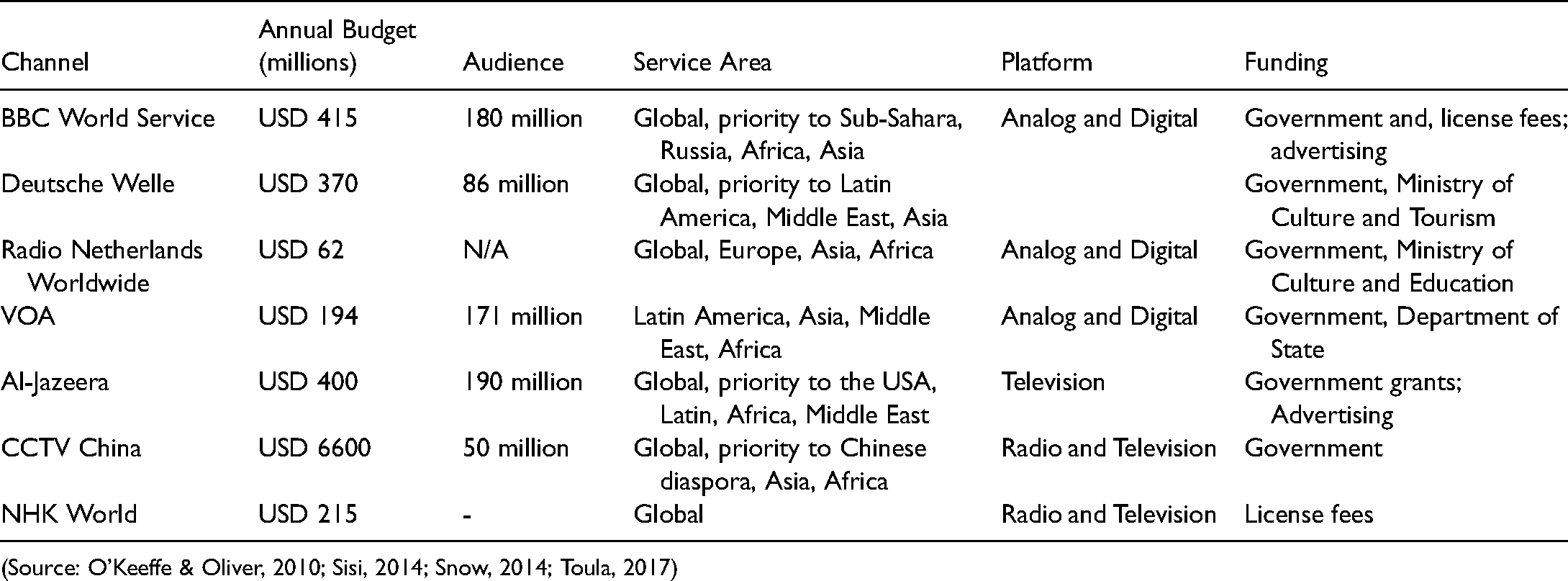
The table below compares several international broadcasters (Table 1):
Comparison of international broadcasters.
(Source: O’Keeffe & Oliver, 2010; Sisi, 2014; Snow, 2014; Toula, 2017)
This table shows high levels of competition between IBs in the Western and non-Western worlds. It also demonstrates how different countries support their IBs, from legal status to funding. Notably, most IBs have adopted digital platforms to remain relevant in digital diplomacy. At the same time, however, we must acknowledge that IBs’ continued relevance in the digital era is related to two ideas: (1) the new culture and geopolitics of information and (2) the mediatization of cosmopolitanism (Christensen, 2013). The first is highly political, being related to the use of media for propaganda, and used to exert soft power while considering specific geographical contexts (for example, in the Asia–Pacific). The second is cross-sectoral, simultaneously political, economic, and cultural, and through it, IBs serve to advance a culture of mobility and open-mindedness.
In summary, although international broadcasters initially emerged to voice both colonial or anti-colonial messages, they have embraced cultural diplomacy as a ‘new/middle way’ since the fall of military colonialism, the Cold War, and authoritarianism. Building on this review, this paper examines the IBs of Indonesia (SLN) and Australia (RA), two broadcasters that enjoy different political climates and state–media relations. The author uses the concepts of political parallelism and/or politics in broadcasting offered by Hallin and Mancini (2004). At the same time, this paper also relies on the four pillars of media identification offered by Hanretty (2007): mission, ownership, media structure, and funding. Likewise, this paper borrows from Steenfadt & Screenworld (2010) and Schweizer & Puppis (2017), who identify key issues that must be considered when analyzing state-sponsored broadcasters: policies; remit; funding; and (in)dependence of structure, ownership, and staff, which necessitates creative and professional human resources.
Method
This paper examines the continued presence of the IBs of Indonesia and Australia, assesses their current status, and compares the broadcasters’ use in serving public diplomacy. This paper focuses on two issues: the history of the broadcasters and their organizational governance. This paper seeks to answer two main questions: What is the current state of the Indonesian and Australian IBs? From a public diplomacy perspective, how are these IBs linked with political authorities, and to what extent does political parallelism determine their role as well as their sustainability? By using the cases of Indonesia and Australia, this paper provides a recent picture of IBs in liberal (Australia) and transitional (Indonesia) democracies outside Western Europe. This study also contributes to the academic debate on the continued relevance of IBs as state-sponsored channels in digital public diplomacy.
To answer its research questions, this paper uses qualitative methods. Data were collected over the course of 2020 through a review of pertinent documents, observation, and semi-structured interviews. Per the tradition of qualitative research (Denzin & Lincoln, 1994; Creswell, 1998), research was conducted in three stages. First, primary data on the history and development of IBs, as well as their use for political diplomacy, were collected through a review of these broadcasters’ strategies as published on their official websites and other relevant sources (e.g. official social media channels). Second, the media policies of Indonesia and Australia were analyzed, with particular emphasis on the policies of Indonesia's Ministry of Foreign Affairs and Australia's Department of Foreign Affairs and Trade. Third, in-depth interviews were conducted with the head of SLN, the Director of Public Communication at the Indonesian Ministry of Foreign Affairs, and Indonesian and Australian broadcasters with IB experience. Due to the COVID-19, interviews were conducted online. Empirical data were analyzed using the concepts of public diplomacy, media governance, and the political factors influencing the relationship between IBs and acting government officials.
Findings and discussion
This section describes and discusses the findings of this study. It first explores the history of Indonesia's SLN and Australia's RA as well as their dynamic evolution as IBs. It then compares the management of these media, as well as their connection with their respective political authorities. This section compares key aspects of these two IBs, including their history, legal frameworks, ownerships, and funding source.
Similarities and differences were found between the history, policy and management SLN and RA. In Indonesia, SLN as the country's international radio emerged in the late 1940s, when pro-independence activists began the Voice of Free Indonesia to propagate the nation's political independence—as evident in its tagline Indonesia Merdeka (free Indonesia). In 1950, the Voice of Free Indonesia was renamed Voice of Indonesia, a name it has retained until today. It targets Indonesian citizens abroad, the Indonesian diaspora, and all people around the world (Hadyan, 2020). Until the fall of Suharto's autocratic regime in 1998, it employed a primarily autocratic approach. During this period, Radio of the Republic of Indonesia (RRI) served as Indonesia's sole national broadcaster, and SLN was similarly under total state control. Today, aside from broadcasting political news, it also exercises soft political power by spreading the nation's culture and promoting positive understandings amongst the international public (Masduki, 2017).
Similarly, Radio Australia was established in 1932 as a tool of political propaganda. It was highly influenced by British broadcasting, and over time developed to promote Australia's interests in the Pacific. However, unlike SLN (which was established with the spirit of political independence and national integration), RA emerged within a more stable political atmosphere. Established by the Australian Broadcasting Commission (ABC) as a commonwealth corporate entity under the name Australia Calling, it began shortwave broadcasting in 1939 after Great Britain sought assistance countering the propaganda spread by Germany during World War II. The language used and the countries targeted were depended strongly on the political views of the Australian government (Clark, 2003); initially in French, Dutch, German and Spanish, broadcasts began to be made in Japanese, Thai, Indonesian, and Mandarin after 1942 (Vincent & Walsh, 2019). As of 2021, RA remains the only Australian channel dedicated to supplying international shortwave and digital broadcasts to the Asia–Pacific region (ABC, 2021).
Political parallelism has been prominent in these broadcasters’ management. Likewise, the legal status of SLN and RA have been influenced by the dynamic developments in their country's political landscapes. Both broadcasters have continuously adapted. After Indonesia proclaimed its independence in 1945, SLN was established by independence activists to challenge colonialism; it continued this struggle through the 1950s. Under Suharto's autocratic political regime (1966–1998), SLN was used to voice a developmental ideology and protect Suharto's political reputation around the world. SLN was Indonesia's sole international radio, and thus received the full support of Suharto's political administration. After the fall of Suharto in May 1998, the regime's control over the media ended. Since then, SLN has focused on public diplomacy by airing cultural events.
After Indonesia began its political reform in 1998, the Ministry of Information (under the auspices of which SLN operated) was dissolved, and the Ministry of Foreign Affairs (MoFA) was uninterested in taking over. As such, SLN lost its government ownership, taking instead a minor position under RRI and providing relatively limited services. Compounding this situation, as Indonesia democratized its media system, SLN experienced structural and cultural obstacles in its efforts to survive as a tool for public diplomacy. Inheriting the stigma of being a state-controlled broadcaster, and having experienced significant difficulty with digitization, the station lost its former reputation. Its limited influence is further undermined by the Ministry of Foreign Affairs’ continued emphasis on social media—instead of radio—for public diplomacy. Meanwhile, Suharto's successors (i.e. Habibie and Joko Widodo) have applied liberal media policies that favor commercial broadcasters over public ones, without any effort to redevelop the country's national and international broadcasters (Masduki & Darmanto, 2014).
Likewise, RA has experienced dynamic changes in its legal and governmental status. During World War II, RA was used by the Australian Government to help its war efforts—particularly in Asia (Clark, 2003). Consequently, management of RA was surrendered to the ABC in 1942, even as the broadcaster's editorial policy rested first with the Department of External Affairs and later with the Department of Information; in this, it mimicked the American system, wherein international stations were under government control. Following the end of the war, RA was primarily used as an instrument of the government's immigration policy. It offered an enticing picture of Australia, using English-language broadcasts designed to entice foreigners to settle in Australia (Hodge, 1995). Administration, meanwhile, shifted back to the ABC, indicating a return to the BBC model of autonomous broadcasting to propagate the liberal democratic values of the country.
Currently, RA focuses its services on the Asia–Pacific region, and public diplomacy is embedded in its mission and programming strategies. Following the international media policies of BBC World, RA has highlighted the value of Australia's liberal democracy and sought to convey accurate news and information while providing an Australian perspective. RA aspires to emulate BBC as an autonomous media agency, while SLN remains a state agency, marked primarily by state-controlled staff and funding. SLN has legally adopted a soft power approach and is legally mandated with providing credible and pro-public news and information. In practice, however, the channel has continued to voice the views of the government rather than the Indonesian public. As a further implication of their status as civil servants, SLN staff mostly refer to governmental views of diplomacy, viewing it through a state-centric (rather than public-centric) view.
SLN lacks the legal framework and protections enjoyed by RA, operating not under a special law, but under a broader media law: Broadcast Law No. 32 of 2002. The provisions for SLN in this law are normative and abstract, simply highlighting the need for the channel to develop Indonesia's reputation abroad through cultural and news programming without describing how SLN can fulfill these functions. Government Decree No. 12 of 2005, a lower policy, does not require SLN to establish overseas branches and/or cooperation with other IBs. At the same time, Purwanto et al. (2020) find a lack of clarity in SLN's area of service. The idea of formulating a special law was floated in 2012, but this proposal gained little public attention and ultimately failed. Likewise, neither SLN's ten-year strategic plan (2011–2021) nor its annual strategy (2019–2020) provides a quantifiable means of helping the channel compete in the digital media environment.
Despite being an autonomous radio with a mandate for public diplomacy, SLN has limited state backing. Unlike RA, SLN has no specific legal framework that emphasizes its presence for public diplomacy and the necessary collaboration with relevant governmental partners (such as the Ministry of Foreign Affairs), nor can it access significant funds from the Ministry. Ministerial guidelines for media cooperation, meanwhile, tend to promote flexible programs in Indonesian embassies rather than emphasize formal support and partnership with SLN. In practice, ministerial officials often use different media for public diplomacy, thereby creating synergy with non-SLN broadcasting outlets.
Analyzing the public diplomacy documents of the Ministry of Foreign Affairs, the author finds no formal and continual partnership between it and SLN. All efforts have been merely tentative, carried out in response to special events, without any initiative to create a strategic and measurable partnership. Recognizing the plethora of mass media available, the Ministry has chosen to engage all platforms in supporting its public diplomacy. For example, when Indonesia's embassy in Russia organizes a festival, SLR is not its sole media partner in covering the events. Supriyadi (personal communication, 2020) concludes that SLN has limited involvement in diplomacy, both because of policy shortcomings and limited government funding. A report from the Ministry of Foreign Affairs, covering the 2014–2019 period, found that funding for SLN decreased during Joko Widodo's presidency; it received only Rp 102,002,215,000 of the Ministry's Rp 7,911,758,663,000 budget.
SLN's main source of funding is the national budget, which is funneled through the funds allocated to RRI (its parent organization) annually by the Indonesian parliament. However, SLN is positioned not as a strategic pillar of Indonesia's public radio services, but as an extension. Consequently, the channel receives limited funding through RRI, less than ten billion rupiahs per annum. Exacerbating this situation, SLN has no specific department to manage external cooperation and access funding outside RRI, its parent organization (Agung Susatyo, personal communication, 2020). It is also important to note, due to its annual receipt of financial support from the Indonesian government, SLN can only develop annual-short term (rather than five-year-long term) management plans.
Also detrimental to the quality and popularity of SLN broadcasts have been its technologies. As Indonesia's sole international broadcaster, for most of its existence SLN broadcast internationally using a range of shortwave frequencies (9525 kHz, 11785kHz, and 15,150 kHz). Since 2018, however, SLN has reduced its analog service, reaching audiences 24 h a day via the internet and 12 h a day via shortwave (3325 kHz). Although the channel sought to expand its coverage to nine languages and establish international offices by 2021 (Dewan Pengawas RRI, 2020), it fell short of this target, providing services in only seven languages and operating solely out of Jakarta.
Recent advances in digital media have challenged SLN to transform its services and technology. Although the station manages both analog and digital platforms, the skill of its staff is lacking. Most SLN staff are civil servants over the age of forty, who are more skilled with administration than broadcasting. Productions, thus, rely on younger staff members who are hired on a contractual basis. SLN's slow adoption of digital technology has hindered its ability to manage public engagement (Masduki, 2019), and its official website and social media platforms (such as YouTube) do not provide any forums for public comments on its published content. In contrast, RA's trained staff and ability to embrace digital services have enabled it to remain digitally attractive. The author's observation of its website, https://www.abc.net.au/radio-australia/programs/, shows that audiences can easily reach live-streamed programs and podcasts. Meanwhile, SLN's website https://voinews.id/ is still in its infancy, lacking any on-demand podcasts. RA has made clearer efforts and contributions to countering fake news and disinformation than SLN through a fact-checking unit, https://www.abc.net.au/news/factcheck/, that ascertains the accuracy of claims by politicians, public figures, etc. SLN, conversely, merely distributes fact-checking results from the Indonesian Ministry of Information.
To serve Indonesia's public diplomacy efforts, SLN has several programs, among other Diplomatic Forum and Bilik Sastra. The first is an interactive program that hosts discussions with foreign ambassadors in Jakarta, while the latter is an art program for Indonesians living around the world. In addition, the broadcaster regularly produces news on Indonesian cultural events. Lacking funding and skilled staff, these programs are broadcast only sporadically, without any guarantee of sustainability.
Unlike SLN, RA has received relatively strong support from the Australian government—particularly the Department of Foreign Affairs and Trade, with which it has worked to advance the country's international political interests. RA provides independent news coverage and explores current affairs, serving not only to socialize Australia's political policies but also to create dialog amongst international publics.
The Australian Defense White Paper (2016) and the Foreign Policy White Paper (2017) highlighted the country's neighbors in the Asia Pacific as priorities for soft power (O’Keeffe & Greene, 2019). The documents emphasize that a systematic and sophisticated approach to soft power is in the national interest, and having the ability to influence others through the power of attraction and ideas is vital. To further this mission, Radio Australia created programs to be broadcast through local stations and networks in the Asia–Pacific area. Twenty-one FM stations, providing their services 24-h-a-day, 7-days-a-week, were located in Southeast Asia and the Pacific, including in Timor-Leste and Solomon Islands. Most of these services served opinion leaders and expatriate Australians with a variety of programs, including news, current affairs, music, culture, and entertainment (Supporters of Australian Broadcasting in Asia and the Pacific, 2018).
Australian authorities have provided RA with various supports, such as a special governance law—the ABC Act of 1983. Under this regulation, RA and ABC as its parent media are a key pillar of public media both internal and external publics, alongside the Special Broadcasting Services (SBS). In matters of funding, RA is funded through a multi-year scheme, and thus enjoys relatively sustainable funding. This funding arrangement allows RA to undertake mid-term plans; the current funding period runs from July 1, 2019, to June 30, 2022. For this period, it has been allocated about AUS$3.16 billion in ABC funding. Consequently, although RA—as with SLN—receives funding through a parent organization, it can manage its funding over three-year periods. Furthermore, per the national budget, ABC (including RA) is fully exempt from the efficiency dividend, a funding reduction program for Commonwealth government agencies introduced in 1987 (Wils, 2018).
Influenced by three politico-economic conditions—geostrategic factors; the increasing competitiveness of ABC; and technological disruption—Australia has adopted new strategies for the Asia–Pacific region, and in so doing strengthened its collaboration with public broadcasters. For example, it initiated an integrated program called the Australia Network in 2006; more than 31 million viewers from all over the world had watched the channel before the program was terminated in 2013. Likewise, on its website, RA clearly states its purpose of providing the latest news, and talks from across the Pacific, Timor-Leste, and Australia. It regularly broadcasts across the region on 24-h FM stations; livestreams, on-demand audio, podcast downloads, and social media broadcasts are also available.
Changes in public diplomacy strategies and budgets, change of political office as well as broader transformation of political systems, have a pronounced impact on IBs. The experiences of SLN and RA show that government intervention is essential in determining broadcasters’ relevance and sustainability. Recent domestic political crises in Australia, for instance, have affected RA's annual budget, leading the government to neglect its overseas broadcasts (O’Keeffe & Greene, 2019)—particularly in the Asia Pacific region. Between 2010 and 2018, Australia changed its prime minister five times. Consequently, the availability of funding for public diplomacy has fluctuated, from USD 29.132 million in 2014 to USD 4.594 million in 2017; in 2020, this amount increased again to USD 18.126 million.
Further compounding this situation, in 2013 power shifted away from the Australian Labor Party (which had held power since 2007) to the Liberal Party. The Labor Party has historically been oriented toward social democracy, and in its diplomacy focused on a regional and multilateral approach, one conducive to IBs. The Liberal Party, meanwhile, is marked by conservative liberalism and prefers a bilateral approach that prioritizes internal economic interests. Indonesian political parties, meanwhile, have no clear or specific international diplomacy agenda in their platforms.
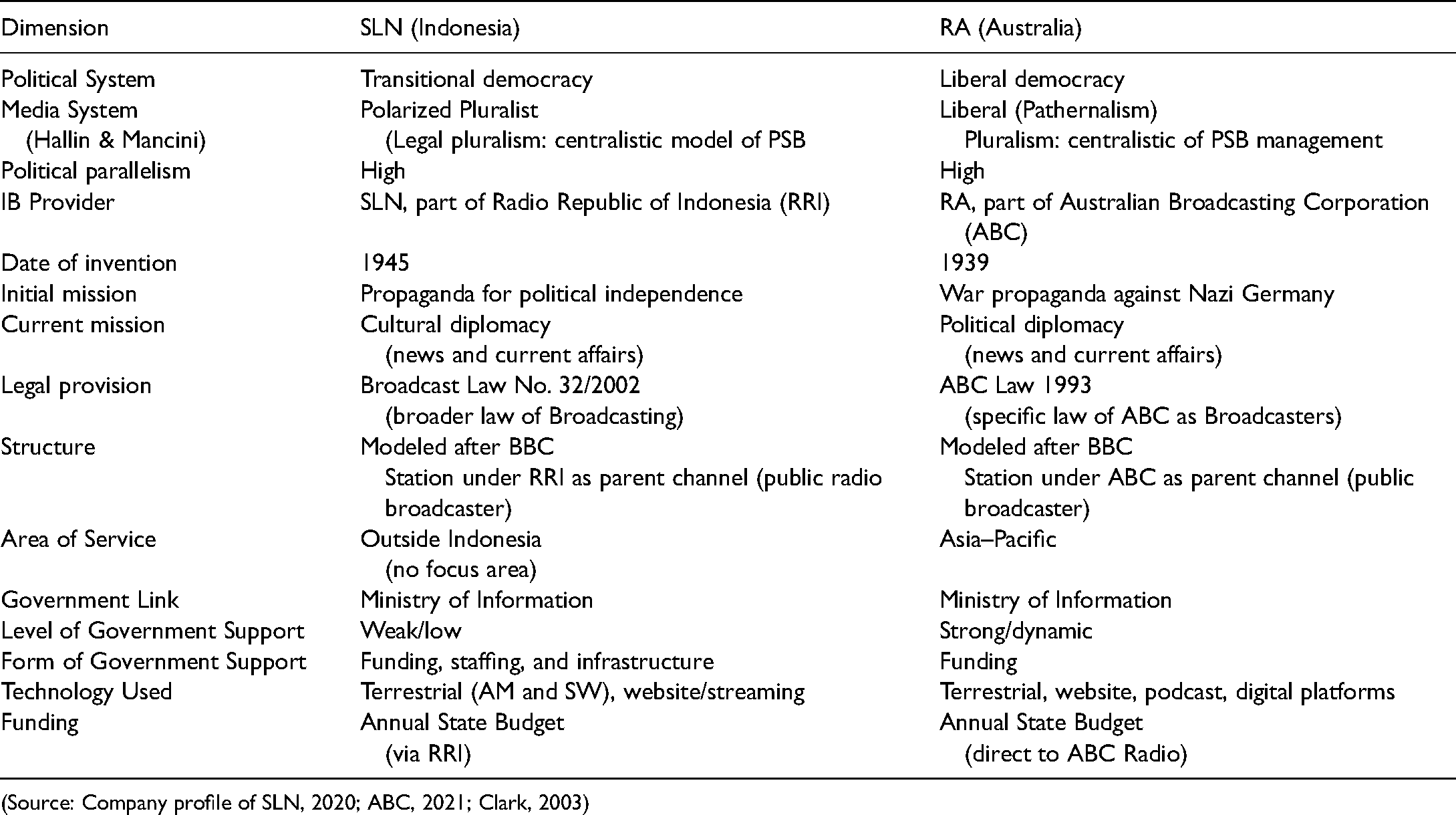
The below table compares the management models of SLN and RA (Table 2):
Comparison of SLN and RA.
(Source: Company profile of SLN, 2020; ABC, 2021; Clark, 2003)
The table shows that SLN and RA share similar historical roots and management (legal framework and governance). Both were partially modeled after BBC, though the latter has been better managed to promote the Australian diplomatic interests. Both IBs, likewise, have been heavily influenced by political parallelism (Hallin & Mancini, 2004). Despite sharing legal autonomy as public interest radio channels, SLN and RA have had different experiences with state supports—particularly in matters of funding and partnerships of public diplomacy for delivering content to international publics.
The SLN and RA models reflect the diversity of broadcast systems in Asia and the Pacific. With reference to the three models offered by Hallin and Mancini (2004), the author sees that SLN occupies a unique position that reflects the overall Indonesian media system. On one hand, the absence of state support for SLN's public diplomacy fits with the country's introduction of a free-market media policy. On the other hand, SLN's paternalistic working culture remains rooted in Suharto-era autocratic politics (Masduki, 2020). The broadcaster continues to prioritize state officers as key references in translating its public diplomacy, instead of referring to the general public, and its strong interest in maintaining close ties with and loyalty to the ruling regime—the ‘father’ of the civil servants working at the channel—is embedded in SLN's written policies, including its vision and missions.
Within this climate, the author sees a trend towards mixing the polarized pluralist and liberal models (Hallin & Mancini, 2004). Indonesian government policies have favored private broadcasters, keeping political control for public broadcasters and creating space for commercial entrepreneurs. The strong market expansion encourages concentration of media ownership by investors having close relationship to the political power.
The Australian government, meanwhile, has applied what Hallin and Mancini (2004) categorize as a liberal media policy modeled after the United Kingdom. With this policy, RA enjoys its position as the country's sole IB, but still competes with commercial broadcasters that may replicate its international services. Digital platforms provide unlimited space for Australia's commercial broadcasters to serve as ‘unofficial’ IBs through active streams and podcasts that can be accessed by the international public. Although Australia's political and media systems trace their roots to the United Kingdom, they also refer to the United States’ “early democratization and highly professionalized information-based journalism and private media structure” (Jiang, 2021). Australia thus has a blended design that combines UK-style public broadcasting, including the ABC and RA, with “US-style of favoring the massive commercial networks.” With this policy direction, the Australian government has sought to privatize the RA television network. At present, Australia has the highest concentration of commercial media ownership, particularly in print media (Jiang, 2021).
Conclusion
This study has shown the continued presence of IBs in Indonesia and Australia as tools of public diplomacy. To encourage their mission, SLN and RA (these countries’ IBs) share a legal position as autonomous public radio broadcasters and serve to voice the agendas and viewpoints of their political backers. However, these broadcasters have experienced different media systems and government support frameworks. The weak position of SLN reflects the Indonesian media system's transition from autocracy to democracy, creating a hybrid media system (Voltmer, 2013) that blends autocratic and democratic media performance. RA, meanwhile, has benefitted from Australia's mature democracy and maintained a strategic position alongside commercial broadcasters. Furthermore, this paper supports the argument proposed by Toula (2017) that SLN's performance reflects management factors that can be traced to its colonial and authoritarian legacy.
Overall, this paper supports Hallin and Mancini’s (2004) argument regarding the politics of broadcasting. The cases of Indonesia and Australia confirm that political parallelism is evident in broadcasters’ legal and ownership statuses, and that political systems determine the sustainability of IBs. SLN and RA represent two models of IBs within two different countries. Both are modeled after the BBC as autonomous public radio, yet have different experiences with state funding and policy. Tracing their historical roots to the colonial, World War II, and post-colonial eras, both IBs have experienced government control and autonomy while simultaneously becoming core elements of public diplomacy. In this climate, they have over time copied BBC and VOA, embracing two distinct state intervention and management models.
These findings also support the argument that the evolution of international public diplomacy (its concept and application) has determined the nature of Indonesian and Australian IBs (O’Keeffe and Oliver, 2010). In particular, this paper shows that IBs have shifted in their orientation. In World War II, they functioned as war propaganda (Risso, 2013), using radio as their sole medium. By the end of the colonial and Cold War eras, however, they functioned as tools of development and media of cultural diplomacy. New technologies have also been embraced, with broadcasters beginning to use television and internet platforms. Politics, thus, have significantly affected the evolution of international broadcasters. This study finds that Indonesia and Australian IBs have shifted away from hard diplomacy (i.e. political propaganda) to soft diplomacy (i.e. cultural publication) and have experienced different levels of partnership with authorities.
Presently, with unstable political climates and the rapid advances in internet technology, SLN and RA are at a crossroads. The free market has facilitated the rapid rise of digital media competition, wherein a wide range of other platforms (analog and digital) can supply video, text, and audio content to global audiences—including commercial and community broadcasters. Publics use media in distinctive ways, and the plethora of available news platforms has drawn attention away from analog IBs. Although it can be said that SLN and RA have remained relevant as key players in Indonesian and Australian efforts to promote their interests internationally, these broadcasters—existing within different legal protections and political climates—have reached different destinations. SLN cannot guarantee its sustainability, while RA has been more stable. SLN thus requires managerial reform and full partnership with the Ministry of Foreign Affairs, perhaps referring to the experiences of RA and BBC. Similarly, to ensure their sustainability, both broadcasters must maintain their autonomy while simultaneously providing accurate and balanced international news.
Footnotes
Acknowledgment
I am sincerely thankful to Hangga Fathana (Department of International Relations, Universitas Islam Indonesia, Yogyakarta) for his engagement to this research around 2020 and for his invaluable insights on Indonesian public diplomacy that enriched this paper.
Declaration of Conflicting Interests
The author(s) declared no potential conflicts of interest with respect to the research, authorship, and/or publication of this article.
Funding
The author(s) received no financial support for the research, authorship, and/or publication of this article.
