



Abstract
The 1891 International Electrotechnical Exhibition in Frankfurt am Main displayed a wide range of technological inventions and advancements from around the world. Inspired by the big world fairs, organisers staged spectacular arrangements of exhibits and technological inventions combined with theatrical entertainment. This article will take as its focus a specific performative aspect of a water spectacle, called ‘Tatzelwurm’ – a fantastical environment inspired by the poem ‘Zum feurigen Tatzelwurm’ by German novelist Joseph von Scheffel, which was dedicated to a Bavarian tavern on top of a waterfall. Repurposed to depict the power of steam engines within the context of the Electrotechnical Exhibition, this tavern was built on an artificial rock above an electrically powered waterfall. Besides the interplay between new inventions and theatricality in the nineteenth century, the article focuses on the ecology of this scenery. The exhibition actually cost more money to build than it ever earned back in visitor revenue. Using Alfons Paquet's concept of Schauwert (value of aesthetic experience) and Joseph Pine/James Gilmore's concept of the Experience Economy I will illustrate that theatrical environments produce their own value on aesthetic terms.
The nineteenth century brought us so many significant discoveries and advancements in the field of applied sciences and in our way of life […] It is with an uplifting feeling that we witness, as it approaches its end, the significant result of the harnessing of electricity by human culture. The spark that Volta's ingenious mind wrested from the hesitant metal is transformed into an arc of light, which not only illuminates the darkness of the past but also lights the way through the shoreless seas of the future.
1
In this article, I will analyse one of these theatrical strategies by focusing on a fantastical environment inspired by the German Tatzelwurm myth and the Bavarian tavern and waterfall of the same name. Repurposed to depict the power of steam engines, this tavern was recreated on an artificial rock above an electrically powered waterfall in a central position of the exhibition fairground. The main claim of this article is to answer the following two questions by combining historical material and contemporary theorisation: Why did the organisers especially choose this narrative with which to confront visitors with electricity? And why did they decide on a theatrical environment rather than some other form of display, such as a painting or some other two-dimensional representation? There seems to have been a necessity or, at least, a desire for theatrical methods, which I will explore in the following pages and which provides a useful perspective on the interplay between new inventions and theatricality in the nineteenth century.
The first section introduces the myth of the Tatzelwurm. In the second section, I add some background information on the city of Frankfurt, which has been an important location throughout German history. In hosting this specific exhibition, the city tried (and managed) to regain its traditional status. The third section is dedicated to the re-built Tatzelwurm-Scenery and its detailed design, which leads to a discussion of the sublime and mythology. In the final section, I consider the theoretical concepts of experience, vision, and sensation in relation to the historical example of the Tatzelwurm Scenery. I also want to think about this episode through the lens of theatricality. 4 With this application of contemporary theory, I hope to provide new insights into the experience of the nineteenth-century exhibition visitor.
Tatzelwurm I – Origins
On the 15 August 1863, the German farmer Simmerl Schweinsteiger celebrated the opening of his mountain tavern Zum feurigen Tatzelwurm in Oberaudorf, Upper Bavaria. The name of his guesthouse referred to an impressive waterfall located close to the venue's backyard. A mystical creature called Tatzelwurm (clawed worm) was believed to live at the base of the waterfall, the Gumpei Gorge. On the occasion of the tavern's opening, court painter August Vischer (1821–98) drew a painting of this beast, in which he depicted the Tatzelwurm as a dragon-like monster (Figure 1). During the picture's solemn unveiling in the presence of illustrious and erudite guests, a poem by Joseph Victor von Scheffel (1826–86), a well-known nineteenth-century novelist, was recited, telling of the lore of the fabulous animal and its culinary predilection for hiking pilgrims and farmers from the mountain meadows.
5
The Tatzelwurm is a creature with origins in Germanic mythology, legend, and folklore. Its appearance is a hybrid of a dragon and a worm, with a catlike head and a spiked back. According to the legend, it lives in the mountains, especially in the Alpine areas of Switzerland, Germany, and Austria and is well known to alpine people, even though its name varies from valley to valley.
6
Sightings have been reported since the seventeenth century; yet while many respectable people swore that they have seen the Tatzelwurm with their own eyes, no one ever succeeded in capturing a specimen. Legend has it that the Tatzelwurm prefers dark places and can generally be found in burrows under rocks near waterfalls. Moreover, the Tatzelwurm is considered to be extremely dangerous: it exhales fire, its breath is poisonous, and if you disturb it while hiking, it will ‘knock you down and eat you’. In other words, the Tatzelwurm is a terrible, mountain-dwelling creature no one would want to encounter. To escape death, a young and innocent virgin must be sacrificed, unless some brave knight could be found who should have courage to encounter and kill the Tatzelwurm.
7
Vischer's painting still decorates the front door of the Bavarian Hotel Zum Feurigen Tatzlwurm (Oberaudorf, Germany). Source: Photo courtesy of the author.
Frankfurt and the International Electrotechnical Exhibition
Nearly thirty years after the ostentatious Tatzelwurm opening, the Bavarian engineer and director of the German Edison company Oskar von Miller (1855–1934) had the idea to recreate the idyllic mountainside tavern, including the Tatzelwurm myth, 260 miles away in the urban surrounding of Frankfurt am Main, the largest city in the German state of Hesse. At the time, Frankfurt, a large industrial city, was the complete opposite of a rural, unspoiled natural environment. Once one of the most important cities of the Holy Roman Empire (from 1562 kings and emperors were crowned in Frankfurt's Imperial Cathedral of Saint Bartholomew), Frankfurt continued to play an important role in the history of Germany, especially in the nineteenth century. After the Napoleonic Wars in 1815, Frankfurt entered the newly founded German Confederation and became the seat of its confederal parliament (Bundestag). In the aftermath of the March Revolution in 1848, Frankfurt became the seat of the first democratically elected German parliament (Frankfurter Nationalversammlung). Finally, the Treaty of Frankfurt marked the end of the Franco-Prussian War and therefore the founding of the German empire in 1871, when twenty-six formerly independent states (kingdoms, (grand-)duchies, principalities, hanseatic cities, and one imperial territory) merged into the German nation state.
Keeping this in mind, it comes as no surprise that in this very city, the history-charged Frankfurt, the International Electrotechnical Exhibition took place, organised and technically managed by Oskar von Miller and held on the grounds of the old Western Railway Station from 16 May to 19 October 1891. 8 The exhibition displayed a wide range of technological inventions and advancements from around the world and was pivotal in incentivising and documenting the arrival of electricity in Europe. At this time, Thomas Edison (1847–1931) had already established the first electric supplier and saw a market for a system that could bring electric lighting directly into people's homes. His concept was based on the idea of direct current (DC), whereas Edison's employee Nikola Tesla (1856–1943) recommended the concept of alternating current (AC). Edison insisted that DC was superior and, more importantly, safer, because it would maintain a lower voltage when supplied to consumers. Tesla's concept of AC allowed the transmission of massive quantities of energy – as was required by large cities and industry hubs – over many miles. Like experts and electricity companies, Frankfurt's city council paid close attention to this controversy, which is today known as the ‘War of Currents’. Liberal politician and publisher/editor of Frankfurt's City Newspaper Leopold Sonnemann (1831–1909) proposed a specialised exhibition ‘to solve nothing less’ 9 than this competition between the different systems. The contest was decided through the first-ever long-distance transmission of AC current between Lauffen am Neckar and Frankfurt, covering a total distance of over 108 miles – a distance never before attempted. 10 The produced electricity powered an artificial waterfall and at the same time fed a thousand light bulbs of a large AEG (Allgemeine Elektricitäts-Gesellschaft, general electricity company) advertising sign at the fairground's entrance. As a result, the AC concept was recognised as the most economical means of transmitting electrical energy.
Besides this historical and technical importance, the exhibition marked the beginning of a new stage in the character of industrial exhibitions, as amusement and entertainment gained in importance: one has to imagine the exhibition more like an amusement park than anything else. Prefiguring the aesthetics of Disneyland, but in a more plush and padded nineteenth-century version, the raw form of the machines was set into an environment that was otherwise all fake and kitsch: a hill of concrete, artificial waterfalls and medieval castles made from wood, canvas and paint […].
11
Map of the International Electrotechnical Exhibition Frankfurt a.M. by Karl L. Schwalbach, 1891. Source: Reproduced courtesy of Theaterwissenschaftliche Sammlung, University of Cologne (HS21229).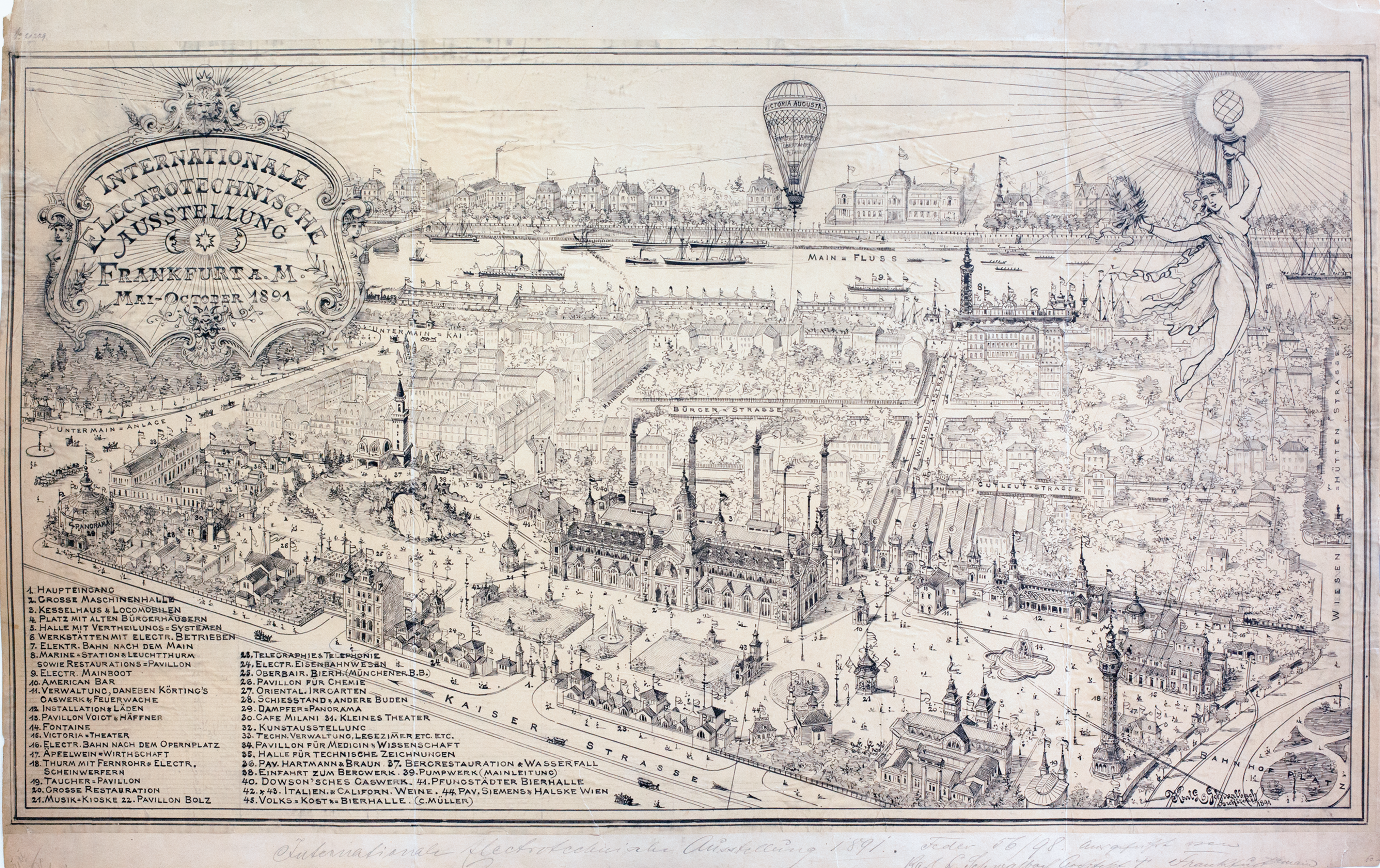
Moreover, electricity was not only depicted on stage, but also installed there in the form of technical equipment: ‘Electricity transformed the theatre like no other art form because, unlike the other arts, the theatre actually made use of it.’
16
The purpose-built and ephemeral Victoria theatre, a wooden building in Renaissance-style architecture also located at the east entrance, featured state-of-the-art stage technology and theatre lightning. The leading stage technician of this era, Carl Lautenschläger (1843–1906), equipped the Victoria theatre with the latest innovations in theatre technology: The theatre featured 3 hydraulic slots, 28 scenery hoists, a large horizontal machine for moving scenery, flying machinery, a pumping station for water features, a 60-cell storage battery, a light regulator for stage and auditorium illumination, stage-lightning equipped with separately controllable white green and red lights, and last, but not least, ventilation.
17
Tatzelwurm II – Afterlife
In addition to the ‘plain’ waterfall powered by the Lauffen-to-Frankfurt transmission, the exhibition was home to another artificial waterfall, which was supplemented with an artificial hill and a grotto in the west of the exhibition's fairground: the so-called Tatzelwurm-Scenery (Figure 3), a fantastical environment, which referred to the ‘real’ mountain tavern Zum feurigen Tatzlwurm and its impressive Tatzelwurm waterfalls.
18
The scenery imitated the Bavarian myth of the Tatzelwurm in the form of a walkable miniature theme park, including small boats on an artificial lake and a hiking trail that led to the tavern on the mountain's top. Repurposed to depict the invisible scientific achievement of electricity and the power of steam engines, the miniature alpine landscape was built around the machinery, including the Tatzelwurm itself, dwelling in the artificial grotto while facing a statue of a naked sacrificial girl. An exhibition visitor articulated his impressions: It seems to be a dragon with a crocodile's throat. Dreadfully, his armoured body twines around the columns of the artificial cave. In the water basin in front of this cave stands a naked, beautiful figure of the desperate Virgin representing the tribute, which the residents of the area offered the Tatzelwurm. One is looking instinctively for a knight or saviour who wrests the pretty woman from the threatening throat of the Tatzelwurm (Figure 4).
19
The Tatzelwurm Scenery during construction. Source: Reproduced courtesy of Theaterwissenschaftliche Sammlung, University of Cologne (HS19851). Newspaper illustration of the Tatzelwurm scenery by Emil Limmer.
19
Already appearing extremely romantic at daytime, the scenery drew a vast number of visitors at night, when the waterfall and the grotto are illuminated by electrical, coloured lights. Steam emerges out of the dragon's throat and glows like red embers. Green, blue, and red lights illuminate the waterfall and the pale body of the desperate virgin. And usually it is when the colours change that the audience erupts with joy and cheers.
20
(a,b) The Tatzelwurm Scenery, surrounded by both the exhibition's fairground and the city of Frankfurt. Source: Reproduced courtesy of Theaterwissenschaftliche Sammlung, University of Cologne (HS13687, HS13688).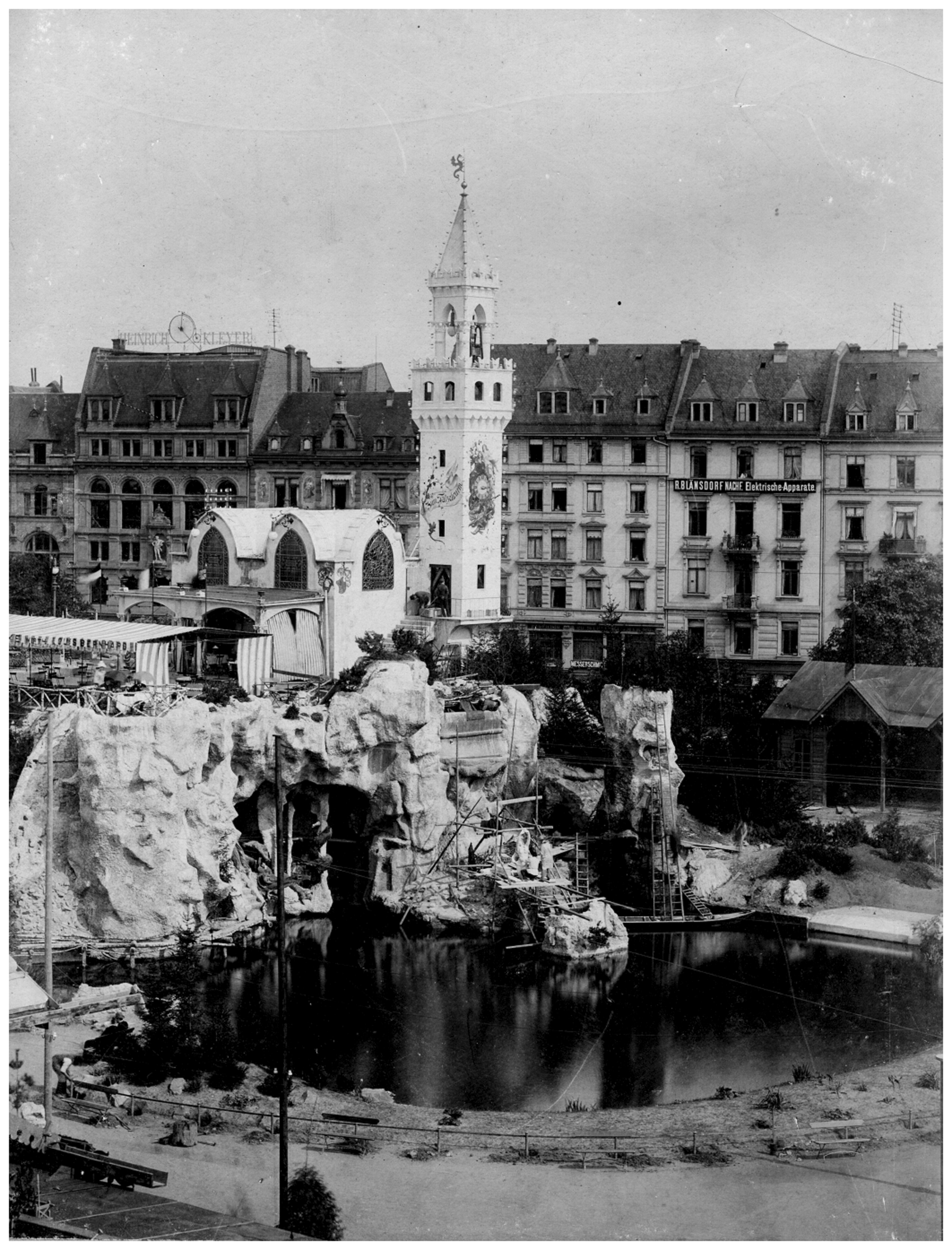


Myth and the Sublime
The scenery at the fairground can easily be placed in the greater context of nineteenth-century engagement with the sublime, which has been defined as an ‘expression of the unknowable’.
25
Eighteenth-century British writers used the aesthetic category of the sublime – as distinct from beauty – to describe aspects of nature such as impressive alpine areas. The sublime experience can be related to the romantic sensibility that is associated with the emotions one may feel in front of intense overwhelming phenomena like waterfalls. The Tatzelwurm scenery used this motif to suggest the sublime wilderness, but simultaneously demonstrated the capacity of technology to tame nature: ‘By demonstrating the subjugation of nature for production purposes, and at the same time celebrating a technology as an aesthetic […] the motorized waterfall becomes a memorial for an electrified future.’
26
Although the sublime first acquired currency in the eighteenth century, the nineteenth-century understanding of the term took on new meaning. In the second half of the nineteenth century, in particular, artistic representation of the sublime continued, for the most part, to reflect the ponderous, grave and divinely troubled values of the aspirant middle classes. […] The presentation of an infinite and potentially threatening vista is a danger we encounter figuratively, vicariously, in the pleasurable knowledge that we cannot actually be harmed.
27
Illustration depicting a mythical ‘alpine dragon’ with a ‘catlike face’. Jakob Scheuchzer, Ouresiphoites Helveticus, Sive Itinera per Helvetiœ Alpinas Regiones Facta, 1723, Illustration p. 385.
30
Source: Houghton Library, Harvard University (Swi 607.23).
Theatrical Environments and Places of Experience
Theatre scholars have described the nineteenth century as a ‘performing century’
32
and as a ‘theatrical age’.
33
Peter W. Marx has pointed out that theatricality and performativity in this era ‘became ubiquitous figures of thought’.
34
Drawing on this idea, I propose to read the Tatzelwurm scenery as a theatrical environment following the definition offered by Elisabeth Burns, who argues that theatricality is ‘a particular view point’ and a ‘mode of perception’.
35
Josette Féral extends Burns’ reflections in her essay La Théatralité: Recherche sur la Spécificité du langage théatral (1988) in which she defines theatricality as an intrinsic viewing-process that takes place between an observing subject and a presenting subject. Thus, is not only its spectacular aspect, that makes the Tatzelwurm Scenery a theatrical environment, it is also the manner in which the observers’ gaze and the multifaceted viewpoints are implicated in the whole scenery. Theatre and theatricality in this sense work as ‘dispositive [sic] of seeing and being made to appear’:
36
Theatricality […] is an act of representation, the construction of a fiction. As such, theatricality is the imbrication of fiction and representation in an ‘other’ space in which the observer and the observed are brought face to face. Of all the arts, the theatre is best suited to this sort of experimentation.
37
Looking into the aesthetics and the materiality of the Tatzelwurm scenery is essential at this point, especially for an exhibition piece that is essentially non-productive. In his study Das Ausstellungsproblem in der Volkswirtschaft (1908), the German economist and, later, dramatist Alfons Paquet considers the economic question of why so much money was spent on exhibitions in this period, despite the fact that there was little material or economic output. The exhibitions actually cost more money to build than they ever earned back in visitor revenue. This aspect also refers to the world exhibitions’ habit of incorporating sites ‘that became iconic, yet of little practical value’, 38 like the Crystal Palace in London or the Eiffel Tower in Paris. Paquet argues that the economic categories of value – and here he is drawing a Marxist distinction between exchange value and use value – should be expanded ‘to include the value of the presentation or Schauwert [sensation]’. 39 Paquet's concept includes the staging of objects in the context of an exhibition and asks us to place a value on aesthetic experience. The material value of an object is estimated by the observer through a consideration of its outward appearance. This ‘feature of visibility’ therefore is pivotal in terms of production, distribution, and consumption. It produces its own value, its aesthetic value. Furthermore, in economic terms, this aesthetic value takes on an even greater significance. During the industrial era, machines became more and more complicated. Thus, the sensual and aesthetic experience of an engine in action was seen as necessary to comprehend its function and significance. Technology obtains legitimacy here ‘not only by being represented but by the way in which it is represented, by the way in which it lets things appear, puts them on display and opens up a way to look at them’. 40
Thinking about experiences in terms of economic categories leads to Joseph Pines and James Gilmore's study The Experience Economy (1999), in which they conceive of experience as the fourth economic sector, next to commodities, goods, and services.
41
In contrast to the other sectors, experience is memorable because it can bind a visitor to an event and connect individuals to their environment. Following Pine and Gilmore, we might think about experiences in two dimensions (Figure 7). The first dimension, on the horizontal axis, corresponds to the level of the visitors' participation. Either there is a passive participation, in which the exhibition visitor does not directly affect the performance, or there is an active participation, in which the visitor personally influences the performance: you are either only a spectator of the Tatzelwurm, taking a seat in front of the scenery, or you create your own experience by taking the hiking trail or a boat. The latter changes the visitor's position: on the one hand, the spectator becomes an explorer. On the other hand, the passive spectator could recognise the active explorer as part of the performance as actors on the Tatzelwurm stage. However, the spectator who becomes an explorer can also be described as what Robin Nelson calls experiencer, a term which serves where audience or even ‘spect-actor’ (Boal) prove inadequate. It suggests a more immersive engagement in which the principles of composition of the piece create an environment designed to elicit a broadly visceral, sensual encounter, as distinct from conventional theatrical, concert or art gallery architectures which are constructed to draw primarily upon one of the sense organs – eyes (spectator) or ears (audience).
42
The Four Realms of Experience. Source: Adapted from Pine and Gilmore (1998).
The intermingling of the dimensions of immersion and absorption as well as anticipation and participation defines the four realms of an experience: entertainment, educational, escapist, and aesthetic, all of which can be found in the Tatzelwurm scenery. The educational sphere involves the spectators and increases their knowledge about new technologies, especially electricity. Visitors could actually participate in the performance by occupying the simulated environment. They could escape reality by taking a walk in the Bavarian Alps or boating on an idyllic lake – even though they were escaping, people were not escaping a place; they rather travelled to a special place that formed a stark contrast to the urban city of Frankfurt. And regardless of whether the spectator was part of the scenery or not, she or he was always exposed to an aesthetic pleasure while enjoying the picturesque landscape of rural Bavaria.
The spheres of experience also indicate what Baz Kershaw calls theatrical environment. While he deploys the term theatre ecology for referring ‘to the interrelationships of all factors of particular theatrical systems,’
46
Kershaw focuses on the impact of the spectator's movements. They are, he writes, performed by environment. In this case, I could argue that spectators were made to act in this or that way by the environment of the Tatzelwurm scenery. Thus, the theatrical environment only emerges in the course of the spectator's movement and performance. This relates as well to Erika Fischer-Lichte's concept of the performative space: By ‘performative space’ I mean a space as it comes into being when people – or animals – move in and through it. While the architectural-geometrical space in which a performance takes place is more or less stable, the performative space changes with each movement of an actor, an animal, an object, the light, with each change of the light, with each sound ringing out.
47
Conclusion
While the nineteenth century is today considered to be the era of world's fairs, historians have primarily focused on Britain's Great Exhibition in 1851 as a starting point, followed by the two ‘big’ exhibitions in Paris (Exposition universelle, 1889) and Chicago (World's Columbian Exposition, 1893). Germany, however, had never been a host of a world fair until the year 2000 in Hannover. Yet historians have tended to overlook some of the smaller industrial exhibitions hosted by German cities, which were designed to mark their emergence onto the international stage. Frankfurt am Main, which has been Germany's trade fair centre since the Middle Ages owing to its well-situated geographical location, is such a city. Here, several industrial and commercial exhibitions were held annually, such as the International Patent and Copyright Exhibition (1881), the Roses, Flowers and Plants Exhibition (1879), the Beer Brewers Exhibition (1876), or the Art of Cooking Exhibition (1894). All of these exhibitions had something in common: their organisers shared a desire for spectacular display, which combined new inventions with theatrical entertainment. The exhibitions’ staging techniques of imparting knowledge, the kind of presentation of art and technology, is deeply revealing about the cultural condition of that era. 50 As Peter W. Marx has pointed out: ‘Theatre in this period is an art form that represents but also provides a social scene that catalyses and transmits concepts of social behaviour, political ideas, consumption habits and new technologies […].’ 51 Theatricality, in this sense, functions as a vehicle for social acceptance or as ‘an active propagator – in putting these technologies to the test […]’, 52 and this might be the reason the exhibition organisers made use of theatrical strategies to promote electricity. Both the narrative of the Tatzelwurm myth and the historicising mise en scène of new and modern technology supported this idea: the anti-modern aesthetic seems like a wrapper, a traditional style employed to conceal the signs of modernity. Likewise, the exhibition architecture was designed in a historicising style, the entirety visualised as a journey back in time to the ‘good old days’.
Also, the constitutive role of spectators, transformed the moment they themselves become part of the scenery, undergirds the idea of theatricality as a vehicle for social acceptance. The spectator of the Tatzelwurm Scenery was no longer merely an observer, and his or her purpose was no longer to understand the representation of reality but, instead, to create his or her own reality. 53 According to contemporaries, it was this change of perspective that left an impression on the visitor's mind: experiencing the new technology physically first-hand – by taking an electric cruise on the river Main, joining a virtual cruise in the panorama, taking the electric elevator, taking a phone call out of the captive balloon, or reflecting about the future opportunities and risks posed by electricity by observing or experiencing the Tatzelwurm scenery. As Sophie Nield has pointed out, ‘[t]he theatre, as always through its history, found itself intimately connected with particular nexuses of wider cultural change.’ 54 Notably, the ‘exhibition complex’, to quote Tony Bennett, deals with this cultural change by presenting and staging objects in a theatrical manner. By doing this, nineteenth-century exhibitions served as ‘social field[s] of experience’. 55 Using the wild forces of waterpower, the exhibition's organisers made clear that this power had only become useable as electrical force transmission was made possible. Waterpower furthermore allows the transport of power over long distances. Spatial distance became unimportant – electricity created ‘temporal proximity, dismantling the local materiality and transferring it in the form of energy to an urban space where it became an object for spectacular consumption’. 56
Finally, I believe that the exhibition used this mythical story as a way both to ignite and to circumvent public discussion about the positive and negative attributes of new technology. By reflecting on Blumenberg's understanding of myth and Paquet's theory of the value of presentation, I have argued that the exhibition used the metaphor of the Tatzelwurm as a means to encourage the public's acceptance of new technology. Finally, I have demonstrated the complex relationship between theatre, society, new media, and the environment and shown how experience connects the visitors to new technology by performing the environment.