



Abstract
In the early years of the twentieth century, cinema joined the multitude of images (such as paintings, photographs, and engravings) which were spreading worldwide postcard stereotypes of Naples and its surrounds. The icons of this topographical myth included the natural beauties of the region and the monuments of the city, but also the citizens themselves. In fact, from macaroni eaters to tarantella dancers and brigands, they were an essential part of the urban landscape. This paper especially focuses on the Neapolitan tarantella dance and its local variants in silent cinema, examining how they were strictly linked to the city and its environs.
Introduction
In the early years of the twentieth century, cinema joined the multitude of images (such as paintings, photographs, and engravings), which were spreading worldwide postcard stereotypes of Naples and its surrounds. The Pathé catalogue (1896–1914), for instance, listed several views of this topographic theme, including Excursion en Italie: de Naples au Vesuve (1904), Naples Pittoresque (1909), and Une Ville Romaine, Pompei (1913). The icons of this topographical myth were the eruptions of Vesuvius, the typical streets and monuments of the city, and the ruins of Pompeii. No less important, however, were the Neapolitan citizens, who were given a fundamental role in the promotion of the city worldwide. From macaroni eaters to tarantella dancers and brigands, they were an essential part of the urban landscape.
This paper focuses in particular on tarantella dance and its local variants (i.e. within the Campania region), showing how strictly they were linked to the urban fabric and its environs. In samples of this cinematographic production, one can quickly observe certain recurrent elements, such as the Sorrento setting, the traditional costumes, the scenery where the dance took place (generally an open space), the presence of a tambourine, and the circular disposition of the dancing couples. 1
Nonetheless, there are also some distinctive elements that demonstrate the existence of local variants of the true tarantella dance and its sister, the tammurriata. This distinction arises in nineteenth-century Naples and its locale. Furthermore, the Neapolitan folkloric topos – as a consequence of the archaeological excavations of Herculaneum and Pompeii – brought tarantella also in ballets of the early nineteenth century, either to convey the Neapolitan local colour or as a mere divertissement. Cinema also incorporated this peculiar use of the tarantella, through the pioneering works by Peter Elfelt and Alexander Shiryaev. Later, in Lois Weber’s famous adaptation of Daniel Auber’s grand opéra, La Muette de Portici, the tarantella was cleverly used to foreground Naples as a locale while at the same time engaging a broad American public. As I will explain below, in Weber’s work the tarantella is at once exotic, nostalgic, and balletic; it is a dance that emerges within a specific city yet which is flexible and inclusive in terms of audience appeal.
One of the first elements to be considered in the study of dance in silent cinema is its relation to the music. As is well known, a wide range of sounds actually characterised ‘silent’ film screenings. There would typically be a pianist or (depending on the venue) even an entire orchestra to accompany the exhibition. Some had ‘effects’ players and machines, or, for earlier films, a speaker explaining the images, not to mention sync-sound experimental apparatuses. Music for film screenings could be improvised or predetermined, either as a score ad hoc, or as a cue sheet, featuring a selection of pre-existing tunes. 2 Furthermore, there were often musicians on the film set during the shooting, to help actors find the right mood, or to set the rhythm for choreographic scenes. 3 In most cases, even where no detailed information survives, it is possible to make reasonable suppositions about the music which accompanied the filming or screening. 4
Tarantella in dal vero Films
The dal vero film was a cinematic form of sight-seeing in the early twentieth century, and it played a major role in popularising the association of Naples with the tarantella. Tarantella was the subject of two dal vero films produced in Italy – Tarantella (prod. Ambrosio, 1906) and Tarantella sorrentina (prod. Fratelli Troncone, 1907) – along with two foreign productions entitled Neapolitan Dance at the Ancient Forum of Pompeii and The Tarantella, an Italian Dance (both produced by Mutoscope and Biograph Syndicate, London, 1898).
The two Biograph films present the same documentary-style scheme, with minimal variations: a small group of men and women wearing traditional costumes perform a tarantella before the camera. The point of view is frontal and static and the scene filmed outdoors, in the courtyard of an ancient building. At first glance, the costumes and the dancers’ movements visible in these two films correspond to those described in the captions accompanying the famous illustrations by Gaetano Dura, whose first edition of tarantella prints dates back to 1834. 5
Despite the title of one of the Biograph views, the word tarantella is not of Neapolitan origin. In fact, it is named after the original European tarantula spider (or Lycosa tarantula), whose bite, according to folklore, was said to cause (or possibly be cured by) a frenzied ‘possession’ ritual called the tarantismo, characterised by its peculiar dance. The spider’s name, and the dance that was first called tarantella, come not from Naples but from the Apulian city of Taranto, founded in the eighth century BC (Τάρας in Ancient Greek, Tarentum in Latin). Since the nineteenth century, this Apulian dance has also been known as the pizzica, from the word pizzico – the bite of the tarantula. 6
The tarantella of Naples differs in origin, choreographic form, and meaning from the therapeutic tarantella/pizzica of Apulia. It is a couple dance that represents a courtship, and it is also popular in other regions of Central and Southern Italy, especially in Campania. 7 A further distinction between the Apulian dance and the Neapolitan one resides in the rhythm of their music (one time signature is binary, the other ternary): a difference that Athanasius Kircher noted in seventeenth century. 8
According to Renato Penna,
9
the fusion between the two variants of folk dance under the name of tarantella happened around 1640. Roberto De Simone affirms that this duality is in itself characteristic of Neapolitan tarantella, where two main forms coexist: the possession dance and the erotic dance.
10
Given the Neapolitan setting and the pace of the dance, we would not expect to find the true Apulian version in the above-mentioned Biograph films. Closer examination confirms this and proves that the films depict two distinct dances in the Neapolitan tradition.
11
In Neapolitan Dance at the Ancient Forum of Pompeii,
12
the choreography is so chaotic that it is hard even to establish whether men and women are dancing as couples or individually. The featured dance might, in fact, be the so-called tammurriata: a peculiar form of the Neapolitan tarantella family, whose name derives from tammorra, a kind of wide tambourine traditionally used to accompany this dance. Unlike the regular Neapolitan tarantella, the tammurriata is performed to a binary rhythm, not a ternary one. Steps and movements are those typical of peasants’ everyday life: the symbolic gestures of the arms recall the sowing and the harvesting, though the dance itself is a choreographic tale usually danced during religious devotional celebrations, thus mixing the sacred and profane. In fact, while the gestures draw on ancestral rituals of soil fertility, the performance of the dance has been incorporated into the Catholic celebrations linked to the local sanctuaries. The choreographed tale might narrate various stories, depending on the composition of the dancing couples: typically it is a romantic (or rather an erotic) tale if there are man–woman couples, or a challenge dance in case of same-sex couples, although in my opinion this does not exclude homoerotic nuances.
13
At one point, the moment named votata, the rhythm becomes more hectic (it changes to one beat per bar) and the performers form couples to dance certain figures, though these couples can be broken at any time by other dancers. In the case of this particular film, the presence of a tammorra player (on the right side of the frame), the mixture of the couples (sometimes same-sex, sometimes not), and the presence of castanets and handkerchiefs as scene objects indicate that this specific choreography is that of a tammurriata, and most likely a challenge tale (see Figure 1).
14
A still from Neapolitan Dance at the Ancient Forum of Pompeii (1898). Source: Courtesy of Eye Filmmuseum.
In The Tarantella, an Italian Dance,
15
the choreography is tidier: some man–woman couples dance in the background of a few musicians, who play a greater variety of instruments (a regular tambourine, a special guitar called chitarra battente, and two triccheballacche).
16
In addition, the dancers play percussion instruments (tambourines and castanets) while performing. These were typical instruments of the Campania region and especially of tarantella music, while the lack of the tammorra marks a significant difference to the Pompeii dance. The ensemble is divided spatially by a marble bust at the centre of the background (see Figure 2): the statue evokes the ancient courtyard that usually welcomed such choreographic rituals. The costumes of the performers are slightly different but still consistent with Dura’s drawings, which presented a variety of possible outfits. The movements of the dance consist of a few figures traced by the couples and several leaping turns accomplished by alternately raising one leg and one arm. The choreographic structure thus retraces the description proposed by Dura’s drawings and their captions.
A still from The Tarantella, an Italian Dance (1898). Source: Courtesy of Eye Filmmuseum.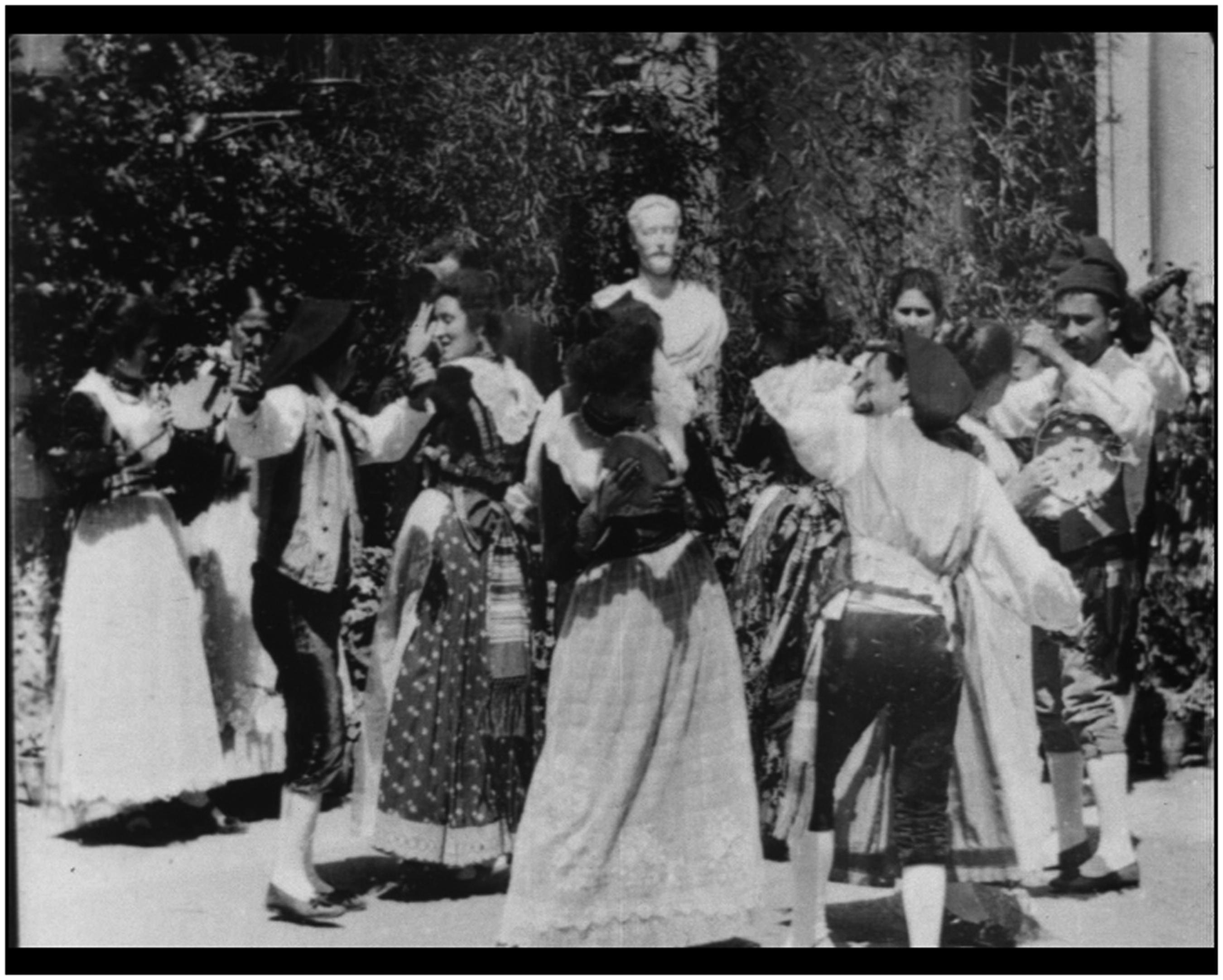
According to De Simone’s systematisation, the dance demonstrated in The Tarantella, an Italian Dance seems to be the romantic–erotic Neapolitan tarantella. On the other hand, the Neapolitan dance of Pompeii matches Cosimo Alberti’s description 17 of a tammurriata, as is suggested by the presence of the tammorra. Clearly, the primary aim of both Biograph views was to document a local tradition, in order to fascinate the foreign audience or at least the Italian immigrants. In this sense, despite its half-Apulian history, the tarantella is established as an icon of Naples: it plays exactly the same function as the monuments and natural attractions of Naples and surrounds, becoming part of the urban landscape itself. It is no wonder that the ancient forum is the same one shown in the Pathé view Une Ville Romaine, Pompei (1913), when the intertitle introduces ‘une porte de la ville’. 18
The same folkloric interest also animated Elvira Notari’s films: not only the features, but also her brief documentaries (now largely lost). 19 These were regularly requested and financed by Italian-Americans living in major US cities, where entire immigrant communities re-established their own villages between the second half of the nineteenth century and the 1930s. 20
Balletic tarantella and Melodrama
The Neapolitan folkloric topos, back in vogue thanks to the archaeological excavations of Herculaneum and Pompeii (around 1750), also brought tarantella into ballets of the nineteenth century to convey local colour. 21 These include Jean Coralli’s La Tarentule (1839), Jules Perrot’s Ondine ou La Naïade (1843), and August Bournonville’s Napoli (1842). 22 The latter was filmed in 1903 by the Danish director Peter Elfelt in his Tarantellen af Napoli (The Tarantella from Naples, 1903), starring the soloist dancers Hans Beck and Valborg Guldbrandsen. 23 The choreography was filmed in Elfelt’s studio where the set design replicated the theatrical staging on a smaller scale: a wooden stage and a painted backdrop. Analogously, the single shot (static and frontal) that constitutes the film imitates the point of view of the theatrical audience, as was usually the case for early cinema dal vero. 24 The choreography includes a mixture of sentimental-style tarantella and ballet steps for both dancers. 25
With the popular Neapolitan districts reduced to a painted backdrop, the dancers are disciplined and de-reified, effectively alienated from the folklife that the traditional dance intended to celebrate. In this way, tarantella and the film itself are deprived of the ‘shared memory’ value that the Biograph views could represent for the Italian emigrants. 26 The only traces of tarantella surviving in Elfelt’s film are the costumes and the citation of the heel-toe movement, whose function is to bring the Neapolitan local colour as background to the plot.
Absent from eighteenth-century melodramas, tarantella reappears in nineteenth-century musical drama as solo or group inserts. For instance, Daniel Auber inserted a tarantella in his grand opera La Muette de Portici, also known as Masaniello (1828). 27 This spectacle was later adapted for the screen by American director Lois Weber, with the title of The Dumb Girl of Portici. 28 This film is best known for starring the Russian ballerina Anna Pavlova, here in her first and only choreographic performance in a feature film. She did, in fact, dance for Douglas Fairbanks in a series of fragments filmed in 1924, but this short was never approved for public exhibition. 29
Set in seventeenth-century Naples, The Dumb Girl of Portici tells the story of Fenella, a speechless girl tragically involved in the popular revolt led by her brother Masaniello, against the Habsburg regime. The cinematic adaptation worked as a marvellous springboard for Anna Pavlova. In fact, as the shooting finished, she toured the US with a stage production of the opera, together with Boston Opera Company and the Ballets Russes. 30 This forged a sort of intermediality between the two different spectacles (on screen and on stage), of which both the American audience and Pavlova were most surely aware. 31 Concerning the adaptation of the text, ‘the action of the opera parallels the last third of the film, while the first two thirds show events that are only narrated in the opera’ 32 and – according to John Sweeney – presumably the opera score worked as the basis for the film score. 33 A consideration confirmed by the programme for the film screenings at Tally’s Broadway theatre: ‘the opera score will be used in its entirety’. 34
Dance is present in many scenes in The Dumb Girl of Portici, probably choreographed by Ivan Clustine, ballet master of Pavlova’s Company.
35
There are only three scenes, however, dedicated to tarantella. These are justified by the Neapolitan setting of the film, although it was in fact shot between Chicago and Los Angeles.
36
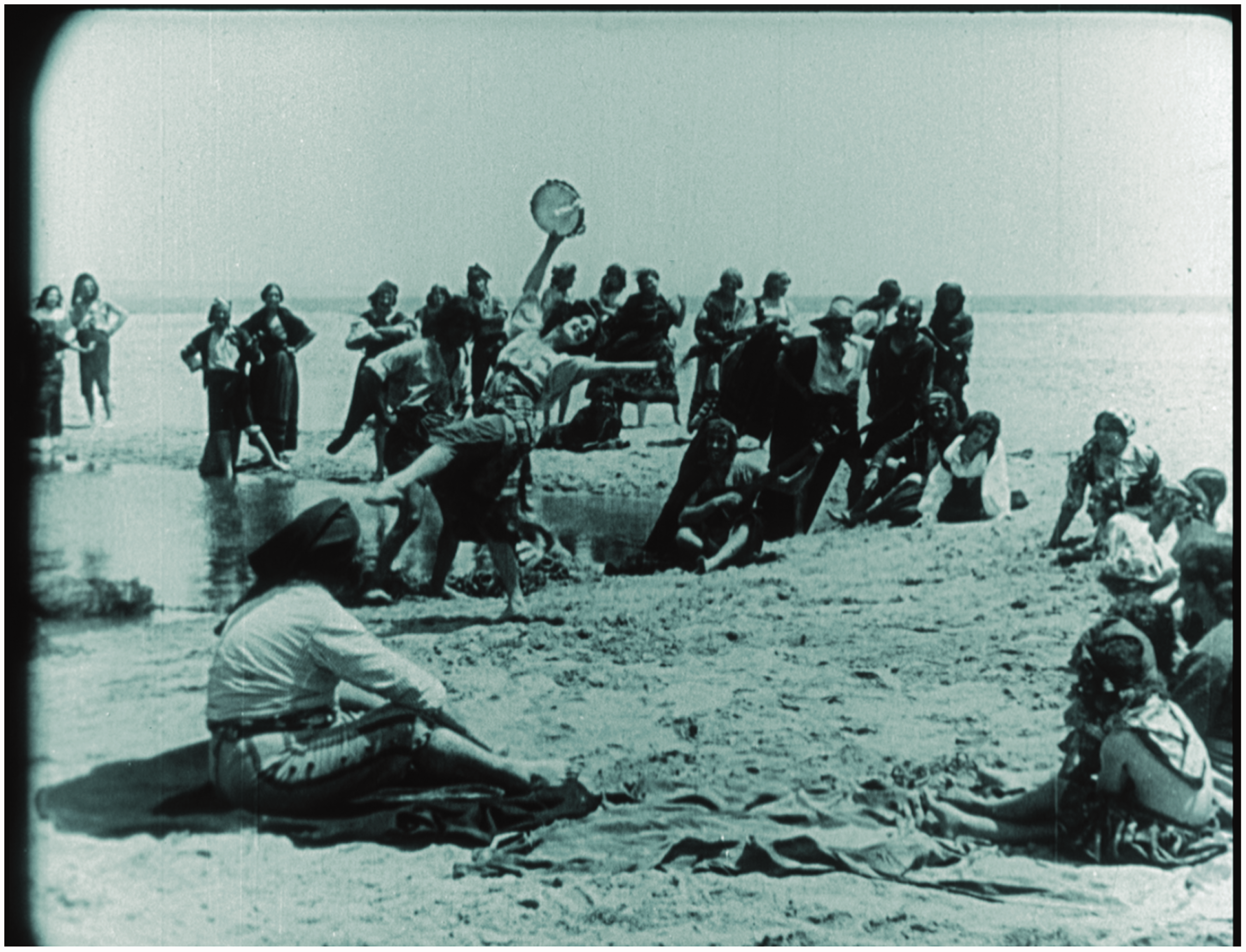
The first of these scenes is crucial to the diegetic representation of Fenella’s dance skills. We first see her through a cameo-frame, in which she lazily lays down on a boat, with a tambourine that predicts the type of dance that is to follow (see Figure 3). This scene takes place on a beach where Fenella (Anna Pavlova) joins her friends dancing, though she actually interrupts the flow of the ensemble dance to perform by herself (see Figure 4). Her solo is a mixture of tarantella steps (the basic jump-like step) and ballet, evident in the attitudes en relevé on the half pointe with the leg en arrière (bent backward) and the jetés (a type of small jump) accomplished by the dancer.
37
Anna Pavlova in The Dumb Girl of Portici (1916). Source: Courtesy of Milestone Films. Anna Pavlova in The Dumb Girl of Portici (1916). Source: Courtesy of Milestone Films.
In other words, Fenella’s character and her tarantella were adapted to Pavlova’s profile and ballet training, to exalt the dancer’s terpsichorean skills and fully exploit her diva potential. Essentially, the film – which was very successful in the US – was conceived by Carl Laemmle (president of Universal Pictures) as a star vehicle for Pavlova. As it turned out, the director Lois Weber received several positive reviews, while Pavlova’s acting was perceived by many as overloaded, exaggerated. 38 On the contrary, the imitative skills of the Russian ballerina were meant to shape the inner world of Fenella, as a mute character in a silent film. 39
Pavlova’s acting style did not derive from a misunderstood relationship with the camera, but rather from her ballet training. Dance and pantomime were indeed both the means of expression of the ballet d’action, the art in vogue between the second half of the eighteenth and the early nineteenth century, which later evolved into the romantic ballet that was part of Pavlova’s repertoire. For instance, before 1916, she performed in the leading roles of Giselle (1903), Le Corsaire (1904), The Sleeping Beauty (1908), and Le Papillon (1910). 40 Furthermore Pavlova had also studied under the guidance of Alexander Shiryaev (1867–1941), chief promoter of the interpolation of character dances within late nineteenth-century and early twentieth-century ballets. A member of the Russian Imperial Ballet of St Petersburg, between 1906 and 1909 he filmed the ballets staged at the Mariinsky Theater. Among those films is a Neapolitan Dance performed by Natalia Matveeva, dancing with a tambourine on a stage set en plein air. Presumably Matveeva’s variation was a Neapolitan tarantella, revisited through the ballet technique, in a similar manner to Bournonville’s ballet of 1842 – and to Pavlova’s dance in Lois Weber’s film. 41
The second tarantella scene in The Dumb Girl of Portici develops during the wedding party sequence. It is a group dance that takes place in the great hall of the Spanish viceroy’s palace. The public is placed in the background, functioning as a double to the audience in front of the screen (see Figure 5). Moreover, the presence of the real cinematic audience is evoked by the dancers’ body language: they perform towards the camera, instead of facing the ostensible spectators at their backs. The choreography is a collective dance in traditional costumes and includes the ubiquitous tambourine. However, at a closer look, we can see that – despite the resort to the basis of Neapolitan tarantella (as the dancing man–woman couples separate, mix, and reunite) – the complexity of the choreography, some of the steps and jumps, is drawn directly from the vocabulary of ballet. The overall impact is very suggestive and – following Giorgio Bertellini – it perfectly fits in the ‘Southernist poetic strategy’. This ‘tendency’ shaped the image of the Italian picturesque, which was very popular at the time in the United States, as the huge wave of Italian migrations towards America (c. 1860–1930) reached its peak.
42
A still from The Dumb Girl of Portici (1916). Source: Courtesy of Milestone Films.
The third tarantella scene is also the last dance of the movie. A banquet-orgy is taking place in the paroxysmal confusion created in the viceroy’s palace by Masaniello (who made it his headquarters) while a backwards tracking shot slowly reveals the general dissipation. The camera draws back as if threatened by the group of drunk Neapolitan commoners, who dance deliriously (see Figure 6). The scene is dominated by wine and madness: a pairing that recalls the ancient myth of the Bacchants, inverted into meaningless decadence. In fact, instead of a priestess whose madness allows her to access a higher dimension, we see in the orgy a common woman who degrades herself in the search for a self-destructive pleasure (since this pleasure is an end in itself and not a quest for higher knowledge). The movements and gestures are chaotic, although the tambourine and the jump-like steps remind us that this is still – pretentiously – a tarantella.
A still from The Dumb Girl of Portici (1916). Source: Courtesy of Milestone Films.
To understand the meaning of these group choreography scenes, we must take a step backward and consider them in light of the cinematic context and of the other ensemble dances of this film: to be exact, a choreography inspired by Ancient Greece along the lines of Isadora Duncan’s dance concept, and a scene of balletic flamenco. So conceived, the function of the dance scenes inside the movie is the same as the choreographic intermezzi of the tragédie lyrique, which emerged in the same era in which the film is set. 43 These were festive group scenes, purposely inserted within the text, which did not actively contribute to the development of the story. According to this reading, the dancing intermezzi, though superfluous for the plot, remain relevant since they serve to convey local colour: the Neapolitan setting, the Spanish viceroy court, the popular government’s intoxication of power.
Nevertheless, it is necessary to make a distinction among the divertissements linked to the tarantella: if the two ensemble tarantellas work as intermezzi, according to the sense we have established, the function of Pavlova’s tarantella solo is very different. 44 Her solo is conceptually linked to the balletic prologue and epilogue of the film, thus depicting a sort of visual synthesis of the artistic skills of the diva-dancer, able to move fluently between different choreographic registers. 45 In her dance we are not invited to consider the body of an ordinary woman, with whom the commoner could identify in person. We see instead rather the body of the diva who was at the same time performing in New York theatres, for the sophisticated pleasure of the bourgeois public. Pavlova’s presence functioned as the hypostasis of the picturesque for the consumption of the American public, but her performances had to fulfil its expectations at all levels – from the cultured taste for ballet to the proletarian desire for the exotic and the homesickness of the Italian immigrants – so as to attract as wide an (American) audience as possible. From this viewpoint, the fanciful and artificial Naples in which the story is set, from the slums to the beach, was meant to work as a ‘travelogue in absentia’ 46 for both American proletarians and Italian immigrants, though with different meanings: exotic for some, nostalgic for others. Pavlova’s tarantella, balletic though it may be, is in this sense fully a part of the Neapolitan urban landscape.
Footnotes
Acknowledgements
A special thanks to Eye Filmmuseum (Amsterdam) and Milestone Films for kindly providing images and documents.