




Abstract
Boucicault’s Octoroon was famously ‘adapted’ by the author in response to British audience’s discomfort with Zoe’s death in 1861. As it turns out, however, a play very similar to Boucicault’s appeared in England nearly a year before its British debut. The Quadroon; or, the Sun Picture (1860) is not simply an act of plagiarism, or even simply an adaptation of Boucicault’s play. Instead, it is a pastiche of the sources Boucicault drew on for his play, along with unmistakable elements of Boucicault’s – a kind of meta-adaptation. I focus on how The Quadroon incorporates The Octoroon’s use of photography and his sources for the idea of a camera capturing a murderer in the act. What emerges is a play that offers a different representation of the figure of the photographer, the dynamics of racial justice, and the dynamics of racial visuality. By focusing on the use of photography in The Octoroon, The Quadroon, and Branden Jacobs-Jenkins’s An Octoroon (2014), I explore more broadly how the spectacle of photographic technology on stage itself offers a self-reflexive commentary on melodramatic form and structure. Melodramas that stage photography both highlight the strange temporality of the tableau and ask us to think of photography as both a frozen image (a product) and kinetic act (a process and performance).
Keywords
Branden Jacobs-Jenkins’s Obie award-winning adaptation of Dion Boucicault’s Octoroon (2014) has bought renewed popular attention to the way Boucicault represents the raced body, desire, and antebellum law. 1 Boucicault’s play was itself famously ‘adapted’ by the author in response to British audiences’ discomfort with Zoe’s death; in 1861 he remarked that the new ending was ‘composed by the Public, and edited by the Author’. 2 As Verna Foster notes, ‘the history of The Octoroon was a history of adaptations made to suit different audiences’, and it continued to be adapted, changed, and re-staged throughout the nineteenth century. 3 Versions of the play appeared as far away as Australia even before British audiences had a chance to see (and disapprove of) Boucicault’s ‘original’. 4
But, as it turns out a play very similar to Boucicault’s involving a mixed-race woman with ambiguous legal status, an amorous scheming villain, and a photograph of a murder appeared in England nearly a year before its British debut at the Adelphi on 18 November 1861. Appearing on 8 December 1860 at the Surrey Theatre, The Quadroon; or, the Sun Picture is not simply an act of plagiarism, or even simply an adaptation of Boucicault’s play. Instead, it is a pastiche of the sources Boucicault drew on for his play, along with unmistakable elements of Boucicault’s – a kind of meta-adaptation. 5 As Sarah Meer has pointed out, Boucicault himself was so prolific an adapter of French plays, that by the time of his death his name was turned into a synonym for having plagiarised or pilfered. 6 And, at first sight, The Quadroon appears to have ‘Boucicaulted’ Boucicault. Yet The Quadroon offers a more attentive adaptation of one of The Octoroon’s most important sources – Mayne Reid’s novel The Quadroon; or A Lover’s Adventure in Louisiana (published in 1856), which was already being adapted for the stage in England before, during, and after Boucicault’s play, as this playbill from the Eastern Opera House, Pavilion Theatre shows (Figure 1). 7 Just as Reid’s novel ends with a coy reference to ‘the tranquil after-life’ of Edward and Aurore (the quadroon of the title), the play’s ending resembles the ending(s) Boucicault would ultimately offer in response to audience pressure – a happily united mixed-race couple and vigilante justice meted out by a figure from the racial and national margins. Of course, not even Boucicault’s happy ending is unique; he builds on earlier quadroon and octoroon plays from the 1840s and 1850s, many of which had happy endings. 8
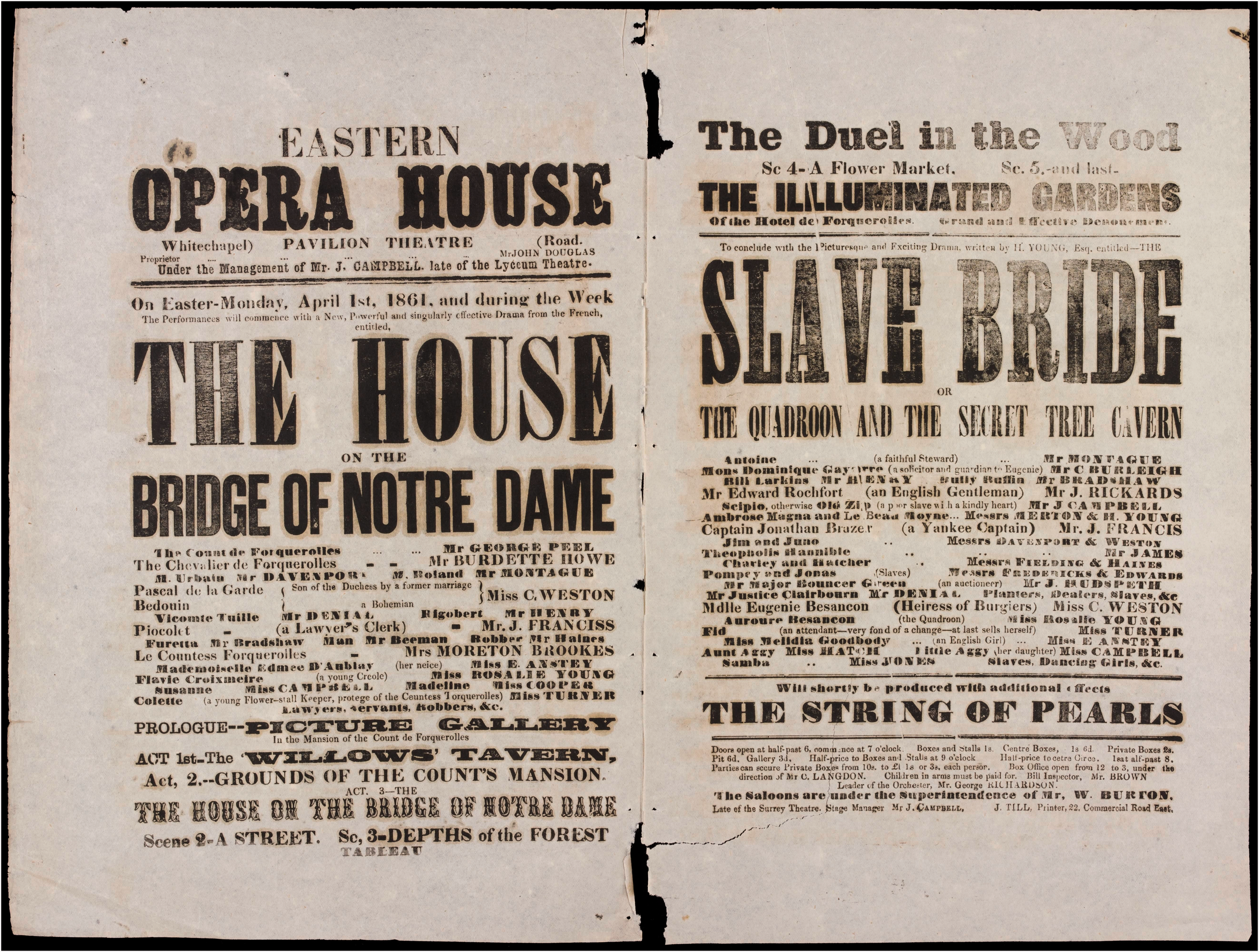
Playbill for the Eastern Opera House, Pavilion Theatre, advertising The Slave Bride; or, The Quadroon and the Secret Tree Cavern (April 1861) – an adaptation of Mayne Reid's novel The Quadroon. Source: © British Library Board (Mic.C.13137/Playbills 376).
This essay has a number of overlapping goals and approaches: uncovering a virtually unknown play, I use it to trace the intersecting influences on, and exerted by, Boucicault’s play, while correcting a common scholarly assumption about Boucicault’s source for his photographic plot; I explore how these adaptations reflect back on Boucicault’s representation of African American and Native American subjects and explore the intersection of photography, theatre, racial embodiment, and racial justice; I build on theoretical models of the relationship between photography and melodramatic form – especially the melodramatic tableaux – as well as between photography and theatre more generally; and, I think through the relationship between photography and adaptation in a number of ways – in broad theoretical terms, through The Quadroon’s reverse engineering of Boucicault’s sources, and through a short reading of Jacobs-Jenkins’s play. If, as Linda Hutcheon argues, the formal and hermeneutic condition of an adaptation is its explicitly ‘multilaminated’ intertextuality, Boucicault’s use of photography adds another layer to his multiple borrowings and to the way adaptations affect our understanding of the relationship between art and originality. 9 As Walter Benjamin argues, the advent of photography produced a challenge to a model of art based on auratic uniqueness and originality, transforming ‘the entire nature of art’. 10 If works were ‘designed for reproducibility’, it made no sense to differentiate the ‘original’ and the reproduction. 11 Just as adaptations are not simply reproductions of their source texts, photography is not simply a form of mindless copying. 12 As Jordan Bear has argued, photographers and their audience both shared ‘a recognition of photography’s fundamentally mediated status’. 13 On the one hand, photography created ‘the possibility for a new kind of simulation’. 14 On the other hand, even theories of photography’s fidelity and objectivity emphasise its capacity to defamiliarise. As Benjamin argues, photography ‘can bring out those aspects of the original that are unattainable to the naked eye yet accessible to the lens’. 15 Moreover, mechanical reproduction provided opportunities for new kinds of redeployment and re-contextualisation – for producing likeness without sameness – in other words, for adaptation. 16
It is fitting then that, like many of the other elements of Boucicault’s play, his use of photography was apparently borrowed. Photography had appeared on stage before The Octoroon, and as Tom Gunning has shown, a wide variety of works (from stage to screen) explore the idea of catching the ‘act of malefaction’ on camera. 17 Nevertheless, Victorian plays featuring photography as evidence are fairly rare. 18 Rather than borrow his dramatic technological plot device from the stage, according to biographers and critics, Boucicault used Albany de Grenier Fonblanque’s story ‘The Filibuster: A Story of Nicaragua’ as the inspiration for having the play’s crime caught on camera and a photograph ultimately expose the villain’s machinations. 19
Fonblanque’s ‘The Filibuster’ is set during the invasion and conquest of Nicaragua by the American William Walker’s private army in 1855 (a ‘filibuster’ was an unauthorised military campaign by private armies). 20 Despite this very specific historical frame, ‘The Filibuster’ focuses mostly on familiar melodramatic tropes of mysterious parentage, lovers separated, near executions, and villains exposed. Indeed, the narrator distances himself from the historical events noting that ‘It forms no part of my purpose, and is far from my desire, to become the chronicler of their campaign.’ 21 A quick summary: the story opens in the camp of the Filibusters, whose ruthless chief, Ramon De Mortas, is a former guerilla and pirate. One of the band, Lionel, is a loyal fighter until he is told by his ‘mother’ that he is really not her son and a native Nicaraguan. She had saved him from a burning house whose family was victimised by De Mortas’s band. The band has captured a Colonel Sartalli, who (as it turns out) is Lionel’s father and who recognises De Mortas as the man who sacked his house. The two struggle and De Mortas stabs Sartalli in the heart. ‘For a moment the combatants stood motionless’ and they are captured by the photographer (a correspondent for the ‘New York Thunderbolt’) who had wandered into the camp that day. Lionel rescues a young woman (an orphan adopted by Colonel Sartalli) named Emmeline, and along with the photographer, they flee to a nearby city. That city ends up being overtaken by De Mortas’s men and Lionel is taken captive. He arranges with a former comrade to shoot him (at the last stroke of midnight) at his prison window to save him from a dishonourable hanging. Emmeline manages to sneak in a file and rope. Surprised by De Mortas in the process of trying to escape, they trick him into standing in front of the window with the lamp at his heart at the stroke of midnight and he is shot. After some time convalescing at the house of what turns out to be Lionel’s sister (and Emmeline’s dear friend), the lovers are united. De Mortas returns, exposes Lionel as a former member of his band and accuses him of murdering Colonel Sartalli, but the photographer (Tinto) presents the photograph as evidence and De Mortas promptly expires.
If the circumstances in which the photograph is taken and used sounds familiar, it is because it presages quite closely Scudder’s own dramatic display of a photograph as proof, found just in time to exonerate the innocent and identify the murderer in The Octoroon. Even the language with which ‘The Filibuster’ frames photographic objectivity is similar: “Yes,” shouted the exultant little man—“a scene in the ruins that accidentally came into focus. I was taking a view of them deeming them deserted, when two men appeared struggling in the field of my lens. Only be quiet for one instant, said I, and I have you. They did pause for a moment, and—crack!—the thing was done. Look at those two faces—the handle of the knife in his hand,” pointing to De Mortas; “the blade in his heart,” pointing to the picture. “I saw the blow struck, and there—there, by God’s blessed light that cannot lie, it is recorded to condemn the guilty.”
22
And yet the story’s publication history suggests that the idea of wielding the photograph as proof of M’Closky’s guilt might have been Boucicault’s after all. Part 1, chapter 2 of ‘The Filibuster’ (published on 16 July 1859) ends by noting that a murder had been captured inadvertently by a camera: ‘His face would not have assumed so pleasant an expression had the Filibuster known that the lens of a photographic camera had been directed upon him for the last half hour, from a hill that overlooked the ruins.’
24
But, the story was interrupted at the end of July 1859 because of a change of management at the London Journal. Fonblanque only completed the story (including its use of a photograph to deliver justice) when it was published as part of a collection entitled Tom Rocket in April 1860. As Fonblanque explains in his preface, The conclusion of the story of “The Filibusters” is absolutely original, as a change of dynasty in the government of the paper in which its first chapters appeared prevented its completion therein. Those of my readers who have flattered me by expressing their disappointment at such mutilation, will now have an opportunity of renewing their interest in the tale.
25
In what follows, I focus on the implications of how The Quadroon ‘pre-adapts’ and weaves together the sources that inform Boucicault’s play. Rather than simply follow Boucicault’s lead (by lifting only the photographic device), The Quadroon infuses other plot elements, directly quotes from ‘The Filibuster’, and weaves the photographer deeply into the racial and legal drama of Mayne Reid’s Quadroon. Taken together, what emerges is a play that offers a different representation of the figure of the photographer, the dynamics of racial justice, and the dynamics of racial visuality. Rather than simply an adaptation or response to Boucicault’s play, The Quadroon acts as a response to and comment on the processes of adaptation itself. By focusing on the use of photography in these plays, I also explore more broadly how the spectacle of photographic technology on stage itself offers a self-reflexive commentary on melodramatic form and structure. Posing and remaining still for the camera doubles as a melodramatic ‘picture’ or ‘tableau’, while also producing an image that, in revealing a crime at a ‘critical juncture’, makes the photographic image the vehicle for the play’s moral, racial, and romantic resolution. 26 The frozen pose is simultaneously a temporary theatrical and pictorial ‘realization’ (to use Martin Meisel’s term) and the occasion for the creation of a material and durable image – so durable that, in Boucicault’s play, it can withstand the smashing of the camera itself. 27
While a number of critics have linked the melodramatic tableau to photography through its abiding influence on film, 28 I suggest here that photography, especially nineteenth-century photography – in all of its slowness, its dilation of time, its uncertainty, its exaggeration, and yes, its theatricality – best captures melodrama’s visual aesthetics and even its temporality. On the one hand, still-photography offers the fantasy of an escape from narrative time and history itself, a technology to pause and picture a frozen ‘eternal present’. 29 Yet even as it marks its historicity, the photograph also ultimately speaks to the impossibility of arresting that temporal flow. In this sense, photographs are less ‘still life’ than we might think. As Bear has argued, for Victorian viewers, the mass production of studio images represented less the capture of a singular and unique moment or individual, and more the ‘irrelevance of uniqueness’ itself – ‘The negation of the singularity of the moment’. 30 And, if theatrical form emphasises the interplay between narrative movement and affective stasis, this is particularly visible when photography is put on stage. 31 As Carolyn Williams argues, the tableau produces an ‘unusual effect… The stillness of the stage picture is paradoxically moving. And, in fact the picture literally will move again.’ 32 Melodramas that stage photography, then, both highlight the strange temporality of the tableau and ask us to think of photography as both a frozen image (a product) and kinetic act (a process and performance). Like the tableau it is ‘paradoxically moving’. The essay closes with a reading of how Jacobs-Jenkins’ own ‘meta-melodrama’ and adaptation of Boucicault’s text itself offers a self-reflexive meta-commentary on the intersection of photography, melodramatic form, and the possibility of racial justice.
‘Pause + Picture’: Photography and Melodrama
The Quadroon; or, the Sun Picture was never published and the author is not listed on the manuscript in the Lord Chamberlain’s collection at the British Library. 33 Nevertheless, the play speaks to the degree to which the ideas, sources, plots, and devices – including the role of photography – were already available to playwrights and audiences before the British debut of The Octoroon. Throughout this article, I will be referring to four texts, three of which have similar plots and characters. To avoid confusion, here are the lists of characters and roles for those three: in Reid’s The Quadroon, the title character is named Aurore, her lover Edward, and the heiress Eugénie. In the play The Quadroon; or, the Sun Picture, the quadroon is named Mia, her lover Sidney, and the heiress Coralie. Finally, in The Octoroon, the octoroon is named Zoe, her lover George, and the eligible heiress Dora. The subtitle of The Quadroon (the Sun Picture) explicitly and implicitly points to two of these sources at once; it echoes the title of the climactic and final chapter of Fonblanque’s story (Chapter 8, ‘The Sun Picture’) as well as Boucicault’s play. In fact, in the scene in which the photographer (Hiram Anodyne) displays his evidence, he uses the exact language that the photographer (Tinto) in ‘The Filibuster’ employs. The prominence of photography in the title of the play also suggests that photography and the photographer will be more central to the action of the play than in either of its sources. Because the play’s main source is Reid’s The Quadroon, it essentially inserts a photographer into the plot of the novel, starting some thirteen chapters into the narrative. Prior to the opening of the play, both the photographer and a British traveller (Sidney Grey) arrive at the plantation after a boat fire directly drawn from Reid’s novel. 34 While Sidney carried an heiress (Coralie) from the burning and sinking ship and falls in love with the quadroon of the title (Mia), Hiram carries the ‘apparatus’ that will play an equally (if not more) important role: ‘From the steamer that bust her biler [sic] – I swam on shore the same as you did – with this difference, you carried a young lady, I my Photographic Apparatus.’ 35 While this ‘difference’ is obviously not a small one, both the camera and Coralie end up serving as vital instruments in resolving the play’s romantic, racial, economic, and legal plots.
The character of the photographer hews closer to Fonblanque’s Tinto than Boucicault’s Salem Scudder. Like Tinto, Hiram Anodyne is a correspondent for the ‘New York Thunderbolt’,
36
though like other stage photographers, Hiram has had a number of other professions, describing himself as ‘all sorts o’ things rolled into one’ – reputable and otherwise.
37
Even the title of the newspaper obliquely invokes photography, with its implications of illumination (prior to the widespread use of flash) and of revelation. Hiram’s grandiloquence exceeds that of both Tinto and Scudder: Hiram Anodyne descendant of Earl Dagurre [sic] who married into the family of the Photo’s and thus became first Cousin to Baron Sunlight and Sir Timothy Lens – in short I’m a Photographer – who having Photo’d all creation yourself excepted, the ladies of this house.
38
Photography infiltrates almost every scene in which Hiram plays a part, even where it is not particularly relevant. For example, when he helps free the tortured slave and Gabriel hits an overseer over the head, he notes approvingly, ‘One for his nob – how do you like that. I wouldn’t Photo you if you would pay me double.’
40
When he ‘floors’ an overseer in the same scene, he remarks, ‘Taken this way full length. Price/fl Here’s a pretty go for a travelling Photographer – this is taking full lengths with a vengeance – I tumbled about in that infernal mud pond – into which I leaped with this box under my arm till I was pretty nearly choked … coming up by his [the alligator’s] tail I got on it and rode majestically to the shore – and arrived in time to give my evidence against that yar Villain.
43
The photographic studio in particular becomes a convergence point for a wide variety of characters and is the site of the play’s murder. Hiram is squatting in a makeshift studio belonging to the play’s villain. As in The Octoroon, where Scudder sets up his camera at the wharf, Hiram’s studio (a ‘shed’) is at the docks, ‘where they land the mails’,
45
so it is also near where a servant (Antoine) will retrieve a letter authorising funds for Sidney to purchase (and save) the plantation. Antoine also hopes to have his photograph taken as a gift for Gabriel the ‘snake doctor’ (a character drawn directly from Reid’s novel), who is to meet him at the studio, and with whom he has a close friendship akin to the relationship between the slave Paul and the native-American Wahnotee in The Octoroon.
46
Hiram has been sent off by Adder’s men and takes his camera up a nearby hill: I’ll stroll up the hills there and wait for my customers – I hope I shant run up against a sheriff’s officer – who knows but I may see a nice bit of landscape worthy of being transformed to the broadside of the Thunderbolt.
47
In The Quadroon, photography and the studio mediate cross-racial desire, though photography is not a medium in which that desire is pictured or through which liminal racial bodies can be read. To a certain extent this is also true of The Octoroon. As Adam Sonstegard points out, in Boucicault’s play, ‘Zoe constructs her racialized image as she teaches George to read her body, but she does so while cameras are nowhere in sight… Neither suitor woos her or flatters her with a daguerreotype.’ 53 But, in The Quadroon, it is not for want of trying. Shortly before the murder of Antoine, Mia and Sidney arrive at the studio to have Mia’s photograph taken but find it empty. Even though we do not end up with a photograph of Mia, it is important that the play offers the possibility of testing photography’s powers to make legible the liminal racial body. The trip to the studio is the occasion for a rare private conversation between Sidney and Mia. As he laments that the photographer’s absence robs him of a ‘valuable treasure’, ‘the faithful likeness of a lovely woman’, the studio becomes the site of and moment for Sidney’s declaration of love and his proposal – a ‘moment when without witnesses I could pour out my heart before you’. 54 Unlike the racial violence that follows, however, this spectacle of interracial tenderness is not ‘witnessed’ by the camera; despite standing where the murder takes place, Hiram has yet to train his lens on the spot.
At the same time, Mia’s status as a quadroon and her proximity to Reid’s eponymous character suggests that, like Aurore, she is recognisably non-white: ‘Reid insists on the “blackness” of the “Quadroon” … even as he makes her (literally) the girl of the hero’s dreams.’
55
Her blackness would not reside in vanishingly visible spaces like her fingernails or as ‘one drop’ in her unseen blood. For example, in the play, when (like George in The Octoroon) Sidney is outraged that Mia is treated as a slave, his confusion stems from his position as an outsider (he is British), who does not understand the ‘subtle racial hierarchy’ of the plantation,
56
not from racial misrecognition. Presumably, the audience would not have to ‘imagine how her “deviant” difference might be written on her body’.
57
And yet, for some reason, The Quadroon awkwardly imports Boucicault’s scene (and language) of Zoe’s ‘exposure’ of her blackness to George – so awkwardly that Mia describes herself as an octoroon rather than a quadroon: The curse is rushing thro my veins – an eighth of my blood is impure – you may trace in my veins – in my eyes – in my hair in my very finger nails – tis that which makes me known only to be despised – a thing for the white man to try – to play with – and you would make such an object your wife – yours Sidney – you would be scorned – jeered – laughed at, condemned, dream not of it – tear the feeling from your heart – I am an outcast. I am a slave – love! It is not possible.
58
The other character who most completely showcases and combines Boucicault’s original sources with his play is Gabriel the ‘snake-doctor’. Just as the photographer is both a liminal figure in the play and essential to its resolution, Gabriel’s racial and social liminality also puts him at the heart of the play’s action. In Reid’s novel, Gabriel becomes a runaway slave (after striking an overseer) who cures Edward’s snake-bite and harbours him and Aurore in a hollowed-out tree briefly before they are all captured (a detail foregrounded in theatrical adaptations). In the play, Gabriel absorbs aspects of Boucicault’s Wahnotee (especially as a vehicle for extra-judicial revenge) and takes on other roles drawn from ‘The Filibuster’. As Katy Chiles points out, in Boucicault, Wahnotee represents a palimpsest of racial identities, whose ties to the Lipan tribe ‘identifies him with both the unstable, highly contested, and partially permeable southwest border of the United States and with the liminal national and racial status of these newly appropriated Mexican peoples’.
65
In The Quadroon, Gabriel’s racial identity is similarly complex. As in Reid’s novel, Gabriel identifies himself as ‘the Bambarra’ (a West African ethnic group mostly based in Mali), while also combining this with discourse that builds on images popularly associated with Native Americans.
66
He refers to himself as a ‘chief’, who ‘shall … die – die in the sunset of your negroes home – far from the people with whom I ruled’.
67
Other slaves describe him as a ‘good redman’.
68
Speaking of his fondness for Antoine, Gabriel invokes tropes associated with the ‘redman’: I have sat in hut, partaken of his salt – warmed me by his fire – reposed in his blankets, nursed his sickness and rejoiced in his returning health – to the great spirit of his father does the Bambarra raise his hand and prays that the fish may forsake his lakes – the Buffalo his hunting ground – may his forest become cities, his glories fade and his name be forgotten if he loves not Antoine.
69
Rather than doubly disempowering or marginalising Gabriel, the combination of Native American and African American ancestry – of Gabriel and Wahnotee – in the play gives Gabriel a form of moral authority and nobility not granted to anyone else in the play. He is not only a free black man, but also free to threaten white slaveholders with impunity: ‘And if we do Darkie will shoot the Pig – Pale face shall not beat Ceasar, or if he does Gabriel will revenge him.’
74
Unlike Reid’s Gabriel, he does not speak in dialect, nor does he speak a ‘mash up of Indian, French, and Mexican’ like Wahnotee.
75
Instead, he offers some of the most rhetorically lofty speeches in the play, at times even condemning white criminality and exploitation: You – the snake accuses the bird – the thief the man he robs – and Adder the Negro of a deed which Gabriel would blush to own. Seek for the criminal in your crowded streets where miscreants fatten on iniquity – go to your cities where craft thrives – hypocrisy grows rich – but come not to the wanderer in the woods and degrade him with the butchery of an unoffending child.
76
rescue a fugitive slave – anon to aid a negro to escape – or save a darkie from the cruel scourge – so shall I die – struggling and doing how best I can advance this right hand to save, to shelter, to defend the slave.
78
The Quadroon offers more extensive representation of Gabriel’s pursuit and execution of Adder, which The Octoroon largely indicates in stage directions and visual tableaux: ‘Darken front of house and stage. Light fires.—Draw flats and discover Paul’s grave—M’Closky dead on it—Wahnotee standing triumphantly over him’. 81 But, in The Octoroon, Scudder describes M’Closky’s death as white justice (‘’tis the white man, whose laws he has offended’), 82 whose ‘executioner’ (Wahnotee) is chosen by ‘providence’. 83 The Quadroon explicitly frames Adder’s death as the ‘Bambarra’s … justice’: 84 ‘“Here in the Negro’s clutches, here at the Black man’s mercy – cruel and brutal murderer – his hour has come – his knell has rung – I offer up his blood to Antoine. Perish” – Stabs him/.’ 85
That justice is ultimately fused with photographic technology, as both Hiram and Gabriel get a chance to confront Adder with the photograph or cite it as evidence of his guilt. Repurposing lines from ‘The Filibuster’, Hiram describes the circumstances under which the incriminating image was produced: I was turned out of my workshop [, and] I fixed my Camera on the hill there. By and by two people appeared struggling in the field of my lens – only be quiet one instant said I and I have you – they did pause – Crack. The thing was done – look at them two faces – the handle of the knife in his hand – the blade in his heart – I saw the blow struck and there by heaven[’]s blessed light which cannot lie it is recorded to condemn the guilty.
86
‘I can’t see anything’: An Octoroon, Melodrama, and Photography
If both The Octoroon and The Quadroon foreground the overlap between melodramatic tableau and photography, Jacobs-Jenkins emphasises the temporal strangeness of both techniques and aesthetics. For example, at the end of Act 1, M’Closky articulates his plan to intercept the letter and attempts a tableau just as in Boucicault’s play. Jacobs-Jenkins’ scene does not end there, however. Instead, M’Closky tries and fails to perform a tableau, while African American slaves blithely perform around him: ‘M’Closky stands with his hand extended towards the house. Music. An attempt at a tableau. He holds the tableau for a while before Dido walks in with a washing bucket and some laundry.’
88
When M’Closky returns, he sneaks up on Dido, strikes her and threatens her before all strike a pose successfully: ‘(M’Closky strikes her violently.) M’CLOSKY: “And don’t you ever fuckin’ sneak up on me like that again, you nigger bitch!” (An Actual Tableau).’
89
As if to emphasise the relationship between photography and the tableau, in Jacobs-Jenkins’s version of the scene in which Dora’s photograph is taken by Scudder, everyone, not just the sitter freeze in a tableau ‘awkwardly’, even as the reappearing figure of Br’er Rabbit disrupts the scene: Everyone freezes awkwardly … Br’er Rabbit wanders in again, pauses, noticing audience from afar, and wanders back out. Meanwhile, Dora’s smile and pose melts into something so hideous it’s hard to look at. It goes on for a while and then it’s over.
90
Finally, in advance of the climactic scene of photographic exposure and justice, an actor playing BJJ and Dion Boucicault (Playwright) discuss the ‘sensation’ that the photograph would have produced in Boucicault’s play. BJJ calls the photograph a ‘plot hole’ while Boucicault admits that it is ‘hard to describe how this scene works’. 91 In the twenty-first century, however, BJJ argues, the photograph is ‘boring’, not ‘sensational’ or ‘new and novel’. 92 In fact, because ‘we’ve basically learned how to fake them’, he adds, it is unclear that a photograph would even command the kind of belief or bring the same instantaneous and unquestioned justice. BJJ’s solution is to project a lynching photograph as George speaks Scudder’s lines pleading with the lynch-mob not to execute Wahnotee: ‘You call yourself judges—you aren’t—you’re a jury of executioners.’ 93 A lynching photograph, more so than Boucicault’s image of murder, depicts a ‘jury of executioners’. Its depiction of a smiling crowd of men, women, and children captures the collective guilt of a complicit white majority. 94 But it also emphasises a collective failure to see and locate guilt and innocence or mete out justice, even and especially when caught on camera; indeed, these images were made into postcards and widely distributed. 95 Ultimately, BJJ abandons the exercise. As if in response to Pete pointing to the camera and the plate inside of it, BJJ (blinded by the light of the projector) responds ‘I can’t see anything. I’m sorry—Can we turn this off? (The picture disappears).’ 96 Projected on the back wall and visible to the audience, the image is invisible to the actors who play the scene blinded ‘in the light of the projection’. 97 Moreover, by the time George does speak these lines, the projector is off, and there is no image to describe. Even though the play returns to the text of Boucicault’s play and its use of a photograph for proof, when read through BJJ’s introductory framing, the lynching photograph, and the abandonment of the entire gesture, the play sows doubt that photography can be a vehicle of racial justice. At the same time, Jacobs-Jenkins’s use of a projection aligns the photograph more with the ephemeral performance of a tableau (‘The picture disappears’) than with the physical (prop) image held up by Scudder in The Octoroon.
By contrast, The Quadroon ultimately goes out of its way to transform a scene from Boucicault’s source (‘The Fillibuster’) that had little to do with race into one that delivers a form of racial justice. Moreover, it doubles down on Boucicault’s investment in photography weaving it more thoroughly into the play and mining Boucicault’s sources for additional plot devices and characters. If as Hutcheon argues, adaptations are ‘(re-)interpretation[s]’ and ‘(re-)creation[s]’, 98 The Quadroon is both a re-interpretation and effort at reverse engineering. Appearing in England before The Octoroon, it can even be thought of as a pre-interpretation. Rather than offering a ‘sun picture’ of Boucicault’s play, rather than ‘Boucicaulting’ Boucicault, it redeploys and reorganises its components (especially its use of photography) to imagine possibilities out of the reach of its sources. If photography fails theatrically and ethically for Jacobs-Jenkins, The Quadroon ultimately uses it (in the figure of Gabriel) in the service of articulating a politics of black and native humanity and black justice.
Footnotes
Acknowledgements
Thanks to Sharon Weltman for reading several versions of this essay and to Carolyn Williams and Matthew Buckley for their encouragement and engagement.
