



Abstract
Elizabeth Polack (fl. 1834–1843) is the earliest known Jewish woman playwright in Britain. In this essay, I detail the historiographical difficulties in researching Polack's lost play The Echo of Westminster Bridge (1835), which lived vibrantly in cultural memory for a century even though the play itself disappeared and its author receded into obscurity. One problem with becoming modern is confronting the increasing inaccessibility of the past. I demonstrate that, notwithstanding some confusion about authorship, Echo is by Polack and that her melodrama made a long-standing impact. I delineate the special problems associated with using a twenty-page Skelt's toy theatre condensation of the full-length stage play to reconstruct some of its main features. Then I speculate that – like Polack's best-known play, Esther, The Royal Jewess (1835) – Polack's The Echo of Westminster Bridge also potentially nudges forward the cause of Jewish emancipation. But how can one study a play that was popular and influential but has ceased to exist? That metacritical problem – the ephemerality of theatre and its compounding challenges for research – is part of the condition of the modern.
Elizabeth Polack (fl. 1834–43) is the earliest known Jewish woman playwright in Britain. 1 We know very little about her life. What clues we do have contradict one another to the point that at times in my research I have felt that the more I learn, the less I know for sure. But despite her biographical obscurity, Polack's entertaining melodramas made lasting impact. They address pressing issues such as the struggle for the emancipation of the Jews and of women at a time when both were subjected to overwhelming legal and cultural disabilities. In this essay, I detail the historiographical difficulties in researching Polack's lost play The Echo of Westminster Bridge, which lived vibrantly in cultural memory for a century even though the play itself disappeared and its author receded into obscurity. One problem with becoming modern is confronting the increasing inaccessibility of the past. 2
Scholars have long assumed that only two of Polack's plays are extant: Esther, the Royal Jewess, or the Death of Haman! (1835) and St. Clair of the Isles; or, The Outlaw of Barra (1838). Both were published twice in the 1830s and produced multiple times. 3 The names of three other dramas appear on her printed plays’ title pages, suggesting they were so recognisable that listing them would entice contemporary readers to purchase the newest work by the author of such exciting shows as Woman's Revenge. Unfortunately, no publications, manuscripts, or playbills of these plays have as yet come to light; so far, no letters or diaries seem to allude to them. 4 Yet strong material evidence exists of dramatic offerings by Polack not listed on those published title pages. 5 Several playbills from the Pavilion Theatre advertise Polack's Echo, or Whisper of Westminster Bridge for late June 1835. Despite these announcements, the melodrama does not seem to have opened at the Pavilion; instead, it premiered at the Victoria Theatre a few days later in early July as The Echo of Westminster Bridge. Critics praised the play and production, crediting Echo with helping to improve the Victoria's financial returns during its revival in February and March 1838 by bringing in good houses for several weeks. 6 Most exciting is that there is a play text of sorts to analyse and interpret: the Skelt's Toy Theatre version survives. 7
I demonstrate elsewhere that Polack's first known extant play, Esther, The Royal Jewess, advocates Jewish emancipation, bringing together Jewish and non-Jewish populations in the same commercial theatre to enjoy a play that appeals directly to both groups by blending two meaningful genres: the melodrama (enjoyed by almost everyone at the time) and the Purimspiel (a Jewish folk entertainment celebrating the biblical story of Queen Esther). 8 The character Esther even directly addresses the audience at the play's conclusion to ask for religious tolerance. Here, I build on that argument, first presenting the meagre and contradictory biography so far gleaned about Polack and the intersectional challenges confronting a Jewish woman playwright in the 1835. I demonstrate that, notwithstanding some confusion about authorship, Echo is by Polack and that her melodrama made a long-standing impact. I delineate the special problems associated with using a twenty-page Skelt's toy theatre condensation of the full-length stage play to reconstruct some of its main features. Then I speculate that – like Esther, The Royal Jewess – Polack's The Echo of Westminster Bridge also potentially nudges forward the cause of Jewish emancipation. But how can one study a play that was popular and influential but has ceased to exist? That metacritical problem – the ephemerality of theatre and its compounding challenges for research – is part of the condition of the modern.
Who was Elizabeth Polack?
All we really know about Polack is that two of her plays were performed and published at a time when few women playwrights and even fewer self-professing Jews achieved that success. Her best-known work, Esther, the Royal Jewess, opened on 7 March 1835 at the Pavilion, a public playhouse in the Jewish working-class neighbourhood of Whitechapel in London's East End. Both Lacy's and Duncombe's published it (Duncombe's twice). John Franceschina's modern scholarly edition appeared in 2000 on the British Women Playwrights around 1800 website. 9 Her St. Clair of the Isles, first performed at the Victoria on 16 April 1838 and published that year in two separate period editions (Pattie's Modern Stage and Dicks’ Standard Plays), has also drawn some critical interest. It was anthologised as recently as 1997, also by Franceschina. 10 The other three plays identified as her prior work on her own published plays’ title pages are Angeline, or the Golden Chain; Alberti, or the Mines of Idria; and Woman's Revenge; all are lost or not yet identified. 11 As of now, no further evidence of these three plays has turned up. They do not appear in Allardyce Nicoll's handbook. 12
The historian Alfred Rubens states that the playwright Elizabeth Polack, ‘a cousin of Francis Cohen (later Palgrave)’, was born in 1794. 13 But the 1841 census records show that Elizabeth Polack, ‘Author’, is of age twenty-five years. Because ages were routinely rounded up five years, she would have been born between 1816 and 1820. 14 In that case, she was a mere teenager, at most either eighteen or nineteen if she had really been twenty-five in 1841. Or she could have been as young as fourteen when she began seeing her plays on stage and in print in 1834. Thus, either Rubens is wrong about her birth year, or the census is wrong about her age, or there are two ground-breaking Anglo-Jewish authors named Elizabeth Polack writing and publishing between 1834 and 1843. In that case, there would be a good chance that they are related.
The confusion does not end with Polack's birth. Although her death date is currently unknown, an author named Elizabeth Polack had likely died by 1853. This is clear from W. Milbourne Kirkhouse's 104-line elegiac poem ‘To the Memory of Grace Aguilar’, which prefaces Essays and Miscellanies (1853), a posthumous collection of writing by the well-known Jewish woman writer Grace Aguilar, who had died in 1847. Here Kirkhouse lists the ‘gifted Polack’ among other recently deceased women writers of note; most famous is Felicia Hemans, but also Louisa Sheridan and Margaret Harries Wilson (a.k.a. Mrs. Cornwell Baron Wilson). Like the highly regarded Aguilar, they have left us bereft of their talent: ‘Meteors too bright, they dazzled us, / Then vanished from our view’. 15 A footnote specifies ‘Miss Elizabeth Polack’ as the author indicated. 16 This elaboration was necessary: James Picciotto's Sketches of Anglo-Jewish History (1875) puts the dramatist Elizabeth Polack in the same literary Polack family that produced the first Anglo-Jewish woman novelist, Maria Polack, whose Fiction without Romance; or, The Locket-Watch appeared in 1830, just five years before Esther, the Royal Jewess came out. Picciotto says, ‘Ephraim Polack, father of Maria Polack, an authoress, and grandfather of Elizabeth Polack, also a writer’, befriended and supported a poor Jewish orphan who was later to become the world-famous opera star John Braham (ca. 1774–1856). 17 This lineage is corroborated by the 1841 census, which places Elizabeth in Maria's household as a daughter. Thus, the Ephraim Polack family included a theatrical connection in addition to its strong showing of women writers, useful to an aspiring playwright. It is difficult to glean any further biographical information about her personal life, but from the title ‘Miss’ in Kirkhouse's poem, we can assume tentatively that this Elizabeth Polack never married.
Coming from a theatrically engaged family was practically de rigueur for a successful woman playwright in the 1830s. Kate Newey explains that nineteenth-century women dramatists whose work was performed and published largely came from stage families that would foster rather than hinder or forbid their work. Prominent examples are the Kembles and Planchés. 18 Newey argues that women playwrights ‘closely linked to the theatre through family networks … suffered fewer of the frustrations … in having their works accepted in the theatre’; but there was a downside in that ‘their individual careers were obscured by those very family connections.’ 19 References such as the New Dictionary of National Biography generally subsume their details into the family group or include them as a subsidiary comment on that of their more famous male relatives. 20
This is true also for Elizabeth Polack, who appears in The Palgrave Dictionary of Anglo-Jewish History only under a family entry. 21 Yet, there is no question that such a personal network made female dramatists’ entrance into the playwriting profession possible at a time when women were barred from joining official networks such as the professional organisation for playwrights, the Dramatic Authors Society (though they could be given honorary membership, without the right to go to meetings). 22 Obviously, they could not join prestigious social clubs popular with theatre professionals that were so important for career advancement, men's clubs such as, later, the Arundel. 23 Moreover, once a play is in production, a playwright associated with a particular theatre (Polack repeatedly wrote for the Pavilion) would normally be involved with rehearsal. The era's antitheatrical prejudice was hard enough on male theatre professionals, 24 but the nineteenth-century's cultural constraint on women in public-facing employment made this especially difficult for women working in the theatre. This also applied of course to actresses, who – because their work involved not only paid public display of their bodies but also the blatant use of makeup – were often conflated with prostitutes. The bias extended to women playwrights as well. Unlike the private, domestic status of a novelist (a profession that did not endanger a woman's reputation by the 1830s), a playwright is fundamentally an exposed figure, working in an environment considered the purview of sex workers. Although Newey demonstrates amply that nineteenth-century women playwrights achieved significant success throughout the period, 25 women playwrights’ imputed identity of ‘author-whore’ goes all the way back to the first professional woman dramatist, Aphra Behn (c. 1640–89). 26
In addition to the challenges facing any woman becoming a commercial playwright in the 1830s, Polack worked in an environment that imposed legal and social barriers against Jews. Esther, the Royal Jewess appeared only five years after the first male Anglo-Jewish dramatists found their way on to the stage and into print; for example, Charles Zachary Barnett's earliest play is The Phantom Bride, or The Castilian Bandit, originally performed also at the Pavilion on 9 September 1830. 27 The decade of the 1830s brought uneven progress in eliminating Jewish civil disability, with great leaps and perpetual setbacks. The first Jewish barrister came in 1833 followed by London's first Jewish sheriff in 1835, and The University of London opened in 1837 with no religious requirement, allowing Jews into higher education. What a heady time it must have been! Yet Jews were still barred from many professions, schools, clubs, social life, kinds of property, and political offices. The House of Commons repeatedly passed bills approving Jews’ entrance to Parliament, but the House of Lords turned them back again and again: in 1830, 1833, 1834, 1836, and 1841, plus six more attempts before the Jews Relief Act became law in 1858, when Lionel de Rothschild finally – after having been elected three times but blocked by his religion from taking his seat – became a Member of Parliament. 28
Yet at the same time, there was serious anxiety within the Jewish community about assimilation into the mainstream as well as conversion to Christianity, a common occurrence when being Jewish meant being barred from professional opportunities or from marrying whomever one chose. As Jo Caruthers explains in regard to Polack's Esther, The Royal Jewess, at this ‘historical moment … religious freedom was inextricable from political freedom’. 29 Indeed, a baptismal registry from 10 December 1840 indicates that Maria Polack, daughter of Ephraim and Cecilia Polack and – as we have seen in the 1841 census – the mother of an Elizabeth Polack, ‘writer’, was baptised in the parish of St Mary, Whitechapel, Middlesex. 30 As Tod Endelman explains, some feared that ‘participation in public life would weaken Jewish faith and practice’, 31 a rational concern given the circumstances. At a time when merely depicting positive Jewish characters was an inclusive statement, Polack's Esther, the Royal Jewess goes much further by interjecting an explicit call for tolerance, justice, and Jewish integration into the majority during a performance in a commercial theatre with large Jewish and non-Jewish clientele.
Toying with Melodrama
If the biographical tangle of too few facts about too many Polacks is not enough of a difficulty in researching the playwright's work, her The Echo of Westminster Bridge at the Victoria Theatre poses two interwoven historiographical challenges: to prove that she is indeed its author and to prove that the Skelt's toy theatre text is viable evidence for helping us learn about her play. In this section I do both, along with demonstrating the play's enduring impression on those who encountered it either on stage or in their home toy theatres.
Why is it necessary to establish that Polack is the author of The Echo of Westminster Bridge? Because her name appears on the playbill announcing a play with a slightly different title instead. Several consecutive playbills advertise The Echo, or Whisper of Westminster Bridge by Elizabeth Polack, stating that it is in rehearsal at the Pavilion and set to open Tuesday, 30 June 1835, and to continue on Thursday, 2 July and Friday, 3 July. It offers a full list of dramatis personae and cast (see Figure 1). However, no reviews or advertisements in periodicals regarding its production at the Pavilion have yet come to light, suggesting that Echo did not open there after all. Instead, according to Nicoll, on Tuesday, 6 July 1835 (one week after its expected opening at the Pavilion), a play with a nearly identical title, The Echo of Westminster Bridge by an unknown author and a completely different cast, opened at the Victoria theatre. What can explain this? Was the Victoria's The Echo of Westminster Bridge Elizabeth Polack's play?

Pavilion Theatre Playbill for the week of Monday, 29 June 1835. Victoria & Albert Museum, 2009, The East London Theatre Archive.
The case against Polack's authorship is that in published notices of the performance, the dramatis personae do not match. There is no overlap. Did the Victoria's dramatist, remaining anonymous, pirate Polack's concept, creating a different plot and set of characters, earning with the theft a far wider success? As Michael Pisani points out, there was ‘a vast amount of piracy in the theatre industry’ in the period. 32 The Victoria had stolen entire plays and sets before; in fact, fourteen years earlier when it was the Royal Coburg, Joseph Glossop, the manager at that time, along with John M. Maddox, attended multiple performances of John Howard Payne's Therese, the Orphan of Geneva at Drury Lane in January 1821 in order to copy the entire play, even bringing along a sketch artist to catch the visuals, for their own production in February. 33 It is appealing to construct a narrative of theatrical espionage. Yet there are two important obstacles to the theft. First, it would not be easy for a manager to attend a performance at the Pavilion to steal Polack's concept for a performance mounted within just one week at the Victoria. In addition to writing, rehearsing, composing music and creating costumes, the spectacular set alone would take time and ingenuity to design and build. More important, nothing indicates that a performance of Echo, or Whisper ever opened at the Pavilion. Nevertheless, the Pavilion playbills note as early as 16 June that Echo, or Whisper is in rehearsal, and London's minor theatres were notorious for their ability to churn out and stage new plays swiftly. It is not inconceivable that in the close-knit world of Victorian theatre, word seeped out or spies sneaked in.
Despite the odd situation that begs for further study, there is good evidence that the Victoria's Echo is Polack's play. In addition to the Pavilion, Polack had a working relationship with the Victoria, which mounted her St. Clair of the Isles in 1838. Moreover, at least one contemporary review names Polack as Echo's author. The Theatrical Observer; and Daily Bills of the Play notes that on 6 July at the Victoria there will be three productions on the bill, including Polack's: ‘The Minerali will be re-peated to-night, with the amusing Burlesque The Roof Scrambler, and a new piece, called The Echo of Westminster Bridge, written by Miss Palock [sic]’.
34
Also, in an 1873 article in the Era recalling The Echo of Westminster Bridge, Edward L. Blanchard also ascribes it to Miss Polack: The Victoria now came under the administration of Henry Wallack and Mitchel [sic]. After a short recess the Theater reopened on Whit-Monday, when Denvil appeared as Richard the Third. A drama called The Echo of Westminster Bridge, brought out in July, 1835, proved very attractive. The plot turned upon the circumstance, well known in the neighbourhood, that one of the recesses on the northern side of Westminster Bridge possessed so strong an echo that the lowest whisper within was to be heard on the opposite side of the bridge. The piece was attributed to a Miss Polack.
35
That more critics do not mention Polack as author by name in reviewing or remembering the Victoria performance need not raise an eyebrow regarding her authorship of this play: Kate Newey has shown that in the nineteenth century this is a typical snub of plays written by women. 36 Why Polack would have jumped from the Pavilion to the Victoria is unknown, but that she did seems to be the case.
The Echo of Westminster Bridge was a hit for the Victoria, with at least ten contemporary periodical notices responding positively to the clever plot device of a mystery solved by hearing a whispered confession through the peculiar echo in the alcoves of the Westminster Bridge. 37 Designed by Charles Labelye, the bridge had been opened for use in November 1750 (and was to be replaced by the current bridge, designed by Thomas Page, in 1862). Many artists painted Labelye's pleasing structure during its construction, demolition, and the century in between, often more than once, including Richard Wilson, Canaletto, Samuel Scott, William Anderson, J. M. W. Turner, and James Abbott McNeill Whistler. The architecture of the first Westminster Bridge spanning the Thames and leading to Parliament included a series of stone alcoves on each side allowing pedestrians to shelter during rain. A surprising sonic phenomenon meant that a whisper in one alcove could be heard perfectly in another on the opposite side. Several reviews of the play strongly praised the performance of William Mitchell, a comedian with consistently excellent reviews in London papers. He moved to New York in 1836, where he took over management of the Olympic Theatre in 1839, making it very popular and helping to inaugurate the genre of burlesque in the United States. But even more than the talented Mitchell, the critics loved the fabulous three-dimensional set depicting an enormous and realistic simulacrum of London's Westminster Bridge, alcoves and all. 38
After having excoriated Polack's Esther, the Royal Jewess at the Pavilion on 28 March 1835 as ‘trash’,
39
the generally antisemitic Figaro in London extolled the ‘unparalleled’ success of The Echo of Westminster Bridge on 11 July 1835, praising both Mitchell's performance and especially the extraordinary set: ‘The Echo of Westminster Bridge’ is another lucky hit, and yields to no calendar of horrors in the exquisite horror of the bloody murders which are perpetuated in it. Mitchell has a good character, Matty Nicks, which loses nothing in Mitchell's hands. This actor has a happy knack of giving a vraisemblance to all his characters, which stamps them upon the mind as the representative of their class: his disguise, in the second act, is perfect. The last scene in this melo-drama stands unrivalled on any stage. The spectator sees before him an immense model of Westminster Bridge, built upon and covering the whole stage; and from the farthest extremity the actors walk over down to the footlights, the famous echo effect taking place immediately in front of the stage. The success was absolutely unparalleled.
40
Even The Spectator was taken with this play, noting that the Westminster Bridge crossing the Thames really did sport alcoves that the play dramatised so effectively: The last novelty at the Victoria is a melodrama ‘of powerful interest’, called the Echo of Westminster Bridge; founded on the fact, it is said, that every word spoken in one of the recesses of the bridge is audible in the opposite recess. We shall expect to hear of the bridge being blocked up by the curious experimenting the truth of this legend of the whispering alcove of the Westminster.
41
The Spectator's amusing vision of the melodrama inspiring such a crowd of playgoers that they would block passage on the bridge while experimenting with its acoustics testifies to the power of Polack's play for its contemporary audience and The Spectator's expectation of its resounding success.
So memorable was Echo, its murder plot, and its use of Westminster Bridge's acoustics that the marvel remained in cultural memory for decades, long after the bridge was demolished in 1862. But while The Spectator notes that the echo is ‘founded on fact’, over time the so-called ‘fact’ that the play was founded on morphed from the historically accurate rendition of its echo to its fictional murder and detection. In 1883 someone named Colon wrote to Notes and Queries to ask about ‘an old transpontine drama entitled The Echo of Westminster Bridge’, going on to explain, ‘An incident was the discovery of a murder owing to a remarkable echo in the arches of old Westminster Bridge. I should be glad to know upon what facts the story rests’.
42
Even as late as 1904, F. F. Battersea recalls the play at the Victoria about the echo on Westminster Bridge and speculates about the real murder that could have been solved in that way: An article by John o’ London never fails to call up pleasant memories and curious old half-forgotten facts. In ‘Round London by Teetotum’ he alluded to the echoes of old Westminster Bridge. Instantly there flashed into my mind memories of a night at the old ‘Vic,’ where I saw a play, ‘The Murder of’ (I forget the name), ‘or the Echo of Westminster Bridge.’ A murder was discovered through the echo. The story was founded on fact. Who now can tell me the original story?
43
Like the enduring success of the 1847 melodrama Sweeney Todd by George Dibdin Pitt, Echo spawned a notion that it tells a true story of murder. Coincidentally, Dibdin Pitt was Polack's colleague at the Pavilion, an actor scheduled to perform a role in Echo, or Whisper of Westminster Bridge, although of course he was not in the cast at the Victoria. Perhaps watching what happened with Echo gave Dibdin Pitt the idea to present his 1847 melodrama of murder and cannibalism Sweeney Todd (then titled The String of Pearls) as ‘founded on fact’, as the Britannia playbill announces, even though the play is actually founded on the 1846–47 novel The String of Pearls. 44 In any case, the exciting theatrical experience of the bridge's dramatised echo had tremendous longevity.
One factor helping to maintain the play's cultural sticking power may have been its adaptation for the toy theatre industry. Julie Sanders argues that adaptations protract the canonicity of their sources by reviving and maintaining interest; adaptation is a ‘veritable marker of canonical status, prolonging the life of the source’. 45 The nineteenth-century theatre world had already figured this out: in 1887 William Archer commented on the effect of toy theatre art printed by William West in extending the celebrity ‘of the great theatrical figures of his time – the Kembles, Kean, and Miss O’Neill’. 46
A toy theatre is a miniature proscenium stage for home entertainment. It is about the size of a microwave oven, often a replica of a particular theatre as a souvenir. Behind the proscenium are slots for theatrical flats to slide in and out and space to put on what is in essence an elaborate puppet show. Skelt's and other publishers produced abbreviated versions of popular plays for the thriving toy theatre market. These publications included a script of approximately twenty pages (usually based on a live production at a full-sized theatre) and elaborate printed paper sets and characters with costume changes for home performance of the abridged play, often retaining the original's multi-act structure. The paper sets and costumed characters would be glued onto pasteboard; both sets and characters would depict the stage performance, often with some accuracy. The character sheets would frequently identify the actor known for that role. The prices varied, costing perhaps a penny plain (black and white line images, so that one could have the pleasure of colouring the sets and costumes oneself) or twice the cost – perhaps a tuppence – if the purchaser wanted them already hand-coloured. Although the term ‘toy theatre’ might suggest that the industry marketed its product exclusively to children or teens, that is not the case. The term ‘toy theatre’ was not universal; the same kind of product was sometimes called ‘The British Theatre in Miniature’ or ‘Model Theatre’. Adults consumed toy theatres as well. 47
Skelt's Juvenile Drama version of The Echo of Westminster Bridge was immortalised by Robert Louis Stevenson, who mentions it in his essay ‘Penny Plain and Tuppence Coloured’, a love-song to toy theatres in general. To be clear, the twenty-page published Skelt's version is not the same as Polack's melodrama (see Figure 2). Skelt's advertises that their plays are expressly written for Skelt's, suggesting that the original authors may not even have been consulted, let alone credited; George Speaight states that the authors were ‘never mentioned’ in these publications. 48 The dialogue, heavily cut for home performance by amateur puppeteers, simply cannot replicate the spectacular stage melodrama, performed live at a packed playhouse on the rambunctious south side of the Thames by excellent professional actors, including a popular comedian in the role of the less evil of the play's two villains. There is no time for Polack's usual wordplay, verbal nuance, or dramatic soliloquies. Instead, we get just the bare bones of plot in a string of action scenes. We have no musical underscoring, a necessity in the genre of melodrama, although toy theatre performers probably created their own. The script gives just one interpolated song (a full-length melodrama would have several more), ‘The Miller of Dee’, originally performed in Isaac Bickerstaffe's Love in a Village (1762), but offers no sense of what music accompanied the seven paper dancers in costume included in the packet to be presented at the beginning of Act I, before the dialogue begins. Cleverly drawn in mid-jump (the men doing a pas de chat and the women executing a low sauté arabesque), they are no substitute for the dynamic encounter with living bodies in motion that must have been part of watching Polack's play; yet they vividly render a taste of theatrical dance experience (see Figure 3). 49 While the early scenes from Act I read almost like excerpts from a comic drama, in Acts II and III the action and dialogue are too compressed to gain an impression of how Polack's language might have sounded. At times, the Skelt's play simply muddles the plot, including an unexplained gap of fourteen years between Acts I and II.
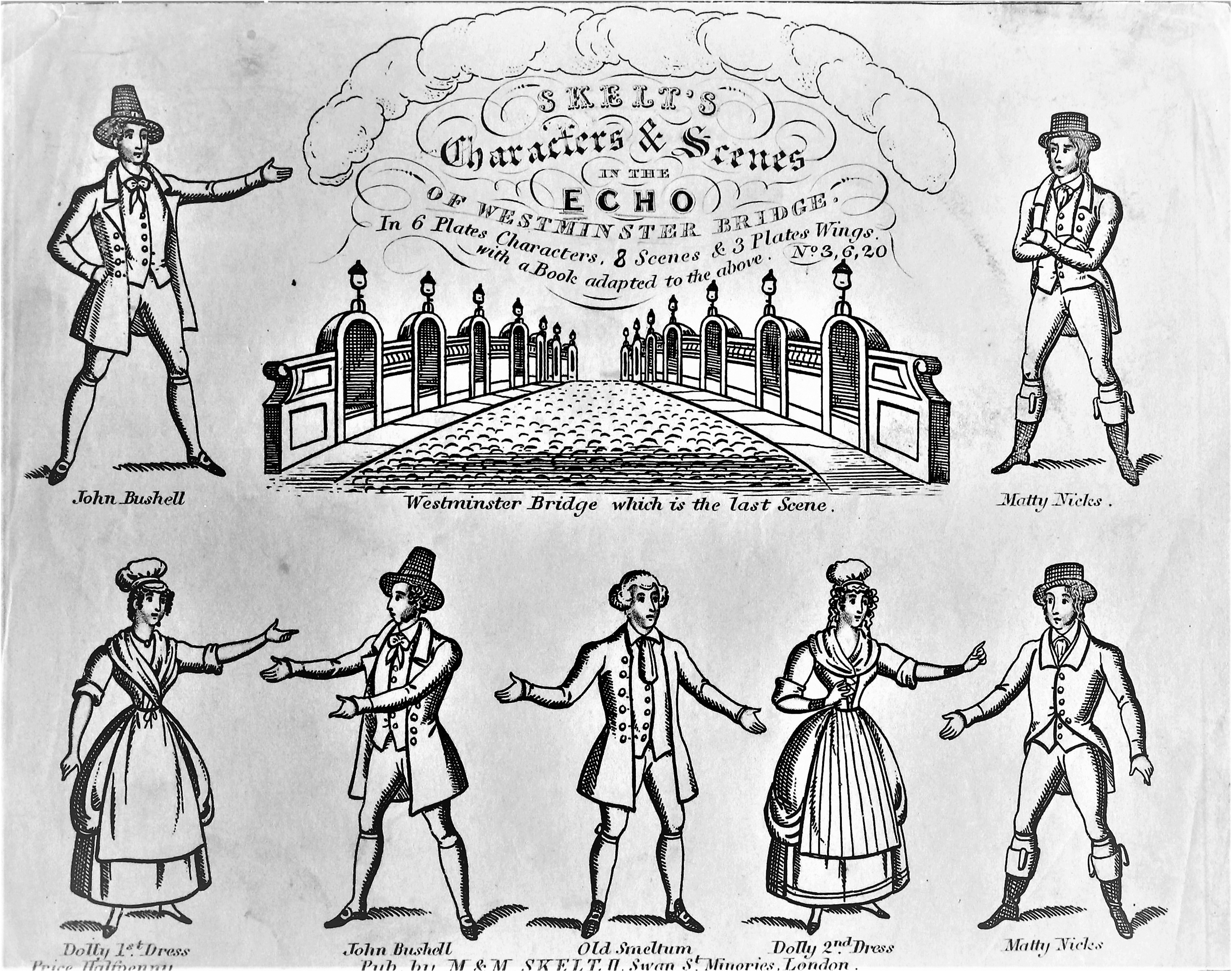
Skelt’s title page for Characters and Scenes in The Echo of Westminster Bridge. *T-Icon (Echo of Westminster Bridge). New York City Public Library for the Performing Arts.
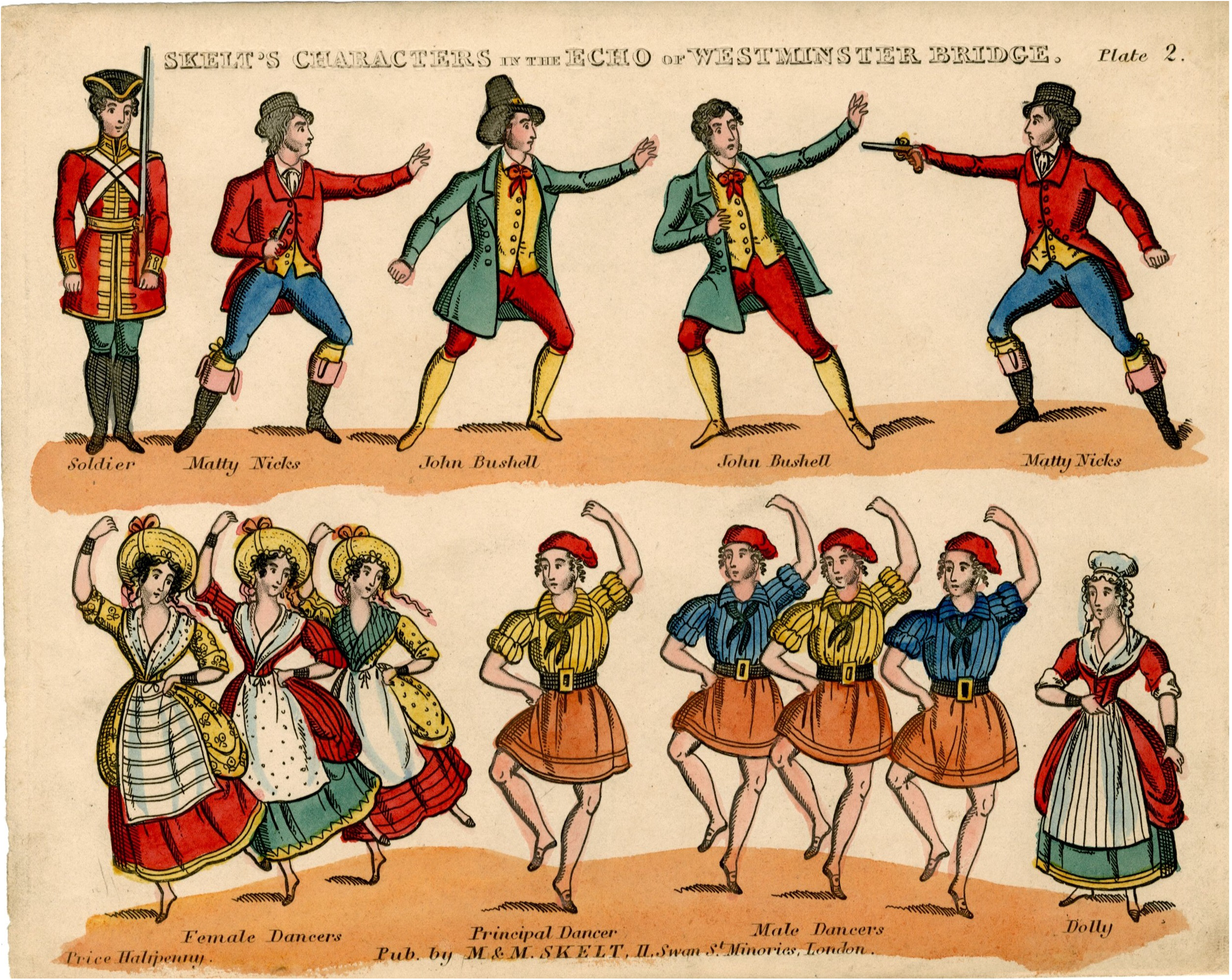
Skelt’s Characters in The Echo of Westminster Bridge. Plate 2. The Echo of Westminster Bridge published by Skelt, nineteenth century. Marcus Stone Collection. V&A Theatre and Performance Collections. GB 71 THM/234/1/15/9. ©Victoria and Albert Museum, London.
It is vital to recognise these limitations in using any toy theatre adaptation to make arguments about its source. Furthermore, as Joanna Hofer-Robinson points out, despite the utility of nineteenth-century toy theatre artefacts as documentation of the live theatre they adapt, the toy theatre plays, sets, and costumes should be ‘critically examined as performances in their own right’. 50 With that imperative in mind, it is also important to employ available tools to excavate Polack's oeuvre. A comparison of the Skelt's text and the theatrical reviews reveals that the truncated toy theatre version follows much of the Victoria production: not only the identical list of characters but also a two-dimensional flat rendering the bridge precisely as the reviewers described the fully built set they saw at the Victoria, as we have already seen depicted in the Skelt's title page above. 51 The murder exposed by overhearing an echo in one of the bridge's alcoves is preserved, and some comic business for the character Matty Nicks hints at what reviewers report of Polack's play. Even a bit of Polack's dialogue may have made it into the toy theatre version since there is at least one instance of wordplay that seems a bit ribald for ‘juvenile drama’. After raucously singing ‘The Miller of Dee’ late at night in front of his girlfriend's house, Nicks complains that he has roused her aged employer when ‘it was you I wanted to arouse’. 52 Although the OED's earliest listing of the sexual meaning of ‘arouse’ is from Kinsey in 1948, I find it hard not to read it as a suggestive double entendre, resembling jokes in Esther, the Royal Jewess. These titbits give us a sense of what more the full-length Echo might have offered its audiences. Until a manuscript or publication of Polack's entire play surfaces, the Skelt's version of The Echo of Westminster Bridge is the closest thing we have to the original performed at the Victoria.
Melodrama's Bridge to Jewish Emancipation
In addition to the playbills and reviews naming Polack, there is an important thematic reason for accepting the Victoria's Echo of Westminster Bridge as Polack's. This becomes apparent when recognising it as a dramatisation of ‘The Parish Apprentice’, a multi-chapter sketch in George R. Gleig's The Country Curate (1830). The characters of John Bushell, Old Smeltum, and Martha Bushell all make the transition from page to stage to toy theatre, meaning that the Skelt's Echo is an adaptation of an adaptation, often the route to more modern renditions of earlier texts. Gleig's story depends on an antisemitic portrayal of its only Jewish character, Noah Levi, a peddler. When Levi the peddler first appears in ‘The Parish Apprentice’, he is established as a jolly and beloved figure with an atrocious Yiddish accent, bringing fun along with his baubles wherever he goes. But as the plot continues, it becomes clear that his kindliness and amusing stories are sham. A complete villain, he uses this façade to gain the trust of his foolish customers. He masterminds the dastardly actions of John Bushell in murdering his employer, the blacksmith named – appropriately – Mr. Smeltum.
Polack's dramatisation removes Gleig's antisemitic elements by eliminating the villainous peddler altogether. Polack replaces him with the highly praised comic role of Matty Nicks, who nicks things. He plans to steal from Smeltum while wooing and wedding the kind-hearted Irish servant, Dolly (whom he tricks to get at Smeltum's goods). In the play, Bushell is fully culpable for his own heinous misdeeds; Nicks murders no one, but neither does he raise the alarm when he realises that Bushel is killing Smeltum, instead demanding half the booty. But Polack did not simply remove Levi the Peddler from her adaptation to rid it of an offensive stereotype when she replaced him with Nicks. Instead, she recuperates the peddler by moving him to Esther, the Royal Jewess. There he appears with the same name, the same trade, and the same atrocious accent, bringing trinkets and joy to the Persian Jews of the fifth century BCE, who are not in the least taken aback by his speaking the not-yet-invented language of Yiddish. Unlike Gleig's Levi, Polack's Levi the Peddler is a genuinely kindly and amusing fellow. She maintains the positive characterisation that Gleig introduces early in ‘The Parish Apprentice’ and then snatches away from any reader who – perhaps like Polack herself when she first read Gleig's book – had been hoping that, finally, a contemporary author was writing against the antisemitic stereotype.
With Levi gone from the play and swapped – problematically – with another oppressed other in the hard-drinking stage Irishman (we first see Nicks exiting a public house, and we know he is Irish from his accent), Polack relocates the events from the countryside to London. Rather than a blacksmith, Smeltum is now a boat builder on the banks of the Thames. His name Smeltum endures, even though the boatbuilder never smelts anything, emphasising the play's tie to the source text. Everything in the adaptation that closely replicates Gleig's antisemitic story highlights the elements that Polack has changed, such as the removal of Levi; the relocation from Kent, where the sketches told by the ‘country curate’ take place; and the introduction of the newly titular pièce-de-théâtre, Westminster Bridge itself. Bushell is still in Smeltum's employ, still secretly marries his boss's daughter without her father's consent in order to enrich himself, and still murders his father-in-law for his money, though not put up to it by Levi/Nicks. The new city setting permits staging the denouement on the spectacular set of Westminster Bridge across the Thames, which provides the vehicle for detection of the main plot element, Bushell's whispered admission of his dirty deed, overheard by the good man whom Dolly ultimately has married. While the echo fascinated viewers in 1835 and remained in memory till the beginning of the next century, the massive replica of the bridge that dominated the final scene brought the play's most effusive praise, as we have discussed. This must be seen with renewed importance because Westminster Bridge itself carries symbolic resonance.
Although far more obliquely than Esther, the Royal Jewess, Polack's The Echo of Westminster Bridge also gently moves forward the project of naturalising Jews into the British body politic. This occurs primarily in the removal of an antisemitic portrayal from the plot, but two other subtler changes – in setting and set – also hint at coming changes.
The first is the setting. Polack's relocation of the story to London matters. A sizable Jewish population resided in the metropolis, unlike the English countryside, as laws still largely prohibited Jews from land ownership where Gleig's country curate resides. Although no Jewish characters appear in this play, the urban locale makes reasonable their inclusion as normal residents in the play's world, perhaps as Smeltum's or Dolly's neighbours, rather than monsters of duplicity and murder in the British countryside as Gleig portrays Levi. Because the urban environment was (and still is) far more diverse demographically than rural England, Polack's Surrey-side dramatis personae would be more familiar to the Victoria's audiences than the population provided by Gleig's narrator, who lives in a landscape so replete with Englishness that even the bushes are describes as ‘genuine English shrubs’. 53 The use of an Irish character in place of a Jewish one makes sense in light of Michael Ragussis's examination of ways in which the Georgian theatre was beginning to use the stereotyped stage Jew and stage Irishman to criticise and deconstruct each other. 54
The second is the set. The shift in the site of criminal detection from the country parish to Westminster Bridge carries emblematic significance for a population that still did not have the right to representation. Westminster Bridge was (and still is) the main thoroughfare leading directly to the seat of government, the Houses of Parliament. It connects the lower-class transpontine theatregoers at the Victoria to the workplace of every Member of Parliament, that holy grail of political position not permitted to Jews until 1858. Polack's Esther, the Royal Jewess depicts a Jewish character attaining the highest office for a commoner in the government. Given the three recently failed attempts in 1830, 1833, and 1834 to legalise the place of Jews in Parliament and given Polack's already advocating Jews’ rights in a play in March 1835, seeking metaphors to suggest similar interests in her Echo only three months later is warranted. In a sense, the play's magnificent stage set figuratively creates a bridge to Jewish emancipation and Jews’ equal access to representation while suggesting that some secrets should be audible to all, magnified through the seeming magic of acoustic science. It is significant that the whispering villain is not a Jew in Polack's play, when he is in so many other tales, including ‘The Parish Apprentice’. While none of this proves that the Echo promotes Jewish emancipation, when considered in conjunction with Esther, The Royal Jewess, Echo's anti-antisemitism reverberates across the centuries.
Conclusion
Theatre is relentlessly ephemeral. Researching the nineteenth-century stage always presents historiographical puzzles, forcing us to confront how much is lost while we sift through the jumbled bits and pieces that persist. Our own modernity manifests itself partly in the frustration with reading a past that comes to us in fragments, echoes, and whispers. We do not know enough about Polack or her once-famous play about a murder detected and avenged on Westminster Bridge. That historical Westminster Bridge is itself long gone, taking the famous echo with it. But the idea of the echo lingers, even though Polack's play – like its namesake bridge – also does not survive. The idea of the echo continues to resound in Skelt's adaptation, whispering in archives and pulsing in digitisation. What Rita Felski describes as ‘a text's capacity to signify across time, to trigger unexpected echoes in new places’ helps define our own modernity as constituted by our excitement in listening to those nearly forgotten but still repeating echoes. 55 Perhaps only a few of Polack's words remain in Skelt's play, but her ideas and her repeated effort to undo antisemitism continue even now, right here, on this page.
